

Just over 92 years ago a gang of robbers, at least one armed with a tommy gun, held up a mail truck in broad daylight in downtown Charlotte and made off with over $100,000 in $5 bills, over $2.5 million in today’s dollars.
The robbery of the mail truck while on its way to the Federal Reserve Branch in Charlotte was dubbed the “Crime of the Century,” at the time and at least for Charlotte. It was a case that stayed in the headlines for more than decade.
The crime and the gang behind it have strong connections to East Tennessee in both Cosby, where thousands $5 bills were buried in glass jars, and in Knoxville, where gang members of a notorious Chicago Prohibition-era gang stayed frequently or “holed up” in the upscale neighborhood of Seqouyah Hills.
It’s a tale worthy of a Netflix series with:
- A bold heist. A daytime robbery orchestrated by a Chicago crime boss whose rivals were Frank Netti and Al Capone.
- A desperate need for cash. A crime boss needing ready cash for his defense in a what turned out to a fake kidnapping. He was being framed by the Capone’s organization.
- Big money. Stolen cash bound for the Charlotte Federal Reserve Bank branch reported at between $105,000 and $130,000, or something around $2.5 million today. Up to half never recovered.
- An indefatigable cop. A Charlotte Police detective FBI Director J. Edgar Hoover called the “finest in America: pieced together bits of evidence that led to the arrests of the crew within months, but who spent years chasing the elusive stolen loot.
- A falling out. Only three of the robbers originally arrested stood trial, the fourth was found murdered in the Chicago area; shot multiple times and holding a penny in his glove hand, said to be a sign of a “cheap” hoodlum.
- A romantic interest. A girl from Knoxville who loved the gang leader “more than life” and was called the “Queen” of the gang.
- A daring prison break. The crime boss and leader of the heist got 99 years in a faked kidnapping cash. They escaped from prison in 1942 and were recaptured by the FBI a couple months later in an widely publicized manhunt. (This was but one of several prison breaks for gang members.)
The Heist
It was Nov. 15, 1933 and Charlotte Police had been tipped days earlier that something big was about to go down.
Something did go down. Spectacularly.
A Buick pulled out of an alley in downtown Charlotte in front of the mail truck on Third Street. Four men jumped out of the Buick, one with a tommy gun. Two men held the driver at gun point while two clipped the lock off back of the truck. The four made off with bags of cash.
It took about two minutes in a brazen broad daylight robbery.
The men were part of Roger “The Terrible” Touhy gang in Chicago, sent south to get money for his court defense in the kidnapping of John “Jake the Barber” Factor, a conman, a gangster associate of Al Capone, a British citizen, the half-brother of cosmetics giant Max Factor, and who faked his own kidnapping in a ploy to avoid deportation.
(Factor, accused in a massive stock swindle in England and other crimes, spent decades fighting extradition to England until he was pardoned by President John F. Kennedy in the 1960s. He was to have been the largest individual donor to Kennedy’s presidential campaign.)
After the robbery, the gang didn’t immediately leave Charlotte. They had a hideout, but were flushed out by police and met up in Lexington, Ky., where they divided the haul.
At least $36,000 of the money was brought to Cocke County and buried.
The Detective
A tall, lanky, cigar-smoking detective with a big nose named Frank Littlejohn started piecing together the evidence.
The getaway car, a stolen Plymouth, was found on the outskirts of town. It was determined that the car had only been driven nine miles since it’s last service so Littlejohn had officers drive every route from the robbery to where the car was found to find a route that was exactly 9 miles. Then they knocked on doors.
Police found a woman who rented an apartment to two men, who needed a garage for a car, but were always walking when when they left.
Next they got a tip about a strange car at another apartment. When Littlejohn got to the second apartment, he heard his own radio blaring out from a radio. Whoever had been in the apartment had left in a hurry, leaving behind clothes, food and even a newspaper with an article about the investigation.
Littlejohn had everything taken to the police station, including the trash, where 27 bits of paper were to prove integral. Pieced together, the bits of paper revealed a Chicago rent receipt. It was a break in the case.
As quick as he could there, Littlejohn was in Chicago questioning the landlady. “The landlady said one of the men carried a violin all the time,” Littlejohn said in the 1957 interview. “That was no violin. That was a machine gun case!”
With eyewitness descriptions and fingerprints of four suspects found on beer bottles in the Charlotte hideout, Littlejohn developed his list of suspects:
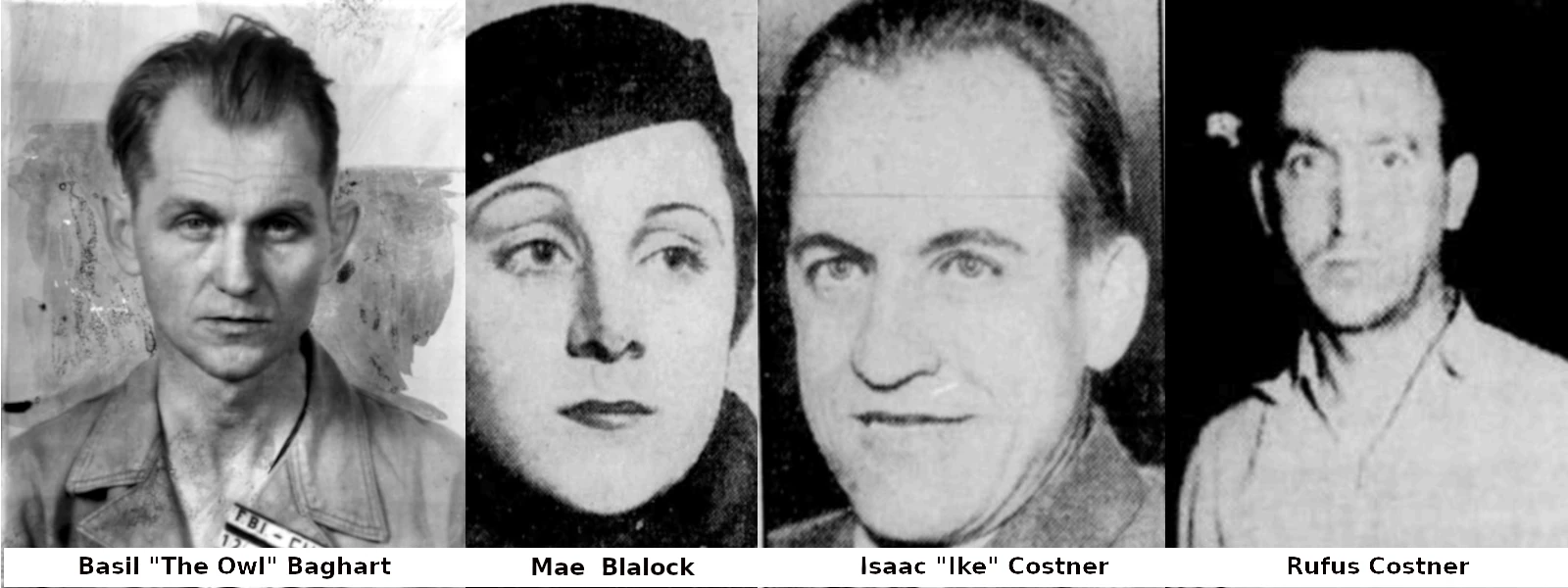
- Ringleader Basil “The Owl” Banghart, a notorious Chicago crime figure and Touhy’s first lieutenant. Banghart was also an escape artist who had escaped from state and federal prisons multiple times. Once he escaped by convincing officers to arrest his escort. In another escape, he blinded a jailer with pepper, taking the keys, seizing a machine gun and shooting his way out. He failed, however, in an escape attempt from the Knox County Jail.
- Ludwig “Dutch” Schmidt, immigrated from Germany to America and a life of cirme. He eventually was imprisoned at Alcatraz and was known as Alcatraz #71. One court appeal form Banghart claimed Schmidt went to Hamburg after being released from Alcatraz but that cannot be confirmed.
- Isaac “Ike” A. Costner, a native of Cosby in Cocke County who operated a bootleg joint on Papermill Road in Knoxville during prohibition, was involved in the moonshine business and was deeply involved in Touhy’s gang.
- Charles “Ice” or “Ice Wagon” Connors who would be found murdered in Willow Springs, Ill., in March 1934, a penny inside the glove on his right hand. Police took Costner to the morgue and he was quoted by the New York Times as saying: “I saw him alive the last time in Lexington, Ky. in December. He had taken his share of the robbery in Charlotte, N.C., where we got $110,000 from a mail truck and he went off by himself. I guess the boys didn’t like that very well.” Littlejohn contented Connors was killed because he was dumb and put the police on the mob’s trail.
Five years later, Rufus Costner, brother of Isaac Costner, would admit he was a fifth member of the gang and was involved in burying a share of the money in Cocke County.
The Capture
With his list of suspects, it took Littlejohn four months -– until February 10, 1934 — to take them into custody.
Banghart, either his wife or girlfriend at the time, Mae Blalock of Knoxville, Isaac Costner and Jessie Touhy (wife of Roger Touhy’s brother, Tommy) were arrested in an Baltimore apartment that had a large assortment of firearms believed to have been used in the Charlotte robbery. Ludwig “Dutch” Schmidt and Tommy Touhy may have been in the same apartment building but were missed.
Just days later a federal grand jury in Asheville, N.C., indicted the captured robbers. Mae Blalock was also taken into custody and jailed in Charlotte.
“Dutch” Schmidt wasn’t arrested until April, 1934, when by chance he was recognized on the street by a Chicago patrolman.
During the same period, John “jake the Barber” Factor accused Touhy, Banghart, Cosnter and others in his faked kidnapping. Costner turns state’s evidence and testifies as the prosecution’s star witeness in the separate trials of Tuchy and Banghart. Both are convicted and get sentences of 99 years.
Costner is transported to the Mecklenberg County Jail in Charlotte, where Banghart’s girlfriend/wife was being held on federal charges of conspiracy and as a material witness in the mail truck robbery.
In jail and pregnant with Banghart child, Blalock is allowed to return to Knoxville to have her baby on the condition she return to Charlotte to stand trial.
The baby, a daughter, was actually born in a tourist camp in Asheville while Mae Blalock was attending Banghart’s trial. After the birth, the mother and baby were admitted to an Asheville hospital.
The justice system moved at a quick during time.
In April, 1934 Issac Costner, then 38, went on trial in Charlotte for the bank heist, saying he would “tell all and plead guilty.”
After threats against his wife and sister, Ella Costner, he pleads not guilty. He is sentenced to 30 years in federal prison on April 4, 1934. The Associated Press report observed the mobster had become “too big” for his Tennessee mountain liquor business.
Federal Judge E. Yates Webb sentenced Costner despite his plea of immunity based on what he said was a deal with prosecutors for his testimony in the John “Jake the Barber” Factor kidnapping cases. His defense attorney told the court his client thgouth he was getting “a bum rap.”
But it was a fate better than that of “Ice” Connors who was found murdered on the outskirts of Chicago the next month.
In mid-May, “Dutch” Schmidt and Banghart are convicted for their roles in the Charlotte robbery in federal court in Asheville. Schmidt gets 32 years and Banghart gets 36 to run concurrently with his 99-year kidnapping sentence.
The Missing Money
Various amounts have been reported over the years for how much of the heist money was stolen and recovered.
The stolen amount varies from $105,000 to $130,000.
Of the recovered money, over $10,000 may have been found wrapped in newspapers in the Baltimore apartment during the arrest of the gang. And $8,000 was found in buried two half-gallon glass jars in Cocke County.
While arresting the gang happened quickly, Littlejohn, postal investigators and other federal law enforcement agencies spent years trying to recover the stolen loot.
The most generous estimates are that as much $65,000 – about half – was found.
In 1936, Rufus Costner and his wife met with Blalock and two prison escapee friends of Banghart at a house on Woodlawn Pike in Knoxville to “discuss” the whereabouts of Banghart’s share of the money.
Rufus Costner claimed they were kidnapped and the ordeal involved a trip to Newport to find the money, where he escaped. That “meeting” led to a kidnapping conviction for Blalock, who got either 30 or 45 years (reports from the time vary), and for the two men. Her conviction was upheld by the Tennessee Supreme Court later in 1936.
Littlejohn and federal investigators, aware of the testimony in the kidnapping about the missing money due Banghart, were still on the hunt.
In May 1938 — now four and a half years after the robbery — Rufus Costner is charged with concealing $50,000 of the Touhy gang money and is arraigned in Asheville. He claims he is being framed by Banghart.
By June 3, Rufus Costner drops his “framed” claim and admits to investigators his involvement in the heist in 1933 and to burying the money in Cocke County. He is convicted.
His sister, Ella, known as the “Poet Laureate of the Smokies.” and their father, L.F. Costner, are taken into custody the next day by Littlejohn and federal authorities who believe they are complicit in at least stashing the cash. Father and daughter were tried in federal court in Greeneville, Tennessee in October 1938.
Ella Cosnter testified her brothers, Ike and Rufus, brought $36,000 to their father’s home after the Charlotte robbery, and he told them to take it out. They buried it. Then apparently dug it up Then buried it again.
Ella also stated that she tried to get government officers to take her to see Ike in prison to help recover the money, but they refused. She did take investigators to a field where the money had been buried and $8,000 was recovered in two half-gallon fruit jars.
After news spread of the money in buried jar, Littlejohn said people headed for the hills in search of treasure and investigators returning to the scene where ran into “any number of” searchers and found evidence of “gold seekers” prodding the ground.
The elderly L.F. Costner was convicted, but is is unclear if he was ever sent to prison. Ella was acquitted.
Some of the money washed away.
Post Office Inspector P.C. Van Landingham testified in 1938 that he found “several five-dollar bills” on the banks and in the shrubbery along the French Broad River between Newport and Knoxville in the Dandrdige area. And he wasn’t only one to find soggy bills by the river. Investigators said they believed “high water” rooted out some of the buried jars and washed the cash down river.
At about the same time, Tennessee Gov. Gordon Browning pardoned Mae Blalock of his kidnapping conviction. She left prison accompanied by two federal officers, including a postal inspector, presumably as part her cooperation in the search for the money.
Doubt also had been cast on whether Rufus Costner and his wife were actually kidnapped. The pardon, however, was highly controversial and criticized. For his part, Browning described the kidnapping as “entirely fictitious”
Blalock, who had had and who would continue to have many scrapes with the law, was described as “Queen” of the heist gang.
How much money washed down the river? Is any money still buried in Cocke County? How much did the perpetrators actually get a chance to spend? Those questions remain unanswered.
Why East Tennessee?
The most plausible explanation to why a Chicago gang members called Knoxville home away from home is that East Tennessee was the home stomping ground of Isaac Costner, who ran criminal enterprises in Knoxville and Cocke County. He had befriended Banghart in federal prison in Atlanta.
The area did became a primary bases of operation for several members of the Chicago gang. And as a hideout, it had the advantage of being a long reach from Chicago. Yet, they made no attempt to keep a low profie.
After getting out prison, Banghart dealt in stolen cars in Knoxville. His girlfriend and later to be his wife, Mae Blalock, may have gotten her start in a life of crime as a delivery girl for a Knoxville bootlegger.
Banghart also was said to be involved in hijacking moonshine shipments from Cocke County to Knoxville.
He and Blalock lived on Cherokee Boulevard in fashionable Sequoyah Hills for two years.
Several other members of the Touhy gang left trails in the area in the 1930s, including Tommy “The Terrible” Touhy, brother of the Chicago gang leader, Roger “The Terrible” Touhy. (Yes, both were nicknamed “The Terrible”).
In the faked kidnapping of John “Jake the Barber” Factor, Tommy Touhy proved he was in a Knoxville hospital when the alleged crime was committed. Newspaper accounts say he also had house in Sequoyah Hills and that his daughter attended the University of Tennessee.
Ludwig “Dutch” Schmidt was convicted of a robbery of a Knoxville motor company in the early 1930s and sent to state prison only to be released by the governor on a recommendation of the attorney general and a criminal court judge in Knoxville because of ill-health.
During this era, there was a gun battle reported near Dandridge that was said to involve the Touhy gang and rivals.
Later Years
- Touhy, Banghart and five others escaped from prison in Mt. Joilet, Ill. in October 1942, with two pistols secreted into the prison and hidden in a refrigerator. The escapees seized a mail truck, loaded it with ladders and hostages, stormed a tower, wounded a guard, went over a wall, and drove off in the tower guard’s car. Authorities believe Touhy and Banghart might have had hopes of recovering the hidden Charlotte money in Cocke County. Knoxville newspapers reported unconfirmed sightings at a Rutledge Pike tourist court and in a “beer place” at Three-Way near Mascot. The Knox County Sheriff cast doubt the pair returned in East Tennessee.
- Two months later, FBI Director J. Edgar Hoover personally led G-Men in a raid on an apartment building on Kenmore Avenue in Chicago, capturing Touhy, Banghart, Edward Darlak. William Stewart, Martilick Nelson, Eugene Lanthorn, and St. Clair McInerney. Two members of the mob are slain resisting arrest (sources vary on who exactly was slain, but the FBI source implies resistance leading to deaths in the “series of raids”). Mae Blalock Banghart (referred to as “Mary Block”) was there and reported as possibly under arrest.
- Ike Costner got out of Leavenworth Penitentiary in April 1949 on “good behavior.” In 1953, after serving another two years in federal prison in Atlanta after a gun was found in his car, he was working in the produce department at Cas Walker’s Western Avenue store. Walker, one of East Tennessee’s most colorful characters, said he could have gotten him out of prison three months earlier, but Costner wanted to complete a bookkeeping course he was taking in prison.
- In 1954 a federal judge declared the John “Jake the Barber” Factor kidnapping a fraud and ruled that Touhy and Banghart had been wrongly convicted through machinations of the Mafia’s “Chicago Outfit” and corrupt officials.
- Touhy was released from prison in 1959 and murdered within a month in a killing believed to have been ordered by the Chicago Outfit. No one was charged.
- Banghart got out prison in 1960 and, according to some accounts, reunited with Blalock and retired to a small island in the Puget Sound with an inheritance from an aunt.
Information for this article was drawn from from numerous articles from the time in The Knoxville News Sentinel, The Knoxville Journal, The Asheville Citizen-Times, The Charlotte Observer, The Charlotte News, The New York Times and from Our State magazine, N.C. Department of Natural and Cultural Resources and Wikipedia.
(Image credits: FBI mugshot of Bail Banghart. Mae Blalock, Isaac Costner and Rufus Costner from Knoxivlle News Sentinel screen shots.)