

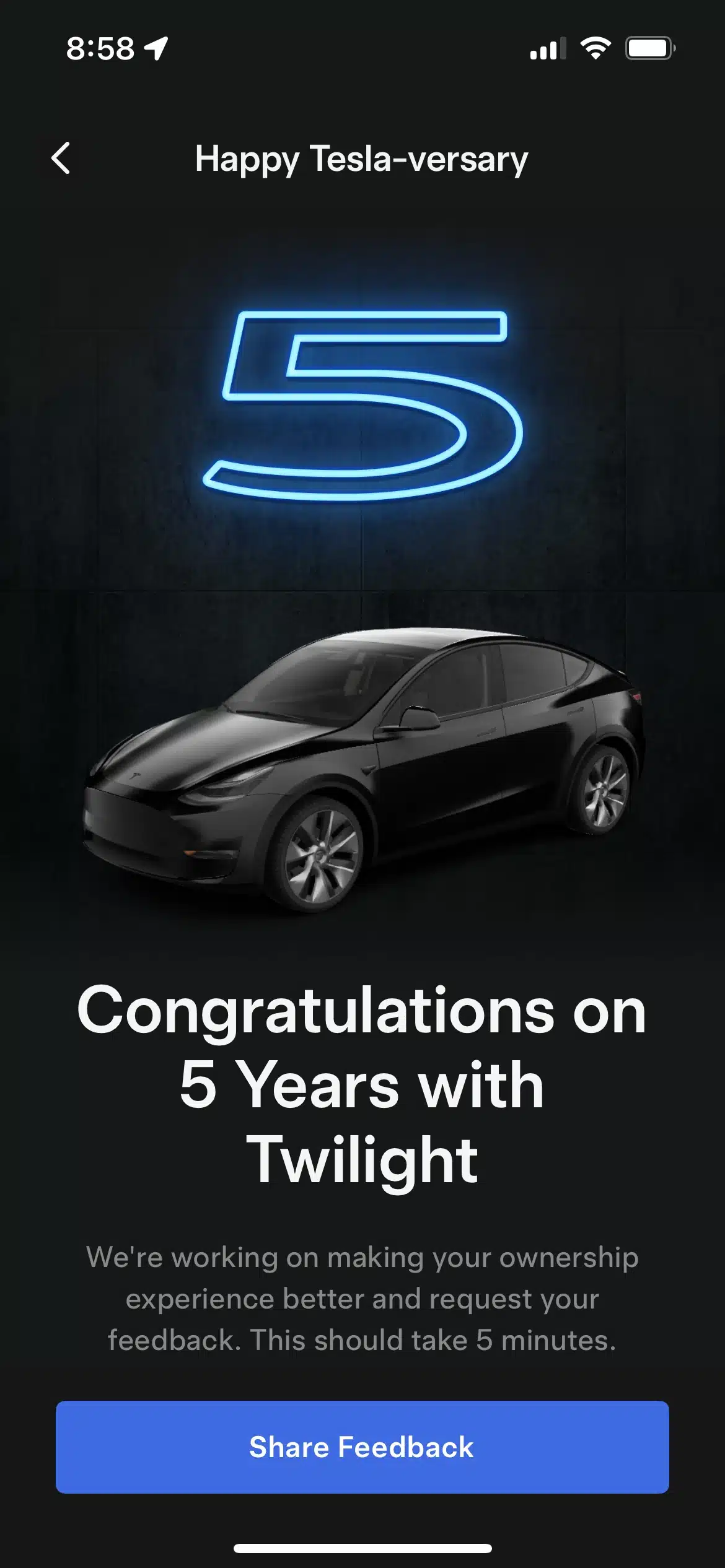
I’ve just hit five years owning a Tesla Model Y Long Range, one of the earliest owners to hit that mark with a Y because the first ones were only delivered in mid-March 2020, just as COVID was beginning to shut down much of the economy.
My VIN suggests my Model Y was among the first 20,000 built; now millions are on the road worldwide. I’ve written about my buying experience on my three-year anniversary. I have also chronicled my first-year of ownership.
Key stats at five years
-
Mileage: 54,083, an average of 10,816 miles annually. I retired in 2020 so I don’t have a daily commute. Most of the places I shop are within a few miles of house. We have used the Tesla for all long trips.
-
Average energy consumption: 276 Wh/Mile or 84.27% efficiency, according to stats from TeslaFi, which pulls data form the car.
The “efficiency” is a comparison to the EPA rated mileage; lower Watt hours per mile are better.
- Range: TeslaFi estimates my battery range at 280.86 miles, a little more than an average of 276 Wh/Mile would suggest for Tesla’s 75 kW battery. (I’m not sure exactly how this is calculated.)
TeslaFi also estimates that I have lost 10.75% from the original 314.69-mile starting battery range and 12.39% from a high range of 320.58 miles. Some software tweaks from Tesla increased the range.
- Battery degradation: Related to range, but is often asked as “How long will be the battery last.”
The battery range loss of 10.75% to 12.39% is in range for the battery degradation expected for a five-year-old electric vehicle. (Age seems to be a bigger factor than mileage.)
Electric vehicle batteries could last 15 to 20 years. Tesla’s warranty covers the battery for eight years or 120,000 miles (whichever comes first) with a minimum of 70% battery capacity.
- Charging: The car has spent 61 days 10 hours and 37 minutes charging, Sounds like a lot, but over 95% has been while the car was parked in the garage, typically at night.
Charging at Tesla SuperChargers on trips amounts to two days, five hours and 18 minutes, with an average charging session of 19 minutes.
- Gas savings: Hard to figure, but Telsa estimates the gas savings as $1,216 over the past year – or more than $6,000 if that annual estimate holds up for the full five years. I spent $1,693 for electricity to charge in the last five years.
The big savings for EV owners is home charging. My utility charges about 11.3 cents per kWh of electricity, or about 3 cents a mile for my Tesla. SuperCharger rates are more than double that rate and could be triple depending on location, time of day, and congestion pricing.
Compared to a car that gets 30 miles to a gallon, I’m paying 91 cents “a gallon” when charging at home and $2 to $2.40 a “gallon” when charging on the road.
-
Tires: I’m on the second set of tires. Yes, EV tires wear out faster. The OEM Continentals were replaced at 27,367.50 miles. Barring road hazards, the current Vredestein set (not “EV tires” but rated for the load) will last several thousand miles more than the Continentals.
-
Maintenance: Only one trip to the Tesla Service Center, the rest done by mobile service: cabin air filter replacements, a 12-volt battery replacement, a USB module replacement and a panel gap adjustment. Mobile service is fantastic.
The one Service Center visit was for the replacement of the A/C desiccant bag, which I thought was recommended by the manual at the time (last year), but no longer appears in the maintenance schedule of the current manual.
The only thing that has broken in five years is the head rest on the front passenger seat no longer adjusts, it’s frozen in the down position. Haven’t bothered to get a repair estimate.
-
Paint Quality: I have more rock nicks in my Tesla than in any other car I’ve owned over five decades. I don’t know if the company has figured this out in new builds, but they didn’t have the paint figured out in 2020.
-
Range anxiety: This was an issue I had in 2020 and with justification. I was careful to map out trips in advance and to make sure I could get back to a SuperCharger after arriving at my destination. But the growth of the Tesla SuperCharger network has made this a non-issue except for rural areas and small towns well off interstate routes. SuperChargers are easily found in populated areas.
Before auto manufacturers jumped on board with the NACS charging standard, I bought a CCS adapter just in case I needed it for charging on another network. in five years, I’ve used the CCS adapter five times.
Concerns about range and chargers seem to still be a barrier for first-time prospective EV buyers, but if the car can charge on the Tesla network, it’s a non-issue in most use cases. (But to get the maximum savings, the ability to charge at home is required.)
Issues and concerns at five years
- Full Self Driving. I like it but it’s not “full self driving.”
Telsa CEO Elon Musk admits the computer system in my car is not capable of delivering the company’s promises. Musk has stated cars with the older “Hardware 3” computers will be upgraded, but there is no timeline and little recent information on the progress toward a fix. Newer MY’s also have better cameras in addition to a more powerful computer.
I’m not sure what it will take to make this a priority with Tesla (somehow forgetting or avoiding it seem to be the priority). I doubt those who purchased Full Self Driving on cars now deemed to have insufficient computing power will let it go as a bit of corporate hyperbole.
- Elon Musk’s erratic behavior. Too many distractions, too much drama, too much brand damage.
With the FSD issues and his “it’s coming in two weeks” that never happen, I’m over the richest man in the world. Unlike the fan boys – and perhaps his own overly compliant board of directors – I hold the view that Tesla is larger than Musk.
Considering buying a Tesla? Use my referral code to get three months of Full Self-Driving (Supervised).