

I have been spending time lately coloring the leaves of my family tree and I’ve found a family link to two heavyweight boxers entwined in the career and legacy of Muhammad Ali.
It was a surprise to learn that my first cousin, once removed was manager of two heavyweight boxers who lived in Detroit in the early 1960s, Sonny Banks and Cody Jones.
An Unlikely Boxing Manager
Burns Stanley (Morris Burns Stanley 1920 - 1999) doesn’t fit what I imagine as a boxing manager.
Yet, he sunk thousands into the careers of two boxers in Detroit during the first half of the 1960s.
He was a top tax attorney for Ford Motor Co. and later headed the automakers’ governmental affairs office in Washington.
Before joining Ford, Stanley worked in the tax division of the West Virginia Attorney General’s office.
He had a law degree from Harvard, an advanced law degree from Wayne State and he taught law in night classes at Wayne State while working for Ford.
Stanley also had a masters degree from Emory University and he was valedictorian of his graduating class at Lincoln Memorial University in Harrogate, Tennessee.
He joined The U.S. Marine Corps during World War II, getting accepted into officer’s school and serving as a lieutenant. He caught shrapnel in the elbow and hip during the Battle of Guam.
But there he was in the early 1960s with a side venture from his tax work at Ford as a boxing manager with Ted Ewald, a Detroit area car dealer. (Ewald would go on to manage several boxers.)
Sonny Banks
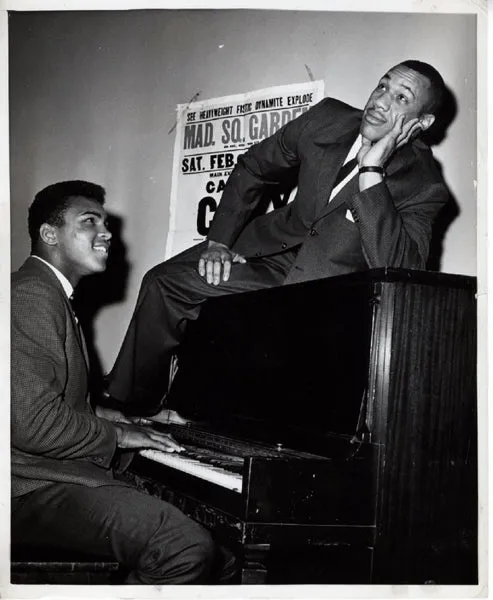
Lucien “Sonny” Banks was their most promising boxer.
He had dropped out school in the eighth grade and made his way from rural Mississippi to Detroit. He met Stanley, who was already managing a boxer named Harvey Cody Jones, and, according to Stanley, asked him to manage him.
His first professional fight was in May 1960 and by February 1962 had fought 12 matches, winning 10.
The Detroit media hyped Banks as the “New Joe Louis.”
Hyperbole, but Joe Louis was quoted as saying “Sonny Banks is the best right-hand puncher I’ve seen since Max Schmeling.”
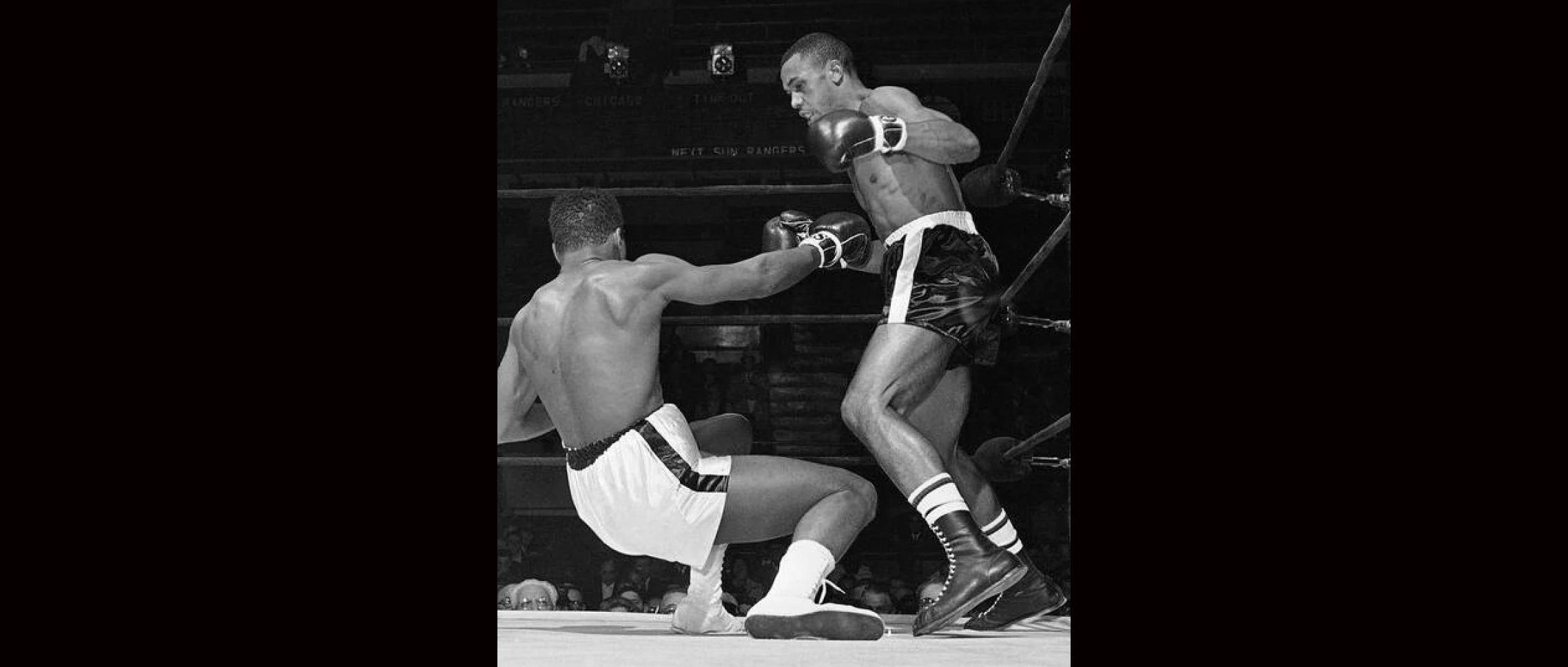
A break for Banks came when a bout between Eddie Machen and Cleveland Williams in Madison Square Garden was postponed. A hastily arranged matchup pitted the relatively unknown Sonny Banks against a rising phenom who at the time went by the name Cassius Clay, the young Muhammad Ali.
“We felt for the last six months that he was ready a for a big move. We were ready to head for bigger things, and when this chance for a New York fight came we grabbed it,” Stanley told the Detroit Free Press.
The crowd size was reported as slim, estimated, depending on the source, as between 2,000 and 8,500, but the fight was nationally televised. While his career was on the rise, it was Ali’s first fight in a major arena.
Ali was a 5-to-1 favorite over Banks, who had only fought 31 rounds in his career.
But in the first round Banks landed a left hook that sent Ali to the canvas. It was the first time Ali had been knocked down in his professional career (some say he just slipped). Ali recovered and won the match in a technical knockout in the fourth round.
“I look at the movies now and I just get sick,” Banks told a Detroit Free Press reporter a year later. “I just stood there, not knowing what to do.”
Despite the loss, the fight was pivotal in Banks’s career. He was tagged as the first boxer to knock Ali down and that buzz made him attractive to promoters.
Boxing observers looking back at Banks’s career see the notoriety as tragic. He did not come up through the amateur ranks and had little experience against top tier heavyweights. But as the first boxer to deck Ali he was matched with much more experienced top tier fighters.
In his next fight in May 1962, he lost to Young Jack Johnson. Later, he had some matches against closer competition and fared well.
“What slowed Sonny after his fast early start was that he had to meet better fighters and his inexperience began to show,” Stanley said in 1965. “He simply did not know how to handle himself when he got into a difficult situation in the ring.”
A fight against Cleveland “Big Cat” Williams in July 1964 in Houston was hyped as a risky match for Williams. But Williams’ manager told the media he wasn’t worried because of Banks’s inexperience.
“Sonny’s no ordinary fighter… He’s fast-faster than (Cleveland) Williams,” Stanley told the Houston Chronicle before the bout. “He can punch harder than Williams.
“The average heavyweight is slow. Not Sonny. He is extremely fast. The average big guy throws a haymaker, jabs once or twice and then another haymaker … one shot a time. Banks put his shot together … like (Floyd) Patterson.”
At the time, Williams, known as one of the hardest punchers in heavyweight history, ranked as the No. 4 heavyweight in the world. He brutally beat Banks before the fight was stopped after six rounds with a TKO.
The sanctioning boxing authority enforced a six-month medical suspension to ensure Banks was fit to return to the professional boxing ranks.
He returned to the ring 10 months later in Philadelphia on May 10, 1965 against Leotis Martin. Before a crowd estimated at about 1,000, Banks was knocked out in the ninth round of the ten round match. Unconscious, he was carried on a stretcher to his dressing room where he came to briefly.
He was taken to a Philadelphia hospital, where doctors operated to try to reduce the pressure of a blood clot on his brain. He remained in a coma for three days before dying early in the morning on May 13.
The doctor ruled that the knockout punch, a blow to the left jaw right under the ear, was not the direct cause of death, but nonetheless Banks was death at age 24.
His career record was 18 wins (14 by knockout), seven losses (five by knockout), and 0 draws across 25 bouts.
Cody Jones
Harvey Cody Jones never had the promise of Banks, but he had the dream.
The Atlanta native drew Stanley into the boxing world. “Harvey had always been in trouble, that’s how I got to know him,” Stanley said in 1965. “But boxing seemed to give him something to work for. He’s good, but not as good as Sonny.”
Jones, whose record as a professional boxer is 12 wins, eight losses, and two draws, is primarily remembered today as a sparing partner of Ali.
His work with Ali included:
The 1964 Sonny Liston Camp: Leading up to his first heavyweight championship fight, Ali and Jones frequently sparred, with training camp reports detailing intense sessions. Jones later estimated he went more than 150 rounds with Ali in preparation for the Liston fight.
Jones helped Ali train for Liston’s left hook. Sports Illustrated said Jones had a left hook that was quicker than Liston’s, but not as devastating.
The 1966 Brian London Preparation: While training at the Noble Art gym in Hampstead, London, Ali and Jones went head-to-head in multiple sparring sessions in training to defend his World Heavyweight title against Brian London.
The 1965 Scotland Tour: Ali brought Jones with him to Scotland in 1965, where they participated in public exhibition matches, with Jones occasionally stepping in as the opposing fighter.
The 1972 Floyd Patterson Camp: Rare video and photographs show Joe Louis watching Ali spar with Jones in September 1972 at Ali’s training camp in White City, London.
After Banks’ death Stanley and Ewald tried to convince Jones to give up boxing, but Stanley said he “blew up” at the suggestion.
Jones supposedly warned Stanley that if he made him give up boxing his next home might be Jackson Prison. But Stanley and Ewald tried.
“I don’t know what they thought,” Jones told George Puscas of the Detroit Free Press. “They said I didn’t look right. They said my eyes were glassy. They said, well, I don’t know what they thought, but they wanted me to give up fighting.
“They even showed me some films of my fights to convince me that I should quit.”
They sold Jones’s contract to Miami boxing manager and promoter Chris Dundee, the older brother of Ali trainer Angelo Dundee. (Dundee promoted eight world championship fights, managed nearly 300 fighters, and staged more than 1,000 bouts over four decades.)
“Fighting`s my life. I like it and I can make some money at it. I’m sending home a couple hundred to my family today,” Cody told Puscas. “Now, where am I gonna get that kind of money anywhere else except by boxing? I don’t know anything else.”
No Regrets
Stanley had a close relationship with his two boxes. Banks lived for a time in his home.
“You have to like him,” Stanley said of Banks. “He’s not like fighters you hear about. He’s the exact opposite of, say, Sonny Liston.
“In two years I’ve yet to hear him utter a vulgar or profane word. He’s a born gentleman. I’d say he’s spiritually motivated, if the phrase doesn’t repel you.
“My wife and kids are crazy about him. You ask why he wants to fight and he’ll tell you because he wants to be somebody and because he want to do something for his mother and father. He’s devoted to them.”
In the days after Banks’s death, Stanley was asked if he had regrets.
“No, I can’t regret getting into boxing, although I certainly regret what has happened.
“A lot of boys fight for different reasons and it is good for them because it answers their needs.
“With Cody Jones, for instance … Well, I think if he got out boxing, he might well become a problem again. Traveling with the Clay camp and the the big fight crowd means something to a boy like him.
But with Banks … well, with Sonny I was probably closer than anyone except his mother and father … with him, fighting was the answer to a driving ambition to achieve recognition and perhaps make a lot of money.
“What he saw for himself in a future without boxing was a life in the foundry. He wanted something better.”
Regrets or not, it is clear Stanley was shaken by the death of Banks and wound down his involvement in boxing.
Top photo: Associated Press photo that appeared in The Courier-Journal, Louisville, Kentucky, Sun, Feb 11, 1962, Page 28 showing Sonny Banks and Muhammad Ali after Banks knocked down Ali.