
Over the past few days I’ve found I have a direct family connection to one of the most brutal and violent events of the Revolutionary War.
It may seem a twisted story for an upbeat celebration of the United States Semiquincentennial, but it is worth retelling.
The Genealogy
I’ve been spending a lot of time in recent months adding sources and citations to my family tree and adding missing branches. It turns out my sixth great-grandfather was a Palatine refugee from the Holy Roman Empire who, like many other German speaking Palatines, emigrated to present day Montgomery County, Pennsylvania near Philadelphia.
Eventually he moved to present day Lincoln County, North Carolina, in or near the modern city of Lincolnton where he built a mill on Clark’s Creek near where it flows into the South Fork of the Catawba River.
His name was Dietrich Ramsour (there are various anglicizations of his name, including Derrick, Dirk, Ramsauer, Ramsaur) and his mill became known as Ramsour’s Mill. By 1780 Dietrich had died and the mill was operated by his son, Jacob. It was a landmark in the region and a gathering place.
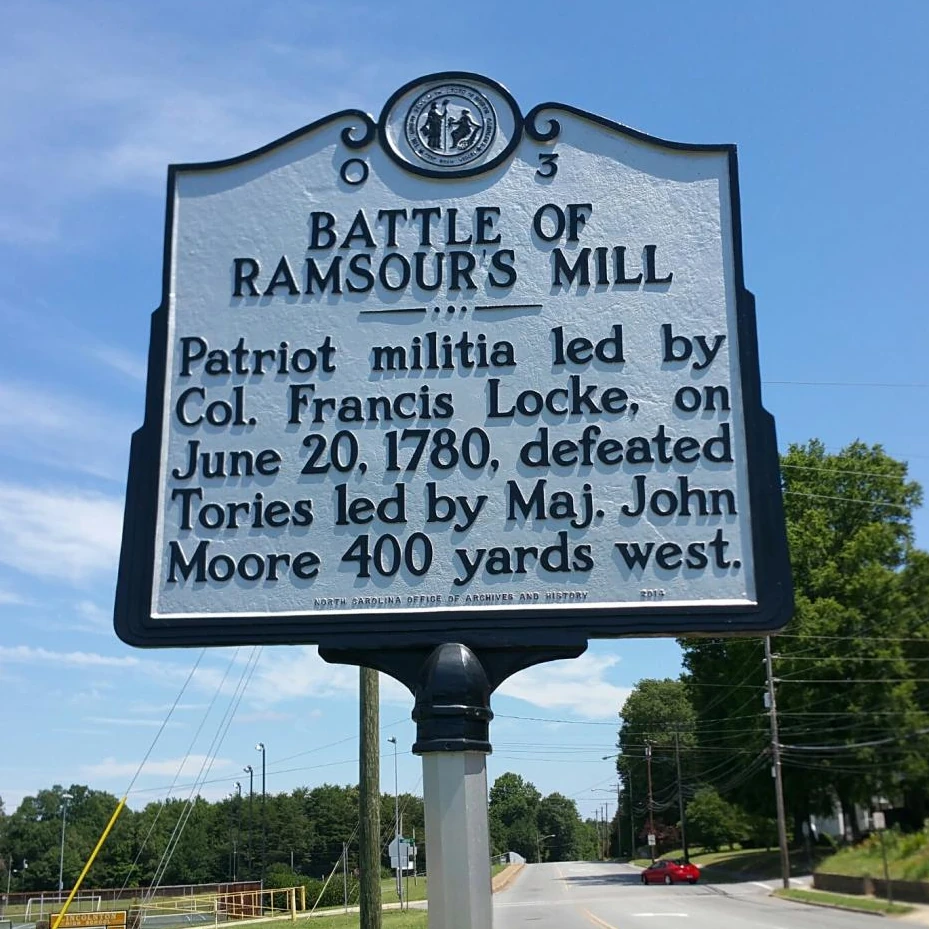
And on June 20, 1780 it was the closest landmark to a battle that became known as the “Battle of Ramsour’s Mill.” Some consider it the most important Revolutionary War battle you never heard of.
It did not rate a mention, for example, in the 12 hours of video in Ken Burns’ “The American Revolution” that aired last fall on public television.
When I think of the American Revolutionary War battles, I think of British “Redcoats” and George Washington’s Continental Army, drum beats and fifes playing. But that was not how the war–and particularly the Battle of Ramsour’s Mill–was fought in the North Carolina backcountry.
It was more personal, neighbor against neighbor, even brother against brother.
The historical context
The frontier areas of North Carolina were settled by German-speaking Lutheran and Reform Church immigrants from the vast Holy Roman Empire region and Presbyterian Scots-Irish primarily originally from Lowland Scotland.
The Scots-Irish were estimated to be 80 to 95 percent Patriots while the Germans were more 55/45 percent in the favor of the Patriot cause, but sentiment varied widely.
In Lincoln County, Loyalists—along with those neutral to the rebellion or reluctant participants—may have outnumbered Patriots among the German Lutheran population by three-to-one due to strong religious beliefs about obeying authority, prominent and influential leaders who were Loyalists and fear of losing their land if they sided with the rebels and the British won (a fear stoked by British propaganda.)
The Scots-Irish support depended on where they were. The Lowland Scots who first emigrated to the Ulster area of Ireland (English speaking Presbyterians) and then to Western North Carolina were anti-British while the more recent arriving Highland Scots (Gaelic speaking Presbyterians or Catholics) who settled in the Cape Fear Valley in Eastern North Carolina were overwhelmingly Loyalists.
Settlers’ political positions on the revolution were influenced on both sides by Protestant religious beliefs grounded in the Bible:
- German Lutherans looked to Romans 13 and believed that rulers had a divine mandate and even a flawed ruler was preserving order against anarchy as a God-given duty.
- Presbyterian doctrine held that rulers were subject to God’s law. If a King became a tyrant or violated the rights of his subjects, Calvinist theology held it was their religious duty to resist.
The Lowland Scots also had a long history of ill-treatment under the British and were radicalized early on. The Mecklenburg Resolves in May 1775 (centered in Charlotte, a Scots-Irish stronghold) were a radical set of resolutions that effectively declared royal authority null and void a year before the Declaration of Independence.
If the German settlers could read, it was their German Bibles. If they got news about what the Battle for American Independence was about, it was from word-of-mouth or from political broadsides. There were no German newspapers published south of Maryland during that era.
Both the Patriots and Loyalists used the German information void for propaganda purposes. The British Southern Strategy executed by General Charles Cornwallis was to rally known Loyalists and closet Loyalists in support of the British Army while the Provincial Congress of North Carolina and the Continental Congress had key manifestos, resolutions and other political documents translated into German to get the word across.
Cornwallis sent Lt. Col. John Moore, a local who had gone to South Carolina to join the British and became an officer, to begin organizing and training Loyalists for the day when the Redcoats would arrive.
The Bloody Battle
But Moore, who had little actual battle experience, got too eager and disobeyed the orders from Cornwallis to organize and train, but otherwise lay low. He gathered a militia of 1,300 Loyalists across Clark’s Creek from the mill on the farm of Loyalist Christian Reinhardt.
They were raw recruits, untrained, inexperienced. Many did not have weapons.
The Patriots learned of the gathering and militiamen from nearby counties under Colonel Francis Locke were ordered on June 19 to head toward Ramsour’s Mill. Regular Patriot Army troops in Charlotte set out as well but they would not arrive until after the battle.
The battle that followed on the morning of June 20 did not involve the regular armies of either side. Neither side even had uniforms. These were settler farmers, sometimes neighbors, who lacked military discipline but who had taken sides.
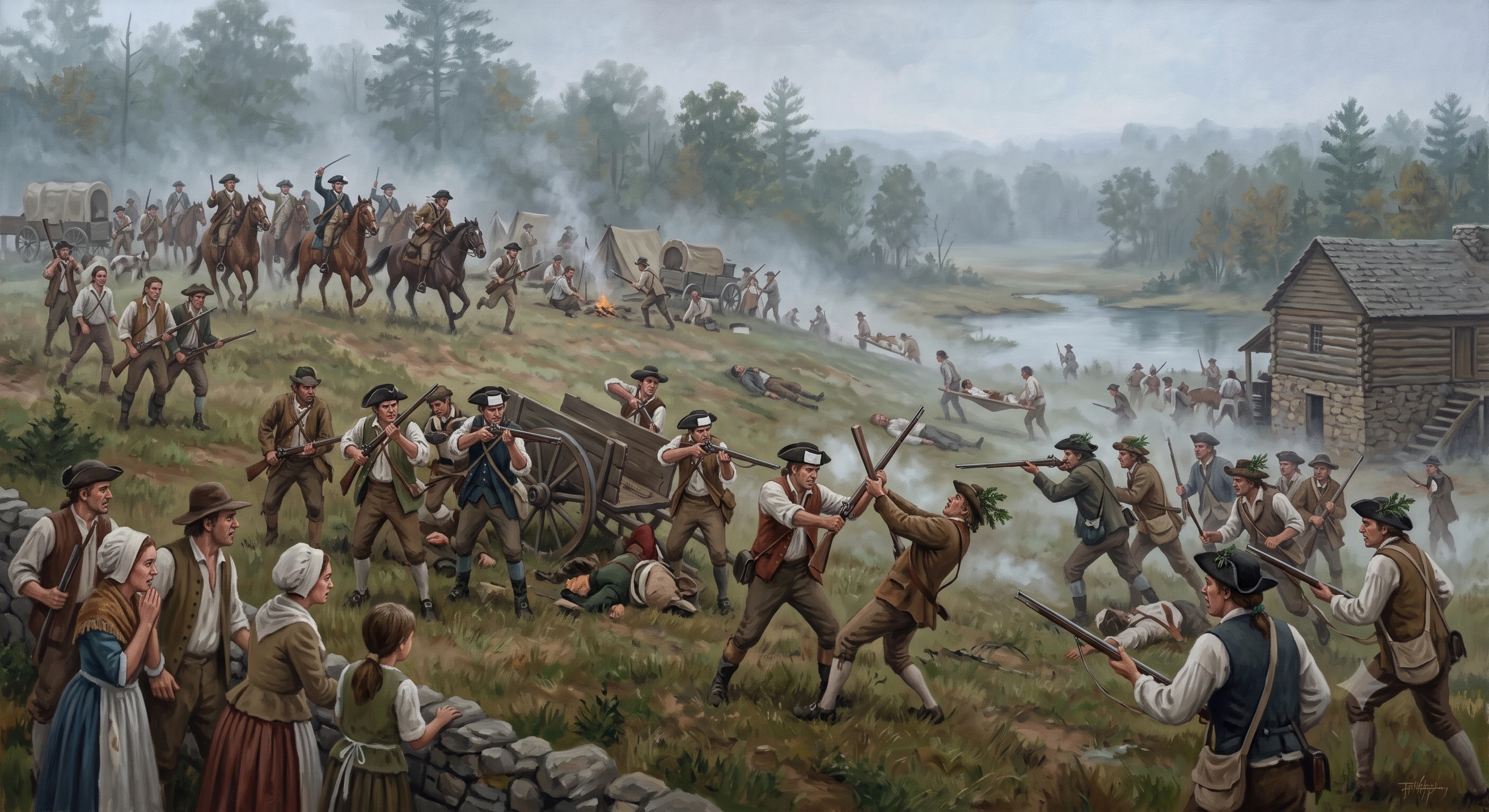
To identify themselves, the Patriots put white pieces of cloth or paper in their hat brims while the Loyalists put green pine twigs in theirs. These could fall out in the heat of battle, causing confusion and friendly fire casualties.
The Patriot militiamen first encountered Loyalist sentries about a mile from the encampment on Reinhardt’s farm during one of the foggiest mornings people could remember. The sentries fell back to the main camp with Patriot cavalry in pursuit. Meanwhile, many of the recruits in the field at Reinhardt’s farm were still sleeping and fixing breakfast.
The battle involved about 400 Whigs (Patriots) vs 1,300 Tories (Loyalists). But the Patriots had the advantage of more experienced officers even with both sides having untrained forces.
With the heavy fog and the lack of weapons, the fighting happened at point-blank range or in hand-to-hand combat with musket butts, hunting knives, and hatchets. It was chaotic and brutal.
It was a killing field with catastrophic casualties. In total, 20 to 25 percent of the combatants were killed or wounded, or about 350 to 400 casualties:
- Killed: About 35 to 40 on each side.
- Wounded: Some 200 (about 100 on each side, but it is estimated that many were not counted because they slipped away from the battlefield after the fighting.)
- Captured: Some 50 Loyalists.
Officers on both sides paid a heavy price. Without uniforms, the only way leaders could direct the chaos was to stand up and shout orders, making them immediate, easy targets in the opening half hour.
And the carnage happened in just two hours.
A Loyalists retreat toward Ramsour’s Mill turned into a panic. Some men drowned while trying to cross the creek or swim the mill pond or were shot trying to cross.
Moore called for a “parley” with the Patriots. It was a ruse or delaying tactic that allowed most of the Loyalists to slip away.
The Patriot Victory
While both sides sustained about the same number of dead and wounded, the Patriots are considered the winners because they took the ground.
But their biggest victory was psychological. It, and the battles soon to come at King’s Mountain and Cowpens, wrecked the British Southern Strategy in the backcountry.
The Battle of Ramsour’s Mill broke the Loyalist’s morale. Sentiment in the Loyalists strongholds in Western North Carolina of German Lutherans started to shift towards the Patriot cause or at least neutral. Again, one of the fears was loss of land or reprisals for being on the losing side.
Jacob Ramsour’s home was near the mill. He was a Patriot sympathizer, but did not participate in the battle. He and his family fled to a nearby ravine and spring house to stay out of the way. Both Ramsour and his brother, David (my fifth great grandfather), aided the Patriots with supplies.
A Family Conflict
But David Ramsour’s extended family is a good illustration of the civil conflict of the Revolutionary War in the backcountry.
While David Ramsour provided supplies to the Patriots, and is recognized by the Sons of the American Revolution as a Patriot for his services, his wife’s brothers, Captain Nicholas Warlick and Phillip Warlick, were both Loyalists killed in the battle and buried in a common grave with a third man at Ramsour’s Mill.
Fear of reprisal was a real threat. The Warlicks also operated a grist mill in Lincoln County which was burned by Patriots after the battle.
It was the second time the Warlick Mill burned. It was first burned down by Cherokees. But after each fire, the mill was rebuilt and operated until the equipment was dismantled in the late 1940s.
(This mill is not the better known Schenck-Warlick Cotton Mill in Lincoln County, the first cotton-spinning mill in North Carolina.)
Top AI generated illustration makes no pretense to being historically accurate. It is for illustration purposes only. The historical marker photo is from the website of the North Carolina Department of Natural and Cultural Resources.