- Ramblings 707
- Online Media 539
- Newspapers 429
- Video 144
- Quotable 119
- Family 77
- Adversity is a mean teacher 55
- Fatblogging 42
- Music 40
- Uncategorized 38
- Carnival 24
- Tesla 12
- ETSPJ 4
- Mobile 4
- Open Meetings/Open Records 2
- Social 1
- website 1
Ramblings
A mostly forgotten medical first on June 14, 1965
June 14th of 2025 marks the 60th anniversary of a little-known medical miracle involving one of my cousins.
Ella V. Costner: Poet, nurse, veteran, storyteller, bootlegger
In the spring of 2015 I participated in a GoSmokies group hike near the Cosby Campground that included a stop at a cemetery that includes the grave of Ella V. Costner, known as the “Poet Laureate of the Smokies.”
Tennessee schools have a book ban cheat sheet of nearly 400 titles
A list of some 390 books banned earlier this school year by school officials in one Tennessee county is being used as a “cheat sheet” by other school districts to vet their assessment of which books to ban.
Exiting the freak show X
I’m joining the crowd rushing out the door at X. I will no longer post at the freak show, but I plan to keep my seat to lurk until the sports accounts I follow find the exit sign.
Riding out Hurricane Helene in Western North Carolina
Today, two weeks after Hurricane Helene it is hard to comprehend the scope, scale, and fury of the storm that hit western North Carolina, East Tennessee, the Upstate in South Carolina and parts Georgia and Virginia.
DIY: How I converted a dumb home security system to a smart system
This month I replaced an ancient security alarm system with a combination of DIY solutions.
Taylor Swift’s Bench: A bench for Taylor Swift … where she’s never sat
Here’s a photo of “a bench for Taylor Swift,” one of the odder features of the popular Centennial Park in Nashville.
North Carolina BBQ: Lexington and Eastern NC BBQ in one weekend
I managed to eat at two iconic BBQ restaurants in North Carolina in one weekend featuring two of the most popular types of North Carolina barbecue.
The ‘castle’ at Jockey’s Ridge visible again
A castle buried at Jockey’s Ridge State Park in Nags Head on North Carolina’s Outer Banks has emerged from the dune’s shifting sands, according to The News & Observer in Raleigh.
More than 340 books banned in Tennessee public schools
(Update:More than 1,100 books have been banned by Tennessee school systems in the first half of the 2024-2025 school year.)
The Tennessee Three: Petty, partisan and profoundly racist saga
The question I have is was it after the fourth or fifth round at the Good Ole’ Boys Bar did it begin to sound like a good idea to bring expulsion resolutions against two young black Democratic lawmakers, Justin Jones and Justin Pearson and one of the few women in the Legislature, Democrat Gloria Johnson.
Emerald ash borer making ash trees a memory
I have firsthand experience at how devastating an invasive insect called the emerald ash borer can be. Small it may be; inconsequential it is not.
Ditching the file cabinet in 2023
I’m going paperless with all those pieces of paper in file folders.
Google 2022 search trends for Knoxville
I love Google’s year end search trends each year, but this year’s presentation of local searches is particularly look. Here are the screen shots for Knoxville in 2022.
Essential photo, video, productivity tools
This is a listing of programs I use regularly on my Pixelbook, a Chromebook introduced in 2017. That is to say it’s not the most powerful or fastest Chromebook and all the apps listed here work with it.
NASCAR driver Bubba Wallace’s life was shaped by an event in Knoxville
ESPN’s E60 documentary “Fistful of Steel – The Rise of Bubba Wallace,” which debuted Tuesday night, highlights how an event in Knoxville changed the NASCAR driver’s life and the life of his family — forever.
Elon Musk is TIME’s latest Person of the year, but Dolly Parton has never won it?
TIME magazine on Monday named entrepreneur Elon Musk its “Person of the Year,” seemingly more based on his influence than his outsized accomplishments of which there many.
Remember the COVID toll in Tennessee on this ‘more normal’ Thanksgiving
While Tennesseans look toward enjoying a more normal Thanksgiving Holiday this week with family feasts and fellowship, take a moment to remember the those who have died of COVID-19 during the pandemic and to ponder what is yet to come.
Upgrading the Wi-Fi seemed such a simple idea
A few weeks ago I decided to upgrade my aging, but rock solid Wi-Fi network.
9/11 from my photo archives
A lot will be written and broadcast about 9/11 on its 20th anniversary on Saturday. Here are a few glimpses from my personal time machine.
Time marches through the neighborhood
What’s it like to own a Tesla Model Y for a year
If you are thinking about buying a Tesla – and perhaps any electric vehicle – here are some random observations after one year of ownership.
Rural Tennessee tangled in turn-of-the-century internet speeds
Lack of high-speed internet in much of rural Tennessee is well known, but today the White House is emphasizing the disparities in broadband access with a new map that visually and vividly highlights the problem.
Sun on Big Bald Mountain
Here is a photo of Big Bald, part of the Bald Mountains as seen from the Wolf Laurel Country Club in June 2021.
Tesla: How a MY does on a 1,635 mile road trip
One of the biggest worries electric vehicles is how practical is it to take an electric car on a long road trip.
Tesla Supercharger opens in Pigeon Forge
UPDATE: The Pigeon Forge Supercharger is up and running. It’s at a shopping center on Teaster Lane near Wears Valley Road. It has 12 stalls (up to 250 kW).
Tesla service center coming to Knoxville
With a Tesla Service Center rumored to be opening in April in the former Sears Automotive building at West town Mall (after being touted as “as opening next year” in by Tesla CEO Elon Musk in 2018), East Tennessee interest in the car company’s models should increase.
Ask a lawmaker on Saturday
The League of Women Voters of Knoxville/Knox County and the East Tennessee Society of Professional Journalists are holding a “Legislative Webinar” on Saturday at 10 a.m. to hear lawmakers talk about key issues that will be taken up by the Tennessee General Assembly this year.
Top 25 Google search terms in Knoxville for 2020
The top 25 rising Google search terms for the Knoxville area in 2020 are not much of a surprise – almost of them had to do with “Life in the Pandemic” or the election. Popular Google Doodle Games, Kobe Bryant, Tesla stock and PS5 may be the exceptions.
COVID-19 vaccinations by day in Knox County
Here’s a look at how COVID-19 vaccinations are going in Knox County, according to the Tennessee Deparmtent of Health. They can’t come fast enough; the rolling seven-day average as of Dec. 21 was 23.11% of the coronaivrus tests were coming back positive. (Simple visualization using Google Flourish.)
2020 in review from Google, Facebook, Reddit and Twitter
2020 is nearly done and here’s a look back at the year that got sick.
Diversity of choice in the Google Age
What if the Internet is providing us not with seemingly limitless choices of news sources and a diversity of viewpoints, but with about as many as we got in the early days of cable and everyone watched TV news on one of three networks.
Flooding in Knoxville
Just seven days ago, Knoxville was flooded by historic rainfall, more than five inches on in a day on top of 10 days of continuous rainy days. Here is what it looked like just outside my subdivision.
We’re scattered
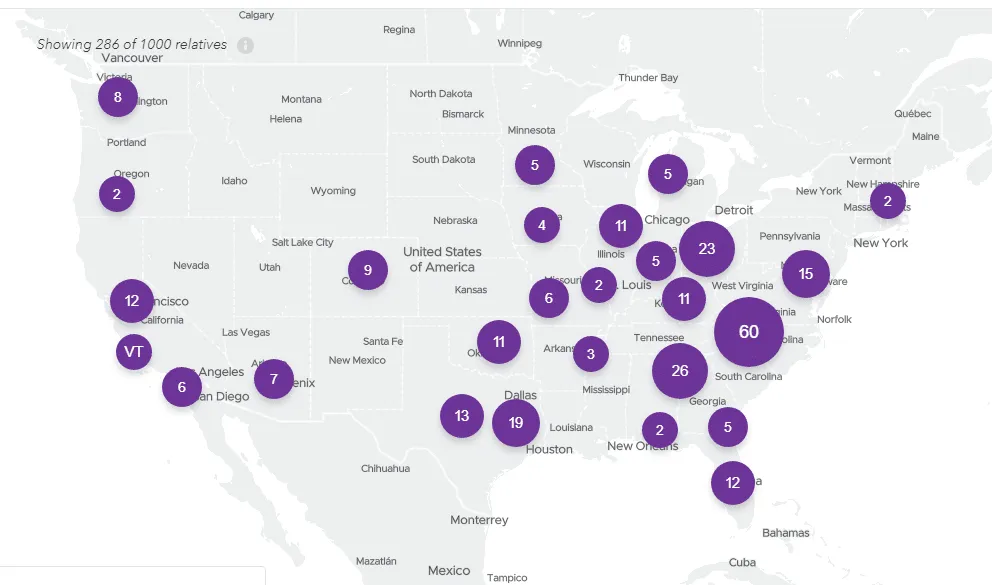
2018: The year in search
Here is what Google said we searched for in 2018 in many categories.
Chromebooks just got a lot more interesting
 My desk with the Pixelbook connected to a KVM switcher with a PC mouse, keyboard and 26 inch monitor. I can switch from a Windows 10 desktop to the Pixelbook.
SPJ Executive Director Alison Bethel McKenzie to speak in Knoxville
Alison Bethel McKenzie, the new executive director of the Society of Professional Journalists, will speak to the East Tennessee SPJ chapter on May 10.
Google PhotoScan
This one has been around awhile – and it really does a good job. “Scan” old photo prints with your phone with Google PhotoScan. It actually stitches together five copies of a photo to create a digital copy. This video explains some of the science behind this seemingly simple app.
Knoxville growth timelapse
From the Google Earth Engine.
Leonard Pitts: The facts need someone to defend them
Press Freedom Tracker
Check out the Press Freedom Tracker. Story here.
Plex just keeps getting better

Journalist training opp coming up in Knoxville
[caption id=”attachment_1995” align=”alignnone” width=”1200”] Journalism Writing Workshop with Al Tompkins of the Poynter Institute on Saturday, October 7, 2017, 9:00 a.m. – 3:00 p.m., Scripps Convergence Lab, University of Tennessee, Knoxville. To register, contact contact Brenda Heidt at brenda@tabtn.org, or (615) 365-1840.[/caption]
First Amendment Encyclopedia launched
Can I take photos of public records?
Even Tennessee lawmakers sometimes tire of government open records silliness.
Changes at Wirecutter
I hope the New York Times doesn’t screw up one of my favorite sites.
Hurricane Irma
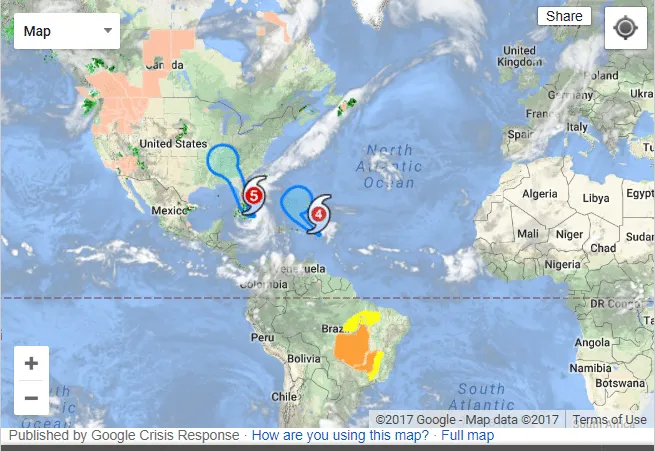
Most popular news sources on Facebook

No one does it alone
From StoryCorps and NPR:
Journalism training opportunity in Knoxville in October
From the Tennessee Association of Broadcasters president Whit Adamson:
What’s it like to cover the solar eclipse
Updated site
I overcame inertia and turned the lights out on my old Movable Type blog CMS and moved to Wordpress and SSL. Things went pretty well (it seems). 
First Amendment rights for digital assistants

Get signed up for the NewsTrain stop in Tennessee

Altering the news with photos
Let’s replay that
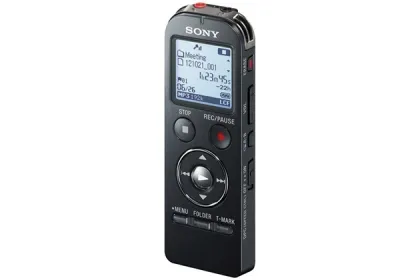 Still like a voice recorder for capturing interviews instead of a smartphone?
State of the First Amendment 2015
Congress shall make no law respecting an establishment of religion, or prohibiting the free exercise thereof; or abridging the freedom of speech, or of the press; or the right of the people peaceably to assemble, and to petition the Government for a redress of grievances.
A decade of freedom of information challenges
Here’s a A timeline tracing events over the past 10 years that show the country’s ambivalence over the free flow of information. It is being distributed by ASNE and major news organizations, including the Associated Press, The McClatchy Company and Gannett, as part of Sunshine Week, March 15-21, 2015.
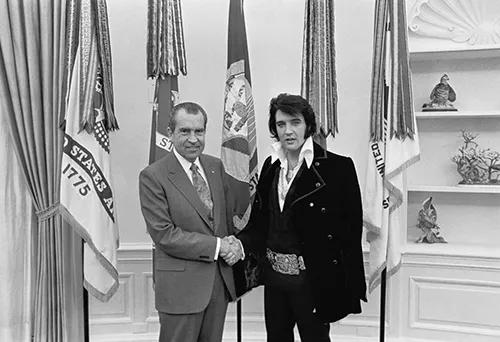
Snapshot of presidential photographers
ESPN looks to the future of sports coverage
Neat look at ESPN and how it’s trying to embrace a future full of media disruptions.
Is ‘Serial’ bad journalism?
Is the wildy popular “Serial” podcast bad journalism or is objectivity in journalism a threadbare concept?
CNN gets FAA approval for drone tests
My guess is this news is huge for news media use of drone aircraft.
Newscast bunnies get into some sexy business
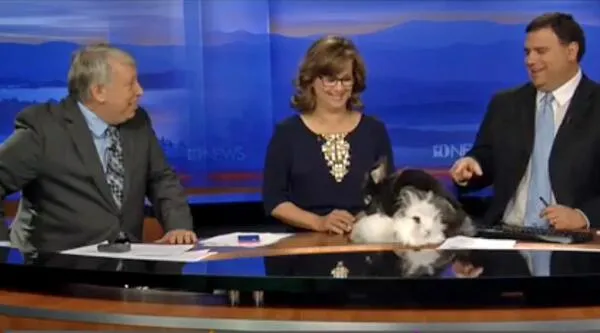 Local TV station WBIR has been in the news as an Easter segment last week went viral. What made everything from Gawker to the Today Show were some bunnies that in an on-air segment in front of the anchors did what … ah … rabbits often do. The Gawker headline: “Bunnies Have Sex Like Bunnies on Local News Channel’s Easter Broadcast” And CNN:
Toledo Blade files suit after Army security detains journalists
 Here’s another incredible example of the government’s trampling of the rights of photojournalists.
The Toledo Blade filed suit Friday after the Army security personnel detained two journalists outside a tank plan in Lima, Ohio. Cameras were confiscated and some photos deleted.
The incident occurred March 28 at a General Dynamics plant.
The lawsuit claims the newspaper employees were unlawfully detained, that one was unlawfully restrained and received threats of bodily harm, that cameras were unlawfully confiscated and images unlawfully destroyed, and that their Constitutional rights were unlawfully prevented from being exercised.
Was this part of some newspaper uncover project? Nope. They were in Lima covering a press conference at a Ford automotive plant and, while they were in town, they went around taking photos of businesses as file art for future stories.
They were outside the plant’s fence and took photos from public property, the newspaper said.
One of the employees, a female photographer, was held in handcuffs for over an hour. One officer said to her “You say you are a female, I’m going to go under your bra,” the newspaper reported.
There have been a string of incidents involving law enforcement officers confiscating cameras or interferring with photographers. At times, it almost seems there is a not-so-secret government war on photojournalism.
Everybody needs a little FOIA machine

Google’s spreadsheets just keep getting better
Google Sheets is an extremely powerful tool for journalists. If you’re a “math-challenged journalist,” you owe it to yourself to learn how to use Google Sheets.
Police vs photos
Getting arrested for merely taking a photograph of a law enforcement officer doing his or her job is all too common. In Memphis, there’s a memo.
Journalist Ernie Pyle’s last column reads much like poetry
Ernie Pyle’s Last Column from James Brown on Vimeo. I had breakfast the other day in Indianapolis with my friend James W. “Jim” Brown. He turned me on this video he did recently about the last column Ernie Pyle wrote, a handwritten draft found in his pocket after he was killed, and about plans to print it as a small “book” on a letterpress. Among Jim Brown’s many projects has been helping out Pyle’s hometown museum in Indiana.
Google Reader Replacements R Us
Google announced a couple months ago it was discontinuing, or “retiring,” Google Reader on July 1.
More on drone journalism

Now this from our drone desk

Every journalist needs hacking tips from the NSA
The Rebel Mouse look
More mobile friendly design
I’ve switched this website to a more mobile friendly design. It’s the new “Rainier” template that ships with Movable Type 5.2.2.
Sometimes SEO goes ‘completely wrong’
“A Google images search for the phrase “completely wrong,” which Romney used in a recent interview with Sean Hannity, now leads to page after page of pictures of the GOP presidential nominee. A Google spokesman told CNN the photos are the unintentional result of normal Google search rules.”
Another look at recording police officers on the job

We toot our horn
This blog won “Best Blog” not affiliated with a news organization from the East Tennessee Society of Professional Journalists in awards announced Friday night.
Lots of great regional journalism was honored; read through the list.
An Appalachian stereotype you may have missed
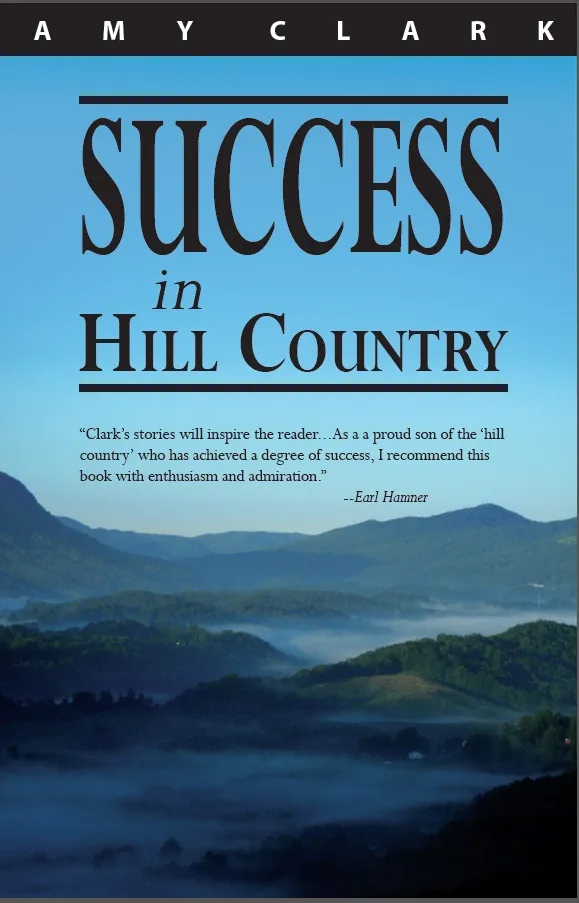 Success is not one of the stereotypes of Appalachia or its people. If you watch TV, the images are of the violence and drugs of “Justified,” moonshiners like Popcorn Sutton, the crazy dancing outlaw Jesico White of West Virginia and a host of other images in which “role model” never comes to mind.
My cousin, Dr. Amy D. Clark, an English professor at the University of Virginia’s College at Wise, hopes to change a few Appalachian stereotypes, at the very least, for the young people living on its hills and in its hollers.
Working with the Napoleon Hill Foundation, she collected success stories from Appalachian sons and daughers into Success in Hill Country
The book was published March 2 and the official launch with an author signing and a reading will be April 28 at the Southwest Virginia Museum in Big Stone Gap, Va.
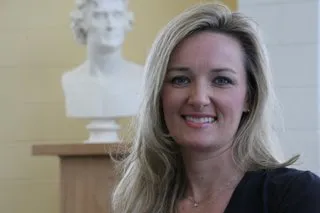 Clark collected oral histories from, among others, NASCAR president Mike Helton (from near Bristol, Va.), former NFL player and College Football Hall of Famer Carroll Dale from Wise, Va., author Lee Smith who grew up in Grundy, Va., and novelist, television writer and film director Adriana Trigiani, who hails from Big Stone Gap, Va.
In addition to personal advice on what made them successful, Clark explores how where you come from is as important as where you are going.
Among her inspirations for doing the book was her own childhood. As she writes on her blog:
“I knew I wanted to write something that could inspire young people, particularly those like me from the mountains or otherwise rural places that might be all but forgotten. I remember as a teenager thinking about what I would do in life and feeling convinced that to make something of myself I’d have to leave home, that there was no success to be found here in the hills and hollers, the farthest place imaginable from where Important Things were Happening, places like Los Angeles and New York City. I loved the mountains and everything about our way of life (and still do): the way we talk, our seasonal work like harvesting tobacco and making molasses, the old-timey hymns we sang in church. But I saw nothing resembling our way of life on television or in the magazines that came in the mail. The one television show we could relate to, even though it was set during the Depression, was The Waltons, because it was about a rural family who sounded a little like us and lived in the mountains. (I’m proud to say the creator of that show, Earl Hamner, read this book.)”
A few pictures and videos you won’t see this week

The seamy side of cool

Created by: Online MBA Programs
Touch typing on a touch screen with your eyes closed
A touch screen app for the visually impaired. That’s ingenious Georgia Tech.
The info:
A team from Georgia Tech, led by Post Doctorate Fellow Mario Romero (School of Interactive Computing) has designed BrailleTouch for touchscreen mobile devices. The prototype app allows visually impaired people to easily type and opens the door for everyone to text or type without looking at the screen.
The Three Little Pigs meet modern media
… And we learn the wolf wasn’t all that bad, the pigs weren’t all that little, and it’s all part of a larger problem anyway, anong other story narratives.
If fairy tales were news stories, they’d be a whole lot messier.
And, oh yeah, ths is a great ad. (via Techdirt)

Broadband availability is for city slickers
Connected Tennessee is doing a “crowdsourcing” experiment to gather information on boradband availability in Tennessee.
Use this map to verify what’s available in your neighborhood. If it needs correcting, use this form.
The good news: 95 percent of Tennessee hosueholds have broadband available. The bad news: 110,000 rural households are completely unserved.
Details on how Connected Tennessee came up with its stats.
The slant on media bias
The Wall Street Journal is among the most liberal media outlets in the U.S., more liberal than the New York Times and NPR. And the Drudge Report is left leaning, yes, left leaning, more left leaning than CNN.
One study found:
The most important factor driving the slant of a given newspaper is … the political leanings of the people who buy it. In other words: newspapers are giving the people the news that they want.
Media Credentials, the virtual debate version
Who is a “real” journalist? Why does @nypd decide who gets credentials? @megrobertson suggests nymedia “stop using them” #smwknd #ows
-- Jennifer Preston (@NYT_JenPreston) January 28, 2012
My most read blog posts in 2011
My most read blog posts during 2011 include only three written in 2011. Long tail at work or did I just used to write more interesting posts? A handful of these also made the list for the most read in 2010.
In the ring: Dolly vs Google (2008)
Just how did Benton’s Bacon become a craze? (2010)
Angry Journalist as career Yoda (2008)
Clematis in early morning (2007)
These days there’s always a camera near the spotlight (2011)
First Amendment found damaged in storm cleanup (2011)
In Washington, a half-effort on open government will get you an award (2011)

Are you getting ‘Return On Influence!?’
Friend and fellow Knoxville resident Mark Schaefer has a new book coming out in March on social media and marketing called Return on Influence!..
And he’s got a special offer. If you pre-order the book between now and March he’ll send you a bonus eBook. The eBook is an Insider’s Guide to Klout. Sounds interesting as well.
I haven’t had a chance to look at the book much less read it, but the promotional copy will give you an idea if it’s something you would be interested in:
Return On Influenc e is the first book to explore how brands are identifying and leveraging the world’s most powerful bloggers, tweeters, and YouTube celebrities to build product awareness, brand buzz, and new sales. In this revolutionary book, I’ll show you how to use the latest breakthroughs in social networking and influence marketing to achieve your goals through:
The text message is still a teenager

Source: Tatango SMS Marketing
Cell phone text messaging turns 19 today. How long have you been texting?
Related articles
LiquidText might go in the toolbox
Craig Tashman, a doctorate student in the School of Interactive Computing, says this research project at Georgia Tech is being spun out of the university and will become a startup. LiquidText will be first released as an iPad app. It’s a tool that could have implications for journalists.
The plan is to make it work with PDF documents (it only works with text files right now), standard issue for much government information. The ability to easily and graphically selected noted sections and relate them could be a powerful tool.
I don’t think I’ve seen anything quite like it. It was one of the things I stumbled upon at FutureMedia Fest 2011 at George Tech.
You can follow the conference on Twitter at #fmfgt.
What happened to local TV news
Running on Empty: The Brain Drain in Local TV News (TRT 57:00). This documentary was produced by Bill and Karin Schwanbeck, professors of journalism at Quinnipiac University.
The documentary covers a development that doesn’t bode well for local communities. While this trend may be accentuated in TV newsrooms, similar pressures exist in newspaper newsrooms.
There are reporters, editors and even publishers/general managers and, yes, corporate executives trying to serve their local communities well with impactful journalism, but with less and with difficult business realities even in the best of circumstances.
(Hat tip to Hagit Limor)
Why ‘Conan O’Brien may be about to push the envelope’ should be banned from TV news – forever
Hilarious (or sad) video of how local TV news handled this story about a same-sex wedding on the Conan O’Brien show. (via Techdirt).
Journalist videos his own arrest during Occupy protest
Nashville Scene reporter Jonathan Meador “covers” his own arrest during Occupy Nashville arrests early in the weekend. He is lucky the camera wasn’t confiscated.
More coverage:
News can be a fun game
Bobby Schweizer talks about the news game he is helping develop called “The Cartoonist.” He was among the students talking about their projects at the GVU Fall Research Showcase at Georgia Tech on Wednesday, Oct. 26, 2011.
Foursquare gets pissed
The above “Mark Your Territory’ video is about one of the many student projects I saw Wednesday at the GVU Center’s Fall Research Showcase. It was a great way to see some really fascinating projects grad students at Georgia Tech are working on.
I’ll write more about that later, but it included data visualization, a lot of augmented reality projects (Georgia Tech has developed an augmented reality browser for mobile devices), some social networks, lots of game-related projects, some efforts around film and filmmaking, advanced TV, a mobile application development framework that allows for rapid development and sharing of mobile apps at Georgia Tech and some projects designed to address quality of life for certain medical issues.
I liked that the projects were in general designed to improve people’s daily lives using open source tools and relatively inexpensive off-the-shelf hardware (modified to their needs).
The “Mark Your Territory” project by Andrew Ouitmeyer was one of the funniest and he enthusiastically explains it.
Hey, it’s another thing you and the dog can do together.

Did Occupy Wall Street find its Rick Santelli?
Is MSNBC’s Dylan Ratigan Occupy Wall Street’s Rick Santelli?
The above video with TV business/financial journalist Dylan Ratigan going on a “mad as hell” rant has been among YouTube’s trending videos over the last few days.
In this video, Ratigan’s message is associated with the Occupy Wall Street protests, but the rant was actually made on August 9 before the protests began in New York.
A version of the video went viral then as well. Ratigan explains his rant in more detail on his blog.
It’s strangely reminiscent of Rick Santelli’s Feb 19, 2009 rant on CNBC that called for a Chicago Tea Party that helped give voice to that movement.
Like Santelli, Ratigan seems to articulate the rage and frustration of the grassroots picking up on their message (those who identity themselves as in the Tea Party in Santelli’s case and those in the Occupy Wall Street movement in Ratigan’s).
In both cases, it is an odd role for journalist as observer.
Related articles
Two out of three times, the media gets it wrong
When people say there’s nothing but “bad news,” they may mean wrong or slanted.
The widely-shared belief that news stories are inaccurate cuts to the press’s core mission: Just 25% say that in general news organizations get the facts straight while 66% say stories are often inaccurate. As recently as four years ago, 39% said news organizations mostly get the facts straight and 53% said stories are often inaccurate.
Randy Neal and Stacey Campfield on same page
Who knew? Randy Neal and Stacey Campfield on same page https://ow.ly/6oGsbThu Sep 08 12:43:59 via HootSuite knoxnews
knoxnews
Student sports writer gets schooling on Calipari coverage
These days there’s always a camera near the spotlight
Nice snapshot by the First Amendment Center’s Ken Paulson on the latest conflict between law officers and a seemingly law abiding photographer.
Today video devices are ubiquitous. Flip video cameras and phones with built-in camcorders mean that almost any image can be captured at any time by anyone. Good taste is the least of law enforcement’s concerns.
Increasingly, tensions arise when the press or public try to document police activity on video. On July 29, Phil Datz , a freelance cameraman with news credentials, was arrested by police in Suffolk County, Long Island. The video Datz took of the arresting officer – already viewed by about 40,000 people on YouTube – shows a police sergeant ordering him to “go away” even though the journalist is well away from the crime scene. Neighbors stand nearby and watch the gathering of police and squad cars from a similar distance, but are not disturbed. Even when Datz asks for an explanation or suggests contacting the police department’s public information officer, he’s told to leave. In the end, a squad car pulls up and Datz is arrested.
The War on Photography
Attrorney Morgan Manning writing in a perspective column running in this Sunday’s Knoxville News Sentinel:
A simple Google search reveals countless incidents of overzealous law enforcement officials detaining or arresting photographers, and in many cases confiscating their cameras and memory cards, despite the fact that these individuals were in lawful places at lawful times, partaking in lawful activities. Often, law enforcement officials cite blanket notions of “national security” as their source of authority. Other times, they cite broadly worded criminal statues such as “obstruction of justice” or “interfering with a police officer.” My personal favorite is “Its against the 9/11 law.”
….If efforts are not made to resolve the War on Photography, both individuals and society at large will suffer. Photography represents a powerful tool for increasing public awareness and inspiring reform. Photography is also a valuable means of enhancing accountability on behalf of law enforcement officials and private security guards. Vicki Goldberg, a photography critic and author, notes that “photographs have a swifter and more succinct impact than words, an impact that is instantaneous, visceral, and intense.”
We were honored

TN journalist Duren Cheek dies
 Tom Humphrey has the news about the death of retired UPI Tennessee bureau chief and Tennessean reporter Duren Cheek.
Cheek’s bio on his Facebook page says:
Spent most of my life in the news business. Started with UPI before graduating from UT. Got so frustrated as a beginner that I marched down to the Marine Corps recruiting office and was ready to sign up. Fortunately, the Sergeant was out for coffee and I came to my senses and got out of there before he got back. I began my career at the Knoxville UPI bureau, located in the News-Sentinel City Room _**.
**_
Mobile factoids
Learn More about Mobile Tagging at Microsoft Tag.
Saw this on Alltop’s Holy Kaw blog. This is a great infographic, but why did Microsoft come up with its own tag system? Seems like just as QR codes are beginning to get some traction, Microsoft comes in and says, hey, let’s do it the Microsoft way. Geez.

Related articles
An essential download about the iPad and print news
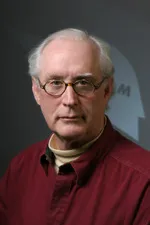 Bill Tallent, CEO of iPad and smartphone developer Mercury Intermedia, has published some thoughts for news executives on the disruptions they are facing.
Having built 30+ high-volume, high-visibility touch screen news apps for 14 behemoth print and television media organizations, apps that have been downloaded 20 million times and yield over 1� billion user sessions per year, our experiences lead us to suggest three things that will help news organizations decipher this disruption and “skate to where the puck is going.”
First: Consider what consumers seek.
Second: Realize that apps are diminishing the role of printing presses
Third: News industry business models must change
Twitter coverage of the Mobile Migration workshop
Hashtag set for Mobile Migration workshop
We have a hashtag for the “Mobile Migration” workshop next week. You’re coming right?
It’s on April 1 at the John Seigenthaler Center in Nashville.
The hashtag is #ONAMM.
See ya there.
Some other disclosures Tennessee Gov. Bill Haslam might not like
Tennessee Gov. Bill Haslam is getting some unfavorable attention in a new video posted Monday by the Sunlight Foundation.

Tennessee gets a D- for government transparency
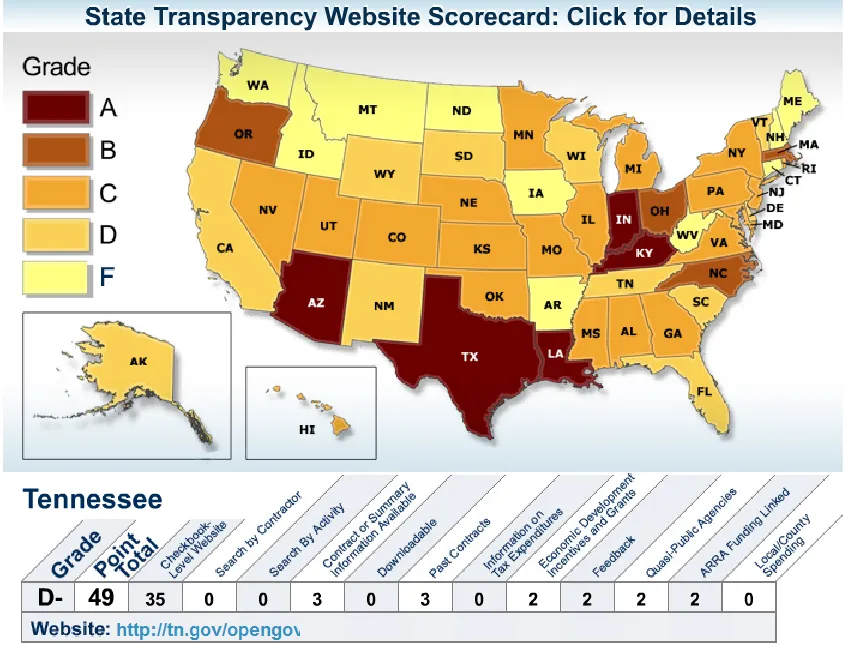
In the second annual ranking of states’ progress toward new standards of “comprehensive, one-stop, one-click budget accountability and accessibility,” Tennesse gets a “D-.”
The ranking of how states are achieving Transparency 2.0 standards was done by U.S. PIRG, the federation of state Public Interest Research Groups (PIRGs)
An interactive map on the federation’s website lets you drill down into the data for each state.
Tennessee, for example, gets the maximum positive score for having a “checkbook-level” website, but its low grades come from the site not offering much information.
Seems to be story of open government in Tennessee.

In Washington, a half-effort on open government will get you an award
(U.S. Rep. Rep. Darrell ) Issa disclosed in his letter that (Catherine) Papoi complained confidentially to the inspector general in March 2010 that the department, under a directive signed by (chief privacy officer Mary Ellen) Callahan, had illegally sidetracked hundreds of requests from journalists, watchdog groups and others for federal records to top political advisers. The advisers wanted information about those requesting the materials.
Dark spots in the Sunshine
 Jennifer LeFleur of ProPublica has put together a great piece on the dark spots in federal “Sunshine Laws” as part Sunshine Week.
Some of those statutes allow exemptions that seem quite reasonable, for example to protect medical or financial information. Many others are more puzzling.
Citing the Watermelon Research and Promotion Act, for example, the U.S. Department of Agriculture has withheld lists of watermelon growers.
Under another law, information about the location of “significant” caves has been withheld by USDA and the U.S. Department of the Interior.
What I’ve been doing with Storify revealed
(This is a storyBo Hee Kim did with me about my use of Storify as a reporting tool. She combines social media snippets with her original reporting in a phone interview using Storify as the way to present the article.)
.
Clapping at checkered flag brings debate on sports journalism’s checkered ethics
Who started science fairs might surprise you
I stumbled across this the other day. If I knew it earlier, I had totally forgotten.
Newspaper mogul E.W. Scripps is generally considered the father of science fairs in the United States.
The origins of the science fairs in the United States began almost thirty years before the first National Science Fair in Philadelphia in 1950. Its beginnings can be traced back to newspaper mogul E.W. Scripps in 1921. He fathered the Science Service, now known as Society for Science & the Public, in collaboration with The American Association for the Advancement of Science, the National Academy of Sciences, and the National Research Council. Scripps created the Science Service as a nonprofit organization to popularize science by explaining technical scientific findings in a jargon-free manner to the American public. Under the watchful editorial eyes of Edwin Slosson and Watson Davis, the original weekly mimeographed Science News Bulletin evolved by the end of 1920s into the Scientific News Letter, a weekly magazine.
The Mobile Migration workshop will be April 1 in Nashville
 If you are developing or executing mobile and tablet strategies for your news organization, reserve April 1, 2011 on your calendar for “The Mobile Migration” workshop in Nashville, Tenn. – almost a year to the day that the iPad went on sale in Apple retail stores.
The Online News Association and the Freedom Forum Diversity Institute are co-sponsoring a one-day workshop at the John Seigenthaler Center on the campus of Vanderbilt University in Nashville that will share real world information about delivering news and information for the small screen.
Speakers include James Moroney III, president and CEO of the Dallas Morning News; William J (Bill) Tallent, CEO of app developer Mercury Intermedia, which has developed apps for USAToday, the New York Times and others; and Rex Hammock of Hammock Inc., a company that has been recognized for taking using new technology and web-based strategies in the custom media and content marketing industry.
We also will have an international perspective on exploding mobile and tablet markets.
“The Mobile Migration” workshop will cost $50 with discounts for ONA members (435) and students. Special room rates for overnight visitors (the workshop is on a Friday so spend the weekend in Music City) will be available from the Embassy Suites at Vanderbilt in Nashville’s West End District.
The workshop is being made possible in part with funding from the Scripps Howard Foundation.
(“Save the date” photo fromthrownoverbored on flickr.)
We’d like to thank to our referers
Many thanks to the top 10 referring sites to his blog during 2010 that are not search engines. Have a Happy New Year!
Fellowship opp
This may be of interest:
Ted Scripps Fellowships in
ENVIRONMENTAL JOURNALISM
University of Colorado at Boulder
“The program was better than I expected, mainly because of the educational opportunity. Once I realized how much I did not know, it truly became a renaissance experience for me. I feel like a new man, and I have much more intellectual energy to continue my journalism journey.”
Jim Mimiaga, Fellow 2009-10, Four Corners Free Press
Apply now for the 2011-2012 academic year. Full-time U.S. print, broadcast and online journalists with a minimum of five years professional experience are eligible. Applicants may include reporters, editors, photographers, producers and full-time freelancers. Prior experience covering the environment is not necessary. Fellows will take classes, attend special seminars, go on field trips and engage in independent study at a university renowned for its environmental science and policy studies.
The fellowship provides a 9-month stipend of $50,000, and additionally covers tuition and fees.
Application Deadline: March 1, 2011
For more information and application instructions contact:
https://www.colorado.edu/journalism/cej
The Center for Environmental Journalism
University of Colorado at Boulder
1511 University Avenue, 478 UCB, Boulder, CO 80309-0478
(303) 492-4114

Tell us what is on your “Cooler than a Visit to ESPN Headquarters” list

Clarifying the perfectly clear is to muddle
This move to “clarify” the laws looks like an attempt to close more government records in Tennessee.
State Rep. Vince Dean said it ‘makes sense’ that any e-mail sent on a public computer would be a public record. But the law itself does not address the issues that have muddied its interpretation.
‘Any time you’ve got a law that’s in place, it needs to be clear enough the average citizen can pick it up and read it,’ Dean said.
WNOX, a beacon in radio history
 In my Google Alerts over the weekend was a piece from the Arcane Radio Trivia blog on the history of WNOX.
It reminded me of Knoxville’s rich radio history, particularly with WNOX, the first radio station in Tennessee (yes the first) and the 10th (or the eighth depending on who is counting) in the nation.
It is also interesting that it was started by a 16-year-old.
Here’s a bit of the history:
In 1935 WNOX was sold to the E.W. Scripps Company which also owned the local newspaper, the Knoxville Sentinel. The Scripps Company hired announcer Lowell Blanchard in 1936 to and told him to hire more hillbilly performers. It was probably their plan to compete better with the upstart WROL. He began the variety program called the Mid-Day Merry-Go-Round. It became an institution. It mixed comedy, dixieland, swing and live Hillbilly performers. It was not a pure country program by any stretch but it went head-to-head with the Farm and Home Hour on WROL. In 1936 it’s star Roy Acuff quit to work at WROL. They were now rivals, not just competitors.That would last into the 1940s. In March 1941, WROL moved to 620 AM; they changed calls to WATE and began doing more news.
Free enterprise just hasn’t been good for journalism

What were those editors thinking (Day 2)
Carole Tarrant had some great Twitter coverage of APME. If you don’t follow her, you should.
South Florida students blogging APME
Full list ofstudent blogs.
APME Conference 2010: The Twitter verison
mTurk could be the citizen army of journalism

Random evolution: We split the gene pool
After 1,665 entries over more than five years, I’ve decided to split this blog in two, with this one renamed to reflect the domain name, jacklail.com, and a new Random Mumblings blog at www.randommumblings.com.
This will remain my professional presence and Random Mumblings will be a bit more … random.
What’s up with this?
There’s no single answer, but not more than a handful.
I’ve powered this site with MovableType since the beginning and have been very happy with it, even when Wordpress became the new darling. I’ve used Wordpress a bit and while it’s a serviceable platform, I didn’t see much advantage in moving. While the developer community moved to Wordpress, MovableType keep adding just enough features, like the Activity Stream and OpenID support to name two, to more than meet my modest blogging needs.
The sale of Six Apart to VideoEgg announced last week, however, makes me wonder about the future of its blogging platforms; they don’t seem to central to the new company’s mission. The new company is called SAY Media and seems focused around developing advertising solutions. MovableType development will continue to be based in Japan. I wish them well and I’ll continue to use MovableType Pro on this site for the foreseeable future.
But I also wanted to seriously experiment with at least one of the upstarts. I’ve had a Posterous account for awhile, but hadn’t used it. I gave a quick size-up of Posterous and Tumblr. Users of both are passionate about them, each has its pluses and minus, but Posterous feels at this early stage to more of what I’m looking for: Dead easy, minimal in fuss and muss, and strong technology underpinnings. I’m sure Tumblr fans will say, yeah, but. So be it. For now, it’s Posterous for a platform.
Creating the site in Posterous, including selecting and customizing a theme, registering a domain name (why didn’t I think of registering the name of my blog years ago?), setting an “A record” to map the domain to my Posterous blog, getting Google Analytics turned on, and hooking into my Facebook account took maybe a couple hours. Yeah, I could fiddle with the CSS for hours on end, Yeah, I could. I doubt I will.
I’m creating yet another blog as many continue to say “blogging is dead.” Blogging is dead as a particular, perhaps peculiarly quirky, platform for daily personal commentary with reverse chronological posts that allow for comments. Most content management systems or social media sites have those and more. And “blogging” platforms have gone pro from Huffington Post and Gawker Media to the corporate PR department.
Of course, outlets for personal expression are increasing: Facebook, Twitter, Foursquare and others.
What’s not dead or dying is the need to create a personal brand and to have a home base for one’s digital life. This site will remain that for me. I think it’s always good career advice to get your “name dot com” if it’s available. LinkedIn and Facebook have roles as well.
What’s not dead or dying is the desire of people to share things, to have an opinion, to see something that makes us smile (and hopefully laugh). The new Random Mumblings will be that for me in addition to Twitter and Facebook and flickr and delicious and Foursquare and … Yeah, it’s complicated.
We’ll see how it plays out. The unchanging law of the digital world is that everything changes or evolves. This splitting of the gene pool is the next evolution for me.
Thoughts on how blogging and social media and digital life are evolving? Post ‘em in the comments.
Related articles by Zemanta
Biggest news stories in each of the last eight years

Help the flood victims in Pakistan
I’ve had some interesting updates about the flooding in Pakistan. See the blog post.
Morning mist in the mountains
Wo

View from Wolf Laurel, N.C., early Sunday morning. Some more here.
This post has not been tape recorded
Among the AP Stylebookchanges announced Friday:
video recording Precise term for digital audio and visual recording. Digital has largely replaced videotaping.
videotape (n. and v.) Largely replaced by digital recording. The terms apply only if tape is used.
These young journalists will have them dancin’ in the streets
Linda Nguyen, who graduates from the University of Tennessee at the end of the fall semester, and April Alexander, who will graduate from Hampton University in the spring, were a great pair of interns with our online editorial group this summer.
.
I wish them well and I expect them to have great success.

What the Tennessee candidates for governor are saying on Twitter
Something has gone amok with the PubliTweet widget and it has been removed.
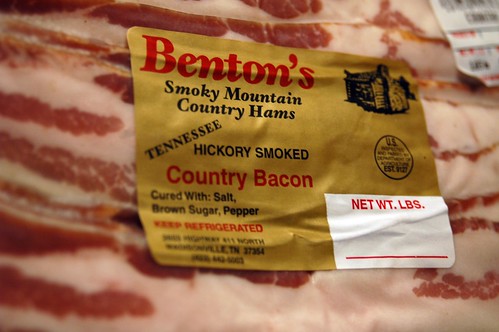
Just how did Benton’s Bacon become a craze?
Oh, no, not again Delta
Hey, Michael Moore, I’m calling you out
 Michael Moore is an artistic and intellectual thief.
Yes, Michael Moore, the American filmmaker, author, political commentator and self-professed liberal who enjoys the skewering the ethical transgressions of corporate organizations.
Yes, Michael Moore of the documentary films Roger and Me, Bowling for Columbine, Fahrenheit 9/11, Sicko, and Capitalism: A Love Story.
Yes, Michael Moore, an unabashed and unrepentant nose-thumber atcopyrightprotections. Hey, it’s just a federal law.
On July 5, while most Americans were enjoying a Fourth of July day off, Knoxville News Sentinel reporter Frank Munger and photographer Michael Patrick were out in the 90-degree heat covering peace protesters at the Department of Energy’s nuclear weapons facilities in Oak Ridge, Tenn.
In addition to calling in Web updates and writing a story for knoxnews.com and for next day’s print edition, he shot a short video. Patrick shot several photos that were used in a photo gallery.
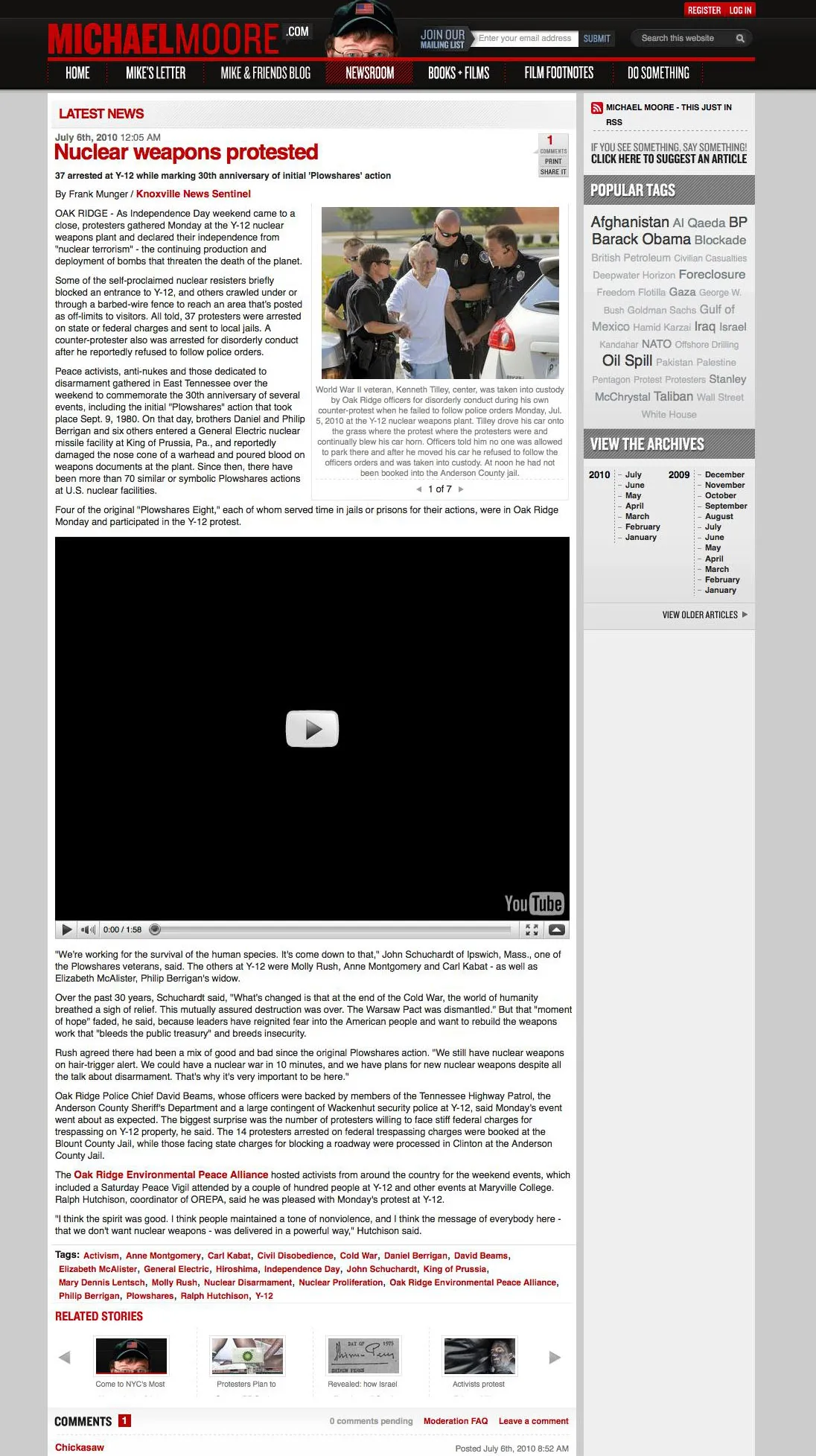
Despite a prominent copyright notice on every page of the website, Michael Moore’s website took the entire article and posted it online.
The video Munger shot was grabbed, the Knoxnews logo was clipped out and a new copy posted to Michael Moore’s YouTube channel complete with video credits for Munger at the end.
Early Friday, I filed on the behalf of the Knoxville News Sentinel (my employer) a “take down” notice with YouTube and the pilfered version of the video was removed by YouTube by Saturday afternoon.
I also submitted the contact form on the michaelmoore.com website directed to the website administrator demanding our photos, which had also been snagged from knoxnews.com, be removed.
So far, they haven’t.
It’s not that we’re opposed to sharing our content. We like other sites to link to our content and we also heavily link out to sites other than own.
The video we posted on knoxnews has embed code that allows it to be legally be placed on another site, as does the version of the video we posted to our YouTube channel. It’s just a simple cut-and-paste of a code snippet. But why bother, it’s only someone else’s work product.
A thumbnail of one photo (the ones posted are larger than thumbnails) and a link to the gallery would have been great. But why bother, it’s only someone else’s work product.
An excerpt of the article with a link to the complete story would have been excellent. But why bother, it’s only someone else’s work product.
From a look at some other content on the site, MichaelMoore.com makes a regular habit of reposting copyrighted work in total without adding any type of additional value.
Did Michael Moore personally misappropriate our copyrighted material? I don’t know, but he has to take responsibility for the website that bears his name.
And that’s the awful truth and Michael Moore.
(Photo: Screenshot of MichaelMoore.com page with News Sentinel story and photos. By the time I grabbed this, the video they had taken from knoxnews.com and uploaded to YouTube had been removed. Click on the photo to see a larger version.)
Related articles by Zemanta
And then there were fireworks
These are a few years ago, but enjoy on the Fourth!
Army journalist dies in combat in Afghanistan
 The first Army Journalist killed in combat since 9/11 died June 18 when he was struck by improvised explosive device while on patrol near Kandahar. See AP report.
Photo: James P. Hunter, first Army journalist killed in combat since 9/11. AP / US Army Photo
Related articles by Zemanta
Your audience got wired
Oh, it sounds like a familiar tune
Insert “blank” for music
The music industry and innovation will cease to exist unless there is an investment in music, Burnett says. “There are a lot of people making a lot of money today, but the creators of the music are not being rewarded at all,” he adds, calling it dangerous for society and the industry. “Google made $28 billion in advertising last year.”
Knoxville.com does Bonnaroo like no one else
If you’re into Boonaroo, there’s no better place to follow happenings (whether you are there or not) than our Bonnaroo section on knoxville.com and our Bonnaroonews Twitter stream.
We’ve posting our stuff and linking to the rest! We have one of larger coverage teams this year with Wayne Bledsoe, Lauren Spuhler, Saul Young and Linda Nguyen.
Here’s the most recent coverage as of early Saturday morning (See Knoxville.com for the latest).
Bonnaroo creates home for imposters: I’ve said before that Bonnaroo is another planet. It actually goes beyond that. Online intern Linda Nguyen discusses the trend of posing as characters throughout the festival.
Nine shows in nine hours: An intern’s guide to rocking your face off: There is so much to do and see at Bonnaroo. So, how does the average avid music lover get to see his or her favorite bands in one day? Online intern Linda Nguyen has four general rules to making the most out of your Bonnaroo experience.
Wale makes his entrance at Bonnaroo: I love that there’s hip-hop at Bonnaroo. I wish there was a lot more of it.
A latecomer’s guide to Bonnaroo: So you got up this morning thinking you might head to Bonnaroo.
Bonnaroo already wet and wild and muddy: Here’s a look at what others are writing about the Bonnaroo music festival outside Manchester.
Bonnaroo all about the experience: Bonnaroo is all about the experience – from camping out to enjoying a plethora of bands, meeting people from all over the country (and the world) to helping out the community at-large.
Bonnaroo advice for the summer intern: “You’re the mentor,” my intern told me yesterday. I’m sure it was said partly in jest, but I’m taking it.
Ten reasons why Bonnaroo is another planet: Knoxnews online intern Linda Nguyen describes her first impressions of Bonnaroo 2010.
Bonnaroo: A personal list of pros and cons: I don’t know why I keep doing this. I’m a single man in my thirties who should be at home soaking his bad knees in hot water while spray painting hair on a bald spot. I should be resting comfortably in elastic-waisted pants eating greasy potato chips. I should be looking over my dwindling 401k while cursing my bad financial advisor. I should be watching late night television while ironing a wrinkle-free dress shirt. And I should be appeasing my mother’s incessant nagging on my inability to provide her any legitimate grandchildren. Instead, I’m galavanting about with kids half my …
41,000 fans turn out for Bonnaroo’s 1st day: MANCHESTER, Tenn. - The 2010 Bonnaroo Music and Arts Festival opened with relative calm Thursday. Thunderstorms raked through the area just as the gates were opening, making things slightly soggy and muddy, but the dark clouds that loomed over the opening day never broke loose with a deluge.
Bonnaroo 2010 opens with relaxed mood: It’s a little muddy, but Bonnaroo 2010 off to a calm start. Stevie Wonder, Jay-Z and the Dave Matthews Band among the show’s headliners.
Break out your deodorant, it’s Bonnaroo time: Is it really already time for communal showers, Porta-Johns and sweat-drenched people everywhere you look? Bonnaroo 2010 opens its gates this Thursday in the wee town of Manchester, Tenn.
Bonnaroo’s appeal spans generations of music fans: Bruce Springsteen. James Brown. Tom Petty. B.B. King.
Bonnaroo-bound Dave Matthews ready for a break: The prospect of a year off touring in 2011 has Dave Matthews hatching a few ideas - although he notes that “I’m much better at not having any plans. The success of my career … has depended heavily on me having no control over it.”
Bonnaroo 2010: What a long, strange trip it’s been: Who would’ve thought eight years ago that the music festival that shut down little Manchester, Tenn., would become a yearly institution? A rite of summer? The biggest, most successful music festival in the country? The 2010 Bonnaroo Music and Arts Festival is June 10-13. Here’s a look back on how it’s grown.
Grudge Match: Bonnaroo vs. Xanadu: We compare two pop-culture subjects to see which you like better. To be included in next week’s tally, vote for your favorite before noon Monday. This week’s match: Bonnaroo vs. Xanadu.
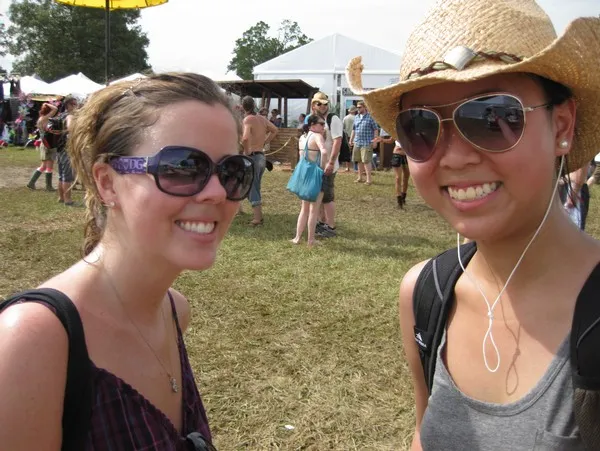
_Photo caption: Online producer Lauren Spuhler and online intern Linda Nguyen show off their hipster sunglasses at Bonnaroo 2010.
_
Turning stoneware into schools
 Here’s an Interesting effort by at least 24 Seagrove, N.C., potters to raise money for help Greg Mortenson build schools in Pakistan and Afghanistan.
They are creating special pieces to sell on Aug. 14 to raise money for his Central Asia Institute (at least half the sales price of each piece will go to the group). The Central Asia Institute is one of 10 charities that received part of President Obama’s Nobel Peace money. Mortenson’s book, Three Cups of Tea
You can find out more at the website “Seagrove Potters for Peace.”
 Seagrove Potters for Peace started with Beth Gore (pictured at left) of Cady Clay Works, who finished reading Mortenson’s book last spring and wanted to do something more than just write a check. The event last August involved 13 potteries and was called “Seagrove Potters for Peace - 100 Cups of Tea.”
Seagrove’s potters are not rich. Their shops are small family businesses. Often their homes are on the same property as the shops, which dot the Seagrove area (Seagrove is a small town of 260 people or thereabouts). So if you want a piece of unique pottery and help a good cause, visit these potters in rural North Carolina on Aug. 14.
Related articles by Zemanta
FOIA power play by federal agency TVA

Nashville flood cleanup: Sunny days but still a wet disaster

Photo taken Sunday morning on Second Avenue between Church Street and Broadway in downtown Nashville, Tennessee. Lots of workers were on the job just a bit down the street as the cleanup from the May 1-2 floods in Nashville and Middle Tennessee continues. Some more photos on Flickr.
Help out by donating to the Community Foundation for Middle Tennessee flood relief
Some related headlines from Zemanta:
Related articles by Zemanta
This story intentionally left blank
I am really surprised to see how the mainstream media is pretty much ignoring the massive flooding in Nashville…Thu May 06 14:14:31 via web Meghan McCain
McCainBlogette
Some data on database journalism
 I’m speaking to a journalism class at the University of Tennessee this morning about:
- Computer-Assisted Reporting
- Computational Journalism
- Open Government Data Advocacy efforts
First mumble unearthed
I wanted to note this is in passing and April Fool’s Day feels right: This blog turned five just a few weeks ago, on Feb. 18. For those who read it regularly, thank you! For those that read it all all, thank you, too.
As they say in archeology stories, the site shows signs of a primitive civilization.
During Random Mumblings’ history, it has had some 1,602 posts (an average of .87 a day), 1,217 comments, 214 trackback links and over 86,000 spam comments or trackbacks blocked by TypePad AntiSpam.
Subscribing to this blog would be a splendid way of marking this milestone.
Do the “Lola dance;” donate today!
 Help Knoxville News Sentinel reporter Lola Alapo in her effort to raise money for East Tennessee Children’s Hospital through “Star 102.1’s 2nd Annual Dancing with the Knoxville Stars .”
The fundraiser is drawing to a close and helping Children’s Hospital is certainly a worthy cause. Here’s an article she wrote about her effort.
Or just skip the article and vote.
![Reblog this post [with Zemanta]](https://img.zemanta.com/reblog_c.png?x-id=0b3cdc97-aa2b-4d25-a2ba-d35588be43f7)
Journalism educators can get a break on training
From Val Hoeppner at the Freedom Forum Diversity Institute:
Associated Press Managing Editors’ NewsTrain program will hold a two-day workshop for newsroom editors and college educators/media advisers Sept. 23-24 at the Freedom Forum in Nashville.
Through a grant from the McCormick Foundation, 20 educators will win awards valued at up to $400 to help them attend. Applications are being accepted now through June 15.
Apply today at:
https://bit.ly/Nashville_NewsTrain_Educator_AwardFor information about the workshop:
https://www.apme.com/?page=NashvilleNewsTrainFor help or more information, contact Elaine Kramer, NewsTrain project manager at: apmenewstrain@gmail.com.
Become a fan


The next logical step to FOIA: POIA
There’s new open data, government transparency effort. Find out more about POIA in this Sunlight Foundation video.
Related articles by Zemanta
Engel Stadium: Down in the last inning
It is great to see a group of people are trying to save Chattanooga’s historic Engel Stadium, the second oldest minor league baseball stadiums in America and one that is on the National Register of Historic Places.
It’s an 80-year-old, 5,997-seat monument to baseball history that seems to be locked in a “Twilight Zone” episode of ownership.
I was there in 2008 and took the above HRD photos. It was in bad shape then; I can only imagine what it’s like with two more years of no maintenance and being a haunt of the homeless.
A story in the Chattanooga Times Free Press today offers a glimmer of hope of saving the park. Its supporters need to be wearing their rally caps.
![Reblog this post [with Zemanta]](https://img.zemanta.com/reblog_c.png?x-id=6d1b8545-459a-47a9-9eb7-3bc735d5aab4)
The Social Media thing
 I have done this post in awhile!
Be sociable:
Collaborating with Pablo
 I’ve been using a project collaboration Web service called Teambox for several weeks. I was drawn to it, frankly, because it was free and seemed to meet my needs for a Web site relaunch project involving a committee of several people all in different cities.
The Twitter-like design is intuitive for me.
One night I sent an email about a minor bug and got nearly an immediate reply from a real person who signs his emails merely as “Pablo.” Eventually, I learned more about Pable and his Teambox.
I discovered from reading the site’s blog that it is not a Silicon Valley or New York startup, but is based in Barcelona, Spain. Yes, Barcelona.
The company just launched a pay plan, but continues to use a freemium model of a free level of service and various paid plans.
In a series of emails with the founder, I learned his name is Pablo Villalba and that the company has six employees with open source developers scattered about the world Spain, Canada, Germany, France, Russia and the United States.
“We started developing Teambox two years ago, when we needed a tool to manage our own projects as a startup,” Villalba said. “At the beginning it was only an internal tool, and then it was released in Spanish. We’re now the number 1 tool in Spain for project collaboration.
“Then we did a complete re-write to target twitter-like communication. So far, we’ve been funded by local Business Angels and we’re planning to move to San Francisco to keep the startup running and growing.”
Here’s a brief Q&A:
Yours is a familiar story. Company starts on one idea and along the way a side idea before the product (like Twitter’s development for example). How did you come to realize that the internal tool was really the more viable product?
In order to start a real business and stop selling our time and skills, we needed to have a product. We realized the moment somebody saw what we had and said, “I just paid 6000 euros for something worse than this”. At that moment, we started learning about marketing and adapting what we had for the public.
How have your been marketing your product?
So far, simply word-of-mouth. Our users have been responsible for most of its success, blogging and tweeting about it.
Recommendations from trusted sources can do wonders!
If someone asks, ‘How is this different from Basecamp?,’ what is your answer?
Teambox is like Twitter for project management. It brings your team together in a horizontal communication structure.
Tools like Basecamp are great for client work, having a place where you can share results with them. Teambox is meant for ongoing projects, that evolve with time and where daily communication is important.
We offer some more features (auto-refresh, activity feeds, email notifications), and multi-language support.
Teambox is also developed under an open-source license, meaning you can download and host your own copy.
Who is the target market?
Developers, designers, consultants and marketers. From any country.
Is this your first startup?
First one was an e-learning academy. It’s still profitable, but I’m not running it anymore.
Second one has to do with sustainable field work for power lines. We deploy cable for power towers with green helicopters. It reached break-even two months ago, and it’s still growing. I only own 50% of this company, and I don’t run it anymore.
Teambox is taking all my time now.
Related articles by Zemanta
A Pirate should take home Oscar booty
I don’t do Hollywood as a blog topic, but here’s an exception. I do want Sandra Bullock to win an Oscar on Sunday. I really do.
Image by fabbriciuse via Flickr
Competing against Bullock for the best actress Oscar this year will be perennial favorite Meryl Streep, who won kudos for her portrayal of chef Julia Child in “Julie & Julia.”
“If Meryl wins,” Walters asked, “what will you say to her?”
“I’m gonna beat the s*** out of her!” exclaimed Bullock, without missing a beat. “No, I’m just kidding. Um, you know that.”
“And thank you, censor,” said Walters. (ABC News)

Traveling between Rockefellers and rural North Carolina byways
 The remarkable story of Nancy Sweezy, the woman who may have just saved pottery making in Seagrove, N.C.
I had talked to her a couple of times, but knew little of her amazing life.
The National Endowment of the Arts named her a “national treasure” in 2006.
(Family photo via The New York Times)
Court puts silencer on gun arguments

Answer the call for training
 For the last couple of months, I have been helping plan a workshop that will be held April 9 at the Freedom Forum’s John Seigenthaler Center in Nashville (pictured above).
 A joint effort by the Online News Association and the Freedom Forum, it is called “Smart Phones for Smart Journalists.”
It’s extremely affordable training at $35 per person ($25 for Online News Association members and for alumni of the Freedom Forum’s Diversity Institute). You can see the schedule for the day and register at the Online News Association’s site.
The affordable registration cost was made possible in part through support from the Scripps Howard Foundation and Nashville-based Cell Journalist Inc., a photo and video platform used by more than 60 media outlets nationwide.
Here’s a look at the speakers, a lineup I’m extremely excited about. I hope you can join us in Nashville in April. If you have questions, drop me an e-mail.
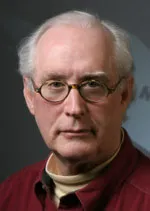 Bill Tallent, CEO of Mercury Intermedia, Brentwood, Tenn.
Tallent is CEO of Mercury Intermedia, a firm that develops native mobile applications for some of the nation’s top news-related companies. The insights gained should be of interest to all attendees.
Tallent has worked in technology since he helped start the first computer class in his senior year at Western Kentucky State University in 1963. He worked in technology at Genesco, Inc. for 20 years and started a new tailored apparel division. Bit by the “start-up” bug, he has spent the last 25 years starting, operating, and selling small businesses.
He sees the iPhone and Android phones as fourth generation computers that will expand computer usage dramatically given that they are truly personal and carried by the owner 16-18 hours per day.
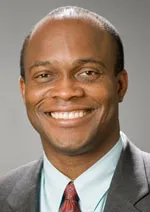 Rob King, Vice President and Editor In Chief, ESPN Digital Media
Rob King was named Editor In Chief of ESPN Digital Media in September 2009. In the role, he is responsible for supervision of all content and the overall editorial direction for the leading portfolio of digital sports properties, including all text, audio, video and multimedia content. He also oversees the management of the award-winning team of more than 200 editors, writers and designers across ESPN.com and its network of related sites. He reports directly to John Kosner, senior vice president and general manager, ESPN Digital Media. King had previously served as vice president and Editor In Chief of ESPN.com since June 2007, adding oversight of digital video and audio content as well as all editorial content on ESPN’s local sites in 2009.
King works closely with ESPN’s many news, information, content and programming units under Norby Williamson, executive vice president, programming, to develop greater cross- platform integration and development of cross-media franchises.
King brings extensive experience and sound news and editorial judgment to the job. Since 2004 he served as a senior coordinating producer in the studio production unit, responsible for (at various times): ESPN’s award-winning NBA studio programming; the award-winning Outside the Lines; ESPN’s on-location coverage of major golf events, including the Masters and the U.S. Open; and ESPNEWS, the nation’s only 24-hour sports news television network.
King began his career in the newspaper business. From 1997 - 2004, he was at the Philadelphia Inquirer, serving as graphic artist, deputy sports editor, assistant managing editor and deputy managing editor. Prior to that, King worked at the Louisville Courier-Journal as a graphic artist, director of photography and presentation editor. From 1987 through 1992, he worked at the Courier-Post in Cherry Hill, N.J., a major suburban Philadelphia paper. His first job was with the Commercial-News in Danville, Ill., as a general assignment reporter and graphic artist.
King received a Bachelor of Arts degree in English from Wesleyan University in 1984.
 Jeff Herr, Director Of Interactive Media, Lee Enterprises.
Jeff Herr joined Lee’s corporate office in April 2006 as the director of interactive media. Previously, Herr had been director of online operations for Tucson Newspapers Inc., the agency that handles business operations for the Arizona Daily Star, owned by Lee, and the Tucson Citizen, owned by Gannett Co., Inc.
Herr began his career in 1985 as a newspaper reporter and editor covering business, politics and state and federal government, working for the Arizona Daily Star and other metropolitan newspapers in the West. In 1994 he began his Internet career with an online international trade law online service and newsletter. In 1995 he joined Paul Allen’s Internet company, Starwave, working through 1999 on major sites including ABCNews.com, ESPN.com, Outside Online, and TheStreet.com.
In 1999 he returned to Arizona to develop a suite of Internet-based financial calculators and tools that were licensed to more than 100 of the largest banks in the United States. He also worked as digital strategist with an online agency working with clients including Electronic Arts, Rational Software, Coty Cosmetics and America West Airlines before joining TNI in 2003.
**
 Ray Meese, Director of Photography, Ventura County Star
**
Ray Meese is the director of photography at the Ventura County Star in Southern California. A graduate of Western Kentucky University, he has worked at newspapers in Pennsylvania, Illinois, Indiana, Texas, Utah, Oregon and California. He has more than a decade of experience as a photojournalist and five years as a picture editor.
Meese has not let the constant advances in information technology escape him and is excited about how mobile devices can provide news to web readers within seconds. He currently oversees the use of mobile devices to: capture, edit and transmit still images and video; post information to Twitter and Facebook; update the Ventura County Star’s photo galleries; and edit pictures and videos from staff photojournalists.
On the committee planning this training opportunity with me are Patrick Beeson of the Scripps Interactive Newspaper Group in Knoxville, Cory Haik of the On line News Association and The Seattle Times, Val Hoeppner of the Freedom Forum, Jack Marsh of the Freedom Forum, Jane McDonnell of the Online News Association, Ken Sands of the Online News Association, Sherry Salko of the Online News Association, Knight Stivender of The Tennessean, and Tracey Trumbull of the Chattanooga Times Free Press.


![Reblog this post [with Zemanta]](https://img.zemanta.com/reblog_c.png?x-id=17e66a9a-e509-452c-98b2-fbaab760f3ee)
Mobile workshop for journalists coming up
From the Online News Association Newsletter today:
Save the date: “Smart Phones for Smart Journalists “
Stay tuned for details on a training session that will bring you up to speed and place you a step ahead on mobile technology. Smart Phones for Smart Journalists will be held Friday, April 9, at the Freedom Forum’s John Seigenthaler Center on the campus of Vanderbilt University in Nashville. Admission is $35, $25 for ONA members and Diversity Institute fellows and alumni. Keep an eye on the Journalists.org Events Calendar for more details and to register.
Seeing the journalists of the future
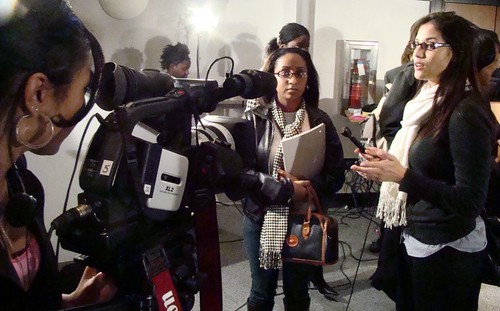
I spent most of last week at Hampton University at Scripps Career Days. The students I met were extremely bright and they have a wonderful facility to work in at the Scripps Howard School of Journalism and Communications. There are links to more coverage, including photos and videos, of the week at the ScrippsDays.com Web site.
(Photo by Hampton studentNolan Smash, who also shot video of some of the panels.)
Birds enjoyed the snow
They’ll have to tow Ruffin McNeill away
GREENVILLE, N.C. (AP) – Ruffin McNeill didn’t say a word. He just walked into the room filled with reporters and fans waiting to hear from East Carolina’s new coach and repeatedly pumped his right fist in the air.
He was home, back at his alma mater and in his native North Carolina.
“This is my destination job,” McNeill said Friday. “Let’s get that out front right now. This is not a stepping-stone hop for Ruff. This is where I want to be until you tow me away from here. You’ll have to drag me away.”
Hurry, antidote needed for dreaded ‘Knoxville Syndrome’
A random top 10 list for 2009
Random Mumblings’ top 10 posts during 2009 based on page views.
Marc Andreessen: “The game is completely over”
Video of Marc Andreessen on the Charlie Rose show, talking at length about newspapers. (February 22, 2009)
Why Examiner.com’s traffic is growing through the roof
On the SEO success of Examiner.com and why original content providers might want to study what it’s doing. (December 21, 2009)
A stranger than fiction story line that’s true
A tale that should have been aSnark Bites post, but wasn’t. (July 29, 2009)
Just another victim of a shifting, churning landscape
_
Sen. John Kerry’s defense of newspapers? (May 6, 2009)_
The Internet Age that vanished
On the Internet archives that aren’t (July 1, 2009)
On Being There
On using a Flip cam to shoot video of a porn. Questions about its enduring popularity? (May 22, 2007)
Journalists running toward burning buildings as fast as they can
Crowd sourcing a speech by E.W. Scripps VP Rusty Coats with Twitter. (September 23, 2009)
Who knew, videos on YouTube are embeddable
On a bonehead decision by the Associated Press (April 9, 2009)
Finding our way in a very old saying
“Give light and the people will find their own way.” (January 4, 2009)
Journalism is not a federal earmark
Channeling Dave Winer (March 4, 2009)
All but one of these posts (the On Being There post) have a common link, they got links from Glenn Reynolds’ Instapundit blog, who sent this site 51 percent of its visitors. Mighty Google only accounted for about half that. Others non-search engine sites among the top referrers were Twitter, piratenews.org, knoxviews, facebook, econlog.econlib.org and saysuncle.com. Thanks to all and wishes for a happy New Year.
Snowy morn in Knoxville

An HDR photo of snow on the trees and our Christmas decorations. The star is a Moravian star. Taken Dec. 5, 2009.
The most needed in a democracy
Nice piece from Sigma Delta Chi and the Society of Professional Journalists.
Make a donation to Sigma Delta Chi.
Google Wave: Coolest places in Knoxville
The number of Google Wave users is growing and people are find interesting ways to use it. Here’s one that is aimed at crowdsourcing the “Coolest Places in Knoxville.” If you’re on “Wave,” contribute to it.
Your cell phone is Big Brother (but which one?)
Fascinating blog post from Jeff Jonas about all the data that little cell phone you’re carrying is collecting:.
The data reveals the number of co-workers that join you Thursdays after work for a beer, and roughly where you all go. It knows where these same co-workers call home, and just exactly what kind of neighborhood they come from (e.g., average income, average home price) … information certainly useful to attentive direct marketing folks.
Wither the ‘Average American’
The 2010 Census data (being collected now … we completed our form last weekend) won’t begin to be available until 2011, but experts already are making projections:
Something to say
The next couple of weeks seem to be all about giving talks.
Doing a roundtable discussion with Kevin Slimp and Tom Chester tomorrow at lunch at the Institute of Newspaper Technology. This session meets at Regas and should be fun. The institute cranked up on Thursday. Hope Tom and I can still hold their attention on Saturday; Slimp probably will have their heads filled to bursting by then.
Talking with some college faculty Tuesday afternoon about Skype and Twitter and such.
On Friday, Oct. 30, Kurt Greenbaum of the St. Louis Post-Dispatch and I talk about “Social Media: Cheap & Simple Tools, Expansive Reach” at the Associated Press Menaging Editors Training Conference in St. Louis. Greenbaum has a great presentation I’m adding a few slides too. If you haven’t signed up for the conference, hurry on over and do that. There are lots of excellent sessions planned.
On Nov. 5, I’m doing a News University Webinar from the Poynter Institute on “Managing Comments on Your News Site.”. This one will be fascinating to anyone involving with wrestling with comments on news sites. It’s a hot topic with lots of ramifications for newsrooms. Now, if I can just survive the being on a Webcam part.
Scripps Networks in play?
A trade publication fuels rumors that Knoxville-based Scripps Networks will be acquired by a larger media player by saying it looks ripe to “be nibbled at or gobbled up whole.”
Knox County campaign contributions are to get a lot clearer
This is a major step toward greater transparency in local campaign finance.
An online, searchable database of local candidates’ campaign finances could be up and running for public use in time for the August 2010 county primary election, said officials with the Knox County Election Commission.
And I didn’t know Kanye West even read my blog
Here’s what he said about my blog (and yours, too).
The back story.
(Thanks to Gizmotastic for this tip.)
Feed frenzy
It certainly is a good time to subscribe to this blog:
The real “health care” issue
Is it “health care” or “healthcare?”
The red underline in my browser says “healthcare” is misspelled, but sometimes browsers are better at surfing than spelling, especially in areas where popular use is evolving a spelling or word meaning.
To slightly modify a favorite saying of media iconoclast Jeff Jarvis: “What would Google say?” Google returns 131 million “hits” on healthcare and 165 million on “health care.” Advantage “health care” but not by much. Popular opinion is roughly divided on the issue.
In times like these, journalists often turn to the AP Stylebook stashed under the dark recesses of the desk along the telephone book, but I used the online database version of the “book,” more style search engine than book, but, alas, an issue for another day. (My browser does underlines “stylebook,” but you don’t think this bible of word usage from the world’s largest news service would get its own title wrong, do you?)
The AP Stylebook introduces another possibility in this debate, the fence-straddling, hyphenated “health-care.” In this debate, the middle ground is not highly valued.
Thankfully, the AP Stylebook also doesn’t smile upon such insidious waffling on such an important national issue:
Use of the hyphen is far from standardized. It is optional in most cases, a matter of taste, judgment and style sense. But the fewer hyphens the better; use them only when not using them causes confusion. (Small-business owner, but health care center.)
Damn, they know how to stroke my ego
Woohoo, I got an email this morning that this blog had been named one of the Top 100 Journalism blogs by The Daily Reviewer, which I wasn’t familiar with, but which seems to be a Web title of Times-Shamrock Communications in Pennsylvania. Whoops. It appears to have been created by Azure Web Design in the Philippines. (Thanks, Kathy!)
It’s a nice aggregator of blogs, similar to Alltop.com, of which this blog is also included in the journalism category.
Try both of ‘em out.

No photo of government transparency available
It’s outrageous that a school board and a state school board association would base efforts to limit cameras at public meeting on an attorney general’s opinion that has been declared unconstitutional.
But that’s what the Loudon County (Tenn.) Board of Education would like to do.
It would be interesting to see how that is explained in a civics class.
Being an school board member is thankless task, but it’s also a good place to learn that governing in a democracy is just plain messy. That’s the picture.
Spotlighting “Sunshine issues” also spurs open government opponents
Ironically, one of the outcomes of the Tennessee Coalition for Open Government’s 2004 public records audit, the first such statewide audit in Tennessee, is that lawmakers are filing more bills to close records.
In this year’s session, Tennessee legislators filed three times as many exemptions to open meetings, open records laws than normal.
Do you believe in the “sanity clause?”
Groucho: “That’s in every contract, that’s what you call a sanity clause.”
Chico: “You can’t a fool a me there ain’t no sanity clause”
-- Groucho/Chico Marx in A Night at the Opera (movie)
Credential Crud continues; victims fighting back
The Associated Press and Gannett say their reporters will not sign the new Southeastern Conference Media Credential Policy.
“The credential restrictions would be untenable,” said Mark Silverman, editor of the Tennessean, which covers the SEC’s University of Tennessee and Vanderbilt University. “They fail to recognize that we are not just a newspaper. We use a variety of mediums and I believe we are going to be able to make a prior restraint argument.”
SEC Media Policy = #FAIL
Several media-related groups have signed a joint letter protesting the Southeastern Conference’s new Media Credential Policy.
From the letter:
We understand that media coverage of sports is changing. New media and channels for disseminating information, including ownership of distribution channels by leagues or teams themselves, require adjustments to the league/team/media partnerships that have existed for years. But the new credentials go beyond “adjustments”; they are wholesale changes that restrain our members from covering your teams in ways that serve fans without harming league interests.
Many of these changes may also violate existing law, which, in most instances, has not changed despite the advent of new media. We further believe that the real loser in this fight will be the fans, who have every reason to be wary of the SEC’s actions in consolidating what can only be described as a “stranglehold” over the release of information about teams, players and games.
SEC finds X’s and O’s of Social Media not as easy to learn as in football
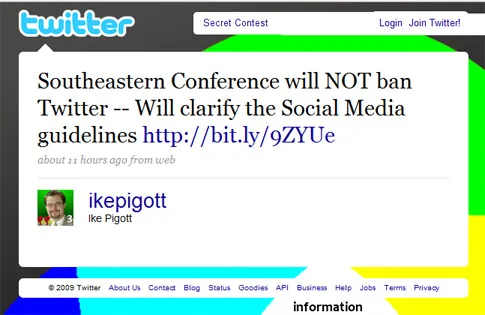
Soon they’ll be tailgating Tweet Parties
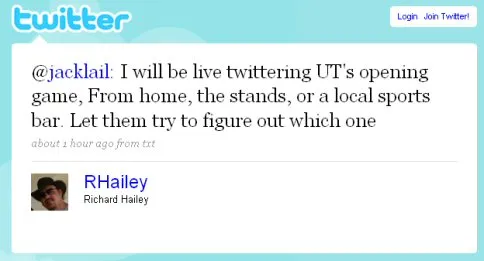 More Rich Hailey on Twitter.
And more comment on the SEC’s plans to limit fans in the stands.
-
[SEC controlling the message, profiting off taxpayers No Silence Here knoxnews.com](https://blogs.knoxnews.com/silence/archives/2009/08/sec_controlling.shtml) -
[More reaction coming in on SEC’s draconian policy No Silence Here knoxnews.com](https://blogs.knoxnews.com/silence/archives/2009/08/more_reaction_c.shtml) - /Message: Corporations Want To Own Our Experiences And Our Culture
-
[No Blogging, Tweets or Videos Allowed When Attending SEC College Games The Blog Herald](https://www.blogherald.com/2009/08/17/no-blogging-tweets-or-videos-allowed-when-attending-sec-college-games/) -
[Social Media Banned from College Stadiums Mashable](https://mashable.com/2009/08/17/sec-new-media-policy/) -
[Some eyebrow-raising snippits from the new SEC policy No Silence Here knoxnews.com](https://blogs.knoxnews.com/silence/archives/2009/08/some_eyebrow-ra.shtml)
SEC Media Policy doesn’t get better with study
After reading the new SEC Media Policy and re-reading it, it’s becoming clear the revised policy isn’t much of an improvement over the restrictive draft policy that was floating around before Friday’s official release.
It’s like a doctor saying to a patient: “It’s not terminal, just fatal.”
It heartening to see that the Southeastern Conference’s new rules are raising eyebrows among some lawmakers.
And in one of the few media corporate public reactions, an attorney for the New York Times, which owns the Gainesville newspaper and others in the Southeast, said the originial rules would have unduly restricted independent news coverage, but with the new rules, the SEC is still trying to dictate editorial judgments that should be left to news organizations.
-
[Some eyebrow-raising snippits from the new SEC policy No Silence Here knoxnews.com](https://blogs.knoxnews.com/silence/archives/2009/08/some_eyebrow-ra.shtml) - The Kentucky Democrat: Revised SEC media credential policy
- Newscoma: The SEC Tries To Control The Messenger
-
[The S.E.C., Bloggers and Fans Gizmotastic](https://www.gizmotastic.com/2009/08/16/the-s-e-c-bloggers-and-fans/) -
[Bloggers on the SEC trying to control the message No Silence Here knoxnews.com](https://blogs.knoxnews.com/silence/archives/2009/08/bloggers_on_the_15.shtml) -
[SEC’s ‘revised’ policy on blogging and twittering games No Silence Here knoxnews.com](https://blogs.knoxnews.com/silence/archives/2009/08/secs_revised_po.shtml) -
[New SEC media policies angering legislators Gators Sports Scene Florida Today’s Gators Blog](https://www.floridatoday.com/content/blogs/gators/2009/08/new-sec-media-policies-angering.shtml) - The SEC Media Policy: One Key Point : SECRivals.com
-
[SEC loosens some of its new media rules Gainesville.com The Gainesville Sun Gainesville, FL](https://www.gainesville.com/article/20090815/ARTICLES/908159956/1136/SPORTS?Title=SEC-loosens-some-of-its-new-media-rules) - SEC issues revised media policy GoVolsXtra
- PDF: SOUTHEASTERN CONFERENCE MEDIA CREDENTIALS
The SEC’s troubling approach to news on the Internet
The Southeastern Conference’s new “finalized” media credidentials policy is still troubling to news organizations that regularly cover the storied football schools of the South, despite some concessions from the draft that was leaked last week to an Alabama news organization.
The outrage over the stricter draft version illustrates the way traditional media concepts of “live broadcast rights,” control of multimedia rights, “accredited media,” and what constitutes coverage are becoming irrelevant. We’re in an era where the distinctions between print and broadcast are forever blurred, where newspapers don’t want to be defined by their printed paper technologies and where broadcasting doesn’t mean just something transmitted over the air.
For newspapers, TV and other media, the Internet is the news platform of not only the future, but today. That could be any combination of Web site, cell phone, TV screen, Twitter or Facebook, Yahoo, Google or some other other technology or service that I haven’t heard of or have forgotten.
It’s an era where wondering who’s a participant, a journalist or just part of the audience is a valid question. The game-changer – and a sports analogy is apt in this context – is that with Social Media the audience is part of the action and “news” is a part of a never-ending stream of information.
I was watching the Little League World Series on ESPN Thursday night. Every time the camera panned to the stands between innings, moms, sisters, dads, brothers and everyone else was texting away on their cell phones to friends, to Twitter, to Facebook, to wherever.
The SEC new policies have left more than one prescient observer of the Internet scratching their heads.
In short, the SEC is out of its league.
Drive page views and user stickiness with outbound links
Kurt Greenbaum on “link journalism” for ASNE.
Linking out is such a dead simple traffic builder , it’s hard to see why “curating the Web” isn’t embraced more enthusiastically.
What the SEC needs is a good coach controversy
Because their new media policy has grabbed the media attention (like a two-by-four to the forehead). Is Rick Pitino available?
Knoxville News Sentinel blogger Michael Silence with the latest developments on the new SEC Media policy.
Seriously, hopefully the foggy thinking that brought this was caused by the heat or something.
Send in the tsarina to make a play
The Southeastern Conference is reacting to criticism of its iron-fisted media rights policy by saying it’ll tweak the rules a bit.
The emphasis is on a bit. A conferences spokesman said SEC execs will definitely look at the provision that says only full-time employees of media organizations can get press credentials. Seems, lo and behold, they’ve discovered media organizations are now using a lot of part timers and stringers to cover even their events. Imagine!
There was no signal that the restriction on video, including from press conferences, would be modified. Basically, the SEC wants to control all video of “SEC events” in a game or outside of a game.
And Twittering, fugetaboutit.
A year ago at preseason practice, it was a non-issue. It wasn’t even a personal sideline for coaches and reporters watching X’s and O’s in the summer heat. Now coaches (or their surrogates) are Twittering, sports reporters are Twittering and maybe you are Twittering, too.
When reporters at Tennessee, and other school’s started Twittering practices this August, it became an issue as in NO.
I asked the University of Tennessee’s John Painter, associate sports information director, about the Twitter policy at practice.
He explained in an email:
The media coverage policy in question isn’t new. For instance, live phone reports from the practice field never have been allowed while practices or scrimmages still are in session. More modern phones and faster ways to communicate should not change the policy of not reporting on practice while it still is taking place.
Practice reports should be held until practice and interviews with the head coach are over. After that, fire away.
I want your reporters to give UT fans all the information about our team they can handle, but I need to respect our coaches’ and trainers’ wishes to at least have the option to comment on the events of the day after practice has concluded. Your interpretation of events from that point forward absolutely is your business.
React to the SEC’s new media policies (or hand over that cell phone)
Some react to word of the new Southeastern Conference media policies that place new restrictions on journalists and fans taking photos at game, blogging or using “real-time” services such as Twitter and text messages.
The new rules also severely limit the posting of video even from press conference!
Blogging has its limits in the SEC
The Southeastern Conference is seeking to control how many blog posts or, presumably, even Twitter updates, can be done during a football game as well as control even video from press conferences.
The more restrictive rules disclosed Friday are in the credential agreements journalists covering SEC games must sign for press passes that allow photographers and videographers on the sidelines and writers in the press box.
The new policy is more restrictive on what “real-time” coverage is and the SEC terms say only it can decide if a blog is violating “real-time” coverage rules. Would find the experience of reading a blog during a game similar to the real-time radio broadcast or televised coverage? Not me.
Auburn University’s version of the agreement says three in-game accounts (stories, blog posts or Tweets and text messages, too, presumably) are allowed per quarter and one at halftime, but the SEC terms don’t seem to be that specific.
The Auburn University version of the agreement says:
While the game is in progress, the use of textual statistical information is time-delayed and limited in amount (e.g., updates pertaining to score, injuries and national, conference or institutional record-breaking performances, a condensed half-time story) so that the Bearer’s internet or online game coverage does not undercut the authorized and rights-paying fee organization’s right to play-by-play accounts of the game and/or exclusivity as to such rights. For football, these submissions are limited to three per quarter and one at halftime.
A stranger than fiction story line that’s true
I go out of town for a couple of days and return to the surreal. Liberal Randy Neal and conservative Brian Hornback united in defending a blogger for the News Sentinel, a media company neither has been shy about calling out when they’ve felt moved to do so.
And that happens with some regularity. (Hornback likes to call the newspaper’s building “the Big Metal Shed on the Hill.”)
They and others, however, decried a bare-knuckled attempt by county mayoral aide Susanne Dupes to silence Scott McNutt, who writes a political satire blog for the News Sentinel called Snark Bites.
But Neal, Hornback and News Sentinel Editor Jack McElroy united on an issue? Why that’s right out of McNutt’s fictional Snark Bites.
Here’s what they and others have been saying.
A tool for creating clear understanding and agreement
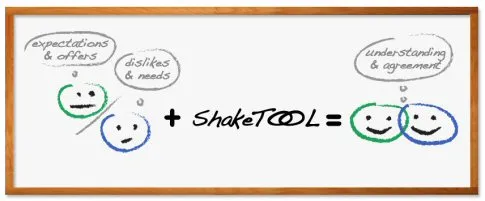
Shaketool.com, a new site from a veteran group of Knoxville online entreprenuers, is going into wider beta testing.
What is Shaketool? It’s a Web-driven system for reaching agreement and, along the way, increasing mutual understanding.
Is it for you? Beats me. Give it a try and find out.
It’s the latest project of the group led by Danny McCall that also developed Talentsphere and its forerunner Digital Discoveries for human resource management in the workplace.
McCall said in an email “make sure you take this tool for a test drive with anyone, and in any personal or professional situation, ….wherever you wish to avoid. assumptions, misunderstanding, confusion or shirking of respective accountability. We’ve worked real hard to make it VERY simple without compromising the power.”
It may sound kind of out there and it probably is. It wouldn’t be the first time McCall has seen concrete business opportunities where others have struggled to grasp his vision. That’s what visionary people do, right?
Who thought 140 character public postings would become a communications platform? I’m not predicting the next Twitter, but it bears watching.
Good luck, guys!
Tennessee journalist honored with lifetime achievement award
SPJ news release from this morning:
INDIANAPOLIS - The Society of Professional Journalists is pleased to honor pioneering Tennessee journalist Robert Churchwell with the Helen Thomas Award for Lifetime Achievement. Churchwell, who died Feb. 1, 2009, was the first black journalist to work as a full-time reporter for a Southern general interest newspaper.
Recapping the “open government” agenda in the Tennessee Legislature now that lawmakers are safely home
The two biggest surprises from the just-ended legislative session were the unprecedented high number of bills affecting open records and meetings, public notices, and an assortment of other First Amendment issues and the failure in the Senate to close gun carry permit files.
The 30 bills represented three times the norm for a single year in a two-year session. We dealt with several of them, but unfortunately more than 20 are likely to return in January. Even though 2010 is an election year, we expect more to be filed.
Some of the deferred legislation is very bad, which means we have a lot of homework to do this summer and fall on such issues as closing police records, changes in public notice laws and possible changes to established libel law.
A not-so-secret scuffle over what’s secret
The Knoxville News Sentinel finds itself in the middle of a semantic veg-a-mantic between Us. Rep. Zach Wamp, R-Tenn., and MSNBC’s news personality Rachel Maddow.
Maddow picked up on a Michael Collins piece in the News Sentinel/knoxnews on the Washington conclave known as the “C Street House,” which Wamp shares with several other members of Congress. Wamp took public umbrage with her piece.
Here’s the News Sentinel story. Here’s a Chattanooga Times Free Press follow with audio from Wamp, a Huffington Post react and a Nashville Scene take.
Here are couple YouTube videos.
One would think that Zach Wamp would just want to this go away as a distraction to his guvernatorial hopes in Tennessee. But he fanned the flame by disputing Maddow’s characterizations of the “C Street” housemates and Maddow has been happy to keep it going.
He’s ended up looking a little shifty in this one and Madodw is making some fans, one presumes, among certain Tennessee Republicans who generally abhor her..
The political liver
Glenn Reynolds thinks health care delivery might get easily entwined in politics as a result of a large government presence in health care reform. “I don’t want someone looking to see who I have donated campaign money to before they decide if I get a liver transplant. And If you don’t think that’s not going to happen, you haven’t been paying attention,” he said Sunday during a radio call-in show in Knoxville.
Reynolds, Michael Silence and I were on George Korda’s show on WNOX.
The column mentioned in the video he wrote for the Washington Examiner on the hidden cost of national health care is here.
Plausible?
On social media
From George Korda’s “State Your Case” radio show on WNOX Sunday afternoon that I was on with Glenn Reynolds and Michael Silence.
Join us Sunday afternoon on the radio
University of Tennessee Law School professor and blogger Glenn Reynolds, News Sentinel columnist and blogger Michael Silence and I will be on George Korda’s “State Your Case” Sunday from 1 p.m. to 3 p.m. on FM 100, WNOX.
You can listen live on the Web.
All you really need to know about Scripps Networks in one graph
The story of Knoxville’s Scripps Networks (SNI) in one paragraph from the Pot of Gold blog.
Kenneth W. Lowe wanted to create a 24-hour TV cable network about rooms in the home for the E.W. Scripps Co. and wanted to do it while Scripps’s was losing nearly $1 million a month in a brutal newspaper war in Denver. A reluctant board agreed - and then began losing $1 million a month on the network. Payback for the gamble? Within a decade of the launch of HGTV and Scripps Networks: $2 billion in revenues, $700 million in profit
Just for the record
A bit light in the profound department, but the first nonetheless.
On the idea front
Is “Maximizing Shareholder Value” an innovation killer?
First McGill Medal awarded
 You might have missed this. The University of Georgia awarded the first “McGill Medal for Journalist Courage” on April 30 to Clarion-Ledger reporter Jerry Mitchell for his reporting that has put four Ku Klux Klansmen behind bars.
His investigation and reporting on the Byron de la Beckwith case alone was enough merit the award, said E. Culpepper Clark, dean of the Gray College of Journalism and Communication. Beckwith murdered Mississippi civil rights leader Medgar Evers in 1963.
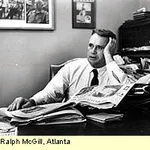 Dusty Nix, writing in the Columbus Ledger-Enquirer, said: “There is no statute of limitations on murder, nor should there ever be an expiration date on atrocities like those Jerry Mitchell has dug deep into ugly history to uncover. In that regard, his mission is not so unlike that of Simon Wiesenthal, the Holocaust survivor who spent much of his life after World War II tracking down Nazi war criminals and bringing them to justice.”
Here’s another piece about Mitchell in the Christian Science Monitor.
About Ralph Emerson McGill.
_(Mitchell photo by Patrik Johnson, Christian Science Monitor)
_
Sizzling science on bacon and social media
The whole bacon thing explained. Yo, Michael Silence.
Scientfic-ish proof that bacon ain’t no sausage.
Do you get Twitter now?
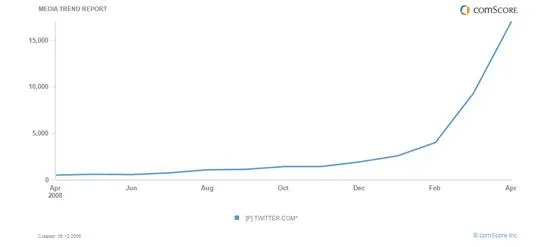
A petition worth signing

In praise of last year’s model
 Anil Dash of Six Apart has a funny new site with a semi-serious purpose: Last Year’s Model.
Dash says with all the coverage of what’s new, soon to be in released and cutting edge, existing technologies that are less expensive and work get marginalized. I guess that’s an attention problem for gadget guys and gals.
“Even alpha geeks often don’t run out and buy the newest gadgets and electronics the minute they come out,” he writes on his personal blog.
So he created a movement “to save the planet through sheer laziness.”
The constant hyping of what’s new creates the impression that you have to geek-up to keep up.
It ain’t necessarily so. I bounced this idea off of a few tech experts I know, and they all agreed that the constant pursuit of novelty over actual value takes a lot of the joy out of loving great technology. So, to help promote the idea of being thoughtful about what we buy, and how long we hold on to it, I created Last Year’s Model, with a design from my friend Mike Monteiro of Mule Design.
Cherrie with ice cream
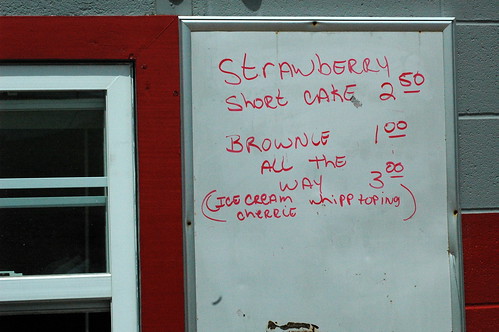
Concession stand sign at baseball tournament in Ooltewah, Tennessee.
Odd Couple?
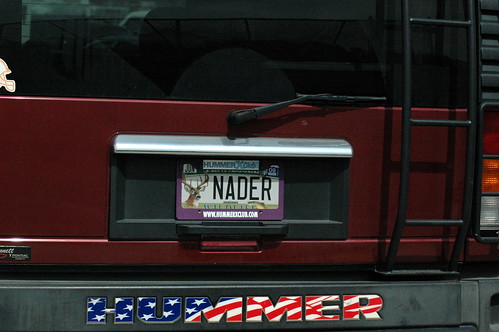
Nader and GM.
Knoxville Tea Party coverage
Blog entries in the Knoxville Blog Network about the Tea Parties.
(Video by Lauren Spuhler)
Stalking bad guys for good
I found this TechCrunch piece fascinating in how technology rapidly morphs itself. While people get all 1984 Orwellian about the implications of location-based services that utilize the GPS in a cell phone to beam out your location, here someone uses it to nab the bad guy.
Yesterday, Silicon Valley’s local CBS affiliate ran a story (video here) about a woman getting her purse snatched. But what’s interesting is the way she got it back: With an assist from Google Latitude.
You see, in her purse, her phone had Google’s location-based social networking service installed, and it was updating the location of her phone in real-time. So even though the thief hopped in a car, when the girl called her sister, she was able to tell police exactly where the criminal was. They arrested the man and got the girl’s purse back.
Watch this whacky case and hope for federal legislation
 There’s a weird journalism law case going on Detroit that bears watching. Pulitzer Prize-winning Free Press reporter David Ashenfelter has been ordered to divulge his source for a story about a former federal prosecutor.
The former prosecutor, Richard Convertino, claims in a civil suit that the U.S. Justice Department violated his privacy when the reporter was provided with information about his misconduct that led to dismissals of two terrorism cases.
Ashenfelter has argued the First Amendment prevented the court from forcing him to reveal his source, but that was denied by the judge in the case. Since Convertino alleged that the sharing of information with Ashenfelter was a crime, the reporter has also invoked his rights under the Fifth Amendment.
It’s cases like this that cry out for a federal shield law to protect reporters. A bill passed by the House on March 31 is now under consideration in the Senate. Maybe this will be the year.
Here’s some resources on Ashenfelter’s case and shield legislation and laws.
Lawyers for Free Press reporter ask court to intervene
A ruling that imperils every citizen’s rights
Wikipedia: Shield laws in the United States
A Guide to Journalist Shield Laws
US shield law’s qualified privileges would aid journalists both at home and abroad
SPJ Praises Shield Law Getting Through House
Struggling to Report: Federal Shield Law
(Photo via AP)
The collectors
Paul Chenoweth coins a type of social media person, The Collectors.
Collectors seem to be obsessed with acquiring the most friends/followers or network connections (depending upon the terminology within a particular online site). I know many of these individuals from several years of participation and research within online communities. Their rationale for connecting (their term) varies but tends to follow one of several patterns:
The individual with the most connections is somehow the best person you should connect to (quantity trumps quality)
- The perception that an individual’s ranking (by quantity of connections) equates to brand value within the community (quantity equals name recognition)
- Competitive team power is derived from the size of one’s list of connections (my team is bigger than your team)
- Huge following numbers can translate into increased ‘sucker-link’ traffic to other sites and financial gain (playing the percentages)
- Social Network Gamers who could actually care less about the intended purpose for a site but simply get a thrill by figuring out how to game the highest scores/rankings/numbers.
Going bats

Baseball bats in the Bearden dugout on Friday, April 10. Despite the storms, game got played.
News Flash: Hot new trend bulges from relaxed fit aisle
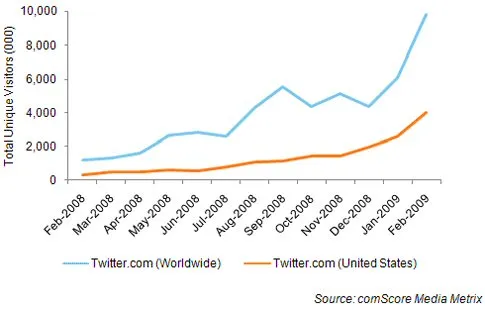
Twitter’s growth is exploding, but it’s not coming those usual trend setters, the 18-24 group. Sarah Radwanick writes:
It is the 25-54 year old crowd that is actually driving this trend. More specifically, 45-54 year olds are 36 percent more likely than average to visit Twitter, making them the highest indexing age group, followed by 25-34 year olds, who are 30 percent more likely.
Business cards going the way of …. ah … newspapers?
Ouch!
In an era of Hybrids, Teslas and Go Green initiatives, business cards are starting to fall the way of the newspaper …out of print and into environmentally friendly formats.
A newspaper is a blog that leaves ink on your hands
The Colbert Report| Mon - Thurs 11:30pm / 10:30c
—|—
Better Know a Lobby - Newspaper Lobby
comedycentral.com
| Colbert Report Full Episodes| Political Humor| NASA Name Contest
—|—|—
Hey, it’s good to laugh at yourself.
An intolerable lack of tolerance
Tolerance is in short supply nowadays.
That is obvious in two situations where the First Amendment is under assault in Tennessee. Basic freedom of speech and expression and the right to publish are in a crossfire and face threats of prior restraint.
Could Ida Tarbell bust Standard Oil on Twitter?
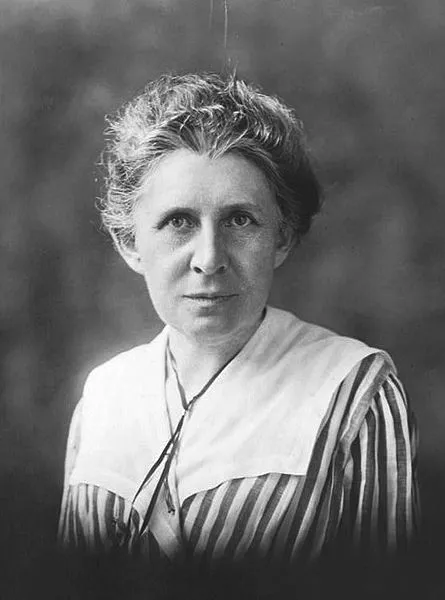 Dave Winer on Twitter:
I wonder why press people have trouble seeing that news is what’s happening there. Sure there’s a lot of other stuff on Twitter – they focus on that instead. I leave it to the investigative journalists to figure out why.
One last look at the beach

Another HDR photo from Gulf Shores. This was taken late yesterday afternoon. Shot from room balcony.
Sunrise at Gulf Shores

An HRD photo taken this morning at Gulf Shores, Ala. More on flickr.
Sunshine poll
Americans overwhelmingly support President Obama’s order that federal agencies must show a “presumption in favor of disclosure” when asked to open government records to the public, an order issued during his first full day in office.
But a survey of 946 adult residents of the United States also found that 61 percent believe the federal government “only sometimes, rarely or never” obeys the Freedom of Information Act that requires such disclosure.
Carl Malamud for Public Printer of the U.S.
 I can’t think of anyone more qualified in the Digital Age to be the government’s head printer than Carl Malamud.
Find out about his campaign to become the federal government’s printer and why that would change America.
Malamud, who was responsible for putting SEC filings online, has more recently has been grabbing huge chunks of governtment records and posting them online.
Records behind bars
SPJ has joined an open records battle in Tennessee.
INDIANAPOLIS - The Society of Professional Journalists has joined an amicus brief written by the Tennessee ACLU supporting a magazine that won an open records battle in its quest to cover and analyze prisoners’ rights.
The brief supports the appeal of Prison Legal News, which is fighting off an appeal by the Corrections Corporation of America, a private company that operates state prisons in Tennessee, after a lower court determined that the CCA was subject to the state’s open records laws. The amicus brief argues that the trial court was correct in determining that the law in Tennessee requires contractors of the corrections system to turn over records upon public request, just as government agencies must do.
The Prison Legal News has also appealed the lower court’s decision to deny it attorneys’ fees in the case. “The Prison Legal News should have its legal fees paid by CCA,” said SPJ President Dave Aeikens. “It would serve as a good deterrent to those who refuse to release public information.”
Joining the ACLU and SPJ in supporting the Prison Legal News on appeal are the Reporters Committee for Freedom of the Press, the American Society of Newspaper Editors, the Associated Press, and the Association of Capitol Reporters and Editors.
This is the second case SPJ has supported in 2009 by joining an amicus brief. The last case, in January, involved the appeal of a historical society in Nebraska asking for open death records at a state mental hospital. Read about the case and SPJ’s support here. Learn about SPJ’s legal advocacy and other news items by reviewing the news archive here.
Founded in 1909 as Sigma Delta Chi, SPJ promotes the free flow of information vital to a well- informed citizenry; works to inspire and educate the next generation of journalists; and protects First Amendment guarantees of freedom of speech and press. For more information about SPJ, please visit www.spj.org.
Reading is fundamental
Read The Bill from Sunlight Foundation on Vimeo.
It’s not a novel, but it would be novel to read legislation before it’s voted on. There’s a petition you can sign.
About those friend requests …
Read Write Web on new Forrester study (from @jowyang):
In 2007, the percentage of Boomers consuming social media was 46% for younger Boomers (ages 43 to 52) and 39% for older Boomers (ages 53 to 63). By 2008, those number increased to 67% and 62%, respectively.
… Almost one in four younger Boomers (43-52) are active in social networks, up from 15% in 2007.
A place to hang

I went by the Knoxville Overground opening party last night. They were doing tours of the upstairs space in the Sequoyah Hills offices. This is a shot in the front room where I thought I could hang around for awhile. It’ll be interesting to see how this develops; it’s an ambitious effort to do in Knoxville. I have a couple more photos.
A friendly New Yorker

Friendly New Yorker on the street on Ninth Avenue around 8 a.m. on Sunday.
A birthday visitor
 Former News Sentinel photographer Cathy Clarke was in News Sentinel on Tuesday celebrating her birthday. See Saul Young’s post on the new photo blog.
The Onion covers Knoxville slackers
The Onion has a Knoxville datelined story today headlined: “Incompetent Staff Feels Underappreciated.”
KNOXVILLE, TN–Taking a break from surfing the web, going out for multiple cups of coffee, and missing important work deadlines, employees at Winthrop Media complained once again Monday about being taken for granted.
“I come in almost every day, bust my hump for like four or five hours, and what do I get? Nothing,” said Tom Bertram, one of several chronic underachievers employed by the Knoxville advertising firm. “You’d think management could show us a little appreciation now and again. It’s not like I particularly enjoy just sitting around here all day.”
Bertram then returned to his computer’s web browser, logged out of Facebook, and hurriedly responded to 14 work e-mails that had accumulated in his in-box.
According to sources, the 36-year-old isn’t the only incompetent employee on staff who feels undervalued. Joseph Garten, a production designer, notorious procrastinator, and all-around liability, said that he wished he got more respect around the office.
Where to go in 2009
ShermansTravel.com’s list the Great Smoky Mountains National Park as one of the “29 Places to Go in 2009.”
Why go in 2009: With American travelers forecasted to plan more trips to national parks this year, the Great Smoky Mountains offer one of the country’s most cost-efficient vacations in the great outdoors. Admission to the park is always completely free, and as this year marks the 75th anniversary of its founding (www.greatsmokies75th.org), many additional complimentary activities are planned, including musical performances and special ranger-led programs.
Resistance is futile
Geeks eat pancakes

It was a networking opportunity, but he also encouraged people to bring peanut butter or tuna for Second Harvest.
It was a great idea and seemed very received.
Here are couple of his twitters on the event
https://twitpic.com/10rl4 - We collected 56lbs of peanut butter and tuna at this morning’s #geekbreakfast. about 4 hours ago from TwitPic
#geekbreakfast in Knoxville was a big hit with about 30 peeps in attendance. Photos/video later today. about 4 hours ago from TinyTwitter
Cardinal

Soft, but I like the color. If we have bad weather tonight/tomorrow, feed the birds!
Journalism group calls on EPA to quit slow-walking release of facts in TN spill
The Society of Environmental Journalists is urging the Environmental Protection Agency be more transparent and release all its data regarding the TVA coal sludge disaster in Roane County, Tennessee.
Of concern, notes James Brugger, a board member of the journalism group and a reporter at the Courier-Journal in Louisville, Ky., is that it took EPA 11 days to release its first findings – 11 days.
SEJ wrote a letter to EPA administrators last week that says:
We encourage EPA to make public all its environmental sampling as soon as it is available. We request that the agency post those results on the EPA website in a form that allows the media and the public to easily determine what was sampled, where it was sampled, when it was sampled and how the sampling results compare to the relevant established environmental standards. There is even greater urgency for complete and immediate transparency given the results of private testing analyzed by an Appalachian State University lab that found alarmingly high arsenic levels.
In addition, we understand that some of the environmental monitoring has been conducted by TVA or the state of Tennessee. We encourage EPA, as the nation’s top environmental regulator, to require TVA, and other entities conducting environmental monitoring, to make the results of all of their testing available to the media and the public in an equally comprehensive manner.
Coats to keynote ONA Nashville workshop
 ONA Nashville: Journalism Has a Future, “Real things real journalists can do right now to embrace it,” is shaping up as a tremendous learning opportunity for regional journalists.
The day-long workshop sponsored by the Online News Association and the Freedom Forum will be Jan. 30 at the Freedom Forum on the Vanderbilt University campus in Nashville. The workshop costs only $35 per person ($25 for Online News Association members).
The keynote speaker for the workshop is Janet E. Coats, Executive Editor and Vice President of The Tampa Tribune.
Coats, 45, supervises an interactive newsroom of 275 journalists producing content for the newspaper, WFLA-TV and the website TBO.com.
She joined the Tribune in July 2004 as managing editor and became executive editor in January 2005. She has worked in Florida journalism for more than 10 years; all of that work has been in multimedia newsrooms, practicing journalism across print, television and online. She joined the Sarasota Herald-Tribune as managing editor in 1997, becoming executive editor of that newspaper in 1999.
Coats graduated from the University of Missouri in 1984 and began her career as a reporter at the Irving Daily News in Irving, Texas. She was a reporter and editor for the Stuart (Fla.) News and a city hall reporter for the Virginian-Pilot in Norfolk, Va. At the Pilot, she rose through the ranks to become deputy managing editor for features, sports and weekends. She was managing editor of the Wichita (Kansas) Eagle from 1994 until 1997.
Coats worked briefly at the Poynter Institute as dean of the faculty.
She is on the board of directors of the American Society of Newspaper Editors and has served as a Pulitzer Prize juror five times, chairing the Public Service and Investigative Reporting juries.
She has three children - Sam, Rachel and Luke - and two stepdaughters, Carly and Casidy. She is married to Rusty Coats, who is vice president/interactive for the newspaper division of the E.W. Scripps Co.
Check out the full schedule and register.
Old writer, new blogger
Former News Sentinel managing editor Vince Vawter has started a blog. See Deerfield Diary.
From the backyard

Just send them this way
Here are the top referring sites to this blog during 2008.
The top two are really the same site since Glenn Reynolds has moved his Instapundit blog to Pajamas Media. It is interesting that for this site Google images ranks higher than the regular Google search engine. And Yahoo is a non-factor, showing up No. 60. And Twitter is very high, but Facebook not so much.
Thanks for the visitors!
Top URLs of 2008
Here are URLs with the most pageviews in 2008 for this blog. Thanks for reading. I appreciate it.
NewsTechZilla, where journalists discover tech is a friendly monster
 A couple of Tennessee bloggers have something new to start off 2009, NewsTechZilla, which aims to help journalists get a handle on tech to do better journalism.
Journalists are often ridiculously tech phobic. A digital camera is like a device from the Space Shuttle. They’ve spent days walking around the building looking for the Word Press. And they’ve been amazed to discover the work computer has “Windows.” At staff meetings, they trade revelations about finding email on their Blackberry (and you can write email, too).
So I think NewsTechZilla could find the sweet spot for many veteran journalists – and maybe not so veteran journalists – who are discovering they need to learn a new thing or two, but find it all so baffling to even begin.
I asked the founders, one a journalist and the other a techie, earlier this week about the site. This is what they said:
Trace Sharp, aka the Newscoma, the finest journalist in “Hooterville:”
Mainly I’ll be talking about old school journalism and how I’m trying to remain relevant in the new age of technology and Scott is the go-to guy on technology. We came up with this concept when he’s been helping me with things going into my blog when I started hosting it. There were things coming up that I had no idea how to fix.
We realized while chatting one day when he was fixing an issue for me that there might be a market for folks like me who want desperately need assistance.
One thing some of my posts will be about is how in one generation, I’ve gone from using wax in paste-up to everything computerized.
Here’s a post I wrote last week: Wax On, Wax Off (I used that machine in the graphic, mind you.) I’m also doing a little bit of history and information regarding news as I know it. (Example: Kisha Clubs in comparison to American journalism.)
We are also going to be utilizing featured editorials from folks on how the changes in news have impacted them even if they aren’t in news and technology.
Our hope is also to create a community at NewsTechZilla where folks can ask questions if they would like (tech questions going to Scott, who be the man.)
Feel more productive by the time you finish this post
It’s that resolutions for the new year time of season.
Here’s a couple:
Friend this blog. It’s easy with Google’s Friend Connect.
Subscribe to this blog’s RSS feed. Again, real easy.
Now, don’t you feel better. Two resolutions already accomplished and the new year is just getting here.
My, you’re organized.
Never too random for words

See you in Nashville
Tennessee journos mark your calendars for Jan. 30. We’re organizing some low-cost day-long training in Nashville through the efforts of the Online News Association and the Freedom Forum
More details later, but it’s shaping up awesomely.
Blog it test
Testing Six Apart free app Blog It to post to my blog from Facebook. Still wondering exactly why I’d want to do that, but hey, it can be done! Do you use Blog it?
Gingerbread in the house

Sunday afternoon fun. There’s more.
Trends in my random patterns
Two-minute inspiration
(via RexBlog)
America’s fastest dying cities

Not a list you’d like your city to be on.
Even before adjusting for inflation, workers in places like Asheboro, N.C., or Spanish Lake, Mo., saw median incomes decline over the last seven years. In the former, this is a result of job losses in the manufacturing and heavy industry sectors; in the latter, an inability to attract highly skilled workers has hampered annual salaries.
Judge takes meat cleaver to First Amendment
An outrageously unbelievable First Amendment development.
Nothing magical about this number
There are only 138,930 larger sites than this one.
But then again our readers are a “more educated, largely male, more affluent audience” than average. And, surprisingly, more popular than the Internet average by far with teens.
The Year of Palin
The election of Barack Obama may have been most historic thing that happened in the U.S. in 2008, but Sarah Palin was the biggest news meteor of the year globally.
The new, new thing: White trash computing
This is an obvious growth industry for Tennessee. The governor ought to hire the Red State guys in Murfreesboro to pitch Tennessee to Microsoft.
Aww, come on, be a friend
Be one of the first to become a “Friend of Random Mumblings.”
(Google Friend Connect at work)
Things are slower in the South – even on the Internet
PCmag gathered 200,000 speed tests from 17,000 users, coupled it with some other broadband penetration data and analyzed the numbers. They’ve mashed the data it various ways, including a ranking of states by Internet access speed.
The analysis did find Internet speeds on average are slightly slower in the Southern region than the rest of the country. And both speed and availability rank lower in rural areas, which the South has lots of. See the PCmag results.
Results for Tennessee were not stellar, with a ranking as the state with only the 35th fastest Internet access. Border state Virginia was No. 2! And based on the user satisfaction percent, Tennesseans know it.
Tennessee
Population: 6,156,719
Area: 42,143 square miles
Average speed: 474 Kbps
SurfSpeed rank: 35th
Satisfied users: 33 percent
Median monthly price of broadband: $39
Broadband penetration 48.9 percent
Sitting right above Louisiana–in our SurfSpeed ranking, that is–Tennessee ranked 35th with an average speed of 474 Kbps. User satisfaction was similar to the Bayou State’s as well, with only a third of users claiming satisfaction with their sluggish surfing speeds. Perhaps it’s Charter’s local service, which proved itself a hound dog at just 240 Kbps.
Warning: Feed work ahead
I have made some changes in my feeds and not all is going well. If my feed is not updating for you, please use this link.
Reading list
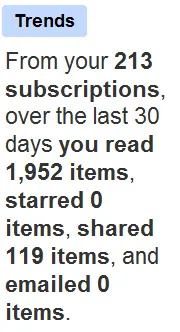 Here’s what I’ve been sharing in Google Reader lately.
I think I have a shorter “reader” list than a lot of people, certainly the power users, but even at that, it’s hard to stay on top of it.
No reports of plates thrown in pottery festival duel
 This weekend is the weekend of the dueling pottery festivals in tiny Seagrove, NC. I’m heading to the upstart one at the old Luck’s Beans plant instead of the traditional one. I suspect visitors to Seagrove will be at an all-time high for this weekend because the festival war has been getting a lot of media coverage.
Here are my delicious links tagged pottery.
Photo is from “Celebration” site and is of fromCrystal King’s shop.
Alison Stewart sighting
 I woke up this morning and lo and behold in my inbox I did see, legit comments on a post I had written in May 2006.
What’s up with that? Timeless prose is doubtful.
The post happened to be about Alison Stewart and I checked Google trends and her name was No. 18 early today, “medium hotness” as Google likes to say.
Stewart, was guest hosting on MSNBC for Rachel Maddow. She’ll be the guest host again tonight. Her appearance came after a Monday night guest hosting appearance by Arianna Huffington that didn’t get good reviews.
Stewart’s on TV and then Google sees lots of searches for her name. _Hmmm …
_ The 1996 post has remained among the most popular of this blog so there’s been a continuing buzz about her at some level, but last night’s appearance sparked a few comments.
What’s Stewart been doing since she her daytime show on MSNBC ended? She’s been on NPR. She joined NPR in May 2007 to work on a show called “The Bryant Park Project “ that ran from Oct. 1, 2007, to July 25, 2008. She returned from maternity leave to do the final week. She’s also been showing up on the popular public radio show “Wait, Wait … Don’t Tell Me! “
2007 photo by Stephen Voss
My Googleganger did it
Looking at Google trends is one of my diversions.
Sometimes gamed or “Google bombed,” often weird and very often a good early indicator of mass trends or crazes.
Among the top 10 early this morning was the term: Googleganger. It’s not a new word, it’s been around at least a couple of years and why it is hot today I have no clue.
Odds are, you have a Googleganger.
Your Googleganger is someone who has the same name as you who appears when you “Google” yourself.
It comes from combining Google with Doppelg�nger, which refers to a look-alike. No less than the American Dialect Society voted it the “most creative word of 2007.”
As a journalist, I find Google trends to be a very useful way of looking at how people are reacting to news (broadly defined). I’d love to hear how other people use it or view it in the comments (hint, hint).
Hunt as education secretary
Former N.C. Gov. Jim Hunt is being mentioned among a handful of others as a possible education secretary in the Obama administration. He would be a good choice.
It’s more than just red states, blue states
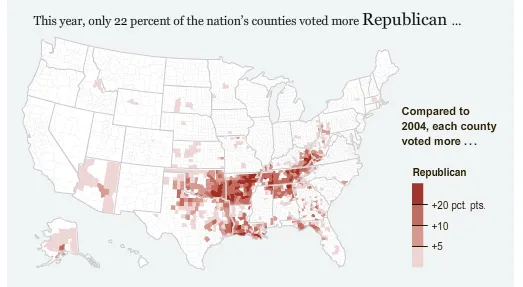 The New South is Tennessee, Missouri, Arkansas, Oklahoma, and Louisiana? Or are those five what’s left of the Old South?
It may be a tribal effect … “it’s about telling a story that may just energize some that don’t want you to succeed.”
However you view it, the New York Times’ series of maps is a fascinating visualization of the votes cast on Tuesday.
The person who wins the election is America’s president
Now that the histrionics of presidential election cycle are hopefully winding down, some good advice from Knoxville blogger Glenn Reynolds in a Forbes column:
We don’t have to agree on issues, or on leaders. But if we can’t agree that a free and fair election can produce a legitimate president even when it’s not the candidate we like, then we’ve got a very serious problem. *[]: 2007-12-12T15:21:48+00:00
Stylin’ a beard for a buck
 atto, three people “in a wee studio in Belfast,” have started a viral campaign whereby they donate a dollar to one of my favorite projects Kiva.org just for pasting a beard on your face. Cool idea. See the site where you can build your beard. (via Seth Godin)
Why thanks, Ma
Free Wifi for AT&TiPhone users and Blackberry users at many businesses, including Starbucks and McDonald’s hotspots, and public locations. Some background from TechCrunch.
In the ring: Dolly vs Google
 Nothing like some star power to spice up a wonkee policy debate: Dolly Parton, among others, has come out against a plan to turn over the space between the digital television channels to a wireless broadband service,
Performers like Parton and sports and entertainment venues fear the Federal Communications Commission’s “white space” plan will muck with wireless microphones.
Parton said in a letter to the FCC:
“As someone who uses the white spaces and knows the value of them for the work that I and many of my friends do around the country, I ask the FCC to recognize the entertainment industry’s valuable contribution to the cultural life. I can unequivocally confirm that the importance of clear, consistent wireless microphone broadcasts simply cannot be overstated. This industry relies on wireless technology and is in jeopardy of being irreversibly devastated by the commission’s pending decision.”
Read with me
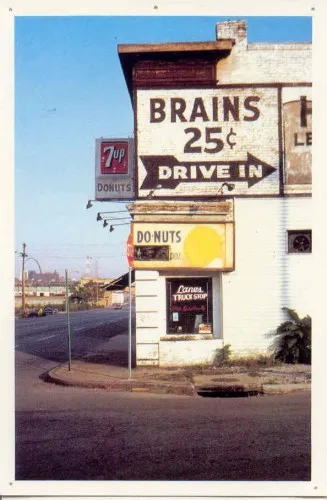
Color it preposterous
The “Financial Crisis” version of “Blame the Journalists.”
_
_
I like it
Press bashing in fashion for fall
The style of the presidential campaign increasing is becoming about mainstream media’s coverage of the campaign.
Here’s a video of Jeri Thompson, wife of former Tennessee senator Fred Thompson, taking on the press in general, the New York Times in particular and verbally slapping Alan Colmes of Fox News.
Fred Thompson made a failed bid for the White House in the GOP primary, but seems almost to be campaigning harder for the McCain-Palin ticket than he did for his own candidacy.
.
(via mofopolitics.com)
A few words make a picture
My all-time most popular photo on flickr. I think it’s the caption.
We’d like to thank …
The Southern Newspaper Publishers Association, meeting in Florida on Tuesday, named the Knoxville (Tenn.) News Sentinel, www.knoxnews.com, as the third place winner in the “Best Web site” category for large newspapers in the 2008 Better Newspaper Contest.
See full list of winners.
(No we weren’t in Florida.)
Funding improbable beginnings
A post by Susan Mernit reminded me that the deadline to for a spot in the 2009 edition of the Knight News Challenge is looming.
A piece of $5 million is up for grabs for projects submitted by Nov. 1 and that then make the check cut. This is the third year in the five-year plan to give away $25 million for projects “or innovative ideas that develop platforms, tools and services to inform and transform community news, conversations, and information distribution and visualization.”
I suspect my idea of a mountain retreat to restfully muse on the future of journalism from the comfort of a rocking chair is destined to be rejected.
Nonetheless, the rules are simple:
- Use or create digital, open-source technology as the code base.
- Serve the public interest.
- Benefit one or more specific geographic communities.
Bail money
Interesting Web site Mark Cuban helped make happen: BailoutSleuth.com.
Good idea!
Writing Wright
UT journalism professor writes that he has a new book out, “The Writing Wright: Notes, Essays, & Advice on Writing, & Ponderings on Writers & the Writing Life”
Here is a slide show of some of the drawings in the book.
Heads and faces from Jim Stovall on Vimeo.
Web 2.0 sign of fame (infamy)
… A fake Twitter profile.
A corn maze with a message

Makeover
I switched to the Mid-Century template from Jim Ramsey, the lead designer for Movable Type at Six Apart.
I was thinking this site was due for a change. I hope you like it.
Journalism on the MTurk
Wow, Andy Baio explains how he used Amazon’s Mechanical Turk program to transcribe an an audio interview. The interview was transcribed in less than three hours for $15.40. He also gives a step-by-step description of how he posted his work request.
That’s pretty innovative. Anybody else using Mechanical Turk for journalism related “Human Intelligence Tasks?”
Another attractive looking service that was mentioned in the comments is podclerk.com. Anybody got feedback on that service?
Mechanical Turk is not without its criticisms.
(via Mark Schaver)
Getting wired in Nashville for the debate Tuesday
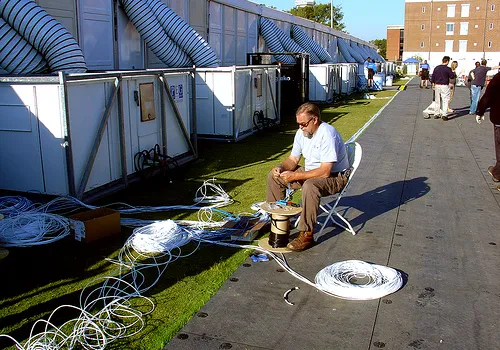
Stats after three quarters: Three of the 10 top keywords include sex
Here’s a look at some Random Mumblings’ stats through three quarters from Google Analytics. Thanks for visiting and thanks for linking! If you don’t subscribe to my feed, consider it.
**
Summary:**
Pageviews: 116,147
Average pageview per visit: 1.29
Visits: 90,369, or 326 a day
Absolute unique visitors: 76,873
Average time on site: 32 seconds
Top sources of traffic:
1. pajamasmedia.com
2. instapundit.com
3. google (organic)
4. images.google.com
5. (direct) / (none)
6. twitter.com
7. google.com (referral)
8. piratenews.org
9. knoxviews.com
10. images.google.ca
(1 and 2 are the same site. Instapundit moved to Pajamasmedia during the period.)
Top keywords
1. oral sex
2. jack lail
3. iphone sex
4. graduation message
5. facebook facts
6. where do people get their news
7. find sex offenders in your neighborhood
8. jack lail publish2
9. barbara bain
10. channon christian autopsy
**Top posts
** 1. Raising new and troubling questions …
2. Improve this post with comments
3. Random Mumblings (homepage)
4. Getting schooled in street politics
5. May 2007 Archives
6. Blink and you’re beat
7. Video Archives
8. Of voters and rabbit ears
9. On Being There
10. Boss Hogg couldn’t survive bloggers buzz
(Note: homepage ranks only No. 3)
Where visitors come from:
Top countries:
1. United States (84%)
2. Canada
3. United Kingdom
4. Germany
5. Australia
Top states in US (percents are of US traffic)
1. Tennessee (12%)
2. California (12%)
3. New York (7%)
4. Texas (6%)
5. Virginia (4%)
(Top cities include Knoxville, New York, Tempe, Brooklyn, Washington, Chicago, Powell Houston, Atlanta and Nashville.)
New journalist resource in public beta
 ReportingOn, a Knight News Challenge project created by the bright and talented Ryan Sholin, has launched. Best of luck!
Investors don’t jump from windows anymore
… They go online and check their 401(k) accounts (and hope it’s just a computer crash).
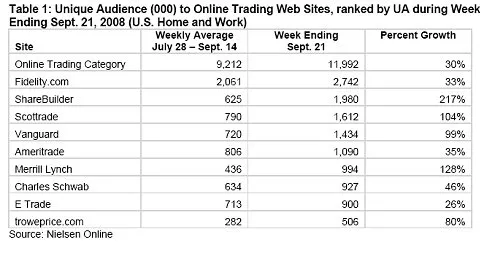
The cell phone vote and technology use shifts
Two fascinating posts on technology adoption and trends at Clive Thompson’s “Collision Detection” site.
Young people with landlines are more likely to be Republicans than young people with cell phones only. While not affecting polls dependent on landline telephone responses this year, a Pew study found among the cell-only respondents under age 30, there is a 34-point gap: 62 percent identify themselves as Democrats, 28 percent Republicans.
Not sure what would cause that trend.
The other post points to some stats from Amherst College’s incoming freshman class of 438 students and other campus-wide stats of technology usage at the college.
Only 14 incoming freshmen brought a desktop computer to school; only five got landline service. Nearly all – 432 – were on Facebook. The classes of 2009 and 2010 were more likely to have Windows-based computers while the classes of 2011 and 2012 were more like to have Apple laptops.
The stats, as Nicholas Carr noted, show the reign of email. The amount of disk space required for storage of email in 2007 is the same as in the previous five years – combined.
This small college of about 1,700 students (about the size of a high school in Knoxville) is getting 180,000 emails a day, 94 percent of them spam.
I would love to see similar stats for the University of Tennessee.
These shifts certainly should be ground into the strategic planning of media companies, hoping to win the class of 2012 and beyond as their audience.
(via Nicholas Carr)
Getting schooled in street politics
I’m getting first hand experience at a lobbying effort by progressives aimed at one of the Associated Press’ top Washington journalists.
Long-time activist/journalist Al Giordano of “The Field” blog, among other projects, is taking the campaign against Ron Fournier, AP’s Washington Bureau Chief to newsroom senior managers across the country with a campaign targeting the 27 members of the Associated Press Managing Editors association, or APME.
I know this because I was recently elected to the board of APME as an online representative.
Giordano’s “Field” has local chapters of “Field Hands” in several states, including Tennessee, and members have been urged to contact APME board members in their areas.
He is urging them to write personalized emails or letters to APME board members and to make several points about Fournier’s coverage, which they view as pro-John McCain. Fournier has been criticized for biased coverage by a number of blogs and political sites, including MoveOn.org. Whatever the merit of those claims, it’s fair to say, Fournier’s controversial.
Progressive organizations have been highlighting Fournier for awhile, including with an email campaigns to the wire service’s management.
Focusing on APME – which promotes journalism excellence, training and is a sounding board between newspapers and the wire service (see the full about us) – is a new tactic just launched this week.
I received a handful of polite and impassioned emails today. I tried to give thoughtful responses (basically, Fournier seems to me to be a journalist of the highest professionalism and that the Saturday AP story on an AP-Yahoo poll on race and the election was good journalism, but I appreciate their concerns).
Based on what I have read on Giordano’s site, I assume they will be posted online although they were intended as personal replies to the email writers.
The response I got from Giordano was bit gruffer (and returned in kind), but he’s an old hand at the hurly-burly of street politics, first testifying before a state legislative committee as a teen and working for several years with radical Abbie Hoffman.
I suspect this effort will continue at some level beyond the election in early November.
And you would eat them for why?
Do you hate prunes, too.
A face for a jug
Dan Traveling has done a video on a couple of my favorite potters, Terry and Anna King of King’s Pottery outside of Seagrove, NC. Fine folks. I think I was in the same high school graduating class as Terry at Southwestern Randolph High School.
Dan McCoig does some of the best videos I’ve seen of life in the rural South, focusing mostly on North Carolina, Tennessee and Virginia. He’s laid back enough to let his subjects tell their stories.
It’s in my inbox
Like a present, Steve Rubel on “personal knowledge management” with GMail.
My stats have been Chromed
A blog is not a blog if it hasn’t posted on Chrome, right? Seems that way.
Chrome is showing up as a browser in my stats for this site for Sept 2-5. (When I look at the last 30 days, Firefox tops IE.)
Browsers (Sept. 2-5)
% visits
Internet Explorer 45.33%
Firefox 40.70%
Safari 9.44%
Chrome 1.97%
Opera 1.45%
Operating Systems (30 day)
% visits
Windows 80.32%
Macintosh 15.30%
Linux 1.72%
iPhone 1.39%
Hurricane blogging from New Orleans
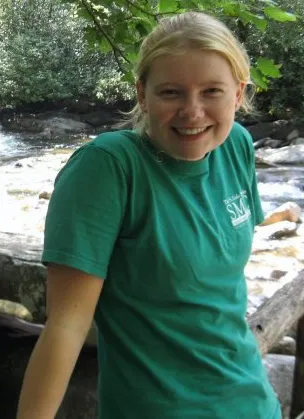 An intern in our online group this summer, Willow Nero, is blogging this morning from the New Orleans airport. She’s trying to get a flight to France, yeah, a bit far to evac from Hurricane Gustav, but while you’re going …
I started to think things were getting a little weird yesterday when the National Guard drove through my neighborhood in Bay St. Louis and set up camp outside town near the Silver Slipper Casino sign.
Is it just bad luck that I have a flight out of the U.S. to study abroad on the same day a hurricane is coming?
Do you have an opinion?
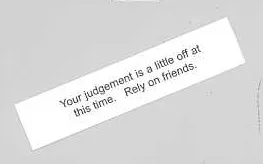
Isaac Hayes
The life stream
Serenity

Another HDR shot.
Plant life

One of several photos of flowers I took around my parents house at Badin Lake, NC, and at Winthrop University in Rock Hill, SC. This one is an HDR photo. More here.
Lake view
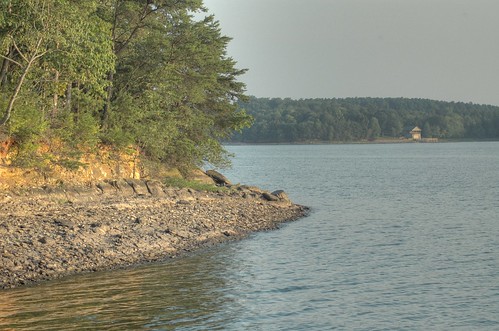
Badin Lake, North Carolina. HDR photo
A fire at Whynot
Went to some of the potteries in Seagrove, N.C., today. A point of conversation at some is the competing pottery festivals the small town will have in November.
Like retailers from Wal-Mart on down, the Christmas shopping season is critical for the artisans that operate the pottery shops roughly from Seagrove down N.C. 705 (the so-called “Pottery Highway”) to the Jugtown area.
Historically, a pottery festival has been held at the Seagrove School, but this year, a large contingent of Seagrove potters will hold their own festival at the former Luck’s Bean plant. It’s called the Celebration of Seagrove Potters and will have a gala and an auction of special pieces. I hope to make it.
However, one pottery had some other news. At Whynot Pottery, Mark and Meredith Heywood, who call themselves first generation neo-traditionalist potters and have been operating their shop since 1982, gave us a tour of the fire damage that destroyed part of the building where they produce their pottery.
Early this month as a violent evening thunderstorm was ending, they heard a loud boom. Meredith said she thought a lightning bolt might have hit in the yard. Mark went out after the rain ended to check on their shop. As he was looking outside, he saw what looked like fog, but as he left the house, he realized it smelled of smoke.
Lightning had struck the shop in the area where they had their potter’s wheels and resource materials. Fire had started between the walls and quickly spread to the attic area.
Meredith tells the story at her blog.
Luckily, much of the production area, made up of a couple rooms built over time, could be cleaned up and they are going about recovering. Neither the showroom/shop building nor their house was damaged.
If you’re ever in the Seagrove area, stop by their shop; they’re fine folks. (Directions are on their web site and it’s on the maps available at nearly every shop.)
Busy in the late summer heat

More hummingbird photos here.
Kneading public opinion
 Great post by Randy Neal on how the blogosphere’s growing importance in shaping customer opinions about companies and how companies are responding.
This one involves a company close to home and a hallowed product in kitchen pantries, White Lily Flour, whose superiority to other flours long ago reached legendary proportions. That would be great, except now blogging cooks are saying it’s not as good as it used to be.
They are saying that because the original mill in Knoxville has been closed and now this Southern tradition is being made in, eeh-gads, Ohio! (The Cleveland Plain Dealer story says the flour has been made for years at undisclosed mill in Ohio as secondary location to Knoxville, something that was news to me.)
J.M Smucker, owner of the brand, isn’t rising to the volume of discussion that’s baking among blogging cooks.
Dell is often touted as a success story in turning the tide in brand backlash by actively getting involved in the blogosphere. @Comcastcares has been praised for responding to customers on Twitter and that big because Comcast generally has been an easy bad customer service whipping boy.
From the Plain Dealer article:
“If only the Smuckers would speak up, said (Alton) Brown of the Food Network, “they could easily win over the hearts and minds of every baker out there.”
Most famous celeb in town
Who’s the most famous celebrity in Knoxville (and I bet knoxnews TV columnist Terry Morrow would get this one wrong).
My guess is this one. This celeb has a video on YouTube with has over 3 million views. The most popular Johnny Knoxville video on YouTube, by contrast, has only 1.36 million views.
Who needs business cards?
Knoxville Realtor Jim Lee has an alternative he likes.
Your gender most likely is …
This site will attempt to guess your gender based on your browsing history. The results are expressed in a percentage. Just in case you’re wondering.
Reactions to adversity
Interesting take on two people dealt with adversity:
Yesterday morning, two miles away from my house, a man named Jim Adkisson burst into a church and started shooting people. Today we found out that Mr. Adkisson has not been able to find a job, and that he’d hoped to die in the shooting, too.
Last Friday, another man named Randy Pausch did die, after first inspiring an entire nation with his positive approach to lifeeven as he was battling terminal cancer.
Craigmillar Castle photo
 One of my photos (on left in image at right) of Craigmiller Castle got included in the “newly released fifth
edition of our Schmap Edinburgh Guide.” The screen shot at right shows how it looks in an iPhone/iTouch and here is how it looks in its regular web version.
I suspect the creative commons license I use was appealing, but Schmap did ask to use it and I’m happy if someone likes it. It was taken during our vacation last summer.
Looking for support
In the wake of a hateful crime, a blogger asks the Knoxville community to reach out to the church where the Sunday morning shootings occurred.
(via KnoxvilleTalks.com)
A living treasure
 Meredith Veto at d/visible has written anexcellent piece on one of my favorite potters, Ben Owen III, who lives down the road from Seagrove, NC, in Moore County. Pictured at right is one of his pieces that I bought in, my god, 1998.
“Country potters used to make things for everyday life, like jugs for storage. My grandfather, while he was working for Jugtown, looked at the Orient and began making decorative designs, away from utilitarian purpose.” Owen had previously traveled to Japan in order to immerse himself in the culture that had inspired his grandfather, who embraced the simplicity of Asian artistic traditions: “It’s easy to make things complicated,” he would say. “The challenge is to keep things simple.”
The itinerary of my blog visitors
They say you can tell a lot of about a person by the company she keeps.
Images of controversy
We had some moving photos on knoxnews earlier this week from a military funeral, but covering a military funeral has become something of a controversy.
Photo intern Kohl Threlkeld writes about his experience while the Patriot Guard Riders and others respond on News Sentinel Editor Jack McElroy’s blog.
You can find more about the Patriot Guard Riders on the organization’s Web site.
Visit here and you’ll be smarter and richer
I’m a sucker for stats and lists so obivously I would be drawn to looking at Quantcast. I use Google Analytics for stats for this site, look at my Feedburner stats for RSS and have played around with Google’s new Ad Planner, but I decided to see what relative newcomer Quantcast had to say.
Quantcast estimated 2,926 people look at the site in a month (based on its panel estimates). That’s quite a bit different than the unique visitor number in Google Analytics, but I’ve found most panel approaches vary widely from direct measures. It ranks No. 311,106 in Quantcast’s list of top sites, tied with a slew of other sites with about the same number of people visiting.. Oh well.
Here’s it’s demographic breakdown for this site based on an average being an index of 100.
Or as Quantcast says: “An index represents how a site’s audience compares to the online internet population as a whole. If a site’s index is below 100 for a particular attribute, its audience makeup relative to the total internet population is smaller than average. If larger than 100, its concentration of audience is higher than the internet population. An index of 100 indicates a site’s audience is at parity with the total internet population.”
Looks a little geek nerdy to me, but Quantcast is a bit more charitable: “This site reaches approximately 2,926 U.S. monthly people. The site appeals to a somewhat male, more affluent, more educated, 35-49 crowd.”
My spin? If you look at this site, you’ll be smarter and richer than average.
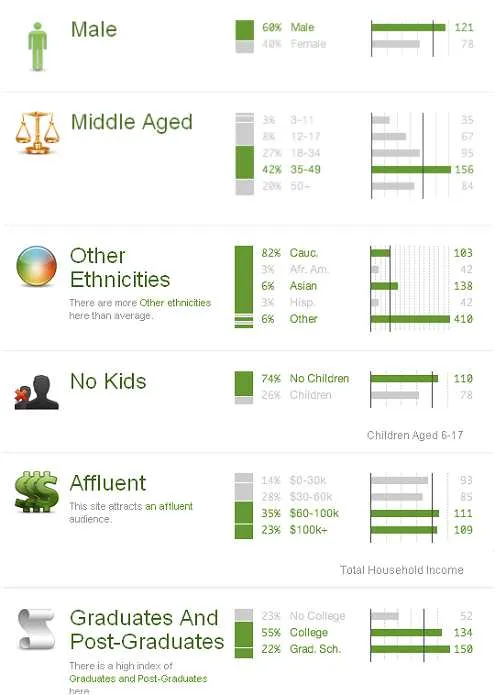
Meeting math
Pot full of cash needed
 Tough times for a nice museum, the North Carolina Pottery Center..
The decade-old center is in Seagrove, which the AP’s Martha Waggoner wrote has “been described as the largest continuing community of European-based potters in the United States. In the mid-1700s, seven families from England settled within a five-mile radius of each other and began producing pottery from locally dug clay, and the area is now home to more than 100 potters.”
(Photo from center Web’s site)
Twittering up a storm
The storm that knocked power out to more than 37,000 homes in Knoxville was something to Twitter about on Monday (and I’m sure I missed some others):
boriqua: Turning cell off now to conserve battery. Goodnight, all!
boriqua: Entering third hour without power. Thus our first unplugged night is born.
boriqua: Holy shit-storm has knocked out power and downed trees here at our house.
djuggler: @comcastcares Knoxville appears to be back online.
ryanberg: @comcastcares FYI Cable was up but internet down during storm that passed through 3920 Lonas Dr area in Knoxville, TN
jigsha: Hoping to leave work after an immensely busy day. Storm, power outages, blocked traffic on I-40 not helping. And it’s only Monday!
jigsha: KUB reports 37,426 customers are without power after severe thunderstorms this evening. And I-40 is closed east of town.
raowen: power just teased me… came back on and went right back off.
raowen: no power. no internet. no tv. we’re in the stoneage!!!!
mumchase: watching a thunderstorm from my hotel window in knoxville
Whodini: At least the website tells me that out of 5100 homes in my zip code, 2900 have no power. w00t!
Whodini: WTF? I can’t get a live person on the phone at KUB? I’m sorry, I don’t have a local 7 digit phone number.
Whodini: Power is out at the house. I should have worked late. And here I was hoping the DTV wouldn’t be effected.
cpknoxify: @comcastcares Cable down in West Knoxville. This has become a weekly occurence.
J3R3MY11: Massive wind storm moving through knoxville.
ericmoritz: Look at the fallen tree https://twitpic.com/4ydi
ericmoritz: holy shit I am about to drive into some nasty shit
Seriously
This one is going around, but as one who’s worn glasses since I was five, I can’t resist. You may have seen it, but if not, see “How Glasses Can Change A Person.”
Hacking? Hardly!
 Some are calling what Virgil Griffith is doing hacking, but I think it’s journalism, computational journalism.
Griffith, a graduate student in Computation and Neural Systems at Caltech, created a stir last year when he released Wikiscanner. It revealed how active companies were in cleansing their Wikipedia entries of negative news. Now, Griffith, pictured on right, has released Wikiwatcher, a set of tools that go further in revealing just who makes edits to Wikipedia entries.
The software is part of a Cal Tech project called “Wikiganda” that says:
Deliberate misinformation and false propaganda has been a problem since the dawn of civilization. This problem is acute with ever more information obtained — by all segments of the public — from open digital encyclopaedias such as Wikipedia. Deliberate insertions of falsehoods, or partial truths, are especially dangerous in an election year. The goal of this project is to develop and implement algorithms that help identify information that may be suspect.
In praise of small cities
 Tennessee is full of small cities, but only one was good enough to m ake Money magazine’s 2008 version of the 100 Best Places to Live, Mon ey’s list of America’s best small cities. That city is Franklin.
The list was limited to cities with populations between 50,000 and 300,000 and is featured in the August edition. Here is a the snapshot of Franklin and how Knoxville compares to the Top 10 (that’s a great tool).
For those interested, here’s the methodology.
Franklin is a great choice, but there are numerous cities in Tennessee with a great quality of life.
(PHoto is from visitwilliamson.com)
Speculation: Scripps’ cable networks in play
 I wonder what the Knoxville impact of this would be:
With a little more than one week of trading as a separate company under its belt, Scripps Networks Interactive is once again the topic of merger speculation, with some analysts and observers predicting that NBC Universal could end up with the group of lifestyle cable networks.
Radio Silence
Doing talk radio this afternoon at 1 with Michael Silence and George Korda. Glenn Reynolds is the guest at noon. It’s streamed from here.
A perscription for stellar rankings
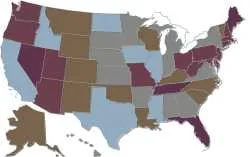 Tennessee ranks No.1 in morphine and codeine use, No. 2 in hydrocodone, No. 3 in oxvcodone, No. 4 in meperidine, and No. 6 in fentanvl, according to this info-packed, but easy to understand map from the Rob Curley crew at the Las Vegas Sun.
I’m sure these stellar rankings are included in the state’s economic development and tourism pitches. Don’t you?
* Rankings are based on state per capita use in 2006.
(via Underoak)
Front Page Follies coming up
University of Tennessee journalism professor Jim Stovall says in an email that an especially good show is coming together for the East Tennessee SPJ’s Front Page Follies on July 19, a fast-approaching Saturday night.
Stovall says:
There has been plenty to spoof this year, and the show is hilarious. I know because I am in the cast. For instance, one of the songs we’re doing this year is called Jailhouse Rocky Top, sung to the tune of Jailhouse Rock. Here’s an excerpt from the script:
Pass it on: Voicemail is dead
Now, here’s something to get viral over.
Voicemail is dead. Please tell everyone so they’ll stop using it.
Happy Fourth of July!

Happy Fourth of July! This was taken last year on the Fourth at Badin Lake, NC. More here.
Recall on fireworks that make ‘loud bang’
Consumer Products Safety Commission recalls fireworks product that “can produce a loud bang and unexpectedly scatter debris, posing an injury hazard to the user and bystanders.”
I guess that’s a problem?
Do or Die time
Charlene Li, who announced today she’s leaving Forrester Resarch, says:
I was once asked what was the best career advice I ever received – and it was to plan for job obsolescence every 18 months, because research showed that people typically master a job in that time period and fall into a routine.
Weird Ralph for President
This is pretty cute. (Stay with it until after the end.)
Search me
Should I make something of this fun with Google Analytics?
In the latter half of June, long-time leader “oral sex” was displaced as the top search engine query that brought visitors to this blog in a rolling 30-day period. It was displaced by “graduation message.” Hmmm …
The top 10 search terms resulting in visits to jacklail.com in the latest rolling 30 day period are:
An idea to nap on
 Merlin Mann says he’s met an astonishing number of people who can’t bring themselves to take naps during the day.
He’s never met me.
I don’t need a guide and software is unnecessary. TV on, TV off; it doesn’t matter. I try not to nap when I’m driving.
But I’m glad Mann’s often evangelizing the “transformative power” of a quick nap. Makes me think I’m onto something instead of a slacker.
Wikipedia finds a difference between a power nap and a catnap. Seems to me you awake refreshed and recharged from either. Something to dream upon.
Despite feeling groggy around 2 every day, I don’t get to nap – power, cat or otherwise – at work. But there are some famous people who regularly napped. I found this list:
- Winston Churchill - said he needed his afternoon nap to cope with his responsibilities.
- Thomas Edison attributed his tremendous amount of energy to sleeping whenever he wanted to.
- John D. Rockefeller took a nap every afternoon in his office.
- Eleanor Roosevelt was known to take a nap before a speaking engagement.
- William J. Clinton retired to his private quarters every afternoon at 3:00 for a 30-minute nap.
- Connie Mack took a nap before every game.
- Gene Autry used to take an hour nap in his dressing room between performances.
- Ronald Reagan has the ultimate napping reputation even though his wife denies that he had a napping habit.
Art in numbers
Knoxville artists by number
Actors 85
Announcers 255
Architects 465
Fine artists, art directors, animators 570
Dancers and choreographers 60
Designers 1,730
Entertainers and performers 105
Musicians and singers 600
Photographers 380
Producers and directors 395
Writers and authors 390
Artists in the Workforce, 1990-2005, a May 2008 research report from the National Endowment for the Arts
That old computer is green
We know you’re keeping that old dog slow computer cause you’re all about green, right? The video is cute.
(via Bob Sutton)
Yeah, he’s rich
 Possible new copyright spokesman for the AP.
Remembering a master
 Reading this blog post by Sanford (N.C.) Herald reporter Jonathan Owens about his grandfather, M.L. Owens, reminded me of my own visits with “M.L.” I have a few pieces of his pottery – I wish I had more. I particularly like his salt glaze pottery.
He was, indeed, a true character. He could be a bit gruff and then regale his listener with some remarkably funny stories all in the space of a few minutes.
Unpretentious, individualistic, a skilled artisan.
I’ve read that he added the “s” to the family name, but I don’t know the story behind that. But he is part of a whole family of related Owen/Owenses that loom tall in any history of North Carolina pottery as pioneers and who continue the tradition today.
The picture’s real, but it swirls in misinformation
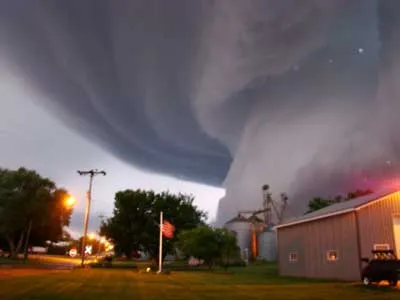 Gizmodo says this tornado photo from Orchard, Iowa – which made it onto a New York Times blog – is why you should carry a digital camera at all times.
But Kurt Greenbaum has the story of how newspapers and news sites handled the photo and that is nearly as fascinating as the photo is stunning.
Gizmodo’s advice is cogent. And the editors who took the time to check out and verify the photo are what I call journalists.
Lori Mehmem photo
Wikipedia breaking news site
Wikipedia posted Tim Russert’s death before AP could move an alert.
If need be, I can write this on your wall
There’s a reason journalists shouldn’t make sources Facebook “friends.” And that’s not the only one!
Politicans say the darnest things
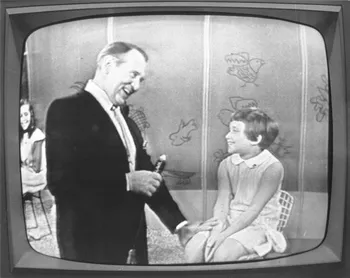 Scott Adcox is starting a Carnival of Local Political Gaffes.
Probably the biggest factor that keeps local politicians from being more than just local are the idiotic messes they get themselves into. The Carnival of Local Political Gaffes aims to shed light on these small timers and give them the credit they deserve.
Insty-Photography
 Glenn Reynolds has added a photo section to his site. A great idea because he takes fabulous photos, most of them of people or sights in and around Knoxville.
Bonnaroo vs SXSW
Is Bonnaroo SXSW for uncool people?
Even boring lives can have action streams
I started experimenting over the weekend with an “action stream,” a way of viewing one’s activities on various social networking sites in an updating stream, a link blog of life.
There is a relatively new plugin for the Movable Type blog platform that implements this. After battling my own brainlessness for quite awhile, I got it implemented.
See my action stream. Of course, there’s an RSS feed.
Does this “life stream” stuff have any value?
‘Roo bound
 Three-time Bonnaroo survivor (see 2007, 2006, 2005 coverage) and online producer Lauren Spuhler is getting in the ‘Roo mood with previews of Knoxville bands scheduled to play at Bonnaroo in Tennessee.
Spuhler will be Manchester-bound mid-week with music writer Wayne Bledsoe. Follow her blog reports, which will include photo and vidoes, as well as on Twitter. (Follow twitter.com/bonnaroo!)
News Sentinel photo by Saul Young, 2006 Bonnaroo
An election year indicator to watch
 One of my friends, Robin Raskin, and Steven Edelson are winding up again electionwatches.com, a Web e-commerce site for presidential election years with a line of “waving” candidate watches.
Yeah, that’s right, “waving” watches.
“If the Interent were a country, Obama would win.Visit www.electionwatches.com and check out my every four year pastime,” Raskin writes.
Of course, there’s still “time” for McCain. They do a “poll” based on watch sales. Vote buying at its best and completely legal.
From the PR release:
Waving Good-bye or Hello? The watches have a clever “third hand” that allows your fav candidate to wave back and forth, like a presidential metronome. In contrast to cheesy buttons and bumper stickers, these watches make a discreet, sophisticated political statement. Plus, by choosing a political timepiece to adorn your wrist, there’s the added utility of always being on time: A conversation piece and a timepiece for the price of one.
Rooms with a view
 That uncontrollable idea match thrower Bob Benz has created a flickr group called “rooms with a view” that may be catching on … fire. Join and contribute!
The mystery of “the couch” in KnoxVegas
The New York Times features a look at a weekend in Knoxville. I must hang with the wrong crowd, or at least with the people writer Allison Glock knows. I have never heard Knoxville referred to as the “the couch.”
KnoxVegas, K-Town, Knoxpatch, yes. But “the couch,” no, never.
The accompanying slide show to the article includes a WDVX Blue Plate Special show. Online Producer Talid Magdy has a weekly series of videos on those shows.
Update: KnoxvilleTalks is doing a “couch” poll. So unless you’re a couch potato, head on over there.
Blogging is a cause of most everything
Just when I was all convinced I could blame blogging on weight gain, sleep disorders and other maladies of my unhealthful living, Rex Hammock points to an article in the June issue of Scientific American that says blogging may actually have therapeutic value for serious ailments.
“Whatever the underlying causes may be, people coping with cancer diagnoses and other serious conditions are increasingly seeking–and finding–solace in the blogosphere. ‘Blogging undoubtedly affords similar benefits” to expressive writing, says Nancy Morgan (the author of a major study on the subject), who wants to incorporate writing programs into supportive care for cancer patients.’”
Technically speaking …
I upgraded last night to Movable Type version 4.2 RC1 (a beta). Living bold!
I also added three OpenID plugins and turned on some internal login features.
**
This is the good news: Users can now log to make comments with their AOL/AIM screen name or their Yahoo, Wordpress, Vox, and LiveJournal user ids in addition to a “regular” OpenID login, Typekey login, or even anonymously. That should make commenting a whole lot easier.**
The Yahoo and Wordpress plugins were written by MT developer Byrne Reese and the AOL plugin was written by Minh Nguyen. The Vox and LiveJournal logins are native to MT 4.x, but I hadn’t turned those on previously.
I only ran into one glitch. I couldn’t see my blog preferences menu (which is bad). I turned in a bug report and decided to sleep on it. This morning I went into MT’s beta forums and got the answer in four minutes! User dug said disabling the iPhone/iTouch interface plug in fixed that for me. It did for me, too! Hopefully, that plugin will be upgraded.
A number of new things and performance improvements are in version 4.2 RC1, if you are interested.
A Web 2.0 guide for work
 |
View | Upload your own |
I’m not a Gen Yer and this is not about journalism, but I think it applies to journalists of any generation. From Sacha Chua.
(Via Scott Merrick)
In my orbit
A lava lamp for flickr. Try entering Sunsphere.
When Twitter is down, I just say “oh me”
I’ve never done any of these when Twitter is down. I guess I haven’t lived.
Old Media still has its mojo working
On Sunday, Martin Varsavsky, an Argentine/Spanish entrepreneur, and his global wireless network,FON, were featured in the business section of the New York Times. That got him musingabout the differences between old media and new media:
Even though the Sunday New York Times has a circulation of 2.3 million papers and is arguably the best newspaper in the world the cover article only added 200 additional uniques to this website. Instead when I heard from Michael Dell that he used Ubuntu I blogged it, my post was picked up by Digg and I got over 50,000 additional unique visitors to my blog!
But while there is a big disconnect between old media and new media and old media does not send visitors to new media, the impact of an old media paper article far exceeds that of an internet article. Michael Arrington may send you a lot of visitors but it is rare that I will go somewhere and people will remember what Techcrunch wrote a year ago. With paper this is not the case. People will cite the Erika Brown Forbes a year later. And yesterday I was getting many emails from long time friends and even a former university professor about the New York Times article and this does not happen to me when blogs who send me tons of visitors write about me or Fon.
The great tag cloud in the sky
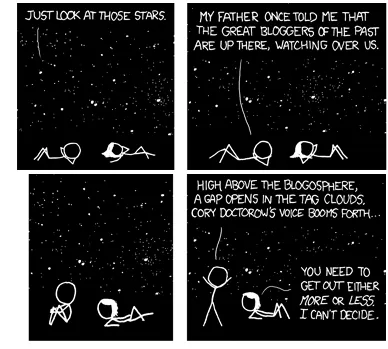
xkcd.com and its creator 23-year-old creator Randall Munroe are featured in a New York Times article today.
(via popurls)
Give this blog post 5 stars or I’ll beat your ass
Social media has evolved to the days when angry story subjects showed up at newspapers to take a swing at the editor. That’s actually happened once since I’ve been at the News Sentinel, but that’s a tale for another day..
Of course, the tactic may not be all that successful.
Revised headline: Give this post blog post 5 stars, pretty please.
Like a mermaid in a pantsuit
Appalachian voters, Hillary Clinton and Barack Obama continued.
More from videos from Tennessee’s Red State Update guys.
Nattering nabobs of negativism …
would have you believe otherwise, but resistance is futile.
Best cities list needs a reranking
How does Charlotte top this list? And Chattanooga come in No. 3. And Asheville, NC. No. 7. And Knoxville at 85th? That’s a rank ranking of the best places to live.
That’s not a hole in your pocket, it’s a gas pump
 You think gas is high now. Here’s oilman T. Boone Pickens’ prediction:
Fast Company: What will happen in the next five years?
**
Pickens:** Demand will go up, and price will go up.
Fast Company : Take a stab at what we’ll be paying at the pump in five years.
Pickens: Oh hell, that’s so far out. Maybe $6 to $8 a gallon.
Full Q&A.
Fast Company photo of T. Boone Pickens and his dog Murdock by Susanna Howe.
Printcasting
Ah, printcasting explained!
He said what?
And John McCain’s gettting a free ride while the Democrats duke it out, right?
My reading list
I am sharing links to posts I find interesting (or share-worthy) in Google Reader. You can subscribe to it if you like as well.
Enjoy the ride
 One of the best Best Scenic Drives in the U.S. is close by:
Blue Ridge Parkway
Stretching some 469 miles along the Southern Appalachian Mountains and linking two eastern national parks – Virginia’s Shenandoah National Park in Virginia and North Carolina’s Great Smoky Mountains – the Blue Ridge Parkway has often been referred to as “America’s Favorite Drive.” It’s certainly the country’s first rural parkway – parts of it date back to 1930s (when construction began as a make-work project during the Depression) – and the longest, with breathtaking scenery and dozens of recreational opportunities to distract you when you need to stretch your legs.
Though some may argue that autumn is the best season to drive this stretch, as the brilliant fall foliage is in full effect, May is also a superb time to head this way, to witness the profusion of wildflowers in bloom along the elevated mountainsides. Also included in this scenic route is the impressive Skyline Drive, a 105-mile swath of road that cuts through Shenandoah National Park. Of course, no nature drive of this sort would be quite complete without wildlife sightings: Keep an eye out for resident whitetail deer and black bears.
A field trip
Aunt Hattie visits Seagrove and takes photos.
(She visited a couple of my fav places.)
Not a mangled word here
A small suggestion that reporters might want to develop a new role.
Web-to-video?
HGTV.com’s “Rate My Space” hits cable TV on Sunday, June 8, at 10 p.m. and will regularly be on Thursdays at 9 p.m.
“The success of HGTV.com’s Rate My Space page has given the network an incredible opportunity to include our online fan base in our programming,” Michael Dingley, senior vice president, HGTV programming said in a news release. “Online visitors have uploaded more than 30,000 room photos to the site, which has generated more than 150 million page views in less than one year. We want to make this appealing, interactive approach to design accessible to all our viewers.”
It’s not the first time that’s happened, but it’’s interesting to see the concept make the jump from interactive, user-generated content feature to cable TV show.
The “tell” in job openings
Steps in the right direction
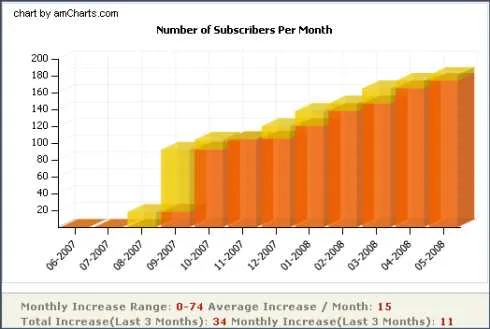 Thanks for helping the feed subscribers to this blog
 Where they send their kids to school on Star Trek
 There was a Star Trek sighting at the graduation ceremonies I was at Sunday, but I blissfully missed it.
Find out how journalists think!
The press release below is about a really interesting effort by The Society of Professional Journalaits (of which I’m a card-carrying member).
Chicago, Greensboro, LA. At $25 a pop, that’s a deal. Deadline for the Chicago one is coming up fast.
**
SPJ to launch Citizen Journalism Academy in Chicago**
For Immediate Release:
5/1/2008
Contact:
Clint Brewer, President, (615) 301-9229
Beth King, APR, Communications Manager (317) 927-8000, ext. 211
INDIANAPOLIS - The Society of Professional Journalists will launch the first of three Citizen Journalism Academy programs May 17 at DePaul University in Chicago.
The workshop will teach citizens how to practice accurate and ethical journalism. The Society aims to help participants understand how such practices could increase reach and reputations within a specified community and around the world.
“As people are practicing journalism through blogs, Web site production and interaction with sites maintained by mainstream news organizations, they’re contributing to the daily news cycle while influencing how community members get their news and perceive the world around them,” said SPJ President Clint Brewer. “SPJ sees this as an opportunity to help citizen journalists by arming them with the tools they will need to be an effective citizen journalist or community watchdog.”
Topics in these one-day workshops will explore:
-- Journalism ethics. The new-media landscape is rife with dilemmas for anyone wanting to report accurately, fairly and outside the bounds of special interests.
-- The basics of media law. The same longstanding laws concerning libel, slander and access to people and information apply to 21st-century news-gatherers.
-- Access to pubic records and meetings. Public information can add substance and value to every news story. But knowing where to look for it can be tough.
-- Standard and responsible reporting practices. With media ethics and law in mind, how else should news-gatherers approach sources?
-- The use of technology. We’ll show you an array of tools you could start using – or continue using even more effectively.
The program will take place from 8 a.m. to 5 p.m. The cost to attend the Citizen Journalism Academy is $25, which includes lunch and course materials. For more information about this program or to register, visit SPJ’s Citizen Journalism Academy page. Please note, the registration deadline is May 3 and seating is limited.
Other upcoming Citizen Journalism Academy workshops include Greensboro, N.C. on June 7 and Los Angeles on June 28.
Funding for this program is provided by the Sigma Delta Chi Foundation, a tax-exempt, 501(c)(3) public foundation organized for the purpose of supporting the educational programs of the Society of Professional Journalists and to serve the professional needs of journalists and students pursuing careers in journalism.
Founded in 1909 as Sigma Delta Chi, The Society of Professional Journalists is the nation’s largest and most broad-based journalism advocacy organization. SPJ promotes the free flow of information vital to a well-informed citizenry; works to inspire and educate the next generation of journalists; and protects First Amendment guarantees of freedom of speech and press. For further information on SPJ, please visit www.spj.org.
Total basket case
Music Row overrated
Nashville’s Music Row makes MSN’s “America’s Most Overrated Places.”
”.. a visit to Music Row, supposedly a great tourist destination, really is just a walk down a block filled with ugly offices.”
” … go to Tootsie’s Orchid Lounge, the Bluebird Caf� or even the Grand Ole Opry to see Nashville’s musical heritage really come to life.”
A critical election issue
Co-worker Lauren Spuhler says someecards has to win the humor category of the Webby Awards -- if you vote for it.
A novel idea: Just throw red light tickets in the trash
Red Light cameras from a company called Redflex Traffic Systems Inc. are a hot topic in Knoxville, even a hot target.
But in St. Louis, Alderman Freeman Bosley recently said about camera tickets: “If you threw it in the trash, nothing would happen.”
Huh? What about here?
Kurt Greenbaum of the STLtoday.com says the cameras are popular fodder for bloggers there. So too here.
(Fine print disclaimer: Don’t blame me if you throw them away.)
The deadly seven …
If you are reading this blog, I’m sure you are suffering from one of these.
Do the subscribe thing
Another thing the Internet is good for
I had never noticed these dollar bills tagged for Where’s George. George? Where have I been?. The Where’s George site has been going on since Dec. 23, 1998.
I got a bill stamped with “Track me at www.wheresgeorge.com” the other day and decided to enter it into the tracking web site.
I was the only second person to enter this particular bill. It had been originally entered on Sept. 20th of last year and was in Pigeon forge. It hasn’t traveled far. I may even have received in Sevierville instead of Knoxville, but I’m not sure.
Or as it says on the Web site:
This bill has travelled 29 Miles in 210 Days, 13 Hrs, 56 Mins at an average of 0.14 Miles per day.
Craigslist now doing to blogging what it did to classifieds
Did you know Craigslist had a blog?
 You can find out more about this spaceship for sale and how that weird Oregon case shows Craigslist is not a hideout for criminals. “Criminals take a giant risk when they use craigslist in conjunction with illegal activity, since an electronic trail is created that law enforcement officers can easily follow ,” the blog says.
There’s more. Craigslist founder Craig Newmark also set up a Twitter account on April 12 so people can find how boring his life is. He’s on a trip to Israel right now. Recent Tweet: My first rocket attack, and I eat algae. Well, he says his life is boring. Anyway, hope he keeps it up. Newmark also has his own blog that has been around longer than the new Craigslist blog.
The domain name says it all
We have a lot of domains registered at knoxnews. Usually, someone will say we’ve got to register some-really-lame-URL.com because someone else will snatch it up. These are parked safely under lock and key and are unlikely ever to see the address bar of a browser. Consider it a public service.
And the snatch-it-up part does happen, only we didn’t know we wanted that domain until somebody else got it. At that point, it gets expensive to be wishful, we’ve found.
However, so far we haven’t thought of any of these featured in “Your Domain Says What? 9 Hilariously Misleading Websites.”
(via popurls)
RU4Real is the question
As a Twitter user, if someone follows me, I like to return the favor and follow them. If it looks like a spammer (and my test is they are following 5,000 plus people, but only 39 people are follow them), I do pass.
Twitter weather
Twitter weather reports from Nashville. I think we’d better get ready for a stormy night in Knoxville.
nitweet confirmed tornado in lawrence county - buffalo road.
Busymom Heh, “hen egg” sized hail being reported
scottmerrick just saw an instantaneous lightning/thunder occurance a half block away on the roof of a building. Cool!
r It sure is a dark and stormy night here in Nashville – except it’s noon
Busymom @moogiesworld Big storm (tornado?) bearing down on my neighborhood in a few minutes
Blogger dollars
I didn’t know that E.W. Scripps subsidiary (at least until mid-summer) Shopzilla had an ad network for bloggers and other publishers. Problogger has the details on the Shopzilla Publisher Program.
Shopzilla is a comparison shopping site.
How to use earphones in less than 40 pages
I know the Apple fanboys will pout; those that rave about the Apple packaging experience, but I call a 40-page manual in a box of iPod earphones excessive. Count’ em.
The short version: Put the pointy end in your iPod and the other two ends in your ears. Listen!
Not even 40 words!
Flowers on screen
 If you’re into daylilies or just beautiful flowers, here’s something FREE for spring.
Noticed in a Saturday email newsletter (that I just got around to reading this morning) that Ken Oaks at Oakes Daylilies in Corryton has a free daylily screensaver.
Here’s what he said in the newsletter.
I noticed just the other day here in our office that my sister was using a folder of daylily pictures as the screensaver on her computer. And it struck me to see just how impressive the pictures were, blown up large enough to fit the screen. I don’t think I had ever looked at those pictures that large, but at that size they looked spectacular! I could see and appreciate all the gorgeous detail – When it comes to pictures of daylilies, it seems that bigger is better.
From that observation, the thought occurred that perhaps you might enjoy having some extra-large daylily pictures to use as a screensaver on your computer. So I’ve pulled together some of my favorite pictures (40 of them), and if you would like them, they are available for you to download (4.2 MB). Some of the photos are pictured here, but the photos in the download are even larger! Let me know if you enjoy these (or if you have any suggestions for improving them, size-wise or otherwise), and I’ll try to pull some more together to make available later. I have enjoyed using the program Google Photos Screensaver, which is available free to download from Google. You might want to give it a try.
Sounds tops to me
 Oh yeah! Random Mumblings has been added to the journalism section of Web startup aggregator alltop. Hanging with some of my favs in the journalism area.
Alltop is a project of Nononina, Inc., which does another site I like, Truemors.
Nononina CEO Guy Kawasaki told Forbes:
“Alltop is an ‘online magazine rack’ that displays the news from the top publications and blogs. Our goal is to satisfy the information needs of the 99% of Internet users who will never use an RSS feed reader or create a custom home page. Think of it as aggregation without the aggravation.”
Mesmerized by creepy girl
What’s up with everyone linking to the woman here. Most people are calling her “creepy girl.”
Weird, but here I am linking to her, too. Go figure.
Within earshot …
Have you heard this one?
What I’m sharing
Don’t forget to see my shared Google Reader items. Add it your reader (a Read the Shared Reader thing).
Earth Hour gets buzz
There was a lot of buzz on Twitter this morning about Earth Hour. Here’s a sampling from Tweet Scan, a “real time” Twitter search engine. Oh yeah, follow me on Twitter.
 |
Despil : @scarab I thought we have about 6 hours ‘till Earth Hour. It’s not even noon yet « (2008-03-29 06:52:21) |
|---|---|
 |
rgabostyle : Turn of your lights for an hour from 8pm to 9pm local time and join the Greener One team for Earth Hour! https://tinyurl.com/yrb23j « (2008-03-29 06:51:07) |
 |
mic2007 : twitterfolk as part of earth hour today-take a picture of where u are now n send 2 pics@dailytwitter.com w/ location see earthhourus.org/ « (2008-03-29 06:47:38) |
 |
halfscottishguy : still has his lights off after earth hour « (2008-03-29 06:47:16) |
 |
antonmannering : @gabig58 What is Earth Hour meant to acheieve exactly? « (2008-03-29 06:46:51) |
 |
gabig58 : Earth Hour tonight at 8pm- your local time https://www5.earthhourus.org/ Turn your lights off! « (2008-03-29 06:43:41) |
 |
mattbodman : its earth hour!!! stop using twitter, it wastes electricity!!!! « (2008-03-29 06:43:33) |
 |
steverosebush : Earth Day: Turn off the lights for an hour. I never turn ON my lights to begin with. Sometimes have a desk lamp on. Maybe I’ll light candles « (2008-03-29 06:43:05) |
 |
scarab : I wonder how many stores and shops got robbed during Earth Hour. « (2008-03-29 06:43:02) |
 |
Wedge : It’s ‘Earth Hour’ tonight at 8pm, see Google.co.uk - just working out my Carbon Footprint now at actonco2 « (2008-03-29 06:42:48) |
 |
harikishore : Earth Hour!! « (2008-03-29 06:42:10) |
 |
patrickcurl : @steverosebush Its to celebrate earth hour - between 8-9pm a large portion of the world will be dimming lights to conserve 1 hour of energy. « (2008-03-29 06:41:07) |
 |
styler : @jwegesin it’s for earth hour, but black screen could actually be using more energy hahaha « (2008-03-29 06:40:50) |
 |
reemyrobby : What a Earth Hour??? « (2008-03-29 06:40:39) |
|
patrickcurl : They need to have earth hour around 6pm, so I can use it as a time to take a nap before dinnger and conserve my internal energy too lol « (2008-03-29 06:38:48) |
 |
bruingeek : For excitement today, I’m considering an Earth Hour observance…but may need someone to hold my hand in the dark snortle « (2008-03-29 06:38:43) |
 |
virginia : I was in a bar during Earth Hour, and they didn’t turn off the lights, so we went outside in protest. Then we came in again due to coldness. « (2008-03-29 06:37:54) |
 |
siopaomaster : tinamad akong mag swimming..wait ko na lang earth hour « (2008-03-29 06:37:29) |
|
patrickcurl : @steve228uk they sure did - Don’t forget to turn yours off between 8pm and 9pm for Earth Hour! « (2008-03-29 06:36:40) |
 |
wbarthol : Yum, Baskin & Robins… Earth Hour seems to be a bit of a failure. « (2008-03-29 06:33:17) |
 |
CodeJedi : Funny how you can still twitter during Earth hour! « (2008-03-29 06:33:00) |
 |
Yarra64 : I thought every hour was earth hour in adelaide (sorry dt - just had to!) « (2008-03-29 06:32:34) |
 |
01000101 : Watching Melbourne switch back on, from my roof as Earth Hour comes to a close « (2008-03-29 06:32:31) |
 |
pcrobot : Turn your lights off for Earth Hour. Kudos to Google as well… when I opened Firefox this morning I thought my homepage had been changed! « (2008-03-29 06:31:59) |
 |
linglingtai : Lights off from 8pm to 9pm today! Support Earth Hour! « (2008-03-29 06:31:38) |
 |
kbond : Did not take part in the BS earth hour, house is lit up like a freakin’ Christmas tree « (2008-03-29 06:30:35) |
 |
dailytwitter : twitterfolk as part of earth hour today - take a picture of where you are now n send to pics@dailytwitter.com with location - blog ensues. « (2008-03-29 06:29:55) |
 |
gboaca : Earth Hour tonight at 20:00 « (2008-03-29 06:29:14) |
 |
shauntrennery : Took some neighbourhood kids to get all the house on our road to turn the lights off for earth hour. « (2008-03-29 06:26:52) |
Black is the new green
 Betcha noticed this today. Good for Google; let’s see if we notice lights out between 8 and 9 p.m. tonight.
I somewhat suspect that life will go on fairly normally between 8 and 9 p.m. And granted “Earth Hour” is mainly symbolic. But in an ironic sense, the lack of being able to discern much change in lifestyle during Earth Hour is the most apt symbolism.
AP says lights are noticeable dimmer in Sydney. Take a poll on whether you plan to participate.
Mixing it up with a startup
Rage of the day.Muxtape.com. Lost Remote’s Cory Bergman calls it “Super mega coolness.” Brittney Gilbert has done one celebrating Nashville. There’s more, of course.
Launched Tuesday. Have you account yet?
State government’s reading list
The new opinion shapers.
Free Beer – In Knoxville!
Now we’re talking Creative Commons.
Free Beer points out Free Beer version 3.3 is available in Knoxville.
 Copyshop Knoxville and Everything Mushrooms get the credit for bottled “FREE BEER version 3.3.”.
Photo from The Art Gallery of Knoxville
(vis Underoak -- Who knew Danes licensed Free Beer under Creative Commons, and someone’s bottling it in Knoxville? Nice design too.)
Update: A back story. Underoak, a Twitter user at The Charlotte Observer noticed the Free Beer in Knoxville link on a French tech site. She says: “_French blog on tech. gets Free Beer hat tip. Keeps my French and global perspective halfway fresh.https://snurl.com/22nbi” _ .
Who knew. The French and beer? Tip a cold one to the Internets!
Life measured in bytes
The running total of my ever-growing digital footprint …
ReadWriteWeb explains it.
There will be reporters for at least 60 years
 Steve Boriss writing at Pajamas Media says reporters are a dying breed and that’s a good thing. They are mere “unnecessary recyclers of news.”
The downfall of the reporter it seems, it that she turns out to be human, “the public increasingly understands that reporters are often biased and inaccurate, just like the rest of us.”
He says Internet is destroying reporters as the middlemen between news and audience.
Boriss is nothing if not consistent. Earlier this month he explained “why modern journalism will be extinct long before polar bears.”
And also this month, he suggested that blogging is simply journalism without the organizational overhead that tends to screw it up.
In that one, he said:
Blogging allows personal style, journalism doesn’t. Blogging allows opinion, journalism doesn’t. Blogging gets news out immediately, journalism doesn’t. Blogging allows the writer to take risks, journalism doesn’t. Blogging allows rumors to be followed by updates, journalism doesn’t. Bloggers are independent of oversight by editors who slow down publication while removing the style, opinion, rumors, risk, and edge. Journalists aren’t. Oh, and there’s one more difference. Blogging is growing because news consumers prefer all of the above. Journalism isn’t.
I’m sure I backed it up somewhere
 I signed up and have been trying JungleDisk. I’m thinking it’s a pretty nice (and safe) service for keeping your digital life backed up somewhere in the Cloud. Sort of sounds like the Matrix, but it’s really off-site backup, stuff that IT department guys muss about with.
Sometimes they leave with the building with backpacks on to go to these off site data depots for disaster simulations. (Scout camp for geeks?) I don’t think Amazon will be letting me do simulations in the JungleDisk, but I could buy a book.
JudglesDisk, a Georgia high tech startup, uses a small client and Amazon’s S3 servers to safely store your data for pennies on the gig. As an aside, I think Amazon has been really smart with its Web services that it’s rolled out to developers. Competitors just seem to be getting there while Amazon is building out a robust set of services.
But I’m not using its services because I’m a developer. I’m beginning to think I’m a backup freak. I use a Seagate Mirra box that watches the two main computers in the house. Course the links on Seagate site to the promotional material go to a 404 so I’m not feeling secure about Mirra’s longterm place in Seagate’s product mix. (The existing customer support and Web access to your data site is still found.)
And it did fail once, well before the hard drives of the computers whose data it was “protecting” died (they haven’t thankfully). And then there’s that little drawback that it’s in the same house as the computers it’s backing up. What if the unthinkable happens?
I do like the Mirra product. It keep tracks of versions and runs pretty much without complaint. Restores are simple. Plus, once you buy it, there are no monthly fees.
I’m thinking of JungleDisk, which works very much like a network drive on the user’s machine, as a place to permanently archive photos, music and docs/spreadsheets. And, oh yes, the files are available from anywhere through a simple browser interface.
Anyone else have opinions on JungleDisk, Mirra, backup strategies (or the lack thereof)?
Shared Google Reader links
I’ve started sharing links to posts I find interesting (or share-worthy) in Google Reader. You can subscribe to it if you like.
Bracketology is academic
Which Tennessee men’s basketball team will be in the Final Four and play for the championship?
One educated guess is Belmont.
Inside Higher Ed did a NCAA men’s basketball bracket based the NCAA’s Academic Progress Rate with the NCAA’s Graduation Success Rate as the tiebreaker.
See the full details on this methodology, which is not recommended for those with hopes of winning the office pool.
In this bracket, No. 2 seed Tennessee doesn’t make it out of the first round and No. 1 seed Memphis exits in the second round. But that B-ball team from Belmont makes it to a final game against brainy Davidson, where its Cinderella run ends.
See the full bracket.
(Hat tip to Underoak)
Is Friend Feed a longterm relationship?
Friend Feed, a service that aggregates social network information, is having its “Twitter Moment,” according to Michael Arrington.
After the buzz wears off, is it here to stay?
In the meantime, I’m here.
**Updated: **Louis Gray says A-lister bloggers are joining in DROVES.
Subscribe to this blog and more
High profile Tennessee political blog shuttered in budget cutting move
It was very sad to hear of the layoff of A.C. Kleinheider, the writer of VolunteerVoters, today by Nashville TV station WKRN.
The media business is a tough business these days. Hard decisions are made. I don’t envy the ones making them. It’s sad to see VolunteerVoters go after a year, 11 months and 13 days..
There is more perspective on VolunteerVoters and Kleinheider from
And from Kleinheider’s last post:
My tenure here was much like a dream from which I’ve just begun to awaken. I hear the alarm. It went off a few hours ago. My eyes are still closed but my mind is slowly becoming aware of my surroundings. Before I do get up and splash that water on face though, let me say this.
I have always been a voracious reader of political news and opinion and to have the names of the people I’d see in print both in the body of text and the byline of those stories know my name was a thrill. To have some of them speak to me as if I were some sort of peer or respectable member of the press was a surreal experience I never really wrapped my head around.
Of course, that only happened because I was standing on the shoulders of some very generous people. Those people, of course, were you, the bloggers whose words I cut and pasted and the commenters whose sometimes inspired, sometimes delightfully ad hominem words made this space a “go-to” hub for those interested in Tennessee politics to come and see “what was going on in blogosphere.”
As seen on HBO …
Mary Farrell, one of my favorite potters, says in her email newsletter:
Those of you who’ll be tuned in to the “John Adams” miniseries, which begins on HBO this coming Sunday, may notice some familiar pottery! For the filming of “John Adams”, Westmoore Pottery provided over 60 pieces of pottery to enhance the historical setting of the miniseries. Most of the work supplied was redware, with just a few pieces of the salt-glazed stoneware. We also provided a few pieces of handblown glass for the filming.
The 7-part miniseries, which will air on HBO beginning March 16th, is based on the John Adams book which won author David McCullough a Pulitzer prize.
There you have it; now you don’t
And your excuse would be?
I’m financing piglets in Vietnam
 Today would be a good day to do a Kiva update.
I’ve written about it a couple times before in “Spare change can change the world” and “Grassroots lending Web style.”
Kiva is a non-profit that makes micro-loans to entrepreneurs in developing countries.
The loans are not tax-deductible charitable donations and you do get paid interest or dividents so it’s not a financial investment. But it is an investment in people.
How does it work?
Maybe my own experience will explain it.
On Dec. 23, 2006, I deposited $82.50 with Kiva. Of that, $7.50 was a tax-deductible charitable donation to Kiva and the other $75 went to Jovcho Bakalov, a Bulgarian, who borrowed - along with my $75 - a total of $2,000 from a Kiva partner organization.
Bakalov got his loan in early January 2007. I got periodic emails about loan payments and an email today that the loan had been repaid in full. When a loan is repaid in full, the Kiva lenders get their original loan amounts credited back to their account where it can be reloaned, donated to Kiva or withdrawn.
Now, I’m starting the cycle anew. I added another $75 to my account for a total of $150 and made another $7.50 donation to Kiva.
I loaned $75 to Nguyen Thi Ngoc, a Vietnamese woman who wants to borrow $575 to buy pigs. and who at this writing needs $300 more committed.
The description of why she wants a loan is:
Mrs. Nguyen Thi Ngoc, 47 years old, is a third year member of TYM Fund (Kiva Partner). Her family includes her husband, her four children and herself. Their family’s main job is farming and animal breeding. She uses her previous loans efficiently so her family income increases significantly. The cost of piglets and cows are increasing, however, causing her a need to borrow larger loan. Since her children are all grown up and have their own job, it’s easier for Mrs. Ngoc to make the weekly repayment. This time Mrs. Ngoc wants to borrow 575USD to buy piglets and food for them.
Only the journalism survives
Dave Cohn’s right, it’s about individual transformations. See why.
What recall
Now that’s a thought, but Reqall is not for me.
Jack and Hill
The YouTube effect on the presidential campaigns continues to be among the more interesting innovations in the 2008 campaign.
Fred Thompson used YouTube effectively -- maybe he thought he was going to run from the YouTube video “porch?”
Then there was Justin Dylan and Will.i.am’s “Yes We Can” video.
Now here’s a very funny video from Jack Nicholson called “Jack and Hill” composed of clips of from his films.
The video, which was not coordinated with the Hillary Clinton campaign, was posted early Saturday.
From Showbiz Spy:
He says: “There is nothing on this earth sexier - believe me gentleman - than a woman you have to salute in the morning.”
Hollywood director Rob Reiner put the video together on Nicholson’s behalf and the actor appears at the end to say: “I’m Jack Nicholson and I endorse this message.”
Bonus day
Louis Gray says all salaried folks are working for free today because of Leap Day. There are 366 days in the year this year and only 365 last year and next year.
But wait, my annual bonus fell into my bank account today.
Nevermind. It truly is a bonus day. Even the accountants have a sense of humor.
Google Sites sighting
In my email this morning was a note from Google that Google Sites had been enabled for my jacklail.com domain.
As the official Google blog says:
Meet Google Sites, the newest addition to the Google Apps product suite. It was designed to allow you to easily create a network of sites and share them with whomever you choose. Google Sites lets you pull together information from across Google Apps by embedding documents, spreadsheets, presentations, videos, and calendars in your sites. Of course, we also harness the power of Google search technology so your search results are always fast and relevant.
Underground news
We sure got beat on this one about “Tennessee Helpless Against New Basement Tornadoes:”
“Some people lost their entire basements,” said Knoxville-area relief worker Dan Weiss, who personally observed a dozen rec rooms that were completely destroyed, and a half-dozen more that might have been destroyed, though it was difficult to say for sure. “Everything they had ever stored was suddenly lost. So much extra stuff gone to waste.”
Buzzed up
I’m thinking they were over-caffeinated.
Blogger media strategy
The National Rifle Association is getting blogger savvy.
I’ve heard the politically powerful group has been reaching out to “gun bloggers” in a serious way and this year they’ll be able to ‘cover” the national convention in Louisville, Ky.
A Second Amendment Blog Bash will be May 16-18 in conjunction with the NRA convention. SayUncle is among those planning to head to Kentucky and has more info.
The bloggers will get media credentials and access to the media room.
Pretty smart media strategy! The NRA definitely isn’t all NRA caps and pickup gun racks on the backroads.
I wonder how many other organizations are developing media strategies around bloggers?
Seriously, it’s real
 A wearable computer. Not a new concept, but today was the first time I had ever met anyone using one. Ga. Tech professor Thad Stamer, who’s been building these gizmos since the early 1990s, was explaining the technology. He can type 130 words a minute with a 12 key keyboard -- seemingly while talking to you and not looking at the handheld keypad.
Conversation worth noting
Journalist/blogger and all-around Knoxville wired maven Katie Alison Granju hears a conversation with the power to change in the Knoxville blogosphere.
This conversation extends beyond bloggers themselves, and even past the thousands of people who now read local blogs every day. It’s seeped out into the community at large - into political coverage by the “mainstream media” (which has gotten more hard-hitting and appropriately aggressive in the past year or two), and onto front porches and over backyard BBQ grills and into party chatter.
Knoxville in just six words
OK, I’m stealing this one honest from Tommy’s Table. I’m a sucker for stuff like this anyway.
Free my office apps!
Following up on my mini-rant Sunday about Microsoft Office, is the Microsoft-Yahoo deal really about free software, or to use the buzz phrase, “zero-dollar” software?
The paperless office is at home
Forget the paperless office, think paperless home.
The New York Times in a Sunday piece trots out high tech heavies Brewster Kahle and Brad Templeton on a piece on the paperless home.
Brewster Kahle is the founder and director of the Internet Archive, a nonprofit digital library, and Brad Templeton founded an Internet newspaper and is chairman of the Electronic Frontier Foundation.
Kahle: “Paper has been dealt a complete deathblow. When was the last time you saw a telephone book?”
Well, today, but it’s a bit ragged and anyway it’s under some other papers away from page turning temptation.
Templeton: “I’m a digital pack rat. I have phone bills from 1983 and taxes from the 1990s. But I have everything scanned, so it takes up no physical space. For me, scanners provide the magic of still having all my documents without the clutter.”
Phone bills from 1983? And for why?
I do have a scanner, but haven’t committed to going paperless, but I may just be a yellowing scrap of humanity from the Paper Era. The article says paper use is declining to a mere 502 pounds per person in the “richest” countries.
There’s always the backup issue when going paperless, which gets amazing short-shift in the piece. You’ve got everything safely backed up at home, right?
But the paperless home appears more likely than the fabled paperless work office. Perhaps that’s because the people doing the printing are paying for the “expendables.”
At work, we’re on a campaign to force duplex printing. Based on our paper use – copy paper, not newsprint – we could save a tidy sum with all duplex. We still print out lots of reports and sales presentations and things that find their way into the trash within hours – often sooner. There’s something deeply comforting in having the same piece of paper someone is reading the highlights of in a meeting. Call it the shuffle factor.
So go paperless in 2008, we’re in the Digital Era after all. But if you have phone bills from the 1980s, trust me, you can dump them.
New for the reporter’s tool belt
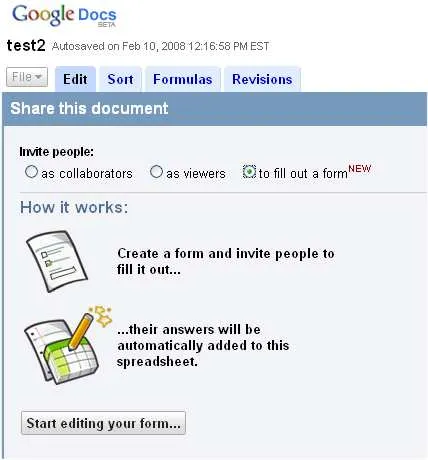 Gee, where I have been, asleep or something?
A Steve Rubel twitter drove me to his Web site where he’s trying out a new Google Docs feature that allows users to create Web forms and collect the data in a Google Doc spreadsheet. Anybody can create them.
The feature apparently went live on the sixth.
I tried one and the only problem I noticed is that web-based version of Outlook (OWA) wouldn’t write the data when the form is sent in an email, but otherwise it worked great. The form can be sent in an email or just the link to the form.
This looks to be a great tool for journalists. Newsrooms that want to quickly do a survey and collect data can without programming help. No need for a Web monkey to create a form and a database. Just do it yourself. If you can fill out a form, you can create these Web forms.
You start by creating a Google Docs spreadsheet and click the “share” tab. Then under the “invite people” heading, choose “to fill out a form.”
Couldn’t be simpler. Google continues to make Docs useful. For me, it’s more than beginning to have the features that I want from MS Office and MORE without the stuff I’ve never used anyway.
Seems a crime we used to have spend all that money on MS Office licenses for what, the right to upgrade to next year’s version? Glad those days are over.
NYT discovers Knox County politics
The New York Times has discovered Knox County politics.
Gotta say they Dan Barry nailed it. Some of the vivid observations:
It seems a catfish could have been appointed if properly connected.
Snapshot of your freedoms
I guess you’d better throw away those photos of the White House and the Washington Monument and maybe Mount Rushmore just to be safe.
Here’s an experience of a Knoxville photographer taking photos at the John J. Duncan building downtown::
When I got to to the building, I stood across the street with my wide angle (to fit the huge structure in the frame) and put the camera to my face. And after a few clicks of the shutter, I hear this man yelling at me, “Ma’am! Ma’am! You can’t photos here!!!” It was the security guard, and he was running down the stairs towards me. I immediately put my camera down by my side and ran across the street to the guard. I asked him what the problem was, and he suddenly went into a tirade about post 9/11 laws prohibiting the photography and videography of any federal properties. He went off about terrorism and national security and then threatened me with two years in the penitentiary for possessing images of federal property. I had to delete my photographs or else I would get two years in jail.
Watch for it
 One of the delightful things about innovation and technology changes is seeing the unintended impacts. While delightful to find, they are vexing to predict.
This is not a particularly new one, but I noticed it in an article today at SignOnSanDiego:
Wristwatch sales have slowed - down 25 percent for Timex between 2003 and 2005 - as teens and young adults tell time by their phones.
What would happen if …
Good tips on emergency planning for freelancers from Thursday Bram.
These would be applicable to bloggers as well who aren’t writing, doing photography or doing other freelance work for others.
I think I have some planning to do.
Ninja not
I am so definitely not an email ninja. Does anybody really do this stuff?
Eyes on the prize
If you need a sound track for Martin Luther King Jr. Day, try Mavis Staples’ “We’ll Never Turn Back
Snapshots of Tennessee

I’ve been reading about flickr and the Library of Congress’ Commons Project and decided to take a look and see if there were any photos from Tennessee. There are. The photo above was taken in June 1942 at Douglas Dam of “Big Pete” Ramagos, a rigger.
There are several of Douglas Dam’s construction, copper mining near Ducktown, Watts Bar Dam, various other TVA facilities. a corn field by a river in northeast Tennessee, and work on the “Vengeance” dive bomber at a Nashville plant. I wish there were more.
Rex Hammock writes about some of the details of the project and has some links to more info. This is a wonderful way of unlocking the rich-with-history collection of public domain photos at the Library of Congress. The flickr folks blog about it.
Twitter for journalists
Why journalists should use Twitter (Nico Luchsinger)
If you haven’t “gotten” Twitter yet as a journalist, this might help. But I’ve found only using it for awhile really explains it. It’s that game-changing.
If you don’t know, at knoxnews, we funnel local news headlines into Twitter. Not a bad place to start exploring it.
(via Twitter, of course, and “follow” me)
Maybe this idea is catching on …
Free WiFi at Knoxville’s airport, which is under consideration, would be a great idea.
I said in November it would be a leading edge idea and it looks like I’m not the only one who thinks that.
(Updated: WelcomeInstapundit readers! Feel free to add this site to your feeds.)
Traffic driver?
New Web site: knoxvilledriverssuck.com
Just for fun
A “Star Wars” candidate guide
(via scottstead)
Maybe it’s not the ribs
Former Knoxville journalist turned California girl Kim Boatman has a soft spot for an East Tennessee spinach side dish.
Spare change can change the world
 Reading the Sidney Morning Herald’s “Ten things that will change your future” reminded me that I hadn’t mentioned Kiva lately.
But I’ll get to that in a moment. The list is interesting in that the writer says the items might not individually change the world “but which taken together give a picture of where our brave new networked world may be heading.” Now, that’s interesting.
The newspaper’s list of 10:
THE CHUMBY
MICROBLOGGING
EVERYBLOCK
23ANDME
PEER-TO-PEER LENDING
MOB RULES
GUERILLA WI-FI
WORLD COMMUNITY GRID
LOOPT
ONE LAPTOP PER CHILD
Maybe you have, but I hadn’t heard of all these and there’s some more info and links in the article.
Kiva is mentioned in peer-to-peer lending. Instead of a technology driven network idea, it’s a human network encompassing the globe.
I got interested in Kiva after hearing a podcast with Permal Shah, its president.
I made a “donation” of $75 on December 23, 2006. (Yeah, I was intrigued by the idea, but my cynical journalist instincts was also at work.) In all, $18.9 million has been loaned and the default rate is .17 percent, according to Kiva.
My money was loaned to Jovcho Bakalov in Sliven, Bulgaria. He received a total loan of $2,000 through a Kiva lending partner for a special vacuum press used in a manufacturing process. So far, 79 percent of the loan has been repaid.
Course, I’m not the only one who loaned Bakalov. There’s Lowell, an auto worker in Georgetown, Ky.; Belle, a real estate developer in Austin, Texas; Lori, a teacher in Madison, Wis.; Paul, an architect in Cambridge, Mass. and others. A network of people in different cities and places who chose to help this one businessman.
When the loan is repaid, I can either pocket my $75 (no interest is paid to “donors”) or reinvest it in another microloan.
Kiva is not charity, the loaned money isn’t tax deductible, and it’s not a financial investment, but a people investment. At the risk of sounding a bit bleeding heart, I think it’s kind of a cool way of people helping people.
Check it out. As the Sidney Morning Herald said, it’s one of those ideas that could change the world. Maybe you could change the world.
Virtual candidate forums
At the blog, Knoxify, candidates are addressing the blog’s three questions for hopeful officeholders (more details). For me, the first two are but warm-ups for the real question, No. 3, What 5 things could you not live without?
Ah, we can tell when you’re faking it It’s kind of fun. Give Knoxify a visit.
At knoxnews, we’ve been rolling out our series of candidate video interviews, about two minutes or so with a candidate. News Sentinel Editor Jack McElroy explains.
We’re watching
From Memphis, Tom Guleff’s YouTube video on Open Meetings in Tennessee.
(via Newscoma)
Bloggers are too starving journalists
President Bush apparently believes bloggers are journalists.
In the closing days of 2007, Bush signed the OPEN Government Act, which strengthens the Freedom of Information Act and also importantly extends journalist status in many cases to bloggers and other independent writers. This makes them eligible for reduced fees when getting FOIA information out of the government.
Doc Searls did something on it and the Society of Professional Journalists put out a press release.
Now about that starving part.
Question, please
Knoxify, a blog by Brandon Clarke and Casey Peters, have an innovative way of sorting a passel of local political candidates this election season. Just ask them three rather novel questions on a blog and let them introduce themselves. Easier than hoofing it through a subdivision; less juicy than kissing babies. And you don’t need a governmental policy wonk to craft an answer. (If you do, don’t bother answering.)
Here’s their plan:
The upcoming Knox County Commission election has amassed a colossal pool of candidates, many of whom we know nothing about. The Knoxify solution: interview them all and publish their answers unedited. We’re asking all of the candidates to answer the following questions:
1. Introduce yourself to Knoxville, who are you, and why are you running?
2. We think it’s better knowing what not to do rather than having an extensive plan. What areas or interests would benefit Knox County not to venture into?
3. What 5 things could you not live without?Check back daily to see how the candidates answered our questions.
Top posts and referrers in 2007
Top 10 blog postings in 2007
Is this you … or me?
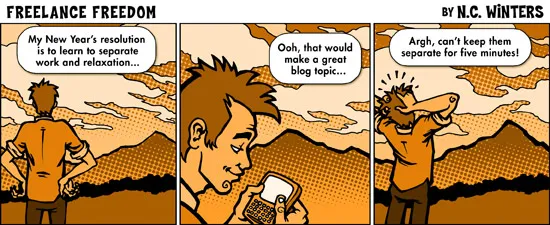
Remembering the year in weird
My favorite list of Top 10 stories for 2007. East Tennessee is certainly a contender for the title of “Home of the Weird Story.”
Got a problem, ask a librarian
When people need answers, most turn to the Internet, but don’t turn out the lights at the public library. Eighteen to 29-year-olds, known of Gen Y’ers, are the heaviest users of libraries for problem solving information, says a new Pew Internet and American Life study released Sunday.
I hadn’t really thought of the library as a youth haunt, but Gen Y respondents were startlingly far more likely to go to a library to solve a problem than the next group up, Gen Xers, those who are 30 to 41 years old.
Course, they could be going for free access to computers.- about 70 percent said they used a computer at the library.
We’re not talking the homeless or just people on the slow end of the digital divide. The study says::
While libraries have worked to become the place to go for those who cannot afford a computer or an internet connection, people with high access are equally likely to turn to libraries for government information as those with low access. Instead of the internet making libraries less relevant, internet use seems to create an information hunger that libraries help satisfy.
Mirror, mirror on the …
On Thursday I hung out at the family business in North Carolina for a short while.
Crowdsourcing fatigue
 Once the glow of they’re finally paying attention to what I say fades, some are seeing crowdsourcing as a one-sided relationship that is all about giving with no getting.
Mary Ann Chick Whiteside says Tara Hunt has hit on the some of the same problems she has with crowdsourcing.
Hunt writes in “Please Stop Crowdsourcing Me:”
Christmas morn
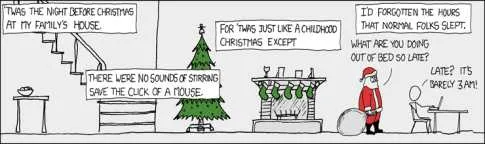
Paper View Monday comes to Knoxville
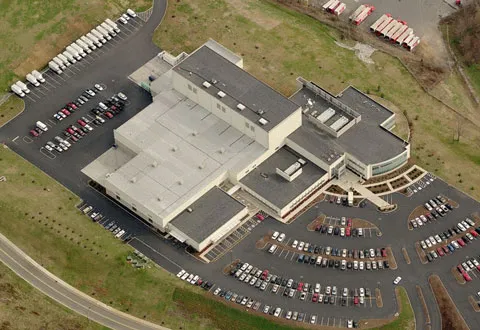 William Hartnett, a reporter at the Palm Beach Post, features the Knoxville News Sentinel in his Paper View Monday series of aerial views of newspaper plants.
Hartnett says the aerial shot (or bird’s eye view as Microsoft calls it) of the News Sentinel building was just added in the last few days to Microsoft’s Virtual Earth/Live Maps service. Looks like the Microsoft team did a big dump of Knoxville images. The News Sentinel has been in this building since 2002, but finding its address (2332 News Sentinel Drive) is still a bit spotty with online map services so this is pretty good. I think I see my car!
Zoomable version of the shot is here.
Thanks, Will, for the Christmas Eve present! I enjoy your Paper View Monday blogging.
Sunshine Sunday
The Newscoma points to a new Tennessee Sunshine site.
Some buzz for reform
This is getting some buzz, but it deserves a lot more.
Congress has sent to the president a bill this week that substantially reforms the federal government’s Freedom of Information Act process by calling the game on some common stonewalling tactics and opening it to more free access from non-traditional journalists, bloggers and other thorns in officialdom’s side.
The bill is called the Openness Promotes Effectiveness in our National Government Act and thankfully goes by the acronym laced, OPEN Government Act. Passage was a bipartisan effort in Congress.
President Bush has some quibbles with the bill, but the White House has not indicated that a veto is likely. Hopefully, it will become the law of the land.
Supporters hailed the passage:
“This is the most significant victory for transparency in the federal government in more than a decade,” Reporters Committee Executive Director Lucy Dalglish said. “There is still much work to be done, but this is a major step toward a more open and accountable democracy.”
Who cares?
Scandal fatigue or just maybe people don’t care about local government?
Those are two theories from a couple of Knoxville area bloggers who usually only agree that they are both passionate about news and politics.
They are reacting to radio talk show host George Korda’s column about an “interesting lack of interest” in grilling County Commission Chair Scott Moore on the various county scandals and shenanigans.
It’s not like it has been ignored by the news media.
Web Celeb in our midst
Tuesday evening Forbes magazine published its second “Web Celebs 25.”
What’s a Web Celeb? Forbes says its a person famous primarily for creating or appearing in Internet-based content, and for being highly recognizable to a Web-based audience.
At No. 21 is Glenn Reynolds of Knoxville, of whom Forbes says:
By day, Glenn Reynolds is the Beauchamp Brogan Distinguished Professor of Law at the University of Tennessee, and an expert in space and technology law. His opinions have appeared in publications ranging from The Columbia Law Review to The Harvard Journal of Law and Technology. But to most of the world, he’s better known as the voice of Instapundit–a hugely popular political blog with a libertarian spin. In 2006, he published a book, An Army of Davids: How Markets and Technology Empower Ordinary People to Beat Big Media, Big Government, and Other Goliaths. With his wife, forensic psychologist Dr. Helen Smith, he produces a weekly podcast, The Glenn and Helen Show.
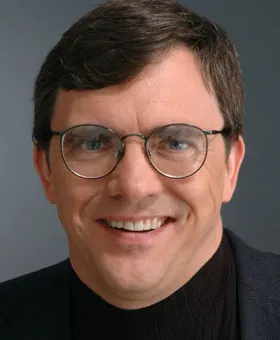
From serial killers to race and IQ
I’m glad to see author and New Yorker magazine writer Malcolm Gladwell blogging a little more regularly. Lately he’s written on race and IQ, Kenyan runners and serial killers.
I googled you and found …
 The quick headline of a Pew Internet and American Life Project study released Sunday afternoon is close to half (47 percent) of people have googled themselves, up from just over one in five (22 percent) in a similar study five years ago. But the real news in the study, “Digital Footprints Online identity management and search in the age of transparency,” is that people aren’t that worked up about privacy. There’s been a shift. And for younger people, as you might expect, it’s happening at faster rate. I can remember people freaking out over a land transfer or divorces granted listing being put online, but it was OK to put it in the paper. Huh? The local audiences of the two weren’t even close and it’s OK to be in the bigger one, but not the smaller? Sixty percent today say they’re not losing sleep over it. That’s dramatic! And when you slice it into subgroups, the one the Pew researchers call the “The Unfazed and Inactive” group is neither worried about their personal information online nor taken steps to limit the amount of information that can be found out about them online. Those people are in the largest grouping at 43 percent. The study offers that privacy. or the expectation of privacy, is a casualty of 9/11. But that doesn’t begin to explain how much information people are willing to post about themselves and the comfort people have with online transparency and presence. How it will evolve is anybody’s guess. That crazy thing you did in college or even high school that got posted might be given more latitude in the future as people get used to finding such things. Or people might get more demanding of their ability to control what’s known about them. One thing for sure, these footprints in the sand aren’t washed away by the tide. As for googling oneself; I’d call that prudent rather than self-obsessed. It’s a good idea ot be aware of what’s out there about you, I think. (Photo by Melanie Ehrenreich)
The “Don’t Taze Me, Bro” Christmas Meme
I had requests for Christmas pictures. Well, to be truthful, I had one, but then the Newscoma started this with a double-dog dare.
So a double-dog combo to go, photos and a blog meme.
Rules for the game include:
- Link to the person that tagged you, and post the rules on your blog.
- Share Christmas facts about yourself.
- Tag 7 random people at the end of your post, and include links to their blogs.
- Let each person know that they have been tagged by leaving a comment on their blog.
Suntan lotion not needed
An update on what’s being said about reforming Tennessee’s Sunshine Laws:
Google sometimes reminds me …
 I don’t have any particular angst about Google. In fact, i love the company’s products and am a heavy user. Among my favs are Google search, Google Reader, Google Docs, Picasa, GrandCentral, Google tools for Webmasters, Google Analytics, and Google Apps for your domain. Wonderful stuff.
But sometimes the company does remind me of a railroad in the Robber Baron era.
Google (NSDQ: GOOG) accounted for more than six of 10 online searches in the United States in November, more than triple the amount of its closest rival Yahoo (NSDQ: YHOO), a Web metrics firm said Tuesday.
Glued to Windows
Bryon Chesney’s Twitter made me laugh: I once briefly had a blog called “Only in East Tennessee.” but almost everything that happens here is a bit like that.
bchesney I swear I am running the tech support version of SNL’s Appalchian Emergency Room, guy just called with a XP CD glued to the side of his head
Gestalt therapy
Forrester analyst Jeremiah Owyang and influential blogger Mathew Ingram both noted that Twitter.com has become a big referrer of traffic to their blogs.
I had noticed that same trend on this very own blog, but thought that it was an effect warped by the small amount of traffic I have. But Owyang and Ingram are well-trafficked blogs. So it’s a trend worth watching. For this site, Twitter.com is up to No. 5 in referrers, surpassed only by Google, Google images, a Knoxville site that is linking to one post, and direct traffic, according to Google Analytics.
Says Owyang:
Twitter is one of the top referrers of traffic to my blog, over 2000 referrers from twitter to my blog in the last 30 days…there’s something happening there.
Top J-Bloggers
Top 10 journalism blogs in the U.S. from Paul Bradshaw with caveats.
Ancient longleaf pine found
 You think of redwoods living a long time, giant awe-inspiring towering trees, but a pine tree?
I noticed in the Charlotte Observer today a story picked up from the Greensoboro News & Record about a stunted, gnarly pine tree that scientists say is 459 years old. Yes, 459 years.
The discovery is thought to be the oldest longleaf pine in the world, but it’s possible there are others even older where it was found in theWeymouth Woods Sandhills Nature Preserve in Southern Pines, N.C.
The tree, which by all accounts is not a majestic looking specimen, was discovered by two researchers from the University of North Carolina at Greeneboro Tree Ring Science Lab as part of drought research.
Henri Grissino-Mayer, a longleaf pine expert at the University of Tennessee, says of the discovery:
“We have found older longleaf pines but they are all dead now,” Grissino-Mayer said. He noted that the oldest on record lived 490 years in Florida.
“Finding a longleaf pine dating back that far is exceedingly rare, extremely exceptional.”
Mojo kit
These Nokia N95 and peripherals mobile journalism kits looks intriguing. Anybody used this in the field for an extended period of time? Feedback?
Mooning with Venus
 My wife suggested this would make a neat photo and I agree. It’s the moon and a star (i guess, as opposed to a planet) in the upper part of the frame. Can any of you astronomical types enlighten me? It was taken just before sunrise today.
Click through on the image to see a larger version on flickr and leave a comment (if you like it).
Update: Venus? StarDate says for Dec. 6: “Look below Venus at dawn for the crescent Moon, which is at apogee.”
Sunshine Sausage tasters
 Joe Lance of “the pulse” in Chattanooga has a good opinion piece on the Sunshine law “reform” called “A Quorum, a Forum, or a Threesum?”
Lance is one of many disturbed by a state legislative committee’s Sunshine Sausage.
Update: Trace Sharp has a photo.
Michael Silence has been doing yeomen’s effort of trying to keep up with what’s being said statewide by bloggers and others. Below is a list of links including Silence’s coverage that are drawn from Knoxville Blog Network’s feed search and widget tool. Since the link lists are javascripts, they won’t show up for RSS readers; you’ll need to click through to this post.
Other voices are weighing in across the state.
(photo from William Conway)
Bubblegum music
This is too funny – and too true.
Update : The video in the link has been taken down by YouTube. The creators say they were doing parody and had a fair use right to the content they used. Someone disagreed. They hope to work it out.
For kid’s sake
The Dec. 10 issue of Forbes magazine list features a Knoxville non-profit under the heading of “This Is Charity?”
The magazine says the Knoxville-based Youth Development Fund of Richard Bowen raised $3.1 million, but only had 19 percent left after fund raising expenses and only spent 18 percent on its mission.
The average for the largest 200 U.S. private charities is 90 percent is available after funding raising and 85 percent goes to the mission, Forbes says.
It wouldn’t be the first time Bowen, whose charity paid him a $363,100 salary in fiscal year 2005, has gotten some media attention.

Sunsetting Sunshine
Russ McBee sees some rays of hope in the dimming Sunshine law “reform” that’s coming out of Nashville.
My view? Best thing that could happen now is to leave the totally ineffectual, weak Tennessee Open Meetings law as is cause the reforms are worse.
It’s a roller coaster out there
Barry “Inn of the Last Home” Wallace emails that his college roommate Gary and his brother, Phillip, have put together a website about amusement parks: RexandTheBeast.com. They will be doing reviews and reports of new rides.
Separating the audience from the customer
White nationalist Hal Turner, who has found more to hate in this life than nearly everybody, has this message posted on his show’s Web site about going to a subscription site on Nov. 28:
.
Free WiFi at McGhee Tyson would be a leading-edge idea
In the wonder-why-we-don’t-have-it-here department.
While most large airports have Wi-Fi in their terminals, it is smaller airports — those serving 500,000 to 2 million passengers annually — that have full Wi-Fi access, and many of those airports offer it for free , according to the ACI.
In aisle five
Attention Christmas shoppers: Chris Pirillo shares tech buying tips.
Just watching
J ust like watching the detectives.
Don’t get cute!”
It’s just like watching the detectives.
I get so angry when the teardrops start,
but he can’t be wounded ‘cause he’s got no heart.
Watching the detectives.
It’s just like watching the detectives.
-- Elvis Costello
A special legislative study committee may decide to recommend “reforms” to the state Open Meetings Act today. Hopefully, it’ll all be transparent.
Dollywood values
On Dollywood values seen clearly from afar. Expect for not dealing with race, this picture of Dollywood is iconic of the conundrum that is the South.
Your flight has been …
This is neat and useful. A map showing flight delays out of McGhee Tyson (or any airport).
Mashable says the site launched just before the Thanksgiving travel rush.
Watching your Qs and Rs

A beacon in the shoals
Obviously, a lot of people from MoveOn.org to the other end of the political spectrum are weighing in negatively on the Facebook Beacon. But when it’s wigging out smart people like Forrester’s Charlene Li, … uh … it might be time to rethink.
Soon it’ll be more popular than pop up ads.
Sign of the times
 The virtual version of pulling up the other candidates’ signs?
Accentuating the issues
Is a Southern accent a political liability?
Sez David Freddoso:
It takes conscious effort for some New Englanders to overcome the First Impression that Southern Accent doesn’t equal perhaps deliberate ignorance…Yes, it’s prejudice, but try and get a New Englander, a genuine Yankee, to admit a shortcoming like this. It’s almost always rationalized as something else, and thinly…
Long Journey Home
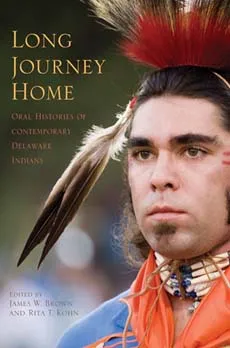 Longtime friend and journalism professor Jim Brown has a new book coming out, Long Journey Home.
Be careful out there
The dark, and very sad, side of social networking.
Meanwhile in Nashville …
There is a battle going on, did you know that? It’s about the right to know. You might think all this stuff is small potatoes or think it doesn’t affect you, but it does.
Getting a fair trial amidst a blogosphere feeding frenzy
Have blog postings – many of them filled with inaccurate accounts – so inflamed a community that it is impossible for a man charged in connection with a brutal murder case to get a fair trial?
That’s a legal argument being made in Knoxville, Tenn., involving the gruesome carjackiing and murder of a young couple, Channon Christian and Chris Newsom.
The attorney for Eric Dewayne Boyd, charged with sheltering the accused ringleader in the crime, says Google returns 27,000 articles for “Channon” and “murder.” I’m not sure what day the attorney, Phillip Lomonaco, did the search, but he’s severely understating what’s on the Internet. On this day, I got 50,400 returns from Google with those two words in the search box and further tests yielded somewhat varying results. Click the link and see what you get.
The murder which occurred in January 2007, already has reached “urban legend” status with an entry on the popular urban legend site Snopes.com.
There are at least 66 videos on YouTube when you search for Christian Newsom. Laomonaco said he found 82, but I’m sure what his search terms were.
There has been a circus-like rally by white supremacists with counter-protesters.
The attorney said in a court filing, the Internet buzz “spread lies and helped create an urban legend surrounding the details of the final state of the victims’ bodies — details meant to outrage and taint any jury pool.”
There hasn’t been a ruling on the attorney’s motion, but a story from The Associated Press quoted George Washington University law professor Stephen Saltzburg:
“Judges have always been aware that potential jurors get their information in a variety of ways,” said Saltzburg, who chairs the American Bar Association’s Criminal Justice Section.
“It used to be newspapers, then it was newspapers and television. Then it was newspapers, television and cable channels. Now it is newspapers, television, cable channels and blogs and Internet messaging.
“I don’t think it changed anything,” Saltzburg said, adding that Internet concerns can be addressed with existing remedies, such as careful jury instructions and screening.
In search of the TRS-80 of the 21st Century
Editorial Comment: I’m My Wife’s Grandpa
I had to post this one cause it’s about the home state candidate and it’s just dang innovative for stodgy old opinion writers. And it’s the funniest thing I’ve seen in awhile.
The Wichita Eagle opinion staff has created a satirical video about the age and looks gap between two presidential candidates and their wives.
Damn, two Fred videos in the space of as many days.
(via Howard Weaver)
How blog subscribers are counted
An excellent and in-depth explanation of Feedburner subscriber and reach stats, and why they go up and down from day-to-day.
This is a better description of Feedburner stats than I’ve been able to find on Feedburner’s site. Good stuff!
Oh yeah, subscribe to my feed.
Fred Thompson savvy Internet campaigner
Is Tennessee’s Fred Thompson the savviest presidential candidate at appealing to the net community? That’s the question posed by Mark ‘Rizzn’ Hopkins at Mashable.
The video above aimed at liberal movie maker Michael Moore is but one example. Hopkins said:
Sean Hackbarth, of the Fred Thompson campaign, sent me an email yesterday essentially stating that not only is Fred Thompson a lawyer, but he played one on TV, citing his appearances in In the Line of Fire, The hunt for the Red October, Die Hard 2, and Law and Order. As such, he recognizes the value of “star power” in spreading the word about why “Fred will make a great, conservative President.”
Essentially, Fred wants to create the next Chris Crocker or Star Wars Kid by surveying the roster of YouTube-worthy talent in his support base, have his fans vote for the favorites, and then promote the heck out of them, and by proxy Fred (ostensibly on YouTube, although I wouldn’t rule out traditional TV ads).
All you need to do is upload your video, and stay tuned to Fred08.com to vote yourself up. He’s looking for positive videos about himself, trying to stay away from attack ads against his competitors.
Hugh Hefner in large orange and a cap
Bloggers and story commenters had one double-entendre after another and no end of snarky comments about the GVX story Tuesday headlined “Police quiz UT center McNeil, charge three women found in his bed.”
But this quote on the Get the Picture blog, written by a Georgia Dawg fan, is one of the most creative images:
Look at Knoxville as the Playboy Mansion South, and (Tennessee Coach Phillip) Fulmer as a very large, very orange Hugh Hefner, and it all begins to make sense. Strange sense, maybe, but sense…
An iPhone serving
I didn’t know there was an iPhone version of the Food Network.
(via file under awesome by way of slightlypale)
Easily read here
 Wonder if I’ll have to xplainz it to Pee H. Dees?
(via Muhammad Saleen)
The life of a yo-yo
When it comes to yo-yo tricks, I never got much past the Sleeper and Around the World, but I do answer to “Hey, yo-yo.” As a kid, I thought the Duncan Imperial was just the coolest toy. The Duncan Toy Co., which had its own yo-yo history, dates back to 1929. The kids in this video are doing some amazing tricks.
More stories form the just launched Daily Mahalo.
Glancing backward to the future
Interesting to remember:
- iPod and iTunes come out in 2001.
- The first BlackBerry phone was released in 2001.
- Firefox isn’t a browser until 2003.
- RSS with enclosures (podcasting’s guts) happens around Sept 2003.
- Gmail doesn’t exist until 2004.
- Wordpress got popular in 2004 (after Movable Type changed licensing).
- IBM sells its ThinkPad division to Lenovo in 2005.
- Facebook launches in 2004 and opens to the masses in 2006.
Greasing foul-ups with humor
It’s certainly not how it would be done by the corporate book, but I like a sense of humor when things screw up with computers as they will and do. Here’s an example from over the weekend from the Feedburner blog:
Saturday Subscriber Count Drop?
If you saw your subscriber count drop precipitously in your Saturday, November 3rd summary from FeedBurner, the reason is that specific subscriber stats from Google Feedfetcher were offline because this service was apparently out late with friends on Friday night, and well, it completely slept through Saturday. It appears to have rallied, however, and amid firm declarations of “I’m never doing that again”, Feedfetcher has started diligently reporting subscriber numbers to us, early this morning Pacific Time. FeedBurner publishers’ subscriber counts should be closer to what you’d normally expect starting with reports that will be available on Monday morning.
Sunday
Blogging from the car wash! Beautiful day.
Vitamins for your Twitter feed
Carolina Middlebrook on growing you Twitter audience. Could use this as a to-do checklist.
Follow my Tweets.
Halloween nights

See some more of my 2007 Halloween photos at flickr. This pumpkin was carved by Amy. Some people have had a hard time seeing the design. Do you see it?
RSS feeds get less geeky; more cheeky

The UK’s Daily Star is promoting its RSS feeds with the photo at right. No wonder U.S. newspapers are considered dull.
Subscribe to this blog feed.
(via Martin Stabe / Daily Star photo)
Appreciating community
 Think the social nature of the Internet is just for 18-to-34 years olds – or younger? Think community is your neighborhood? Think everything online happens in the highly wired, tech meccas?
A mind meld for search engine fatigue

When the team goes to the pits
 Question: Does a team fall apart from the stress of things not going well or do things begin to not go well when the team falls to work together?
For those who aren’t NASCAR followers, this is a photo of Roush-Fenway driver Carl Edwards getting angry enough to almost punch teammate Matt Kenseth following Sunday’s race in Martinsville, Va.
See the YouTube video.
Edwards yesterday said a feud had been brewing. Both drivers have been fading in the Nextel Cup Chase. Edwards is fifth and Kenseth is 12th.
B movies be free
 A local business blog has has some insights to an interesting new Web venture in KnoxVegas, bmovies.com from DMGX.
It launched Oct. 5 without advertising or SEM, but is attracting viewers rapidly.
Wade Austin of DMGX says:
The business plan is based on 2 core premises: 1. People will watch anything for free, and 2. Off the radar movies can be broadcasted for next to nothing.
I’d give you a good cussing if it’d do any good

Random thoughts on cursing, cussing and dirty words in general.
Steven Pinker uses 5,200 words to explain why we we curse in The New Republic article Why we curse, but he could have just stuck with “To begin with, it’s a fact of life that people swear”
It’s interesting that The New Republic decided not to use the illustration that was created for the article.
A lot of people have happily picked up on this report that Swearing at work ‘boosts team spirt, morale’ But it’s not likely to win friends in HR.
And then there are words that sounds dirty that aren’t.
And ones that should never be used in an email subject line.
Cartoon from Jeffrey Rowland/Overcompensating.com (larger version) and tip via Brittney Gilbert
Internalizing the problem
“Link Crack” for blogging enterprises; they can’t stop.
Critics “with attitude”
Oh my!
Greg Sterling on his encounter with a restaurant that has posted a sign that says “No Yelpers.”
Snarky! Imagine that.
Could this be UCG backlash?
To work, users reviews aggregated have to approach the truth to be valuable to the community using them. Buyers/user/patron reviews are powerful influencers of behavior. But what of trolls, people with a vendetta and people who just get it wrong?
Interesting debate.
Even in business, it’s a dog life
This post could be called the Harvard Guide to Business Success (if your dog is named Harvard).
There’s some treats in there that could well be applied to business – and life.
And I’ll add one: Getting hung up on details is like having fleas.
Louder than Neyland?
 Now, East Carolina football fans (where I went to college) have had a rep for being a tad bit on the rowdy side. There have been those four little incidents (see photo caption), among others, at N.C. State.
But louder than Vol fans in Neyland?
ECU athletic director Terry Holland includes this quote in an email to ECU supporters:
“To be honest, I’m not so sure that 43,000 wasn’t louder than that 107,000,” Southern Miss defensive coordinator Jay Hopson said. “I was like, ‘Goolllyy!’ That was a loud crowd that rocked for 60 minutes.”
Southern Mississippi took on the Vols the week before. Times are tough in Volville when the opposing team says what often is the largest crowd in college football on any given fall Saturday is just not as loud as some places they visit.
Seagrove videos
I found several excellent videos on some of the potters I know in Seagrove, NC. We’ve bought several (as in lots) of pieces of Terry and Anna King and their daughter, Crystal. Terry King, who I went to high school with one year, also talks a bit about my favorite Seagrove potters, Dorothy and Walter Auman, who made our wedding china. You need to go yourself!
The videos were done by Dan McCoig. He’s got lots more videos from the Southeast. I noticed several out of Great Smoky Mountains and East Tennessee.
Hey Dan, I like that Knoxville cap. I’ll send you a knoxnews.com cap if you want one!
Holy Hyphenation!
18,000 wordsjust lost their hyphen, victims of tex(-)messaging and e(-)mail.
But Google still loves ‘em.
(via Steve Rubel)
Will I even need a mailbox anymore?
Where have I been been not to know this.
12 Bones
He’s sold me on this place.
Tweet, tweet to the music
Last night was bloggers night at the Symphony. The symphony in a gambit, I persume, to generate buzz gave bloggers free tickets to the opening night concert at the Tennessee Theatre in downtown Knoxville and they got to go to a special post-concert reception.
I followed it some last night as it was live Twittered. It was historic! It was the first Knoxville event that was live Twittered. These are some I noticed. There may have been others. No, I have no idea what the marmalade is about.
From bchesney ...
It’s 1:50 am, why am I still awake? Oh yeah, I had to write the KSO blogger night reivew: https://tinyurl.com/2eqowv about 7 hours ago from web
Just got back from KSO, had to leave blogger party early, babysitter needed to go home. Getting ready to blog. about 11 hours ago from web
From Djuggler ...
Did anyone that went to the kso tonight catch who the group of 34 people were who were pointed out in the beginning? about 10 hours ago from txt
That was a joke thank you! What a blast the reception was! Couldn’t leave because noah mad friends with the conductor’s son. about 11 hours ago from txt
Too much champagne and wine. Letting noah drive home. about 11 hours ago from txt
Occasionallyi tgifk the composes channels jack black about 12 hours ago from txt
Intermission. Great show thus far. Thought the audience failed to applaud twice. about 13 hours ago from txt
Excellent seats! See https://flickr.com/photos/mc… about 14 hours ago from txt
We have arrived. Getting noah some champagne. about 14 hours ago from txt
Parking about 14 hours ago from txt
I think noah has looked out the car windows for the first time in 5 years. “there’s a lot of nice houses on this road.” lyons view about 14 hours ago from txt
Bending space and time to make up for leaving 15 minutes late. about 14 hours ago from txt
The other bloggers will be wearing pajamas to the kso also right? about 14 hours ago from txt
Getting ready to see the Knoxville Symphony Orchestra! https://tinyurl.com/2fb55r at the TN. about 15 hours ago from web
From LissaKay ....
Wondering if peach preserves is as good as marmalade …about 11 hours ago from txt
@djuggler Even better up here! https://tinyurl.com/2glxpy about 14 hours ago from txt in reply to djuggler
@djuggler we’re almost there too! about 14 hours ago from txt in reply to djuggler
@lasthome Pbbtht! :p about 20 hours ago from txt in reply to lasthome
BREAKING NEWS: I blogged. The blogosphere reels in shock. All three regular readers rush to their feed aggregator to mark the rare occasion about 20 hours ago from Twadget
From cathymccaughan ...
Considering going to the grocery tomorrow for marmalade. about 11 hours ago from web
@bluesloth @djuggler He knows it annoys me when he twitters while driving. Multitasking is not his forte. about 14 hours ago from web in reply to bluesloth
They call posting on Twitter micro-blogging. If you’re on Twitter, consider following my Tweets.
And, oh yeah, local bloggers did do a lot of blogging from their night at the symphony.
Bloggers as a niche market?
Bloggers night is going to be a regular monthly event at a Knoxville establishment, says Les Jones..
On being there (Florida version)
 Megan Taylor, writing on News Videographer, has an interesting covering-the-coverage piece on last week’s Andrew Meyer “Tasergate” story.
Ah, Internet-attention-span-readers, remember back to early last week before Chris Crocker’s whole Brittney thing to the University of Florida student Tasered by police during a John Kerry campaign event on campus. OK, here’s the story which is still big in Gainesville.
Anyway, I found it interesting that even with videos from two different angles, people can’t agree on the facts of the incident. Police are tracking down the people that can be identified in the videos as witnesses.
(Florida Alligator / AP photo)
Connecting the dots
It looks like Open Social Graph, or whatever people start calling it, is gaining momentum.
(I’ve also seen it referred as social network portability. Dave Winer says skip the geekness and call it a social network. Hey, Dave, for most of us normal folk, the name Social Graph is about the least geekiest thing about this idea.)
SmugMug, a photos sharing site, implemented the Open Social Graph technologies (XFN, FOAF, OpenID) just a day after David Recordon posted his “manifesto” on blogging software and social networking company SixApart’s site.
First, the basics. Recordon says the Open Social Graph is based on the ideas that:
- You should own your social graph
- Privacy must be done right by placing control in your hands
- It is good to be able to find out what is already public about you on the Internet
- Everyone has many social graphs, and they shouldn’t always be connected
- Open technologies are the best way to solve these problems
Reading your feed leaves
And I thought it was just a search tool! Fascinating possibilities from Steve Rubel.
NWS changes weather warnings
The weather service goes hyper-local!
Twitter stream
You can get some interesting juxtapositions in your Twitter stream …
Make a blog marketing move
Knoxville bloggers: Increase your priority in Knoxnews’ blog network by just adding a link on your home page to the blog aggregator and email me the link. It’s free; it’s painless. Why haven’t you done it already?
Murder and manslaughter create wordsmith mayhem
In addition to the earlier reporter math alert, we have a copydesk fact alert just to be fair and balanced.
Well poke me
I was clueless on the purpose of a feature without any specific purpose. I wonder if I am innately clueless or if it’s a talent developed in (biological) maturity.
Of Xs and Os and Averages
Reporter math alert from Semantic Compositions.
Using the tools at hand
The value of video conferencing on the cheap was demonstrated Sunday when the Society of Professional Journalists president used her Macbook to do a video conference at an event of the society’s East Tennessee chapter in Knoxville.
Mashups: Ya a weem o wep a weem o wep
A pretty amazing campaign mashup of where the presidential candidates are traveling complete with Youtube videos of their speeches there.
The site says:
Take control of your phone
I agree with Merlin Mann that GrandCentral’s feature set holds a lot of potential for managing phone contact. I wish Comcast would steal a few of these ideas and my work phone acted a lot more like it.
That said, anyone who has had the same phone number for a long time may find it hard to get friends, family and business/professional contacts to switch to the GrandCentral number.
Mad Jack
 I wasn’t really mad, but it looks that way. It looks bizarre! I was testing the camera on the Nokia n800 Internet tablet. It created a 640 pixel wide image.
Testing a Nokia n800
I’m testing my ability to post to my blog with this tiny Nokia n800 Internet tablet and a Bluetooth keyboard. It actually does seem to work! Although it took a little trial and error. Steve Yelvington inspired me to try to see if this could be used for remote posting. I haven’t gotten use to the keyboard, but other than that, it’s pretty sweet. Sort of a poor man’s iPhone. Course it’s not a phone, but rather an Internet tablet ( www.nseries.com/products/n800 } Worth taking a look at if you just need to surf and not a phone.
Music to your ears
Radio personality Frank Murphy has the scoop on a freebie bloggers. And there’s a deadline involved.
It’s an interesting trend you’re seeing more of: “Press passes” for bloggers; review units of smartphones from Nokia, cameras from Nikon. The power of the trusted recommendation!
The 140 character campaign
Everybody knows John Edwards Twitters, but I just figured out soon-to-be-official prez candidate Fred Thompson does as well. Well, his staff touts him in Tweets for him.
Confirming just now that Fred will make a call-in appearance at tomorrow night’s house parties: https://tinyurl.com/3ycpx5 [staff]
Knoxville blog aggregator
We’re rolling out an area blog aggregator on knoxnews.com at blognetwork.knoxnews.com. Take a look and let us know what you think.
Where’d you say you’re from?
This is an interesting toy …. if it works
It’s from maps.amung.us
(via TechCrunch)
SonicWALL update
Perhaps, I’m no longer running a porno site.
The request has been reviewed and rated as:
“31.Web Communications” at 2007-09-02 13:28:08.520You should see this rating change reflected within 1 to 3 business days.
Thank you for your request,
SonicWALL CFS Support
Banned from Panera
I wouldn’t give you Jack for that
Naming rights for a person?
That’s a new one.
But Stan Oleynick, a 23-year-old Sacramento, CA., is taking bids on his Web site, holdmyrecord.com, to rename himself.
It’s a ploy to raise money for his start up. The winner also gets a 10 percent stake in the fledgling company, which may release its “revolutionary” product in September
Oleynick promises to try to break a Guinness Book record to get his new name some good pub.
And you can buy it now for $250,000 or bid on it. The current top bid is $16,000.
It was crazy enough to get me to write about it.
(via Read/WriteWeb)
Concert tweets
Now that Twitter has a search box, i discovered A.C. Entertainment Twitters.
What Facebook is …
I wish I had thought of this description: Facebook Is Viral Viagra
She’s a winner
 Almost 11 months ago, Cathy Clarke, a News Sentinel photographer, was seriously injured in an automobile wreck while on assignment. See earlier posts.
Some photo staff folks got together for a luncheon to present her with a Tennessee Associated Press Managing Editors’ first place award in feature photography. The winners were announced in Nashville in July.
Find sex offenders around your neighborhood
A lot of the “mashups” (a web application combing data from more than one source) I see only cover San Francisco or California or maybe just a few major metro areas, but here’s one that includes data on Knoxville – and it’s useful too.
Vision 20/20 has created a nationwide sexual offender database/map mashup.
Go to the map search and enter Knoxville for city and TN for state. You might be surprised.
The company, which says it is committed to “Peace of Mind” products, frames this one around:
There are 650,000 registered sex offenders in America - and that number grows by about 25,000 every year. Wouldn’t you like to know if any of them are living in your neighborhood?
Yo, we’re moving things around (again)
Made the jump to using Feedburner.com for my RSS feeds.
There shouldn’t be any issues for existing people who follow my feed. I redirected the old links. But if something doesn’t work for you, let me know.
And subscribe to my feed.
Facebook facts
If you’re still trying to figure out the whole Facebook thing, then here’s a cheatsheet:
Upgrade complete (mostly)
Survived upgrade. Still tweeking. Moved blog and blog feeds to root of www.jacklail.com. Users should be automaitcally redirected. Feeds should update. Most difficult part was updating the templates. I finally found it easy to “export” the blog entries, delete the blog and re-import them into a new blog by old name.
Upgrading in progress
Please excuse the mess, I’m upgrading to MT4 today.
Zero time zone
Think just getting more organized will make you more productive; maybe not. Jimmy Guterman found the GTD regime does not work if …
Stowed with Google
Folks may not pay for content online, but I’m betting they’ll pay to keep their content online … and so is Google. From the Google blog
It’s not a Wonderful Life, but I like it …
| I’ve become a fan of TNT’s ‘Saving Grace’ that started coming on TNT in July. Totally surreal premise, but, hey, I’ve got a lot of practice at suspending disbelief. You’re headed for hell, Grace, but God’s given you one last chance. He sent me to help you. -- Earl, the guardian angel. Not exactly Jimmy Stewart and “It’s A Wonderful Life.” Holly Hunter makes it work as the cynical and saucy Oklahoma City detective Grace Hanadarko. I hope the scripts continue to be fresh as the episodes I’ve seen. I really like the theme song, “Saving Grace” by Everlast. He does it with some promotional video of the show in the YouTube video above. Give it a listen; good song. Everybody could use a guardian angel and a little Saving Grace, couldn’t they? Tags: Saving Grace | Holly Hunter | Everlast |
Tweetsourcing news
| Rex Hammock has coined a new term: Tweetsourcing. He says don’t tell reporters. Follow me on Twitter. Tags: twitter | tweetsourcing |
Discovered on a byway of the campaign trail
 I recently discovered the Rocky Mountain News’ M.E. Sprengelmeyer was doing a presidential campaign blog called “Back Roads to the White House.” It’s been a fresh read on the campaign. Take his McStrategy post. Hadn’t read that one before. What first caught my eye were the photos he’s taking and he’s a writer; not a photographer. Yet he’s capturing what it’s like between sound bites. But maybe what was most interesting is how I found it – from a Facebook group he created. This evening he had 58 photos posted in his Facebook group. Some are calling Facebook the new business card; maybe it’s the new portfolio? Tags: presidential campaigns I recently discovered the Rocky Mountain News’ M.E. Sprengelmeyer was doing a presidential campaign blog called “Back Roads to the White House.” It’s been a fresh read on the campaign. Take his McStrategy post. Hadn’t read that one before. What first caught my eye were the photos he’s taking and he’s a writer; not a photographer. Yet he’s capturing what it’s like between sound bites. But maybe what was most interesting is how I found it – from a Facebook group he created. This evening he had 58 photos posted in his Facebook group. Some are calling Facebook the new business card; maybe it’s the new portfolio? Tags: presidential campaigns |
2008 elections | M.E. Sprengelmeyer |
Driving text messaging
| I wonder how many were drinking, driving and texting? Tags: texting while driving | SMS |
Pownce invites
I have a few Pownce invites if anybody needs one.
Twitter and real people
The “what is Twitter” discussion continues. Scott Karp’s take is one of the better ways of descrbing it to people who have never used it, but even he says “If I’ve failed to explain Twitter to you, that probably means you’re a real person.” If you have the answer, Twitter me. Course, I might not be a “real” person. Tags: Twitter
eBay country
Attention Internet sellers. Bryon Chesney noticed the venerable Scarborough Research says Knoxville, Tenn. is tied for No. 2 in the penetration of eBay among Internet users. It’s an interesting list. Some factoids from the release:
Kudzu of Connections
I’ve seen a lot of thoughtful react to Jason Calacanis’ weekend post about Facebook bankruptcy, but Ethan Kaplan has the best two sentences I’ve read:
Just like the Astronaut Farmer
Arvinder Kang from Ole Miss pointed me to this strange project from a guy who grew up in Knoxville and South Africa, and now lives in Greensboro, NC. He’s creating an IMAX movie from still photos. Ah, yes. There’s a web site Stephen van Vuuren says he is creating an “IMAX movie in the basement.” I think it’s kind of a Billy Bob Thornton “The Astronaut Farmer” does a big budget movie in the basement instead of a rocket ship in the barn. According to the Web site, the movie “Outside In” is a giant-screen visual symphony that aims to artistically bridge science and spirituality as it journeys from the big bang to the Cassini-Huygens Mission at Saturn.”Outside In” is a giant-screen visual symphony that aims to artistically bridge science and spirituality as it journeys from the big bang to the Cassini-Huygens Mission at Saturn. Well, he tells his story here:
iPhone sex appeal overrated!
| Here’s two video views of the sex appeal (or social networking creds) of the oh-so-trendy iPhone. iPhone of the Sexes from New York video blogger Ilana Arazie and iPhone Lovin’ from the Wall Street Journal’s Andy Jordan and his new Tech Diary video blog. Gee, maybe iPhone owners will just have to use it as a phone/iPod/Internet device. Go figure. Tags: iPhone | sex appeal | social networking | adult toy |
Thumbs up to the CNN/YouTube Debates
Woohoo! Jackie Broyles and Dunlap did wonders for Tennessee stereotypes during the CNN/YouTube debate on Monday night. They were funny, but my, oh my, they’re the image Tennessee wants to project about itself? They’ve got a lot of other videos here.
@johnedwards
| It is interesting that Democratic presidential hopeful John Edwards seems to be the only candidate attempting to use Twitter as way of communicating with voters. The Twitter blog says Edwards will answer Twitters during a live Webcast following the Monday YouTube/CNN debate among the Democratic hopefuls. Edwards’ Twitter page is twitter.com/johnedwards, but see the Twitter blog for details. There’s some discussion of the YouTube/CNN debate here and all the official info here. Is Twitter an effective platform for creating dialogue and connection to voters or customers, or is it just micro-blogging among friends? It’s already obvious that YouTube will be a campaign factor, but Twitter much less so. Edwards is approaching 3,000 Twitters users following his postings, which will get sucked into Google’s search results. That’s a small number for a nationwide political campaign or any kind of national marketing campaign; he’s definitely early to the technology. (I was able today to get knoxnews headlines coming back into Twitter by using twitterfeed.com. Nice! Follow knoxnews at twitter.com/knoxnews. Ignore the coffin colors.) Tags: Twitter | YouTube/CNN Debates | John Edwards |
Reality check
 Too funny. Faith Hill gets a
 A little planning would help
What happens to your virtual life when the physical one ends? Tags: personal planning
Less ka-ching
This looks to be a very good page on getting a deal on a hotel room. Tags: cheap hotel rates
Cash potential
| Keep repeating, there is no blogging “A-list.” Knoxville’s Glenn Reynolds and several others could have been included in the BusinessWeek slide show above among those building audiences, brands and businesses through their blogs. Seriously, A-list or not, among the wonderful stories of the blogging phenomenon is the creation of small businesses that are highly rewarding personally, professionally and financially to their creators. The BusinessWeek slide show highlights but a few. Tags: blogging | entrepreneurs |
Ya, Google!
Yahoo! has been taking its lumps in the last few months and there were rumors of a Yahoo-Microsoft combination as the only way to take on Google, but Robert Young, writiing on Publishing 2.0, comes up with six reasons why Google, yes Google , should snap up Yahoo!
Strange bird sighting

The Dollar General store of Social Networking
| In the continuing MySpace is so 2006 storyline, there’s a report that says that usage among the ever-fad-attuned high school crowd of Facebook is gaining ground while their usage of MySpace is declining. Net scoreboard comScore says in a new study that Facebook has increased its number of US visitors under the age of 18 by about 2.5 times while MySpace has dropped about 30 percent.. MySpace is still leads in that age group, but it’s beginning to look as exciting as toys in a Dollar General store. That goes against the line that MySpace is a high schoolers product while Facebook is a college student product. Facebook began changing all that when it opened up registration to all last September and with its API launched just in the last couple of months. It’s the juggernaut of the summer. More comScore data says in the last year Facebook had 181 percent growth in use from the 25-34 year old demographic, 149 percent growth from the 12-17 year old demographic, 98 percent from those 35 years and older. The lowest increase occurred was with the 18-24 year old demos. Facebook is even attracting no-clue-as-to-a-fad-folks like me. But there there one person in my small work group that says she’s not signing up cause she’s not doing another stinkin’ social networking site, but if she relents it could be a bellwether of sorts (the juggernaut is rolling downhill?). I’ll keep you posted. (via Mashable here and here) Tags: MySpace |
Surprise, surprise, surprise! Google Quotient
 Damn, I’m a 10. The “Online Identity Calculator (beta)” says:
Al Gore Inc.
Must reading for Gore watchers is Fast Company’s “Al Gore’s $100 Million Makeover.” Here’s a guy who was worth, oh maybe, $2 million in 2000, who is worth well north of $100 million today, with a mere $30 million in Google stock options. Is he just now hititng his stride? Tags: Al Gore
Power grid is for the birds
It’s amazing that with all the high tech mumbo jumbo and fail-safe systems we have available in modern society that a bird on a suicidal swoop at a substation can hold the newspaper and 4,299 other customers powerless.
Some handy lists from Mashable
| Mashable is getting good with list posts. On Friday there was this list of keyboard shortcuts for Web apps. I can never remember those things. And earlier in the week, they did an awesome list of video tools. The video space is moving so quickly, I don’t know how long this will be current enough to be useful, but it’s an excellent roundup of the present. Now, these are things I find useful. Tags: Mashable | lists |
Lock me in the open platform
 Whew, everybody’s gaga over Facebook. It’s the “new, new” thing and it isn’t even new! Just look at these blog search results. What changed? Well, expanding it beyond college students helped, but the rage yesterday was a new study that found, heavens, most Facebook at college-educated over-achieving yuppie pups. It’s interesting reading. But really what’s giving Facebook its “new, new” status is the release of the Facebook API, which opened up the network to others making all kinds of useful and not so useful toys for it. LinkedIn is already trying to play catchup, but even through the “Facebook Platform” was only announced on May 28, it may be too late. BlackRimGlasses says:
Free Love
North Mississippi musings
 More on John Battelle’s journey to the North Mississippi hill country. (An earlier post is here.) Battelle is a Silicon Valley icon who was a founder of Wired magazine, a founder of The Industry Standard, wrote the book on Google. He is an entrepreneurial journalist who started and runs a blog business called Federated Media and is an authoritative source on search engines from his Searchblog perch. But on a hot June day in the back woods of the Deep South:
The limelight of hate
Leonard Pitts Jr. writes a column for the Miami Herald that is syndicated nationally. He won the Pulitzer Prize for commentary in 2004 and is the author of “Becoming Dad: Black Men and the Journey to Fatherhood
$10 DSL from AT&T
Rex Hammock notes that AT&T;, the telephone company formerly known as BellSouth in these parts, is offering an unadvertised $10 DSL rate as part of a government settlement. AN AP story from late yesterday says:
It slices, it dices in bankruptcy court
| Ronco, of Veg-O-Matic and the Pocket Fisherman fame, has filed for bankruptcy. Company founder Ron Popell, who sold the company two years ago, also brought modern civilization devices that scrambled eggs inside the shell, a food dehydrator, a pasta-maker and a spray to cover bald spots on people’s heads. Life won’t be the same. Tags: Veg-O-Matic | Ronco |
From jambalaya to icicles in my meatloaf
Karen Knotts, one of the Book Bandits, has posted a Chicken & Sausage Jambalaya recipe that sounds right tasty. She says it came from a “gazillion-year-old Southern Living magazine” and doesn’t have anything to do with books at all, except:
Did you see this fax?
 2007 is the year the facsimile machine died? Not everyone agrees. I still have a fax machine on my desk, but it startled me when it rang the other day. I do have some regular junk faxers, which like cockroaches, will probably outlive the end of the earth, but other than that, I think I receive something I actually need to have about once every five or six months. I could live without it. The newspaper and the newsroom still get a lot of information via fax. Says something about the industry. Says something about PR folks, too. Tags: fax 2007 is the year the facsimile machine died? Not everyone agrees. I still have a fax machine on my desk, but it startled me when it rang the other day. I do have some regular junk faxers, which like cockroaches, will probably outlive the end of the earth, but other than that, I think I receive something I actually need to have about once every five or six months. I could live without it. The newspaper and the newsroom still get a lot of information via fax. Says something about the industry. Says something about PR folks, too. Tags: fax |
facsimile machines | antiquated technology |
Traveling and Tunes
| John Battelle takes a break from covering search engines and is on a road trip to Bonnaroo. He posted on Memphis and a trek to the North Mississippi haunts of the blues Dickenson brothers and the festival in Manchester. Just waiting for more on what John makes of the Roo. Tags: North Mississippi All-Stars | Bonnarro | John Battelle |
Some tale
| Newscoma has pointed out a fascinating autobiography. Tags: Newscoma | Squirrel Queen |
Clearing the haze
Steve Rubel is drawing on a number of sources to come up with a solution to “always on” that allows him to be productive. The underpinning of all the ideas is that we’re dealing with too much information, disruptions, meetings, schedules, RSS feeds, email, blogs, telephone calls, voice mail to accomplish much. He’s rallying to Marc Andreessen’s The Pmarca Guide to Personal Productivity and Tim Ferriss’ ideas in his book “The 4-Hour Work Week
Bonnaroo 2007
| If you’re a fan of Bonnaroo and aren’t there this year, follow our coverage on knoxnews. Online producer Lauren Spuhler, and Bonnaroo vet, will be blogging, doing audio podcasts and shooting videos and photos. And when that’s not keeping her busy, she’ll be twittering. Keep track of her twits. Music writer Wayne Bledsoe, a grizzled vet of the outdoor concert in Manchester, Tenn., will be filing stories. And the intrepid Saul Young will be capturing scene in photos and admiring the ladies. We’ve already got some video mini-profiles of the Knoxvegas bands that will be performing, but Spuhler turns up the volume tomorrow when she arrives on the scene. Update: Assistant Business Editor Roger Harris notes that I missed one: business writerAndrew Eder. Hmmm, there are economic issues that could be studied there. Actually, he explains what he’s doing on his blog. Tags: Bonnaroo | Manchester | music festival | Bonnaroo blogging |
Ocracoke Island beaches, undoubtedly the best!
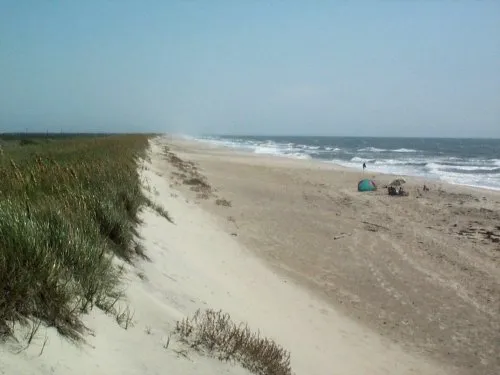 Dr. Beach says Ocracoke Island has the best beaches in the nation in his 2007 list. He’s right. It is an island of most wonderful beaches and a special place. We’ve been several times on family vacations. It was the first time a beach in Florida and Hawaii didn’t take the top spot, but Ocracoke has been in the Top Five the last two years. From an Associated Press story about Florida International University professor Stephen “Dr. Beach” Leatherman list this year::
Brittney Gilbert strikes a chord
| More on Brittney Gilbert, the Nashville blogger who abruptly quit her job, as a full-time blogger for a Nashville TV station … Cory Bergman Steve Safran Terry Heaton Michael Silence: Here, here, here, here, here, here, here. here, here and the poll Glenn Reynolds here and here. David Oatney Trace Sharp Rex Hammock And much, much more. Did she connect with people or what! Tags: Brittney Gilbert | Nashville is Talking | Nashville blogger |
OMGWTFJOBLESS
 Brittney Gilbert, a really distinctive voice and blogging pioneer at a MSM TV station, resigned her job. Here’s her resignation post on Nashville is Talking and a post on her personal site. Apparently, a blog slug fest over a link she did was the last hit she wanted to take.
The hidden link between Rosslyn Chapel and Innovation
Most of the ways we tend to think about innovation and innovators are just wrong, based on comic book-like fables of eureka moments and genius super heros. That’s some of what I got from Scott Berkun’s new book, The Myths of Innovation
A different look
 I tried to do some HDR photography while on vacation in Scotland last week. I’d say the results were mixed. I like the one above and there are some more here. HDR is “high dynamic range” imaging. I got interested in from looking at some stunning photos from Bob Benz, who pointed me in the right direction to learn about it and passed along a few tips. As a total neophyte, I had to learn some options on my camera I hadn’t used. I don’t have that all figured out yet. The biggest obstacle to overcome, however, was camera shake. I didn’t use a tripod with any of the ones I did. They would have worked a lot better had I had one. HDR involves taking bracketed exposures (I was trying to do three) and any movement of the camera makes the results very blurry or ghostly. In some of mine, I only used two photographs because three looked as if I had been drinking shots of Scottish whiskey between frames. I used Photmatix Pro to create the images. It’s very easy to use. Course, I’m a five-year-old flipping the switches at Mission Control. Simple! There are a number of guides and tutorials. I think I’ll try some of more. Tags: HDR I tried to do some HDR photography while on vacation in Scotland last week. I’d say the results were mixed. I like the one above and there are some more here. HDR is “high dynamic range” imaging. I got interested in from looking at some stunning photos from Bob Benz, who pointed me in the right direction to learn about it and passed along a few tips. As a total neophyte, I had to learn some options on my camera I hadn’t used. I don’t have that all figured out yet. The biggest obstacle to overcome, however, was camera shake. I didn’t use a tripod with any of the ones I did. They would have worked a lot better had I had one. HDR involves taking bracketed exposures (I was trying to do three) and any movement of the camera makes the results very blurry or ghostly. In some of mine, I only used two photographs because three looked as if I had been drinking shots of Scottish whiskey between frames. I used Photmatix Pro to create the images. It’s very easy to use. Course, I’m a five-year-old flipping the switches at Mission Control. Simple! There are a number of guides and tutorials. I think I’ll try some of more. Tags: HDR |
high dynamic range photography | Scotland | Edinburgh |
It would have been better two years ago
| We only waited two years to see this. And Bill Shory explains why. Tags: open records | police video | in-car cameras |
More media on the Channon Christian-Chris Newsom murders
| An insightful column by Cleveland Plainer Dealer columnist Ted Diadiun on Knoxville’s Channon Christian and Chris Newsom murders and the media coverage of their horrific deaths. Tags: Charlie Daniels | Channon Christian | Chris Newsom | racial hate | Ted Diadiun |
He’s got me beat by a notebook
 Now this is a desk, I can relate too. It’s Al Gore’s office. (via Rex Hammock, who doesn’t have the same reaction as I do) Tags: Al Gore Now this is a desk, I can relate too. It’s Al Gore’s office. (via Rex Hammock, who doesn’t have the same reaction as I do) Tags: Al Gore |
GTD | paperless office |
Mary Farrell paints her pots
| I was testing out my video camera, a Panasonic SDR-S150, and shot this video of one of my favorite potters, Mary Farrell. She was kind enough to be my test subject. Mary and her husband, David, are marking their 30th anniversary of operating Westmoore Pottery in the Westmoore area of northern Moore County, N.C. If I haven’t bought at least one piece from them every year they’ve been open, it’d be close. I love their pottery. They make pottery in the styles of pottery made in the 17th, 18th and early 19th centuries. She said she’d had a great time helping put together an exchibit at the North Carolina Pottery Center in nearby Seagrove that features the work of Farrells, Hal and Eleanor Pugh of New Salem, NC, and historical works from North Carolina drawn from private collections here and yonder. The exhibit is called “Slipped, Dipped and Dotted: 18th-21st Century North Carolina Redwares” and runs through Aug. 25, 2007. On this Saturday afternoon, she was doing a demonstration for two children and me of how she decorates pottery. Later a photographer from the Asheoboro, NC, newspaper showed up to take some photos. If you are ever in the area, visit their shop. It’s been featured in Country Living and Home and Garden magazine. Tags: Westmoore | Seagrove Pottery | North Carolina pottery  |
Charlie Daniels should be ashamed
The double-murder of Chris Newsom and Channon Christian that occurred in early January in Knoxville was an extremely heinous crime by any definition and has attracted international attention. Unfortunately, it has been adopted by white groups as the poster child of Black on White Hate Crimes. Now it has its own Wikipedia entry. The entry says:
I’ve pulled myself away to write this
 The just launched today flickrvision and the earlier twittervision are utterly and endlessly fascinating. You have a real time (or less than a minute ago) sense of the ever-changing teeming ecosystem of the Internet to wax National Geographic. Flipping from one to the other you see messages and photos popping up all around the globe. People expressing themselves in myriad ways through photos posted to flickr or tweets on Twitter. Both sites are from Dave Troy. He posted this on Twitter early this evening:
Comcast and E911
Tennessee women bloggers
| With help from Tracy Sharp and Michael Silence, I did a list of women bloggers in Tennessee. It’s not billed a complete list, but just a selection of women bloggers in the state that shows varied interests and views of the writers. Lots of good ones to follow. Add ‘em to your newsreader. It is a Mother’s Day piece of sorts, but I was looking for women bloggers, not women who are mothers or blogging on motherhood. Tags: women bloggers | Tennessee |
A cocktail of facts
There is a debate about whether Twitter and blogs are journalism. Fred Wilson suggests that the discipline of journalism is an outdated concept, supplanted by conversation … “a world of conversation.” Based on that Twitter, Blogs, MySpace are journalism. I do learn things on Twitter that I consider to be news. A lot is not. I do learn things from blogs that I consider to be news. A lot is not. A lot is not journalism in newspapers; classified ads, for instance. The cynical might suggest that a lot of editorial content in newspapers and on newscasts doesn’t involve journalism in the gathering and reporting of news, either. That would be true. You can’t define journalism by platform. While mostly it’s a social network, users did use Facebook as a news source during the Viriginia Tech murders. I do see on Twitter headline type information and pointers to other information that are real news. It’s 140 character message limit does give new meaning to the concept of a “tight story.” Tony Hung writes in Twittering Vs. Blogging: What Constitutes Journalism?:
Brand Me update
Changed my Twitter user name to Jack Lail. It was Devanel. Now you can find me at twitter.com/jacklail. Newscoma says thanks! Yes, add me as a friend. Tags: Twitter
A letter from the newspaper while watching morning TV
| Thanks to Mark Potts for pointing to Iowahawk’s Subscribe Now!. And to NewTeeVee’s Liz Gannes for pointing to Good Morning World. Iowahawk has the history of the newspapers satirically nailed. And Andy Peppers (played by Peter Oldring) and Alasdair Coulter (played by Pat Kelly) are indeed a “bad morning show for the world.” Together, they were a great way to start the day. Check them out. Tags: newspapers | TV morning shows |
And I didn’t even study
| The technology and media use quiz from the Pew Internet and American Life Project divines that I’m in the “Omnivores typology group,” part of what Pew calls “Elite Tech Users” in a report posted on its site on Sunday. I don’t think it’s deadly, but it may tag me geeky. It doesn’t exactly describe me; I’m not in my twenties or a student. But in general, yeah. But the real question is what are you? All the groups are described here and in the report linked on this page. Key report finding: Half of all American adults are only occasional users of modern information gadgetry Oh yes, Omnivores. Here’s what we know about Omnivores (from the Pew report) … Omnivores make up 8% of the American public. Basic Description Members of this group use their extensive suite of technology tools to do an enormous range of things online, on the go, and with their cell phones. Omnivores are highly engaged with video online and digital content. Between blogging, maintaining their Web pages, remixing digital content, or posting their creations to their websites, they are creative participants in cyberspace. Defining Characteristics You might see them watching video on an iPod. They might talk about their video games or their participation in virtual worlds the way their parents talked about their favorite TV episode a generation ago. Much of this chatter will take place via instant messages, texting on a cell phone, or on personal blogs. Omnivores are particularly active in dealing with video content. Most have video or digital cameras, and most have tried watching TV on a non-television device, such as a laptop or a cell phone. Omnivores embrace all this connectivity, feeling confident in how they manage information and their many devices. This puts information technology at the center of how they express themselves, do their jobs, and connect to their friends. Who They Are They are young, ethnically diverse, and mostly male (70%). The median age is 28; just more than half of them are under age 30, versus one in five in the general population. Over half are white (64%) and 11% are black (compared to 12% in the general population). English-speaking Hispanics make up 18% of this group. Perhaps unsurprisingly, many (42% versus the 13% average) of Omnivores are students. (via Twitter friend sheywood) Tags: Pew | technology use |
An angel in Robert Langford
| A nice story about one of the News Sentinel’s carriers, the folks in the wee hours of the morning delivering newspapers. From Sunday’s Letters to the Editor. Woman in need received help In this day and age, we don’t often hear about anyone stopping to help someone who is hurt and in a lot of pain unless that person is a public servant — but not on a recent Saturday morning. A man was delivering the News Sentinel at 3 a.m. on a very cold day — low 20s, I think. He heard a voice yelling for help. He wasn’t sure at first which apartment it was coming from, so he went door to door to find out where that person was. He found this person and knocked on her door and told her he was calling for help. This woman of 83 had spent most of the night on her kitchen floor with a broken leg, yelling and crying for help for hours until Robert Langford stopped to help. He stayed at the apartment until the police and an ambulance came. He made sure she was safe with the police and medical help before going to finish his route. You see, this woman is my mother, and Robert Langford was her angel who was sent to save my mother’s life. She is on the mend now, but all the Gaines family will always owe this man for saving the life of our mother and grandmother. What do you give an angel and hero for saving a life so precious to us? As the movie said: Pay it forward — from the Gaines family of Oak Ridge, Clinton, Andersonville and Jacksboro. SUZZANE DAUGHERTY Jacksboro, Tenn. Tags: newspaper carrier | Good Samaritan |
Paperwork
| I ought to do something like this at home and work. Have you ever seen my desk? All the secrets of Narnia are there and more. Back to Twitter. Tags: organization | organizing | clutter |
Clematis in early morning

 Thought I’d share these early morning photos of the Clematis growing up our back porch. Tags: Clematis | flower photography
Need tips on ‘while I’m in Scotland …’
Remembering the 1982 World’s Fair
| Knoxnews Online Editor Jigsha Desai has posted her 1982 World’s Fair 25th anniversary package. It even links to the 20th anniversary package that Traci McDonell (who now runs the city of Knoxville’s web site) did while she was at the News Sentinel. In addition to today’s package, there will be stories through the week. This is one of our joint projects with WBIR. Here’s the schedule for the series: Monday: Legacies of the fair and the things that didn’t make it Tuesday: A look at businesses that have thrived thanks to the expo Wednesday: For every World’s Fair there’s a memorable dish; find out what delicacy was introduced at Knoxville’s. Thursday: A fashion fad that debuted in ’82 — and lives to this day Friday: They came, they sang and Knoxville was never the same. How the fair boosted our entertainment profile ON WBIR Today at 6 p.m. and 11 p.m.: As part of the “Our Stories” series, Bill Williams looks at how the idea of the World’s Fair came about, the controversy that surrounded it, and how construction eventually played out. Monday at 6 p.m.: Bill Williams takes you inside the 184 days of the fair. Tuesday on Live at Five: Russell Biven, Beth Haynes and LaSaundra Brown take the show live to World’s Fair Park for a fun look at the fair’s legacy; at 6 p.m., “Our Stories” focuses on Jake Butcher, the man behind the World’s Fair, who later left a different kind of legacy; at 8 p.m., “Our Stories” presents a one-hour special on the 1982 expo; at 11 p.m., Bill Williams sits down one-on-one with Jake Butcher. Tags: 1982 World’s Fair | Sunsphere |
The Sopranos have a “Whack it” problem
If you think you need to “whack it,” think about the Sopranos. Yep, when you need to kill something. Well, the Sopranos figure prominently in a post by Om Malik on when to whack a venture or proejct, but it’s a little more complicated than just calling Tony. Malik tackles one of the toughest part of innovation: when to drop and move on. Innovators are builders so whacking doesn’t come easy. He relates his “Plug-Puller’s Procrastination” in failing to quit playing with GigaGamez even though the signs were there that it wouldn’t work three weeks into the venture. Two months and thousands of dollars, he was out of the game (site).
I’ve got the Willies with this storm
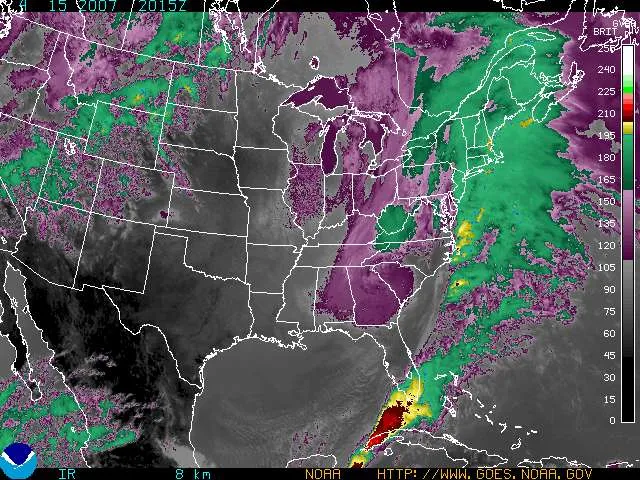 The powerful nor’easter covering the Northeast is also affecting East Tennessee. We’ve had 1.65 inches of rain in the last 24 hours at the airport and haven’t seen any sign of the sun during the weekend. Meanwhile, nationwide the storm was grounding airlines and created the worst coastal flooding in 14 years, according to AP reports. The gray day seemed like good weather to llisten to The Little Willies while I was exercising. The album is a collection of classic country tunes, including, “Lou Reed.” And we don’t mean to sound like we’re trippin But we swear to God We saw Lou Reed cow tippin Cow tippin The Little Willies are Noah Jones, (piano) Alexander (bass), Jim Campilongo (electric guitar), Richard Julian (guitar, vocals), and Dan Rieser (drums). Check it out. Tags: weather The powerful nor’easter covering the Northeast is also affecting East Tennessee. We’ve had 1.65 inches of rain in the last 24 hours at the airport and haven’t seen any sign of the sun during the weekend. Meanwhile, nationwide the storm was grounding airlines and created the worst coastal flooding in 14 years, according to AP reports. The gray day seemed like good weather to llisten to The Little Willies while I was exercising. The album is a collection of classic country tunes, including, “Lou Reed.” And we don’t mean to sound like we’re trippin But we swear to God We saw Lou Reed cow tippin Cow tippin The Little Willies are Noah Jones, (piano) Alexander (bass), Jim Campilongo (electric guitar), Richard Julian (guitar, vocals), and Dan Rieser (drums). Check it out. Tags: weather |
The Little Willies | nor’easter |
Cathy Clarke makes a visit
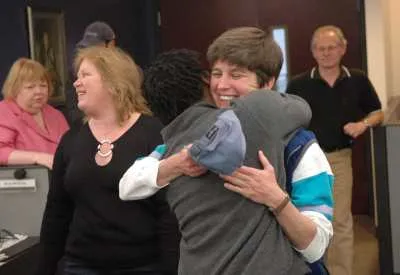 -- Paul Efird photo It was great to see News Sentinel photographer Cathy Clarke’s smile on Friday afternoon. She made her first visit to the office since she was injured in an automobile accident in late September. Cathy was looking good and seemed to be in excellent spirits. I hope her physical therapy continues to go well. You can follow her progress on the Friends of Cathy blog. Tags: cathy clarke
A Top 5
This is a good list for Knoxville to be in the Top 5 on for the second year in a row.
Imus makes a small contribution to Media Matters
 Don Imus was toppled by a blogger (WSJ article, currently free access). Fascinating tale of how Ryan Chiachiere. a 26-year-old researcher in Washington, D.C., for liberal watchdog organization Media Matters for America, toppled the multi-million-dollar generating radio and TV brand of Imus with this blog post. This is the latest – and a good example, I think – of how a relatively small, but media savvy organization can use the Internet to have as much influence on public opinion as a Big Four network or a powerhouse newspaper. Here’s a somewhat self-promoting timeline from Media Matters that shows how quickly and how far-reaching the story spun out of control for Imus. It’s a good study in how a news frenzy develops and how not to get ahead of it. The efforts of smart, veteran media execs from NBC, CBS, as well as media savvy Imus and his handlers were like trying to light a candle in a hurricane with matches. Course, there is the unavoidable fact that Imus’ comments were outrageously offensive. But he was outrageously outrageous on a regular basis. That’s his shtick. And for Media Matters, well, the pub will be Imus’ charitable (non-tax-deductible) contribution to its funding. Tags: Imus Don Imus was toppled by a blogger (WSJ article, currently free access). Fascinating tale of how Ryan Chiachiere. a 26-year-old researcher in Washington, D.C., for liberal watchdog organization Media Matters for America, toppled the multi-million-dollar generating radio and TV brand of Imus with this blog post. This is the latest – and a good example, I think – of how a relatively small, but media savvy organization can use the Internet to have as much influence on public opinion as a Big Four network or a powerhouse newspaper. Here’s a somewhat self-promoting timeline from Media Matters that shows how quickly and how far-reaching the story spun out of control for Imus. It’s a good study in how a news frenzy develops and how not to get ahead of it. The efforts of smart, veteran media execs from NBC, CBS, as well as media savvy Imus and his handlers were like trying to light a candle in a hurricane with matches. Course, there is the unavoidable fact that Imus’ comments were outrageously offensive. But he was outrageously outrageous on a regular basis. That’s his shtick. And for Media Matters, well, the pub will be Imus’ charitable (non-tax-deductible) contribution to its funding. Tags: Imus |
Media Matters in America |
Great resource on workplace issues
| There’s a quick, excellent daily roundup of links to articles and blog postings on HR, workplace, employment, hiring trends etc. right here. It’s done by Danny McCall, founder and head of Talentsphere. Bookmark it! It’ll come in handy. Tags: workplace issues | HR | employment issues |
Just Another Pretty Farce
An interesting big company threatens to sue little-blogging-housewife-and-her-laid-off-husband case is unfolding in Tennessee. It involves this post by Katherine Coble of Nashville. You can find her continuing coverage of her own story at her “Just Another Pretty Farce” blog. This is the not the first of these type of libel/First Amendment issues for bloggers, but expect the trend to continue. Companies trying to control their image on the Internet are scanning search engines to keep track of what’s out there. If you are going to get negative about a company, be prepared to hear about it – whether you do or not. And bone up on the basic rules. Whether Katherine Coble’s content passes the libel test is another matter and I’m not an attorney. The lawsuit threat, however, makes the writer consider the expense in money, time and emotional turmoil of battling a deep-pocketed company. The counter PR offensive – like this one – that bloggers can unleash when one of their is attacked is powerful (a corollary in the blogosphere equivalent to the print world’s “never get into an argument with a man who buys ink by the barrel”). But blogger buzz may not deter a company either foolhardy or steadfast enough in its efforts to strip the Internet of disparaging words. It’s not a battle for the faint of heart even if the writer is within their rights, but it is what the First Amendment is all about. I’m glad Katherine Coble has legal representation to help weigh the principles and the practicalities. I would imagine the same discussion is occurring at the company, JL Kirk Associates, as the irate villagers of the blogosphere bang on their castle door with pitchforks and mattock handles. Foolhardy or steadfast?
The Outlook from here
| And the reason to still use a desktop email client would be? Tags: email | mail client | gmail |
Latinista!
| Co-worker Josh Flory, a business staff writer at the Knoxville News Sentinel, writes an interesting blog on Latin America, Latinista.net. Tags: Latin America | blog |
Now I know the next new, new thing
(via Rocket Boom) Tags: Internet
A growth Tweet
One more Twitter post … I found this quote incredible ….
Twitter is a bad, bad thing
So says tech writer Andrew Kantor in his USA Today CyberSpeak column. He sees “overscheduled kids, over-prescribed Ritalin, and anti-depressants in value-sized jars” in the Twitter phenomenon. He says:
Not a 20-something geek
| Quirky maybe, but this guy’s not “a 20-something geek.” Yes, add me as a Twitter friend. Tags: online newspapers | journalism | online news |
Rock Star Treatment
 John Seigenthaler got a standing ovation during an impromptu visit to students and faculty attending the Center for Innovation in College Media’s workshop on online media. The 80-year-old Seigenthaler said he wished he was the age of the students because it’s one of the most exciting times for journalism. Course, at 80, Seigenthaler is getting more done right now than most college students – or people in general. Gannett exec Jennifer Carroll had just finished mapping out the chain’s bold plan to remake newsrooms and revamp content. I did a roundup of react in November, but it was fascinating to hear it outlined by a top exec and to hear about some of the successes. I think the speech was recorded and a video interview was done later. Looking forward to finding those on CICM Web site. They’ll be worth listening to or watching. Tags: journalism John Seigenthaler got a standing ovation during an impromptu visit to students and faculty attending the Center for Innovation in College Media’s workshop on online media. The 80-year-old Seigenthaler said he wished he was the age of the students because it’s one of the most exciting times for journalism. Course, at 80, Seigenthaler is getting more done right now than most college students – or people in general. Gannett exec Jennifer Carroll had just finished mapping out the chain’s bold plan to remake newsrooms and revamp content. I did a roundup of react in November, but it was fascinating to hear it outlined by a top exec and to hear about some of the successes. I think the speech was recorded and a video interview was done later. Looking forward to finding those on CICM Web site. They’ll be worth listening to or watching. Tags: journalism |
first amendment center | center for innovation in college media | john seigenthaler |
Smile and fess up
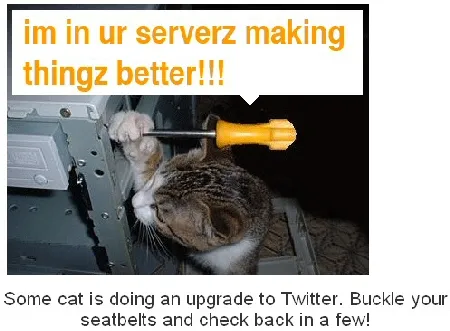 With the flash flood of attention, Twitter has had some growing pains. It got slow (it’s better, but still can be slow). Features disappeared (they’re still gone). People started whining (and probably still are). Twitter’s seemingly everywhere buzz could have developed into a Red Tide. But it hasn’t. I think that’s because they doing blog posts like this one: Twitter Blog: The Tortoise and the Twitter. It does the job of addressing the problems in a serious but playful way and lets people know what is going on and that it’ll get better – soon. Instead of the rants they were getting yesterday, the commenters now are generally understanding and making suggestions. Note to self. Might be a good tactic to emulate when the need arises. In the meantime, here’s my Twitter page. Tags: quotable With the flash flood of attention, Twitter has had some growing pains. It got slow (it’s better, but still can be slow). Features disappeared (they’re still gone). People started whining (and probably still are). Twitter’s seemingly everywhere buzz could have developed into a Red Tide. But it hasn’t. I think that’s because they doing blog posts like this one: Twitter Blog: The Tortoise and the Twitter. It does the job of addressing the problems in a serious but playful way and lets people know what is going on and that it’ll get better – soon. Instead of the rants they were getting yesterday, the commenters now are generally understanding and making suggestions. Note to self. Might be a good tactic to emulate when the need arises. In the meantime, here’s my Twitter page. Tags: quotable |
dealing with crisis | customer service |
Fueled on caffeine
| Some things are better not known, but if you must, it’s here (via lifehacker.com) Tags: coffee | caffeine |
Get Up, Stand Up
 My Sunshine Week theme song. So you better: Get up, stand up! (in the morning! git it up!) Stand up for your rights! (stand up for our rights!) Get up, stand up! Dont give up the fight! (dont give it up, dont give it up!) Get up, stand up! (get up, stand up!) Stand up for your rights! (get up, stand up!) Get up, stand up! ( … ) Dont give up the fight! (get up, stand up!) Get up, stand up! ( … ) Stand up for your rights! Get up, stand up! Dont give up the fight! See the Tennessee Coalition for Open Government for information on open meetings and open records in Tennessee. See the Society of Professioanl Journalists’ Project Sunshine. And, yes, enjoy Bob Marley. Tags: open meetings My Sunshine Week theme song. So you better: Get up, stand up! (in the morning! git it up!) Stand up for your rights! (stand up for our rights!) Get up, stand up! Dont give up the fight! (dont give it up, dont give it up!) Get up, stand up! (get up, stand up!) Stand up for your rights! (get up, stand up!) Get up, stand up! ( … ) Dont give up the fight! (get up, stand up!) Get up, stand up! ( … ) Stand up for your rights! Get up, stand up! Dont give up the fight! See the Tennessee Coalition for Open Government for information on open meetings and open records in Tennessee. See the Society of Professioanl Journalists’ Project Sunshine. And, yes, enjoy Bob Marley. Tags: open meetings |
open records | sunshine week | tcog | spj |
More Daylight Savings Time is good
I admit I had a bias in favor of Daylight Savings Time, but it’s sure been nice this week going to baseball games and getting home before dark. Why didn’t we do this earlier? Oh, yeah, it involved Congress. Natch. Tags: daylight savings time
Duck in a game
 Location: Farragut High School Tags: rubber duck
The Twitter on Twitter
follow Devanel at https://twitter.com
Smart guy Ross Mayfield says Twitter, on the eve of turning one, has hit the tipping point. I love this buzzword: Continuous Partial Presence. Sounds like something from a Sci-Fi movie. If you’re trying to figure what the twitter is about all, Chris Brogan’ 5 Ways to Use Twitter for Good from lifehack.org might get your started. Or Anil Dash’s Consider Twitter. Maybe Dan Blank has it figured out with this headline: Twitter: Always Feel Important Update: Another great Twitter guide. More on Twitter I signed up to see what all the twitter was about. Add me as a friend. Do you use Twitter, find it useful in the least? Tags: Twitter | social networks
Cable love
| Steve Safran at Lost Remote is just another guy feeling totalliy Comcastic these days. My co-worker Lauren could relate to his tale. My only issue is whether they’ll bury the cable they left in my yard months ago before mowing season. Have you ever noticed that replacing the cable is one of the “most dos” on any service call. Tags: comcast | customer service |
Major upgrade to Picasa’s web photos
A Who jumped from Where and What was driving When
I keep a Google News Alert query set to “News Sentinel” (without hyphen) just to see what shows up about the paper I work at. A few days ago this classic lede popped up in Gmail from Layla Bohm, a Lodi News-Sentinel (with hyphen) staff writer:
Free air conditioning here
| Great NYT piece on how having public WiFi, but charging for it is the Web-age version of the “coin-operated locks on bathroom stalls.” Starbucks and McDonalds fit this mold. The article notes that DFW is even charging airline passengers caught in its labyrinth for electricity to plug up! But it does point to several chains who are using free WiFi as the “air-conditioning of the Internet age.” Panera Bread and Schlotzsky’s Delis (but not here apparently) are among those mentioned as having free WiFi. The writer is in Silicon Valley so I guess that’s why Krystal (whose first free WiFi location was in Knoxville) didn’t make the list. Krystal doesn’t seem to have a place on its jazz-upped Web site to find a list of the WiFi locations. Duh! Actually, a number of restaurants and other businesses in the Knoxville area “get it” a little better than Starbucks. Here’s one incomplete list. What are the best free Wifi locations in the Knoxville area? (via Techmeme) Tags: WiFi | hotspots |
The 11 p.m. email in disguise
| Here’s how to create “face time” for Web workers. Hey, the comment thread is great, too. Was I just workstreaming? Tags: web workers | productivity |
Get me a screen shot of that site
I was googling around today for a utility to make Web screen shots for a project I’m currently working on and stumbled across Nathan Moinvaziri’s wonderful WebShot (for Win XP). The latest version is 1.31 and it came out on Jan. 7, 2007. I was looking for something that would do screen captures of Web pages and this does just that – and for free (donation requested and deserved). It captures the entire page, including the part not visible on the screen (yes, lots of other programs do this). The program includes two programs: a regular GUI version and a command line version. I wrote a little perl script to run the command line verison, calling several sites up to get screen grabs and saving the images with a date and time naming convention so I can keep track of when the grabs were done. This rules! I had a question about the program and Moinvaziri, who lives in Arizona, did answer me within a couple hours. A big wow for a free product. I noticed has done several other interesting programs. He also blogs on programming and TV. and has some beautiful photos on his site. But what I liked best was this quote:
Yeah, you’ll check
| Just for fun, see what the Social Meter score is your blog/Web site. This site runs out and scans varioius sites (Technorati, Google, Bloglines, Yahoo’s MyWeb, etc.) to see how popular they are. (via Social Media) Tags: viral | linking | reputation |
Hardball
| Hey, Chris Matthews, this is hardball -- Tennessee style. And here, too. Tags: hardball | Tennessee politics | Knox County Commission |
Powered by Google
| PC World is reporting that Google will soon add its Docs & Spreadsheets Web apps to “Google Apps for Your Domain.” That’s good news. I did mail, calendar and start page options “Google Apps for Your Domain” recently and it’s been excellent. My host AQHost was great about doing the DNS changes needed on a weekend just minutes after I asked for it. The switchover in mail and pointing to the start page and calendar were pretty seamless. Gmail is much better than the Web-based Horde I had access to before and I’m weaning my self off Outlook Express (and all desktop mail apps for home). For my personal use Web site (this one), it’s convenient. But for a small business, this is pretty much a no-brainer, isn’t it? Google Docs and Spreadsheet meet most of my home word processing and spreadsheet needs, although I still use Office. … But I can see a day …. Once Docs and Spreadsheets is offered, that will leave only the web-photo albums of Picasa and Google Reader among the Google services I regularly use that is not offered in the “Google Apps for Your Domain.” Tags: Google | Microsoft Office |
Let’s do …
And I was sure it was just me. I do know a few people who haven’t heard the news.
Eight views of life
| The News Sentinel’s photographers have a wonderful exhibit of their work in the back lobby of our building at 2332 News Sentinel Drive. It’ll only be up through the end of February so come on by Monday-Friday during business hours. The photographer portfolios of stunning photographs are displayed on eight iMacs, one for each photographer. Each photographer selected at least 40 photos – some more than double that number – that rotate in a slide show on the iMacs. They do good work! Tags: photos | photography | photographers | photojournalist | photojournalism |
The “We media” split?
| Now this was different. Not exactly Time’s “We Media” couple of the year. It’s interesting to see the power of an online social network as “news source” and the amount of “media” this event attracted. It’s looks like life imitating the filming of a realty TV show about life. Watch the nine minute video, which had gotten 5,295 views in about a day. Decidedly viral. Tags: UNC | Ryan Burke | breakup | google video | YouTube | viral | social networks |
Remembering Charles Scripps
| Nice piece on Charles Scripps by Dan Thomasson, former and longtime editor of Scripps Howard News Service. Tags: E.W. Scripps | Charles Scripps | newspapers |
Did you inhale?
| That blogger Amanda Marcotte resigned under fire from John Edwards’ presidential campaign emphasizes what is wrong with public debate in America. It’s not about issues and candidates. It’s about code words and political correctness. When someone, in this case, Bill Donohue, the president of the Catholic League, points to a blog posting someone made before they joined a campaign and says, this is poltically incorrect, you must go. Something’s wrong. I’m not surprised Marcotte is gone; it was the right decision given the circumstances. But it’s the new “Did you inhale” question of the MySpace Generation: Did you ever say something dumb, political incorrect or stupid online? And remember, it’s still out there … somewhere. It’s an issue for job seekers, political candidates and even the candidates’ digital foot soldiers. Of her departure, Marcotte said: “The main good news is that I don’t have a conflict of interest issue anymore that was preventing me from defending myself against these baseless accusations. So it’s on.” And so it is. (via Instapdunit) Tags: john edwards | bill donohue | amanda marcotte | blogger |
Would you dump Office?
| Two interesting takes on Google Docs: Charlene Li and Scott Karp. Obviously, Google Docs aren’t as good as Microsoft Office. The question is are they good enough – or how long will it take to make them good enough. For home managing, it appears close for Li, although she finds much to dislike. For Karp, the inability to work on a Google Doc on a plane and its slowness in certain operations are real barriers to adoption. Would you dump office for Google docs? Tags: google docs | microsoft office | word | excel |
Less than helpful
| I couldn’t agree more. The click stalling is a real pain. Tags: Wordpress | Snap Preview |
In the Mix atop The Hotel
| View from the Mix Lounge atop The Hotel at Mandalay Bay. Taken with a $99 Pure Digital camera. Music from Spice Music and “toxic playground remix.” Tags: the Mix | Las Vegas | Mandalay Bay | NAA |
A MockTech Celeb!!
 At some point in time, I became a MockTech Celeb, just a hair less prestigious as being on the Forbes Web Celeb 25 which Knoxville’s Glenn Reynolds made at No. 7 this week. I have my own paparazzi email address spottedjackL@gmail.com. Well, not mine, but anyway. So help the MockTech keep track of me – if you can! As you can see from the photo at right, I am elusive. Tags: MockTech At some point in time, I became a MockTech Celeb, just a hair less prestigious as being on the Forbes Web Celeb 25 which Knoxville’s Glenn Reynolds made at No. 7 this week. I have my own paparazzi email address spottedjackL@gmail.com. Well, not mine, but anyway. So help the MockTech keep track of me – if you can! As you can see from the photo at right, I am elusive. Tags: MockTech |
Forbes web celebs | Paparazzi | Instapundit |
Is this Polar problem due to Global Warming?
I have a Polar F6 Heart Rate Monitor Watch

Happy First Birthday
| Congratulations to Randy Neal and the KnoxViews bloggers and users on the anniversary of the first year of operation of KnoxViews. For those not familiar, KnoxViews is a Knoxville blogging community site that skews toward government/politics/policy topics, but delves into a lot of areas with a vibrant community of bloggers. The stats are impressive. Tags: citizen journalists | blogosphere | KnoxViews | blogging | community | social media |
Blogging on Blogging
Nielsen//NetRatings said Wednesday the number of unique visitors to blog pages within the Top 10 online newspapers was up 210 percent in December from a year ago, while overall readership grew by only 9 percent.
Tennessee River from Lakeshore Greenway
 I always like this view of the Tennessee River from atop the hill at the Lakeshore Greenway. Today the temperature was 66 when this was taken, but there was a good breeze (wind gusts of 25 mph forecast) and you can see the gray line of a band of clouds moving in. By Wednesday, the forecast is the high will only reach 39. Weird winter weather, but I love the warm breaks. Tags: tennessee river I always like this view of the Tennessee River from atop the hill at the Lakeshore Greenway. Today the temperature was 66 when this was taken, but there was a good breeze (wind gusts of 25 mph forecast) and you can see the gray line of a band of clouds moving in. By Wednesday, the forecast is the high will only reach 39. Weird winter weather, but I love the warm breaks. Tags: tennessee river |
photography | weather |
20 lists of trends for 2007
Recipe for the youth audience
| A youth play: Food! So says BusinessWeek in its Jan. 8, 2007, issue in story about how the Food Network is attracting the youth market. Course it may not be all about heatin’ up the stove. The story quotes a 21-year-old Binghamton University student who says he and his buddies are into Giada De Laurentiis, the Everyday Italian host, and record her so they don’t miss episodes. The same guy says he and his buddies are into the Food Network for cooking tips, too: “Any time a girl sees guys cooking something delicious, it definitely helps out.” Young women also are taking a greater interest in cooking, the article notes. A Scripps Networks exec did say there were no plans to MTV-ize the Food Network. Food for thought: Winning the youth audience isn’t about the hokey features and dumbed-down content that often pass for “youth content.” If cooking shows can attract a young audience, then lots of topics have the potential too – with the right ingredients. Tags: Giada De Laurentiis | Food Network | youth audience |
Lex Luthor?
 Photo adapted from kryptonsite.com Jim Smith over WATE noticed I, too, had taken the Super Heroes test and said: “What about the Super Villians” test. Below are the results. Interestingly, both he and I are Spider-man as “hero” and Lex Luthor as “villian.” For the villian, I do know I answered two of questions the exact opposite of his answers. He said he does wear skin tight clothes and I said no. He said he did answer “are you bald” yes and I said no. Of course in the movies, Lex wasn’t always bald. Course, as a bad guy, there’s a lot to like in Lex Luthor:
Speaking of lists …
It’s kind of a funny best-and-worst list (at least the best 10), but I couldn’t agree more on who is the No. 1 Worst Communicator of 2006. (via Guy Kawasaki) Tags: communicators
Sidey
Another viral … Your results:
You are Spider-Man| Spider-Man|
Good news in the stocking
The latest issue of Barron’s – out just in time for Christmas – has an article about my employer, E.W. Scripps, that is getting a lot of buzz on investing Web forums. The article is behind Barron’s pay subscription wall, but here’s a Reuters story on the story. A couple of big name analysts are forecasting a $60 to $62 share price over the next year. Friday’s close was $49.23. Fav graph:
Grassroots lending Web style
Caught on the scene
 That crafty Mocktech espied me yesterday on my way to the fabled “Gold Room.”
Blog Tag: 5 things you don’t know about me
Geez, I’m it. Thanks, Jay. That’s viral. Jay Small posted his five things you don’t know about me and has passed it on. He’d been tagged by Greg Sterling, who’d been tagged by … well, you get it. I notice Susan Mernit is playing, too. She has a link to a bit of history on blog tag. It’s one of those “aw, what the heck” things that burn through the Internet from time-to-time. So, aw what the heck, here’s five from me: 1) The only thing I was first at in high school was in the first class to graduate from the high school (South West Randolph which had just opened). 2) I actually have been to WhyNot and back, as well as Erect and Climax. 3) Lail is a German surname for most people of European descent, but it also is the Arabic word for “night.” A chapter of the Koran is Al-Lail, or The Night. 4) Until adulthood, I was known by the nickname of Jackie. My family still calls me by that name – sometimes. 5) Much to my baseball card collecting son’s amazement, I blithely used all sort of now valuable baseball cards as noisemakers in the spokes of my bicycle. First lost fortune, no doubt. My fire line: The viral stops here. Tags: blog tag
The unwritten rules are the toughest to read
I noticed a few “unwritten rules” posts today and decided to have some fun with it. Actually what got me going was this post ValleyWag on the unpublished rental rates of Wi-Fi in cafes. Interesting new social problem and it could have been the “unwritten rules of Wi-Fi in cafes.” Unwritten rules can be well, enigmatic. I did run across all the unwritten rules below. What’s you favorite or craziest unwritten rule (or is it against the rules to ask)? Camping Outdoors Behavior - Unwritten Rules 12 Unwritten Rules of Cell Phone Etiquette Bill Swanson’s 25 Unwritten Rules of Management Resumes: The Unwritten Rules of The Game. The Unwritten Rules of Online Dating Revealed The Unwritten Rules of Gift-Giving The Unwritten Rules of Movie Watching 10 unwritten rules of soap opera The Book of Unwritten Baseball Rules 7 unwritten rules for professional women Tags: unwritten rules
Brands or deals
Shopzilla besting consumer brand names in audience with strong growth, notes Mark Ippolito. Is it brands or deals or just deals on brands?
Traffic cam pics from the past
Don’t link that link
Linking illegal (via Lost Remote)? If the link is to material that violates someone else’s copyright, it seems you’re in a gray area. The Electronic Frontier Foundation’s Fred von Lohmann notes there is a great incentive for sites to remove the links instead of trying to fight the battle. These leaves a lot of room for lawyers in a Web 2.0 world where content (or data) is coming from many sources. Tags: copyright
Just part of the E-Mail Generation
| The generalional divide is IM/E-Mail – at least according to this AP Poll. We’ve been trying rather unsuccessfully to get a group of newsroom managers to use IM as a speedier way to communicate about breaking news internally. We’re in a business where minutes matter. Maybe this explains it. All the recalcitrants are over-40. IM is too far across their generational divide? Early onset of old-fartitis, perhaps. An AP-AOL poll released Friday says: - Almost three-fourths of adults who do use instant messages still communicate with e-mail more often. Almost three-fourths of teens send instant messages more than e-mail. - More than half of the teens who use instant messages send more than 25 a day, and one in five send more than 100. Three-fourths of adult users send fewer than 25 instant messages a day. - Teen users (30 percent) are almost twice as likely as adults (17 percent) to say they can’t imagine life without instant messaging. - When keeping up with a friend who is far away, teens are most likely to use instant messaging, while adults turn first to e-mail. - About a fifth of teen IM users have used IM to ask for or accept a date. Almost that many, 16 percent, have used it to break up with someone. Current status: |
IM |
When photojournalists become only memorable
Dan Gillmor has an interesting and vivid snapshot on “The Demise of the Photojournalist.”
Beginning to Digg
| Guy Kawaski is right. This is a good beginners guide to Digg. If you’re trying to explain Digg to someone who’s never used it, it’s a good resource to point them too. Tags: Digg | Guy Kawasaki |
Great little amp
Have you seen one of these? I first read about the Sonice Impact T-amp (Sonic Impact 5066) in the Oct. 3, 2005, Forbes magazine (article in pay archives now). The article raved about the sound quality of the $39 amp, which was introduced in 2003. Other rave about it, too:
Almost too weird
 Engine smoke forced a two-hour delay Friday in the charter jet flight of the Marshall football teamto East Carolina. No big deal, except … It happened on the game trip to Greenville where on Saturday East Carolina unveiled a plaque near the football stadium entrance honoring Marshall’s 1970 team. The 1970 team died in a plan crash returning from an ECU game 36 years ago. That crash on Nov. 14, 1970, killed 75 people on a cold, rainy hillside in West Virginia. A movie, “We Are Marshall,” about the crash and the aftermath comes out this fall. Whew, what a soundtrack. Here’s a great little featurette Tags: Marshall, East Carolina, We Are Marshall
Making the A list
Oh, wow, this book
Start Garrard
Nice seeing former ECU quarterback David Garrard getting some starts at Jacksonville – and winning. He’s lead the Jags to two victories subbing for injured Bryon Leftwich, including today’s 37-7 win over the Titans. “I’m glad I’m not the coach,” safety Deon Grant said. “It would be real hard to sit David down right now and real hard not to put Byron back in there. I guess that’s the coach’s fault for having two good quarterbacks.”
-- Associated Press And remember, Garrard went 4-1 when Leftwich went out last year with a broken ankle in the last five regular-season games. Five years ago, when he was drafted by the Jags, Garrard must have thought he was the franchise’s quarterback of the future after then-starting QB Mark Brunell, but there was a coaching change, Marshall’s Bryon Leftwich was drafted and proclaimed the QB of the future for Jacksonville. Now, coach Jack Del Rio may have a “quarterback controversy” on his hands with Garrard playing well in his two starts this year. I hope it works out well for Garrard, who was the best East Carolina quarterback since Jeff Blake. Tags: Jacksonville Jaguars | David Garrard | NFL .
Sort of like Knoxville feels this morning
 This looked to me like Knoxville feels this morning after the loss Saturday night to LSU. This was taken around 7 a.m. from my front porch. Tags: cloud photos This looked to me like Knoxville feels this morning after the loss Saturday night to LSU. This was taken around 7 a.m. from my front porch. Tags: cloud photos |
Knoxville |
Pirates on top
Nice article from the The Commercial Apeal’s Jim Masilak on the East Carolina Pirates, who had a huge win last week (Oct. 28) against Southern Mississippi. Don’t know if it’ll last, but it’s good to be leading the division this year. Laughingtock, r-i-g-h-t. Tags: East Carolina
Yeah, the cable works, but the office is another story
| I made the big switch yesterday from landline POTS telephone to cable digital phone service yesterday. Comcast was cheaper than MCI, which I used for local and long distance, and both offer basically the same set of phone features: Caller ID, call waiting, call waiting Caller ID, three-way calling, web-based voice mail, and a lot of blab, blah stuff I never use plus free nationwide long distance. Other than being over an hour past the 8 a.m. to noon “show up” window, the installer did a great job. He knew what he was doing and quickly move through the process (I was upgrading to digital cable too so I had three cable boxes to get hooked up). All was going well, until … The office desk had to be moved to access the phone jack that was nearest where I have my ‘cable modem” and router. The desk is close to 20 years old and was getting unstable, I knew. “Wait, I said, I’ll move it” I took most of the books out to lighten it up a bit. When I moved one end out from the wall, the other end collapsed sending papers, pens, paperclips, nnotebooks, speakers, a boulder of a tube computer monitor, dust and shelves flying. When the avalanche ended, the nonplused tech simply said: “Yeah, I think I can get to it now.” Tags: comcast | cable | telephone service |
Good news!
| Some good news on News Sentinel photographer Cathy Clarke is here. Tags: Cathy Clarke | Knoxville News Sentinel |
Talking with Ms. Dewey
Continuing to catchup, John Battelle introduced me to Ms Dewey, a sexy search site apparently put up by Microsoft to promote its new live search. She’s flirtatious and funny. I searched for Knoxville, Ms. Dewey says:
Blogroll updated!
Updated my blogroll today. I manually update this by exporting my Google Reader OPML file to my computer and running a perl script written by Srijith Krishnan Nair against it. Thanks, Sri! Does your blog need to be on my reading list? Let me know.
Jukebox debut
Whoa, JB’s got new toys. Cool. It’ll be a good read the total system looks like.
Google Reader vs Bloglines
I think I’m making the switch from Bloglines to Google Reader for RSS feeds. Been using the Google one for a few days and I like it. It was pretty much a snap to export my Bloglines list of blogs as an OPML file and import them into the Google Reader. What you think? Which one is better? What’s your fav?
On the hook at UT
The Knoxville News Sentinel (where I work) and sportswriter Dave Hooker are making news this week in a flap with the University of Tennessee over the suspension of his credentials for acting like a reporter. See:
A Cameo appearance
 Even apple varieties have their own Web sites. I bought a bag of Cameos at the Erwin Apple Festival; grocery stores, even the mega-behemoths seem to carry just a few varieties, Red Delicious, Yellow Delicious, Granny Smith and a couple others, maybe. The vendors at the festival were offering varieties that I hadn’t had in awhile or had never heard of like Cameo. Cameo apples are really good, I found. Of course, I googled it and found there is an official Amercain Cameo Web site, which says about the variety::
Cathy Clarke
One of The News Sentinel’s photographers was seriously injured in an automobile accident Sunday evening. We’re thinking about her and her family. A blog has been created for updates.
It’s called Blufr: True or False?
Powered by Answers.com:
free online dictionary and more
—
Very addictive trivia site. It asks true false question and keeps a running score. You can save your score, but there’s no registration. Besides the actual travia quiz, the site is very aggressive around developing virla links. Good idea. Try it yourself. There’s probably a news application here … hmmm. Smart, very smart.
Saving time …
| I saw a reference to this site on Friday and found it to be just what I needed because I hate typing into my address book on my cell phone. Zyb.com, a service based in Denmark, lets you do all that typing in a Web page and synch with your phone. You can do appointments as well. It uses synchML (Synchronization Markup Language) to perform its magic. Most phones have synchML built-in, but I had begun to think that it was a pretty useless feature, one that I would never use. Tags: mobile phones | contact management | cell phone To set the service up, you find your phone model and click some buttons to configure your phone for the service. It didn’t automatically configure mine, a Siemens S65, but the site anticipates this and had good instructions on the settings to use. Once imputed … viola … it worked like a champ. The site seems to support tons of phones. Thee’s no software to load into your phone or onto your computer. And it’s free! You can email contacts from the zyb.com and get them to verify their info, You can export your contacts to your desktop. You can transfer your data to a new phone. Even data it won’t display (fields your phone may have that it doesn’t display) is saved. There’s no Outlook support at this point except through a third party, but I have no desire to put all my Outlook contacts on my phone so that’s OK. Cutting and pasting on the computer is fine with me for the number of contacts I want to put on my phone. I don’t use it for appointments, except to have Yahoo’s calendar send me an SMS for some meetings. Pretty slick – and useful. Anybody else using this tool? |
An interesting survey
| Surveys are always fun even if you’re not sure what they mean. Michael Silence did a write-up today on a survey Randy Neal did on his popular Knoxviews.com site. The survey at best only represents what the demographics of the community site, knoxviews.com, look like. At worst, it’s the demographics of only the people that responded. But the results are still interesting. Glenn Reynolds of Instapundit.com says Neal’s visitors look a lot like his. And they are all not too different from knoxnews: over 40 and upscale. Tags: blogoshere | community journalism They do differ from some surveys of the national picture, such as here, where the age at least skews younger. But knoxviews’ writers don’t delve much in entertainment, trends, lifestyles. It’s not particularly hip or cool. It’s basically news and politics or politics and news. Sometimes indignant, sometimes outraged, often irreverent. As Neal says, its topics aren’t aimed at the youth market. I suspect many of the readers are people looking for the “back story” on Knoxville and East Tennessee political machinations – or at least some context to the events. And I’m sure the people Neal and the other Knoxviews bloggers are writing about are among the readers. Obviously, he’s been very successful at creating an active community of readers (and contributors). Four hundred thousand page views a month with zero dollars for marketing is excellent traffic in my book for a locally focused site in a metro market the size of Knoxville. And I suspect the survey does represent his overall audience: older, professional/white collar, engaged in the community. And they appear to read newspapers or their Web sites (thanks!). UPDATE: : Few American adults use blogs to get news. I missed this when it moved on the wires and the story’s statistics really aren’t as negative as the headline, but anyway. |
And in a blink, abolish the NCAA
| Malcolm Gladwell of the New Yorker weighs in on that self-righteous bastion of certitude, the NCAA. And finds it, well, inhumane. (The comments posted so far on his post are pretty fun reading as well.) Tags: NCAA | Malcolm Gladwell |
Bakersfield bargain
Howard says buy his house.
Catch me if you can
 I’ll be on the radio show “State Your Case,” hosted by George Korda, on FM 100 WNOX at noon on Sunday (Aug. 13) talking about Knoxnews. Tune in if you can. The station does stream its shows on the Internet so I’m guessing this one is available both on-air and on the net. Never been on the radio with Korda so it should be an adventure in radioland. I have no clue as to what kind of questions callers might have. The show is on from 12 to 3 p.m. – three hours! Tags: WNOX I’ll be on the radio show “State Your Case,” hosted by George Korda, on FM 100 WNOX at noon on Sunday (Aug. 13) talking about Knoxnews. Tune in if you can. The station does stream its shows on the Internet so I’m guessing this one is available both on-air and on the net. Never been on the radio with Korda so it should be an adventure in radioland. I have no clue as to what kind of questions callers might have. The show is on from 12 to 3 p.m. – three hours! Tags: WNOX |
knoxnews | State Your Case |
New blog
| Katie Kolt, one of the knoxnews online producers, has started a blog on knoxnews called “Linked.” It’s described as discussing “her new ties: to Knoxville, to her fiance and to the ‘real world.’” She got engaged in the last couple of weeks and it’s sort of about starting life as an adult, first job out of college; living in a new city, getting married. Give it a read. Leave her a comment. Tags: Blog | Bridal | Wedding Planning |
The signs are everywhere
| Visiting the North Carolina county I mainly grew up in, I was struck by how far-reaching the headlines of about population trends can be. The signs were everywhere – in Spanish – in Asheboro, the county seat of Randolph County. Asheboro is a city south of Greensboro of about 25,000 residents in a large rural county of 138,400 people scattered across 788 square miles. (Census qucik facts) It’s not a “border” town or South Florida, but the Hispanic population is exploding. Tags: Hispanic | Latino | Kenan-Flagler Business School | Kenan-North Carolina The Hispanic population grew 394 percent in North Carolina between 1990 and 2000. Astounding? Not when you consider the Hispanic population growth rate was three times that in Randolph County. From 488 in 1980 and 734 in 1990 to 8,646 in 2000 and over 12,000 in 2005, Hispanics make up 9 percent of the county’s residents. Much of the influx is believed to in undocumented immigrants from Mexico, according to the (N.C) Governor’s Hispanic and Latino Advisory Council. The immigrants tend to be young and male and filled one out of every three new jobs created in North Carolina in the past decade. They are having a significant economic impact, says this study by the Frank Hawkins Kenan Institute Of Private Enterprise at UNC. That’s gigantic change for communities where it seems nothing much ever changes. |
Fans at The Colbert Report?

I learned today that a screen grab from KnoxNews was used last night on The Word segment of The Colbert Report. Here’s the video from Comedy Center’s Web Site. The segment was about “It’s time for management and labor to come together as management to exploit labor.” Don’t know how they came to find our version of this state AP story, but, hey,that’s OK. Thanks to Randy Neal at KnoxViews for noticing this! (You can click the photo to see a larger version of the image above.) Tags: Colbert Report | Stephen Colbert
Enough to give poltiical parties a heart attack, Dr. Frist
| Tennessee shapes up as a key battleground state again this year with control of the Senate in the balance. A Tennessee seat is in play because Senate Major Leader Bill Frist said he wouldn’t seek re-election when he ran for the office (he didn’t say at the time he had his eye on running for president, but, hey, nobody thought to ask). Three “formers” (former House members Van Hilleary and Ed Brysant. and former ‘Nooga Mayor Bob Corker) are duking it out to fly the Republican flag while Harold Ford Jr., who has token opposition in the Democratic primary, will have to have the political ring skills of Muhammad Ali to become the first black elected to the Senate from the Old South since Reconstruction. We’ve posted podcasts with all four on KnoxNews and if you’re trying to get a quick take on the majors, listen up: Ed Bryant, Bob Corker, Van Hilleary, and Harold Ford. If you’re don’t do Windows Media Player, you can get at them from RSS, Yahoo Podcasts or iTunes. Tags: Politics | Senate Race | Elections | Campaign |
KeePass
LifeHacker did a very positive post on KeePass. I’ve been using this password database program for awhile and I really like it as well – and it’s free. Try it! I notice there is a slghtly new version available.Think I’ll go off and update. Later.
Very wired with moxie
 Since an Apple store just opened in Knoxville, I guess someone can now write the Great American novel there or at least their resume – or maybe just look for work like Isobella Jadeco. Jadeco is a short girl (5’2”) trying to make it in a tall girl’s game – modeling. She lives out of a suitcase and since she doesn’t have an Internet connection, she’s been writing a novel and pitches at a New York Apple store, so says fishbowlNY GalleyCat wondered how she saved her writings and was told that Jadeco saved it to her Yahoo account. She writes in the third person pitch letter to fishbowlNY:
It was Said
 You get used to NASCAR drivers mentioning sponsors in interviews, but usually they only dish fellow competitors, not competing products to their sponsors. But it happened twice last night after the Daytona race. First, No Fear’s Boris Said, the pole sitter and who led late, hyped SoBe by saying buy it instead of that “Red Bull stuff” and a line like “drink more cases so we can run more races.” Tags: NASCAR You get used to NASCAR drivers mentioning sponsors in interviews, but usually they only dish fellow competitors, not competing products to their sponsors. But it happened twice last night after the Daytona race. First, No Fear’s Boris Said, the pole sitter and who led late, hyped SoBe by saying buy it instead of that “Red Bull stuff” and a line like “drink more cases so we can run more races.” Tags: NASCAR |
SoBe | Daytona | Fox | Jeff Gordon | Tony Stewart Then, Tony Stewart, the winner, dished the Pepsi colas placed on his car (Pepsi is the race sponsor so they get stuff in the winner’s circle) and said he’d drink Coke even the Coca-Cola weren’t a sponsor right after someone handed him a bottle. Fox next cut to Pepsi’s main man, Jeff Gordon, who had nothing bad to say (“If I don’t have anything nice to say, I shouldn’t say anything at all”), but the interview mainly featured Gordon’s Pepsi cap. Was that planned? I mean Gordon wasn’t among the top finishers who have to hang around for TV. Pepsi not only sponsored the race, the brand was advertised during the race with the funny Pepsi delivery trucks and A-Rod ad. With Fox, the coverage-commercials-political spin just blurs. The VP showed up in Daytona to monitor driver-pit communications, right? Said, by the way, is one of the freshest storylines to hit NASCAR this season. Here Said is trying to make it as a regular Nextel driver at age 43, an age when some drivers start to think about life outside the car. Yeah, he’s been around for years as a “road race ringer,” but here he is winning the pole at Daytona (“I feel like the chimp that gets to fly the rocket”) and then finishing fourth Saturday night. Said has formed a racing team with No Fear founder and CEO Mark Simo and crack crew chief Frank Stoddard (whose savvy call to stay out rather than pit late gave Said his top five finish). The new team debuted the weekend before Daytona at Sonoma, Calif. The team is running a four-race schedule so far (Sonoma, Daytona, Indy, Watkins Glen) and is looking for sponsor money to expand. It’s such a small operation Said and Stoddard are turning to themselves to do things like order crew uniforms and clear logos with NASCAR. After winning the pole for Daytona on Friday, Said said: |
Just don’t leave a message
I have always thought the only good purpose of the red “message waiting” light is as a night light for the phone so I particularly enjoyed Gina Trapani’s little post on “The inefficiency of voicemail.” The Guardian’s Charles Arthur got her cranked up and he has a great rant on one of the truly evil manifestations of technology:
Going to pot in North Carolina
| Marsha Mercer, Media General’s Washington Bureau chief, has a nice piece on a “mug quest” to one of the places I grew up in – and like to return to often. Apparently, it drew her back, too, for it wasn’t her first trip. She says she detoured to Seagrove, NC, while on a work assignment. She captures the flavor of the rural town and tells its story in visits with several area potters (buying pottery in Seagrove is more like visiting relatives and taking something home than shopping at the mall), including Jugtown, Turn and Burn and Dirtworks. Tags: Pottery | Travel | North Carolina  Seagrove is primarily known as a center of traditioanl pottery and is home to the North Carolina Pottery Center, a beautiful museum well worth visiting if you find yourself in “downtown” Seagrove. At one point in her visit, she says: Seagrove is primarily known as a center of traditioanl pottery and is home to the North Carolina Pottery Center, a beautiful museum well worth visiting if you find yourself in “downtown” Seagrove. At one point in her visit, she says: |
LISTSERV turns 20
| Eric Thomas, who created theL-Soft listserver software that’s called LISTSERV, noted on the LISTSERV list owners’ forumthat today is the software’s 20th anniversary and his 40th birthday. A history of the ubiquitous software is here. If you subscribe to many mailing lists, you’re probalby a LISTSERV user. The stuff runs like a tank! Happy birthday to both. And thanks Eric for developing LISTSERV. Tags: Listserv | Software | Internet |
Tom Chester honored
Gawker Stalker moment
 Tags: Music Tags: Music |
Rap | Celebrity Sightings | vanilla Ice We were eating breakfast Sunday morning in the Popeye’s in Concourse B of the Atlanta airport when all of a sudden people started noticing that Rob Van Winkle was sitting at the counter eating breakfast as well. It wasn’t a big mob - it wasn’t a “mob” at all – but people started asking him for his autograph (some seemed to be asking who he was after they got it), there were cell phone camera photos, and one large, gray-haired lady that got also seemed to the need to call someone while she was getting an autograph. He was very polite about it all. Rob Van Winkle is aka “Vanilla Ice,” whose main claim to fame is a hit single “Ice, Ice Baby.” The latest news on his Web site is he has joined the VH-1 TV Reality Show “Surreal Life Fame Games” filmed in Vegas in late March/April. My question, which I didn’t ask: “What’s a rapper doing in the Atlanta airport at before 9 a.m.? Now, that’s a surreal life. |
Going over the wall for success
| Tags: NASCAR | East Carolina | ECU A little late on this one, but as an East Carolina alum it’s nice to see former ECU linebacker Jeff Kerr is doing well in NASCAR He is jackman for Martin Truex’s Nextel Cup team. At the pit crew competition in Charlotte in mid-May, he won the jackman competition and the team was the surprise winner of the competition Kerr pocketed $10,000 in the individual competition and the team took $70,000 for first place. |
Costs of Free-dom
Tags: Marketing Marketer Seth Godin wonders if one of the downsides of “free” as a business model is the “freeloader problem” wherein free “isn’t just an inducement to pay attention, but is, in fact, a right.” In converting our University of Tennessee sports coverage two years ago to a premium, pay-site, several users who had been enjoying our formerly free content, suggested that we were (and are) violating their inalienable (maybe as in “not subject to sale”) rights to a “free press.” Oh well, there goes Big Media again. It’s an interesting problem. Does Free = Entitlement? And does it matter? If the McDonald’s customer is also (or becomes) a Starbucks revenue-generating customer, are the “rights of free” (a set of customer expectations) a business advantage or barrier? I suspect it comes down to the “costs of free-dom.” I’m sorry, it is Memorial Day.
Google video gets smarter
I haven’t noticed mentions of this, but Google Video has gotten a lot smarter. People have been noting Google’s announcement this week of “instant availability’ and elimination of the need to use the separate “uploadier” program. Both of these are seen as reactions to You Tube and the host of video competitors. But I noticed Google has gotten a lot smarter about which still image it shows on search results. For RandomThis videos, it had been showing the standard intro piece we have. But today I noticed all of image stills have changed and are of shots after the “story” starts. Very nice. Even one of our “older,” but popular ones on the Sunsphere has changed. It used to show a pair of feet, but now it has a panoramic view from the top of the Sunsphere with the security guard that was interviewed. Very, very nice. Don’t know if this is a software tweak or more involvement by Google Video team. Whichever, it’s better.
The “new, new thing” revisited
A couple clues on where not put your investment dollars – even if you get the chance.
The hard reality is …
I thought newsroom colleague Michael Silence had a good post Friday on how hard it is to kick the smoking habit even after a heart bypass operation. It seemed to strike chord with some. Several commenters had their own tales to share.
From behind the mirrored glass
In “But the focus group loved it” marketing maven Seth Godin started a nice conversation on focus groups. He says the purpose of a focus group is to help you focus.
Remembering another Rukeyser
Reading about Louis Rekeyser’s death last week and listening to a special hosted by CNBC’s Maria Bartiromo reminded me of an interview I did years ago with Rukeyser’s remarkable father, Merryle S. Rukeyser (Jan. 3, 1897 – Dec. 21, 1988). It must have been in 1988, just months before his death. (Update: I went back and checked the files; it was about a month and a half before this death.) He was a very sharp 91-year-old. I had been invited to the home of his son, William S. Rukeyser, for a brief interview. We sat outside for a bit. He rested his hands on a cane and was wearing a plaid suit. You could see a lot of the Rukeyser’s trademark TV personality in the dad, tough independent thinker. He told me anecdotes from his newspapering days and gave me some advice on understanding economic news. He was fascinating. Listening to him speak, I could see how its accent and style of speaking and even his wit were reflected in how I had heard and seen Louis Rukeyser speak for many years on PBS. On Credibility: “You get credibility if you don’t try to tell people what you don’t know.” On the value of a college education: “If you have the will, you learn a lot. If you’re a loafer, you learn nothing.” He was a powerhouse business and economics journalist. In this day and time of round-the-clock business news, I’m sure he would have as much of a household name as his most famous son. He said a boyfirned of his sister suggested he go into journalism. He declined at first, saying: “Well now, it’s a nice profession, but it doesn’t pay too much.” He entered journalism school at the age of 16. At least one of his books is still being sold on Amazon: reprints of the 1924 classic “The Common Sense of Money and Investments” The elder Rukeyser wrote a syndicated column called “Everybody’s Money.” He was financial editor of the New York Tribune and the New York Evening Journal. He was educated at Columbia University and later taught journalism there. He had a career in journalism that spanned more than 30 years. One brief bio of him says:
With host Alison Stewart
 Yeah, I’m an Alison Stewart fan. I’m glad to see she’s got her own afternoon show on MSNNBC, “The Most,” which debuted May. 1. I’m Tivoing it for awhile to see if it lives up to the hype. It sounds like a good vehicle for Stewart. Wish it didn’t air at 3 p.m. I started watching Stewart when she was the “news girl” on ABC’s “World New Now.” I’m not an insomniac; I just get up early. Stewart was pretty much the only reason to watch World News Now. Her last day on WNN was Jan. 8, 2002, after about a two-year stint. (I’m now hooked on Bloomberg in the early AM these days, but it’s definitely not as quirky as Stewart’s WNN days.) I never watched her on MTV, but the Brown University grad won a Peabody for her political coverage in the 1990s. And I had no idea she worked on CBS’s “Sunday Morning” and “48 Hours.” It’s nice to see someone who doesn’t fit the female TV personality stereotype be very successful in the biz. Good luck and it looks like you’re having a good year to turn 40 this summer.
Meet or delete … my hard drive
This is just wacky enough to be a hit, but it just sounds too nerdy and since somebody at HP thought it was really cutting edge neato, I’m thinking: Another good idea gone bad. It’s called “Meet and Delete” and it premiers May 10 on mtvU Uber on www.mtvU.com, the broadband channel of mtvU, MTV’s network that is broadcast to 750 college campuses in dining areas, fitness centers, student lounges, dorm rooms and other places where watching TV is not the most important thing going on. From the press release, the dating show offers:
Are you a “Boglehead”
Taylor Larimore, 81, a former official at the Small Business Administration, one of the co-founders of the Vanguard Diehardforum on Morningstar, and one of the three authors of “The Bogleheads’ Guide to Investing” on the the Boglehead philosphy ….
GQ style?
 Some “Random” girls at work thought I was just too silly in this photo of me displaying some spring colors News Sentinel swag. Ya think it was the tie?
Claude Allen runs out of family values
 It was shocking news to read that Claude Allen, President Bush’s longtime chief domestic-policy adviser and a guy Bush had once hoped would sit on the Fourth Circuit U.S. Court of Appeals, had been busted for “refund fraud” at Target and Hecht’s stores in Maryland. Allen, 45, resigned his White House post in early February amid various speculation. Only last week did his refund problems come to light. I haven’t seen or talked to Allen since the early 80s. I knew him then as a young campaign aide to Republican congressional candidate Bill Cobey, who lost in 1982. I was a young reporter for a small daily newspaper. The district appeared ripe for a GOP takeover. The county I lived and worked in was heavily Republican, Orange County where Cobey had been athletic director at the University of North Carolina was heavily Democratic and populous Wake County (Raleigh, N.C.) held the balance. The Democratic opponent had been in Congress for more than a decade and had an uninspiring record at best. Cobey seemed a shoo-in after the incumbent Democrat, the likeable, but irascible Ike Andrews got arrested for DUI in Raleigh. But, alas, silver-haired Andrews incredibly used the arrest to his advantage. It invigorated his campaign like, well, a shot of whiskey. And riding the coattails of a popular Democratic sheriff in Wake County certainly helped. As a reporter covering politics in a newspaper in a key county for the GOP effort, I talked to Allen regularly during the campaign. I found one article that called him Karl Rove’s ‘enforcer” during the time he was working for Tommy Thompson at the Department of Health and Human Services. And he once refered to Helms’ Senate opponent Jim Hunt (a popular Democratic governor) as having ties to “queers.” The guy I knew was always polite, smart, reasonable and conservative to the core. I never heard him raise his voice. And certainly in the early 80s, he was one of the few young black conservatives visibly on the way up. Allen isn’t just a Republican; he’s what one would call in North Carolina a “Helms Republican.” That puts him a good ways right of right. He became the first black aide to the colorful and feisty “Senator No” in the mid-80s. Allen, born in Philly, has a law degree from Duke, an undergraduate degree in political science from UNC and eventually developed a conservative record that drew the praise of the religious right and family values conservative crowd, and whose nomination to the federal bench galvanized the left to mount a successful campaign to derail his nomination. You have to wonder what a key aide to the president is thinking when they, according to a Montgomery County Police Department release, sought “throughout 2005 … refunds for items ranging from clothing, a Bose theater system, stereo equipment, and photo printer to items valued only at $2.50.” It’s a sad chapter.
Nothing to do? Go to a meeting!
My God, there ARE people who actually like meetings. I missed this when it bubbled up in late January … musta been stuck in a meeting …. Actually, the work world can divided in two camps: those who find meetings interruptions and hassles and those who find them “welcome events” – or those with something else to do, and those who don’t. So says some research by a team led by Steven Rogelberg, a University of North Carolina at Charlotte industrial and organizational psychologist. (It’s almost comical how the reports of this research put two spins on it: “Some people like meetings” or “Meetings are bad for you.” In general, the research found, goal-focused people find meetings a distraction and ones with a more “flexible orientation’ find meetings a more organic welcome event. This second group’s well-being increases from meetings even if they bitch about them. He put it this way in an article in Science Daily:
Updated Gallery software
Low-profile blown
That bux-maddened Mock Tech has blown my low-profile cover with a photo. He caught me, of course, in the midst of a dangerous mission. It was the New Media assimilation of a self-described “Vice President of Old Media” from New Mexico. He, and his entourge, were subjected to hours of acronym torture in the Scripps’ New Media command center, which is cleverly disguised as “Talbots” and nestled behind behind a McDonald’s. Simply diabotical in its innocuous appearance!
Top cities for “travel value”
I thought this was interesting. Knoxville is in the Top 10 as a “value travel” destination, according to a Hotwire index. Well, it’s even in the Top 5. 1. Denver, CO 2. Greenville-Spartanburg, SC 3. Raleigh-Durham, NC 4. Knoxville, TN 5. Tampa-St Petersburg-Sarasota, FL 6. Albuquerque-Santa Fe, NM 7. Orlando-Daytona Beach, FL 8. Reno, NV 9. Dallas-Fort Worth, TX 10. Los Angeles, CA The Hotwire Travel Value Index ranks the 50 most-visited cities in the US for visitor value. Each city is scored in three categories (on a 100-point scale): Low rates on air, rental car and hotel Discounts on air, rental car and hotel Affordable entertainment and overall appeal Course, there’s no point in visiting a city if you live there, right? Some of the other nine in the Top 10 looked like fun places to go.
Need a line switcher or a Tungsten T cradle?
I’m trying to sell a telephone line switcher (ComSwitch 5500). Works great, but I just don’t need it any more. If interested see my eBay auction here. I’m also trying to sell two Palm Tungsten T cradles and a hardcase (the screen on the Palm just quit working). This is for the T, not the T2. Click here to see that auction.
The New Year plunge
I’ve taken the plunge. I’m trying to get a handle on my Inbox this year. Good luck, huh? I’ve gone the GTD route and moved all my existing Inbox messages to a DMZ folder and am resolving to keep my Inbox clear. I’ve made several passes through the DMZ folder and deleted hundreds of useless e-mails. … But I have a ways to go!
Saturday Night House Party
Listening to “Saturday Night House Party,” my favorite blues radio show, on WNCW. If you’ve never heard it, give it a listen some Saturday night. Good cross section of new stuff and classics, ranging across every blues style. From 7 to 10 p.m. followed by an hour long “House Party Live.” They just cranked into a “drinking” set that started with Floyd Dixon doing “Hey Bartender,” then rolled into John Lee Hooker’s “One bourbon, one scotch, one beer” then Paul Mark and the VanDorens’ “Drinkin on the job,” followed by Albert Collins doing “I ain’t drunk.” Goood stuff.
PDF Web-based software
Now this is a handy site. You can use it to convert many file types to PDF documents. Try it!
Beautiful day
It was a beautiful day today. I jogged 6.75 miles at Lakeshore in 76 minutes. Yeah, it’s slow jogging. So what? It was a nice end to a sad weekend. This weather won’t be with us long.
Kala Elizabeth Hawkins
Tragedy struck the family of one of my co-workers and friends this week. The why is so unfathomable.
The Sony Virus
What’s up with Sony and their new stealth virus? CNET’s Hollly Wood brings you to up to speed. Hope this PR firestorm burns like wildfire. A root kit in a Sony CD? What fun “bonus material!”
Recommended listening ….
 North Mississippi AllStars new album Electric Blue Watermelon. Hear this NPR interview. The brothers Dickinson and Chris Chew add some funk to their hill country blues with guests Robert Randolph, Lucinda Williams, Al Kapone and others. Give it a listen if you like the blues.
At the gala …
Co-worker Debi Welch received a “Volunteer of the Year” award from the Urban League last night at the Equal Opportunity Awards Gala at the Knoxville Convention Center. Well deserved. She couldn’t be recognized enough for she does!
World Series
I’m going with the Astros. Got Phil Garner (former Bearden High School standout, UT star and Jefferson City native) and Chis Burke ( a great player at Tennessee in 2001). Our sons, of course, are going with the White Sox. Mark says White Sox in four. I think we’ll see Game 7.
A couple interesting sites
[I’ve been playing with “Remember the Milk. It’s a simple site concept. It just does “To Dos.” No feature bloat. It’s got a single purpose in life – so far. I’ve never been a list maker.Maybe Post-It reminders and scribbled scraps of paper in the cipher I call handwriting, but that’s about it. Would this make me a list maker?. We’ll see. It’s definitely more fun – and mobile for me – than Outlook’s “tasks.” To Dos can be color-coded by priority, grouped by topic and can tickle your e-mail, cell phone or IM. You can also add To Dos via an e-mail template. Pretty good for a site created by a girl, a guy and a monkey. See the team. Try it. It does help you focus on getting things done.. Another interesting I’ve looked at this week is ZoomInfo. If you’ve ever been in a press release that made it onto the Internet, you’re probably on here. I wouldn’t want to rely on it, but as a first cut tool to find out about someone, it’s sort of decent, particularly if they have an uncommon name. ZoomInfo is combing a lot of Web resources to built it’s database. Note to job seekers: Your next prospective employer could be looking here.
Life Hackers
There’s a great piece on “Life Hackers” in The New York Times Magazine (10/16/2005). The basic premise is our jobs are “interrupt driven” and we end up having “continuous partial attention” (we’re so busy we never focus on anything). You know, you get to the end of they day and wonder what you accomplished other than get interrupted. The article has some fascinating findings from the people that study such stuff and what the possibilities might be down the road (ah, the next version of your operating system). The whole “Life Hacker” concept (with blog sites like Lifehacker, 43folders and others) goes back to late 2003, when technology writer Danny O’Brien asked all the productive geeks he knew what their productivity tips were. He found some interesting ways people – very productive people – adapt to information chaos. He gave a speech about it in 2004 at an O’Reilly conference that drew 500 info overstuffed souls. And then another and soon, we have a new cottage industry of “life hackers.”
Abosolutely Free Software
A great list of free software. Saw a link to it on LifeHacker. I thought Meebo was a particularly good idea.
A beheading in Pirate land
 Whew, what a mystery. ECU Baseball Coach Randy Mazey is axed by AD Terry Holland for unspecified reasons.
Naked ears, bud
I believe there may be a secret plot to corner the world’s known supply of earbud covers. The spongy little things seem to disappear all too frequently. Revelant History seems to try to keep up where you can buy them for the manufacturer supplied earbuds that come with Applie iPods.
Online Media
Learn more about the Black in Appalachia podcast
Journalist and activist Angela Dennis and University of Tennessee sociologist and critical studies scholar Dr. Enkeshi El-Amin will talk about the Black in Appalachia podcast in a session for the East Tennessee Society of Professional Journalists on Feb. 2 at noon.
The storming of the Capitol is archived
The FBI and District of Columbia police are searching for people involved in the violence at the Capitol on Wednesday – and they’re finding them and they are likely to find and arrest more.
It’s about distribution, stupid
While everyone agrees media is being disrupted, it’s the distribution model, rather than the content itself, that’s changed.
Alex Sherman *[]: 2007-12-12T15:21:48+00:00
Reports from the front lines on the war journalists
I participated in a panel Tuesday called “I’m right, you’re wrong–you stupid jerk” or incivility towards journalists on social media. The panel was part of UT’s Social Media Week. Others on the panel discussion were Knoxville sports radio personality Heather Herrington, UT professor Dr. Mark D. Harmon and East Tennessee Society of Professional Journalists President Annie Culver as moderator. Check out the Twitter coverage of #UTSMW19.
Free Facebook Journalism Project Workshop
 The Facebook Journalism Project
Google Tools training for journalists coming to Knoxville
[caption id=”attachment_2088” align=”alignnone” width=”525”] SPJ Training Program in association with Google News Initiative[/caption] Don’t miss an upcoming free training opportunity in Knoxville for journalists. The East Tennessee chapter of the Society of Professional Journalists is bringing SPJ’s Google Tools training to town on Saturday, June 2. The four-hour session begins at 10 a.m. at the Scripps Lab, 1345 Circle Park Drive, on the University of Tennessee campus. While free, registration is required. Sign up here: https://bit.ly/2IJ1cCR Participants need to bring a laptop and phone to the session. [caption id=”attachment_2087” align=”alignnone” width=”510”]
 SPJ Trainer Mike Reilley, founder of SPJ’s Journalists Toolbox.[/caption] The instructor will be Mike Reilley, founder of SPJ’s Journalists Toolbox, a treasure-trove of journalism resources. Reilley (@journtoolbox) is a visiting professor in data journalism and digital journalism at the University of Illinois-Chicago and is a consultant to national media organizations on digital innovation. This innovative training is made possible by the Google News Initiative and the Society of Professional Journalists. The Google News Initiative partnered with SPJ in 2015 to teach Google digital tools for news and storytelling at conferences, workshops and newsrooms across the country. Google and SPJ are committed to training as many journalists as possible. This intensive course will help make you be a better digital journalist, teaching you how to take advantage of Internet sources for researching court cases, public data and news archives, among other sources. It is designed to improve the efficiency and efficacy of your in-depth research. Here is an outline for the course.
Timelapse off Butch Jones coming off the giant video board at Neyland Stadium
Great timelapse by Brianna Paciorka of former Tennessee football coach Butch Jones coming off the giant video board at Neyland Stadium on Monday, March 5, 2018.
First Amendment Encyclopedia launched
The music business is back; are there clues for news?
The music business has been growing for the last few years after going into a decline in 1999. And it doesn’t have to do with buying MP3s. The news and music industries have long been compared; they were disrupted by the Internet at about the same time and forever changed. Are there still lessons to be learned between the two industries. Would a “Spotify model” work for news? Some efforts have been tried and failed from traditional media companies, the tech powers that control the platforms and entrepreneurial startups. 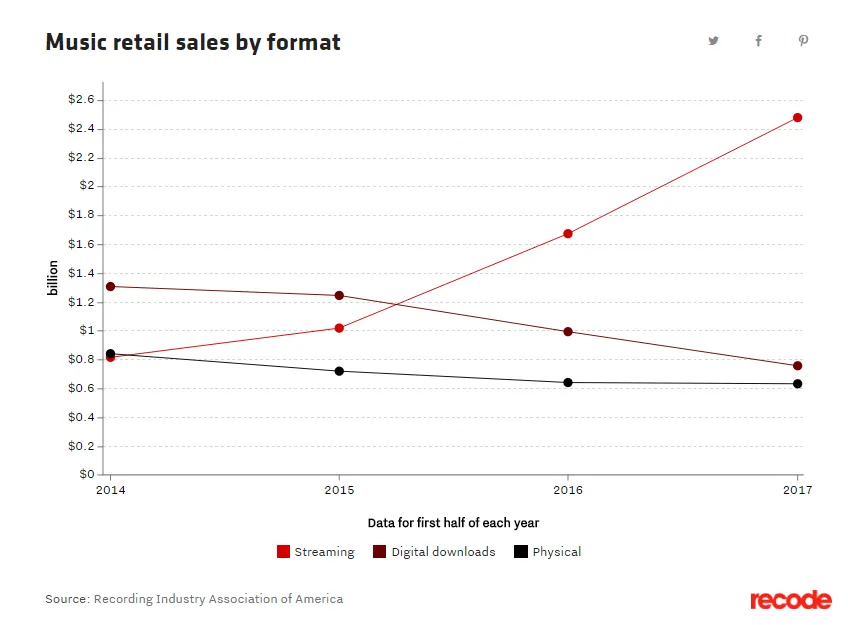
Diversity Scholarships for APME NewsTrain at MTSU
Can’t beat this deal!
When online comments go #MoreThanMean
The podcast “Just Not Sports” tackles the abuse and harassment women sports writers face in online comments with a video of “regular guy” sports fans reading comments to two women sports journalists.
There’s The ‘Web We Want’ and the web we’ve got
The Guardian is trying to bring “The Web Web Want” and the web we’ve got closer together in one of the most indepth looks at the negative issues of online comments and how to fix it in a series called “The Web We Want.”
Social media drives traffic, but the prize is direct users
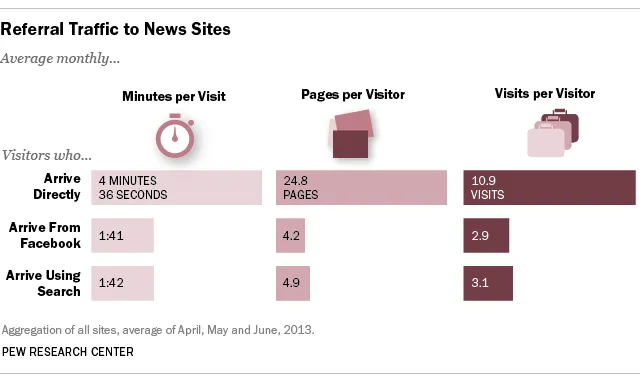
The old and the new
The old knoxnews (a design in use for just over seven years) and the new design, launched July 22, 2014. The old site was on the “Ellington” platform; the new one uses “Endplay.” What’s up with the German ads? We use a screenshot service whose ip addresses are in Germany.
The cheerleader, The Dirty and the court case that could change the Internet forever

About that comment
What’s new in comments about comments. The debate on anonymous comments on websites continues while publisher retool or junk their comment systems. Meanwhile, a few interesting new experiments are happening.
Discovering breaking news as it happens
Editors are safe for the moment, but this is an interesting experiment in news automation and an interesting way of determining what is “breaking news.”
Bot journalist reported California quake first
Ken Schwencke, a journalist and programmer for the Los Angeles Times , was jolted awake at 6:25 a.m. on Monday by an earthquake. He rolled out of bed and went straight to his computer, where he found a brief story about the quake already written and waiting in the system. He glanced over the text and hit “publish.” And that’s how the LAT became the first media outlet to report on this morning’s temblor. “I think we had it up within three minutes,” Schwencke told me.
Tool tip spreadsheet
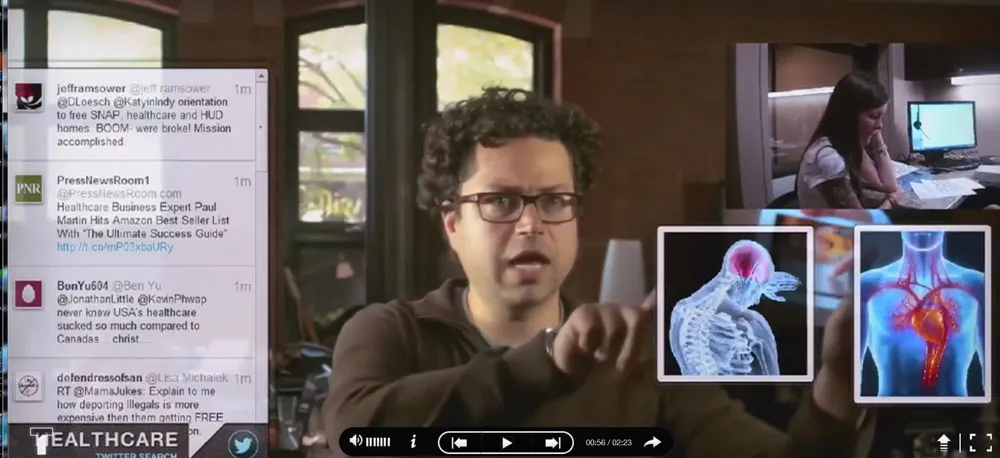
Trends in online journalism 2014
| **Top Trends in Online Journalism for 2014 ** from **[Chartbeat | Real-time site data for front-line teams](https://www.slideshare.net/chartbeat)** |
Students reinventing journalism at MTSU
I’m interested to see what the “Bragg Innovative News Network” looks like when it launches Monday. The network was announced by Middle Tennessee State University earlier this week.
Paywalls aren’t just for newspapers
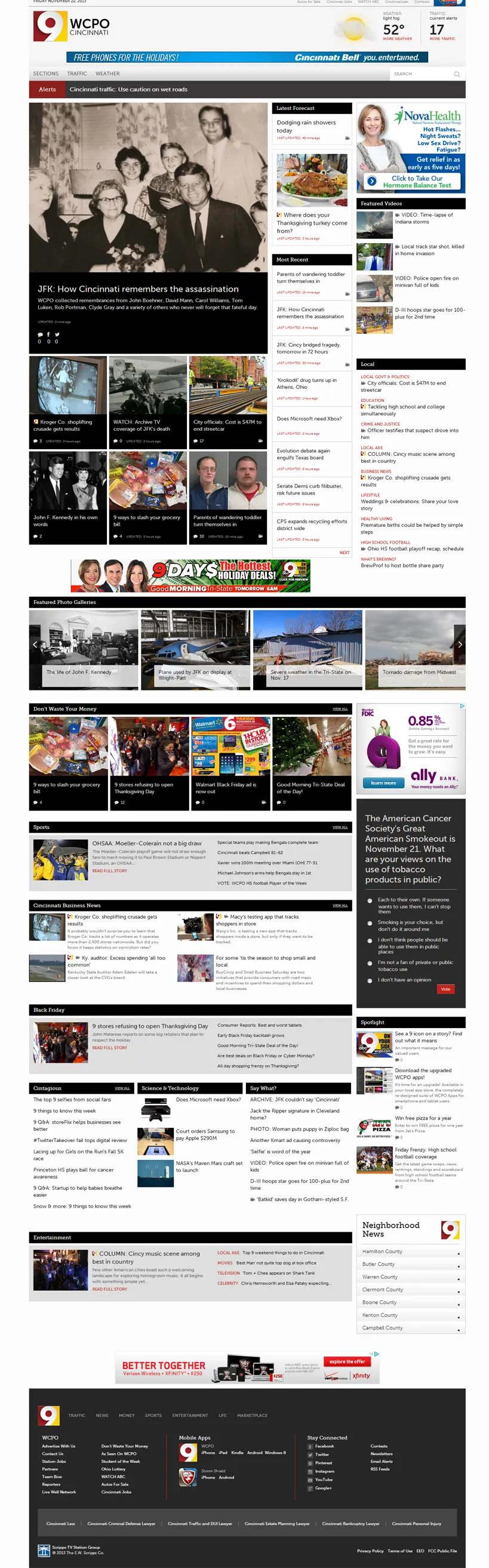 Nice piece by NetNewsCheck on the plan by Cincinnati television station WCPO, owned by E.W. Scripps, to launch a paid-content model in January.
“This is a very aggressive experiment, and I guess I’d be pleased if they’re scratching their heads because that means that they’re not going to compete with us in the short term,” (CEO Rich Boehne) says. “So maybe we’ll get a good head start.”
The real question, Boehne says, is why other television stations haven’t tried it sooner. “Especially watching what the nation’s newspapers are doing, why in the world would we not give this a try?”
Scripps’ portfolio includes a number of daily newspapers in 13 markets that have already launched paywalls, so Boehne may be less averse than many to pull the trigger asking consumers to pay for something they’re long used to getting for free.
Reinventing media at Collab/Space Atlanta
Commenting on comments
- Four Ways to Improve the Culture of Commenting - NYTimes.com
- Gawker founder Nick Denton is still trying to reinvent reader comments – and it’s working – Tech News and Analysis
-
[Why We’re Shutting Off Our Comments Popular Science](https://www.popsci.com/science/article/2013-09/why-were-shutting-our-comments) - George Korda: Anonymous commenters: whether negative or positive, come out of the shadows » Knoxville News Sentinel
-
[What is turning so many young men into internet trolls? Media The Observer](https://www.theguardian.com/media/2013/aug/03/how-to-stop-trolls-social-media?CMP=twt_fd) - Trending: David Goddard: When the few out-yell the many » Knoxville News Sentinel
-
[The Reputation of the Internet Stumbles Dr. Leslie Gaines-Ross](https://www.huffingtonpost.com/dr-leslie-gainesross/the-reputation-of-the-int_b_3672978.html?utm_hp_ref=business) - WJLA Removes Comments From Most of Website: DCist
-
[Top 12 Signs You’re Dealing With Trolls LinkedIn](https://www.linkedin.com/today/post/article/20130722211438-2484700-top-12-signs-you-re-dealing-with-trolls) - Note from the editor: The deal on comments » Anderson Independent Mail
-
[Friendships cut short on social media as people get ruder: survey Reuters](https://www.reuters.com/article/2013/04/10/us-socialmedia-behaviour-survey-idUSBRE9390TO20130410) - Tips on comment management - JackLail.com
- How Do You Respond to Trolls? You Don’t. - 10,000 Words
- New commenting platform on pjstar.com – Editor’s Desk: Words on the Journal Star newsroom and the business of journalism - pjstar.com
- Is ‘conversation management’ a core newsroom function? - JackLail.com
-
[North Carolina newspaper cracks down on racial comments JIMROMENESKO.COM](https://jimromenesko.com/2012/11/14/north-carolina-newspaper-bans-racist-comments/) - » Paper turns off comments on crime stories JIMROMENESKO.COM
- Are comments a wretched hive of scum and villainy or an underused resource for publishers? – paidContent
- HuffPo’s new ‘Conversations’ will improve comments — and make money for AOL – paidContent
- Nick Denton is betting the future of advertising is conversational – Tech News and Analysis
- Fixing online comments — how do you automate trust? – paidContent
-
[The Verge and The Huffington Post attempt the impossible: making comments smarter PandoDaily](https://pandodaily.com/2013/02/01/the-verge-and-the-huffington-post-attempt-the-impossible-making-comments-smarter/) -
[Racist anti-aboriginal slurs and offensive comments prompt Thompson Citizen to permanently close Facebook page Thompson Thompson Citizen, Thompson, MB](https://www.thompsoncitizen.net/article/20130130/THOMPSON0101/130139999/-1/thompson01/racist-anti-aboriginal-slurs-and-offensive-comments-prompt-thompson) -
[Commenting threads: good, bad, or not at all. A Blog Around The Clock, Scientific American Blog Network](https://blogs.scientificamerican.com/a-blog-around-the-clock/2013/01/28/commenting-threads-good-bad-or-not-at-all/) - How Facebook comments do/don’t increase/decrease* trolling for news websites [*Delete as applicable]
-
[TechCrunch’s teachable moment: media sites must own the conversation Dan Gillmor Comment is free guardian.co.uk](https://www.guardian.co.uk/commentisfree/2013/jan/25/techcrunch-teachable-moment-media-comment) - Commenting on the Internet »
-
[Early comments on stories affect what later readers believe, and what they say Poynter.](https://www.poynter.org/how-tos/community-engagement/202035/early-comments-on-stories-set-the-tone-for-what-readers-believe-and-do/) -
[Bill Would Protect Identity of Online Commenters Humphrey on the Hill knoxnews.com](https://blogs.knoxnews.com/humphrey/2013/01/bill-would-protect-identity-of.html) - Not a good 24 hours for Facebook comments
- Are comments just so 2009? - JackLail.com
- Build a ladder of interactivity to engage your readers with your publishing business
- Embedding Google+ Comments on Websites Will Boost Google+ to New Levels
- Are Comments on Websites Effective? : WebPub
- Xark!: Why I shut down comments
- Why comments have been turned off on the FM website. It’s the same reason others have done so. « Fabius Maximus
- Topix won’t protect identity of blogger named in Hawkins County libel lawsuit » Knoxville News Sentinel
-
[The Science of Why Comment Trolls Suck Mother Jones](https://www.motherjones.com/environment/2013/01/you-idiot-course-trolls-comments-make-you-believe-science-less) - Online story comments affect news perception : CJR
- That’s Not the Way It Is: How User-Generated Comments on the News Affect Perceived Media Bias – Journalist’s Resource: Research for Reporting, from Harvard Shorenstein Center
-
[Exclusive: Attorney at Law and Digital Marketer Glen Gilmore compares ANCHORFAN](https://www.anchorfan.com/image/exclusive-attorney-at-law-and-digital-marketer-glen-gilmore-compares-uk-and-usa-social-media-law-in-sport-59582.html) - Comment Moderation Tool - Facebook Developers
- Comments - Facebook Developers
-
[Newspaper: Don’t even think of slamming us on our Facebook page! JIMROMENESKO.COM](https://jimromenesko.com/2012/08/21/newspaper-dont-even-think-of-slamming-us-on-our-facebook-page/) - What makes a troll tick? You can ask Dr. Troll - Technolog on msnbc.com
-
[How Gawker wants to monetize comments Felix Salmon](https://blogs.reuters.com/felix-salmon/2012/05/22/how-gawker-wants-to-monetize-comments/) -
[New York Legislation Would Ban Anonymous Online Speech Threat Level Wired.com](https://www.wired.com/threatlevel/2012/05/anonymous-online-speech-ban/) - `This is vindication’
- Inside Forbes: Love ‘em or Hate ‘em, Comments Are Critical to Media Success in a Social World - Forbes
- Nick Denton wants to turn the online media world on its head – Tech News and Analysis
- Comments are Bad Business for Online Media – ANIMAL
- How online comments prime readers’ perceptions of negative news
- How to Get Past Times Moderators - NYTimes.com
- The ‘tragedy of comments’ - JackLail.com
- Have online comment sections become ‘a joke’? - CNN.com
-
[Daily Dot Gawker Media’s Nick Denton comments on](https://www.dailydot.com/business/gawker-media-nick-denton-tragedy-of-comments/) - Gawker Will Deputize Commenters, Says Sheriff Nick Denton - Liz Gannes - Media - AllThingsD
-
[Gawker Founder Nick Denton Plans To Revamp Site’s Comment Strategy Adweek](https://www.adweek.com/news/press/nick-denton-tragedy-comments-138881) - Scripting News: What is Relative Writing?
- Scripting News: No comment
- The Washington Post tries a new weapon to fight the trolls: humans » Nieman Journalism Lab
-
[Washington Post cracks down on bad comments Poynter.](https://www.poynter.org/latest-news/mediawire/161358/washington-post-cracks-down-on-bad-comments/) - Who Will Win the Race to Build the Web’s Best Real-Name Identity Service?
-
[Gerber: Our online comments policy is changing timesfreepress.com](https://timesfreepress.com/news/2012/jan/01/gerber-our-online-comments-policy-changing/) - Gannett Blog: GCI switching all sites to Facebook commenting
-
[The case of anonymity in social media TechRepublic](https://www.techrepublic.com/blog/tech-manager/the-case-of-anonymity-in-social-media/7025) - Obit for a Flaming Troll - Noise - Jackson Free Press: Jackson, Mississippi
- The New York Times Loves Some Readers More Than Others - Brainstorm - The Chronicle of Higher Education
- Gannett requiring Facebook for posting
-
[Comments on Your Website: The Good, the Bad, and the Ugly The City Wire](https://www.thecitywire.com/index.php?q=node/19016)
Kevin Spacey: ‘All we have to do is just give it to them’
Hear any advice for news organizations?
(H/T Jigsha Desai)
Instapundit at 12
Knoxville blogger and law professor Glenn Reynolds’ Instapundit blog turned 12 just a few days ago. Here’s his first post.
On newsroom innovation …
Thanks to Mindy McAdams for creating this Storify on newsroom innovation. It’s an awesome discussion.
Is ‘conversation management’ a core newsroom function?
There a good bit of continuing discussion about comments and how to manage them (see the link list below). One camp, of which newspapers and TV stations seem to be moving toward, are trying to find pain free ways to manage comments (technology solutions) or to elminate them. The problem: They’re just so darn messy. Technology solutions alone are unlikely to be successful.
NASCAR’s wrong turn on Fair Use
NASCAR made perhaps one of the more novel copyright claims ever: Compassion.
Are comments just so 2009?
Some recent links about comments on websites.
Here’s another ‘time-suck’ post

APME Social Media Day
Is Pinterest rocking your traffic?

What’s a Facebook like really worth?
The Social Media Day at the Associated Press Media Editors Conference in Nashville has one panel that will attempt to provide some answers to that question. It’s a star-studded lineup of newspaper and TV digital pioneers, who have been innovators and ground-breakers as traditional media expanded into digital.
Social Media Day is Friday, Sept. 21 at the John Seigenthaler Center on the campus of Vanderbilt University. APME is doing a special one-day rate of $35 for editors, broadcasters and journalism educators who would like to attend just that day. Contact Sally Jacobsen or Adam Yeomans if you are interested. There are two great morning panels, a lunch speaker and an aftenroon panel, plus an update from a couple Associated Press political writers fresh from the campaign trail.
It would be worth $35 just to hear this panel, but there’s still time to sign up for the whole Conference, which starts on Wednesday. Sept. 19. All three days are filled with great sessions and speakers and events. And the John Seigenthaler Center is a fabulous facility.
The title for this panel is “Is There More to Social Media Than Being Liked?” and the panelists will tackle why are we tweeting and hanging out on Facebook when we have a newspaper to put out - and with fewer people. What are the best ways to make social media campaigns effective? How do you measure social media effectiveness, and what are some strategies for using social media to engage more deeply audiences that might help generate revenue.
Here’s a look at the panelists.
 Ellyn Angelotti is moderating. She is a faculty member at The Poynter Institute, where she explores the journalistic values and the legal challenges related to new technologies, especially social media. Angelotti regularly teaches journalists how to effectively use interactive tools as storytelling vehicles, and how using these tools changes the media landscape. Her current work is focused on the intersection of journalism, technology and the law. She is attending law school part-time at Stetson University College of Law. Before coming to Poynter, Angelotti directed award-winning, nontraditional multimedia sports content at the Naples Daily News in Florida.
 Frank Daniels III is a digital pioneer who led the creation of the first Internet newspaper in 1993, NandO at the Raleigh News and Observer, then owned by his family. Today, he is the co-founder of Wakestone Press, LLC, a Nashville-based publisher focusing on non-fiction stories. He is also working with The Tennessean as Community Conversations Editor. While executive editor of The News & Observer, the paper won the Pulitzer Prize for Public Service. He has founded or been involved in several Internet startups over the last two decades. He is a 2012 inductee into the North Carolina Journalism Hall of Fame, the fourth successive editor of The News and Observer to be honored (Josephus Daniels, Jonathan Daniels, Claude Sitton) and the fifth member of his family.
 Martin G. Reynolds has served as senior editor for community engagement for the Bay Area News Group and Digital First Media’s Western Region since December 2011. He served as editor-in-chief of the Oakland Tribune from May of 2008 to Dec. 2011. He rose through the ranks to become editor after starting at the paper as an intern in 1995. He was one of the lead editors on the Chauncey Bailey Project, formed to investigate the assassination of journalist Chauncey Bailey, and co-founder of Oakland Voices, a community journalism program funded by the California Endowment, that trains residents to become storytellers and publishes their work in the Tribune.
 Jay Small is president of Informed Interactive, a division of Evening Post Publishing Co. that oversees interactive strategy and operations for Evening Post newspapers and Cordillera TV stations nationwide. The company’s online properties include PostandCourier.com in Charleston, S.C., LEX18.com in Lexington, Ky., and KVOA.com in Tucson, Ariz. With 27 years in local media and 17 years in interactive leadership, Small previously held senior posts at The E.W. Scripps Co., Belo Corp., Thomson Consumer Electronics, The Indianapolis Star and Evantage Consulting. He has also served as an independent interactive strategy consultant, with clients including the American Press Institute, Newspaper Association of America, The National Post of Canada, The Santa Fe New Mexican, a global pharmaceuticals company and a regional financial institution.
 Steve Yelvington works with audience and content teams at the Morris Publishing Group newspapers across the United States, helping them grow both news and non-news audiences. A longtime newspaper journalist, Steve Yelvington was founding editor of Star Tribune Online in Minneapolis in 1994 and built it into one of the top-ranked newspaper sites in the world. As executive editor and network content director for Cox Interactive Media, he supervised a nationwide network of city sites. Yelvington has been a featured speaker at online news gatherings throughout the United States and Europe.
You’re likely to first find out about this on Twitter or Facebook
I’m getting excited about a great panel I’m moderating at the Associated Press Media Editors Conference in Nashville on Friday, Sept. 21, 2012. You remember rock super-groups? I think I’ve got a digital super-group for the panel.
New Scripps Digital Division starting to make noise
This has been a bit under the radar, but a lot of work has been going on with the E.W. Scripps Digital Division, in which I now work, since early last fall. You’ll be hearing more as a lot of projects and initiatives are in the pipeline. Stay tuned, there are some exciting things in the works.
For me at a newspaper, itt’s been fun having more contact with our TV station digital folks and being part of a newly created division with a bevy of bold new ideas. On the downside, a lot of talented Scripps digital foks based in the News Sentinel building in Knoxville and who were with what was known as the Scripps Interactive Newspaper Group did not to move to Cincinnati.

The ‘tragedy of comments’
Gawker Media mastermind Nick Denton said Sunday at South by Southwest Interactive that he plans to institute a new commenting system on his family of sites within the next six weeks; one that still allows anonymous comments, but which makes commenters into moderators. On certain stories, the new system will only allow certain users to comment at all.
For every 2 blog comments that are interesting, 8 will be off-topic or toxic, says @NickNotned here > bit.ly/y3hDzx - Agree?
-- Matthew Cerrone (@matthewcerrone) March 12, 2012
Turns out you can only build so many things with Legos
Andy Plesser of Beet.TV interviews Rob Malda, CmdrTaco, co-founder and former editor-in-chief of Slashdot, on his new gig with the WaPo Labs.
Others saw red flags, but Brad Keselowski saw a smartphone opportunity
Has a tablet replaced your ‘main’ computer for reading news?
Interesting survey. If you have a few minutes, help grad student full-time faculty member in the University of Kentucky Division of Instructional Communicatio Chas Hartman by taking it. He’s trying to answer:
- How is consumers’ use of tablets such as the iPad and the Kindle Fire for gathering news and information impacting their use of laptops and desktop computers?
- How is consumers’ use of digital applications to gather news and information impacting their use of traditional Web sites?
- How will consumers’ needs and wants influence their future choices of technology for the purposes of communicating and gathering news and information?
The inventor of the camera phone may surprise you
I remember Phillipe Kahn primarily as the CEO of database and programming tool maker Borland International, but he is also credited with inventing the camera phone in 1997, yes, in 1997. And he’s the only to have a photo to prove it, a photo shot of his newborn daughter on June 11, 1997. This video extends upon an ad Best Buy will air during the Super Bowl.
2011 was the year of the paywall hype
Sorry, Mashable:
This wasn’t the year that paywalls paid off: It was the year that some paywalls paid off for some specific outlets while the rest struggled. That’s not such a catchy headline. But then again, we all know that sometimes reality doesn’t match the simplicity of the news.
FLDemocracy2012 is a new joint TV-newspaper political site

A new Florida political web site was announced by E.W. Scripps today that leverages its newspapers and TV stations in the state.
The new site is called FLDemocracy2012.com. From the news release:
What the new Facebook means for journalists
Journalist new to Google Plus? Look here

If managing story comments are a pain, read this
If you aren’t convinced that world peace is unachievable, read the online comment’s section of a newspaper sometime.
Be a more effective journalist on Facebook
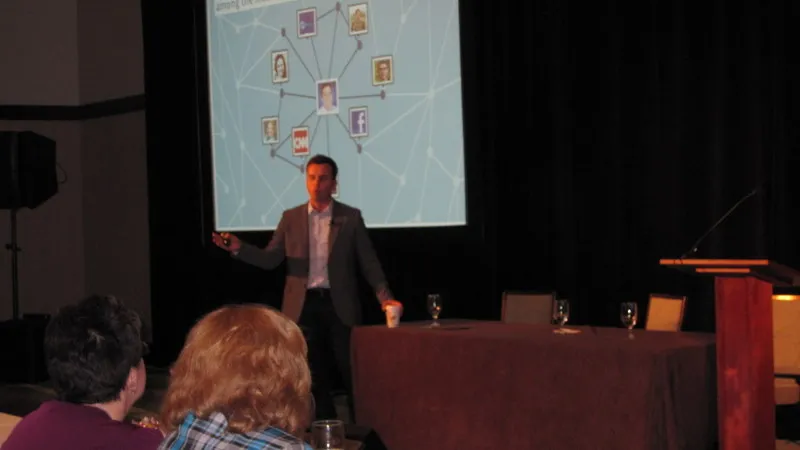
Facebook has begun doing quite a bit of extremely interesting research on how users interact with posts by journalists and on news pages.
Vadim Lavrusik, Journalist Program Manager for Facebook, shared a few highlights of some of that research on Wednesday at the Associated Press Media Editors conference in Denver.
Here are few points from his presentation deck:
Journalist Analysis: Posts with journalist analysis received 20% referral clicks.
Meaty Post Length: 5-line posts (+60% increase in engagement) 4-line posts (+30% more engagement)
Photos Resonate: Photos received +50% likes than on-photo posts. Links with thumbnails received +65% likes & +50% comments.
Weekend Traffic: Saturday links received +85% clicks (Wednesday receive +37% clicks, Tuesday +12% clicks)
Post Through the Day: Spikes at 7 & 8 a.m., 4 & 5 p.m., 12 a.m. and 2 a.m. (all times Eastern).
He also said posts with questions received 2X times more comments and 64% more feedback overall than an average post.
From the study, the most effective posting styles are:
Posts that asked questions or sought user input: +64%
Call to read or take a closer look: +37%
Personal reflections or behind-the-scenes posts: +25%
Posts with catchy/clever language or tone: +18%
Lavrusik and Facebook have created a rich resource for journalists with guides on getting started, best practices, an explainer on the differences between profiles and pages, and articles on some of the research data.
If you’re developing your own following as a journalist on Facebook or are involved in your news organization’s social media efforts, this is a must bookmark resource.
_
(Photo: Vadim Lavrusik, Journalist Program Manager for Facebook, speaking at the Associated Press Media Conference in Denver on Sept. 14, 2011.)_
10 Years of Instapundit
A brief history of Glenn Reynolds’ Instapundit blog and blogging. Reynolds started his blog a decade ago this
HuffPost arrives (again)

Here’s our deal: If you leave a civil comment, we’ll pay attention to it
If there was a Billboard Top 10 for journalism hot topics, the discussion on online comments on news sites would have gone platinum several times over.
There’s a new round of debate, discussion and general consternation this spring.
The Yakima Herald-Republic shut down its commenting system just over 10 days ago and will come back in July with a system that requires real names.
Deirdre Edgar, readers’ representative of the Los Angeles Times, had piece on June 10 headlined “Our goal of civility is falling short.”
Edgar explains of the measures The L.A. Times and other newspapers are taking to better manage comments while continuing to allow them. But she included a line from an email from Op-Ed columnist Patt Morrison. who said:”Personally, I think most comments were of a higher quality when they required pen, paper and a stamp.”
The Boston Globe is joining a growing number of news sites that are outsourcing some pieces of comment management.
The Associated Press Managing Editors circulated a survey last week to newsroom leaders seeking feedback on online comments.
Here’s a roundup of recent articles and discussion on comments.
- Relying on Facebook for engagement: Risky for news …
- Howry: Cleaning up the comment cesspool ‘ Ventura County Star
- The quiet changes to our comment threads
- Paul Keep: Anonymous online comments put MLive.com in …
- Going beyond comments at Hacks/Hackers NYC
- A year later, is your comment system working?
-
[Changes coming to yakimaherald.com commenting system Yakima …](https://www.yakima-herald.com/stories/2011/06/08/changes-coming-to-yakimaherald-com-commenting-system) - Outsourced moderation: one solution for unwanted online …
- Media Nation ‘ Globe outsources online-comment screening
- Online comments: Our goal of civility is falling short …
- A Reporter’s View On The News Industry’s Broken Commenting …
- Future of Media: Curation, Verification and News as a Process …
- News is a subset of the conversation ‘ BuzzMachine
- David L. Hudson Jr.: 3rd Circuit reinstates police officer’s retaliation claim
- Facebook comments: Fewer and better, or just fewer? - O’Reilly Radar
-
[New FB Comment System Analytics: Comparing TechCrunch.com Before and After The Switch Watching Websites](https://www.watchingwebsites.com/archives/new-fb-comment-system-analytics-comparing-techcrunch-com-before-and-after-the-switch/) - How Facebook is Killing Your Authenticity - steve’s blog
-
[Anonymous comments: Adding to debate or facilitating hate? American Observer](https://inews6.americanobserver.net/articles/anonymous-comments-adding-debate-or-facilitating-hate) - Reflections of a Newsosaur: Facebook comments: Friend or foe for pubs?
- On the Media: Your words, your real name - Los Angeles Times
-
[Singel-Minded: Facebook Comments Are Another ‘Good News, Bad News’ Proposition Epicenter Wired.com](https://www.wired.com/epicenter/2011/03/singel-facebook-empire/) -
[Website posters’ anonymity is being put to the test The Indianapolis Star indystar.com](https://www.indystar.com/article/20110306/LOCAL/103060372/Website-posters-anonymity-is-being-put-to-the-test?odyssey=tab%7Cmostpopular%7Ctext%7CFRONTPAGE) - Judge: Media must reveal IDs of online posters - chicagotribune.com
-
[A 5-minute framework for fostering better conversations in comments sections Poynter.](https://www.poynter.org/how-tos/digital-strategies/121664/a-5-minute-framework-for-fostering-better-conversations-in-comments-sections/) - The Pros And Cons Of Facebook Comments
Did you catch Owle, Dipity and Elph at Bonnaroo?
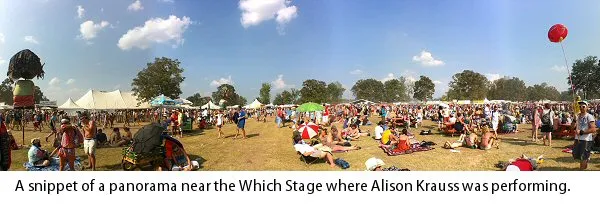
The image of the Tennessee Legislature is growing more frightening and distressing
Did the TN legislature become the first living brain donors? https://t.co/F4ae3qb | cc @jacklail @jeffjarvis #photogSat Jun 11 18:23:36 via web Jeff Manes
gizmotastic
Cultural Change for journalists and newsrooms
More coverage on Twitter of the BBC Social Media Summit. (via Anna Tarkov)
Related articles
Damn, somebody cussed on my wall again
- 47% of our users have profanity on their Facebook Wall.
- 80% of our users who have profanity on their Facebook Wall have at least one post/comment with profanity from a friend.
- 56% of the posts/comments with profanity on a user’s Facebook Wall come from friends.
- Users are twice as likely to use profanity in a post on their Facebook Wall, versus a comment. Whereas friends are twice as likely to use profanity in a comment on a user’s Facebook Wall, versus a post.
- The most common profane word is derivations of the “f-word”. The second most common profane word is derivations of the word “sht”. “Btch” is a distant third.
New sources mean familiar sources
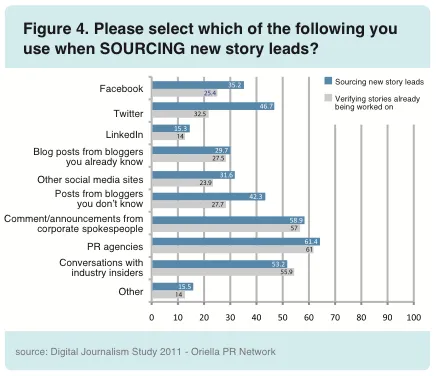
New survey out on how journalists use Twitter, Facebook and social networks.
But conventional PR sources far outweighed the use of social media for story ideas, with 62 per cent of journalists sourcing stories from PR agences and 59 per cent from corporate spokespersons.
Journalists seemed more reluctant to turn to social media to help them with stories they were already working on. The survey found that only a third used Twitter to verify stories and just a quarter turned to Facebook.
Debating ‘best’ in ASNE’s Social Media ‘Best Practices’
Improving comments by having fewer
The Ventura County Star has started limiting comments to just a handful of stories a day. Editor Joe Howry wrote a column about what the newspaper is doing.
He wrote:
If, as they say, the road to Hell is paved with good intentions, then allowing anonymous comments on stories on our website added an express lane to that Godforsaken highway.
What began as a well-meaning attempt to engage our readers in thought-provoking, informative conversations about local issues turned into a cesspool of vitriol, name-calling, rudeness and even racism. What’s worse, the vast majority of these conversations are being conducted by just a handful of people who so dominate the discussions they either scare away or run off anyone who tries to engage in civil dialogue.
Where to find what you need to know about mobile
This video does a great job of explaining why mobile is important
Join us in Nashville on Friday, April 1 for the “Mobile Migration” workshop to learn more. The workshop is co-sponsored by the Online News Association and the Freedom Forum Diversity Institute with underwriting from the Scripps Howard Foundation.
We have some great speakers.
it will be at the John Seigenthaler Center on the campus of Vanderbilt University.
Ah, mobile’s the new, new thing
On successive weeks, you can attend workshops focused on mobile and journalism in Nashville.
March 25
The Society for News Design is hosting a Mobile Design Quick Course on Friday and Saturday (March 25-26) at the Freedom Forum’s John Seigenthaler Center. .
This two-day hands-on course will focus on mobile usability, techniques and tools. Here’s a look at our instructors:
Dave Stanton (@gotoplan) is a web developer, teacher, researcher and manager. He taught web frontend development at the University of Florida for 7 years. He has collaborated with The Poynter Institute to conduct user research since 2006. Currently he is the managing developer for a web development and marketing firm.
Jeremy Gilbert (**@jeremygilbert) **is an assistant professor at Medill, teaching media product design. He has directed award-winning, student-based digital projects, helped revamp the interactive curriculum and is researching the future of mobile journalism. Before coming to Medill, he led The Poynter Institute’s website redesign and worked as a design director.
Free for SND members (a $300 value) and you can get a discount if you’re not currently an SND member (join for only $110 for professional or $60 for students at https://www.snd.org/join/)!
April 1
“The Mobile Migration” workshop is being co-sponsored by the Online News Association and the Freedom Forum’s Diversity Institute on April 1, also at the Freedom Forum’s John Seigenthaler Center. (Underwriting assistance from the Scripps Howard Foundation.)
The workshop is $35 for ONA members and $50 for non-members.
Speakers include:
Grant Steven Moise, Digital General Manager for the Dallas Morning News, who talk about how the mobile web and tablet “apps” fit into the newspaper’s ambitious paid-content strategies that were just implemented last week.
Bill Tallent, CEO of Mercury Interactive, will talk about “Deciphering Disruption.”
Digital technologies have disrupted many industries and their established business models. While websites began the disruption of the printing medium, touch computers seem to be accelerating the disruptive effects. “Deciphering” the disruption is the key to building new competitive business models. This talk will focus on understanding why the disruption is accelerating, characteristics of consumers embracing the new medium, and ways to build the kind of applications that will maximize the revenues from news via touch screens.
Rex Hammock of Hammock Inc. will do a presentation called: “The Reader Decides: How Magazines are Learning What Screen Publishing is All About”
The magazine industry is comprised of companies ranging from giant media corporations to family-owned community monthlies targeting niches ranging from parents to pet-owners to indie-music loving hipsters. From multi-million dollar mega-apps to dorm-room developed content reading apps, the iPad is proving to be both a launch pad of opportunity and a landing pad for humbling crashes. What has year one of the iPad taught magazine publishers that helps predict the future of screen-based media.
Innovations from Africa: A look at case studies from the region on mobile and tablet strategies, Justin Arenstein, media strategist and consultant for Google & the International Center for Journalists.
Using a push-broadcasting system for community reporting and engagement from the folks at VozMob.
(For those who want to stay overnight, there is a special $109 room rate at the nearby Embassy Suites Hotel, 1811 Broadway, To get the discounted rate, call Mike Henry, senior sales manager at the Embassy Suites, 615-277-4964. Only a limited number of rooms are available at this rate … so hurry.)
Join it’s Nashville!
Make the ‘Mobile Migration’
A new survey released with this year’s report, produced with the Pew Internet & American Life Project, in association with the Knight Foundation, finds that nearly half of all Americans (47%) now get some form of local news on a mobile device.
And the move to mobile is only likely to grow. By January 2011, 7% of Americans reported owning some kind of electronic tablet. That was nearly double the number just four months earlier.
I bet you first saw this online
Now we know that 2010 was the year that the declining line of newspaper readership and the growing line of online news consumption crossed.
Eric Sass in MediaDailyNews:
The inevitable shift finally came in 2010, as more Americans got their daily news from online sources other than print, according to the Biannual News Consumption Survey from the Pew Research Center for the People & the Press. The findings were released this week as part of Pew’s annual overview of the news media.
Specifically, Pew found that the proportion of U.S. adults who said they got their news online the day before increased from 29% in 2008 to 34% in 2010. The proportion that cited print newspapers as the source of their recent news fell from 34% in 2008 to 31% in 2010.
SEO (the short version)
If you produce your URL first and get it out there with just one sentence, Google will reward you with search results. #hacknewsSun Mar 13 16:35:03 via Twitter for iPad Colleen Newvine
cnewvine
Editors armed with iPhones and notebooks invade Kennedy Space Center
Last week, E.W. Scripps editors, website managers, and corporate interactive folks (among others) took a break from strategic planning in a windowless hotel conference room in Orlando to tour the Kennedy Space Center.
It was part of the work being done for the launch of a new space site, which officially debuts Thursday. It’s live now, however, with a lot of work still going on.
As part of the site launch, there will be lots of live coverage on the site of the Discovery shuttle launch, set for 4:50 p.m., including live streaming of the liftoff and a live chat. It’s the last space flight of the Discovery.
The video above, mostly shot with the camera in the iPhone, is from the tour.
Give the site a look. It’s www.spacetimesnews.com and if you have suggestions, let me know. I will pass them on. Part of the purpose of the site is to give a place to try out a few new things.

Clark Gilbert and the ‘Inscrutable Dilemma’
 Clark Gilbert, speaking to newspaper industry executives earlier today at the Multimedia Key Executives Conference said:
“A complete transformation is necessary to move forward and to be competitive” with new businesses entering the marketplace, adding that he believed the industry has a three-year window to make the necessary changes.
“The industry is forever broken. It will bounce again, but three years from now will be the permanent reality.”
New Licensing Group to defend virtue of copyright
 AP’s board approved plans today plans for the News Licensing Group, a spin-off news licensing agency that will be something of an ASCAP for news.
The paid-content riches are in the niches
 Over on the “This is How We Roll” blog, I’ve posted some thoughts about a paid-content site I’ve been working on for weeks with 247Sports.com called GVX247.
It launches Thursday and you can get all the details from the post there.
There’s been a lot of talk about paid content in 2010 and there will be more in 2011. Big experiments by media giants have launched in the last several months and more big experiments will launch in 2011,
Some of those involve paid newspaper.com websites, some involve iPad app strategies, some involve niche sites, and some involve other models, including metered use.
The Analog Dollars to Digital Dimes problem has more than few publishers up at night looking for solutions beyond just advertising-supported media. What consumers will pay for and what they believe they should receive for free is a moving target. Finding the right place on the spectrum will be crucial for the eventual winners … and fatal to the eventual losers.
I do not see much of a future in taking shovelware newspaper.com content behind a paywall. For those that want to try it, good luck. The value equation just doesn’t seem to add up to much for the user along with the downside risk for publishers of becoming irrelevant in the community or marketplace (however you want to define those).
I do see the potential for deep dive paid-subscription content in niches with sports being one of the obvious top of the list plays. Financial information seems to work pretty for the Wall Street Journal and Bloomberg as well.
What future do you see for paid content?

Coming down from the mountain with a few ideas for iPad apps
Last weekend I spent an intensive and fascinating weekend at the Snowbird Resort in Utah working on ideas for applications for iPads, other tablets and smart phones. It was one of those events where the positive energy and creativity of the people there fed on itself.
Dallas Morning News Publisher and CEO James M Moroney III held the “Snowbird Digital Storytelling Conference” to brainstorm some good ideas for tablet and mobile applications for that newspaper. But it wasn’t just an internal brainstorming binge; a diverse group of other people were invited to join in. And that, I think, was part of the secret sauce that made it much more rewarding.
They included some tech industry folk, a science fiction writer, a folklorist, an entrepreneur or two, a couple college professors and some just interesting folks. They brought different perspectives of what they want from news and began from different vantage points.
And in one of those small world moments, I wasn’t the only person from Knoxville among the 30 or so people in conference rooms 8,000 feet up in the Utah mountains. I traveled across the country and met someone who is doing some intriguing mobile projects just a few blocks from my desk. That would be Eric Ogle of the University of Tennessee Institute for a Secure and Sustainable Environment’s Community Partnership Center.
Ogle has been involved in bringing free WiFi to downtown Newport with the aid of a grant and worked on a project that first came up with a browser-based multimedia tour called “The Beck Tour.” a tour of some historically significant sites around downtown Knoxville. That now has been released as a first-of-its-kind iPhone and iPad app.
We were divided into three, later four, teams, that developed ideas, winnowed them down to a handful and then honed in on the best from Friday evening through noon on Sunday. The goal was to come away with ideas that could be developed rapidly and introduced as early as the first quarter of 2011. We had to use available technologies and require days instead of months or years of development.
There was no skiing, snowboarding or snowman building.
The video above is about one of the concepts that bubbled up to the top. In it are Cassie Clark, web editor for the Dallas Morning News’ neighborsgo.com, and Steve Ross. a long-time journalism professor at Columbia who now is corporate editor of Broadband Properties and continues lecturing around the globe. The concept is called “Take Back the Morning” and it is focused on regaining with the iPad and iPhone that “morning with your newspaper” experience.
You can see videos about some of the other ideas on the MediaWiki created for the conference. In addition to the presentation videos, Ted Kim did a nice conference overviewshot and edited entirely on his iPhone.
Moroney had former Belo Interactive vice president/technology and digital journalism pioneer Chris Feola run the conference. He said it was the first “Feola Fest” he had put on in more than a decade. Chris, you need to do these more often. Seriously!
Related articles
Anonymity, we want to know thy name
 The debate over anonymous commenters on the Internet got amped Nov. 29 whenJulie Zhuo, product design manager at Facebook, threw her hat into the ring with an Op-Ed piece in the New York Times challenging content providers to discourage or ban anonymous posters.
She wrote:
But the law by itself cannot do enough to disarm the Internet’s trolls. Content providers, social networking platforms and community sites must also do their part by rethinking the systems they have in place for user commentary so as to discourage – or disallow – anonymity. Reuters, for example, announced that it would start to block anonymous comments and require users to register with their names and e-mail addresses in an effort to curb “uncivil behavior.”
Let’s see there’s AP, Reuters, CNN and Twitter
…there is something interesting in what (Twitter founder Biz) Stone seemed to be describing: using the massive stream of 100 million tweets a day that flows through Twitter as the basis of a kind of digital-age Associated Press or Reuters newswire, which news organizations could share and use as a tool for distributed eye-witness reporting from around the world.
An ending almost like truth, justice and apple pie
Last month an article, “American as Apple Pie – Isn’t,” was placed in error in Cooks Source, without the approval of the writer, Monica Gaudio. We sincerely wish to apologize to her for this error. We have made a donation at her request, to her chosen institution, the Columbia School of Journalism. In addition, a donation the Western New England Food Bank, is being made in her name. It should be noted that Monica was given clear credit for using her article within the publication, and has been paid as she has requested to be paid.
A Cooks Source smorgasbord
This one quickly went past simmer until done to just microwave on high and forget the timer. Doug Fisher has a good set links to pieces on it. It’s outrageous example of unashamed theft by copyright infringement.
Future of fair use to be shaped by a dancing baby
The ‘Dancing Baby’ Lawsuit Will Shape Future of Fair Use https://tinyurl.com/27eue2xSat Oct 30 03:58:25 via NetNewsWire for iPad Mike Orren
mikeorren
Journalism as stir-fry
Gawker Media Chief Operating Officer Gaby Darbyshire
Related articles
Turning a social media lens on the Tennessee gubernatorial debate
Getting the lay of the land in digital media law
Wow, what a great resource for digital media law issues. Everybody involved in digital content could stand to give this PDF a read.
A camel, a Lohan and a Curley
Tom Curley, president and CEO of the Associated Press, talks about news on the Web and the four types of news at the APME NewsTrain at the John Seigenthaler Center on the campus of Vanderbilt University in Nashville on Sept. 23, 2010.
Related articles by Zemanta
Newspaper newsrooms need to adjust the metabolism
The Knoxville News Sentinel ran Part 2 of the Scripps Howard News Service package on the “Future of News” today. The first installment ran Sunday. (Other E.W. Scripps newspapers ran the series or parts of the series earlier. Several, like the News Sentinel, also did local pieces to go along with it.
My contributions were Q&As with Dave Morgan and Elizabeth Spiers. I mentioned the Dave Morgan piece in a Sunday blog post. Here’s one of the questions and answers from the piece with Spiers.
Q: How do traditional mainstream get digital products wrong?
A: (I gave a talk about this a couple of weeks ago, so from my notes:) They don’t understand their audiences because they’re not used to using data aggressively.
They view their sites as mere brand extensions and fail to treat them as stand-alone media properties.
They don’t understand usability and make their sites pretty but impossible to navigate, and then naively think they’ll educate their users to find their content.
They don’t understand Web metabolism and produce content that’s stale.
They think Web content is inherently inferior when it’s merely different, and create inferior Web products as a result then wonder why they’re not succeeding.
They fail to monetize their products properly, then underpay talent and wonder why they can’t recruit good writers.

There’s a future in news
E.W. Scripps newspaper editors and online managers collaborated on a “Future of News” project this summer that ran in some newspapers last weekend and is on knoxnews.com today and Tuesday.
It was a challenge put forth by Chris Doyle, the company’s new vice president for content. It was part self-education and part reporting project for the group as Doyle and top managers in his division chart a course for the future. Editor Jack McElroy provides the big picture.
For part of my contributions, I decided I wanted to tap into the thoughts of a couple of smart people outside my familiar ground of newspapers. I reached out to Dave Morgan and Elizabeth Spiers. Both answered a series a questions that we are using as Q&As in the Future of News package.
The Q&A with Morgan, founder and chairman of SimulMedia, went online and in print today. The Q&A with Spiers, a media launch consultant, entrepreneur, and writer, runs Tuesday.
 One the quotes I particularly liked in Morgan’s answers was his advice to journalism students:
You will have a great future if you recognize that there has never been a better time to practice great journalism; that great journalists are the eyes, ears and analysts for their audiences; that great journalists listen more than they talk and write; and that great journalists can now - more than ever before - get truly close to their audiences.
No longer is the media world one of a publishers-top editor-section editor-subeditor-journalist hierarchy. Today, audiences are in charge and they want direct access to, and interaction with, journalists.
A brand of journalist
Below are a few links I pulled together for a pizza lunch (and I wonder why so many accepted the calendar invite) at the News Sentinel today on “Brand Me” for journalists.
Personal branding and the use of Social Media networks can be a controversial topic for journalists, after all more than one has been fired (euphemistically forced to resign) over something they said on Twitter or Facebook or in a blog.
Also, many journalists are uncomfortable about promoting themselves or their work even in the information overload world we live. The early adopters in our newsroom have had few concerns or issues about getting involved in Social Media buzz, but as more journalists are being encouraged to get involved, concerns or frets have surfaced that often don’t have easy answers.
it is clear many journalists, however, are using Social Media, the Internet, and all the digital media at their disposal to draw readers/viewers/audience to themselves, to enhance their credibility and reporting authority, and to find stories, even scoops.
News via social networks and having an identity on social networks is becoming a “must have” within news organizations. Just this week, Facebook published “Facebook + Media” to promote best practices for journalists, developers and media partners.
_
_Where do you weigh in on “Brand Me” for journalists? Are there additional links I should have included below?
It was news, but was it working?
Long-time Knoxville radio news broadcaster Dave Foulk has built up 4,229 friends on his Facebook page. Maybe Foulk personally knows over 4,000 people and counts them as friends; I kind of doubt it. They were there for another reason.
They had grown accustomed to his frequent, short police-scanner type posts throughout the day.
_Stalled car- Chapman Highway- southbound at Stone Road
Wreck: Maynardville Highway at Brown Gap Road
Delta airliner blew a tire taking off from Atlanta for Portland blew a tire. Circled Alabama, then landed safely back at ATL_
Traffic signals not working at Emory at I-75
All that ended Thursday when Foulk posted a Facebook post that said:
 That generated 57 comments (at least by early this morning); most of them were sad, many of them thanked him for the service he had provided, several were mad at the radio station he works for.
I’m not privy to all (or any of) the factors the radio station’s management or Foulk considered, but discussions about the role of Social Media within news organizations and how it fits into newsgathering is a hot topic. How Social Meida fits into the organization’s image and how it figures into the company’s bottom line efforts are questions being discussed by news executives and publishers and general managers and station managers nearly everywhere.
If I had the answers, I’d be a Social Media consultant, or failing at that, a mere media mogul. Lacking answers, I do have some observations.
Innovation winners
Congrats to the Knight-Batten Innovation Award winners! All 30 ideas look exceptional.
A tale from the delta of Social Media
While it doesn’t reach the fame of Dave Carroll and United Airlines’ breaks guitars, Kevin Slimp of Knoxville experienced the power of Social Media on Sunday when he posted this note at 11:32 a.m. Sunday on Facebook about his Delta Air Lines flight:
UPDATE: Flight from Atlanta to Knoxville just cancelled. Have I been here before? Going to get the rental car now. Anybody got a spare tire?
Anonymous commenters could face their own Ice Age
The debate about comments on news sites continues to generate, … er, comment and momentum is building to somehow put personal reputation back behind the words.
The latest piece I’ve seen is Neil Swidey’s piece on Boston.com, which takes a snapshot of the current landscape, but also takes a close-up of several Boston.com commenters. Swidey notes he wasn’t able to talk to several others he had wanted to interview, writing:
But here are the people I didn’t hear back from: the screamers, troublemakers, and trolls (Internet slang for people behind inflammatory posts). Not a single one. The loudest, most aggressive voices grew mum when asked to explain themselves, to engage in an actual discussion. The trolls appear to prize their anonymity more than anyone else.
iPad apps to force website pay walls

Anonymous comments are the stuff sane people wouldn’t write

Jeff Herr: Get Your Mojo On!
Jeff Herr, Director Of Interactive Media, Lee Enterprises, does a presentation called “Get Your Mojo On!” His talk is broken into eight videos.
His is another presentation from the “Smart Phones for Smart Journalists” wrokshop in Nashville on April 9. The one-day workshop was sponsored by the Online News Association and the Freedom Forum Diversity Institute. The workshop was underwritten in part by Cell Journalist, a Nashville company with a photo and video platfrom used by hundreds of media Web sites, and the Scripps Howard Foundation.
More from the workshop.

YouTube rolls out conversation tool for all to use
YouTube and Google on Thursday released to all users a tool called Google Moderator it had used in just a few high-profile events like a Q&A project with President Obama.
It’s an interesting attempt by YouTube to provide a more controlled comment environment than the comments below videos on its site. It’s yet another strategy, a software-based approach, to increase the signal-to noise ratio of user comments.
Here’s how Olivia Ma at YouTube describes how it works:
You set the parameters for the dialogue, including the topic, the type of submissions, and the length of the conversation. Watch as submissions get voted up or down by your audience, and then respond to the top-voted submissions by posting a video on your channel. The platform operates in real-time, and you can remove any content that you or your audience flag as inappropriate. You can also embed the platform on your own website or blog.
AP ripe for disruption by Web platform
Watch live streaming video from disrupt at livestream.com
Ruminations on news
Blogger and professor Jeff Jarvis, Steve Coll, former managing editor of the Washington Post and of the New America Foundation, and John Sturm of the Newspaper Association of America on the future of news.
(viaBuzzMachine)
Possibly related articles by Zemanta
Totally out of the box: Make relevance a measure of journalistic quality

Snagging Tweets on Nashville
If you’re a Nashville disaster, you have to make it deep into the playoffs before the national media takes you seriously. #nashvillefloodless than a minute ago via web Rex Hammock
r
22 weigh in on Web site comments
Maybe it started with a weekend Twitter discussion by Howard Owens and Mathew Ingram a few weeks ago, but however it began, there’s a lively new debate ongoing about Web site comments, particularly on news sites, a topic we’ve written about previously.
I’m sure the current systems used by most news site that allow for users to have “handles” or “nicknames” or “avatars” could be improved upon..
Here’s a thought (fleeting): In addition to real names: add real addresses or current location and display comments on a Google map. Either civility would improve or assaults would rise. It could make for some fascinating looks at the spatial distribution of opinions.
Need to catch up? Here are my most recent Delicious links tagged “comments.”
- Comment Innovation: An Open Door of Startup Opportunity? - ReadWriteStart
- Scott Rosenberg’s Wordyard » Blog Archive » Newspaper comments: Forget anonymity! The problem is management
- Your comments are starting to stink (moderate ‘em!): SteveOuting.com
-
[Judge Who Was Revealed As Anonymous Commenter Sues Newspaper For $50 Million Techdirt](https://techdirt.com/articles/20100408/1124408939.shtml) -
[The Real Problem With Internet Comments Isn’t Anonymity Techdirt](https://techdirt.com/articles/20100412/1526158979.shtml) - Tough love: Gawker finds making it harder for comments to be seen leads to more (and better) comments » Nieman Journalism Lab
- News Sites Rethink Anonymous Online Comments - NYTimes.com
- Change of Subject: Pseudonymity can battle the scourge of comment anonymity
-
[The why and how of a real names policy on comments Howard Owens](https://www.howardowens.com/node/7349) - If you can’t manage comments well, don’t offer comments at all
-
[Plain Dealer sparks ethical debate by unmasking anonymous Cleveland.com poster cleveland.com](https://blog.cleveland.com/metro/2010/03/plain_dealer_sparks_ethical_de.html) - Story Lab - ‘The Lowest Comment Denominator’
- On distributed trust, identity, reputation and anonymity « John Bracken
- More News about Omidyar’s Peer News
- The problem with comments isn’t them « BuzzMachine
-
[California Court Says Online Bullying Is Not Protected Free Speech Techdirt](https://www.techdirt.com/articles/20100319/0503118631.shtml) - Anonymity or identity: Which is the best way to handle comments? « Pursuing the Complete Community Connection
-
[Commenting: An ounce of leadership is worth a pound of management yelvington.com](https://www.yelvington.com/content/commenting-ounce-leadership-worth-pound-management) - Anonymous Comments: Are They Good or Evil?
- Story Lab - Blowback: Do comments scare off sources?
-
[Story comments show their potential The Upfront Page knoxnews.com](https://blogs.knoxnews.com/editor/2010/01/story_comments_show_their_pote.shtml) - Ill. newspaper suspends Web comments - UPI.com
SEO links for news editors

The iPad as “transformative device”
Bill Tallent, CEO of Mercury Intermedia, talks about how Apple’s iPad will transform culture. His company is a maker of applications for iPhone, iTouch, iPad and Android devices. The iPad application it built for USA Today has been getting rave reviews.
Tallent, a fascinating serial entrepreneur, spoke Friday, April 9, 2010, at the “Smart Phones for Smart Journalists” workshop held at the John Seigenthaler Center in Nashville, Tenn., on the edge of the Vanderbilt University campus.
The day-long workshop was sponsored by the Online News Association and the Freedom Forum Diversity Institute and was underwritten in part by Cell Journalist, a Nashville company with a photo and video platfrom used by hundreds of media Web sites, and the Scripps Howard Foundation.
Here is a link to Tallent’s slide deck.
I was able to do a couple other clips:
Changing up the lineup for “Smart Phones for Smart Journalists”
 We’ve made one lineup change in our speakers for Friday’s “Smart Phones for Smart Journalists” workshop in Nashville at the Freedom Forum’s John Seigenthaler Center.
Due to an unforeseen obligation, Rob King of ESPN is unable to attend, but Patrick Steigman has graciously agreed to speak in his place.
Here is his bio:
Stiegman is Vice President and Executive Editor/Producer for ESPN.com, overseeing the site’s day-to-day content planning and management of an award-winning team of more than 200 editors, writers and producers. His role includes strategic planning and cross-platform content development for ESPN Digital Media.
Stiegman in responsible for daily news, analysis, commentary, multimedia, editorial quality assurance and programming for the leading sports site. He was named vice president in November 2006 and added executive producer responsibilities in June 2007.
He joined ESPN in April 2004 after nine years as Vice President and Director of Internet operations for the Milwaukee Journal Sentinel and Journal Communications.
Added to “Smart Phones for Smart Journalists” lineup
 We have a speaker switch on our “Smart Phones for Smart Journalists” workshop on April 9 in Nashville at the Freedom Forum’s John Seigenthaler Center.
Coming up from Atlanta to hold the legal issues session is attorney and press law expert Tom Clyde. The bio:
Tom Clyde is a partner in the Atlanta office of Dow Lohnes PLLC where he has practiced since 1992 in litigation, specializing in media law. Among other clients, he represents The Atlanta Journal-Constitution, WSB-TV, and WSB Radio.
Tom’s practice primarily involves the defense of publishers and broadcasters accused of defamation, invasion of privacy and related claims. In addition to media litigation, Tom regularly counsels and represents the media in connection with newsgathering matters, including hidden cameras, surreptitious recording, protecting the identity of sources and application of state and federal freedom of information laws.
Since 1996, Tom has served as co-author of the Georgia chapter of “The Open Government Guide” published by The Reporters Committee for Freedom of the Press, and the Georgia chapter of the “Survey Libel Law,” published by the Media Law Resource Center.”Tom is a board member of the Georgia First Amendment Foundation and currently serves as its legal committee chair. Tom received his A.B. from Princeton University in 1988 and his J.D., with honors, from Duke University in 1992.
Newspaper paywalls would be a ratings hit for local TV stations
 Nice interview with E.W. Scripps CEO Richard Boehne over at TVNewsCheck, but I hate it when they call the company I work for “venerable.” Sounds so very musty.
Some selected quotes, but read the whole thing:
On online as a business:
There’s a reasonable amount of potential and it’s the same for the TV stations. TV stations have every bit the opportunity that the newspapers have and some would argue they have a better opportunity. Thus far, they have not taken advantage of that and in many markets they’re well behind the newspapers. But they’re catching up.
As strange as it sounds, we are focusing more and more on print and online as separate businesses and not the same.
A Saturday conversation on comments
 I missed the running Twitter debate between Mathew Ingram and Howard Owens on anonymous comments on Saturday; the weather in Knoxville was just too nice to stay indoors and on a computer.
But, thankfully, Ingram has recapped it.
I think the reliance on persistent identity from technologies such as Facebook Connect and OpenID could render the debate moot, but neither “real names” nor “quasi-verified identity” will solve the problem of racist, sexist and just plain hateful speech in Web site comments from the likes of comment trolls as in the drawing on the right. Some people just think that way. And here’s a news jolter: _Not everyone is nice.
_
It would be wonderful if all comments were erudite, thoughtful commentaries on the issues, but forget it, it’s not going to happen. It wouldn’t reflect your community anyway.
Putting resources to comment management is one of the keys to keeping the conversations in bounds. The power of reputation is another. Raising the value of reputation can come through “real names,” persistent identity or by merely making the user’s profile more important on a site.
I’ve been collecting links on Delicious about Web site, particularly newspaper Web site, comments for at least a year as part of the APME Online Credibility Roundtable the Knoxville News Sentinel held. A Webinar at Poynter’s NewsU. continued the discussion.
**Update: Steve Buttryjoins the conversation and Steve Yelvington has a take.
**
Here’s the most ones I’ve tagged (if there are others that should be on this list, please let me know):
- Anonymous Comments: Are They Good or Evil?
- Story Lab - Blowback: Do comments scare off sources?
-
[Story comments show their potential The Upfront Page knoxnews.com](https://blogs.knoxnews.com/editor/2010/01/story_comments_show_their_pote.shtml) - Ill. newspaper suspends Web comments - UPI.com
- Comments by Billie : knoxnews.com Accounts : Knoxville News Sentinel: Local Knoxville, Tennessee News Delivered Throughout the Day.
- Scooping the News: Is self-policing the best way to manage online comments now and in the future?
- New Tools Aid in Policing Web Comments
-
[Section 230 of the Communications Decency Act Citizen Media Law Project](https://www.citmedialaw.org/section-230) -
[Post a vulgar comment while you’re at work, lose your job The Editors’ Desk STLtoday](https://www.stltoday.com/blogzone/the-editors-desk/the-editors-desk/2009/11/post-a-vulgar-comment-while-youre-at-work-lose-your-job/) -
[Local view: Let’s raise our standards on anonymous postings Duluth News Tribune Duluth, Minnesota](https://www.duluthnewstribune.com/event/article/id/152129/group/Opinion/) - Online Comments: Civic Engagement At Its Best—Or Worst? : Features : Metro Pulse
-
[Nieman Reports Ethical Values and Quality Control in the Digital Era](https://www.nieman.harvard.edu/reportsitem.aspx?id=100699) - Updating comments on running stories by andydickinson.net
-
[Reporters: How to respond to comments patrickbeeson.com](https://patrickbeeson.com/blog/2009/oct/02/reporters-how-respond-comments-newspaper-web-site/) - Newspapers get the kind of communities they deserve » Nieman Journalism Lab
- Chicago Tribune Mary Schmich column: Online commentary rules change is overdue
-
[Forum addresses journalism’s comment conundrum Twin Cities Daily Planet Minneapolis - St. Paul](https://www.tcdailyplanet.net/news/2009/10/10/forum-addresses-journalisms-comment-conundrum) -
[Plain Dealer wants comments – without the side order of bile cleveland.com Updates - cleveland.com](https://blog.cleveland.com/updates/2009/10/plain_dealer_wants_comments_–.html) -
[Reporters: How to respond to comments patrickbeeson.com](https://patrickbeeson.com/blog/2009/oct/02/reporters-how-respond-comments-newspaper-web-site/#c1342) - Your comment engine pet peeves - Wired Journalists
- WRAL.com :: Coming up: On the Record: Is civility disappearing in the U.S.?
- Twitter / yelvington: When citing precedent in a …
- Police ready to ‘take on’ commenters, chief says
-
[Seven keys to building healthy online community yelvington.com](https://www.yelvington.com/content/seven-keys-building-healthy-online-community) -
[Troll Alert: A survey of commenting policies on news Web sites CoPress](https://www.copress.org/2009/09/17/commenting-policies/#more-2561) - Ombudsman Blog - Delay In Removing An Insulting Comment
- Chinese Government Closes In On Anonymous Commenters - China - Gawker
- Housekeeping note - Paul Krugman Blog - NYTimes.com
-
[News Websites in Texas and Kentucky Invoke Shield Laws for Online Commenters Citizen Media Law Project](https://www.citmedialaw.org/blog/2009/news-websites-texas-and-kentucky-invoke-shield-laws-online-commenters) - Got a comment? Keep it to yourself - The Boston Globe
-
[Professor Tries To Get Info On Newspaper Commenters Techdirt](https://techdirt.com/articles/20090606/1248575156.shtml) - The Medium - Comment Is King - NYTimes.com
- Newspapers try to maintain civil, intelligent conversations with readers – chicagotribune.com
- Doug Feaver - Listening to the Dot-Comments - washingtonpost.com
- Gannett newsman disagrees with ex-WPer on anonymous comments
- What Type of Web Commenter Are You?
- Poynter Online - Forums
- Poynter Online - Dialogue or Diatribe?
-
[Throw the bums out yelvington.com](https://yelvington.com/20061229/throw_the_bums_out) - Editors explore issues surrounding Community Conversation; ‘We want to reinforce importance of engaging people in a dialogue,’ says Carroll(March 15, 2007)
- Legal Watch: Letter-to-the-editor libel verdict highlights legal distinction for online comments (May 10, 2007)
- Poynter Online - Dialogue or Diatribe?
AOL’s Seed and “bionic journalism” explained
AOL has built a three legged stool to create content: part professional, part freelance, and part aggregated . . . but its model is far more hand-crafted than the other new players in the mass content creation space. “The essence of journalism has always been separating signal from noise,” says (Saul) Hansell. “It’s all judgment. It’s all selecting the best bits.” What AOL hopes to create with Seed is an editorial machine which automates the assignment process as much as possible, but keeps the final selection part in human hands.
“I call it Bionic Journalism,” says Hansell. “Left brain, right brain. We are trying to take the best of a machine, which does lots of things over and over again, and a person.” It’s a tall order, and will take a lot more than a couple thousand band interviews to prove it works.
Run the marathon; not the sprint
Spot on predictions so far.
Gabe’s gaze into media

What to do next
Just got a copy of Mark Briggs’ latest book Journalism Next: A Practical Guide to Digital Reporting and Publishing
Some of efforts we have been doing at the Knoxville News Sentinel are highlighted.
He visited Knoxville during his research for the book. In fact, the book has a bit of a Knoxville flavor. In addition to some people at the News Sentinel, Briggs recognizes Patrick Beeson of the Knoxville-based E.W. Scripps Interactive Newspaper Group (SING) and Jim Stovall of the University of Tennessee in the acknowledgments.
Briggs is a frequent presenter at journalism and media conferences and previously wrote “Journalism 2.0: How to Survive and Thrive.”
In this book, a cookbook of sorts of journalism and technology, Briggs tries to help readers connect the dots between technology and digital concepts and tools to the core principles of good journalism.
He does a good job. Give it a read.
Related articles by Zemanta
Yahoo! at 15

Letter from the epicenter
Editor & Publisher Editor Mark Fitzgerald notes that with the departure of Rusty Coats from E.W. Scripps and the newspaper industry, “that’s two Internet thinkers gone from the business in this young year. E&P’s current Editor of the Year departed Gazette Communications in Cedar Rapids, Iowa for a digital startup in D.C.”
The Editor of the Year, of course, is Steve Buttry, whose wife, Mimi Johnson, perhaps, wrote the best account of his journey to the exit door.
If you add just more weeks to Fritzgerald’s timeline, you also get to Rusty Coats’ spouse, Janet Coats, who left her job as executive editor of the Tampa Tribune in December to move to Knoxville to be with her husband. She was an innovative and forward-thinking editor who guided the newspaper through a brutal reorganization.
The departures of these three and those that came before them may be a clue of the upheaval and human stress at the epicenters of change in the newspaper business, those stress points where the traditional business print model and what must be the future digital-based business model most forcibly collide.
The three are part of a growing list of people I’ve drawn inspiration and copied “best dish” recipes from for years who have exited the newspaper business. Most have retained their love of the news business or journalism, but have moved on from “the paper.” They were the pioneers pushing, pulling, cajoling their organizations and the entire industry to move into the uncharteed future. For example, Rusty Coats’ colleagues in the Newspaper Association of America’s Digital Media Federation voted him their “Online Innovator” in 2005.
These, like those before them, began as print journalists and who became leading digital news thinkers and leaders and doers before moving on. They will be missed from an industry that badly needs them. Yes, there are young people in the newspaper industry with energy and drive and ideas and optimism for its future. There are a handful I could name in my own newsroom and several more scattered about the building, which houses both the Knoxville News Sentinel and the E.W. Scripps’ newspaper division’s corporate interactive group. Smart, talented, and committed people seeing a future.
But there’s a grim reality as well. In a recent NewsU.org seminar Mark Briggs, who himself left newspapers for a news related startup, noted “culture eats strategy for lunch” and “when you bring change back to an organization, the organization’s first instinct is to crush the change.”
Many interesting things are happening at newspapers and they are evolving, but the incubators for the news forms of the future seem to be occurring outside the walls of traditional media companies. The really interesting things in digital news and information are happening everywhere from behemoth Google to small startups like Dave Cohn’s Spot.Us or Michael van Poppel’s BNOnews. It’s harder to find truly innovative efforts at traditional media companies, particularly their flagship nameplates.
Among the start-ups, some of the innovation is ironically being nurtured from fortunes made in traditional media, like the Knight Foundation’s initiatives. Janet Coats’ new role is developing a program to fund innovative New Media journalism for the Patterson Foundation in Sarasota, Fla., which recently received a fresh $200 million in an estate settlement.
It will be interesting to see where these pioneers cut new trails. Best of luck to them. All us journalists need it.
(Update: Welcome Instapundit readers! If you like this blog, consider subscribing.)
“Press Passes” for bloggers
Now that’s innovative. The test in New York of being a journalist will depend on what you do rather than who you work for.
And it’s a trend that is spreading.
“More and more, they are looking for folks who have a track record. They are fully aware that mode of dissemination should not make a difference. They are fully aware of the fact that, in this day and age, income makes no difference. So what they’re looking for tends to be some evidence of experience.”
“Certainly you can’t give credentials to everybody with a computer.”
Social Media Summit
The new Scripps Convergence Lab at the University of Tennessee is being quickly put to use by the public as well as students.
TheKnoxville Digital Strategy Winter Summit will be held in the Convergence Lab on Feb. 24 and is being put on by The Knoxville Social Media Association and Social Media Club of Knoxville.
According to an email from the Knoxville Social Media Club, the Summitl features three panels:
Panel 1 - 3:30 - 4:15 pm: “Social Media & the Health Care Industry: Where We Are & Where We’re Going”
Panel 2 - 4:30 - 5:15 pm: “Journalism and Social Media: Breaking Down Barriers or Crossing the Line?”
Panel 3 - 5:30 -6:15 pm: “Does Social Media Have Real Business Value?: Real-world Examples & Case Studies”
More info here.
![Reblog this post [with Zemanta]](https://img.zemanta.com/reblog_c.png?x-id=6a4e9ebc-a1ed-44a9-897e-18ac800af337)
Bulldog Calacanis bites comScore’s leg
Jascon Calacanis gets his rant on comScore, calling them “the technology industry’s biggest bully.”
It has always baffled me why people continue to rely on comScore when its data is so flawed, particularly when the data drills down to local markets. Generally, it’s beyond wildly wrong.
He called comScore a “protection racket” and says:
it was an unspoken truth for years that if you paid Comscore they fixed your numbers, and if you were a small company and didn’t, well, you suffered. Comscore would probably deny this, but their recent “pay to play” product shows their true stripes.
Re-examining Examiner.com
A follow up to my Dec. 21 post about Examiner.com’s success at SEO, ranking high in Google searches and ballooning traffic: It seems the site has been at least temporarily banned from Google News.
Hat tip to Examiner.com contributor Elizabeth Kelly for making me aware of that news.
I’m not sure what rules infraction got the site bumped from Google News, but I still believe traditional news media sites could learn something from watching it, particularly its ability to rank high in organic search results.
Why Examiner.com’s traffic is growing through the roof
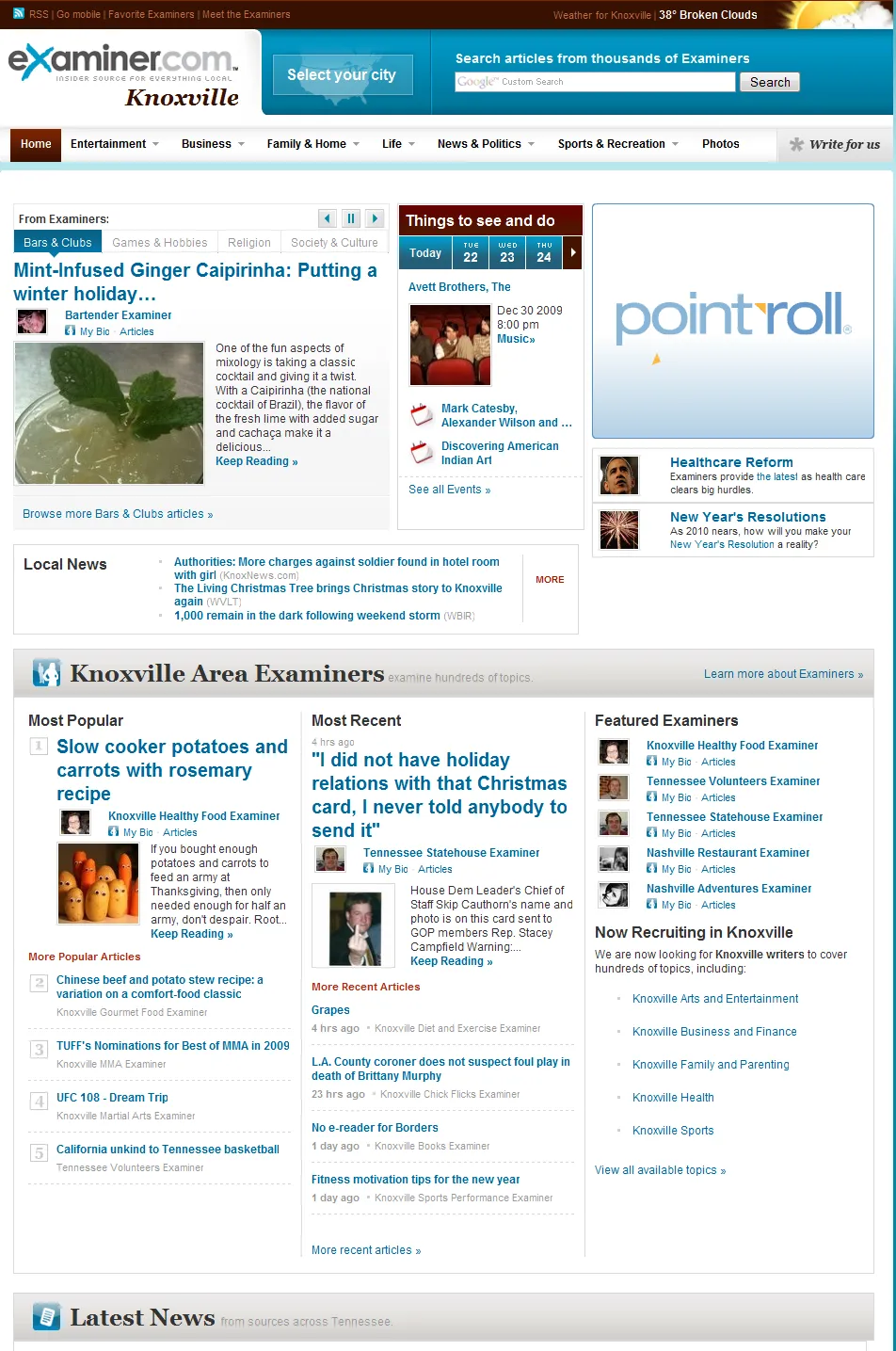 Much to my chagrin, I’ve been noticing Examiner.com versions of stories we’re covering show up prominently in Google search results while our original journalism on knoxnews or govolsxtra is buried.
It happening a lot and not just to the sites I manage.
Examiner.com, a collection of sites that Time magazine cattily describes as “neither advancing the story nor bringing any insight,” is the fastest growing news domain with Nielsen reporting a stratospheric 228 percent increase in audience in November while the big mainstream news sites like CNN.com and MSNBC.com had double-digit declines.
A poster on the Google News forum said: “This is not a reputable form of news. Any half-brained twit can write for them (and do). It’s more like social networking as it is full of opinions and skimpy on facts”
But Google’s famously secret algorithms keep tilling fresh Examiner.com stories to the top of search results. How does that happen?
Time answers the question like this:
So why does Examiner.com’s fairly superficial posts on the big stories of the day often end up near the front of Google News’ queue? “It’s not a trick,” says (CEO Rick) Blair. “We have almost 25,000 writers posting 3,000 original articles per day.” Examiners take seminars on writing headlines, writing in the third person and making full use of social media, all of which are Google manna. But Blair thinks it’s mostly the scale of the operation that makes Examiner.com articles so attractive to search engines, from which more than half of the site’s traffic comes. That is, by stocking the lake with so many fish every day, Examiner.com increases the chances that Google trawlers will haul one of theirs up.
Forget the “Curly Theory” and you’ll get pie in your face, knucklehead
Internet pundit finds being open with FCC trying
In prepared testimony, University of Tennessee law professor and blogger Glenn Reynolds argues that an open Internet has allowed for the creation of new journalism models that harken to the pamphleteers of the Founding Fathers’ age.
Reynolds’ remarks were prepared for testimony he gave Tuesday to an FCC panel gathering opinions on its Open Internet proposals. He describes journalism as an “activity” rather than a “profession’ or, as many journalists refer to it, a craft.
While saying an open Internet allowed people like himself to have their voice heard, he cautions against heavy-handed governmental overnight aimed at ensuring an open Internet.
The popular Instapudit blogger wrote:
The ability to publish inexpensively, and to reach potentially millions of people in seconds, has made it possible for people who would never be able to – or even want to – be hired by the institutional press to nonetheless publish and influence the world, much like eighteenth century pampleteers.
…
“The Internet has also made all sorts of new journalistic models available. Independent journalists like Michael Yon (michaelyon-online.com) and Michael Totten (michaeltotten.com) have provided compelling firsthand reporting from places like Iraq, Lebanon, and Afghanistan, supported entirely by reader donationsAt a time when “mainstream” publications are closing foreign bureaus and slashing reporting budgets, this is a new model for reporting that rewards painstaking reporting and excellent writing, producing results that are, in these two cases, comparable to the very highest level work from traditional professionals.”
Google is freaking amazing (continuing saga)
Story posted at 6:54 a.m. Google e-mail alert mentioning said story at 7:02 a.m.
Degrees of difference in what you can say
I recently was on a panel at a University of Tennessee journalism class with Knoxville blogger Randy Neal and Chattanooga Times Free Press Executive Editor Tom Griscom.
One of the students, Beth Maynard, wrote a piece that has been posted on the “Scooping the News” blog that focuses on one subject that came up: comment management. In fact, there were a number of questions from the students about online comments on news Web sites.
Maynard’s piece illustrates some of the differing approaches to dealing with what readers have to say.
Online legal issues links
I’m doing a Webinar today on online legal issues, another in a series E.W. Scripps is doing with journalism professors at Hampton University using Skype and DimDim. These are some interesting conversations.
I’ve put together a set of links for them and I thought others might find the list useful. An earlier set of links dealt with ethics.
- Associated Press Seeks More Control of Content on Web - NYTimes.com
- Content Aggregation: A Win-Win for Publishers? - By James Sturdivant : Publishing Executive
-
[Techmeme founder: WSJ, NYT are aggregators Digital Media - CNET News](https://news.cnet.com/8301-1023_3-10215444-93.html) - Google Public Policy Blog: Some questions related to Google News and the Associated Press
- Glass houses and content aggregation - Computerworld Blogs
- About Copyright - Keep Your Copyrights
- Fair Use Remix Institute
- Owners, Borrowers
- MediaPost Publications FTC Urged To Clamp Down On Data Collection Online 11/11/2009
-
[Q&A: FTC Blogger Guidelines Mama’s A Rolling Stone](https://mamasarollingstone.com/fashion-tips/qa-ftc-blogger-guidelines/) - At FTC Hearing, Privacy Policies Bomb - ClickZ
- Chilling Effects Clearinghouse: Linking
-
[FTC blogger guidelines might bite traditional media after all Mind Your Own Damn Business Politics](https://mindyourowndamnbusinesspolitics.com/wordpress/2009/10/15/ftc-blogger-guidelines-might-bite-traditional-media-after-all/) - Required FTC blogger disclosure
-
[FTC Responds to Blogger Fears: ‘That $11,000 Fine Is Not True’ Slipstream Fast Company](https://www.fastcompany.com/blog/jennifer-vilaga/slipstream/ftc-bloggers-its-not-medium-its-message-0) - MLRC: Legal Actions Against Bloggers
- Hey, blogger! The consumer protection police would like a word with you. - By Jack Shafer - Slate Magazine
- 091005endorsementguidesfnnotice.pdf (application/pdf Object)
-
[Key Perspectives on the FTC Blogger Guidelines WebProNews](https://www.webpronews.com/topnews/2009/10/16/key-perspectives-on-the-ftc-blogger-guidelines) -
[Free Speech Electronic Frontier Foundation](https://www.eff.org/issues/free-speech) -
[Privacy Electronic Frontier Foundation](https://www.eff.org/issues/privacy) - Internet privacy - Wikipedia, the free encyclopedia
-
[ Privacy Rights Clearinghouse](https://www.privacyrights.org/online-privacy-and-technology) - Privacy.org - The Source for News, Information, and Action
- Fair use - Wikipedia, the free encyclopedia
- All’s Fair Under Fair Use? - Forbes.com
- FAQ about DMCA Safe Harbor – Chilling Effects Clearinghouse
- Stanford Copyright
-
[DMCA Electronic Frontier Foundation](https://www.eff.org/issues/dmca) - Digital Millennium Copyright Act - Wikipedia, the free encyclopedia
- Welcome to FA�E
- U.S. Copyright Office - Copyright Internet Resources
- Copyright Website
- Copyright on the Internet Quiz
- Creative Commons
- Internet Resources for Copyright
- 10 Big Myths about copyright explained
- Center for Democracy
-
[Digital Copyright Center for Democracy](https://www.cdt.org/issue/digital-copyright) - Dialogue: the future of online obscenity and social networks
- US CODE: Title 47,230. Protection for private blocking and screening of offensive material
-
[Section 230 of the Communications Decency Act Citizen Media Law Project](https://www.citmedialaw.org/section-230) - Section 230 of the Communications Decency Act
-
[Section 230 Protections Electronic Frontier Foundation](https://www.eff.org/issues/bloggers/legal/liability/230) - Section 230 of the Communications Decency Act - Wikipedia, the free encyclopedia
- Can the law keep up with technology? - CNN.com
QNH6BRUZ4Y8K
Scripps Twitter list
I recently created a Twitter list of E.W. Scripps folks. If you’re with Scripps and want to be added to the list, fill out the form. Either way, consider following it.
Comment management draws lots of comments
 I had a great time doing a Webinar at the Poynter Institute on Thursday with Howard Finberg and a big assist from Elaine Kramer, who manages the Associated Press Managing Editors’ Online Credibility Roundtables. Our topic was management of online comments and Michele McLellan has some thoughts about it.
Coincidentially, online comments on the knoxnews.com Web site and the APME Roundtable on Comments are the focus of a long piece by Frank Carlson in Wednesday’s edition of Metro Pulse, an alternative and entertainment weekly in Knoxville. Knoxville area blogger Say Uncle has some thoughts about that.
Meanwhile, one of the things we didn’t touch on in the seminar, subpoenas for commenter information continues to be part of the continuing story about the murder case and trials that were the focus of the APME Roundtable. News Sentinel Editor Jack McElroy deals with the issues in “Journalism subpoenas can be abusive,” “FBI criticizes News Sentinel for disclosing subpoena,” and “KNS turns commenter info over to FBI.” A topic for a future Poynter Webinar, I’m sure.
(The photo is a somewhat fuzzy picture of Howard Finberg, director of Poynter’s News University and who moderated/ran the Webinar. He is shown in Poynter’s Studio H.)
Here is a sampling from Twitter of the react to the Webinar:
- Managing comments on your news site? 1) consider your audience when deciding what to allow/disallow 2) Be as lenient as possible. #nuwebinar – mattcrist (mattcrist)
- @amysimons thanks for that hastag info :) #nuwebinar #bp09 – tvamy (Amy Wood WSPA TV CW)
- @cfaust it was a great webinar, lots of great advice and tips. You can read all related tweets by following this hashtag #nuwebinar – CjCastillo (CJ Castillo)
- RT @mfriesen: Comment sections don’t – kmcdade (Kathleen McDade)
- I though today’s #nuwebinar was one of the more useful webinars I’ve attended. – briannepruitt (Brianne Pruitt)
- RT @amysimons: More bad: Commenters may contact each other, – slicksean (Sean Kennedy)
- @richpria: I find commenters often – tvamy (Amy Wood WSPA TV CW)
- Hard truth, sometimes: re 2 streams - editorial and comments - editorial must realize how much traffic commenters generate #nuwebinar – Mudrock (Andy Murdoch)
- @jacklail: Some of our commenters say stupid stuff. Part of it is entertainment, if that’s what they want, it’s what it is #bp09 ##nuwebinar – amysimons (Amy Simons)
- Pitch reporters on the benefits of engaging with commenters – finding more info and tips, keeping story on track, having impact #nuwebinar – jeffsonderman (Jeff Sonderman)
- Watching NewsU webinar about online comments. Interesting to hear other newspapers are dealing with the same issues we are. #nuwebinar – CjCastillo (CJ Castillo)
- @jeffsonderman I like the idea of responding to comments as a more realistic presentation of story. It’s an evolving narrative #nuwebinar – Mudrock (Andy Murdoch)
- Interactive poll result: Only 32% of outlets have reporters responding to comments. 56% say no time, 14% say they don’t want to. #nuwebinar – jeffsonderman (Jeff Sonderman)
- Me: A story should be an ongoing discussion center where the reporter stays engaged with commenters, don’t just publish and run #nuwebinar – jeffsonderman (Jeff Sonderman)
- Scripps reporters have accounts flagged – cosleia (Heather Meadows)
Ethics in journalism’s digital age
I’m talking to a group of faculty members at Hampton University this afternoon about journalism ethics in the digital world.. As part of preparing for that talk, I rounded up some journalism ethics links that I thought others might also enjoy. (Special hat tip to Steve Buttry and Bob Steele for their help.)
_
[You reporters] should have printed what he meant, not what he said. – Earl Bush, press aide to Richard Daley (more quotes here) _
* [Ethics of social media for journalists | Save the Media](https://savethemedia.com/2009/10/19/a-journalists-guide-to-the-ethics-of-social-media/)
* [Society of Professional Journalists: Code of Ethics](https://www.spj.org/ethicscode.asp)
* [SPJ Ethic Blog: Code Words](https://blogs.spjnetwork.org/ethics/)
* [Society of Professional Journalists: Ethics](https://www.spj.org/ethics.asp)
* [NPPA Code of Ethics](https://www.nppa.org/professional_development/business_practices/ethics.html)
* [Poynter Online - Ethics ](https://www.poynter.org/subject.asp?id=32)
* [Indiana University School of Journalism � Ethics cases online](https://journalism.indiana.edu/resources/ethics/)
* [OJR: What are the ethics of online journalism?](https://www.ojr.org/ojr/wiki/ethics/)
* [Nieman Reports | Ethical Values and Quality Control in the Digital Era](https://www.nieman.harvard.edu/reportsitem.aspx?id=100699)
* [Ethics Resources (Steve Buttry's great list of links)](https://www.notrain-nogain.org/Train/Res/Ethics/ETHIC.asp)
* [Steve Buttry: Resources for journalism educators on digital ethics, new business models, journalism � Pursuing the Complete Community Connection](https://stevebuttry.wordpress.com/2009/08/29/resources-for-journalism-educators-on-digital-ethics-new-business-models-journalism/)
* [Steve Buttry: Resources for journalism ethics � Pursuing the Complete Community Connection](https://stevebuttry.wordpress.com/2009/09/18/resources-for-journalism-ethics/)
* [Poynter Online - Talk About Ethics: Ask These 10 Questions to Make Good Ethical Decisions](https://www.poynter.org/column.asp?id=36)
* [Poynter Online - Talk About Ethics: Guiding Principles for the Journalist](https://www.poynter.org/column.asp?id=36)
* [The key to social media ethics: good judgment � Pursuing the Complete Community Connection](https://stevebuttry.wordpress.com/2009/10/15/the-key-to-social-media-ethics-good-judgment/)
* [Newpaper social media policies: Out of touch | Socialmedia.biz](https://www.socialmedia.biz/2009/10/02/newpaper-social-media-policies-all-miss-mark/)
* [The Huffington Post: Citizen Journalism Publishing Standards](https://www.huffingtonpost.com/2009/04/07/citizen-journalism-publis_n_184075.html)
* [J-Source: Ethical guidelines for editing audio](https://jsource.ca/english_new/detail.php?id=1638)
* [The Daily Tar Heel's policies | dailytarheel.com](https://dailytarheel.com/about/policies)
* [Knoxville News Sentinel Code of Conduct](https://docs.google.com/fileview?id=0BwLtt9KAddttOGFiMGIyYzEtYjI0Mi00ZDc1LTkyZTgtM2NjYzA4OGRjZDJm&hl=en)
* [Kathy English's Longtail of News (when to unpublish)](/pdf/apme-longtail-report.pdf)
Hauling a tool chest of ideas back from Missouri
The speed version of the better part of last week during my stay in Saint Louis. My hotel was just across the street from the arch, but, unfortunately, I never made it to it.
Here are some resources and thought-starters from the Associated Press Managing Editors “Inspiration Starts Here” conference.
Amy Webb did a rapid fire presentation on trends to watch. Val Hoeppner leveraged off Webb’s list of trends with a blog post with a list of cool resources and tools of particular interest to journalists and another set of resources was added to the APME09 twitter stream by the Journalists Toolbox.
And then there were three great innovations.
Jill Geisler of the Poynter Institute had some advice for managing change in a presentation called You’re Not Crazy, Clueless or Cruel; You’re Managing Change. She had some links:
Newspaper becomes the story in comment case
Some of the coverage of the federal subpoena for information about a commenter on the Knoxnews.com Web site.
Jack McElroy: KNS turns commenter info over to FBI
Living a “Gutenberg Moment”
 On Sunday, I caught up with an excellent podcast with former MarketWatch CEO founder Larry Kramer that was posted in late September.
Kramer is a reporter turned editor turned entrepreneur who still loves journalism and believes content is king.
He is interviewed by Gregory Galant on the VentureVoice blog. Since focus of Galent’s site is not about entrepreneurs, journalists and Old and New Media executives may have missed this one, but it’s worth your time.
Kramer sketches out his journey from journalist to CEO, his ride on the Internet economy rollercoaster, and journalism, inlcuding paid content.
On paid content, he pointed out what happened when his site, what was known as CBS MarketWatch, pursued a multiple streams of revenue strategy mostly dependent on advertising while Jim Cramer’s rival site, TheStreet.com, pursued a paid content model. There’s some lessons in that for today in the renewed paid-content discussion.
Kramer’s take: Don’t be a purist in either camp. He notes Cramer’s paid-content strategy with theStreet.com prevented it from becoming a mass brand.
He points out the content the companies he was involved with could most easily sell to consumers was “actionable” information, stock information for active traders, and sports odds and information for sports betting gamblers.
He also talks about the role of journalists in curating the Web. “There are new roles we need to learn to take,” he said. “In journalism, one of them is curation.
“We were always curators in that we get 100 press releases at the paper, we’d pick the two to write about. The difference today is everybody gets the hundred press releases. We still have to help our customers, our readers to determine which ones are worth reading.
“We don’t the distribution system anymore. But we do own, what we hopefully own, is an intelligence, and an ability to help our customer or the people that work with us to get what they want out of life.”
Kramer said we’re still in an “Gutenberg moment” with the Internet in which every industry will be changed, much as the media business is already changing.
“The biggest problem we have is people trying to protect their business model,” Kramer said, “not their product. not what they do.”
Good stuff from a guy who was involved in “digital media” before the consumer Internet.
I also found this Beet.tv video with Kramer from earlier this year as well as mediabistro.com piece.
(Photo from Beet.tv)
Of “net neanderthals” and Google promiscuity
Like News of the Weird headlines: “Net neandertahals” have found alive online and Google unintentionally encourages promiscuity.
Danny Sullivan breaks is all down.
The tomato paste libel case
I’ve been doing a lot of research, thinking and writing about online comments for a Nov. 5 webinar on comment management for news sites for the Poynter Institute and APME.
So the story about a libel suit against the owner of a pizza restaurant just blocks from my home attracted my attention.
In what some consider an unusual and risky business move, a marketing firm is suing its former client for $2 million over comments he is said to have made on Facebook and Twitter.
Regardless of the legal merits of the case, if the intent was to stifle negative “publicity” about the marketing firm’s business practices; it failed miserably.
The comments were originally made in relative obscurity even through they appeared on public networks. Since the suit, the news story on knoxnews has been one of the site’s top read and most emailed stories of the past several days. And the case is generating attention worldwide.
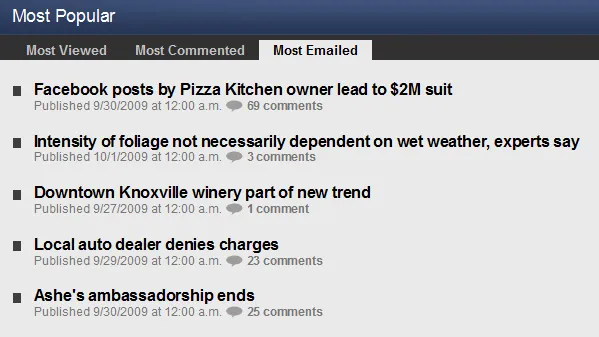 (This is a screen shot of the “most emailed” list on the knoxnews.com Web site on Oct. 6, 2009.)
Note that attorneys for the marketing company didn’t sue Facebook or Twitter where the comments appeared; they sued the commenter.
Facebook and Twitter just provide the network or platform for the comments. Comments at the bottom of articles on news Web sites are similar to Facebook and Twitter comments in that the site is just providing the means for communication.
Online sites from individual blogs to mighty Google, and Internet service providers like Comcast and AT&T rely on provisions in a 13-year-old law for protection against suits regarding user comments. In one of those twists of political sausage making, the law, the Communications Decency Act of 1996, was originally aimed at combating porn and obscene language.
The 15 minutes of fame for the The Pizza Kitchen libel case has resulted in worldwide attention as much over the business strategy of suing clients as over the legal merits of the libel claims. And on the Internet, that 15 minutes of fame gets replayed with every new search engine query.
Palo Alto, Calif., marketing and public relations blogger Steve Farnsworth (@TheRealPRMan on Twitter) is holding a chat on Twitter using the hash tag #SM4B on Wednesday at noon (EST).
Knoxville marketing and social media consultant Mark Schaefer, who has blogged about the case, is his guest.
Here is some of the react being generated by the case.
First, is it ever really a good idea to sue your customer? Pizza Kitchen has one store and 247 followers on Twitter. Even if the owner was really, really difficult, you just … don’t … sue … customers over something liks this. Do you??
Knoxnews wins breaking news award
 I was watching the Livestream.com Web live video of the Online Journalism Awards presentation while I was updating knoxnews/govolsxtra Saturday night. The Tennessee-Auburn game had just ended and it was busy. When Rich Beckman announced knoxnews was the winner in the medium-size category for breaking news, it was … did he say? … yes, he said … knoxnews! That was great.
Journalists running toward burning buildings as fast as they can
 E.W. Scripps Vice President of Content Rusty Coats, speaking to the Knoxville Social Media Association on a humid Tuesday evening, talked about the future of journalism, social media and journalism and how Scripps is remaking itself in an reorganization announced less than a month ago.
Here how the listeners Twittered his speech outside at the Crown and Goose in Knoxville’s Old City.
The posts are not in time order, but rather are sorted alphabetically (so I could remove any duplicates I might have picked up). The “Tweet” stream (what was Tweeted and what commentary was added) is as interesting as the speech, one of his first to an external audience since the reorganization was announced.
- “If a blogger has sources, then they’re a journalist” - Rusty Coats #knoxsocialmedia – PRNicoleV (Nicole VanScoten)
- “Journalists fear we’re on the edge”-Rusty Coates #knoxsocialMedia – TexanAtHeart (Michael Torano)
- “Journos are good at capturing who is on stage but not who is in the crowd” - that’s where social media comes in! – PRNicoleV (Nicole VanScoten)
- “Mass media being replaced by media from the masses” #knoxsocialmedia – webkilledtv (Sobo)
- “Prof journalism will never go away, just some journalism companies” #knoxsocialmedia – PRNicoleV (Nicole VanScoten)
- “in 2009 you are either a multimedia editor, or you are an unemployed editor” Rusty Coates #knoxsocialMedia – TexanAtHeart (Michael Torano)
- “we must build a new model from the new core” regarding journalism -Rusty Coates #knoxsocialMedia – TexanAtHeart (Michael Torano)
- ‘bloggers are doing more verifiable journalism than ever before’ -rusty coats #knoxsocialmedia – reneegts (Renee Gates)
- https://twitpic.com/ircm0 listening to @rcoats talk at #knoxsocialmedia event – CParizman (Chad Parizman)
- @skweeds nah. i was perched on my bum drinkin a beer, listening to the great Rusty Coats #knoxsocialmedia – RandomChick (erin chapin)
- Are bloggers journalists? Coates says, “Some are…Depends on whether you picked up a phone.” #knoxsocialmedia – radioman (Michael Grider)
- Are bloggers journalists? #knoxsocialmedia. Yes, if they do their own research – DeaneneCatani (Deanene Catani)
- At #knoxsocialmedia mixer, people use tweet deck like a police scanner. To have your ear to the ground. – trekkerlc (Lynsay Caylor)
- Coats says there are 3 mobile devices for every computer o earth… That” s going to be important for traditional media #knoxsocialmedia –>radiomanmic (Michael Grider)
- Coats: Scripps centering around content on all platforms and selling the hell out of it – webkilledtv (Sobo)
- Create fundamentally good journalism. #knoxsocialmedia – jigsha (Jigsha Desai)
- Dark and quiet now at crown and goose. The back crew of @tombrasinteractive has chilled. Coats talking about comments #knoxsocialmedia – gavinbaker (Gavin Baker)
- Editors will be multimedia editors, provide actionable infor-cause journalism, sell the audience not the product #knoxsocialmedia – JessieVerino (Jessie Verino)
- Enjoying listening to Rusty Coats at #knoxsocialmedia – DebSanderfur (Deborah)
- Good content from Coats at #knoxsocialmedia and – gavinbaker (Gavin Baker)
- Great #knoxsocialmedia gathering tonight. Inspiring words on future of journalism from @rcoats.– kgranju (katie allison granju)
- Great turnout tonite @ #knoxsocialmedia Some wonderful insights from Rusty Coats, got to meet lots of folks and hear good discussion. – shanerhyne (Shane Rhyne)
- Hi-tek here at KSMA w/the speaker at the podium for Rusty Coates; now I hear him ( – TexanAtHeart (Michael Torano)
- I asked rusty why he doesn”t tweet. said he keeps social media in the family using skype and such with his kids. #knoxsocialmedia – jigsha (Jigsha Desai)
- I don’t understand the concern and focus on online comments. Are you concerned about conversations at a cocktail party? #knoxsocialmedia – Grantham (Grantham)
- I understand the need to delete potential libel and slander, but why be concerned over feelings expressed in comments? #knoxsocialmedia – Grantham (Grantham)
- Just got home from #knoxsocialmedia event. Had a blast, met lots of new people, and Rusty Coats was an exceptional speaker. – JessieVerino (Jessie Verino)
- Listening to Rusty Coates speak at KSMA; great info. Sorry you miss out! #knoxsocialmedia – lspegman (l_spegman)
- Love hearing “Fubar” in a speech abt journalism #knoxsocialmedia – surgirly (Lauren S.)
- Most tweeted comment so far RT @TexanAtHeart “you are either a multimedia editor,or you are an unemployed editor” R. Coates #knoxsocialMedia – ckrapp (CatherineMarlerRapp)
- One loud bird is competing with rusty’s speech in decibles #knoxsocialmedia – jigsha (Jigsha Desai)
- Paid content model: This has a lot to do with wishful thinking. - Rusty Coats #knoxsocialmedia – jacklail (Jack Lail)
- Professional Journalists are ppl who run TOWARDS a burning building, says Rusty Coats #knoxsocialmedia – jenmcclurg (Jen McClurg-Roth)
- Redefining who is a journalist will be central debate of immediate future says Coats @ #knoxsocialmedia – shanerhyne (Shane Rhyne)
- Reporting, data, grass roots, watchdog (iron core) plus social media are pilars to our biz (rusty costs) #knoxsocialmedia – sugirly (Lauren S.)
- Rusty Coats from Scripps on journalism online: with great freedom comes great responsibility. Nice twist on Spiderman! #knoxsocialmedia – velviscali (David Jacobs)
- Rusty Coats from Scripps on print media: we will serve our communities and not stand over own graves and weep. #knoxsocialmedia – velviscali (David Jacobs)
- Rusty Coats from Scripps: there are 3 mobile phones for every PC. #knoxsocialmedia – velviscali (David Jacobs)
- Rusty Coats, VP Content from Scripps just solved the audio issue by suggesting we remove the poster covering the speaker #knoxsocialmedia – jenmcclurg (Jen McClurg-Roth)
- Rusty Coats: Scripps editors will be multimedia editors or unemployed. #knoxsocialmedia – jacklail (Jack Lail)
- Rusty Coats: Social Media allows journalists to transcend self-selecting voices #knoxsocialmedia – KnoxSocialMedia (KSMA)
- Rusty Coats: data is king and mobile is the future in the new journalism model #knoxsocialmedia – KnoxSocialMedia (KSMA)
- Rusty Coats: if newspaper touches posted comments on any way, the newspaper open to liability #knoxsocialmedia – KnoxSocialMedia (KSMA)
- Rusty Coats: journalism is only biz specifically mentioned in U.S. Constitution #knoxsocialmedia – KnoxSocialMedia (KSMA)
- Rusty Coats: social media in teen stage, believes everyone yearning for opinion #knoxsocialmedia – KnoxSocialMedia (KSMA)
- Rusty coats at #knoxsocialmedia event “you don’t develop an audience by being shrill” – trekkerlc (Lynsay Caylor)
- Rusty talked about 21st century business model for journalism, 1st cousin to digital book publishing. Radical changes ahead #knoxsocialmedia – JessieVerino (Jessie Verino)
- Scripps products in Knoxville (KNS, MetroPulse, GoVolsExtra, etc) reaches 7 out of 9 people #knoxsocialmedia – knoxgirl75 (Carly Harrington)
- Scripps restructuring will mean putting audience interaction at core of newsroom #knoxsocialmedia – knoxgirl75 (Carly Harrington)
- Scripps was smart to give #rustrycoats authority…he can see where the media ia heaed, with insight and confidence. #knoxsocialmedia – MikeSCohen (MikeSCohen)
- Sell the crap out of great content! #Knoxsocialmedia – jigsha (Jigsha Desai)
- Social media gives journalist ‘raw reaction from their community’ #knoxsocialmedia – webkilledtv (Sobo)
- Some candid discussion about online comments @ #knoxsocialmedia – shanerhyne (Shane Rhyne)
- Terrific q and a with Rusty Coats at #knoxsocialmedia event – KnoxSocialMedia (KSMA)
- That’s how I use hootsuite! RT @gavinbaker: Coats says he uses tweetdeck like an old school police scanner. #knoxsocialmedia – ckrapp (CatherineMarlerRapp)
- There is a huge Scripps contigent at the mixer to hear Rusty Coats speak. Our publisher Hartmann is here too! #knoxsocialmedia – jigsha (Jigsha Desai)
- Watching the thumbs fly as everyone live-tweets for #knoxsocialmedia – webkilledtv (Sobo)
- We’ve turned the data collection, inside out for readers to build their own narratives – TexanAtHeart (Michael Torano)
- While newsroom struggle with web-first the world has moved to mobile #knoxsocialmedia – webkilledtv (Sobo)
- With social media, everyone writes the news - Rusty Coats #knoxsocialmedia – PRNicoleV (Nicole VanScoten)
- Wow! Coats: You’re a multimedia editor or an unemployed editor at Scripps #knoxsocialmedia – webkilledtv (Sobo)
Remix of famous New Yorker cartoon
On the Internet,
Nobody Knows You’re a Dog
Internship opp
The pitch : How would you like to learn new media skills while having a positive impact on the college media environment? Join us for a semester of new media opportunity as the intern for the Center for Innovation in College Media for Fall 2009.
Finding news in all places
Jeff Cutler posted this video to Qik.com of fellow panelist Bill Adee, editor of digital media at the Chicago Tribune, during our session on link journalism Thursday afternoon with Publish2 CEO Scott Karp at the SPJ convention in Indianapolis.
Adee talked about ChicagoNow, Chicago Breaking News and Colonel Tribune. We had a great group with great questions, but, hey, you should have been there!
Send them away (to get them back)
A fundamental rule of the Internet.
That’s why this works so effectively.
Blame it on Twitter
This was a great idea and I hope it proves successful in Knoxville:
FOR IMMEDIATE RELEASE - August 14, 2009
Knoxville Twestival Announces Charity Selection After Innovative Social Media-Driven Selection Process
Knoxville, Tenn - Organizers for Knoxville Twestival (https://www.knoxville.twestival.com) announced today that The Salvation Army of Knoxville (https://www.uss.salvationarmy.org/uss/www_uss_knoxville.nsf) has been chosen as the designated recipient of the 2009 Twestival fundraising effort. The pick was made following an innovative, two-week long, social media-driven selection process.
Knoxville Twestival is part of a charitable event taking place in communities all around the world during August and September. The
local Twestival is co-sponsored by Social Media Club (https://smcknox.ning.com/), Knoxville Overground (https://www.knoxvilleoverground.com/) and the Knoxville Social Media Association (https://www.knoxvillesocialmedia.com), and it uses the power of the local digital community to encourage people to support a specific local charity effort.The crowd-sourced, viral process by which The Salvation Army was chosen was unique, and was the brainchild of the volunteers behind Knoxville Twestival planning. Beginning August 1, Knoxville-area, non-profit organizations were encouraged to fill out an online form at the Knoxville Twestival site explaining they should be chosen as the designated charity for this year’s Twestival event. All entries received by Friday, August 7 were then published on the Knoxville Twestival blog(https://knoxville.twestival.com/charity-submissions/), where readers were able to cast an online vote for their favorite
charity. Voting was driven via social media, as supporters of each charity encouraged their friends and followers on Twitter and Facebook to go cast an online ballot on their charity’s behalf. In the end, 35 charities were submitted for consideration, and close to 4,000 votes were cast.Voting ended at 5pm August 11, and at 6pm the same day, a panel of representatives (Names and affiliations available at
https://www.knoxville.twestival.com) of Twestival’s three co-sponsoring organizations each cast a single vote to choose the winning charity from among the top three online vote getters. The Salvation Army emerged the winner, and Twestival fundraising efforts on the charity’s behalf will now begin.“We’re thrilled now to be able to use new media to connect with a whole new generation of people who really desire to have an impact on their community. It’s a great fit for what we do,” said Jonathan Haskell, Director of Community Relations at the Salvation Army, after learning of his organization’s selection.
Twestival organizers and supporters, as well as fans of The Salvation Army, will tap into their own online social networks to drive
donations during the fundraising period via the “TipJar” button that is now live on the Knoxville Twestival site. Fundraising efforts will culminate with the September 10 Twestival event from 7-10 pm at The Knoxville Zoo, featuring live entertainment, as well as food and drinks. Details for the Twestival performers will be announced next week.
100% of all funds raised via the Twestival site, as well as all money collected for ticket sales to the Twestival party, will go directly to The Salvation Army.
For more information about Knoxville Twestival, or to schedule an
interview with one of the Twestival organizers, contact us:
Nicole Van Scoten at nicole.vanscoten@gmail.com
Katie Allison Granju at katie.granju@gmail.com
Alex Lavidge at a.lavidge@gmail.com
A Twitter success tale that doesn’t involve a get rich quick pitch
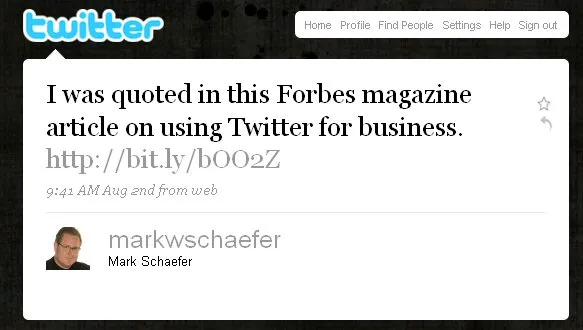 Still wondering about this Twitter thing.
Mark Schaefer, a Knoxville marketing guy who’s developed an expertise in the emerging social media marketing area, has parlayed Twitter into more publicity than his marketing budget could buy - by well over 1,000 percent by my conservative reckoning.
Schaefer developed a professional relationship through Twitter than led to him being interviewed as social media expert in a recent Forbes article and being quoted in the same piece as social media expert Chris Brogan and Comcast’s uber customer service rep Frank Eliason.
He tells the story in a blog post. (My own first contact with Schaefer was on Twitter.) No matter how smart or talented he is,it’s unlikely he would have developed such a national profile without Twitter.
Now, that can’t be bad for business. Might there just be something to this social media stuff beside Facebook quizzes and “get hundreds of followers” pitches?
Social media guides for journalists
A quick list of social media guides for journalists from former Knoxville resident and University of Tennessee jounalism teacher Bob Stepno.
A push-start for three innovative media ideas
In case you missed this from earlier in the week, the McCormick Foundation funded three proposals from new media women entrepreneurs at $10,000 each so they can launch within a year.
Here are the three plans::
ChickRx - Harvard MBA student Stacey Borden and partner Meghan Muntean will lead a team of women in launching an “edgy, approachable, engaging” online health resource uniquely targeted to women, ages 18 to 27. It will have content and Q&As, updated daily, from medical, family and nutrition experts, addressing such questions as: “Can drinking too much Diet Coke increase my risk of getting cancer?” “Can I lose five pounds in week without starving myself?” “Why am I unhappy, even though I know I shouldn’t be?” Borden is the former campus relations director of 85 Broads, a national professional women’s group.
Women’s Community News Franchise - Former MytopiaCafe.com editor Michelle Ferrier will develop a complete infrastructure, to be franchised, for those who want to launch hyperlocal news sites. A demo site will launch later this year in West Volusia County, Florida, piloting services that will include a Web platform, software development, market analysis, some content, and legal and marketing assistance. Such an infrastructure, says Ferrier, will permit citizen journalists and community members to “focus on what they are most passionate about - building their community conversation through good local information and networking.”
The Good Food Fight - Three media-savvy Seattle women will connect consumers interested in food with larger public policy issues that affect food choices, security, safety, health and sustainability. Partners Kristin Hyde, Jen Lamson and Amy Pennington will use their deep experience in policy, marketing, journalism and digital campaigns “to leverage the growing concern and interest in food with a call to arms.” They plan to use a business-to-business model as well as their own outreach to leverage support from subscribers, sponsors, donors and foundations.
Respite from the media dog days of summer
Just when the summer sultry heat convinces you the future of media is the bleakest of deserts along comes something or someone that says otherwise.
There’s Michael Van Popel, who at 17 started the Twitter breaking news service Breaking News Online. Now a mere 20, he’s built a media franchise and is coming out in August with an iPhone app with a monthly subscription charge.
Then there’s controversial 55-year-old former newspaper reporter Nikki Finke.who sold her Deadline Hollywood Blog to Mail.com Media Corp. last month for what the L.A. Times said was a “low seven-figure sum” or, as others suggested, somewhere near $15 million. With her newfound cash and a long-term employment deal, she plans to add a a second reporter, one on the East Coast.
On different ends of the journalism career age spectrum and in vastly different ways, they are proving there’s a there there for digital journalism.
More effort needs to be put into innovating and finding what works than in doomed media protectionist schemes. Finding the new models will do more to get us through these dog days.
I read that, too
Much of the Internet is simply counter-intuitive. I think that’s one of the first thing you have understand to figure it out. The largest Web site on earth, Google, gets its traffic, for instance, by sending users away. There are other examples that, I’m sure, you’ve noticed.
But here’s a counter-intuitive doozie. The Internet with its terabytes of data and hundreds of thousand Web sites is actually accelerating media concentration, a concentration that threatens to reduce news to a few homogeneous sources. That’s roughly the conclusion of The Myth of Digital Democracy
Writing about Hindman’s idea in the New Atlantis, Sebastian Waisman says:
Internet users rarely read blogs or visit political websites, and they gravitate towards large media outlets even more online than in print. Major newspapers like the Times and the Washington Post “have online traffic roughly 2.5 times their share of the print newspaper market,” Hindman writes, explaining that news consumption is “more concentrated online than in print,” with the top ten news outlets controlling more of the total online market than their hard-copy equivalents. The few online self-publishers who can claim to be successful are hardly ordinary; the handful of blogs that attract the lion’s share of attention are mostly run by professors, lawyers, and–drumroll, please–actual journalists.
A new look for knoxnews
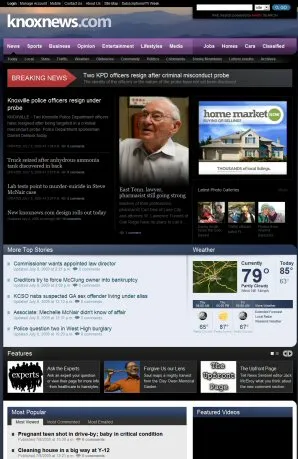 We’ve launched a new version of knoxnews. A thumbnail view of the new home page is at right. Here is a how the last four designs have evolved. All of these redesigns were led by Herb Himes in our corporate Scripps Interactive Newspaper Group.
Would love to hear your feedback on the design.
The Michael Jackson breaking news moment
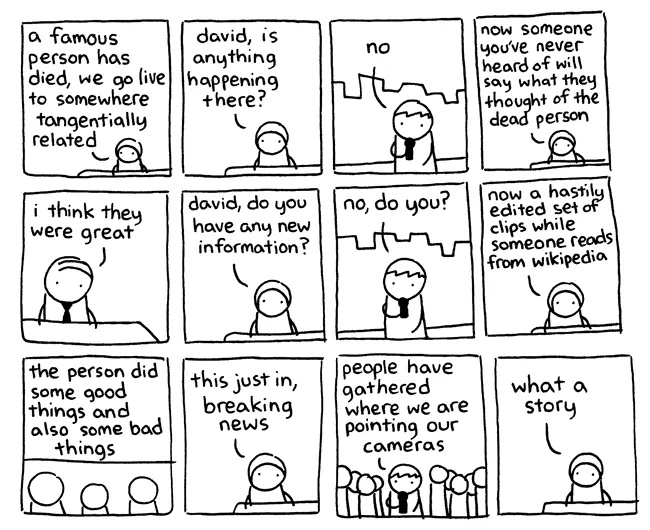
The above comic by John Campbell is a cynically funny view of news coverage of a celebrity death whether it’s Michael Jackson, whose death inspired the above, or former NFL quarterback Steve McNair’s yesterday in a bloody Nashville condo.
Continuing a pattern we’ve seen in the past with Tim Russert’ s death and other breaking news events, Wikipedia was one of the earliest sources of news on the death of Michael Jackson (x17online.com, not TMZ had it first, apparently).
It even beat Twitter, says Danny Doyer of SEOmoz.org, who posted a timeline.
Well behind with reporting the news came MSNBC and CNN, but both had huge spikes in visitors, far outdistancing TMZ.com’s traffic, which, however, increased fivefold and hit a three-year high. Newspaper Web sites? Not even in the equation.
And what was the trusted source that was turned to more than any other? Why, it was Yahoo, according to Hitwise, whose unique combination of search engine and content creator (often seen as a hindrance to having a clear business model) may have helped it. Some journalists were called in from off days in an “all-hands-on-deck” response, Richard Vega, Yahoo News editor, was quoted as saying.
Matt McGee at Search Engine Land has a fascinating post about how the search engines handled the load which Google first believed was some kind of attack.
We have to have accuracy and publish facts not rumors, but it remains clear: those who are right and fast are relevant; those who aren’t, are irrelevant.
TMZ.com, the AOL blog often credited with getting the story first (and right), may have been the big winner. Wikipedia, meanwhile, continues to evolve not only as a encyclopedia, but as a “trusted spruce” for breaking news. And many are learning searching Twitter for real time news is more effective than using Google, which no doubt is troubling to the search giant.
Take my poll below.
Anonymity is not a guarantee for online commenters
Federal prosecutors who had made a broad request for user information of commenters on the Las Vegas Review-Journal’s Web site backed down a bit, but an American Civil Liberties Union attorney representing four anonymous commenters on the newspaper Web site says it’s still an important, precedent-setting case.
(Maggie) McLetchie said that this case is an important one because it sets a dangerous precedent that would send a message that “if you go on the internet and you criticize the government, the government might start a criminal investigation about you, and we think that’s extremely problematic.”
Psst! …. Aggregation
It’s great to see the Miami Herald launch a local blog aggregator, South Florida Blogs, with journalist-turned-entrepreneur Dave Mastio. There’s some explanation of what they’re up on the Knight Digital Media Center Web site.
It’s an idea I’ve long thought was a no-brainer. Maybe that because we’re doing it, too.
Few other newspapers or local news media sites are, however. Organizing and helping disparate voices in the community be heard seems to me to be an obligation of a local media organization.
Mastio had a vision for a business built around blog aggregation a few years ago and he continues to evolve and expand that vision. He runs BlogNetNews and several other blog aggregation sites and at some point expanded his concept to work with local media.
We joined up with him in August 2007 for the Knoxville Blog Network, an attempt to fill the void left by the loss of Johnny Dobbins’ pioneering Rocky Top Brigade Web site (remember that one?). Dobbins is at Media General’s TBO.com these days.
It was also an attempt on our part to be more inclusive of bloggers. I think it’s worked to a degree. Yet, the power of the tool remains largely undiscovered.
If you’re a Knoxville area blogger (broadly defined) and you’re blog is not included, add it. And add the javascript to the most recent posts in the network on your site.
In this audio interview, Mastio uses the Knoxville blog network as an example of what he’s trying to accomplish.
Some of the overlooked features of Mastio’s blog platform is it’s powerful search and it’s RSS feeds and widgets that easily let the non-technical add a local blog “news wire” or blog search to their site.
And what I really think is neat is an advanced feature, Feed Central, that lets users slice and dice the network of blogs by blog or keyword or category and create a custom list that can be pulled into a reader or appear as an email of headlines. (An example below uses just blog posts with the keyword “journalism.”)
Again, isn’t it time to bring in the other voices? If you interested, drop Mastio a line at editor @ blognetnews.com. Tell him, Jack sent you.
No rush to vanity URLs on Facebook, only 3 million so far
Tony Hung of Dive Jive Interests points to a Bloomberg piece that says about 3 million “vanity URLs” were grabbed over the weekend, some 500,000 in the first 15 minutes (that would be me).
He wonders if that’s really a “rush” considering Facebook has, oh, 200 million users.
I think it begs the larger question of the importance and awareness of reputation management on the Internet – specifically realizing how important it is to own your own Google Search results (particularly if you have a reputation and profession you care about), how Facebook ranks in all of that (can rank quite high), and how a Facebook vanity URL containing keywords might in turn rank (again, theoretically high). But that’s really a post for another time.
Linking up at Bonnaroo
While I wasn’t at Bonnaroo, the mega music festival in Manchester, Tenn., I did some “link journalism” around it that I think added greatly to our coverage. See here, here, here, here and here. If you’re not dong links as news content you’re missing a great content resource.
It was just part of an overall coverage package.
Online producer Lauren Spuhler did great “covering” Bonnarroo mostly on her cell phone via our Twitter account @bonnaroonews as well as writing and shooting videos, some with our cell phone on Qik.com. A large percentage of our coverage was on Twitter, the best way to reach the actual people at the festival.
(The Twitter stream for #bonnaroo was incredible.)
We have on Knoxville.com a special section of all our Bonnaroo coverage, In addition to writing articles for print, Wayne Bledsoe blogged (where he posted several videos), and Saul Young posted on the “Forgive Us Our Lens.” the photo staff blog (oh, yeah, he wasn’t “working”).
Randall Brown also kept our Twitter account @KnoxvilleDotCom flowing even through he was in Knoxville with plentiful “retweets.”
They did some great stuff!
The year that Twitter went to #Bonnaroo
Twitter made Time’s cover, but more telling for me is what is happening with Twitter and the Bonnaroo Music and Arts Festival here in Tennessee.
Knoxville News Sentinel online producer Lauren Spuhler (heading to cover her fifth Bonnaroo today) grabbed the user name @bonnaroo in March 2007. You can see her first Tweet below.

She used it in 2007 and 2008, but by December is had but 487 followers. Just last week, we renamed it @bonnaroonews so the official festival site could grab @bonnaroo. By then, it had over 7,800 followers. Today it’s pushing 8,000 (you can help by following @bonnaroonews).
And if you go to search.twitter.com, posts with the hashtag of #bonnaroo are being added at a rate of at least a couple a minute. It’s a fascinating stream of Tweets, sort of real time news coverage from hundreds of sources.
Tweets up are being planned and I’m sure finds will find each other using the service.
Just another sign Twitter has gone “mainstream.”
(We’ve also got complete Bonnaroo coverage at knoxville.com.)
Multimedia with soul
 Lido Vizzutti takes a look at an Ohio University student journalism project, Soul of Athens. Pretty good stuff.
The “about” page describes the project as:
Soul of Athens is an innovative online publication that studies the contrasts of this Appalachian county through a collection of timeless stories and multimedia presentations. The project gives voice to a diverse group of individuals intertwined by a common sense of place through stories that resonate universally.
Reading online comments shouldn’t be icky
 There’s been a lively discussion about online comments as a result of the APME Online Credibility Roundtable on Comments we held recently in Knoxville. Our excellent Roundtable guests raised many points that others are reacting too.
The comment threads are spread across at least three different URLs. You can see the discussion on Knoxviews, on News Editor Jack McElroy’s column about the Roundtable and on knoxnews’ “This is How We Roll” blog.
We’ve posted two video pieces from the Roundtable plus the complete session as an audio file (they’re linked from the “This is How We Roll” post).
The goal is to develop strategies and solutions to curb the meanness and hate that too often deelops in comment threads. Join the conversation. We think this is a bigger problem than just one newspaper news site in Knoxville. if you blog it, let me know and I’ll add a link to our coverage links.
But it’s more than just talk. We’re developing a strategies to improve comments on the News Sentinel’s web sites on five fronts. We’re be talking about those efforts in more detail in the future.
A tip on a new tool
Interesting new tool from Publish2, a “tip form” with tips managed in a database. Implementation is as simple as cut-and-paste.
Fish where the fish are
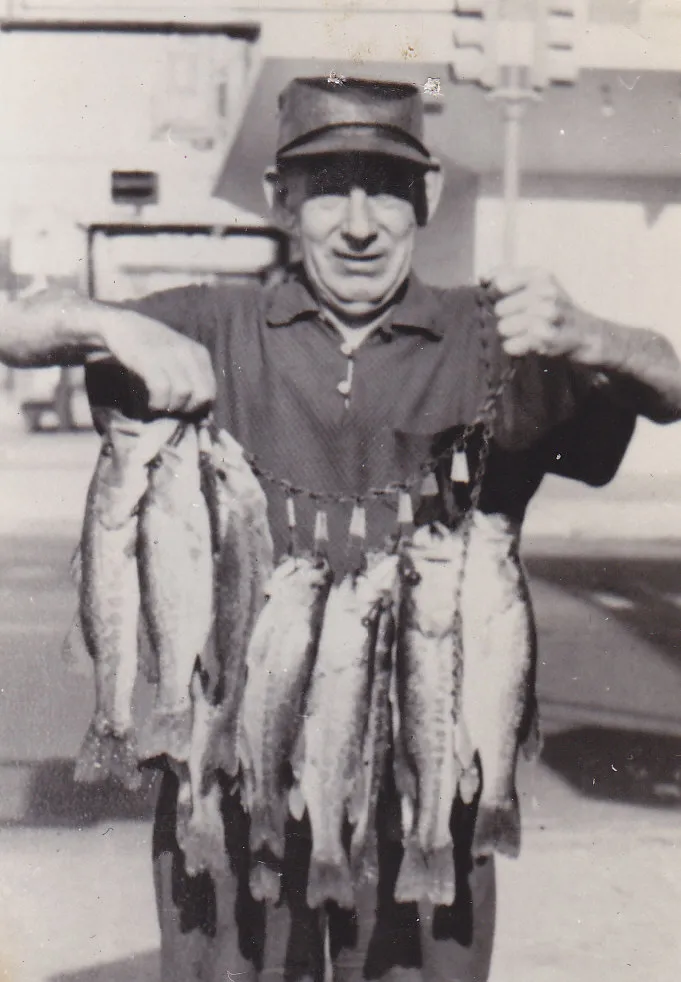 Emily Bell, director of digital content at Guardian News and Media, offers clues to better fishing (for audience).
So from the clues we know that the future of journalism is networked not silo’d, we know that it has to be distributed not static, we know that it has to be appropriate for the platform, and to be really effective it has to be trusted and open to engagement …
First of a series of APME online credibility roundtables held
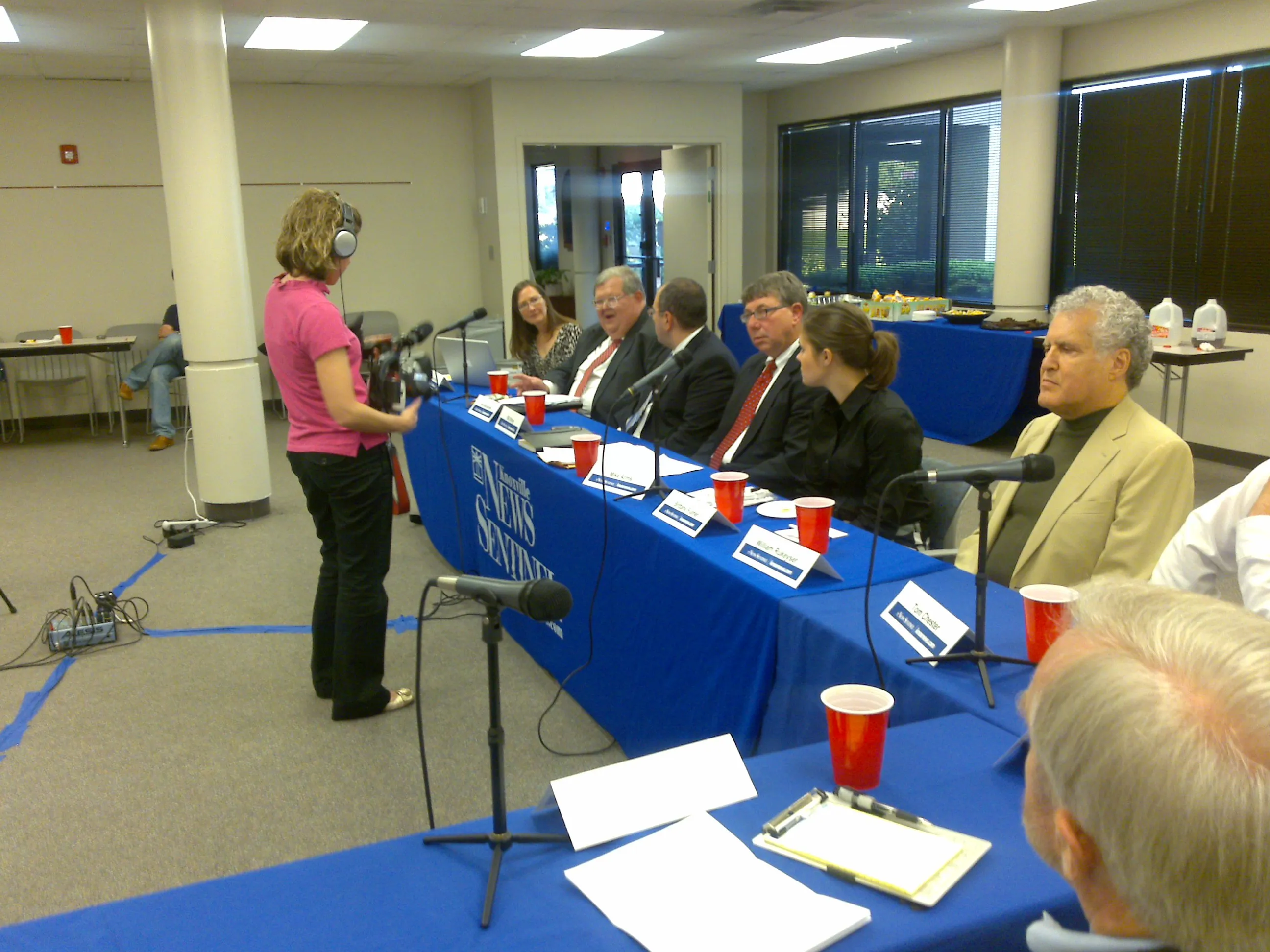
Tennessee power trio plays Knoxville
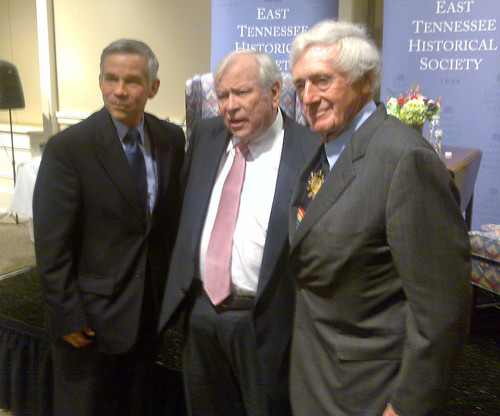 Chattanooga Times Free Press editor Tom Griscom, former U.S. Senator Howard Baker Jr. and Freedom Forum founder and retired Gannett exeecutive John Seigenthaler at the East Tennessee History Center. Griscom and Seigenthaler had a public conversation Tuesday night on the press and journalism.
Cynthia Moxley has a report that includes this quote from Baker, whose daughter Cissy, is a news executive with the Tribune Co.:
The new journalist
An icon of Tennessee journalism, John Seigenthaler, talks about the “new journalist.”,The audio is a little rough. I just wasn’t close enough with the Nokia N96
Congratulations are in order
Congratulations to Lauren Spuhler for two first place awards and Erin Chapin for a second in the Tennessee Associated Perss Managing Editors journalism contest. Also, Knoxnews won a second and Knoxville.com a third in the best Web site category of large newspapers in Tennessee.
Journalism’s future: Small scale, big scoops
The future of journalism is likely to be small scale and hard news scoops. That is what AllThingsD’s Kara Swisher is thinking and she points not only to her highly successful site, but also to that of TheWrap.com, founded by former New York Times and Washington Post reporter Sharon Waxman. PaidContent.org comes to mind as another site in this mold.
I have a hunch she’s right. Very lean with tightly focused and highly professional content is where journalism is heading. Waxman called them: “small, nimble, essential news organizations.”
Here’s a video of Swisher and Waxman discussing journalism and her startup.
New food site smells good in the kitchen
 Influential tech site TechCrunch takes a look at Knoxville-based Scripps Networks’ soft-launched Food.com, a beta search engine recipe site that TechCrunch heralds as the Kayak.com for recipes.
I didn’t know Kayak.com was so ubiquitous to reach benchmark comparison status, but, hey, TechCrunch lives somewhere between Alpha and Beta so maybe Kayak seems like an old, established player .
What is Food.com? It’s a giant recipe search site that draws in recipes from all the big time cooking sites on the Internet, hoping to solve the problem of finding that great recipe. Course, search time could be longer than prep time as you get absorbed.
Says writer Leena Rao:
I did a search for Chicken Marsala on Food.com, Food Network, Epicurious, and Foodista (a Wikipedia for recipes) and Food.com gave me the highest number of choices in recipes, from a variety of sources, and easily allowed me to narrow my search down through its detailed filters. Food.com came up with 368 results, Food Network showed 53 results, Epicurious showed 37 results and Foodista showed 2 results (although, to be fair, Foodista attempts to present the one best recipe)
With the breadth and capabilities of its search capacity and its innovative interface, Food.com is sure to gain a following as a centralized place to not only find recipes but also to store them. One feature that I thought was missing was the ability to filter recipes by chef, which is something that Food Network allows you to do. Epicurious creates a shopping list for the items in the recipes in your recipe box, which is another useful tool when planning a meal. Food.com is currently in beta, so I assume that Scripps will add more features down the line but for an initial trial, the site appears to be a strong addition to the online recipe search space.
The funny thing about growth curves
Jay Small has a smart take on the similarity of Twitter’s audience retention woes and those of local news sites:
The consumer value of a social-status service like Twitter resembles the value of “news” as a service. It is incidentally important, but not always important, and never all important to any one person. The intervals between incidents that you or I might deem important defy any prediction.
Does that mean we in local media should hope Twitter finds a great business model to capitalize on its traffic, since it so resembles ours? Hmm. Maybe. I find it easier (though not completely easy) to connect those dots than the ones between us and, say, Google, Amazon, Microsoft, Apple or eBay.
Judge declines to restrict anonymous comments on Knoxville Web sites
This is welcome news:
A Knox County judge this afternoon issued an order refusing to require local media to shut down anonymous commentary allowed on their Web sites.
Paid content: A growth limiting strategy
Vivian Schiller, CEO and president at NPR and the former head of NYTimes.com on paid news content.
So I’m a little bit of a contrarian with some of those in the news industry who are saying it was a big mistake, we should lock everything behind a pay wall. I think that will drive audiences to lessor quality news content that’s free.
Who knew, videos on YouTube are embeddable
Hey, this is credible information
Note this on your calendar:
KNOXVILLE, Tenn. (April 8, 2009) - In today’s world of 24-hour access to information, the need for credible, fair reporting is more important than ever.
The Society of Professional Journalists will observe Ethics Week, April 27-May 1, by hosting a series of town hall meetings focused on restoring journalistic credibility by helping readers, viewers, listeners and Web site visitors understand what credible journalism is.
The East Tennessee Society of Professional Journalists has been selected as one of 10 chapters across the country to host one of these meetings, beginning at 7 p.m. Thursday, April 30 in the Toyota Auditorium of the Howard Baker, Jr. Center for Public Policy on the University of Tennessee campus in Knoxville. The Baker Center is cosponsoring the event.
The meeting will begin with a discussion about citizen journalism, bloggers, and reader comments on Web sites. As more and more media businesses cut their news staffs, editors and news directors may rely on citizen journalists to fill vacancies or to provide first-hand accounts of events. However, do these citizen journalists operate under the same ethical guidelines as trained journalists? Bloggers and Web site visitors often comment on popular issues and stories presented in the news, which can blur the line between factual information and opinions.
SPJ’s large and diverse membership consistently identifies ethics as one of the organization’s most important missions. The SPJ Code of Ethics, first adopted in 1926, is an industry standard. One element of the code is to “invite dialogue with the public over journalistic conduct.”
During the town hall meeting, the audience is encouraged to ask questions about how local stories are covered and the decision making process of editors and reporters as they go about their jobs of covering and presenting the news.
The panel will include Jack McElroy, editor of the Knoxville News Sentinel; Bill Shory, WBIR-TV news director; Michael Grider, VolunteerTV.com interactive producer; and Glenn Reynolds, UT law professor and founder of Instapundit.com. Marianna Spicer, CNN’s executive editor for news standards, will moderate the program.
For more information, call East Tennessee Society of Professional Journalist President Mia Rhodarmer at (423) 337-7101 or e-mail editor@advocateanddemocrat.com
Views from my table
That Internet thing will be the death of us
Odd, many online journalists – not print or TV curmudgeons, but those who belong to an online journalism association – believe the Internet is changing journalism for the worse. New survey:
More than half, however, believe the internet is changing the fundamental values of journalism – more often than not for the worse. Among the biggest changes cited are a loosening of standards (45%), more outside voices reducing the clout of journalists (31%) and an increased emphasis on speed (25%).
A public conversation on Web journalism
A fascinating group of media folks (well, excluding yours truly, who is decidedly non-fascinating to put it charitably), are participating next Wednesday in a “Public Conversation on Web Journalism” at the Howard H. Baker Center (Toyota Auditorium) from 11 a.m. to 2 p.m.
Patches of sunlight everywhere
Interesting open record, government transparency efforts of “local blogs that do a great job of covering local, state, and congressional political news” from around the country.
A totally intriguing “What if”
The news about a content sharing agreement between Tennessee’s four largest newspapers brought some fascinating Twitter comments from Jay Rosen, the influential New York University journalism professor, and Kent Flanagan, now at Middle Tennessee State University, but formerly the Associated Press’ bureau chief in Nashville.
Some snippets:
Rosen: What would happen if you hooked up to that content-sharing agreement in Tennessee the state’s largest J-schools?
Flanagan: I’ve already approached other j-schools about starting online news a la CUNY’s NYC’s news bureau … with fewer decent internships available, i feel students need another venue to show prospective employers what they can do. … my plan is to emphasize new media skills and encourage more than basic text from all students participating … in a democracy, we need more voices covering state capitol news, not less, and that’s what I am aiming for.
Rosen: Another piece ‘o puzzle. Take Knoxville’s good relations with the blogosphere; spread those across the system.
The magic number is 22
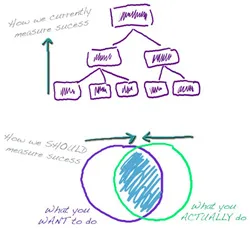 Ken Doctor said earlier this week:
And the envelope, please: How many people does it take to run an online-only metro news site?
The answer appears to be 22.
DIY blueprint: Creating a media venture in a weekend
Great behind-the-scenes piece from search engine expert Danny Sullivan on the launch of laid-off newspaperman Greg Hernandez’s Greg in Hollywood blog.
Basically a tool-kit for doing it yourself.
What would Silence Dogood say?
Some of the react to the effort to have a judge order news media Web sites to remove comments or force commenters to use their real names. Updated: March 1, 8:33 a.m.
-
[Judge In Knoxville Case Questions Media Intent NewsTechZilla](https://www.newstechzilla.com/2009/02/judge-in-knoxville-case-questions-media-intent/) - The Krile Files: Not-So Free Speech
- lovable liberal: Defense to blogosphere: drop dead
- Hal Turner Show: Knoxville Massacre Lawyer Wants Anonymous Comments on web silenced!
-
[Case threatens anonymity for website ‘comments’ National Policy Institute](https://www.nationalpolicyinstitute.org/2009/03/01/case-threatens-anonymity-for-website-comments/) -
[Lawyers want off carjacking/murder case, cite death threats at local media websites KnoxViews](https://www.knoxviews.com/node/10513) -
[Memo to bloggers: Stop being ‘bloggers’ KnoxViews](https://www.knoxviews.com/node/10626) -
[Korda: Make your posts mean more: use your name Knoxville News Sentinel](https://www.knoxnews.com/news/2009/feb/09/korda-make-your-posts-mean-more-use-your-name/) -
[Commentary: Free speech is messy, but necessary WBIR.com](https://www.wbir.com/news/local/story.aspx?storyid=78363&catid=2) - Fatal carjacking trial focus on anonymous comments posted on news Web sites - Kingsport Times-News Online
- Defense in Christian-Newsom murder case wants comments tamed / VolunteeerTV.com
-
[Motions hearing takes aim at media WBIR.com](https://www.wbir.com/news/local/story.aspx?storyid=79381&catid=2) - Media vs. suspects’ attorneys on Christian - WATE
-
[Anonymous Commenters On Trial NewsTechZilla](https://www.newstechzilla.com/2009/02/anonymous-commenters-on-trial/) -
[In defense of the right to online anonymity Katie Allison Granju](https://blogs.knoxnews.com/knx/granju/2009/02/in-defense-of-the-right-to-onl.html) -
[I don’t think I’m a pornographer The Upfront Page](https://blogs.knoxnews.com/knx/editor/2009/02/i_dont_think_im_a_pornographer.shtml) -
[Lawyers seek to silence Web commenters knoxnews.com](https://blogs.knoxnews.com/knx/silence/archives/2009/02/lawyers_seek_to.shtml) - Judge questions media intent on Web commentary : Knoxville News Sentinel
Hey, it’s nice to be noticed
The Inland Press Association presented its New Frontier Awards during its annual meeting in San Antonio earlier this week and knoxnews won a top “General Excellence” award.
The judges said:
The Knoxville site is everything you want a news site to be: It’s smartly reported, deeply local, and amazingly agile. There’s an immediacy about the site that shows up just about everywhere, from text alerts to video that comes straight off the news to a river of headlines. The site is executing well across many different types of content and engagement – video and photos, breaking news, blogs and user interaction.
The importance of programming – or, at minimum, thinking like a programmer – is a skill every journalist needs. And this site displays that mindset well. The user interface is beautiful, and the producers are fearless in changing presentation to match the biggest news of the day. Every local news site should serve its audience so well
Google exec goes into the local news briar patch
Does Google need a hyperlocal news play to crack the local advertising market? Or has Google’s Tim Anderson just recognized a bunch of smart people?
You got to like his stated motivations:
Tim believes that Patch should be in every community in America, and wants Patch in his town. He wants to read local news stories done by journalists, make sure that local government is transparent and accountable, see all the ways he can give back to his community, and have his town be as interesting and alive online as it is offline.
Turning 5 is a bitch
A roundup of views on the Facebook terms of service changes. Party favors for 175 million, please.
Update: Facebook retreats to former terms.
Crazy talk about newspapers
TJ Sullivan proposes “It’s time for every daily newspaper in the United States, in cooperation with the Associated Press, to shut down their free Web sites for one week.”
Ah, you first TJ.
Longtime media consultant and pundit Vin Crosbie on Twitter reacts:
Links for the journalism toolbox
Randy Neal points to several journalism resources posted by the University of Tennessee’s Jim Stovall, but the UT journalism professor and Chuck Warnock also have started a new site tracking trends in mobile communication, mostly news related.
From the about:
Think of it as a mini-Google for mobile communications and mobile journalism in general.
And then think of journalism.
Then you’ve got MobileJPROF.
The power of trusted personal networks
Some tips on how make a story go viral from Tammi Marcoullier, who was speaking on a panel at ONA Nashville: Journalism Has a Future.
From a panel session at the Tennessee Press Association
The Tennessee Three
Rex Hammock, Christian Grantham and Michael Silence discussing commenting, journalism and the future. Yeah, no one was running a bar tab. This is from their blogging panel on Friday, Jan. 30, 2009, at the Freedom Forum in Nashville. It was part of ONA Nashville.
Explaining link journalism
Tammi Marcoullier, editorial director of Publish2, talks about link journalism at ONA Nashville.
ONA recap
A recap of ONA Nashville: Journalism Has a Future, “Real things real journalists can do right now to embrace it” has been posted.
Where the world gets its news
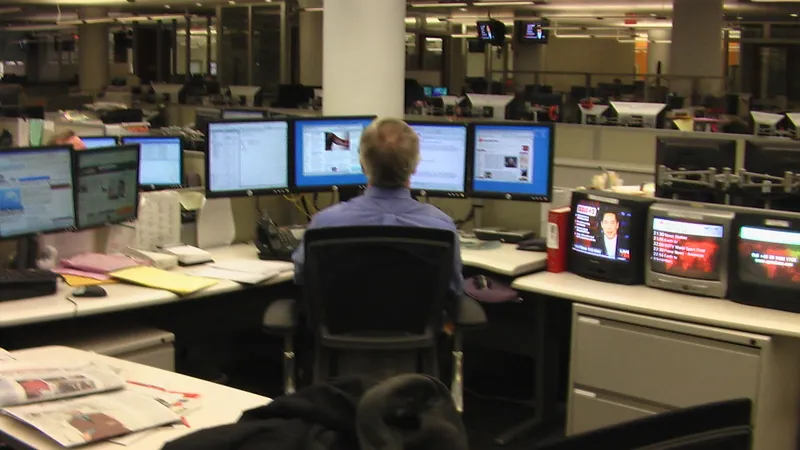
Thoughts, quotes and links from ONA Nashville
Here’s some of the coverage from ONA Nashville: Journalism Has a Future, “Real things real journalists can do right now to embrace it.” This was a workshop held Friday at the Freedom Forum’s John Seigenthaler Center in Nashville. If you see more coverage, post a link in the comments.
Twittering our training
For the ONA workshop on Friday (last day to register is Wednesday), we’re using the hashtag of #onanash (at the suggestion of @patrickbeeson) on Twitter. Follow the action.
Worth commenting on …
Kurt Greenbaum takes a look at commenting guidelines at various news sites.
I, too, like:
If you don’t like the topic, go away. And “comment control on a blog is not ‘censorship.’
Heading right at the problem
Some people do ask what will happen if local mainstream media goes away. Others are working on answers.
The key to building a loyal audience
Dave Winer points to a 2005 blog post to remind us that a maxim of the Internet is:
Now the fundamental law of the Internet seems to be the more you send them away the more they come back. It’s why link-filled blogs do better than introverts. It may seem counter-intuitive – it’s the new intuition, the new way of thinking. The Internet kicks your ass until you get it. It’s called linking and it works.
People come back to places that send them away. Memorize that one.
Recently on NewsTechZilla
NewsTechZilla continues to develop as an interesting source of news and tech information for journalists or those just interested in news content.
Here are some of the latest posts:
- Three Rules That Have Evolved
- Community Blogs May be the Newspapers of the Future
- Easy WordPress How-To Videos
- Are You Archiving Your Work?
- Countless Opportunities To Get The Perfect Photograph
- Tuscon Citizen Up For Sale
- Dang Skippy
- To Twitter Or Not To Twitter
- Hudson River Crash Coverage
- The News Cycle Has Changed
More ICONN
 The ICONN conference at the University of Tennessee wrapped up Friday afternoon. Wasn’t able to attend as much as I would have liked, but here’s some links posted to Publish2.
The next gen of journalism education
ICONN conference first day coverage.
Confabbing on journalism in Knoxville
 I’m on the program of the founding conference of ICONN or the Intercollegiate Online News Network.
The conference will be held at the University of Tennessee on Jan 15 and 16.
The group “is a set of individuals, academic programs and professional organizations dedicated connecting student web journalists and campus news websites and to advancing education in web and online journalism.”
I’m on a panel Thursday:
3:15 - 4:30 p.m.
Views from the professionals
Lauren Spuhler, Knoxville News Sentinel
Jack Lail, Knoxville New Sentinel
Patrick Beeson, Scripps Interactive
Staci Baird, LucasFilms
Twitter kicked butt
Peter Dykstra, a former executive producer of CNN’s Science, Tech and Weather Unit and currently a Public Policy Scholar at the Woodrow Wilson Center in Washington, puts some perspective around the coverage of the Tennessee Valley Authority’s environmental disaster at the Kingston Steam Plant near Knoxville.
His take: Twitter, whose messages are limited to 140 characters, kicked butt on the national media in covering the story.
Maybe it was the Christmas holidays, but the major U.S. media largely took a pass on the story. The New York Times didn’t show up for 48 hours. National TV news outlets mostly ignored it, despite the appalling images of a community spending Christmas blanketed in a gray, soupy, toxic mess.
Twitter was an odd exception. The social networking site was abuzz with info from activists, journalists, scientists, and links to reports from regional media treating the story like the major environmental disaster it was.
With a 140-character limit on individual posts, Twitter looks like a poor conduit for in-depth information. But you can fit just about any URL in 140 characters. Twitter also has a simple, unique feature called a _hashtag. _Type in a key word preceded by the “#” in Twitter’s search function, and you’ll be taken to every Tweet that includes the phrase – in this case, “#coalash.”
Amy Gahran is a Boulder, CO media consultant who specializes in both online and environmental journalism. “I saw a big story that I thought was interesting, and found almost nothing in the national media,” she told me. Within a day or two, Gahran had spearheaded a hashtag effort to bring all available info on the spill to a national audience of Twitterers. Other contributors included RoaneViews, a news and info website for the community near the Kingston power plant; the Knoxville News-Sentinel and Nashville Tennessean, two state dailies that have covered the story aggressively; and Jeffrey Levy, an EPA Web Information Officer, volunteered Agency maps and stats on the facility.
Finding our way in a very old saying
 Glenn Reynolds of Instapundit argues in a post last night that the relationship between blogs and Mainstream Media ought to be viewed as symbiotic rather than competitive or confrontational.
He notes that bloggers who comment on or cover news seem to raise the ire of traditional journalists in a way that Craigslist doesn’t. Yet Craigslist has done far more damage to economic model that underpins their ability to do journalism than anything that ever came out of the blogosphere.
It is ludicrous to suggest – as people nonetheless have – that either Craig Newmark or Reynolds are out to destroy newspapers. Both are extremely good readers of newspapers either in print or online, and have demonstrated over years a high regard and respect for the practice of journalism wherever they find it.
Both are guilty of being adept and enterprising and lucky in utilizing a new technology in the American spirit of exploring a new frontier.
The companies that popularized digital cameras and later the companies that popularized cameras on cell phones, for example, are never made out as villainous as both Reynolds and Newmark have been despite the hallowed spot of the Brownie in camera history.
Given the choice, however, fewer people bought film cameras than digital cameras once digital models were cheaply available. Given a choice, many people have shown they will get their news from the Internet or advertise on Craigslist. Just get over it.
The challenge for traditional media, of course, is to adapt both newsgathering and economic models.
As far as bloggers and digital-only news organizations go, there can be a symbiotic relationship and a competitive relationship with traditional “Big Media.”
Politico.com may have broken more campaign scoops than any other news organization during the presidential election cycle. HuffingtonPost and Pajamas Media are building powerful media brands.
Even on my local level, there’s a bit of trash talking about who’s been more on top the latest big story, the TVA coal ash spill in Roane County. And that’s OK. Making news coverage more competitive whether it’s from the New York Times or a blogger like Randy Neal is a good thing.
Instead of viewing the blogger-MSM relationship as only symbiotic, which it certainly can be, I like to think about the media gatekeeper as having an open gate, drawing in more views and voices from both small and large, from competitor and contributor and from the uncomfortable as well as the comfortable.
Instead of heavy filtering to fit a physical newshole or time slot, mainstream media has an expanded ability to cultivate community dialogue.
Things that fit into that model would be aggregation of blogger voices, the practice of link journalism, increased transparency, user generated content and the often messy comments on stories. This is, perhaps, an expanded concept of conversation hostess or news media as deejay. I sometimes like to think of it as the “Miracle on 34th Street” theory of just being useful.
That all fits well within that very old media tradition of “Give light and the people will find their own way.”
I think there’s a future for journalists and journalism, both new and traditional, in that.
(Photo is of a Kodak Brownie from around 1910, viaSmithsonian Press).
**Update: WelcomeInstapundit readers!
**
The story of Knoxville Talks
Katie Allison Granju on newsroom blogging and how she came to create Knoxville Talks.
Far too many publishers, reporters, editors, anchors and producers still see blogging as some sort of second-class, redheaded stepchild. Bloggers aren’t real journalists, so the argument goes, and they certainly don’t belong in the newsroom. But as real journalists and journalism professors continue to grapple with what exactly it is they do these days, bloggers are out there just doing it–without the angsty navel-gazing or handwringing. Bloggers certainly can be real journalists, albeit ones who fall into their own category within the profession. The sooner the powers that be accept this new reality, the sooner they can begin reaping the benefits.
Make a plan for “Watching the Detectives”
It’s growing clear to me that on a major story, covering the coverage is not a nice to have, it’s an essential. As Steve Outing noted in a recent Twitter Tweet, people in news events increasingly “most won’t alert news orgs anymore; they tell their ‘friends’ (via social networks). Up to news orgs to track “
I had an example at hand the very same day Outing wrote that.
An early Monday morning breach of a fly ash containment pond at the Tennessee Valley Authority’’s Kingston Steam Plant west of Knoxville sent 1.7 million cubic yards (wait a couple of hours and TVA will re-revise this revised estimate again) of fly ash muck and water across the countryside into more than a dozen homes.
On Tuesday, I noticed Amy Gahran finding all sorts of interesting links beyond The News Sentinel’s own extensive coverage even through for the most part until late Tuesday evening, the story was off the radar of the big national TV networks and newspapers. She was rounding up coverage by environmentalist, local news organizations and a host of others. Gahran was finding good stuff and people were joining in.
And as Outing said, people were telling their friends through blog posts or like, Luke Hall, posting great photos on Facebook.
We started adding links to our own content and developments to her Twitter hashtag effort and started a “link journalism” collection using Publish2 (some call it Delicious for Journalists). The links we are saving in Publish2 are used in a “story” that is being frequently updated.
The results have enriched the News Sentinel’s coverage. Do you have your “Watching the Detectives” plan in place?
‘Facebookgate’ unraveled by a couple college recruiters
Facebook’s incredible growth is proving irresistible for some unsavory marketing.
In what was dubbed last week as “Facebookgate,” a college guide may have used Facebook Groups, fake accounts, and “savvy understanding of some behavioral dynamics inside Facebook,” the blog Inside Facebook said, to build a mailing list for the nation’s college class of 2013.
This story is being reported on college recruiting and social networking blogs and in the education trade press, but not yet in newspapers and the AP wire. It came to light, according to the Chronicle of Higher Education, when Winthrop University’s director of recruitment, Michelle Lynch Clevenger, noticed an odd “class of 2013” for her school and contacted Brad Ward at Butler University, known in the college recruiting field as an expert on social networking.
Ward uncovered dozens of similarly suspicious “class of 2013” groups on Facebook and raised an alarm in a blog post with his findings. That seems to have resulted in the company CEO saying its marketing program crossed the line and would be shut down, but still …
As a parent of a child who hopefully will be in the college graduating of class of 2013 – at Winthrop, no less – I’m glad Clevenger and Ward blew the whistle.
How fast is Facebook growing? Dizzyingly.
Facebook’s growth has gone from 300,000 to 400,000 active users per day in the fourth quarter to 600,000 to perhaps 700,000 a day in December, according to estimates from Justin Smith at Inside Facebook.
Most of the growth is happening outside the U.S.
Smith also posted some updated mind-boggling stats from Facebook:
- 13 million users update their statuses at least once each day
- 2.5 million users become fans of Pages each day
- 700 million photos are uploaded to the site each month
- 4 million videos are uploaded each month
- 15 million pieces of content (web links, news stories, blog posts, notes, photos, etc.) are shared each month
- 2 million events created each month
- 19 million active groups exist on the site
Trust me, if it happened, it’s covered on Twitter
As I’ve noted before, Twitter is a unique communication service that just may be the best innovation in breaking news in the last couple of years. Here’s Loic Le Meur on the Denver Continental plane fire last night.
A guy tweetering from the plane crashhttps://www.loiclemeur.com/english/2008/12/follow-the-plan.html

He notes the Twitter user had better information than the official news sources. The Associated Press apparently agreed, also picking up on the messages from the Twitter user on the plane in its wire reports:
Passenger Mike Wilson of Denver described a chaotic scramble to leave the burning plane on updates he posted on Twitter.com from the airport using his cell phone.
“By the time the plane stopped we were burning pretty well and I think I could feel the heat even through the bulkhead and window,” he wrote. “I made for the exit door as quickly as I could, fearing the right wing might explode from the fire. Once out, I scrambled down the wing.”
Tidings are not always glad
There’s a chorus of sorts at this holiday season bringing tidings of things to come.
The theme of these messages is that newspapers, TV stations and magazines are not doing enough to save themselves by radically rethinking their businesses.
Slate media critic Jack Shafer perhaps makes the argument most poignantly in the “The Digital Slay-Ride. What’s killing newspapers is the same thing that killed the slide rule.”
_It appears to me that most newspapers–by choice or by necessity–have made the “decision to liquidate,” to steal the phrase from Philip Meyer’s excellent 2004 book, The Vanishing Newspaper: Saving Journalism in the Information Age: They’re cutting costs, cutting staff, cutting pages, cutting features, cutting quality, and will continue cutting until the last reader and advertiser depart. (Local TV news looks to be following a similar script.)
I keep waiting for one of these distressed, failing newspapers to realize that it has nothing to lose and get a little crazy and create something brand new and brilliant for readers and advertisers. I keep being disappointed._
Let them eat cake

Knoxville.com had cake yesterday. From Magpies. iPhone photo.
Love them links
I sent some stats to Scott Karp on what I think is a pretty successful example of “link journalism.” (Karp is credited with coining that term and has a company, Publish2, built around the concept.)
Like articles, the reader interest in content that is a set of links varies with the subject matter, but in instances where readers want everywhere scrap of info, it’s a phenomenal service to provide.
Check out his post for the details.
What every iPhone needs
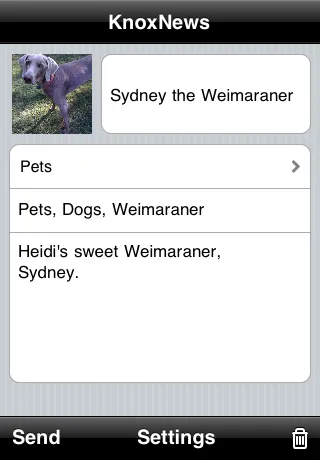 Cell Journalist, the vendor for our photo/video sharing site, launched a free iPhone app to upload photos into im.knoxnews.com. It started showing up in the App store of iTunes on Sunday. Learn more.
Spot.Us spot-on
Spot.Us - Community Funded Reporting Intro from Digidave on Vimeo.
Dave Cohn has officially launched Spot.Us, a Knight News Challenge project in “community-funded journalism.” It’s sort of a Kiva.org for journalism. One of the buzzwords being used around the effort is “crowd funding;” another, “community funded reporting.”
The New York Times explains it:
The idea is that anyone can propose a story, though the editors at Spot Us ultimately choose which stories to pursue. Then the burden is put on the citizenry, which is asked to contribute money to pay upfront all of the estimated reporting costs. If the money doesn’t materialize, the idea goes unreported.
Comic relief

United Features is getting heavy Internet pub for unlocking its vast comics archive.
The beat blogger’s toolkit
 Tools and tips for journalists who are beat blogging. Add yours and make the thread better!
(Photo by Neil T)
The election win in home pages
 Michael Wender has done a neat collage of news Web site home pages on the Obama victory. Instead of newspaper front pages, it’s Web site home pages!
I still don’t know how someone will hold up a Dewey beats Truman Web page. Wave their iPhone?
(see collage)
This is what political conversation looks like on Twitter
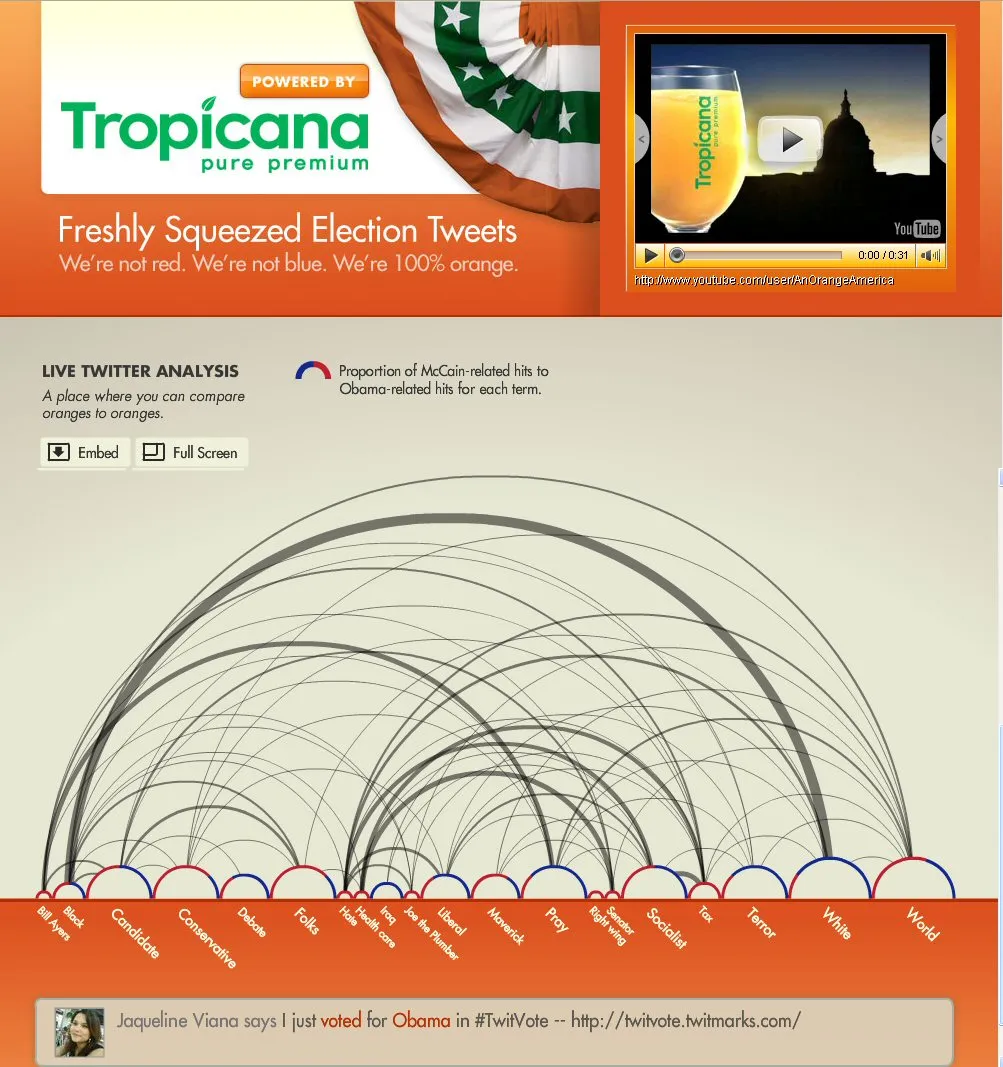 In an email today, William Beutler, Innovation Manager at New Media Strategies, pointed to a new site that launched on election day:
“Created by my team at New Media Strategies and powered by our long-time clients Tropicana/PepsiCo, we’re calling it Freshly Squeezed Election Tweets.
“Tropicana is a longstanding client of NMS, and they wanted to create a micro-site for the election, something cool and useful. So together we agreed a data visualization tool would be the way to go, and Twitter is the obvious choice. So we found we were on the same page and went for it. The best thing? It all came together over the weekend. The actual site-building didn’t begin until Sunday, and it’s working like a charm.”
The real rising political star is not Palin, but the Internet
Nearly three times as many people ages 18 to 29 mention the internet as mention newspapers as a main source of election news (49% vs. 17%). Nearly the opposite is true among those over age 50: some 22% rely on the internet for election news while 39% look to newspapers. Compared with 2004, use of the internet for election news has increased across all age groups. Among the youngest cohort (age 18-29), TV has lost significant ground to the internet.
Don’t everybody come at once
This is what being part of a hot Internet story of the moment can do to you.
Attention: another crash coming
Steve Rubel says another crash is coming -- or is it already here?
New study finds reading blogs doesn’t make journalists stupid
In fact, there’s evidence, at least among journalists that blog, that journalists are getting story ideas and spotting trends from “that one.”
That is among the more interesting data that is beginning to come out of Paul Bradshaw’s analysis of his summer survey of blogging journalists:
Respondents spoke of a clearer perception of audience needs and interests as a result of comments and visitor statistics, which in turn fed into the choice of topics and angles to cover.
The currency markets of news
In a Friday post, Dan Conover writes about “10 reasons why newspapers won’t reinvent news.” It’s an interesting list, but I found more provocative his answer in the comments to the question of what can be done: Newspaper companies should get out of the news business.
It’s a little off my topic at hand, but read that one.
One of his 10 reasons is that:
Newspapers have already lost one of their key selling points: Social currency. In 2008, all meaningful political discourse – the essential element of social currency – takes place on the Web. Print (and televised) political coverage is now but a pale shadow of the real action online.
Psst … Mahalo has been getting interesting
 Mahalo, which launched as a beta site at the first of the year, was derided as no match for Google’s algorithms with its “human search engine.”
(Click on image to see a larger version of the screen shot.)
Turns out, Google doesn’t seem to be evolving as its competitor. It’s news sites and maybe Wikipedia. And it’s doing an interesting job of covering and organizing news. Yesterday, a redesign was launched that added Twitter-length news updates – a live blog it’s being called.
I noticed a Twitter post Friday morning from Ryan Sholin that said the site was “is turning into a really interesting news/information mix.”
He’s right.
Newspaper and TV sites would do well to study its topic pages for ideas.
I checked a few high profile stories in Knoxville that have been getting national attention and all of them had smartly designed topic pages on Mahalo: the murder of Jennifer Lee Hampton; the carjacking and murders of Channon Christian and Chrstopher Newsom; and the shooting at the Tennessee Valley Unitarian Universalist Church. (His team of human editors just isn’t linking to knoxnews enough, which inarguable has the deepest content on all three of these news stories).
Mark Henrickson of TechCrunch said:
When Mahalo launched about 16 months ago, we called it a human-powered search engine and began thinking of it as a Google competitor. But it’s so-called “guide pages” for topics as diverse as the Boston Marathon and Patriotic Drunk Rednecks provide not only links but quick facts, making Mahalo an editor-driven, Wikipedia competitor as well. And with a new site-wide design launching today, Mahalo sharpens its focus on the news cycle and competes more directly with sites like CNN and a multitude of news aggregators.
Explaining Social Media
[What The FK is Social Media?](https://www.slideshare.net/mzkagan/what-the-fk-social-media?type=powerpoint “What The FK is Social Media?”)
Training to be Editor of the Public
Back when I was taking journalism courses (a dimly remembered pre-Googlian time before the dawn of the modern age of technology), we were taught about writing inverted pyramid stories, AP style, the basics of libel and First Amendment law, journalism ethics and the strange hieroglyphics of copying editing on paper (talk about lost arts).
Many journalists are adding a new role to their newsgathering skills, managing user generated content and creating community. I wonder if universities are teaching those skills? I wonder if anybody in newsrooms is doing organized training?
They’re certainly needed.
As news media organizations morph toward being more of an edited resource directory and community conversation leaders around issues, whole new skill sets are being required of journalists.
Journalists have never been the customer service department: “We don’t want that story in the newspaper.” Tough! … click.
Angela Connor, managing editor of user-generated content at WRAL.com. one of the pioneering TV stations on the Web, says her jobs in media have always involved stress, but managing UGC content has brought its own, new kind of stress to the job - including death threats, battles with trolls, hateful emails and calls to her supervisors from anonymous users.
I suspect she was not quite prepared for that role in the broadcast journalism program at Bowling Green State University.
Managing users and their content is part policy, part cheerleader, part host and part art. Connor found a quote from Flickr community manager Heather Champ that captures many of the issues:
Being a community manager is like being a pinata. People beat you with sticks and you still have to give them candy.
The media forgets it is in the being useful business
A lot of media entities – and the journalists who work for them – think they are in the news business and all of their strategies and initiatives are wrapped around that concept.
But despite the much-burnished reputation of the Fourth Estate and the unchallengeable value of a Free Press, that’s not the business they are in – not at all. Media companies are in the business of being useful, useful with information that people consider news at precisely the moment they want to know it
This collective lapse of memory of what it is traditional media enterprises do may explain why the Drudge Report is one of the top news sites, why Google News is the bogeyman man, and why Wikipedia is the first place many people go to find the latest news on a specific topic, person or thing.
Instead of doing journalism as a means to be useful, journalism is being done because it can.
Being useful means both speed (having the information when I want it) and content (having the information I want). On the Web, having well-organized links to the information is having the information readers or users want.
As I write this, two of top three stories on the knoxnews/govoslxtra sites are simply links to external content, a roundup of blogger react to the VP debate and what ‘s being written about the Tennessee football team.
I would suggest part of the reason for the popularity of these two stories vs the thousands of others on the sites is that they are found to be useful right now.
Here’s a look from a different vantage point. The top referring domains to the sites in the last 30 days are: Google, Legacy (where our obits are posted), Yahoo, Drudge Report, and PajamasMedia (Instapundit). All five are sites that are focused on providing useful information. The two giant search engines are dependent on complex algorithmic search results. Drudge Report and Instapundit rely on the skill of humans to find the news we will find useful to know – rather quickly.
On Monday, Alan Mutter wrote:
As I scrambled from website to website this morning for the latest news while my retirement melted away, the place that consistently had the most complete, convenient and up-to-date information was the Drudge Report.
For all the millions of dollars and thousands of people employed at the mainstream newspapers, broadcast networks and cable channels, Drudge had assembled the perfect mix of salient links and real-time information …
It’s so simple you’ll never think of it
Gee, even I should of have thought of this. Some newspaper geek should have. Some newspaper vendor should have. Heck, some econ major smart enough to hack Sarah Palin’s email should have.
I think Mark “Rizzn” Hopkins is right. It’ll make a million because it strips down its product offering to the ONE job to be done: tell me if it’s going to rain.
Am I wrong?
On being the link to news
Scott Karp, founder of Publish2, explains the power of “link journalism” using a roundup of Vol coverage we did Monday.
The concept is so counter-intuitive (create outbound links to generate inbound traffic) that news sites for years were loath to link out, particularly to competitors. But as Karp notes:
By rounding up all of the coverage from around the web using LINKS, Knoxnews created a DESTINATION for fans to discuss the game.
We’d get more readers if we gave them less freakin’ news to read
I missed this in August from Rich Gordon:
On the Web, though, newspapers have clearly emphasized news first. Which is a big part of the reason why so few people visit newspaper Web sites.
Old codger opines about young whippersnappers (harrump!) and civic engagement
These are links I’m sharing during a visit to a class on “Civic Engagement” at the University of Tennessee this afternoon. I’m supposed to talk intelligently (always a challenge) about the changing ways young people get information, the connection between staying informed about current events and being an engaged citizen, and the role of media outlets in shaping civic engagement patterns.
If you have some thoughts post a comment and extend the conversation. Hopefully, I’m not quite an old codger yet and they aren’t all whippersnappers.
- Internet’s Broader Role in Campaign 2008
- Public Knowledge of Current Affairs Little Changed by News and Information Revolutions
- PEW: Peer Networks and Youth Political Media Consumption
- News Media Management Center at Northwestern
- AP Study: A New Model for News
- Engaging Millennials in Election News on the Web
Easy to use trumps everything
A report released yesterday by Stacy Lynch and Vivian Vahlberg of the Media Management Center at Northwestern University says that being “easy to use” beats better or more complete in becoming a user’s favorite Web site.
And their study re-emphasizes the fact that becoming one of a user’s three to five favorite Web sites in critical in growing audience.
From the Center’s Web site:
“To make the ‘favorite’ list, being unique isn’t particularly helpful because so few sites can truly deliver unique content,” said Stacy Lynch, MMC associate and author of the study. “What really matters is being ‘easy to use.’ This goes beyond being attractive to presenting information in a way that makes sense and avoids the problem of being ‘too much.’”
In a completely different time zone
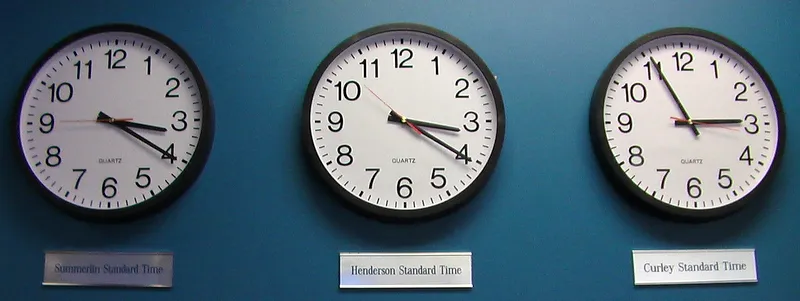
I took a tour of Greenspun Interactive on Tuesday afternoon, the home of Web sites for the Las Vegas Sun and Las Vegas Weekly and discovered what might be a tell for the success (hey I’m in Vegas) of president and executive editor Rob Curley.
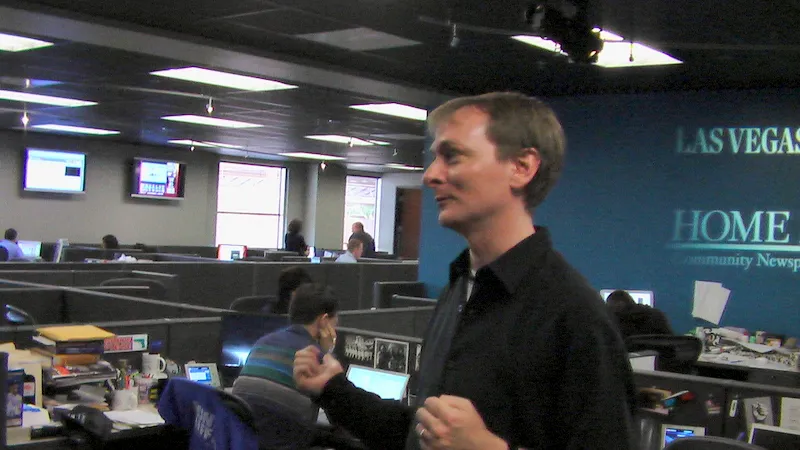 It’s not the refrigerator packed with Red Bull or the 12 pounds of Gummi Bears the 50-plus person staff chews its way through each week, it’s fact that Curley is just operating in a different time zone (see photo above) from the rest of the world.
There were several clocks on the wall in true world news fashion of distant cities, but these were all cities covered by the Greenspun Web crew around Las Vegas so they all had the same time except “Curley Standard Time.”
 The just-completed Greenspun Interactive offices are phenomenal with a 100-inch video screen, studios rigged with enough lights and cameras for a movie premier, a “locker room” to stow gear and a “diversions” room (see photo on left).
Watch for a lot of exciting developments to come out of there – soon.
Pretty vs Practical

If you like this post, Twitter me at @jacklail
Lots of media organizations are experimenting with Twitter, but CNN is the most aggressive of the big sites.
Commenters at Mashable believe this will 1) give CNN a leg up as an early adopter and 2) it’s promotion of Twitter will help push the sometimes difficult to grasp service into the mainstream.
I tend to think CNN is very smart to be near ubiquitous in social media. And that Twitter is role as a multi-platform new channels is growing. Quit looking for the next big thing in mobile, it is the next big thing (and it goes far beyond mobile).
Oh yeah, follow me.
IM @ Knoxnews.com
When you say it, it sounds like “I’m at knoxnews.com.” And if you’re not, you should be!
Making news while covering it
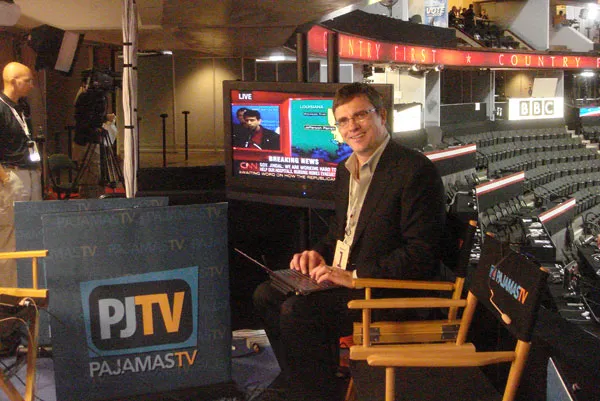 Glenn Reynolds, a blogging pioneer, may be marking a new trail in the electronic wilderness, this time to Internet-only TV.
He’s doing commentary this week at the Republican National Convention for Pajamas TV, a part of Pajamas Media, where he hosts his hugely popular Instapundit blog.
“The chance to do something I’ve never done before is kind of cool, and how often would you get to do something like this?”
Twittering away a convention
A couple good RNC Twitters I’ve noticed in my Twitter stream: the Rocky Mountain News’ M.E. Sprengelmeyer and William Beutler of “Blog, P.I.” fame.
And CSPAN notes it has has a page of convention Twitter postings based on posts with the hashtag of #mc08.
Who’s your favorite Twitterer at the Republican Convention?
Report card time
What’s your Twitter grade.
R. Neal in Denver
Knoxville blogger Randy Neal (of KnoxViews and Tennviews fame) blogging at the Democratic National Convention. It’ll be interesting to see his perspectives on the proceedings. He also has aggregated many other bloggers at the convention.
Innovating at DNC
Video coverage of the Democratic National Convention with Nokia N95’s by UNLV journalism students. Learn more.
Because I said so
 One of my favorite Knoxville voices has a new blog project. See Katie Allison Granju’s “Because I said so.”
And sure, she’s maintaining her well-known personal blog. Before leaving WBIR for a new job with the E.W. Scripps corporate interactive office in Knoxville, Katie launched and grew Knoxvilletalks.com, a very fresh and vibrant approach to creating, highlighting and linking to interesting conversations in Knoxville and Tennessee.
I’m glad to have such a talented blogger working with us at knoxnews on a blog project. Read her; it’ll be interesting.
Let’s be trusted Twitter friends
 Some newspapers have been experimenting with Twitter since its early days (you know, two years ago) and the number of newspaper-affiliated accounts continues to grow, according to Erica Smith’s stats.
It’s up to 303. That sounds great. Newspapers innovating with a new technology. Rah, rah!
But Smith’s stats also show newspapers haven’t figured out to be very effective. The average number of followers of her newspaper list is 132 followers per account.
it’s not too awfully hard for an individual to top 132 followers and the reigning king of followers on Twitter is Kevin Rose, the founder of Digg and, ironically, Pownce, with a following of 55,957. He follows less than a hundred so it’s not exactly personal. Twitterholic keeps a list.
Ryan Sholin offers up five ideas for the use of Twitter for newspapers (the expanded version is here):
- The low-hanging fruit: Tweet your headlines.
- Dr. Obvious: Live-tweet an event.
- Birds of a feather: Gather intelligence from the crowd.
- Data mining: Find the sources in the noise.
- Network effect: Use Twitter followers as a focus group.
NASCAR should be an Olympic sport
Well, maybe not. Campers in the infield of Olympic track sites would never work.
But I was playing around with Google’s new “Insights for Search” tool today a bit. Looked at the top searches in the sports category in Tennessee and the contiguous states of Kentucky, North Carolina, Georgia and Alabama for the last 30 days.
It is interesting how the top terms differ within roughly the same region. And it is ironic that the network Tennessee fans love to hate, ESPN, rnakes it in the Top 10 only for that state.
Olympics and NASCAR were the only search terms to make the Top 10 for all four states in the 30 day period I looked at. Try it yourself; the results change when you look at them over different time periods.
Tennessee
1. golf
2. sports
3. nfl
4. nascar
5. wwe
6. tennessee football
7. olympics
8. nba
9. mlb
10. espn
North Carolina
1. sports
2. soccer
3. nascar
4. panthers
5. nfl
6. olympics
7. mlb
8. wwe
9. carolina panthers
10. british open
Alabama
1. golf
2. alabama football
3. auburn football
4. ncaa
5. braves
6. nascar
7. college football
8. wwe
9. olympics
10. atlanta braves
Georgia
1. golf
2. sports
3. braves
4. uga
5. tennis
6. olympics
7. nfl
8. mlb
9. atlanta braves
10. nascar
Kentucky
1. golf
2. sports
3. soccer
4. wwe
5. reds
6. olympics
7. nfl
8. nascar
9. mlb
10. ufc
Glimpse of the future
In her farewell knoxvilletalks post, Katie Allison Granju foresees a new media landscape.
Well, Google is sorry
A lot of Tennessee bloggers – well, and bloggers everywhere – have been locked out of their blogger.com blogs after flagged as possible spam blogs. But there’s good news, Google says they are on it:
We’ve noticed that a number of users have had their blogs mistakenly marked as spam, and wanted to sound off real quick to let you know that, despite it being Friday afternoon, we are working hard to sort this out. So to those folks who have received an email saying that your blog has been classified as spam and can’t post right now, we offer our sincere apologies for the trouble.
Bonnaroo, tech and Web 2.0
 John Battelle with a good post on the Bonnaroo festival in Middle Tennesse that segues into a new site he’s involved in called CrowdFire.
Of Bonnaroo, where he had backstage access, he says:
I came to realize I was watching something far larger than a music festival. In short, I was watching a new culture emerge, a culture fueled in equal parts by the timeless connection between musician and audience, on the one hand, and the breakdown of the traditional music business thanks to new technologies of personal media, on the other.
…
Everyone there had a cel phone with a camera, for one. Or a Flip. Or a digital camera. And when an amazing moment occurred, more folks held up their digital devices than they did lighters. At Bonnaroo this past June, I took a picture that nails it for me - the image at left. A woman capturing an incredible personal memory of an incredible shared experience (in this case, it was Metallica literally blowing people’s minds), the three screens reflecting the integration of physical, personal, and shared experiences.
Twitter as personal news-wire
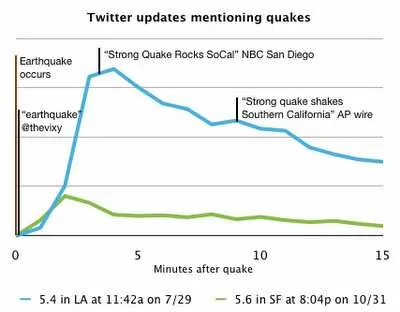 This chart, posted on the Twitter blog, shows trending of the use of the word “earthquake “ following the earthquake in Southern California on Tuesday. The two headlines are from a San Diego TV station and, nine minutes after the quake, the AP.
In the not-so-distance past, getting the story out within nine minutes was considered damn good. The TV station got something out four minutes after the quake. The first Twitter, seconds after the quake. Yeah, it’s different, but it’s still news.
By the time AP moved a story, Twitter already had thousands of first-hand reports. Twitter has often been described as micro-blogging, but the Twitter blog says that for many people, the concept of Twitter is evolving to personal news-wire. We’ve seen this all along, but it’s growing. Here’s the LA Times story on quake twittering.
From the Twitter blog:
Many news agencies get their feed from a news wire service such as the Associated Press. “Strong quake shakes Southern California” was pushed out by AP about 9 minutes after people began Twittering primary accounts from their homes, businesses, doctor’s appointments, or wherever they were when the quake struck. Whether it’s updates from best friends, internet pals, companies, brands, or breaking world events, the real-time aspect of sending and receiving Twitter updates continues to motivate our work.
Let’s make gazillions in ad revenue with no ads
It seems if you can get the model right, there is a revenue growth opportunity in content even in these tumultuous times.
Leave it to Google (well, we did) to figure out how to make $100 million in advertising revenue from pages with no ads – or content of its own.
I still find it hard to see how an argument could be made that Google is somehow siphoning away the audience (and ad revenues) of online newspapers. For those that I am aware of, Google is the No. 1 referring domain. And Google News is a highly effective tool for users.
From starving journalist to creating must-read site
 More from the “Adversity is a Mean Teacher” department. On Venture Voice Gregory Galant interviews paidContent.org’s Rafat Ali, who talks about blogging from a one-room East London apartment in the early days to the sale of the company to the Guardian for a reported $30 million earlier this month.
This is the first of Galant’s podcasts in awhile and it’s nice to hear a new one.
(Photo by Rex Hammock)
How Jerry Falwell helped us protect fake news
Just remember, it was the Rev. Jerry Falwell and Hustler’s Larry Flynt who clarified this issue of First Amendment law. This is a video with Gregory Galant, publisher and CEO of News Groper, that appeared on Uncensored Interview.
News Groper is a parody site of fake blogs of famous people. where, for example, a fake Samuel L. Jackson blog has a headline of “‘The Dark Knight’ needs more dark meat” and a fake Courtney Love says “ Very good scientists! A sturdy erection makes women happy. Thanks for the update!”
I wonder if they have heard about this in Oklahoma?
Journalism.me
Kiyoshi Martinez has created a new entrant in journalism blog aggregators, Journalism.me, the journalism blogosphere. The site is an aggregation of journalists who blog mostly about journalism from their personal sites.
I set out to create a definitive – but ever expanding! – list of young journalism bloggers and just provide it as a simple resource. But then I got to thinking that maybe I could do more than just a list.
So, I bought the domain name “journalism.me” and went to work building a list of not just young journalism bloggers, but a more general list of personal blogs by journalists who blog about journalism. Yes, I’m aware of how meta this is.
…
So, what you end up with is a collection of individual voices discussing journalism all focused in one place. Hopefully, the site will drive traffic to their blogs and connect them with each other.
What radio talk show hosts really do
The NPR voice
Glenn Reynolds on his podcasting with wife, Helen, and the “NPR voice.” This is from a Sunday afternoon radio talk he, Michael Silence and I did with George Korda on WNOX, 100.3
Crowdsourcing was hip last century
Crowdsourcing is soooo 20th century. Instead, we need one-to-one conversation with a mass, or something like that. I am not a part of a crowd, says Dave Winer.
Surviving survival
Yahoo is very close to being a distressed property, it feels like. Or is it already?
If you’re first, you’re fired
What a message in the breaking news age. The person who posted the death of Tim Russert on Wikipedia has apparently been fired, least that’s what NBC sources say they’ve been told.
The Wikipedia entry on Tim Russert seems to be first report of the death, well before NBC, other TV networks or the Associated Press reported the death. NBC said it was waiting until the family could be notified.
The New York Times reported Monday that:
Looking at the detailed records of editing changes recorded by Wikipedia, it quickly emerged that the changes came from Internet Broadcasting Services, a company in St. Paul, Minn., that provides Web services to a variety of companies, including local NBC TV stations.
An I.B.S. spokeswoman said on Friday that “a junior-level employee made updates to the Wikipedia page upon learning of Mr. Russert’s passing, thinking it was public record.” She added that the company had “taken the necessary measures with the employee and apologized to NBC.” NBC News said it was told the employee was fired.
Now, be sensible
With the decision to mothball OJR.org, long-time “online guy” and former Scripps colleague Robert Niles has launched a new site: sensibletalk.com
Why “sensible talk”?
Because that’s how we make better journalism – with sensible talk. Our ability to report is only as good as our ability to perceive, and our perceptions are best informed by both our senses and our understanding of facts.
Blink and you’re beat
Brian Cubbison who edits the “News Tracker” blog at syracuse.com greatly expanded on my observation Friday afternoon that Wikipedia beat AP to even a one line alert in the death of Tim Russert on Friday.
He’s got the full chronology of Wikipedia’s edits and what moved on the AP wire. Great stuff.
Another person Twittered me that the real story is “How did NBC get scooped.” And it does seem Russert’s employer was very slow out the gate with the news that happened in one of its own facilities.
A couple others weighed in on Wikipedia beating the AP on Russert story that I noticed:
Greensboro News & Record Editor John Robinson wrote Wikipedia-1, AP-0.
Kurt Greenbaum in St. Louis wrote Insta-obit on the site we love to hate: Wikipedia.
I understand checks and being accurate as well as fast, but blink and you’re beat.
Update: Welcome Instapundit readers! Consider subscribing to this site.
If it weren’t for refrigerators …
… community news would have died years ago. As it is, we’re in need of a good digital refrigerator.
Amy Gahran writing on Poynter’s site:
(Lisa Williams, a longtime citizen journalist and founder of Placeblogger) posited in a conversation yesterday, and I think she has a point, that in fact perhaps most people really consider community news and civic information to be a nice-to-have, rather than an absolute necessity. There’s a dissonance between people’s values as they envision or proclaim them, and as they live them.
A long tale, 140 characters at a time
On what Ron Sylvester learned from Twittering a trial.
One day, I cut and pasted all my “tweet” updates into a traditional story file. It measured 80 inches. Now, I don’t think anyone would have read an 80-inch story from the newspaper on this trial, as compelling as it was. My editors certainly wouldn’t have run a story that long. But what I found is that people will read an 80-inch story, given to them a paragraph at a time, 140 characters long. *[]: 2007-12-12T15:21:48+00:00
The new new thing is the new new thing
If Feedfriend is the new Twitter , new Google; Facebook is the new ….?
Great campaign tool
Dave Mastio, whom I’ve gotten to know working on the BlogNetNews powered Knoxville Blog Network, announced a new tool yesterday for elections.
It’s incredibly cool. Here’s what the North Carolina section looks like, for instance. It organizes blogging coverage of candidates in a way that tempers a search engine-type query with an editor who takes into account place and person..
I asked Mastio in an email to send me some comments on his thinking behind the project. He said he’d be blogging about that Tuesday, but he said, in part:
… I wanted to build a place where people could get information from the blogosphere where geography, local expertise and a long-term commitment to covering the subject mattered – to serve that reporter and that independent voter and to help those local bloggers get the recognition and the traffic they deserve.
The only way to do that is to combine the technological know-how of an Internet guru (BNN’s Tyler Abbott – also a University of Iowa guy) and the knowledge of an editor who was willing to spend thousands of hours getting to know the bloggers in every state, finding the blogs are the must-reads focused on state and local level news (that would be me).
I think what we’ve created at BlogNetNews.com/Elections is something special because it isn’t just blogging and it isn’t just a neat tech toy and it isn’t just the same old journalism. It can only exist when all three are combined in a way that I don’t think they have been before on a national level.
To err is to win
Funniest thing I’ve read all weekend. I guess that’s because I helped and helped. Some more links.
From Instapundit:
Serious news can be fun
I’m thinking this is the type of site that would rate positively with the subjects in the AP’s new study on youth-adult readers. It fun and short! Test your who-must-have-said-that skills at pullquotes.org. Looks to be from the Sunlight foundation.
The full AP study, A New Model for News, Studying the Deep Structure of Young-Adult News Consumption.
Has a newspaper done something similar? It didn’t leave me with “news fatigue” feeling.
(Via Ryan Sholin)
Encyclopedia Braun creates a journo-New Media reading list
Want a human filtered stream of blog postings from selected new-media-and-journalism blogs? Josh Braun, a journalist, researcher and teaching assistant at Cornell University, has created one. He says:
“I’ve created a combined RSS feed, not of this site, but of around 30 cool new-media-and-journalism blogs from around the web. It will send out about 10 to 15 posts per day, and I’ll filter out off-topic posts, so you won’t have to read about career advice for young journalists, or what someone ate for breakfast.”
A joke is journalism
We’ve all heard the cliche “journalism is a joke.” In a sort of dog bites man story, a joke is developing into journalism.
What began as a parody of “the real” Shel Israel featuring a sock puppet has actually started to develop in an interview series that serves up news, according to Mashable’s Mark “Rizzn” Hopkins.
The interviews, featuring a puppet purporting to be Shel Israel interview Tech glitterati, are done by Loren Feldman, president of 1938 Media. Above it is an interview with Digg’s Kevin Rose. You can see more examples here and here.
Hopkins says:
Interviews are a hard thing to do in an innovative way. The most innovative approach in the last ten years or so has been the rise in the raw or naked conversation (probably talked about the most by Shel Israel and Robert Scoble), but performed avidly by folks like Rob Walch with his Podcast411 show, or even in Old Media shows like Inside the Actors Studio. Even the Mashable Conversations show takes on this format. There are certain advantages and appeals to the format like lowered production time and the ability to really explore the meat of the subject matter in a way that the most hardcore of fans for that subject can enjoy.
The problem is, as Loren has talked about again and again, is that folks not passionately interested in the subject will get bored very quickly. He’s been very vocally opposed for sometime to the style, but before inspiration struck, hadn’t put his money where his mouth is in coming up with a viable alternative.
This method of interview is interesting, entertaining and informative. It’s something to keep your eye on, particularly if you’re a rich media content producer, as an emerging style and trend in digital video. What started out as a joke is turning out to beat the original at his own game.
The buttered popcorn guide to fair use
An excellent short film by Eric Faden, an assistant professor of English and film studies at Bucknell about copyright and fair use. It’s an extra on a longer DVD being distributed by the Meida Education Foundation. There’s a six minute preview of the longer piece. Did you know the song “Happy Birthday to You” is copyrighted?
(via Doug Fisher)
The search engine is overrated
A new research from Indiana University showed that 54% of URL requests had no referrals. That means that most of the time, people do not click on links. They merely pick a site in their favorites or type in an URL in the address bar. A mere 5% of URL requests came from search engines.
Y.M.T.A
Compete did an analysis of Twitter users in April. They found users tend to be Young, Male, and Twitter Addicted.
Two fascinating stats:
- Twitter skews heavily towards the college/twenty-something crowd. Twitter attracts 18-24 year-olds at nearly twice the rate of an average U.S website.
- Splitting age demographics based on usage intensity shows that heavy users tend to skew older than visitors who only hit the site once a month. This could indicate that while the younger segments are more exploratory, the 25-44 year old segments have found more value in Twitter and started to ramp up usage.
A Twitter trial
Reporter Ron Sylvester at the Wichita Eagle Beacon is live Twittering a trial.
The Twitter trial seems to be working. So far.
It’s a modification of what we began last fall: live updates of a capital murder trial in the killing of a small-town Kansas sheriff. It was a way of live blogging from the courtroom. I would email updates from my smartphone and Bluetooth keyboard and send them back to the online team at the newsroom. They would post them with time stamps.
Readers enjoyed it, but the workflow lagged at times. The copy desk during the day is sparse, usually one person posting all the updates throughout the day. Metro editors were in meetings all day. I was filing faster than the posts were appearing. That was a snag we were going to have to work out.
This spring, as another big trial loomed, the copy desk said they couldn’t handle another round of live blogging. People are going on vacation. We’re short-staffed. There was no time to sort through my updates each hour.
Today’s to do: Save the World
My Carnival of Journalism pal Charlie Beckett has a new book, “SuperMedia: Saving Journalism So It Can Save The World” (published by Blackwell books on May 20th). I haven’t read it, but it hones in on a powerful idea for journalism, what Beckett is calling “network journalism.”
Here’s the PR blurb:
SuperMedia: Saving Journalism So It Can Save The World (Published by Blackwell books on May 20th) is a passionate and controversial defence of the social value of journalism. But it argues that the news media must be transformed in to ‘Networked Journalism’ that allows the public much more power and participation. It outlines how forces such as new technology are destroying old media forms around the world. And it gives international examples of how new media will change the way that we report on the big issues such as politics, terror, Development and climate change.
SuperMedia is a riposte to the pessimism of Nick Davies’ Flat Earth News but it is also a realistic manifesto for how the virtues and the business of traditional journalism can be reborn.
It makes a provocative case for a new approach to the ethics and practice of news production and describes how media diversity and literacy must be reinvented.
Knoxnews, two online producers, online editor win awards
Knoxnews won the Award of Excellence for Overall Web site in the East Tennessee Society of Professional Journalists Goldne Press Card Awards, which were presented Friday night at a dinner at the Foundry..
Online producer Lauren Spuhler won the Online Reporting Award of Excellence in continuing coverage for her Bonnaroo 2007 coverage..
Online Producer Erin Chapin and reporter J.J. Stambaugh won the Online Reporting Award of Excellence for Multimedia with a series called “Use of Force.”
And Online Editor Jigsha Desai also won an honorable mention in the multimedia reporting category for a package on the 25th anniversary of the 1982 World Fair.
Complete list of winners is below.
The new black
Short is the new black. Did you make it this far.
(Always has been.)
This Tweet just in
Something very similar to thisbreaking Twitter news happened to me on April 18 with this story.
(via InfoDiva)
DigiDave talks with Scott Karp
David Cohn does a video interview with Scott Karp, who he calls “one freakin’ smart guy,” on Publish2, Link Journalism and more. It’s a good overview of what Karp is doing with Publish2.
Insty Twitter
I’m thinking not many people know Instapundit.com has a Twitter feed. Those are “InstyTweets?” It’ll be popular!
On a completely unrelated, but geographically close topic, I created a Twitter feed for University of Tennessee fans with GoVolsXtra headlines. Follow it here.
Twitter tools
Just one of things that is interesting about Twitter is how many services have been built upon its simple interface to provide additional features. For a service that has yet to hit mainstream, it’s germinated a whole eco-system of apps.
Here’s some of the Twitter tools I like best.
I don’t bother with desktop apps or Firefox plugins, but these I find useful.
TwitterLocal, see what folks around the Hood are saying.
TweetScan, search keywords. Or search you user name and see what others have said about you that you might have missed.
TweetStats, all kinds of stats about your Twitter use. I Tweet most often on Saturdays and at 8 a.m. and 9 p.m. I talk to @Newscoma a lot.
Summize, another great Twitter searching tool.
Twitterholic, if you need Twitter “friends” to follow.
Twist, Compare keywords. Here’s “big brown and belles.”
TwitterFeed, great RSS to Twitter app.
Who Should I follow?, an interesting one to find new friends on Twitter.
Do you have “must haves?”
Here some more best of Twitter tools blog posts:
CyTRAP Labs’ choice - free tools - 12 best Twitter tools
40+ Twitter Tools for Extended Twitter Experience from To the PC
The Clever Sheep: How Many Twitter Tools Are There?
Charles Arthur: Your suggestions please for the 20 best Twitter tools
Oh, yeah, follow me here.
It was silly of you to come, but stay awhile
In the quest for audience, we live by what marketing whiz Seth Godin calls “silly traffic.”
One time visitors who hit a site for a few seconds and are gone. This site, for example, has a high number of them.
The Google Analytics average for the last month is a bounce rate of 79.26 percent and average time on the site of 40 seconds.
Godin says that’s not where publishers should be focused:
I think it’s more productive to worry about two other things instead.
1. Engage your existing users far more deeply. Increase their participation, their devotion, their interconnection and their value.
2. Turn those existing users into ambassadors, charged with the idea of bring you traffic that is focused, traffic with intent.
Creating news that finds its audience
An insider who’s now an outsider has insider advice on outsiders for insiders running news sites.
Now I’ve got you as confused as Lou Costello in “Who’s on First”?
Well, as Bud Abbott said: “I say Who’s on first, What’s on second, I Don’t Know’s on third.”
I’m glad that’s clear; Because is in centerfield.
In a much more lucid piece, I think former newspaper New Media journalist Melissa Worden says we haven’t figured out for her that new buzz phrase:: “If the news is that important, it will find me.” (And as a phrase, It’s quite the rage.)
Or as media consultant Terry Heaton says: “You can’t ‘find’ anybody by insisting them come to you.”
It’s a concept we need to get faster than Costello learned the names of the players on his new baseball team..
Worden has some great observations on how her news habits have changed and some suggestions on how news can find her. What are some more?
And best of luck, Melissa, in your HSN gig!
The ‘Golden Age’ of Web news
(WelcomeInstapundit readers. Consider subscribing to this site.)
I think we’re in what we will be remembered as a “golden age” of Web news.
A golden age amid the rubble of declining revenues for newspapers and local TV stations? A golden age amid downsizing that is shrinking to newsrooms to the lowest levels in decades? A golden age amid the the boardroom battles in some of the largest media companies?
It certainly is and I say freakin’ bring it on.
All-media-meets on the Web has created a local news and advertising battlezone in market-after-market the likes of which I’ve never seen in a 30-plus-year career.
I’ve worked in a JOA (Joint Operating Agreement) newspaper market and the newsroom competition was fierce, but on the advertising and audience sides, it wasn’t because the business side represented both papers.
Newspapers and TV stations have long competed in news and advertising, but in different mediums. Not the same thing as playing in the same ball field.
National competitors were once, well, national, but they’ve gone local with both content and advertising.
Borrell Associates says TV stations are laggards to newspapers in online revenue, but newspaper online revenue growth is seeing a disturbing flattening as competition heats up in local markets.
And audience share is decidedly a different story. Historically, WRAL-TV in Raleigh, KUSA-TV in Denver, KXAS-TV in Dallas, and KTHV-TV in Little Rock have been pointed to as TV sites winning in their local markets. But that’s history.
It’s clear from the National Association of Broadcasters convention this month in Las Vegas that even the gray-haired men in suits have been into the Kool-Aide. And I would dare to guess that in many markets, TV Web sites are rapidly gaining on their newspapers competitors in local market share. Or have caught them. Or have passed them.
Argue specific data, but the trend is undeniable.
In my local market in Knoxville, Tenn., it’s a Web War mainly involving two big media companies, E.W. Scripps (for whom I work) and Gannett. Rocks are being thrown although the two companies remain increasingly uncomfortable partners on several fronts.
It’s a deadly serious battle for audience and ad dollars.
But it’s also fun, tremendous fun. The community will certainly win through more intense and competition-honed news coverage and some damn good local news Web sites.
Both companies are improving their already good Web presences (we launched a new Web platform a year ago and our chief TV rival, WBIR, has a slick new site in beta). Both are working to re-align their organizations for the battle. There is constant pressure for incremental improvement and innovation.
Here’s a snapshot of how it’s going from Compete. (The data from Hitwise, Scarborough, comScore, Alexa and Compete often vary widely, but this Compete tool is publicly available.)


In NASCAR, they call that door-banging racin’. And it is. See how the battle goes in your market.
If, as a journalist, being right and first, or getting a scoop doesn’t get you pumped up; or if getting beat doesn’t make you want to throw things at the wall, it’s time to head for the exits.
And that’s why it’s a golden age.
Some suggested further reading:
- Hard News, Inc.: Web 2.0 Starts to Hit Local TV
-
[Newspaper Sites Losing Market Share Promise Media](https://www.promisemedia.com/?p=102) - Video: NAB 2008: Steve Safran on the Future of Local Media on Broadcasting
- Local TV sites, competition and growth - Lost Remote TV Blog
- Study: Newspaper Web Sites Dominate Local Traditional Media, But Are Losing Share
- How ‘vs.’ thinking drags everyone down - Lost Remote TV Blog
-
[Just thinking about video in the age of disruption Howard Owens](https://www.howardowens.com/2007/just-thinking-about-video-in-the-age-of-disruption/) - TV vs. Newspaper; Local Online Video Battle � Local Media in a Web 2.0 World
- The new urgency for local TV - Lost Remote TV Blog
- Why TV sites lag newspaper sites - Lost Remote TV Blog
- MediaPost Publications - Local TV Web Sites Gaining on Newspaper Sites - 05/24/2007
- Lannie Byrd: Breaking news website: TV vs. Newspaper
- MediaPost Publications - Local Newspaper Websites Dominate Metro Markets - 04/08/2005
- New York Times agrees to sell TV stations - Lost Remote TV Blog
The trouble with print journalists
Paul Conley made me laugh. A commenter wrote: “I’m going to forward it to people who will get angry about it :)”
Conley wrote:
But the worse news for print-based journalists is that much of the Web journalism world wants nothing to do with them.
What print journalists don’t seem to understand is that:
a) A lot of Web folks are pretty tired of print folks. Nearly everyone who works in Web-only or Web-first journalism came from a print background. And for years they toiled in places where the online world was treated with disdain. Then, as Web journalism took off, the online staff found themselves in an all-new form of hell. Every day was filled with the whining, complaining and resentments of the print staff. I assure you – the Web journalists who have managed to escape that scene are not eager to start hiring the same moaning characters they left behind. The big secret of Web journalism is that it’s fun. And we don’t want anyone to spoil that.
b) A lot of Web folks think print folks are kind of lazy and stupid. Every Web journalist on earth has put in the time to learn how to be a Web journalist. No one taught it to them. They taught themselves. They put in the extra hours, took courses, read books, talked to smart people and looked for answers. And they did all that because they knew that Web journalism was important. Print journalists, on the other hand, tend to think that they themselves are important. They’re the sorts of people who, even as their publications collapse around them, think the boss should invest in training them in the new skills. Web folks don’t want to hire anyone like that. Because Web journalists know that six months from now when something new comes around the print guy is going to be demanding more training.
Newspapers have another 10 to 20, new Lail poll says
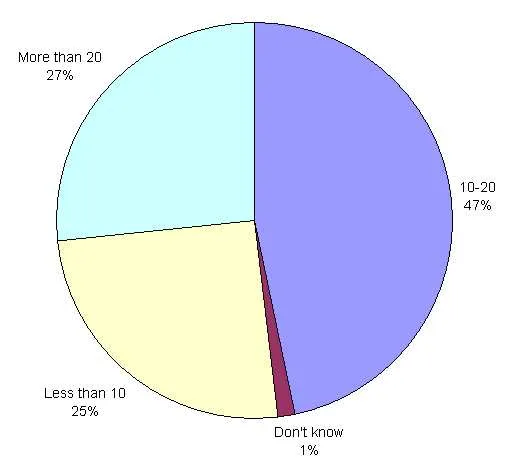 Nearly half the 75 people who took the Lail poll asking “Newspapers will print on paper for …” (years) said it is most likely newspapers will be printing on paper for another 10-to-20 years.
(Click the pie chart to get a larger version.)
The number who said newspapers would be printed for less than 10 years or for more than 20 years is pretty close, with a quarter saying less than 10 years and 27 percent going for with more than 20 years.
Who took my poll? People that responded to my “take my one question” survey, basically. I don’t pretend it’s scientific. It could include users who saw it on this blog, on Twitter.com, on Facebook or in an email I sent to a Scripps New Media list and to Knoxville News Sentinel executives.
The poll was done by using the form creation tool in Google Docs, which works very well.
I promised to compare it to a recent Pew Poll. As best as I can tell the middle range of 10-20 is about the same as what the journalists told Pew, but my poll takers see a greater possibly of newspapers ceasing publishing on paper within 10 years
Here are the comments I received in the poll. It’s great reading and I appreciate all people who took time to answer the one question:
_Not long.
The last newspaper will be printed next to the blacksmith’s shop in the colonial village attraction.
I think newspapers will be printing for as long as there is a market for the product. Printed editions will change – it won’t be the daily newspaper as we know now – to fit the content that works best for that medium.
Newspapers that allow users to define/customize the items/sections they want to read and deliver electronic and/or print versions will survive. Those who stick to the one-size-fits all, historical model will die from the waste of resources and lack of ingenuity.
It really depends on what you mean by “newspaper.” Will the daily newspaper product we see now print for this long? No. It will become more and more of a niche product over time, with lower and lower circulation to a more dedicated, discriminating clientele. Meanwhile, I think we will see and are already seeing a net increase in other niche publications, some of which are created by newspapers and many of which are not. The actual number of copies will not be as important as the number of readers/subscribers, and the number of niches served. Basically, the stratification we’ve seen in the blogosphere and with user generated content in general will move into print, mobile devices and – who knows – chips in our brains? Distribution still matters, and print is a great vehicle for it. It just needs to be more unique to the individual. - Dan Pacheco, www.futureforecast.com
It depends upon when the ink, paper and delivery cost more than it is worth. Printing and delivering to a small no. of subscribers would be a huge expense. The question becomes: When will the subscriber base shrink to that level?
But that’s not to say publishing companies won’t be printing other things. If it were my choice, I’d be researching the viability of printing slick, weekly local news magazines that people subscribe to.
I believe the newsprint, broadsheet model will go away. Sadly, that model is easier to recyle. But let’s face it. It’s dirty and awkward to handle and I think young news readers, besides relying on the Web, view newspapers as insubstantial and they’re certainly not attached to them. But that is guesswork on my part.
only for the next 50 years, most
Define “newspaper.” I give them about five more years, tops. Probably more for the BIG majors (LA, NYC, DC, etc) but for pretty much all the rest, I give ‘em about five years.
People who love print, love print. It’s still a great user interface. And there is lots of room to innovate in this medium.
are you kidding me? when i turn 58, i’ll buy a paper just to prove my point. you can’t kill tangable. even i as a geek know that.
Until the last boomer dies and affordable electronic paper is available.
There’s still a lot of hold out. I suspect plenty will go online only as newsprint becomes more expensive and online business models solidify.
But from what editors have told me lately, at least in the Bay Area, print and online audiences don’t much overlap. Ultimately, that’s a good thing, I think, because it means there’s more audience out there than we realize, but it also means we’ll continue putting out two products for the foreseeable future.
The print edition is going to become the reverse publishing piece of the web. The printed paper will be a recap of what was online the day before. HEED MY WORDS!!!! : )
Major dailies 10-20. Niche and weeklies a lot longer.
Just in a different way than now – smaller news hole, higher subscription prices, etc.
Those of us in our 40s hopefully will still be kicking and pining for the old paper.
How many high schools still have print papers? Colleges?
Foldable screens will obsolete paper
Newspapers will continue to be printed on paper for a while, simply because there is a generation of executives who simply refuse to believe that the future of journalism and newsgathering belongs on the Internet. Only when the stark reality of a business model that has not changed for the last century is finally made plain will publishers finally start to truly invest and innovate in the digital medium.
Comment from a colleague: Just change it to months (instead of years) and we’re all set.
I think we will always have some form of printed newspaper. You can’t get past the convenience of paper.
As a 40-year-old who read the newspaper almost every day as a child and teenager, I have moved to the web only. And I am not alone.
I think they’ll provide a print product for quite some time, BUT printing news on rolled up toilet paper and chucked in people’s driveways is a business model that’ll go the way of the… milkman.
Will H.
newspapers will print on less paper, but they will still print on paper for many, many years. word processing did not fully eliminate printed documents. email has not fully eliminated snail mail. books in electronic media form have not fully eliminated books. why would news online eliminate printed newspaper?
As long as there are blogs we will have customers needing informed factual reporting in print.
mb
They just won’t look like what we are used to reading today.
_
Honored to be an EPpy finalist times three
 Knoxnews/GoVolsXtra today were named finalists in three categories in the 2008 EPpy™ Awards for the Best Media-Affiliated Internet Services.
The winners will be announced at the Interactive Media Conference and Trade Show on Thursday, May 15, 2008 at the Rio in Las Vegas.
The contest, now in its 13th year, is put on by Editor & Publisher and Mediaweek. It’s a big deal to win one of these. Heck, it’s a big deal to a finalist.
Here are the categories knoxnews/GoVolsXtra are finalists in:
Best Overall Design of a Web Site with fewer than 1 million unique monthly visitors
The Enquirer & Cincinnati.Com
KnoxNews.com
Las Vegas Sun
Metromix.com
Observer.com
Best Overall Newspaper-Affiliated Web Site with fewer than 1 million unique monthly visitors
APP.com, Asbury Park Press
GazetteXtra.com
Knoxnews.com
Las Vegas Sun
NWHerald.com
Best Sports Web Site with fewer than 1 million unique monthly visitors
arkansassports360.com
CommunitySportsDesk,kenoshanews.com
GoVolsXtra
varsity845.com, Hudson Valley Media Group
The credit for being named finalists goes to a very strong digital media team at the newspaper.
In the newsroom there is an awesome team of online producers led by Online Editor Jigsha Desai and composed of Lauren Spuhler, Erin Chapin, Talid Magdy and Chloe White. Deputy Managing Editor Tom Chester coordinates breaking news and other initiatives between the print and onlien groups.
On the advertising side, Ed Tisdale leads a group of designer/programmers that include Clint Barnes, Tom Wolber and Chuck Kirkpatrick.
Much of design of knoxnews is the work of E.W. Scripps’ design wizard Herb Himes. The Django/Ellington platform used for knoxnews and GoVolsXtra is supported by the corporate interactive group based in Knoxville.
Here is the complete list of finalists. Other Scripps newspapers among the finalists are naplesnews.com and commercialappeal.com.
Kleinheider launches new blog
A. C. Kleinheider has launched his new blog with the NashvillePost. It’s called “Post Politics, a blogjam of nashvillepost.com.”
Previously, High profile Tennessee political blog shuttered in budget cutting move and That New Coke moment
Banking on good ideas with $1.5 million
Noticed Eleanor Cippel, Knoxville-based director of innovation for E.W. Scripps, got some pub in an AP story today at the Newspaper Association of America’s trade show in Washington.
Eleanor Cippel, director of innovation for Cincinnati-based E.W. Scripps, said her company started a $1.5 million “entrepreneurial fund,” similar to a venture capital fund, more than a year ago to bankroll business ideas mainly from their employees.
In that time, the company has reviewed about 175 ideas and funded about 15 mostly Web-related products, she said. Examples are RedBlueAmerica.com, which caters to readers who want to know about opinions from different sides of an issue, and RootClip, another Web site that invites users to submit short videos.
The idea, she said, is to grow loyalty within such audiences.
Widgets are the new plastics
Today Greg Howelet at Marketing Pligram is pointing to this study result:
Rob Curley’s Neyland Stadium show
 Yes, it was that big. No other venue could contain him. It had to be moved from Thompson-Boling Arena.
My reading list for journalism grads
I’m on a panel at the University of Tennessee’s “Public Conversation on Web Journalism” that is to discuss careers in Web journalism at the Beck Cultural Center on campus at 11 a.m.
Here’s the lineup:
Panel 2 (11 a.m.) (Host: Mark Harmon, University of Tennessee)
Adam Bryant, associate editor, TVGuide.com
Jack Lail, managing editor/multimedia, Knoxville News-Sentinel
Michelle Ferrier, managing editor, MyTopiaCafe.com, Daytona Beach
Patrick Beeson, project manager, Scripps Interactive
Here are some links to great blog posts in my opinion for journalism students, would-be journalism students and recent j-school grads. I hope you find them helpful and thought-provoking.
Pat Thornton: Journalism students need to know business
Pat Thornton: Journalism students need to know marketing
Mindy McAdams: Catch-22 in journalism internships
Saul Hansell: Entrepreneurial Journalism in the Facebook Age
Mindy McAdams: 5 things to tell the students
Ryan Sholin: Ahead of the game
Deborah Potter: Future of news jobs
Deborah Potter: Where are the journalism jobs?
David Reich: Does knowledge of social media make you a better job candidate?
Badger Madge: My oh so wise advice for budding journos
Mark Hamilton: Where talent comes from (updated)
Howard Owens: Mid-career professionals can help lead the way to a new era
Paul Conley: The next crop of journalists
Rob Curley: What sort of things should an aspiring journalist be thinking about?
Doug Fisher: ‘Generation Intransigent’?
Leonard Witt: Rob Curley Replies to PJNet Pitcher as Catcher Post
Magic formula for citizen journalism remains elusive
John Ndege blogs the demise of his London-based ScribbleSheet citizen journalism site, which launched last September, in a post titled “The Problem with Citizen Journalism.”.
Ndege has some observations.
Among them, he thinks NowPublic may have a potentially sucessful model, particularly as a result of its agreement with the Associated Press.
ScribbleSheet is another in a long stream of examples of the how very tough it is to build a successful community model – as a business.
One of Ndege’s hard learnings: Simple display advertising won’t cut it.
That calls into question the business models of a large number of sites.
Good news for a good idea
Scott Karp’s Publish2 has raised $2.75 million in Series A funding from Velocity Interactive Group.
Congratulations! Read the news.
I’ve been experimenting in one area of Publish2 and Karp’s vision of the future, link journalism. I had been dabbling in extensive outside linking as “the content” rather than “supplemental content” before I ran into Karp’s ideas.
But his thinking outlined on his Publishing 2.0 blog crystallized what I could see in my the Web stats for knoxnews/govolsxtra.
The epiphany: Human aggregating is a valuable, journalistic service.
Sounds simple. Most good ideas are. What I have found is that “stories” that consist of links to relevant content are consistently high traffic drivers.
Karp’s vision goes much further than mere external linking to the power of groups, a sort of wisdom of the crowds approach. But one not subjected to gaming or social relationships that happen on sites like Digg. How to quickly develop ad hoc crowds of human aggregators on a breaking news event is one of the challenges still to unravel.
That might be enough of a goal. But his business plan goes further than creating a cool tool for journalists and it’ll be interesting to see what he outlines there. He says his ideas around a sustainable business model will be announced in the future.
This is an intriguing effort that has caught the attention smart media thinkers like Jeff Jarvis. I’m listed as an “advisor” for Publish2, but I’m more of an incurable road tester. I’ll leave the smart thinking and advising to Karp, Jarvis, Howard Weaver, Howard Owens and Beth Parke.
If you’re a journalist and you haven’t already signed up for Publish2, head over there and request an account. This is a good idea to wrap your head around.
As today’s announcement shows, guys with skin in the game think so.
Speaking of speaking again
Someone screwed up again and put me on a conference panel next week as part of something at UT called “Public Conversation on Web Journalism.”
All feeds; All Knoxville
 Casey Peters and Patrick Beeson have launched a Knoxville news aggregator,
 And you were wondering if there was money in blogging
Blogging grows up and tries to survive being a business. And Michael Arrington sees an opportunity.
A media shell game
 When times get tough, companies like to hunker down like a tortoise in its shell. When the rough times pass, they’ll come out of our shell again.
But in the media business today hunkering down and focusing on the core is like a tortoise withdrawing into its shell in the middle of a highway.
You have to get to the other side of the road or …
KnoxvilleTalks blogger and WBIR online producer Katie Allison Granju has some thoughts on getting to the other side in light of the well-publicized scaling back of Internet efforts at Nashville TV station WKRN, once a pioneer in how TV stations should do the Internet (and which has had more than a few ideas that newspapers could borrow).
The new State of the News Media 2008 study from the Project for Excellence in Journalism has some charts that might help to bring it into focus what is happening to news and the media.. Which of these three charts seems to be showing growth?
Daily newspaper readership by age (click image for larger version).
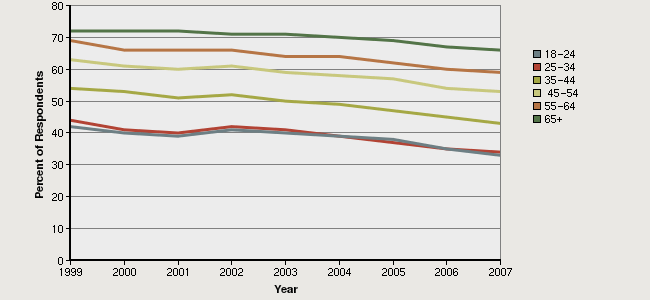 Average early evening news share for TV (click image for larger version).
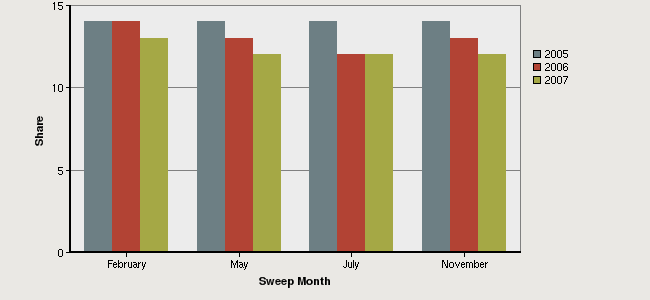 Top online news sites and growth (click image for larger version).

The deejays of news
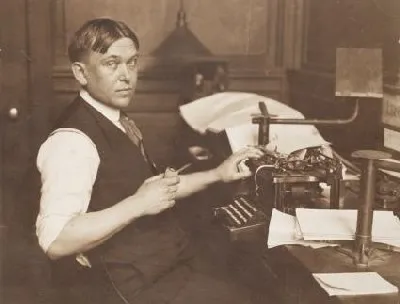 A trio of posts over the weekend had me musing about the new roles journalists find themselves in, roles far beyond what journalist and essayist H.L. Mencken (pictured at right) probably envisioned. Beyond reporting and writing, they are becoming community discussion leaders, the deejays of news.
Robert Niles and Howard Owens, among others, have suggested that this is a role that must be played by newspapers and other media on the Web.
Howard Owens was quoted in January as wishing: “Reporters and editors would take seriously their roles as community conversation leaders, concentrating on getting it right on the web first – Web-first publishing, blogs, video, participation – and using the print edition as a greatest hits, promote the web site vehicle. Old packaged-goods-thinking about the newsPAPER would disappear overnight.”
Robert Niles said a few months back “The core skills one needs to build an active, informative and respectful online content community are precisely the same skills reporters and editors have employed for generations to become good journalists.”
Which brings me around to this weekend’s posts.
WBIR senior online producer Katie Allison Granju says her role on KnoxvilleTalks.com is “akin to one of those salon hostesses of yore who worked to facilitate and encourage great conversation among guests.”
Trace Sharp says adds another angle. The conversation guides must have a voice themselves, much like the radio deejays when you knew the deejay’s name.
She wrote:
Blogging and the tubes are somewhat like personality-driven radio for me. I listened to DJs I liked who engaged me. That’s what I wanted to do. …
I think about blogging the same way.
And I like human aggregators. I just see blogging a bit like radio. I listen/read you because I dig what you, the person, says/writes.
Twitter does a “Rainy Night in Georgia”
Wow, this is how Twitter users covered the storm that damaged the Georgia Dome during the Alabama-Mississippi State game.
This is a Twittersearch result set for “georgia dome.” Noticed some people were talking about the weather without using this exact search terms o I’ve far from caught all the relevant Twitters, but you get the idea of how the news spread among Twitter users.
mrscrumley
Left georgia dome waiting for marta
in Dayton, Ohio
2
minutes ago
jayshepherd
Apparently a tornado hit the Georgia Dome during the Alabama Mississippi State game. https://tinyurl.com/37zj7p
in Alabama
25
minutes ago
usnews
Storm Rips Holes in Georgia Dome: ATLANTA (AP) – A severe storm ripped away two panels in the side of the.. https://tinyurl.com/39367j
in Washington, DC
39
minutes ago
edsbs
Applauding the structural integrity of the Georgia Dome.
1
hour ago
transformer68
Storm rips holes in Georgia Dome (AP). AP - A severe storm ripped away two in. https://www.lnk2.com
1
hour ago
adml
Game on after 1 hour delay in MSU-AL game in the damaged Georgia Dome
in Mississippi State, MS
1
hour ago
amberlrhea
Apparently the tornado ripped a hole in the roof of the Georgia Dome! @rustytanton PLEASE be careful driving home tonight!!
in Atlanta, GA
1
hour ago
slobokan
@sodapoplv A couple big t-storms moving through the ATL. Georgia Dome damaged during the ballgame.
in Gilligan’s Island Debuts On CBS
1
hour ago
dskaggs
Play suspended while a funnel cloud went over the Georgia Dome
in Tennessee, USA
1
hour ago
Page_other Page_other
halosfan
Wow, looks like some intense moments at the Georgia Dome tonight w/ weather.
in 90250
1
hour ago
jacklail
AP says “A severe storm ripped two holes in the side of the Georgia Dome” during SEC tourney game. Whew
in Knoxville, TN, USA
2
hours ago
aakelley
Just flipped on SEC tournament & see there was a tornado over the Georgia Dome. No one hurt.
in Crittenden, KY
2
hours ago
rkischuk
games resuming. Total cloverfield moments at georgia dome tonight.
in Atlanta
2
hours ago
joe_wheeler
yeah, to make the Georgia Dome sound and shake like that had to be big, just watched the replay
in Louisville
2
hours ago
clifmims
Looks like a tornad passed over the SEC tournament in the Georgia Dome. 30,000 ppl all ok. Lots of concerns for a while.
2
hours ago
rkischuk
holy crap - Georgia dome shook like crazy - minor roof tear from mega storm!
in Atlanta
2
hours ago
researchgoddess
Wow….tornado at the Georgia Dome? SEC game is suspended right now b/c something rumbled the roof!
in Cincinnati, OH
2
hours ago
mrscrumley
Severe weather just blew apart some of the georgia dome. very scary. still shaking
in Dayton, Ohio
2
hours ago
adml
Tornado Warning in Atlanta, GA stops play with 2:11 to go in overtime. Debris falling from Georgia Dome ceiling
in Mississippi State, MS
2
hours ago
(Oh yeah, follow me on Twitter)
Inane ramblings of a mad man exposed

 Journalism.co.uk recently started doing a series where it is asking journalists across the globe about social media and how they see it changing their industry.
I was game to give it try.
I think I asked more questions than I answered.
It did make me realize Social Media is such a nebulous concept that I’m not sure what people are talking about when they use the term. I have a concept of it, but I’m not sure it’s their concept.
Join this Facebook group
I wonder if my headline is direct enough?
If you have a minute, join the new Facebook group that co-worker Lauren Spuhler created called “Songs of Appalachia.”
She describes it:
“Songs of Appalachia” is a monthly video series featuring musicians from East Tennessee who help define the music of this region. It is published on knoxnews.com and is more than just country music.
The music may be classified as “home-grown” or “old-timey” and has deep roots to Africa, Scotland, Ireland and England. It is a mixture of fiddle, banjo, mandolin and guitar, incorporating jigs, reels, polkas, country and bluegrass.
Join online producer/videographer Lauren Spuhler and News Sentinel staff writer Morgan Simmons as they explore the musical roots of our region.
Over 70 snowmen captured in Nashville weather roundup
In covering the snowstorm that hit everywhere in Tennessee but Knoxville on Saturday (OK, there was a little on the ground if you didn’t blink), I noticed that WKRN in Nashville totally rocked with user submitted photos.
When I surfed through, the site was heralding 70 snowmen photos or over 400 weather pics. In a matter of hours! That is fantastic!
WKRN has a special site to handle the uploaded photos and videos that it calls Nashflix. Think local YouTube for photos and video. If you go to the bottom of that site’s home page, you can see it’s powered by a Nashville startup called Cell Journalist.
I emailed founder Parker Polidor for the what up. Here’s what he said in an emailed response:
WKRN has been very happy with Nashflix and the response from the community. I think the total has exceeded 500 images/videos of the recent snow. It is a great way for people to share the local news and events with others in the same area.
Recently we added a dynamically updated media badge. It’s a simple javascript that anyone can include on their blog or website and it pulls in the most recent content. This can either be the most recent of a particular channel or the most recent content of a particular user. Its just a great way to push the content from one platform to many other platforms/sites.
Cell Journalist is working with other papers/tv stations across the country and more announcements will be made in the next few weeks.
We are seeing some great interest from smaller papers who want to use our platform to show user AND professional content. Our platform is well suited to handle both.
Leveraging what people are already doing
There’s a point here:
There’s so much opportunity on the web – it’s just a matter of seizing it.
So how can the web make LESS work for journalists rather than more? Which weekend assignment would you have rather had?
Write human interest feature on the storm from scratch, call up people to annoy them for quotes, and then run the AP photo
OR
Read the stories and browse the compelling images already being posted across your local blogosphere, and create a quick link journalism piece to capture it
The web doesn’t have to be harder for journalism – it can be much, much easier – it’s just a matter of learning how to use the web.
Mashup fun
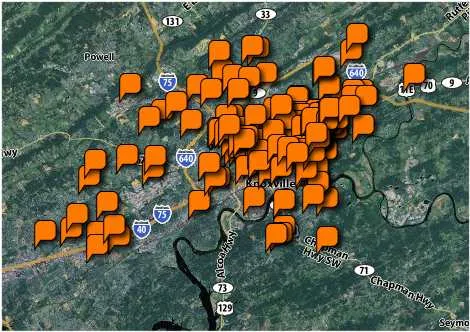 Enjoyed learning a bit about transforming XML documents with XSLT in doing some homicide mashup maps for a series of stories reporter Matt Lakin is doing.
He had complied homicide cases since 2000 into two OpenOffice Calc (Excel compatible) spreadsheets. I converted the spreadsheets to XML docs, then “transformed” each XML document into an HTML file and an XML file in Yahoo’s map format using a simple perl program (all my perl programs are simple) and an XSLT stylesheet.
| One gotcha I ran into was that the same spreadsheets saved by Excel and OpenOffice produced different XML for the date field and another field with using XML | Excel in perl. I’ll have to look at that some more. |
I did run into some issues of things I didn’t know how to do in XSLT stylesheets, but I worked around them and I did have to clean up some addresses in Yahoo..
I used XML and Perl
The results:
Their momma needs to whup their butts
As one who spends an ever expanding amount of time dealing with such creatures, I found Shane Richmond piece on trolls an excellent read and with a pointer to another nice read by Paul Graham.
Finding a balance between robust and vibrant and civil and polite takes a lot of effort.
End-to-end news
I hadn’t heard it put this quite this way, but it’s a great way to thinking about a news site:
Be the first and last word on a story.
That’s a slightly re-spun version of something Andy Dickinson credited earlier this week to Ed Roussel, Digital Editor, Telegraph Media Group, It works for me. Roussel also outlined an interesting timeline in the evolution of a breaking story.
UT campus pub smackdown
Thought for the day: Lose your institutional memory in order to remember what you’re doing
Pat Thornton, a Web content editor at Stars and Stripes, compares two University of Tennessee journalism efforts. See how they fared.
If there was ever a place for journalists to take risks and try things that may not work, it should be in college media. College is the perfect time for failure.
Social media is baggies and Post-its
Social media revealed.
(Actually, Fortune has a great piece on where the above were used. Are you setting up all your business meetings on Facebook yet?)
Just another medium for journalists
Anil Dash of blog software house Six Apart on Joshua Micah Marshall and his Talking Points Memo wining a prestigious George Polk Award for Legal Reporting: It was the first time an internet only news service had won this journalism prize.
At Six Apart, we’ve always believed that blogs are nothing more, and nothing less, than a new medium, native to the web and nimbler than the ones that preceded it. That means that, even though people have been falsely debating “blogs vs. journalism” for the better part of a decade, the truth has always been that this is just another medium in which a great journalist can do great work.
‘Like meeting a rock star’

Reflecting on the first date
 I’m still kind of digesting and fermenting all the things I heard at the computation + journalism symposium at Georgia Tech last weekend. It also had the long name of “Journalism 3G: A Symposium on Computation & Journalism.”
Rich Gordon, a New Media journalism professor at Northwestern, called it a first date and has a great rundown on some of the key points brought up by speakers.
It also was a little like a 20th-year class reunion for an Investigative Reporters and Editor’s computer-assisted reporting bootcamp with Gordon, Shawn MacIntosh, Nora Paul, and Bill Densmore on hand, all journalists who know more than a thing or two about using technology in the practice of journalism. But that’s not quite right because a lot of the other people were either not born 20 years ago or were toddling around in diapers.
So maybe the first date analogy stands, or at least there were some Facebook pokes. Gordon did try to outline the intersection and the missed connections of journalism and computer science:
I concluded that journalists and technology professionals do have two things in common. First, the best people in both fields really do want to change the world and make it a better place. Second, both believe that people want and deserve access to the best possible information.
But there also is a substantial gap between journalism and computer science. Too many journalists don’t respect technology development as a creative activity – they think developers should just build stuff they want. Too many technologists don’t respect journalism as an intellectual activity – they think journalists just pump out content for their algorithms to process. Too many journalists really don’t like technology change; they blame it for hurting media businesses, threatening their livelihoods and diminishing the quality of news available in local communities. Too many technologists think it’s not their job to worry about the negative impact of technology innovation on media companies and journalism – and when they do think about the consequences, think only about information at the national and global level (which is broader, deeper and more accessible than ever) and not at the local level (where online news ventures rarely do the kind of original reporting that newspapers do).
Link journalist
Scott Karp may have coined a new term in “link journalism.”
It’s a bit of jargon news editors need to unravel because it’s a powerful way to engage audiences.
It’s not a new concept. “Link journalism” has been practiced every since the Web was born and people began linking.
But Karp, founder of Publish2, argues it’s a valuable journalism function and defines it thusly.
Link journalism is linking to other reporting on the web to enhance, complement, source, or add more context to a journalist’s original reporting.
Brilliant buzz
 Muhammad Saleem says Yahoo! Buzz is
 Small screen versions of knoxnews/govolsxtra
The corporate developers have quietly rolled out mobile versions of knoxnews and govolsxtra.
See m.knoxnews.com and m.govolsxtra.com.
Let me know if you experience any issues.
New Frontier Awards
Got some great news on Tuesday. From an Inland Press Association news release:
Winners of second newspaper Web contest chosen
The Globe Gazette, News Sentinel receive best in circulation size
The Globe Gazette, Mason City, Iowa, and the Knoxville (Tenn.) News Sentinel took first-place honors in their respective circulation divisions in the second New Frontier Awards sponsored by Inland Press Association.
The contest honors the best in newspaper online initiatives. It consists of seven categories that recognize newspapers’ achievement in producing and disseminating news content using online and new media platforms. Entries are judged on creativity and results, along with category-specific criteria. The contest is open to all Web sites run by U.S. newspapers.
The Globe Gazette (www.globegazette.com) won for papers with less than 20,000 circulation. Judges noted the ease-of-use of the Web site and its strong user engagement through multimedia. Placing second was the Rome (Ga.) News-Tribune (www.romenews-tribune.com). Taking third was the York (Neb.) News-Times (www.yorknewstimes.com).
The Knoxville (Tenn.) News Sentinel (www.knoxnews.com) won for papers over 20,000 circulation. Judges noted its well-organized Web site packs a lot on the page without sacrificing accessibility. The Rapid City (S.D.) Journal (www.rapidcityjournal.com)
earned second place. Taking third was the Frederick (Md.) News-Post (www.fredericknewspost.com).
Judges were Michele Bitoun, Medill’s senior director of undergraduate education and teaching excellence; Janice Castro, senior director of graduate education and teaching excellence, Medill School of Journalism; Rich Gordon, director of digital media in education, Medill; Jon Marshall, Medill instructor and editor and publisher of SPJ’s News Gems blog (www.spj.org/gems); Mary Nesbitt, managing director of the Readership Institute and Medill associate dean for curriculum and professional excellence; Nora Paul, director, Institute for New Media Studies, University of Minnesota; and Richard Roth, associate professor and senior associate dean, Medill.
Intrepids decloak
All the details except where the name came from. Adventures await!
Sassy Southerner better than Wolf Blitzer
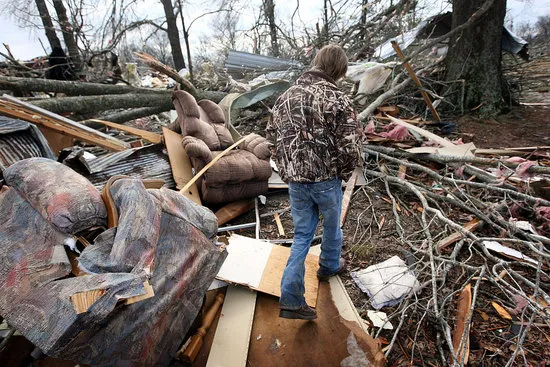 The tornadoes that ravaged West and Middle Tennessee left behind in the debris great gems of people telling their own stories in the tragedy.
Helen Waters at BusinessWeek noticed:
Watching the news and CNN had a piece on the tornado that went through Tennessee last night. The anchorwoman then introduced some pictures from “Facebook” (entertainingly, she said it in exactly the same way my grandmother used to say the word “Internet” – like she was experimenting with a whole new mysterious language.) She recounted how students from Union University in Jackson had been uploading pictures of their experience of being in the storm to their Facebook group – and then showed a few pictures that had been uploaded.
Local news is national story
Some thoughts on Google News new localization feature, or local headlines by city, state or zip. These local news headline area been getting lots of national attention.
Your portal website doesn’t matter anymore, because people are hanging out where they want to hang out and expecting us to bring our products and services to them.
Observations on the Watching Web
The coming “watching web.”
Writing about a new TV Web site called livenewscameras.com, former Nashville TV station general manager Mike Sechrist says:
You want news from your “hometown” from anywhere in the world? Not a problem, it will be available on the web when you want it. The storms that hit Tennessee and other states on Tuesday night could be watched in real time anywhere with internet access as WKRN, WSMV and WTVF all streamed their coverage to the web. These are the opening salvos in the tumultuos changes to come.
Publish2 Election News Network headlines for Tennessee
These headlines are part of an innovatiive effort to cover the election. Click on the Publish2 Election News Network link to find out more.
Buck 40 analysis
I had been thinking about Mathew Ingram’s “Twitter as news delivery platform” for a couple of days and today he demonstrated what he meant with a Twitter stream “analysis” of the Microsoft-Yahoo deal.
If you still believe that insightful news commentary can’t take place in 140 characters, think again.
One Twitter post “Studebaker buys Edsel” sums up the react of many in far fewer than the 140 character max in Twitter.
In the post a couple days ago, Ingram said:
… I started noticing Twitter becoming a news-delivery system when a news event came along – like the fires in California, or the death of Heath Ledger – and probably noticed it the most during the U.S. primaries. The volume of Twitter posts during the debates and the voting was incredible, and it was like a front-row seat to the action, or a really smart water-cooler discussion. Some people were watching CNN, some watching other shows, some were at actual events; it was a sea of information and opinion.
Read what we found
Just four days ago I got an email from Scott Karp suggesting that his Web startup might have some tools that could make covering an election interesting – really interesting.
Surprise: Editors and users disagree
Here’s a quick take from a new online journaism credibility study: Editors are a lot more queasy about real names in Web site comments than users.
_When asked “do you think it is a good idea or bad idea that a website does not require names?” 64% of the editors thought it was a bad idea, and 24% a good idea. Meanwhile, 45% of the public thought it was a good idea, and 40% a bad idea, showing more split on this issue than did the editors.
Regarding the likelihood of their posting a comment if they must provide their names, 27% of the public said “very likely,” 20% “somewhat likely,” 20% “somewhat unlikely,” and 27% “very unlikely,” suggesting that the public opinion was split_.
As someone who deals with some of the wild and crazy things commenters will write, I can tell you if I haven’t seen it all, I don’t want to. But I read into this that the public is fairly comfortable in sorting out what they think about comments and that about half wouldn’t join the conversation if they had to sign their name to it.
The Online Journalism Credibility study was conducted by The Donald W. Reynolds Journalism Institute in Missouri’s School of Journalism in cooperation with the Associated Press Managing Editors in August and October 2007.
A number of the results look fascinating. I’ll probably write more on this later.
Digging up roots
 Two of my News Sentinel co-workers are doing an interesting and historically significant project called “Songs of Appalachia.” It is being done by online producer Lauren Spuhler and writer Morgan Simmons.
They’re capturing the sounds and songs of the region in video and text.
Old-time, bluegrass, folk, just call it roots music in the mountains. It’s the unique musical styles and songs that have survived on the back porches, at the Saturday night get-togethers and in the postage stamp communities of the Appalachian Mountains of East Tennessee and North Carolina.
The first installment is on fiddler Charlie Acuff. Each month will bring a new musician. Bookmark the page! Amazing stuff.
Eye on
 Nashville ex-patriate and pioneering Tennessee blogger Brittney Gilbert’s new work gig blog “Eye on Blogs” officially launched Thursday at KPIX in San Francisco. She got some pub in the trade press earlier in the week.
“If the concept can drive traffic in Nashville, which has a much smaller blogger community, it can certainly work here.” The hope is to bring users to cbs5.com who might not ordinarily visit a station Web site.
What would happen if …
Good tips on emergency planning for freelancers from Thursday Bram.
These would be applicable to bloggers as well who aren’t writing, doing photography or doing other freelance work for others.
I think I have some planning to do.
One for the toolkit
One thing I like about Mashable (despite Louis Gray’s problems with it) are the list posts of resources, you know 10,000 PhotoShop links or Endless Firefox add-ons. They’re great.
But now comes Journerdism with a multimedia McGuyver toolset. A treat!
Maybe one in three would miss their printed paper
From a SearchEngineLand take on the 2008 Digital Future survey from the Center For The Digital Future at Southern Cal:
Would You Miss the Print Edition of Your Newspaper? -- In a new question, respondents who read print editions of newspapers were asked if they would miss the offline edition if it was no longer available. While more than half of respondents (52 percent) expressed some level of agreement with this question, 27 percent disagreed.
Brad Renfro and history as it happens
The death of 25-year-old Brad Renfro was big news in KnoxVegas on Tuesday night and Wednesday. Two things struck me: how fast the Wikipedia entry was updated to reflect his death (very shortly after the story was broken TMZ.com) and how quickly videos appeared in YouTube.com
Overcoming challenges in RedBlueAmerica
There’s been a bit of buzz in the news (and in blogs) today about E.W. Scripps’ launch today of the RedBlueAmerica project, but the best post I’ve read is a sort of behind the scenes glimpse from Laura Scott at PingVision who said:
The traffic projections were such that we had to anticipate and prepare for some fairly robust traffic and posting activity on the site, so we spec’d out and configured an enterprise-level multi-server hosting setup. We did some additional benchmarking and performance tuning to bring the site performance up. (We’ll be continuing to watch the site and make adjustments over the coming days and weeks.)
The not-quite-standard page layout, and targeted Doubleclick advertising placement requirements, led to some interesting challenges in theming, including separating the comments (labeled “thoughts” on the site) from the nodes (aka “posts” for readers not familiar with Drupal), which ordinarily would load in tandem, so as to pull them up in separate containers on the page. (We could only blame ourselves for any interesting challenges due to the design, since we did the design ourselves.)
Paying starving journalists will be the death of good journalism
I may have to create a whole new category for compensation of online journalists.
Edward Wasserman, a veteran newsman and a journalism professor at Washington & Lee University, flattered me a bit by picking up on a blog post I wrote in late December; some thoughts on the same topic from Editor on the Verge Yoni Greenbaum; and a piece by Michael Hirschorn in Atlantic Monthly magazine that compares the most emailed stories list on the Web sites of the Washington Post, L.A. Times and New York Times to those newspapers’ front pages. (If emailed stories are a proxy for reader interest, Hirschorn found readers and editors agree less than a fourth of the time. And he said the readers favored “noncommodified news,” or unique content.)
Wasserman take on chasing page views (or readers) appeared in a column in the Miami Herald today. He characterizes paying more based on a writer’s Web traffic as “popularity pay.” The money graph:
The problem with online Popularity Pay is it that it mistakes journalism for a consumer product, and conflates value with sales volume. Journalists don’t peddle goods, they offer a professional service, a relationship. The news audience renews that relationship to get information and insight on matters it trusts journalists to alert it to, even though the news may be disquieting or hard to grasp.
Contest season
Spread the word:
Since 1953 the Scripps Howard Foundation has honored the best work in journalism through its National Journalism Awards program. The awards honor excellence in 17 categories, including one that you will find of interest. The Web Reporting Award carries a cash prize of $10,000. The postmark deadline is Jan. 31; winners will be announced March 7 and honored at an awards presentation April 18 at the National Press Club in Washington, D.C. Here are details:
WEB REPORTING AWARD
Honors the news organization that demonstrates the best use of new media technologies and innovative techniques to report on a news story or news event while maintaining the highest journalistic standards.
Open to any news organization whose primary function is the gathering and disseminating of news information to the general public. The news story or event must have been originally published online in 2007. Also open to organizations that combine their traditional field with new media efforts or organizations that focus solely on online formats. No college news organization work is eligible.
Entries must provide a URL(s) for judges to view the news story or event. Entry must include a written narrative describing the organization’s efforts, a description of the news story or event and its components, original date published online, as well as justification of why the entry should be presented an award. $50 entry fee. Prize is $10,000 and a trophy. Entry form available at: https://foundation.scripps.com/foundation/programs/nja/nja.html Questions: Sue Porter at 513-977-3030.
Virtual candidate forums
At the blog, Knoxify, candidates are addressing the blog’s three questions for hopeful officeholders (more details). For me, the first two are but warm-ups for the real question, No. 3, What 5 things could you not live without?
Ah, we can tell when you’re faking it It’s kind of fun. Give Knoxify a visit.
At knoxnews, we’ve been rolling out our series of candidate video interviews, about two minutes or so with a candidate. News Sentinel Editor Jack McElroy explains.
Dewey beats Truman
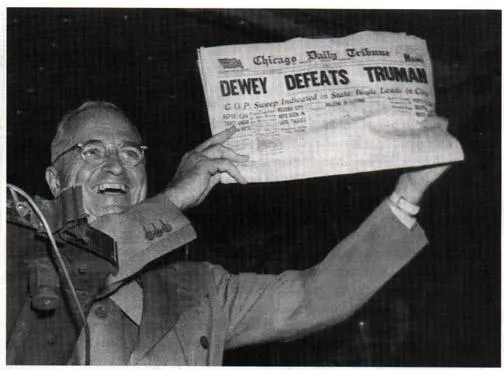 How to cover an election in 2008:
- Mark Glaser: Iowa Caucuses Blanketed by Twitter, Blogs, Video
- Mark ‘Rizzn’ Hopkins: Huckabama Wins, a Few Observations
- Instapundit: Like Twitter, but longer (sometimes).
One more blog entry and you’ll get a technical!
We need referees in the press box.
According to the New York Times in a Dec. 20 story that I missed:
The NCAA issued new rules this week that will allow credentialed press to blog live NCAA championship sporting events. The rules, however, limit the number of times reporters can post live blogs depending on the sport they cover.
Incentivising is a very bad word, but maybe a good idea
Some more thoughts on how to compensate online content creators.
Yoni Greenbaum says extend a performance bonus plan beyond writers to online producers and editors, too! (Bring it on!)
Scott Karp says pay for performance plans might spur traffic, but they may or may not improve quality becuase the Internet “turns a blind eye to quality.” (Quality? Just kidding.)
Mathew Ingram says on balance incentivizing writers “in the long run it is likely to make them more intimately involved in their blogs, and more interested in developing a relationship with their readers, and that’s a good thing.”( Like in taking more ownership of their worK?)
Dan Blank says to find sustainable online success, we must stop calling people bloggers - and work to create more journalists… who just happen to write for blogs. (How true.)
I have some other blog postings here on the pay issue, including one that has a link to the full Nick Denton new-pay-plan memo (a must read for this subject). And there is more react at this search results link.
While people can certainly pick at Nick Denton’s plan, mainstream media hoping to make their way fully into digital need to look at whether their compensation systems reflect their old business or their new.
Readership incentives
 Details have emerged on Valleywag about a new writer compensation plan for those at Nick Denton’s Gawker media empire, which includes the highly read Silicon Valley gossip blog. It’s very close to what online journalist Lucas Grindley proposed as the ideal (see an updated comment he made on his blog).
Valleywag also posted a “short version” of the new plan:
From now on, you will be paid a set monthly fee. You will be expected to contribute a set number of posts in exchange. On top of that, you will be eligible for a bonus based on the number of pageviews your posts receive each month, even if the story is months or years old. Each site will be assigned a pageview rate. At the end of the month, if the money you earn in pageviews exceeds your monthly base pay, you will be paid the extra money as a bonus.
This chart should make it clearer. If your site has a PV rate of $5:
$2,000 = 400,000 views:
$5,000 = 1m views:
$7,000 = 1.4m viewsBased on this example, if your base pay is $2,000 per month then you would need to get upwards of 400,000 pageviews to begin earning bonus. A total of 500,000 views would earn $500 bonus (or $2,500 total pay). Four sites are already using the new bonus system (Gawker, Wonkette, Gizmodo and Defamer). One guest editor on Wonkette landed a huge exclusive and walked away with an extra $3k in his paycheck.
Pay ‘em what they’re worth?
Continuing a theme from a Sunday post, here’s some more views on how journalists might be compensated in a digital world where every click is a metric:
Patrick Beeson: “I’m not sure dangling CPM as a sole means for earning a paycheck would be appropriate at this point however. Though it would be interesting to use it as a metric for bonuses or raises.” (See comments from Mindy McAdams, Ryan Berg …)
Lucas Grindley: “But I have long supported a bonus structure based on the number of page views generated by a reporter’s or columnist’s stories. … A page view bonus structure favors neither quantity or quality more. Sometimes cranking out posts creates the most page views, and sometimes writing one really good post can do the same.” (See comments: Mark Evans, Tish Grier, Jeremy Wright …)
Yoni Greenbaum sees some value in at least enlightening writers about what is read: “I think it’s important for desk editors and reporters to understand the habits of their online readers. Desk editors should know what stories play best online; this is not to say that you don’t report some stories, but editors should understand of what plays best and where.”
Katie Allison Granju: “We online scribes live or die by our ad impressions.”
Your writing’s pretty good; how’s your CPM?
Career columnist Penelope Trunk blogs her firing from Yahoo!.
There’s a tremendous outpouring in the comments as well as some catty ones there and on Valleywag..
She says she was fired because her column commanded low advertising rates. So reporters and writers out there: How’s your CPM doing?
Print media writers look askance at how ratings affect TV news, but in the digital economy, they face the prospect of eventually being tied to their advertising generating power, the almighty CPM, or advertising cost per thousand impressions.
I’ve done some rough calculating on my newspaper’s Web site and I don’t see any writers generating their salary in ad revenues from online. I think others are making similar calculations. On the other side, the same forces are seeing sports cherry-picked from newspapers for six figure salaries by ESPN.
Penelope Trunk; she’ll do fine. For hundreds of other journalists, the value placed on their work will be a bleak reality.
(One of my favorite blog posts by her is about the origin of her name, a “brand me” classic. Her Wikipedia entry, however, is over the top caustic, describing her as an “American idiot,” at least at the time of this writing.)
(via Sparkwood and 21)
More on MTV’s citizen journalist for Tennessee
 An update on Dustin Ogdin and the MTV Street Team ‘08 that I blogged about on Sunday. Ogdin has been selected the Tennessee citizen journalist for the MTV Street Team ‘08. More details are here. I noticed he was a native of Knoxville and I emailed him about that and the project.
He replied:
Thank you for taking an interest in the MTV Choose or Lose project. I was, indeed, born in Knoxville but grew up in a suburb of Nashville from age 7. …
I checked out your blog and see you work at the Sentinel. The Sentinel has a special place in my heart. My grandfather, Seaton Warters, who just passed away this fall was a printer for the Sentinel for over 30 years. He started in the late 40’s or early 50’s working with lead type-setting and was there long enough to see the process move into the digital age. I was lucky enough to film some interviews with him this summer and he talked a good deal about his years at the paper.
You asked what I hope to accomplish with the MTV Street team. My goal is to cover the issues that matter to young Tennesseans, especially young people of voting age. I am particularly interested in covering those issues that are currently not receiving much attention within the ‘08 Election Coverage. As a result, the first thing on my agenda is to hit the streets and hit message boards and ask young people what’s on their mind and what matters to them. I hope to be a conduit for their interests, because that’s the purpose of this project - generating youth participation in the electoral and political process.
My larger hope is that this project as whole, including the work being done in all 50 states, can play some small part in encouraging young people to vote and become involved in electoral politics and political issues in general. We’ve already seen the affect that YouTube, MySpace, Facebook, and other other citizen-based media have had on electioneering and election coverage, and this media is very much in its infancy. Certainly in my lifetime, never has the media been more democratized than it is today thanks to digital technology. I appreciate that MTV and the Knight Foundation have recognized that potential, and I’m excited to find out what we can do together during the next eleven months. It’s an experiment for everyone involved.
MTV connecting to the electorate
A Knoxville native is the Tennessee citizen journalist on MTV’s Street Team ‘08, which was announced last week.
The Street Team is made up of 51 citizen reporters who will follow the 2008 election with weekly multimedia reports optimized for mobile devices. See a story with the full list.
The reports will be distributed on MTV’s mobile site, its social site think.mtv.com and the Associated Press’ Online Video Network, which includes knoxnews.com.
The Tennessee reporter is Nashville-based Dustin Ogdin, a documentary filmmaker, whose latest project is “Shielded Brutality.” He also did a short this year on the “living wage” controversy at Vanderbilt University.
He says on his think.mtv.com page:
I joined Think because I’m truly excited about the possibilities for online grassroots activism and journalism. Digital technology has leveled the playing field between big, homogenized corporate-controlled media and engaged, concerned individuals with a point of view. Never has there been a more exciting time for people looking to affect change and become involved in media, activism, or politics.
Covering traffic with Twitter
An interesting Twitter idea from Kurt Greenbaum and the St. Louis Post-Dispatch.
And (just for Paul Bradshaw) that’s not Twitter shovelware.
Needed: A newsroom of reporters who can break news
The New Media is beginning to look a lot like the Old Media, even down to the need for ink-stained wretches.
“It’s no longer enough to take stories from The New York Times, and add a dash of snark. Gawker needs to break and develop more stories.”
Talk it up
Katie Allison Granju and WBIR are up to something new.
From the About Us:
KnoxvilleTalks.com offers lively and opinionated conversation for East Tennessee’s lively and opinionated blogging community. Hosted by WBIR, KnoxvilleTalks is managed and edited by WBIR.com Online Producer and newsroom blogger Katie Allison Granju. E-mail Katie at kgranju@wbir.gannett.com with your comments and suggestions. Direct your technical and geeky-type questions to our webmaster, Jeff Webb at webmaster@wbir.com
A new Frontdoor to the HGTV house
Scripps Networks’ new Frontdoor is getting quite a bit of attention. The News Sentinel’s Carly Harrington did a piece.
We want to give people the insight about what it’s like to live in a community before they move there. We think we have a unique idea and hope to give someone a sense of what it’s like to live on a street.
Someone’s choking on buttered popcorn
Knoxville native Philip John Clapp, aka Johnny Knoxville, has a new movie that is a ground breaking (and potentially game changing) experiment by a movie studio to bypass theater release and go straight to the Web.
The third “Jackass” movie, Jackass 2.5, will be available online first. Here are the key dates:
- Dec. 19: A week of downloads exclusively through Blockbuster.
- Dec. 26: The DVD, and downloads-to-own from movielink.com, iTunes, Amazon.com, others on Dec 26, with exclusive DVD rental distribution through Blockbuster.
- Jan 1: Download-to-rent release on movielink.
Is convergence dead?
Convergence, as in media convergence, is one of those buzzwords that’s actually hung around longer as a working concept than many in the media industry. Remember synergy. Rarely spoken as a business buzzword these days even if it still sound good in theory..
Newsrooms are “converged” and advertising sales are “bundled.” Newsroom managers manage traditional and digital priorities. Reporters report for the Web and the traditional platform. Ad pricing is linked and account executives are expected to be product experts on a dizzying number of off-line and online products.
Does it work? Media consultant Gordon Borrell says:
**
**
What the world needs now ….
 Sports TV personality Stephen A. Smith on a blogger-free world:
“And when you look at the internet business, what’s dangerous about it is that people who are clearly unqualified get to disseminate their piece to the masses. I respect the journalism industry, and the fact of the matter is …someone with no training should not be allowed to have any kind of format whatsoever to disseminate to the masses to the level which they can. They are not trained. Not experts.”
“Therefore, there’s a total disregard, a level of wrecklessness that ends up being a domino effect. And the people who suffer are the common viewers out there and, more importantly, those in the industry who haven’t been fortunate to get a radio or television deal and only rely on the written word. And now they’ve been sabotaged. Not because of me. Or like me. But because of the industry or the world has allowed the average joe to resemble a professional without any credentials whatsoever.”
Things just got a whole lot smarter
Hey, you gotta try this; it’s powerful.
Dave Mastio, who’s behind the software engine that powers the Knoxville Blog Network, has unleashed a new tool on his main BNN site and the Knoxville Blog Network called Feed Central.
He said in an email:
In short, you can pick any section of BNN (or the Knoxville Blog Network), then slice and dice it by blog, by category, by key words, then sort the new feeds by popularity (most linked, most clicked, most commented) and then have it delivered to your cell phone, your RSS reader, your email (hourly update or daily summary) your blackberry or a custom widget on your web page.
The element of this that I am most proud of is our partnership with BuzMob.com. Working together, we’re making blogs available in a way they never have been before and hopefully expanding the reach of blogs and the blogosphere another important step. It is exactly this sort of thing that I had in mind when I founded BNN. By combining smart, human-edited aggregation with cutting edge technology we can make the blogosphere more useful to more people at the same time we help build readership for the best blogs.
The Constitution can’t join Facebook
First Amendment 1; Facebook 0
Privacy 0; Facebook $100000000000 …
An observation on just between us weasels your’re a weasel and a great set of links from Rex Hammock.
Maybe they just have the model backwards
Is Citizen Journalism and U ser G enerated C ontent simply an overrated fad?
Leah McBride Mensching smugly declares:
The fad journalism model is being brought down by poorly written and poorly presented content that is greatly inferior to content produced by experts, they say. To put it bluntly, if you need information on a subject, would you rather rely on the edited and proofread opinion of an expert, or the misspelled musings from some guy sitting in his basement?
Waiting for the tide
 This picture of increased time spent on the Internet and this picture of time spent on news Web sites are not what we call the picture of the rising tide lifts all.
It’s more like why is the sand castle washing away.
New toys for Propeller heads
 I gave up on Netscape when it morphed into Propeller, but Muhammad Saleen’s sneak peek and review has me considering going back:
wow. it took me a while to calm down before i could start writing anything. i got a chance to look at the new site design (not live, only internal) for propeller, and i have to say, it [expletive] rocks! the design will not only be much much better than the current site design, but it is safe to say that it will be better than all other social sites out there right now.
Not sure of his aims, but he’s on target with SEO
Bryon Chesney notes this week’s red light shooter story hit the mark on Google.
SEO = geekspeak for Search Engine Optimization, or how to get links to appear at the top of search results without paying for them. For the more adventurous.
This just in
Some thoughts on breaking news.
Matt Drudge tells Britain’s Sky News the secret to a good news Website is “keep it jumping” and media writer Steve Outing says when it comes to breaking news, “holding on to it for even a short while means you’ll likely be beaten by eyewitnesses sharing what they know, and that information spreading virally.”
Outing suggests Twitter could be one platform for breaking news and got some cool pointers from the Twitter folks.
Kevin Anderson in the UK picks up on Outing’s thoughts and has some ideas of his own in “Newspapers can break news again.”
I thought how a Knoxville computer programmer and Twitter Doug McCaughan covered a high school football game Friday night was innovative:
Game over. Field stormed. Final score bearden 28. Farragut 14. Well played by both teams! 09:14 PM November 23, 2007 from txt
Bearden runs half the field for a touchdown! Bearden 28. Farragut 14. Field about to be stormed by the students. 09:08 PM November 23, 2007 from txt
Farragut punts. Bearden has possession at farragut 35 with 2:41 left in the 4th. 09:05 PM November 23, 2007 from txt
Farragut qb number 10 okay to walk off field 09:03 PM November 23, 2007 from txt
Farragut making wild passes. Farragut quarter back injured. 09:01 PM November 23, 2007 from txt
Score bearden 21. Farragut 14. 08:59 PM November 23, 2007 from txt
Bearden leads 21 to 14 08:57 PM November 23, 2007 from txt
Bearden on the 7 yard line with 4 minutes left in the 4th. Touchdown! 08:57 PM November 23, 2007 from txt
Bearden making short runs to bring the clock down. In field goal range. 08:54 PM November 23, 2007 from txt
Bearden defense giving farragut running game a hard way to go. Farragut passing game strong. Bearden now has possession at farragut 26. 08:47 PM November 23, 2007 from txt
Bearden punts to farragut 34. 1 minute left in the 3rd quarter. 08:41 PM November 23, 2007 from txt
Farragut attempts a field goal and misses 08:35 PM November 23, 2007 from txt
Farragut intercepts. Has ball on bearden 24. Its cold out here! 08:32 PM November 23, 2007 from txt
Farragut touchdown 08:26 PM November 23, 2007 from txt
Bearden leading 14 to 7 with 10 minutes left in the 3rd quarter. Another on side kick leaves farragut with possession at the bearden 43. 08:25 PM November 23, 2007 from txt
Bearden touchdown! 08:22 PM November 23, 2007 from txt
Bearden accidentally did an on side kick while kicking off in the beginning of the 3rd quarter. 08:19 PM November 23, 2007 from txt
4th and 2 field goal attempt by bearden blocked by farragut 07:51 PM November 23, 2007 from txt
Beautiful full moon. Air crisp. Very clear sky. 07:39 PM November 23, 2007 from txt
Bearden vs Farragut tie game in 2nd quarter 7 to 7 07:37 PM November 23, 2007 from txt
For high school football on the day after thanksgiving i have to park a mile from the stadium! 06:41 PM November 23, 2007 from txt
Heading to bhs to watch bearden beat farragut. And freeze. 06:29 PM November 23, 2007 from txt
Ogling boobies on Facebook
Topless babes in ads, OK; breast feeding mom photos, no.
Hmmm ….
Chris Brogan posted Thursday a screen shot of a topless lass in the ad position in the left rail with a WTF commentary of how did that happen.
This, now, from the same folks that in the last few months banned photos of mothers nursing.
Laura Athavale Fitton wonders why more journalists (and regular people, too) aren’t demanding answers:
I find this very egregious, and I am amazed they haven’t been called on it or pressed to respond. I think the general public would be kind of horrified by this. I think the situation is outrageous and Facebook should immediately, and loudly, address it, fix it, and apologize.
Two Knoxville blogs are on a news “Top 100” list
If you could only 100 blogs, which 100 should you read to be most on top of the news? Two Knoxville area blogs make the list: Instapundit.com at No. 1 and SayUncle.com at No. 91 in a Carnegie Mellon research effort called the CASCADES project.
The project studies “Cost-effective Outbreak Detection in Networks” and in the case of news, it’s looking at how news (information) cascades through thousands of blogs on the Internet. The Top 100 list is basically the best places to see news surfacing.
It’s described this way:
If I can read 100 blogs, which should I read to be most up to date? Unit cost (each blog costs 1 unit), optimizing the information captured – population affected (we want to be the first to know about something with many people blogging about the story after us)
Frayed about the throne
Terry Heaton on why “content is not king:”
Given the math, it’s simply impossible to create enough content in a page view model to satisfy budget demands. It is impossible.
Getting face time on Facebook
Inspired by how easy Greg Sterling made it look, I created a simple business presence on Facebook for the Knoxville News Sentinel. Click the link and add it to your “stores.” (Stores has to be another in a long line of inane terms Facebook forces one to use. Also, there was no business type in its options for a news or media business. Geez.) UPDATE: Well, I recreated it as a “brand or product,” but anyway.
As Sterling demonstrates with screen shots, it’s dead simple. Figuring out how to promote it short of a bunch of cajoles and a cache of plastic cash with Facebook ads; not so simple. I couldn’t convince it to take my corporate credit card; Facebook sniffed nose at Old Media Cash.
Charlene Li of Forrester fame makes the business case for being on Facebook and MySpace.
Knoxnews’ online producers have a MySpace page for their RandomThis videos and there is one for our Friday entertainment section, Preview.
Downsizing Old Media is the troop supply train for “An Army of Davids”
 Terri Bennett, a former chief meteorologist at a Charlotte, N.C., TV station is among the latest recruits in the “Army of Davids,” according to New Media consultant Terry Heaton.
Bennett’s contract was not renewed by the TV station where she worked. Out of a job, she launched her own Charlotte weather Web site instead of sitting out her non-compete clause or seeking a TV job in another city.
It’s pretty good. Her video forecast for this weekend includes several see-and-do items and the lack of weather maps and graphics in the background didn’t bother me at all. And it’s got a good start on providing rich local data using Weather Underground data.
Terribennett.com is potentially disruptive to anybody that does weather content in Charlotte.
Heaton says it’s just what Knoxville’s Glenn Reynolds outlines in his book, An Army of Davids
In his newsletter, Heaton frames it this way:
One of the unintended consequences of downsizing is that we’re sending capable people into the world to compete against us on the Web rather than creating new media options for them from which we also benefit. In this sense, traditional media companies may be supplying a two-by-four that’ll one day be smacking them over the head.
The elements of social media
Reality + Identity + Playfulness + Experimentation = Energy (in the proper proportions).
Rob Pongsajapan is germinating an idea and has some thoughts on a practical guide to social media also. Is he onto something?
Size matters
 The problem with newspapers’ online business model might be size matters.
(Interesting FYI: Instapundit.com was No. 3 in knoxnews’s referring domains list for Wednesday mainly on links to a gun blog posting and secondarily on links to the above item. The only two domains that topped it were Google, of course, and Legacy.com, the obituary site.)
(Photo by David Linthicum)
BYOMD
 Bryan Murley recorded a brief audio clip of New Media journalism’s Billy Sunday at a tent revival in DC.
What? Well, it’s really the Washington Post’s Rob Curley at the CMA/ACP National College Media Convention. But there’s not a more passionate evangelist for journalists to get their careers saved by adapting and adopting. And for those that don’t listen, there’s career fire and brimstone awaiting.
Give it a listen. The advice holds as true for aspiring journalists as veterans. Better to listen to him than me. After a talk I gave to a group of journalists, one blogged that I was “such a bore.”
BYOMD = Bring Your Own Mountain Dew.
Previous Rob Curley posts on this site.
(Bryan Murley photo)
If you can’t measure audience, measure results
On the widely varying results of Web audience measurement:
“One of them can be right, or the other one is right, but they can’t all be right,” said Jack Wakshlag, chief research officer at Turner Broadcasting System. “It’s interesting that people keep talking about it as much more accountable than other media, but we’re not finding that to be the case yet because there’s no agreement on metrics or accounting methods.”
B movies be free
A local business blog has has some insights to an interesting new Web venture in KnoxVegas, bmovies.com from DMGX.
It launched Oct. 5 without advertising or SEM, but is attracting viewers rapidly.
Wade Austin of DMGX says:
The business plan is based on 2 core premises: 1. People will watch anything for free, and 2. Off the radar movies can be broadcasted for next to nothing.
Care to comment?
There’s been an on-and-off again debate about reader comments, how to manage them, whether real names should be required, should there be moderation and more. Comments have been generally supported as allowing reader interactivity or participation and (buzzwords of buzzwords) increasing engagement.
The New York Times is even promoting them at times to the front page of the Web site.
But are they generally bad for business?
Plugged in and Twittering
Good live Twitter stream today (10/10/07) from the Networked Journalism Summit by Ryan Sholin. Follow it.
Five smart strategies
I found this a striking finding in a new survey. I wonder if it’s the clunky hardware/technology of mobile telephony or it’s just lifestyle:
Mobile multimedia usage was the one area that lacked strong penetration–even with connected consumers–as the majority (64%) said they never used their mobile phone to “check weather, news or sports headlines.” Similarly, 76% never used mobile to watch video, 68% said the same for listening to music, and 58% had never used their phone to check email. Some 53% of connected consumers, however, had used their phones to take photos and then share them on the Web.
Better by the dozen
A dozen actions journalists can take to save journalism
The Parliament of Clocks can’t keep time
A piece of by Edward B. Driscoll Jr. about how bloggers expanded the news agenda is getting a good bit of attention in, well, naturally, the blogosphere.
He traces the rise corporate of mass media, pointing to the 1970s as the zenith for the Mass Media Age, a time when the three networks and a handful of newspapers controlled the national news agenda. Driscoll said that monolith first cracked during the Reagan presidency with the repeal of radio’s Fairness Doctrine and the rise of AM talk radio. It accelerated as bloggers came on the scene and had their defining moment as news sources in 9/11.
Ironically, perhaps, there were more owners of U.S. daily newspapers and radio stations in the media monolithic ’70s than today. Even as media has become more fragmented, ownership of traditional media has become more concentrated.
Basked in the sepia tone of liberal media vs. right-wing, individualistic bloggers, Driscoll succinctly de-constructs the disruption of the media industry today where:
Because Internet bandwidth is so cheap when compared with the enormous capital investments required to own a newspaper or television station, it’s possible for a blogger to experiment radically with new technologies as they come along, including burgeoning multimedia formats. It’s the advantage that the flea has over the elephant: Though the elephant may be mighty, he’s awfully slow. As Alvin Toffler once told me, “The flea is fast. The flea is fleet. . .that’s the paradox: The more power you have, the less free you are to exercise it.”
If you can trust me …
Bloggers are more trustworthy than the media, but even that’s not saying much.
Pssst, the game has changed
Journalism icon Seymour Hersh on online journalism:
JJ: New York magazine has a profile this week of Matt Drudge of the Drudge Report, and they call him “America’s Most Influential Journalist.” What have bloggers like Drudge done to journalism, and how do you think it compares to the muckrakers that you came of age with?
SH: There is an enormous change taking place in this country in journalism. And it is online. We are eventually — and I hate to tell this to The New York Times or the Washington Post — we are going to have online newspapers, and they are going to be spectacular. And they are really going to cut into daily journalism.
I’ve been working for The New Yorker recently since ’93. In the beginning, not that long ago, when I had a big story you made a good effort to get the Associated Press and UPI and The New York Times to write little stories about what you are writing about. Couldn’t care less now. It doesn’t matter, because I’ll write a story, and The New Yorker will get hundreds of thousands, if not many more, of hits in the next day. Once it’s online, we just get flooded.
So, we have a vibrant, new way of communicating in America. We haven’t come to terms with it. I don’t think much of a lot of the stuff that is out there. But there are a lot of people doing very, very good stuff..
Could you reboot my table?
Miss, could you reboot my table?
Melissa Worden notes tabletop surfing is becoming a reality. Tully’s Coffee in San Francisco is installing tables with touch screen PCs to allow patrons free access to the hometown newspaper’s Web site, SFGate.com, as they nurse their java.
The tabletop PCs are made by TableTouch. The company calls it their “News Table.” And it has a tease on the Web site: “Please check back September, 25th after 3pm PST to see what’s in store for the future”.
Worden does note that it could put a damper on table talk if all you can get is one pre-defined Web site. And while the Tully’s pilot involves the San Francisco Chronicle, I can imagine some ingenious marketing types limiting the display to a high-flak restaurant Web site or “special” advertising site.. (sigh)
The TableTouch systems run Windows XP boxes The tables are 30 inches tall with a 30-inch round tabletop and weigh 40 pounds. The viewing area of the screen is roughly 12 x 9 inches.
Socialite
Ning.com will pass 100,000 social network sites created by users this weekend, according to TechCrunch. It had a mere 30,000 in February.
The return of Cauthorn
Bob Cauthorn returns comes down the mountain and out of the lab and Robert Niles has the story. Good read from one of the most perceptive thinkers in online journalism. Good discussion on what’s local and community.
A checklist for “Don’t tase me, bro!” news
The Andrew Meyer episode at the University of Florida has the social news phenomenon down to a checklist. It’s worth studying.
Free sex
Now, I’ve hooked you.
The disruption of traditional media even includes porn. The commercial porn industry is being hurt by a combination of “piracy” and amateur video uploads, says George Simpson in a MediaPost column. DVD sales and rentals are down 15 to 25 percent. Sound familiar?
The industry apparently will fight back by touting quality (“We use good-quality lighting and very good sound.”)
(via Terry Heaton, who I think is right in thinking this probably has implications for mainstream video producers as well)
We did two-a-days in July (on average)
The Sept. 12 comScore release on online video in July contains some remarkable numbers:
GoVolsXtra is a finalist in ONA’s awards
GoVolsXtra, one of the sites that keep me busy, has been named a finalist in the Online Journalism Awards in the specialty journalism category for smaller sites. The awards were announced this morning by the Online News Association and the USC Annenberg School for Communication
Small news to have big impact
As a person running a blog on MT this sounds cool, a plugin that automatically presents an IPhone/iPod enhanced version of the site to users accessing the site with these Apple devices. What would be cooler would be a newspaper Web site announce it was doing this. Now that would be forward thinking.
Knoxville blog network
Noticed the Knoxville blog network we’ve launched is getting some attention.
Taking the shades off for a Sunshine suit
The News Sentinel’s decision to recruit some bloggers to help cover its Sunshine suit against the County Commissioners is drawing some react.
Editor Jack McElroy outlines the plan in his Sunday column, which was posted on his blog Friday evening. He’s trying to address the thorny issue of covering yourself in a new way, sort of crowd-sourcing a story in which the newspaper is a player. He said:
To provide independent scrutiny of our coverage, however, we also put out a request among local bloggers for volunteers to monitor our reports. Three bloggers stepped forward. Happily, they span the political spectrum.
On occasion, we may also publish excerpts from these blogs in the print edition
Discerning patterns in uncertainty

Covering Boomsday
Boomsday to those that don’t live here is one of the biggest events in Knoxville. People love it. It’s always Labor Day weekend. This year it was Sunday night.
Yeah, it was covered by the mainstream media, but how did people (I refuse to use the silly phrase citizen journalists) just creating and sharing their experiences cover it?
I found more than a few examples – and it’s good coverage.
Here’s a YouTube video:
;
(Posted by guitaralot920)
There are a globs of Boomsday videos on YouTube.
 And they shot photos like this one on the right from bparton92. And, again, I found LOTS more Boomsday photos at flckr.
Of course, there were bloggers.
Among them were:
Eimers Family News and Photos: Boomsday in Knoxville!
The Mule: Boomsday - The Biggest Fireworks Display in the USA!
And since Google seems to index Twitter, I even found a few people that had covered it live on Twitter.com in what some call microblogging.
rlb865
Home from Boomsday. Worn out and going to bed since I have to work tomorrow. It was lots of fun though! 11:38 PM September 02, 2007 from web
Still at Boomsday. No fireworks yet…. 08:15 PM September 02, 2007 from txt
Sitting at Boomsday with Michael and his family. 06:13 PM September 02, 2007 from txt
Google for news
Lots of people chiming in on Google’s use today of full-text Associated Press stories instead of linking to AP member Web sites.
Find sex offenders around your neighborhood
A lot of the “mashups” (a web application combing data from more than one source) I see only cover San Francisco or California or maybe just a few major metro areas, but here’s one that includes data on Knoxville – and it’s useful too.
Vision 20/20 has created a nationwide sexual offender database/map mashup.
Go to the map search and enter Knoxville for city and TN for state. You might be surprised.
The company, which says it is committed to “Peace of Mind” products, frames this one around:
There are 650,000 registered sex offenders in America - and that number grows by about 25,000 every year. Wouldn’t you like to know if any of them are living in your neighborhood?
This is strange enough to make Fark’s top page

Somehow I totally missed this Tennessee tale.
Resizing photos based on the content!
Content-aware image resizing is an amazing technloogy. Watch thevideo to get an idea of how it works. I wonder how far it is from being adopted? Course, it brings up ethical issues. As the examples show, people or objects can just disappear from the resized photo.
Openings amongst the downsizing
The stock market is generally believed to be a leading indicator of future economic performance in a Wisdom of Crowds
Jay Rosen has a list of …
The real problem with bloggers.
No credit for credit
My oh my, co-worker Michael Silence has stirred up a debate about attribution in blogs with “all the news that’s fit to print.”
Spatial Serendipity
One idea here (and there are several) that I liked a lot is that of a local social media package that would give you the tools to be plugged into a city, scene, location. Here’ s the concept that Chris Brogan outlines in his blog post:
Repeat after me …
But get this straight: Just because a site has 100 million users, that doesn’t mean 100 million people see your ad. It’s not TV. Repeat: It’s not TV. The only people who will see your ad are the ones who see the page on which it appears. If you buy 10,000 impressions, aka eyeballs, you can buy them on a big site or a bunch of small sites, it doesn’t matter. Big brings no advantage other than convenience and it also brings some disadvantages like inefficiency and price. This is the essence of the change in the economic model of media. Post that on your wall and stare at it.
Trend alert
A look around the curve to find Traffic Happens Elsewhere
Bigger than Web 2.0, but you can ride, Steve Rubel says, by:
**
1)Thinking web services, not websites
2) **Connect people.
3) **Make everything portable. **
It’s about taking advantage of distribution to get to the audience’s door rather than putting up neon signs and tossing dollars so the world can beat a path to your door.
Woo hoo!
Commenting on Google comments
A handy reader on the weekend L.A. Times piece on Google comments:
- Tony Hung: LA Times: “… Its Bigger Than Jesus, Worse Than Bin Laden!”
- Ethan Kaplan: Newspapers are Committing Recursive Suicide
- John Battelle: Newspapers: Stages of Google Grief
- Danny Sanchez: L.A. Times editorial board decries Google News comments
- Mathew Ingram: Newspapers ignore Google at their peril
- Dave Winer: Journalism is the new Catholic Church
- Scott Karp: Journalism Is Now A Continuous Dynamic Process, Not A Static Product
- Robert Niles: The L.A. Times tells its readers: ‘Shut up’
- Jeff Jarvis: Just Kidding?
- Mike Keliher: LA Times misses the point on Google News commenting
- Brad Linder: LA Times: Google News isn’t journalism
- Donna Bogatin: Google News is a Joke: LA Times is NOT Laughing
Telegraph gets ‘Dear John’ letter
Note to self: This won’t work. Tags: Facebook
Building bridges before a disaster
Is Twitter the future of breaking news? A post by David Erickson has a fantastic collection of how people (as opposed to the nada phrase “Citizen Journalist”) covered the Minneapolis bridge collapse. Be sure to browse that. Erickson is an Internet marketing and PR guy in Minneapolis. He first got wind of the collapse via a Twitter post from an area blogger. After observing how people and big media in town covered the news, he has several observations. Among them:
The book just takes up space for me
In early 2006, according to Greg Sterling, the Kelsey Group found print Yellow Pages were the “first choice” for local business information. Fast forward a mere year and a half, and a new study from TMP Directional Marketing finds 60 percent of consumers use the Internet as their primary information source for yellow page type information. Sterling says:
Blogging mags like mad
| Brittney Gilbert’s new gig and Brittney on the new gig. Tags: web apps | magazine blogs |
Comments on comments
| Tony Hung notes the new comment feature of Google News and declaires Google News To Change Online News As We Know It. Here’s Why. Eric Berlin is intrigued and Steve Rubel says it’s sure to be controversial Here’s the Google version. Tags: Goggle | Google news comments |
Everybody’s just skewed
Scale accordingly
Here’s a math equation traditional media folks are going to get some schoolin’ in.
I’ll take a long neck
The “long neck” concept is a new one on me.
The sad state of stats
| Go get ‘em IAB. I always find that statistics are hard to swallow and impossible to digest. The only one I can ever remember is that if all the people who go to sleep in church were laid end to end they would be a lot more comfortable. ~ Mrs. Robert A. Taft Actually, Mark Glaser has an insightful look at some of the issues with web analytics I’m looking forward to the second part. It is ironic that the most measurable media ever created has such a hard time figuring out how to measure anything – accurately. Tags: web stats | web analytics |
Multiple Views
 Knoxville’s Randy Neal has spun up a new site, BlountViews.com, (named for the county, not the blogging … or maybe both). Its mission is to be a hyper-local community web space for liberal/progressive citizens of Blount County to meet, organize, and discuss news, politics, events, and issues of interest to the community. It’s cut from the same Drupal-powered mold as his vibrant KnoxViews.com. Best of luck with the new site! Tags: hyperlocal Knoxville’s Randy Neal has spun up a new site, BlountViews.com, (named for the county, not the blogging … or maybe both). Its mission is to be a hyper-local community web space for liberal/progressive citizens of Blount County to meet, organize, and discuss news, politics, events, and issues of interest to the community. It’s cut from the same Drupal-powered mold as his vibrant KnoxViews.com. Best of luck with the new site! Tags: hyperlocal |
blogging | Blount County Tennessee |
Just networkin’
Look out kid It’s somethin’ you did God knows when But you’re doin’ it again -- “Subterranean Homesick Blues” by Bob Dylan Jeff Pulver says he’s abandoning LinkedIn for Facebook to focus all his “professional business social networking contacts” while Chris Brogan says in Lee Corso fashion, “wait, just a minute there,” LinkedIn still does some things Facebook doesn’t but just needs some help. Steve Rubel says Facebook is a fad like well, LinkedIn and Friendster and Flickr and YouTube and iTunes and iPhone. Watch what people do with the technology, not the technology itself, he says. Among 10 things Susan Mernit says we’ve learned from Facebook is:
When news isn’t bottled in an article
| In a review of MaineToday.com’s refreshing redesign, Howard Owens have some good observations on news site design in general, particularly link bloat and internal politics that bewilder more than bemuse. One area he didn’t delve into is one we’re struggling with a bit in our redesign (which we like overall). How do you get front-and-center attention for non-article content like blogs and videos? We have a great design if blogs and video are supplemental to text stories, but it’s a bit tougher to give them equal footing – even with links to both types of content on the front albeit below the fold. We’re still experimenting with the best solution for us and I’m sure we’ll hit upon something that works. Most content management systems I’ve seen have the article at the center of their universe and you end up working around that. Not even newspapers sites, however, need to be article-centric! How are others tweaking article-centric designs to emphasize other types of content? Tags: web design | newspapers | online media |
Chasing youth
Mark Potts is getting a lot of links today on his look back over the Backfence, but another jewel was his post last week on newspaper youth products, Dog Bites Man; Kids Don’t Care. In the not-to-do category, he says:
A broadcast imbroglio
The NashvilleisTalking/WKRN imbroglio has caught my attention again. Lost Remote points to a Cable & Broadcasting piece that says the upheaval at WKRN may be a symptom of a rift between old and new media that has led to the departures of Interactive Media heavyweights Wes Jackson at Belo, Ric Harris at NBC Universal and Eric Grilly at MediaNews Group. I don’t have the inside skinny on any of those, but Gordon Borrell, the respected Internet/Media consultant, is quoted:
The audience loves its brands
| More evidence that brand matters on the Internet – maybe more so than in the non-digital realm. Participants in this study ranked the performance of brand name search engines Yahoo! and Google higher than the not-really-a-brand-MSN Live and an unbranded search engine. All, however, returned the same results. Interestingly, Yahoo! ranked highest, even through many in the study group used Google regularly. I wonder if that has to do with Yahoo!’s traditionally heavier advertising and marketing. Yahoo! has done quite a bit of branding advertising; I can’t recall any from Google, although it’d be hard to find an internet user that doesn’t “google.” Whatever factors influence the choice of Yahoo! over Google, the implication of the study is nurturing a trusted, positive brand image online is money and time well-spent. Positive brand identification = Loyal Audience. Audience = $$$. I’ve seen some research – and I’d like to know more – that TV station Web sites have higher credibility ratings than newspaper Web sites. Obviously brand “feelings” are at work at some level. What I don’t know is what factors are influencing the perception. Tags: marketing | branding | online media |
Shoutouts far and wide
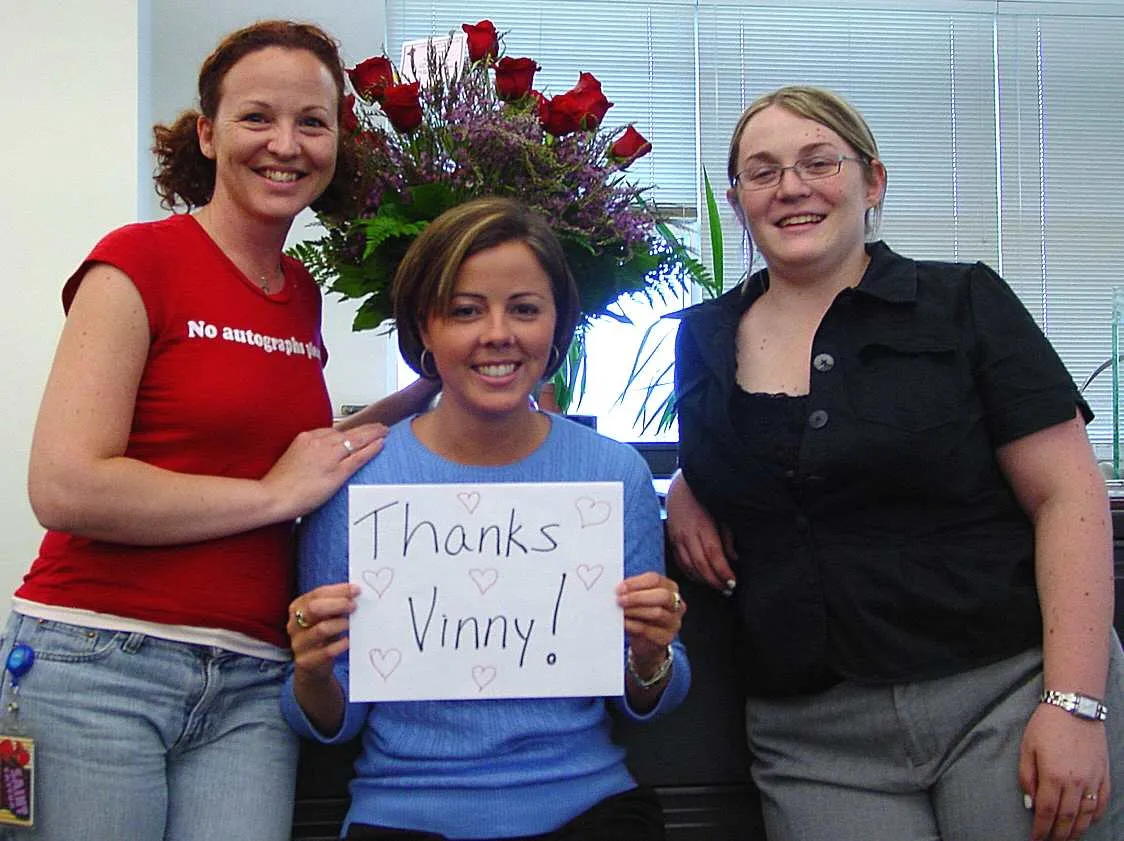

—
A few more reacts to the relaunch of knoxnews/govolsxtra last Thursday. I noted some here last week. Bryan Murley, one of the forces behind Innovation in College Media, did a post Monday on the decision to make the formerly paid-subscription site GoVolsXtra a free site. Murley says of GVX:
Reading the long version
The long version is back? Or blog-style is just the coming thing for all Web sites? Tags: web design
The evolution of knoxnews
We’ve launched a new knoxnews.com today. I thought some folks might like to see the last three designs of knoxnews (sorry, not sure if I have one from further back, unfortunately). The first was used for three or four years and was “retired” in April 2005. We thought it was very tired by then. The second one is the original successor look, but I noticed in looking at the home page yesterday, we had made more “adjustmenets” by the end of its run than I had thought. The one on the right is an early morning shot of the new, current design. You can click on each image to get a larger view. Update: Jay Small explains many of thenuances. 
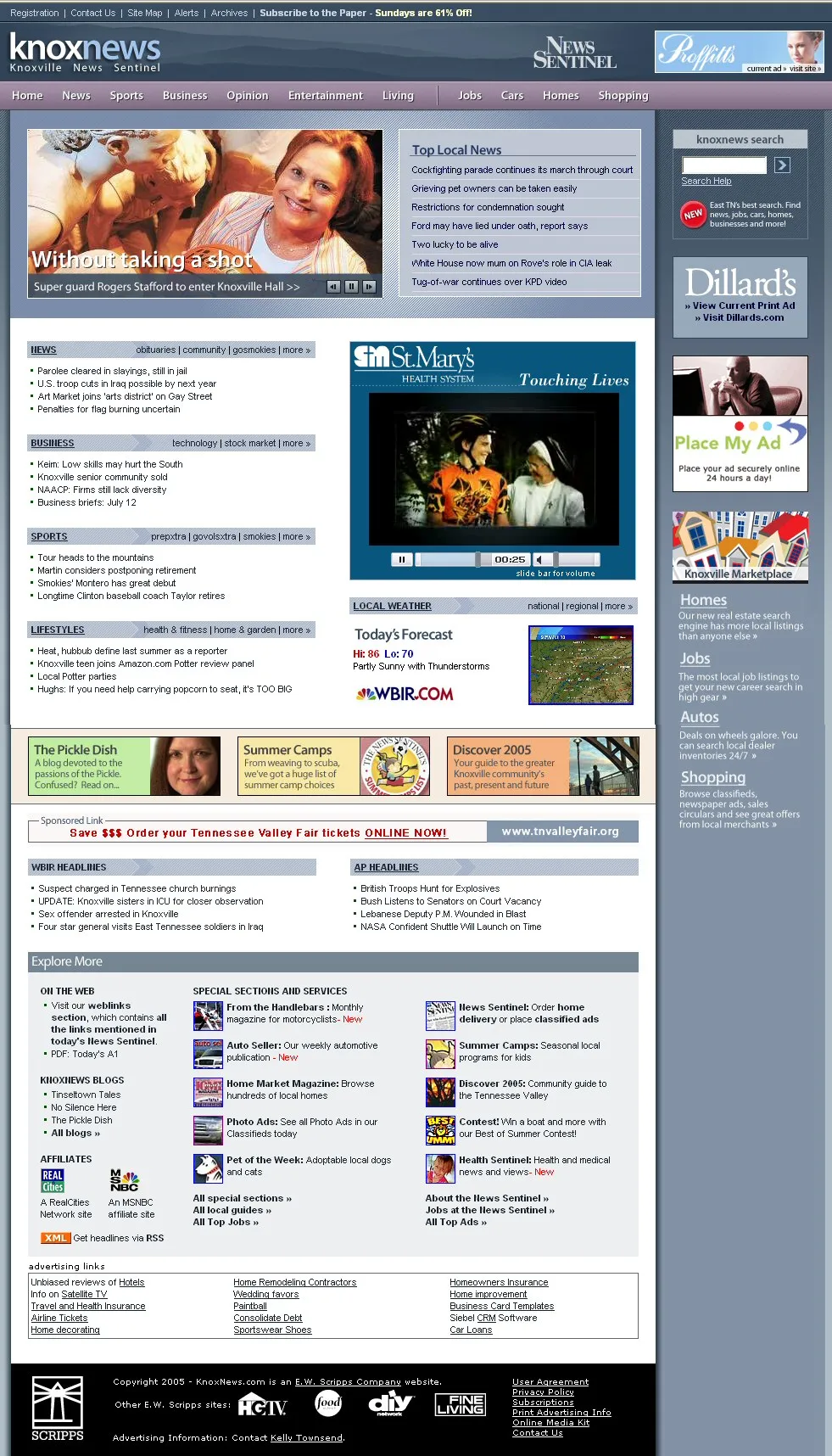
Knoxville News Sentinel | knoxnews | newspapers
Sullivan sighting
This must rank just behind a Paris sighting among celebrity watchers. While the paparazzi didn’t get his photo, journalism professor and blogger Bryan Murley cornered Will Sullivan of exclusive Palm Beach for an online interview. Sullivan on blogging:
Teens make better readers for newspapers
What, you say. Well, hang with me here. I spaced this post from Mindy McAdams on young people last week, but Melissa Worden drew me back to it with her “good reads” list.
Are we measuring how many read over or rode over the newspaper?
Sometimes the react is better than the first act. Mathew Ingram and Steve Yelvington have good posts on British newspaper consultant John Duncan Webster’s Dictionary of Audience Exaggeration: How internet metrics promote the myth of the dying newspaper. Yelvington has several nuggets, but this one I can’t pass up quoting:
Small tinkering
| Jay Small, fellow Scripps interactive media colleague, said the other day he’s going to start writing and opining more on his site when he gives up being an expert. That’s good news because he always has some expert things to say about online and media. Tags: consultant | small initiatives |
Next, please
An interesting eye track side study by Nora Paul and Laura Ruel looks at what navigation methods users chose when viewing a photo slide show using a Washington Post slide show that used several navigation types. Here’s which ones people chose:
Clearing the haze
Steve Rubel is drawing on a number of sources to come up with a solution to “always on” that allows him to be productive. The underpinning of all the ideas is that we’re dealing with too much information, disruptions, meetings, schedules, RSS feeds, email, blogs, telephone calls, voice mail to accomplish much. He’s rallying to Marc Andreessen’s The Pmarca Guide to Personal Productivity and Tim Ferriss’ ideas in his book “The 4-Hour Work Week
NCAA to blogger: You’re outta here
The NCAA is out of its mind.
Bryan on Ryan
| Bryan Murley interviews Ryan Sholin. Tags: Ryan Sholin | Innovation in College Media |
Legal without the ese
| Some good commonsense advice on the legal issues of having an online site, blogging or not. Bookmark it! Tags: law | copyright | trademarks |
And the winner is …
| Big awards weekend for the the online news staff at knoxnews. Of course, they deserved the recognition they got – and more! Jigsha, Erin, Lauren, Katie and Talid are just an absolutely awesome team. Way to go folks. Rock on. SPJ Green Eyeshade Awards (Presented in Nashville on May 5, 2007) NICHE JOURNALISM First Place: GoVolsXtra – Online and Sports Departments, Knoxville (Tenn.) News Sentinel BEST USE OF MULTIMEDIA Third Place: Sweet 15 - Jigsha Desai, Lauren Spuhler, Kevin Cowan, Joe Howell, Knoxville (Tenn.) News Sentinel Full list of finalists. East Tennessee SPJ Golden Press Awards (Presented in Knoxville on May 4, 2007) SERIES/PACKAGE/PROJECT WRITING Award of Merit: Andrew Eder, Erin Chapin,Knoxville News Sentinel WORK FOR OTHER MEDIA – VISUALS Award of Excellence: Jigsha Desai, Lauren Spuhler, Joe Howell, Knoxville News Sentinel Award of Merit: Jigsha Desai, Lauren Spuhler, Erin Chapin, Katie Kolt, The Knoxville News Sentinel (Swept category) Full list of winners. Tags: Knoxville News Sentinel | SPJ | Green Eyeshade Awards | knoxnews | Society of Professional Journalists |
Digging into all this . . .
The Digg Revolt is fascinating: It’s stage-setting.
Community run amok or Viva La Revolution?
| There are lessons to be learned here. It would be interesting to see an analysis of whether the “mass revolt” involved the small percentage of Digg users that consistently push stories to the front page or a wave of dissatisfaction. I suspect the former although the story spin so far is of a “mass uprising.” Sounds like a successful guerrilla action by the heavily armed influencers. Wonder what Jay Adelson and Kevin Rose would do in an electronic lynching? Oh, what the hell, gimme the rope …. ? Tags: digg | social media |
Collegiate Times
| Wow. Great post about the Collegiate Times at the Va. Tech campus. Their coverage and response has been getting kudos all around. Tags: virginia tech | college newspapers |
Green Eyeshade finalist
| Knoxnews submitted entries are finalist in two online categories in the Society of Professional Journalists’ 57th annual Green Eyeshade Awards. The competition covers 11 southeastern states: Alabama, Arkansas, Florida, Georgia, Kentucky, Louisiana, Mississippi, North Carolina, South Carolina, Tennessee and West Virginia. The winners will be announced May 5 in Nashville. We hope we’re happy! Our entries are up against some excellent journalism: BEST USE OF MULTIMEDIA • A Killer’s Grip – Clarisa Gerlach, Tim Price, Tampa Tribune Staff, WFLA Staff, TBO.com, Tampa, Fla. • Carnival Center – Staff, The Miami Herald • Sweet 15 – Jigsha Desai, Lauren Suhles, Kevin Cowan, Joe Howell, Knoxville (Tenn.) News Sentinel NICHE JOURNALISM • Epic – Randy Johnson, Mark Caskie, Pace Communications • GoVolsXtra – Online and Sports Departments, Knoxville (Tenn.) News Sentinel • Tampa’s Local Music Scene – Ryan Bauer, Tim Price, TBO.com, Tampa, Fla. Here’s the complete list of finalists. Tags: spj | newspapers | niche journalism | multimedia |
Forget televised, the revolution is already on video
Not convinced news video is really big right now instead of sometime from now? If Google buying YouTube wasn’t enough to convince you the audience is there, Andy Plesser has the tipping point in some internal CNN stats:
Newspapers catching the “viral craze du jour”
The Newspaper Association of America’s girl in the know, Beth Lawton, has done a look at newspapers with a presence on Twitter. Just a handful of newspapers are using Twitter, including knoxnews.com. I have a list of the ones I know about. Lawton has a good overview of Twitter, some of the Web applications being built around Twitter, and how it’s being used. Good place to start if you’re trying to figure out this whole Twitter phenom. But don’t expect to understand it without participating in it a bit. Why are newspapers publishing anything called Tweets?
Living on the beta edge
We launched the Associated Press beta video player yesterday on knoxnews.com that adds a “local channel” of video content. We’ve been in the AP video network for a year or more, but the ability to upload our own content into the player is new. Take a look. It’s got a pretty easy to use admin tool, delivers video in both Windows Media and Flash formats, works with at least Internet Explorer and Firefox, and the Windows and OS X operating systems. You can email links and create your own playlist. The Associated Press, working with Microsoft and some other vendors/partners, has some ambitious growth plans for the online video network. We’ll see where it goes. Tags: video | AP | Associated Press
The karmagrrrl
 Zadi Diaz has become one of my favorite vbloggers. When I was doing the viral thing, one of my co-workers said: “She’s no Ze Frank.” Ah, no, she’s not. She’s executive producer and host of JETSET and a lover of chocolate and raspberry (more bio). I don’t think I would ever mistake her for Ze Frank. Yesterday, the 50th episode of Diaz and Steve Woolf’s vblog, JETSET, was posted. JETSET, which Diaz calls a Vloggie, is described as an Internet and pop culture show for young adults (that’s not me, but I like it anyway). The first episode were online on June 1, 2006. And Zadi Diaz is on the verge of being of a big Internet video star. Maybe she already is. In the 50th episode, she gave shoutouts to a whole gang of other video bloggers (she must have just spaced The Randoms). Browse around the site and watch some other episodes. Best of luck to Diaz and Woolf in their WebbyAward nomination. Look likes a slam dunk in their category. Earlier this week, Diaz was at the Radio Television News Directors Association big confab in Vegas and talked about what she’s doing in this video clip. Here’s Lost Remote’s coverage of the same panel she was on. Beyond JETSET, Diaz has a text blog and is on Twitter. Photo on right is from her Flickr stream. And there’s Terry Heaton getting his photo taken with Diaz and Amanda Congden. How’d that happen – and in Vegas? Tags: Zadi Diaz Zadi Diaz has become one of my favorite vbloggers. When I was doing the viral thing, one of my co-workers said: “She’s no Ze Frank.” Ah, no, she’s not. She’s executive producer and host of JETSET and a lover of chocolate and raspberry (more bio). I don’t think I would ever mistake her for Ze Frank. Yesterday, the 50th episode of Diaz and Steve Woolf’s vblog, JETSET, was posted. JETSET, which Diaz calls a Vloggie, is described as an Internet and pop culture show for young adults (that’s not me, but I like it anyway). The first episode were online on June 1, 2006. And Zadi Diaz is on the verge of being of a big Internet video star. Maybe she already is. In the 50th episode, she gave shoutouts to a whole gang of other video bloggers (she must have just spaced The Randoms). Browse around the site and watch some other episodes. Best of luck to Diaz and Woolf in their WebbyAward nomination. Look likes a slam dunk in their category. Earlier this week, Diaz was at the Radio Television News Directors Association big confab in Vegas and talked about what she’s doing in this video clip. Here’s Lost Remote’s coverage of the same panel she was on. Beyond JETSET, Diaz has a text blog and is on Twitter. Photo on right is from her Flickr stream. And there’s Terry Heaton getting his photo taken with Diaz and Amanda Congden. How’d that happen – and in Vegas? Tags: Zadi Diaz |
vblogger | JETSET |
I saw on Facebook (Va. Tech murders)
Following up on this morning post, more great coverage on the coverage of the Va. Tech shooting.
How Blacksburg got covered
Here’s a roundup of interesting coverage – and interesting trends in coverage – of the shootings on the campus of Virginia Tech:
Gotta get the soundtrack
I have to blog this one just so I don’t forget where it is. A conference recap set to Jimi Hendrix doing “All Along the Watch Tower.” Watch it here. But it did remind me … I spent a summer in Seattle (well, Bellevue, actually) in the mid-70s and one weekend we went to Jimi Hendrix’s grave site. Below is a photo from the Internet. 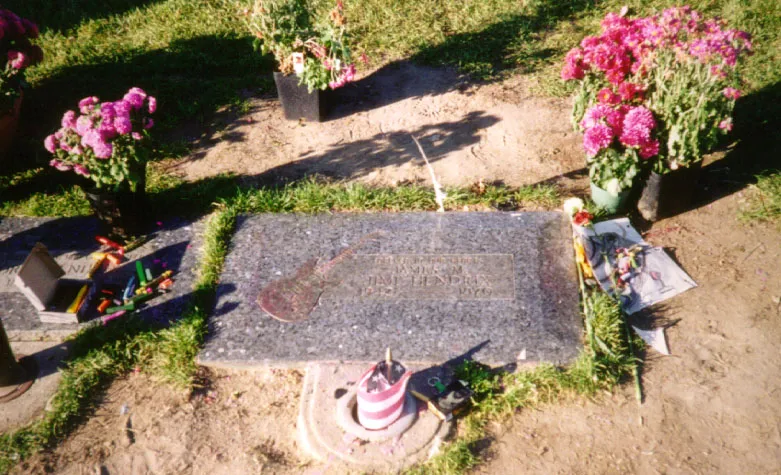 -- Julius Yang photo Tags: CICM -- Julius Yang photo Tags: CICM |
Center for Innovation in College Media | Jimi Hendrix | Ralph Braseth |
Dispatches from digital land
Guy Berger, writing in The Mail & Guardian Online (the first internet-based news publication in Africa), has a great recap of the South by Southwest (SXSW) festival in Texas and the not-so-festive state of the traditional news business. He does a yeomen’s job of weaving all the trends in and says mainstream media still hasn’t grasped:
U.S. newspapers using Twitter
I’ve discovered five six U.S. newspapers providing headlines on Twitter. They are (with links to their Twitter pages):
CICM photos
| Some photos I took last weekend in Nashville at the CICM workshop. Updated: Here aremore on Flickr … just found the Innovaiton in College Media group. Tags: cicm | Center for Innovation in College Media |
Not a 20-something geek
| Quirky maybe, but this guy’s not “a 20-something geek.” Yes, add me as a Twitter friend. Tags: online newspapers | journalism | online news |
What niche next?
| A niche I hadn’t thought of (pirates classifieds), but it looks fun – and a good idea.They’ve aggregated 71,000 ads for Knoxville. Has former newspaper-exec-now-Oodler Lem Lloyd gone the pirate way? Well, anyway, ahoy, Knoxville pirates. (via Greg Sterling) Tags: pirates | oodle | classifieds |
Some light amid the dark clouds
It was great to get a respite from the gloom of the newspaper industry by helping out with the Center for Innovation in College Media workshop over the weekend in Nashville. I got to meet some really bright people:
Tool Up or Take it to the House
| Headed to the Center for Innovation in College Media’s spring workshop (The Future of Journalism: Tool Up or Take it to the House) in Nashville tomorrow. The sessions are Friday and Saturday at the really nice First Amendment Center on the Vanderbilt campus. Jennifer Carroll, vice president of new media content for Gannett, gives the keynote. The center describes itself as “a non-profit think-tank that was created to help college student media adapt and flourish in the new media environment.” Way cool. I can’t think of anything that’s needed more in young people hoping to have careers in journalism than the ability to adapt and to be adept with the varied tools of new media. I hope the folks I talk to come away feeling like they got a lot from the sessions. It sounds like fun. The center has a nice blog as well here. Tags: student journalism | first amendment center | center for innovation in college media |
Heard among the din
Some quotes to think about in the din on the death of newspapering:
Smack down with Craigslist on the Streets of Bakersfield
Howard Owens tells about his personal experiences using Craigslist and the local paper to sell his house. His experience somewhat mirrors what Classified Intelligence found in its January 2007 report on Craigslist and newspapers (via subscription only I believe). During Classified Intelligence’s 18-month study, 12 new Craigslist communities were studied. The bottomline of the study was that newspapers can effectively combat Craigslist – if they aggressively go after the business. Howard Owens’ assessment:
In Twitter, the lead better be short – and forget the rest
A news executive at another newspaper chain asked me the other day what I thought the journalistic application of Twitter is. In my email reply, I gave him the most insightful “I dunno” I could muster. Eric Berlin muses much better than I on that very issue after the question below was posed by “Bloggers Blog” on Twitter (where else?).
Your next assignment …
Having a winning product is all about meeting unmet needs, whether it’s a widget or a Web site – or a newspaper. No unmet needs; no need. We journalists don’t often like to compare what we do to the widget factory … oh, it’s far more important stuff than that. But Dan Pacheco of The Bakersfield Californian takes a stab at looking at the unmet needs journalist need to fill on what he calls a Web Safari through things going on at his newspaper.
News twitters
I’m experimenting with using Twitter to push out breaking news from knoxnews.com. See here. Add knoxnews to your Twitter friends https://twitter.com/knoxnews Anybody else trying something like this, a news channel on Twitter? Tags: mobile marketing, sms advertising, sms marketing, social media marketing, social mobile marketing, texting, twitter, twitter on techmeme, twitter social media, twitter social network
On the other side of the mountains …
| Seth Gitner of Roanoke talks about the “editor ad.” Pay attention to his commitment to trying and failing. “Those failings will take you to your successes.” The clip isn’t really about the process of innovating, it’s about how the project was designed to be viral, but it’s a great thought to keep in mind. From Bryan Murley, who was trying some new things himself. Tags: roanoke.com | innovation |
Thanks for sharing
| CitJ guy Dan Gillmor drew my attention to this Raleigh site. Gillmor thinks it’s smart. I think it’s cool! It’s drupal based. Kudos to all involved. Tags: newspapers | online media | community journalism |
Innovation lies in yonder Mountain Dew
You might not have seen this. Bryan Murley has a new interview with online pioneer and “Hyper-Local Hero” Rob Curley. Bryan Murley is online news adviser and on the faculty of the Mass Communication Department at Emory & Henry College and is the webmaster of the Center for Innovation in College Media. Curley is Curley. As always, he’s dead-on in his thoughts. How to encourage innovation:
Inky-fingered and unbowed
| An inky-fingered print journalist to multimedia contender weighs in. Just discovered a new blog from Ian Reeves called Streaming Blue Murder, subtitled “Old journalism dog. New video tricks.” Looks it’s going to ba a good one! But does “streaming blue murder” mean something? if it does, it flew right over me. Tags: teleivsion | newspapers | online viedeo |
High school hoopla
| This is definitely good news. I’m sure a lot of state high school athletic associations would like to see this happen. And if one state association made it stick, others would follow. At the college level, you alerady have the company town system with the schools making the money – and vigilantly guarding their control. I can see why somebody at the high school level would say we want our own company town. But why would they come up with a rule that depended on whether the photo had been on newsprint? Tags: high school sports | sports photos |
Little Quigo gets noticed
| Way back in May, I wrote about Quigo. Now I see the New York Times is. About time! John Battelle, Greg Sterling and others are noting that Quigo seems to have forced some changes at Google. Interesting … Tags: adsense | quigo | contextual advertising |
No one said culture change was uplifting
| More on newsroom transformation, this one Steve Yelvington, who asks: “When do we become the roadblock?” This one is not a high-level shifting of the trends discussion, but about the often very painful decisions that have to be made while slogging it out in the trenches. Yelvington’s call is for the online leaders to not be roadblocks as change rearranges their world, too Tags: new media | newspapers | culture change |
Are the wires dead meat?
| It wouldn’t be news to say Jeff Jarvis is one of the most interesting people talking – and writing – about media. Last week he proposed a new rule for newspapers: “Cover what you do best. Link to the rest.” it’s a great concept – disruptive as hell. Jarvis didn’t hone in on what this might do to wire services. But if I were AP, I’d be worried. If widely adopted, this makes the reason for having the Associated Press wires move from a “must have” to a “nice to have.” And we all know what happens in budgets to “nice to haves.” But the result could indeed be very good journalism. This is way beyond linking out, which Jarvis observes newspapers are becoming more comfortable with. If aggregating news from other sources was the primary means of getting news from elsewhere, reputation becomes huge. And a site’s usefulness to its users would be even more pivotal than it is today. National news might not be just what’s on the wires. Partial models are there – even with a bunch of flaws – in Digg, Netscape and Reddit, which are more mass media than niche. A story without national interest is unlikely to make the front page of these sites unless it’s been gamed there. This would allow newspapers to focus on covering their core communities like no others can. Tags: online media | jeff jarvis | bloggers | newspapers | news |
The ride really gets bumpy from here on …
| John Robinson, editor of the Greensboro News & Record, weighs in on the Atlanta Journal Constitution’s far reaching revamping and mentions the Knoxville News Sentinel – as well as his paper and some others – as among those reshaping news coverage. The News & Record is a paper I grew up reading in neighboring Randolph County – and later competing against. It’s been at the forefront of including more voices by encouraging blogging. Robinson points to several changes taking place at his newspapers and others. He also says a “different sort of paper” is coming from the News & Record. It will be interesting to see what results. News Sentinel Editor Jack McElroy also weighed in on the AJC changes. And from the comments, not everyone is happy with change. Surprise! Doug Fisher has a longer piece, including outlining a four-phase transition. Read it. And that’s just a little of the react to the changes at the AJC and elsewhere. Look here. I find it all a little like flying into a thunderstorm – blindfolded. (via Will Sullivan) Tags: journalism | newspapers | online media | culture change |
The resource file
| Melissa Worden of the X Degree blog has put together an interesting blogroll of journalism blogs. Tags: journalism | journalist | online media | Melissa Worden |
Just waiting for the wave
 Starting from the premise:
Not drinking the Kool-Aid
Just beneath the surface of convergence and newsroom transformation, lies a darker, more cynical view of changes within newsrooms. And, unfortunately, that darkness could drag newspapers efforts to adapt into the abyss. Consider this from a recent survey of sportswriters about blogging. One longtime sportswriter said:
Quick, where do most people get their news?
Where do most people get their news? Not from newspapers it seems. Not even a second! When pollster Zogby did a survey just a couple weeks ago, people said: Where do you get most of your news and information? Internet Sites 39.9% Television 31.5% Newspapers 12.2% Radio. 12.1% Magazines .8% Blogs 1.5% When asked, “Which of the following is your most trusted source for news and information,” they said: Internet sites 33.2% Television 21.3% Newspaper 16.0% Radio 14.0% Magazine 2.0% Blogs 1.7% I think this one of the strongest showings by Internet sites vs traditional media that I’ve seen. See more poll results at JD Lasica’ Social Media site, which had an exclusive on this poll, in a PDF here. It has some fascinating data.
King of online video: Newspapers, huh?
This is disruptive as hell…
A fiery new reality
Mark Hamilton weighs in the Knoxville warehouse fire coverage that I wrote about here. He quotes extensively from University of Tennessee journalism professor Bob Stepno’s post on the fire and adds:
Arazie asks ‘how long should you wait?’
 Hmmm … this is not my editor’s AP. The august news wire, The Associated Press, is doing some experimenting. They’ve turned a young “product specialist” in the Online Video Network loose on the streets for eight weeks with a video camera, a Typepad account and some moxie. The results are well hidden inside ASAP, an edgier AP youth news package and Web service, but really you can just go to the vblog directly. The vblog, called Reel City Tales, is done by Ilana Arazie and her latest delves into that vexing issue of how many dates a girl should wait before having sex. She gets varied responses. I think something good could happen here while the suits aren’t watching. I hope AP lets it last longer than eight weeks. Check out her latest tale. Tags: vblog Hmmm … this is not my editor’s AP. The august news wire, The Associated Press, is doing some experimenting. They’ve turned a young “product specialist” in the Online Video Network loose on the streets for eight weeks with a video camera, a Typepad account and some moxie. The results are well hidden inside ASAP, an edgier AP youth news package and Web service, but really you can just go to the vblog directly. The vblog, called Reel City Tales, is done by Ilana Arazie and her latest delves into that vexing issue of how many dates a girl should wait before having sex. She gets varied responses. I think something good could happen here while the suits aren’t watching. I hope AP lets it last longer than eight weeks. Check out her latest tale. Tags: vblog |
sex | innovation |
After the fire, everything’s changed
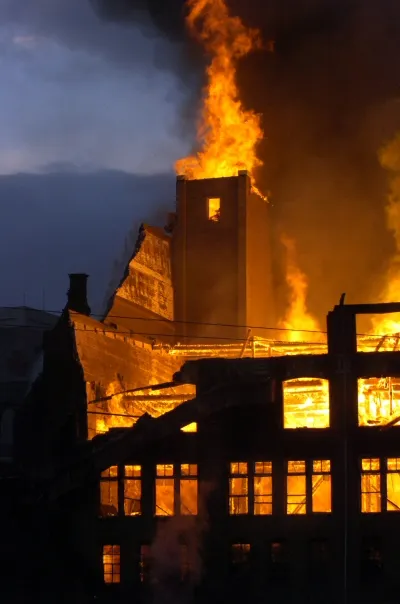 Michael Patrick / News Sentinel staff The early bloggers, people like Jeff Jarvis and Glenn Reynolds, point to 9/11 as the seminal event that forever changed their blogs and blogging as a way of writing about and interpreting news. I wonder if “Knoxville’s Great Warehouse Fire of 2007” (I think I stole that line from somebody) is a seminal moment in the way local news is covered here in Knoxville? I can’t remember a news event that has been covered in quite the same way. We’ve had live blogging from news events, but this, it was different. If you’re just catching up, two warehouses and another building in the downtown area caught fire just after 1 a.m. Wednesday and burned through most of the day, leaving four firefighters in the hospital and raining embers down on much of downtown. People living in the nearby downtown condos on North Gay captured the late-night-into-day fire with digital still cameras and video cameras. The results are just a search away on Flickr and YouTube and personal Web sites. Bloggers here and yonder logged in with personal tales, links and tidbits. The city’s Web site posted a slide show. The sheriff’s department shot aerial video. All the traditional media used their Web sites for as-it-happens news. At the News Sentinel, where I hang out, we had quite a bit of video, audio, tons of photos, stories that seemed living they changed so much. You can see a lot of the multimedia and sidebars attached to this story. Email news alerts flew out. Cell phone alerts buzzed in. Page views and visits ratcheted up. The adrenaline high was palpable even in the print version, but definitely in the Web version. Journalism professor Bob Stepno rounds up some of the varied coverage. He notes:
Woo hoo for the Randoms!
 The online producers of KnoxNews.com on Sunday night won a Digital Edge Award from the Newpaper Association of America for Best Use of Interactive Media for their weekly RandomThis videos. They are, from left in the photo above, Katie Kolt, Lauren Spuhler, Erin Chapin and Online Editor Jigsha Desai. The judges are among the smartest folks in online newspapers so it’s very nice to see this talented team get recognized for their efforts. The News Sentinel “Edgie” was one of six won by E.W. Scripps newspapers with The Naples Daily News winning four and the Evansville Courier winning one. Congratulations to all. Tags: RandomThis The online producers of KnoxNews.com on Sunday night won a Digital Edge Award from the Newpaper Association of America for Best Use of Interactive Media for their weekly RandomThis videos. They are, from left in the photo above, Katie Kolt, Lauren Spuhler, Erin Chapin and Online Editor Jigsha Desai. The judges are among the smartest folks in online newspapers so it’s very nice to see this talented team get recognized for their efforts. The News Sentinel “Edgie” was one of six won by E.W. Scripps newspapers with The Naples Daily News winning four and the Evansville Courier winning one. Congratulations to all. Tags: RandomThis |
vblog | NAA | Edgie | E.W. Scripps | newspapers |
WSJ 3.0
| Uber-bloggers Helen and Glenn Reynolds have a podcast with Wall Street Journal publisher Gordon Crovitz about print and online and why newspaper publishers should be adapting to the new era (duh); why young people don’t read newspapers; and he offers a view of blogging as “a great journalistic art form.” Good stuff. Tags: podcast | wall street journal | newspapers | online newspapers |
If not local search, then what
If local newspapers can’t win local search, what’s there for them to own? We in newspapers better figure this one out. The whole advertising/audience economy of online newspapers depends on it. One of the solutions in Pramit Sigh’s post (and he has several excellent ones) is to give reporters blogs (and we’re back to this evening’s earlier post).
The edge of the future is a Netscape
Eric Berlin says more eloquently than I did in June that the Netscape dreamed up by Jason Calacanis – a hybrid between traditional media news sites and the social news approach of Digg/Reddit/Techmeme -- may be the “Future of News.” Ironic, one of the Internet’s oldest consumer sites, has become the “future of news.” That’s our Internets. Berlin sees successful news sites of the future developing along three lines:
Think and Leap
| If you’re preparing for a career in the shrinking world of mainstream journalism … or just trying to get a journalism job … here’s some good posts to study. It should go without say (but apparently it needs to be said): Big J jobs of the future: online skills a must. Also note: the possible careers in journalism are growing even if traditional newsrooms are contracting. Rob Curley: What sort of things should an aspiring journalist be thinking about? Mindy McAdams: Getting (and keeping) a job in journalism and with another post: It’s about stories … which stories? And why? Bob Stepno: Following up on Mindy with some of his own ideas … Glue this to a journalism school dean’s nose? Howard Owens: Don’t be thrown off by the title, it’s also about what skills to have to get a job … Additional notes on Outing’s advice for small newspapers Tags: journalism | journalism jobs | mainstream media | newspapers |
Can you get me a SoundSlide of that
Just like people use Xerox for photocopies and Google for search, people are using SoundSlides to describe an audio photo slide show. Joe Weiss’s software to create audio slide shows is that ubiquitous for Flash audio photo slide shows – thanks to being good and cheap. The suggestion comes today that, well, SoundSlides, aka audio slide shows shows, are just so 2006. Michael Bazeley, a senior Web editor at the San Jose Mecury News, says he’s bored with ‘em. Howard Owens suggests he is too and recommends ….
Edgie time …
The NAA’s 2007 Digital Edge (Edgie) Awards finalists were announced late last week and the full list was posted this week. The winners will be announced in late January at the Connections Conference in Las Vegas. Knoxnews is a finalist in three categories in the daily print circulation group of 75,000 – 250,000:
More than just beautiful
| Bloggers are all geeks? Tags: geeks | bloggers | online media |
Get less than fabulous free stuff
Get “free stuff” from knoxnews’ very twisted “re-gifting” department. Listen to the end of this audio, Wednesday’s Big Dog Audio Update, for details on how to get the free stuff in time. For the curious, the Big Dog Audio archives are here. Tags: free stuff
NewspaperVideo
| Chuck Fadely recently created a blog about newspaper video as well as an email list. Hopefully, it’ll develop into a great resource. Tags: newspapers | video |
Digging the Times new feature
| Good move by the New York Times to add bookmarking links to their stories! On a related topic, Digg is certainly having its trouble with gaming and frnt page manipulation,b ut how long do think it will be before a newspaper adopts a “digg-like” Web site as its primary site? Tags: Digg | New York Times |
You gotta hear this …
 Another self-promotion item: We started doing something in October that’s become one of the smartest and funniest regular pieces on our Web site. It’s our Big Dog Audio updates. We decided just this week to create an archive of these mid-day promos and updates here. Take the time to listen to a few and send us feedback, rants and raves.. The audio updates are done Monday through Friday. They are posted on the front of the Web site just beside the traffic map around noon. The link is removed late in the afternoon. Regular hosts Lauren Spuhler and Erin Chapin, with guest appearances from “across the pond” Online Editor Jigsha Desai, really have a chemistry working here. I if you listen to a few, you’ll be hooked on checking in around noonish to see what shrikes that crazy pair’s fancy today. Listen for the “Gateway of Morality” moments and the occasional “hey, mom did you hear this” story. Tags: online media Another self-promotion item: We started doing something in October that’s become one of the smartest and funniest regular pieces on our Web site. It’s our Big Dog Audio updates. We decided just this week to create an archive of these mid-day promos and updates here. Take the time to listen to a few and send us feedback, rants and raves.. The audio updates are done Monday through Friday. They are posted on the front of the Web site just beside the traffic map around noon. The link is removed late in the afternoon. Regular hosts Lauren Spuhler and Erin Chapin, with guest appearances from “across the pond” Online Editor Jigsha Desai, really have a chemistry working here. I if you listen to a few, you’ll be hooked on checking in around noonish to see what shrikes that crazy pair’s fancy today. Listen for the “Gateway of Morality” moments and the occasional “hey, mom did you hear this” story. Tags: online media |
podcasts | audio |
Registering complaints
It seems most everybody is saying newspapers should drop registration on their Web sites.
Got any video of Mark Cuban before he was famous?
Like I said before, Mavs owner Mark Cuban would make an interesting newspaper owner. The link above deals with the advertising/revenue model for newspapers. On Saturday, he delves into newsgathering, the newsroom and RSS feeds.
Magazine Web sites lack 2.0 goodness
A Washington, DC, PR firm has done a study that finds that newspapers do better than magazines in terms of new fangled web functionality.
Hooking up shoppers and sellers
Scripps-owned Shopzilla is in the news in a New York Times piece on a trio of upstarts who hope to challenge the current big players in comparison shopping sites (Shopzilla, Shopping.com and PriceGrabber). The article boils down to a business model discussion of pay-per-click advertising vs. pay-per-performance advertising. Meanwhile Nielsen//Netratings said Shopzilla was the No. 9 shopping destination on CyberMonday at U.S. Workplaces and was the first comparison shopping site on the list (via Center for Media Research). Tags: eday | newspapers | CyberMonday | online advertising Top 10 Online Shopping Destinations on Cyber Monday (U.S., Work only)
Site | 11/27/06 UA (000)
eBay | 5,598
Amazon | 4,185
Wal-Mart Stores | 2,531
Dell | 1,780
Target | 1,278
BestBuy.com | 976
Shopzilla.com Network | 959
MSN Shopping | 876
Circuitcity.com | 853
Overstock.com | 800
Source: Nielsen//NetRatings, November 2006
And today (12/4/2006), according to Coremetrics, will really be the top online shopping day of the holiday season. That firm has spun up the term “eDay” for this Monday and estimates online sales will be 19 percent ahead of last year. The other big days? Coremetrics says the next four largest days will be the Monday one week after eDay, the Wednesday after eDay, the Tuesday after eDay, and the Tuesday one week after eDay. Maybe a good day to ask, where do newspaper Web sites fit into this picture? For most, I suspect, the advertising revenue derived from either pay-per-click or pay-per-performance holiday season shopping ad campaigns is minimal. Are there success stories?
Out back in the garage, we have a little …
| Howard Owens is on target in a post on “Video killed the television star” on video strategies for online newspapers. If innovation and disruption come from small startups (or startup-like operations) who come out of nowhere with a product that is good enough to meet a need, then operate like they do. Two guys in a garage or dorm room didn’t create a behemoth Internet portal with mail, maps, movies and more; they created a collection of links. It grew into a behemoth. Craig Newmark started with an email to friends and grew it into Craigslist. Start with what you can do and make it better. Just do. Tags: video | newspapers | Howard Owens |
Podcasting: They hear it differently
BBC News: Podcast numbers show ‘few hooked’ The (San Jose) Mercury News: Podcasts beginning to reach non-geeks Both were reporting on a Wednesday release from the Pew Internet and American Life Project. From the Mercury News article:
Reflections of the mirror in the mirror
| Local blogger Rich Hailey is back in our newsroom observing and live blogging our coverage of the election. See it here. It’s sort of reminds me of a mirror within a mirror; he’s covering how we’re covering what we’re covering (and now I’m covering his covering …) and all in near real-time. I hope he enjoys his visit. I don’t know how exciting he’ll find our newsroom before night’s end, but it’s certainly a historic election in Tennessee – and one that has been a focal point for the nation. Tags: election | blogging | newspaper |
Party line reading
Some election eve frivolous fun. If she’s reading the New York Times, she’s probably a Democrat. If he’s reading the Wall Street Journal, he’s probably a Republican. That’s the upshot of a Neilsen//Netratings report on site traffic by party affiliation via the Center for Media Research. Top five favs for Republicans:
Info at the center
| Gannett’s announcement of plans to rename newsrooms “information centers,” realign editorial newspaper operations along seven radically different “desks” and to embrace ‘crowdsourcing” should strike fear in anyone who works in a newsroom and believes their job is to “put out the paper.” Given the distressed natureof the newspaper business and the fact that the largest newspaper chain in America is embarking on a chain-wide sweeping reorg, a new urgency and higher profile for retooling and rethinking newsrooms at most every chain is a safe bet. The best coverage of the announcement may be Jeff Howe’s in Wired and CrowdSourcing. Read his reports to get the full scoop. A lot of people are weighing in. Here’s a sampling (updated): Tags: Gannett Information Center | newspapers |
How does it Compete?
| Search engine Compete.com has a new domain traffic comparison tool. Anybody got a clue if this any more accurate than the more-probably-than-not wrong Alexa? The results, I guess, can only be considered relative to other sites. Instead of cookies, IP addresses, etc., they are using a “Consumer-based community.” Here’s how knoxnews stacks up against the big TV in town (WBIR). The site does address how it and Alexa differ. Worth watching … maybe. Fun playing with …definitely. Tags: Compete | Alexa |
Surfing in September
Some good news for newspapers: Newspaper Sites See Record Traffic in September (via Lost Remote).
A long time comin’
Merrill Lynch analyst Lauren Rich Fine, whose prescience about the newspaper business is hard to argue, makes a prediction:
A Google bombing run
I noticed this in our referring domain stats for Tuesday on knoxnews. Blogger Chris Bowers, self-described numbers geek and political strategist, has launched a Liberal guerilla effort at search engine optimization. I noticed a number of sites that have the set of links he posted. Don’t know if they are all related blogs of the same group Bowers is in or just like-minded folks. Chris Bowers, by the way, describes himself as:
Simple is good
We bought one of these Pure Digital point-and-shoot video cameras. Seems to be an awesome value in a simple-is-good package. Anyone one else tried them for news video? We’re hoping to arm reporters with them for Web video. It’s the easiest point and shoot video I’ve ever seem. Any feedback appreciated.
In a snit
| Jason Calacanis is in a snit over ads in Netscape’s RSS full feeds – and for good reason. Tags: RSS | news feeds |
Dollars in Dallas
Looks like Wes Jackson, Belo Interactive Vice President / General Manager and one-time Scripps homie, has Belo hitting on all cylinders as navigates its way to “compete effectively in an increasingly Internet-centric marketplace.”
Tracking Hurricane Curley
 Great piece on Rob Curley in Fast Company.
On the other side of the notebook
| An East Tennessee blogger spent a day at the News Sentinel recently and has posted “A Blogger Visits the MSM. Part 1: The Fourth Estate Goes Commercial.” It looks like he plans seven parts. Are we that interesting? I doubt The News Sentinel is anywhere near as entertaining as Bravo’s reality TV show “Tabloid Wars” about the New York Daily News that aired during the summer. But blogger Rich Hailey seemed to find it pretty fascinating and he did ask a lot of the right questions. Take a look at his first post. Tags: Shots Across The Bow | Rich Hailey | newspapers |
The Big Dog’s Bark
 The Randoms launched an audio “Big Dog” alert today on knoxnews. See and hear it on the home page. Lauren Spuhler and Erin Chapin had been testing the format and process for a few days and last week we invited via email some knoxnews users to tell us what they thought about it. Wow, I was overwhelmed with the response. At least 283 people took the time to give us their thoughts from “love it” to “hate it” to detailed suggestions. It was great. Jigsha Desai whipped up a little Flash audio player today (one thing we found was not everyone can deal with Windows Media streaming and we’re not just talking Mac users) and away we go. Hopefully Flash is the solution.. Try it and see what you think. We’re still tweaking this puppy. Tag: online newspapers The Randoms launched an audio “Big Dog” alert today on knoxnews. See and hear it on the home page. Lauren Spuhler and Erin Chapin had been testing the format and process for a few days and last week we invited via email some knoxnews users to tell us what they thought about it. Wow, I was overwhelmed with the response. At least 283 people took the time to give us their thoughts from “love it” to “hate it” to detailed suggestions. It was great. Jigsha Desai whipped up a little Flash audio player today (one thing we found was not everyone can deal with Windows Media streaming and we’re not just talking Mac users) and away we go. Hopefully Flash is the solution.. Try it and see what you think. We’re still tweaking this puppy. Tag: online newspapers |
interactive media |
The War of Words
 Oh, this is just too wonderfully funny. Steve Yelvington’s blog drew my attention to “The War of the Words, The Story of the 101st Fighting Keyboarders,” a Ken Burns style parody of the role of bloggers in the War on Terror. It’s creator, Paul H. Henry, makes great use of the medium and one of the people it highlights most prominently is Knoxville’s own Glenn Reynolds, among others. He has a created a blog for the site here.
Lucky Sevens
Bob Stepno says knoxnews is 77th on “Top 100 U.S. newspaper web sites” at newsknife.com, but we’re not sure what that means as he discovers some weirdness with the list. Interestingly, the 77th rank is about the same as 76th rank for the Knoxville area in terms population for metropolitan statistical areas in the U.S. Tag: newspapers
It’s about what to do Next
| I’m sure the American Press Institute Newspaper Next study will be a blueprint for something, but Susan Mernit, a former online newspaper pioneer now with Yahoo Personals, takes the newspaper industry to task for continually redrawing the drawings and says do something. Read her advice. Tags: newspapers | API | Susan Mernit According to Paidcontent.org, some of the suggestions in the “Next” report for what newspapers should do include: |
(Tennessee) Rivers of News
| UT journalism prof Bob Stepno points to an interesting mobile/PDA project from Johnny Dobbins. Wow, pretty cool. It’s a PDA/mobile news aggregator of news from traditional media outlets in Tennessee (mostly East Tennessee) and bloggers in the Rocky Top Brigade. Some of the RSS feeds seem to be screwing it up. WATE has some headlines that say “September 15, 2006 11:33 PM” and it’s just 9 p.m. And he looks to be using just the local news feeds of the ones we have here. (We could create a special feed on whatever combination of sections Dobbins/Stepno are interested in for that matter. We created what we thought people might want, but we haven’t had much feedback on what they do want, but I digress.) I’m sure he’ll get it tweaked out. The “Tennessee River of News” is an interesting concept and useful implementation. Sounds like it was Bob’s inspiration (who got the “ah ha” from Dave Winer) and Johnny’s coding wizardry. Boom, a news source is born, Web 2.0 style. Good luck! Tags: Tennessee | Web 2.0 | Knoxville news | Rocky Top Brigade |
One in four do it
Psst … here’s how Charlene Li of Forrester Research says you can reach the elusive 18-26 market.
Lost in Nashville
Steve Safran of Lost Remote is bogging from the WKRN blogger meetup in Nashville. See his coverage:
Cash out time, part 2!
In Newspapers: Integrate the Web! No . . . wait!, Scripps new media maven Jay Small tries to reconcile a report from market researcher Scarborough and a report from innovation gurus Innosight on the role of the Internet and innovation at newspapers. You might call this the yin-and-yang of Integration and Disintegration. Jay writes:
Cash out time?
| Mindy McAdams’ blog pointed me to this piece in The Hollywood Reporter. It’s about how the “publishing scions,” including my employer, E.W. Scripps (SSP), are transitioning – or not transitioning – their businesses. Tags: Newspapers | New Media |
Dayton Daily News gets new look
| A sharp new look for the Dayton Daily News Web site was launched today. Congrats to Ray Marcano and the entire team! It’s awesome. Tags: Dayton Daily News | Web Design | Newspapers |
Still so 1995
Steve Outing and Howard Owens have some engaging thoughts on how far we’ve come – or haven’t – that was sparked by revisiting what newspaper online folk were saying more than a decade ago on Outings’ once bustling online-news list. (I still subscribe to it, but it’s much quieter now than in those heady days.) Howard came up with an excellent 10-point list of how newspaper are not getting it done. And Outing’s man point is we fret when we should just do:
Local Search as promised land?
| Howard Owens has some interesting thoughts on local search and self-serve advertising models. Lots of people see local search as easy money, the last Internet landscape yet to be conquered. But in truth the market is already fragmented online and off-line. And advertisers that have not already embraced Google’s self-service ad tools may just be disclined to become advertising DIYers. Instead of conquer, think cultivation. Tags: Local Search | Howard Owens |
News Flash: Blogger read news
| Traditional media, newspapers in particular, are struggling mightily to attract younger readers. Very little has worked to date. The average print newspaper reader is 55 and getting older. Even newspaper on Web sites, where the average age is younger, the average age has become trending up. Beyond the headlinesof a new Pew Internet and American Life Project study released this week are interesting trends that may hold some clues for Big Media. The study suggests news content is extremely important to younger readers, but they are looking beyond traditional media to meet their needs. Consider a few bullet points from the study: Tags: newspapers | blogosphere | Pew Research Center | bloggers |
Try it, NOW
MEDIALIFE has a nice, short piece on the “hotbeds of experimentation” in the newspaper industry and some of the interesting things going on. Here’s a graph:
A site to get fanatical about
 Morris DigitalWorks has reborn FanaticZone.com (once in another incarnation a site we were involved in with the GoVols.com Web site) as a Digg.com-like sports metasite. It’s certainly not the FanaticZone of yore. As Morris’ Steve Yelvington says: “Times change. Ideas change.” Tags: Web 2.0 Morris DigitalWorks has reborn FanaticZone.com (once in another incarnation a site we were involved in with the GoVols.com Web site) as a Digg.com-like sports metasite. It’s certainly not the FanaticZone of yore. As Morris’ Steve Yelvington says: “Times change. Ideas change.” Tags: Web 2.0 |
Sports | New Media It’s WOW. Congratulations to the Morris folks for packing a lot of good, new ideas into a nice looking site. Yelvington says the Morris coding wizards created it in six weeks: |
Still flying with baggage
Seems fashionable to dish “old” newspapers as an ongoing enterprise. One of the latest came just last week when New Yorker columnist Malcolm Gladwell, on a panel as part of the celebration of Slate’s 10th anniversary bash, said newspapers were a lot like airlines:
The Dave Morgan alarm clock is ringing
Dave Morgan of Tacoda tells newspapers to wake up:
New site dances to the tune innovation
| The interactive arm of E.W. Scripps’ newspaper division (which is housed here in Knoxville) is experimenting with a new band-and-bar scene site called knoxville520. In my internal shorthand, I call it an “Innosite,” a play on the name of the consulting firm Scripps has been working with, Innosight, LLC. It’s an interesting experiment in trying to innovate to serve a much-needed market niche locally; see what you think. Congrats to Sara Schwabe, Jay Small, Rich Lacy and all the folks at Northshore working on the project. Tags: Food and Drink | Web | Entertainment |
Organized randomness
I think the new Netscape (beta.netscape.com for now) is a good move for the portal site owned by AOL.
Live on the scene at Bonnaroo
Wow, we have some terrific Bonnaroo coverage with our KnoxNews team on the scene …
When our paths cross
Peter Krasilovksy, Jay Small, and Steve Yelvington had some thoughtful comments late this week about when online ad revenues will intersect with print ad revenues. Whether it’s five years, 10, 12 or more, it’s interesting that people are beginning to stake out a date instead of just “sometime in the future” and “someday.” The “tipping point
Not nice neighbors
| Tags: Bonnaroo | Photos Wow this site, Stoned.com, is using Lauren’s photo with no credit to her or The Knoxville News Sentinel. It’s one thing to just steal our photo, but not even give us credit for it. Whew. |
Media at the Mega-Music Festival
| Tags: Bonnaroo | Outdoor Festivals The KnoxNews online team is gearing up for complete and innovative – and even off-the-wall – coverage of this weekend’s Bonnaroo festival led by audacious Lauren Spuhler, the online producer who will be reporting from the scene. Check it out. We will have (and already have posted) some lively, fun and interesting content. The question I have is even with the mostly sunny forecast, will the Manchester farm yet again become a sea of mud? |
Slick new Courier-Press launches
| Tags: Newspapers | New Media | Web Design | Scripps There should be a bit of well-deserved buzz today about the redesign of another Scripps paper Web site, The Evansville Courier-Press. Lost Remote has already said: “Give them this - it’s unlike any newspaper-based site you’ve probably seen.” Postings have already begun on the Online News list. The new site launched on Monday afternoon after a ton of hard work by the Scripps folks at the Northshore building here in Knoxville and by the Web folks at the paper in Evansville. Some of the new features are listed here. Developer Mocktech chronicles some the launch push here and the working weekends to meet the deadline of what he calls the “djefferson project” here and here. It borrows bits of the design that was developed for KnoxNews a year ago, but with lots of tweaks and additions, and a really nice color scheme. It looks very nice. It’s also the first Scripps Vignette-driven newspaper site to be converted to the Ellington-Django platform that Scripps newspapers will be migrating to over the coming months. Jay Small (takeaway quote: “We’ve done some redesigns, but hoo boy! This is a big deal for us.”) has some details here. I heard the Evansville folks not only were contending with the rollout of the redesign, but also had an early evening power outage. Just a bit of electricity with our stress, please! Congratulations to all. Site looks tremendous! |
Local news: straight to video
| Tags: Video | Media | Newspapers InlandPress.org mentioned our RandomThis video feature here in a June, 5, 2006 article. It includes some tips for newsroom video training from the folks at Florida Today. |
What the smart people are reading …
| Tags: New Media | Online Advertising | Newspapers | Marketing The results of a study done on 10 newspaper sites late last year, including the KnoxNews.com site I work on, are beginning to come out. The study was done for the Newspaper Association of America by MORI Research. I haven’t seen the local site data and analysis, but the national overview is interesting (a Powerpoint presentation is here). Here’s some takeaways on newspaper site heavy users the NAA’s Melinda Gipson noted in a Presstime magazine piece: |
Scrippsnews goes into live beta
| Tags: Blogosphere | News | Media | Tagging Scripps Howard News Service is giving it’s new “for the public” Web site a higher profile. According to the site, Scrippsnews.com has moved into the “live beta” stage. We added a link to it at the bottom of knoxnews.com yesterday, but the Web site quietly went up in February … so quietly I hadn’t seen it until yesterday. They are calling it: |
Gimme that broadband
| Tags: Broadband | New Media | Media | Technology The Pew Internet & American Life folks released late last week their latest Broadband survey and it’s got some really interesting findings. The headline: Broadband adoption grew by 40 percent in the past year with the Telcos the winners. Among the survey’s finding: |
Newsbank and iCopyright
Got a copy of a news release this morning that Newsbank and iCopyright have cut a deal whereby Newsbank will be added iCopyright’s copyright licensing technology into its database. That’s good news. We already use both! Our data was tagged for iCopyright on Knoxnews, but articles that were in the Newsbank database were not. It’s a natural partnership. Congrats to all.
Getting spiked
I find it interesting how news Web sites differ. Maybe I’m over easily enthralled by charts. Who knows. The daily traffic of most news sites depends on the day of the week and whether there is a big story. A big news story results in a traffic spike. Makes sense? What I find really interesting is how big the spikes can be for TV news sites. (A story getting spiked online is a good thing while in the jargon of the newsroom, getting a story spiked was never a good thing – for the reporter.) I was looking over the weekend at Alexa’s traffic statistics for knoxnews.com, WBIR and WATE. According to Alexa, the three month average reach for each site per million Internet users is: 78.5, 62, 27.5. OK, none of us are exactly ruling the total Internet, but we reach a lot of people in our corner of it. And granted Alexa only measures traffic through its toolbar (which I don’t use) so this is not take-it-to-the-bank data, but interesting nonetheless. I used alexaholic.com to make the comparisons. It’s built on the Alexa traffic tool, but it makes it easier to make comparsions. See chart below. What’s interesting to me is while we are all covering much the same news, the two TV sites can see huge spikes in traffic. WATE, the one with the smallest reach of three, according to Alexa, had on a single day a larger reach than knoxnews and WBIR combined. In early May, WBIR had a big spike. The obvious answer is TV as a medium is better at driving users to its Web sites in a breaking story. Are there other answers? What does an Alxoaholic comparison (I just love writiing that) look like in your market? alexa website statistics by alexaholic
An Olive swirling in a rumor martini
We’ve been doing some work with Olive Software so found this item on John Battelle’s Searchblog intriguing:
Going way back with Dave Carlson
 Caught up with David Carlson while he was in Knoxville. That was good. Dave is national president of the Society of Professional Journalists and was in town for the local chapter’s annual Golden Press Card Awards on Friday night. At lunch at the Riverside Tavern with SPJ stalwarts Georgiana Vines, Jean Ash, Lisa Hood Skiner, Bonnie Hufford and Mark Harmon, he gave me some credit for his current involvement in SPJ. I got him to be on a panel at the SPJ national convention in Nashville way back in 1994. Course he agreed long before I let him in on the very small detail that SPJ does not pay expenses for speakers and yes, the registration was not comped. Hey, I did buy lunch at a Nashville eatery not likely to be remembered in Can’t Miss Dining in Nashville! That national convention marked the start of his current involvement in SPJ that lead to him becoming the first academic person to lead the society. By the Nashville convention in 1994, Dave had moved to the University of Florida to teach “interactive newspaper technologies” and to start up Florida’s Interactive Media Lab. Today, his title is the James M. Cox, Jr. Foundation/The Palm Beach Post Professor of New Media Journalism and director of the lab. (Hey, Dave how do you get that title on a business card?) He was – and remains – one of the newspaper industry’s pioneers in the online world. While at The Albuquerque Tribune, he started up and ran “The Electronic Trib,” the first newspaper BBS system. What’s a BBS? Think modems, dial up, garish CGA colors and lots of text. I remember picking his brain about project when it was going on. At that point, Web had no online meaning and Net was something you might take fishing rather than where you went phishing. One of Dave’s many side project is maintaining a timeline of online news here. Actually, getting to see Dave again was a trip down t he personal timeline.
Just flip the business model
We have on the knoxnews.com Web site something called Quigo ads. They are text ads much like the “Goooogle Ads” you see everywhere. I knew that story. But I didn’t know much about the Quigo company story until I stumbled upon Yaron Galai’s “Web X.0” blog and his “sixth anniversary” post on Quigo. Galai says he was originally working on the idea of a ‘forward button” for Web browsers. Ah, OK. He hooked up with co-founder Oded Itzhak to form the company through a friend of Galai’s brother’s wife. The central problem – or need – the Israeli techies saw and addressed was:
Help these girls out
The Randoms want you to be their friend on their MySpace site. So add them to your friends … or they’re going to be mighty tough to work with. Just a random excerpt from one Random:
In the news
The panel I appeared on yesterday at UT got a little coverage here yesterday with a long report from “R. Neal.” Neal and the others who attended overcame a wicked thunderstorm to be there and there was an excellent turnout. Part of what I presented were some statistics here on KnoxNews Web site traffic, usage and demographics. The demographic data from Scarborough is the most interesting to me. Robert Morgan, the News Sentinel’s excellent market researcher, pulled those together for me a moment’s notice (I’m glad he comes in early). I asked for some of the data points that show the differences between print readership and the online audience. Any errors are mine and not his. I find some of the trends fascinating. It was the first time I had met Neal (the blogger formerly known as South Knox Bubba) and UT journalism lecturer Bob Stepno, both of whose blogs I like to read when I have the time. So in all, it was a fun event and the weather had turned sunny by the time I left the Black Cultural Center. The conference continues today and Friday.
Shapers of Change
A few weeks ago, I got a note from the good folks at UT asking if I would be on a panel. “Sure, no problem,” I said. I’ve spoken to a number of classes at UT and it’s always engaging to see what studients will ask about after I’ve quit babbling. I’ve discovered the panel is at least a small part of a big deal at the University: UT’s first Journalism and Electronic Media Week. They put it this way in a news release:
Feeding the broadband news junkies
Howard Finberg did a nice piece on the new Pew study yesterday and was left wondering at least two questions. Jay Small said today the report raised a related issue with him. Rob Runett summed up the major findings of the study:
Video games
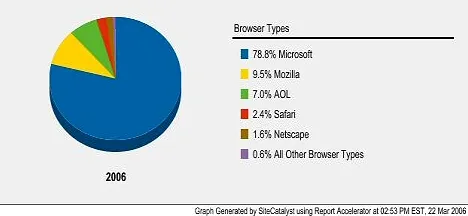
Kathy Gill invited people on the online-news list to join her conversation about the major networks use of Windows Media video formats instead of a more agnostic file format. That reminded me of the whole AP Video Network babble-prattle about its use of Windows only and Internet Explorer technologies. Mark Glaser, Steve Yelvington and others have weighed in on it. To me, it’s a ho-hum issue. Yes, we use a combination of Window Media video, mp4 and more open Flash video. For audio, we use mp3 or put it in Flash. And, we are among the 450 plus Web sites that have signed on to the AP Video. So far, I had one user complain twice – and he was incredulous when I told he was the first KnoxNews to complain they couldn’t see the AP videos. I may be inviting more incoming in my webmaster box, but that’s my real world mileage. A mere 9.5 percent of our users this year are using Firefox; 78.8 percent are using IE. The OS war is more lopsided; 3.2 percent of our users are using a Mac OS; 80.4 percent are using Windows XP and the rest are using creakier, older version of Windows. Admittedly, our site may be less friendly to the Mac OS (we do not supported IE on the Mac, for example, and so, OS 9 users get funky screens). Our Omniture reports peg the Internet average 8.5 percent vs our 3.2. I don’t think AP or the networks are arrogant or lackies of the Microsofties (depending on your point of view); they are looking considering what the user has and making financial decisions based on what makes economic sense right now. I do believe the ads are often too long for the video for that comes after. Hopefully some generally accepted standards will begin to develop. That’s my sound bite.
Hacker Mojo spends the night with python and django
It reads as if the mad scientist is locked away in the lab to all hours with his pliable assistants python and django creating the perfect CMS. The beakers are bubbling and weird smoke is swirling. Hopefully, he won’t blow up the lab – or the wife and the little Mojo. It’ll be fun to see what he comes up with he stumbles groggy and red-eyed from DEV back into the world.
MyWeb2.0
I think Yahoo’s MyWeb 2.0 is pretty cool idea. I find it handier than Google Desktop – at least for me – because I often am using different computers: work desktop, home desktop, laptop.
Knoxnews, GoSmokies win Edgies
Two sites I spend my life on – knoxnews and gosmokies – won Edgies at the NAA Connections. That is great! Here’s a news release. It’s always nice to be recognized by your peers and the Edgies honor the most creative and innovative work in the newspaper New Media space. A great group of people both at the News Sentinel and corporate New Media are very committed to doing their best. Go celebrate! The online innovator award winner – the big honor that goes to an individual – has some East Tennessee connections, too. The winner was Lisa DeSisto, vice president/advertising at Boston Globe Media. She had been general manager of Boston.com until she got a big promotion with print and interactive advertising responsibilities. Her husband grew up in Morristown and his family still lives there. The couple has purchased over 40 acres in Cocke County near some family property. So maybe we’ll see them around these parts sometime in the future?
Guest blogging in Disneydom
I’ll be participating in a group blog at the Newspaper Association of Ameria’s CONNECTIONS confab starting this weekend in Orlando. See the blog here. There’s a group of 29 foks that volunteered to blog at the show – heck, that’s a virtual newsroom of writers. Should keep us out of trouble!
Getting the story
Two good tales of “getting the story” from over the weekend. Terry Morrow tells in his blog how he got to talk to local-boy-turned-superstar-country-singer Kenny Chesney – and no other media did – during his low-profile show show at a local nightclub on “the Strip” on Sunday night.
The end of email?
Hardly! There is a lot of concern – read opposition in many corners – to a plan by AOL and Yahoo to charge marketers who send bulk emails, be it special offers from L.L. Bean, Target or Buy.com that you might have asked for … or all those you didn’t want to get. For a quick look at the issue, see this Forbes article. But these moves by Yahoo and AOL probably will impact legit emailers more than spammers. The spammers, of course, will figure a way around it before it’s implemented; the legit emailers will see their cost of doing business rise and the consumer will wonder why their box is crammed with junk mail. Not the end of e-mail, but hardly progress. Update: An Electronic Frontier Foundation piece.
Small Initiatives gets a big makeover
Looks like he’s still drilling and painting the inside walls this bitter, nasty weekend, but Jay Small’s redesigned SI is looking good: understated, clean and utilitarian See it while the paint’s still wet: https://smallinitiatives.com/
Maybe we just ought to ask an 8-year-old
Everybody’s looking for next the innovation, be it an online product or the latest in dried pulp. That’s why I loved David Hornik’s poston on his son’s fledgling concept. Yeah, it’s cute, but I also noticed:
Yahoo, the real Windows desktop killer?
Google might have mastered simplicity and ease of use, but I actually think Yahoo has the best tools of the big search engines – and I’m never been much of a Yahoo person. My Palm’s touch screen lost its touch and I began looking around for another way to sync my contacts and calendar. I think the Yahoo address book and calendar are – with the free Intellisync tool – pretty good. Contacts sync to-and-from Outlook at work to Yahoo and to-and-from Yahoo to my Outlook Express at home. And then the iPod syncs with Outlook Express. Calendar data syncs from Outlook to Yahoo and back. Yeah, I’ve had some duping record issues, but otherwise it works pretty darn good. And yes, I don’t have my bluetooth cell phone plugged into the system at all. It was tightly with my Palm. But I’m carrying around less. Then I started playing with MyWeb2.search.yahoo.com. Great way to have your bookmarks everywhere. I’m not sharing them with any “my communities,” Don’t really care for the 360 product – or even the concept. And now there’s Tivo-Yahoo integration with weather and photos (and traffic if I lived in a place where Yahoo did traffic). And, oh yes, scheduling your Tivo from Yahoo’s TV listings. (For Tivo, the deals are promising … it had looked like other DVR players were going to easily muscle out the original … ah, but that’s for another day,) Gmail is a great Web email app and yes, I periodically dump my contacts into Coogle. But Yahoo may be closer to replacing the desktop than the Googlemeisters of Mountain View. Look at the Widgets. Am I wrong? P.S.: I noticed some other people’s suggestions for handling contacts here.
Wikipedia, have you met John Seigenthaler?
Wikipedia implemented Monday a registration system for new posts after getting its facts wrong in a bio on Tennessean John Seigenthaler.
V-blog
OJR did a piece on RandomThis today with Jigsha. Read it here.
Sea changes
Susan Mernit’s take on the ONA convention is more about print media than ONA. I think this about sums her point:
Power of Word-of-Mouth
Two of the most common Internet applications – Google search and AOL instant messager – were essentially built on word-of-mouth advertising.
Gaga at Google
These tidbits, which came out last week in the Google earnings, just boggle me:
Online timeline
Noticed this link in the Online-News email this morning. David Carlson has a comprehensive Online Timeline. Worth bookmarking! A couple entries: 1969 – CompuServe Information Service launches in Columbus, Ohio, as a computer time-sharing service. 1974 – First Use of term “Internet” appears in a conference paper by Vinton Cerf and Bob Kahn. 1980 – Pac-Man, a successful video game, is released. 1992 – Newspaper Association of America reports 11 newspapers have an online presence in the U.S. and Canada and more than 250 offer voice information services. 2004 – Jan. 20: Apple’s 4-gigabyte iPod Mini is released and sells well. Dave, a professor at the University of Florida, is one of the pioneers in news online. Thanks for a great timeline to keep it all straight!
The Red State Reader
Noticed on Michael Silence’s blog, Katie Allison Granju’s and Bob Stepno’s that former News Sentinel reporter Jesse Fox Mayshark has started a ezine, The Red State Reader. Best of luck to you, Jesse. It will be interesting to see how it develops.
RandomThis gets more than a random look
In late August the online producers at KnoxNews.com started doing RandomThis a sort of vlog or vblog thing (a blog that consists of video posts). It works like this: Each week one of the producers posts a video piece that she did with a Sony consumer digital camera (Cybershot DSC-P93) that happens to shoot video. The idea was inspired by a visit of blogger Glenn Reynolds to the News Sentinel back in the summer where his talk included some themes along this line.
Knoxnews has launched RSS feeds
We are rolling out RSS feeds on knoxnews using the Scripps-built tool. Some say we were overdue – and perhsps we are – but many of our users have no idea of what an RSS reader is and why they might want one. When they, we hope they use our feeds! Here’s the local news feed…. Your browser does not support JavaScript. Click to read the latest news. 
BlogNashville: They’re with the band
The center of the Blogosphere is in Nashville this weekend for BlogNashville. A few Knoxville bloggers are there and the newspaper has two folks taking in the scene. Read Michael Silence’s posting. We posted the AP account with a link to Silence’s blog late in the day. From blog reports and news accounts, the conference looks to be building a tremendous amount of creative energy. Meanwhile, a piece on the ClickZ network report on the updated Pew Internet & American Life Project report on Blogging contends a quarter of all Internet users say they read blogs, and 9 percent say they’ve created one. But here’s the trend to watch: In the 18 to 29 set, some 36 percent of are reading blogs and 19 percent of that online age group have created blogs. Blogging, podcasting, vlogs, community journalism in many forms, the news and information landscape is rapidly morphing. And at least for this weekend, the story has a Nashville soundtrack. Play on!
AP News Alert: Disintermediation is here
Please pardon this disintermediation … we’re just changing all the rules. Does the venerable Associated Press get disintermediation in its core business? A couple E.W. Scripps executives I work with think not and made some provocative arguments in OJR last week. They envision a Napster model in which Internet technologies are used to open the system and drive down costs.
New Knoxnews
We launched a redesigned knoxnews.com last Thursday. Long days, little sleep, lots of coffee = looks great. The designers and programmers that made it happen on the corporate side did a great job. It’s a radical departure from what we had and, to some, it’s moved away from what they think a newspaper site should look like. See for yourself. An update: Noticed a nice note on Jay Small’s site with some insightful comments.
And the largest digital camera makers are….
Disruptive technologies have a funny way of being disrupted themselves. Digital cameras disrupted the business for film for still photos and now finds itself disrupted by cell phone manufacturers. This item from “om malik on broadband:”
‘New News’ Retro
Nora Paul has some good reading at OJR with ‘New News’ retrospective: Is online news reaching its potential?. Yes, 10 years ago – and even recently – the selling point was “Web as bottomless newshole” which turns out to be exactly what people don’t need. And newspaper news sites still don’t provide the convenience and utilitarian features that readers want. It may be that services like Google News and Findory do provide that utilitarian usefulness while using the content from mainstream media. What a lost opportunity: Aggregators become primary news sources because mainstream news media sites failed to provide the tools readers wanted. New forms of story telling haven’t moved far from “gee-whiz that looks cool” – yet. Hopefully, we’ll learn! Nora nails the state of online news. Hopefully, in Boom 2.0 our promises will better match our readers’ wants and the reality will be a little closer to the promise. They had better.
Ken Sands via Susan Mernit
Online Publisher Ken Sands in Spokane has good good points in this Online News post that the indefatigable Susan Mernit posted to her blog.
Snoop Dog does Google

From Images on Gizoogle… Lauren passed this one along as a fun site … and it is: www.gizoogle.com (language warning). Course it was created by a guy – John Beatty – who’s from the hinterlands of York, Pa., not exactly Snoop Dog song territory, but he calls it a tribute to the Snoop Dog. See story in his local paper. And in the sad but true department: Google had the York Daily Record article index, but the paper’s Web site didn’t. Who ate our lunch?
Google SMS rocks
I was playing with Google’s SMS feature. You can search yellow pages, residential listings, weather, movie times and definitions simply by entering some text and sending a text message to 46645. It works really fast – and well. It found my telephone white pages listing with all the correct info, told me the weather and gave me a definition for the word “parse”. The weather:
Disintermediation in the 500 channel world
Noticed an item about BrightCove on John Battelle’s blog. TV over the Internet? Jeremy Allaire (who brought us Cold Fusion) thinks so and he’s got $5.5 million in VC money to burn. Allaire envisions a future where:
Yahoo turns 10!
Yahoo is a decade old tomorrow, March 2. Hard to believe, revenues of $3.57 billion, net income of $834 million, a market cap of $44.41 billion. … Hey, maybe there is real money in this Internet thing. In the early years, it was the site with the funny name where you found stuff. It survived the Bubble. So far, it has survived Microsoft and Google. Here’s an article with Jerry Yang and Wired’s take “The UnGoogle (Yes, Yahoo!)” Happy Birthday Yahoo!
Newspapers
A portrait of Adolph Ochs
The East Tennessee Pro Chapter of the Society of Professional Journalists is holding three events in September about Adolph Ochs’ early years, when he lived in Knoxville. The last event will dedicate a historical plaque about Ochs on Market Square
A few thoughts on Frank Cagle
Travis Dorman of the News Sentinel wrote an excellent obituary on the life of Frank Cagle.
Warren Buffett on the state of newspapers
“… we haven’t been able to solve it …”
First Amendment Encyclopedia launched
The music business is back; are there clues for news?
The music business has been growing for the last few years after going into a decline in 1999. And it doesn’t have to do with buying MP3s. The news and music industries have long been compared; they were disrupted by the Internet at about the same time and forever changed. Are there still lessons to be learned between the two industries. Would a “Spotify model” work for news? Some efforts have been tried and failed from traditional media companies, the tech powers that control the platforms and entrepreneurial startups.
Rich Boehne takes a look at back at E.W. Scripps
Rich Boehne has stepped down as CEO of the E.W. Scripps company. Here’s a look back in an article on the Scripps-owned WCPO website. Ken Lowe, CEO of Knoxville-based Scripps Networks Interactive said:
How it was done back in the day
A video from the 1940s of The Quad City Times (H/T Autumn Phillips)
Winners named in Tennessee AP broadcast, newspaper contest
NASHVILLE, Tenn. (AP) – Winners of the 2016 Tennessee Associated Press Broadcasters and APME professional and college contests were announced Saturday, April 8, in Nashville, Tennessee.
Thirty-six AP-member newspapers, television and radio stations and 11 colleges submitted nearly 1,000 entries in the contest, which featured news and sports coverage from 2016. The professional contest was sponsored by Middle Tennessee State University’s School of Journalism.
The awards honored exemplary journalistic work published and broadcast in 2016 in Tennessee. The AP is a not-for-profit news cooperative representing about 4,000 newspapers and 5,000 broadcasters in the United States.
John Seigenthaler Award of Excellence: Nate Morabito, WJHL-TV, Johnson City, “Greene Valley Abuse Investigation.”
Outstanding News Operation: The Tennessean.
Journalist of the Year - Newspaper: 1, Kendi Rainwater, Chattanooga Times Free Press; 2, Andrew Nelles, The Tennessean.
Journalist of the Year - TV: 1, Jeremy Finley, WSMV-TV, Nashville; 2, Felicia Bolton, WMC-TV, Memphis; HM, Phil Williams, WTVF-TV, Nashville; HM, Jerry Askin, WMC-TV, Memphis.
Journalist of the Year - Radio: Chas Sisk, WPLN, Nashville.
NEWSPAPERS DIVISION I (Daily circulation under 15,000)
Features: 1, Andy Meek, Daily News, “The Grind: Budding Music Ecosystem Helping Memphis Musicians Make It’’’; 2, Cameron Judd, The Greeneville Sun, “Etchings Resonate a Storied History”; 3, Bill Dries, Daily News, “Massacre: 1866 and the Battle Over How Memphis History Is Told”; HM, Ken Little, The Greeneville Sun, “Bound and Determined to Save Her Sister.”
Sports-Outdoors: 1, Don Wade, Daily News; 2, Darren Reese, The Greeneville Sun; 3, Kevin Weaks, Union City Daily Messenger.
Business News: 1, Andy Meek, Daily News, “Defining Transparency”; 2, Bill Dries, Daily News, “Bursting the Bubble/Blue-Collar High School”; 3, Don Wade, Daily News, “Under Pressure: Facing Criticism, Urban Child Institute Poised for Change.”
Editorials: 1, Michael Reneau, The Greeneville Sun; 2, The Memphis News Editorial Board, Daily News; 3, Doug Headrick, The Daily Post-Athenian.
Daily Deadline: 1, Bill Dries, Daily News, “Black Lives Matter Protest Draws Thousands”; 2, The Daily Post-Athenian, “Tornado”; 3, The Greeneville Sun, “3 Girls Fall From Ferris Wheel”; HM, Union City Daily Messenger, “Levee Breach/Man Arraigned.”
Malcolm Law Award for Investigative Reporting: 1, Kristen Early, The Greeneville Sun, “Greene County Fair Incident.”
Video: 1, Helen Comer, The Daily News Journal, “Tragedy Hits Home”; 2, Kristen Early, The Greeneville Sun, “Hatchery Business is Cracking Up to be Prolific.”
Multimedia: 1, The Greeneville Sun, “Ferris Wheel Tragedy”; 2, The Greeneville Sun, “Andrew Johnson Bank Ladies’ Classic”; 3, Brian Cutshall and Staff, The Greeneville Sun, “Best of Preps 2016.”
Feature Photography: 1, Helen Comer, The Daily News Journal, “A Family’s Pain”; 2, Chris Menees, Union City Daily Messenger; 3, Helen Comer, The Daily News Journal, “Kool Aid Stand”; HM, Helen Comer, The Daily News Journal, “Remembering Omar.”
Sports Photography: 1, Helen Comer, The Daily News Journal, “We Did It!”; 2, Darrren Reese, The Greeneville Sun; 3, Helen Comer, The Daily News Journal, “Bringing Home the Trophy.”
Spot News Photography: 1, Helen Comer, The Daily News Journal, “Fearful Moment”; 2, Helen Comer, The Daily News Journal, “Young Activist”; 3, Darren Reese, The Greeneville Sun, “Gatlinburg Wildfire.”
Photojournalism: 1, Chris Menees, Union City Daily Messenger, “Fair Share of the Fun”; 2, Darren Reese, The Greeneville Sun, “South Greene Girls’ Basketball State Championship”; 3, Helen Comer, Michelle Willard and Nancy DeGennaro, The Daily News Journal, “Trail of Tears”; HM, Donna Ryder, Union City Daily Messenger, “Walk of Hope.”
Individual Achievement / Body of Work in Photography: 1, Andrew Breig, Daily News; 2, Chris Menees, Union City Daily Messenger.
NEWSPAPERS DIVISION II (Daily circulation from 15,001 to 50,000)
Features: 1, Tammy Childress, Bristol Herald Courier, “Paws for Help”; 2, Nick Shepherd, Kingsport Times-News, “Measuring a Life: Penelope McCall Made Deep Impact in Her Short Life”; 3, Ray Howze, The Leaf Chronicle, “Desert Storm a Milestone for 101st Airborne.”
Sports-Outdoors: 1, Autumn Allison, The Leaf Chronicle; 2, Melanie Tucker, The Daily Times; 3, Brandon Shields, The Jackson Sun; HM, Douglas Fritz, Johnson City Press.
Business News: 1, Jimmy Settle, The Leaf Chronicle; 2, Tammy Childress, Bristol Herald Courier; 3, Nathan Baker, Johnson City Press.
Editorials: 1, Chris Smith, The Leaf Chronicle; 2, Robert Houk, Johnson City Press; 3, Cliff Cumber, Bristol Herald Courier.
Daily Deadline: 1, The Jackson Sun, “Noah Chamberlin Found”; 2, The Daily Times, “Firestorm”; 3, The Daily Times, “Ambush Ends Stellar Career”; HM, Bristol Herald Courier, “Racially Motivated Shootings in Bristol.”
Malcolm Law Award for Investigative Reporting: 1, Johnson City Press, “The Opioid War.”
Video: 1, Kenneth Cummings, The Jackson Sun, “Vietnam Veterans of America Chapter 995 Honor Guard Rehearsal”; 2, Joy Kimbrough, The Daily Times, “Remembering Farmer Bob”; 3, Ayrika Whitney and Autumn Allison, The Leaf Chronicle, “Austin Peay Rebuild Starts from the Ground Up”; HM, Ayrika Whitney, The Leaf Chronicle, “Local Veteran Family Benefits from Hemp Legislation.”
Multimedia: 1, Ayrika Whitney, The Leaf Chronicle, “Clarksville Veteran Family Finds Hope in Hemp”; 2, Jeff Bobo, Kingsport Times-News, “Dog Rescued from 30-Foot Hole at Phipps Bend.”
Feature Photography: 1, C.B. Schmelter, The Jackson Sun, “Crime March”; 2, Earl Neikirk, Bristol Herald Courier, “Watermelon Eating Contest”; 3, C.B. Schmelter, The Jackson Sun, “Chiefs Challenge.”
Sports Photography: 1, Earl Neikirk, Bristol Herald Courier, “Football Hurdle”; 2, C.B. Schmelter, The Jackson Sun, “Defeat”; 3, Ayrika Whitney, The Leaf Chronicle, “Conference Champions”; HM, C.B. Schmelter, The Jackson Sun, “Soccer Header.”
Spot News Photography: 1, Ayrika Whitney, The Leaf Chronicle, “Mother and Child Hit by Car”; 2, C.B. Schmelter, The Jackson Sun, “House Fire”; 3, Earl Neikirk, Bristol Herald Courier, “Interstate Logging Wreck.”
Photojournalism: 1, Ayrika Whitney, The Leaf Chronicle, “Noah’s Story”; 2, C.B. Schmelter, The Jackson Sun, “Search for Noah Chamberlin”; 3, Joy Kimbrough, The Daily Times, “Remembering Hannah Tate: Student with Big Heart Memorialized, Celebrated at Service”; HM, Kenneth Cummings, The Jackson Sun, “Community Prayer for Noah Chamberlin.”
Individual Achievement / Body of Work in Photography: 1, C.B. Schmelter, The Jackson Sun; 2, Earl Neikirk, Bristol Herald Courier; 3, David Crigger, Bristol Herald Courier.
NEWSPAPERS DIVISION III (Daily circulation over 50,000)
Features: 1, The Tennessean, “Rivers of Tennessee”; 2, Casey Phillips and Shawn Ryan, Chattanooga Times Free Press; 3, Tom Charlier, The Commercial Appeal.
Sports-Outdoors: 1, Stephen Hargis, Chattanooga Times Free Press; 2, Dan Fleser, Knoxville News Sentinel; 3, Tom Schad, The Commercial Appeal; HM, Joe Rexrode, Adam Sparks and Jason Wolf, The Tennessean.
Business News: 1, Dave Flessner, Mike Pare and Alex Green, Chattanooga Times Free Press; 2, Ted Evanoff, The Commercial Appeal; 3, Jamie McGee and Larry McCormack, The Tennessean, “Rethink Haiti.”
Editorials: 1, Pam Sohn, Chattanooga Times Free Press; 2, David Plazas, The Tennessean; 3, Jerome Wright, The Commercial Appeal.
Daily Deadline: 1, Kendi Rainwater, Andy Sher and Emmett Gienapp, Chattanooga Times Free Press, “Woodmore School Bus Crash”; 2, The Tennessean, “Blue Angels Plane Crash”; 3, Yolanda Jones, The Commercial Appeal, “Counting our Dead: 200 Homicides.”
Malcolm Law Award for Investigative Reporting: 1, The Tennessean, “The Jeremy Durham Investigation.”
Video: 1, Maura Friedman and Mary Helen Miller, Chattanooga Times Free Press, “The Poverty Puzzle”; 2, Amy Smotherman Burgess, Knoxville News Sentinel, “Pat Summitt”; 3, Karen Kraft, The Tennessean, “Sexual Harassment in Tennessee State Government”; HM, Lesley Dale and Ellis Smith, Chattanooga Times Free Press, “Chattanooga Remembers July 16.”
Multimedia: 1, Matt McClane, Ellis Smith and Ken Barrett, Chattanooga Times Free Press, “The Poverty Puzzle”; 2, The Tennessean, “New Nashville”; 3, Jason Viera, Jane Roberts and Mike Brown, The Commercial Appeal, “First Class: St. George.”
Feature Photography: 1, Andrew Nelles, The Tennessean, “Dre Litaker”; 2, Tim Barber, Chattanooga Times Free Press, “Dedication Runs Deep”; 3, Jim Weber, The Commercial Appeal, “Mowtivated”; HM, Jim Weber, The Commercial Appeal, “You Call that a Roar?”
Sports Photography: 1, The Tennessean, “Selected Shots”; 2, Brianna Paciorka, Knoxville News Sentinel, “Selected Shots”; 3, Dan Henry, Chattanooga Times Free Press, “Sweet Redemption”; HM, Nikki Boertman, The Commercial Appeal, “Who Says the Big Man Can’t Sink a Game-Winning Three?”
Spot News Photography: 1, Amy Smotherman Burgess, Knoxville News Sentinel; 2, Mike Brown, The Commercial Appeal; 3, Dan Henry, Chattanooga Times Free Press.
Photojournalism: 1, Mike Brown, The Commercial Appeal, “The St. George’s Experiment”; 2, The Tennessean, “Rivers of Tennessee”; 3, Doug Strickland, Chattanooga Times Free Press, “Blue Collar Blues”; HM, Mark Weber, The Commercial Appeal, “Behind the Scenes at University of Memphis Summer Football Camp.”
Individual Achievement / Body of Work in Photography: 1, Jim Weber, the Commercial Appeal; 2, Andrew Nelles, The Tennessean; 3, Doug Strickland, Chattanooga Times Free Press; HM, Yalonda James, The Commercial Appeal.
TELEVISION DIVISION I (Nashville, Memphis, Knoxville markets)
Short Light Feature: 1, Brittany Tarwater, WYLT-TV, Knoxville, “Waving Man Deserves Salute”; 2, Terry Bulger and Andrew Baker, WSMV-TV, Nashville, “Nashville School of the Arts”; HM, Forrest Sanders, WSMV-TV, Nashville, “Listen”; HM, Mary Scott, WBIR-TV, Knoxville, “Thankful Teacher.”
Long Light Feature: 1, David Dixon, Ryan O’Donnell and Sarah Self, WATE-TV, Knoxville, “Smoky Mountain Air Show”; 2, Alan Devine and Eric Egan, WKRN-TV, Nashville, “McMinnville Lanes”; HM, Forrest Sanders, WSMV-TV, Nashville, “Smile”; HM, Mike Rose and Jesse Knutson, WTVF-TV, Nashville, “The First Burst.”
Short Serious News Story: 1, Kelsey Leyrer, WVLT-TV, Knoxville, “Each Step of the Way”; 2, Becca Habegger, WBIR-TV, Knoxville, “Construction Site Draws Sharp Criticism”; HM, Forrest Sanders, WSMV-TV, Nashville, “For Katy”; HM, Emily Luxen, WTVF-TV, Nashville, “100 Year Old East Nashville Fire.”
Long Serious News Story: 1, Alanna Autler and Zina Bauman, WSMV-TV, Nashville, “A Case For Murder”; 2, Chris Conte and Mike Rose, WTVF-TV, Nashville, “911: What’s Your Emergency”; HM, Sasha Jones, Jeremy Jones and Matt Youmans, WMC-TV, Memphis, “How Are You Using that Training?”; HM, Samantha Fisher, WKRN-TV, Nashville, “Blue Angels Widow.”
Sports Feature: 1, Amanda Hara and Lance Pettiford, WVLT-TV, Knoxville, “Rescue Me: Nourished by Love”; 2, David Hodge and Paul Jones, WZTV-TV, Nashville, “Coach Downs”; HM, Chris Harris, WSMV-TV, Nashville, “What A Shot”; HM, Brian Hallett and Rudy Kalis, WSMV-TV, Nashville, “TSU Basketball.”
Enterprise: 1, Lindsay Bramson and Zina Bauman, WSMV-TV, Nashville, “911: When Every Second Counts”; 2, Alanna Autler and Zina Bauman, WSMV-TV, Nashville, “All in the Family”; HM, Ben Hall, Kevin Wisniewski and Bob Stinnett, WTVF-TV, Nashville, “Newschannel 5 Investigates: Homeless Busing”; HM, Samantha Fisher, WKRN-TV, Nashville.
Political Coverage: 1, Alanna Autler, Demetria Kalodimos and Hayley Mason, WSMV-TV, Nashville; 2, Chris Bundgaard, WKRN-TV, Nashville; HM, Jason Lamb, Catherine Steward and Angie Dones, WTVF-TV, Nashville.
Public Affairs: 1, WSMV-TV, Nashville, “Smoky Mountains Wildfire Telethon”; 2, Elbert Tucker, Alison Coe and Ashley Zarach, WKRN-TV, Nashville, “Crime Tracker Roadblock”; HM, Lori Tucker, WATE-TV, Knoxville, “Gatlinburg Wildfires Red Cross Telethon.”
Multimedia: 1, Nick Beres, Jared Turner and NewsChannel 5 Web Team, WTVF-TV, Nashville, “Buzzworthy Bees!”; 2, WATE-TV, Knoxville; HM, Jared Turner, Phil Williams and NewsChannel 5 Web Team, WTVF-TV, Nashville, “Making the Grade”; HM, WKRN-TV, Nashville.
Investigative: 1, Phil Williams and Bryan Staples, WTVF-TV, Nashville, “MNPS Director of Schools”; 2, Lindsay Bramson and Zina Bauman, WSMV-TV, Nashville, “Burglar Alarm Response Times”; HM, Alanna Autler and Zina Bauman, WSMV-TV, Nashville, “That’s Exactly The Bitch I Thought You’d Be”; HM, Lindsay Bramson and Zina Bauman, WSMV-TV, Nashville, “Waiting on a Paycheck.”
Spot News: 1, WVLT-TV, Knoxville, “Fire in the Smokies”; 2, Chris Conte, Mathew Torres and Catherine Steward, WTVF-TV, Nashville, “Fire on the Mountain”; HM, WSMV-TV, Nashville, “Blue Angels Crash”; HM, Casey Wheeless, WVLT-TV, Knoxville, “Chattanooga Bus Crash.”
Weather Coverage: 1, Lisa Spencer, Paul Heggen and Dan Thomas, WSMV-TV, Nashville, “Snow Shuts Down Music City”; 2, WTVF-TV, Nashville, “Wild Weather”; HM, WKRN-TV, Nashville, “Morning Snow.”
Videography: 1, WTVF-TV, Nashville; 2, David Hodge, WZTV-TV, Nashville; HM, WSMV-TV, Nashville.
TV Editing: 1, David Dixon, Ryan O’Donnell and Sarah Self, WATE-TV, Knoxville; 2, Forrest Sanders, WSMV-TV, Nashville; HM, Ryan Brooker, WZTV-TV, Nashville.
TV Producing: 1, Matthew Parker, WSMV-TV, Nashville; 2, Rhonda Roberts, WTVF-TV, Nashville; HM, Jeff McClain, WATE-TV, Knoxville; HM, Calie Sneed, WKRN-TV, Nashville.
TV News Videographer: 1, Zach Tucker, WSMV-TV, Nashville; 2, Forrest Sanders, WSMV-TV, Nashville; HM, Hector Gardea, WKRN-TV, Nashville.
TV Weather Anchor: 1, Lisa Spencer, WSMV-TV, Nashville; 2, Ken Weathers, WATE-TV, Knoxville; HM, Paul Heggen, WSMV-TV, Nashville; HM, Danielle Breezy, WKRN-TV, Nashville.
TV Sportscaster: 1, Cory Curtis, WKRN-TV, Nashville; 2, Paul Jones, WZTV-TV, Nashville.
TV Reporter: 1, Becca Habegger, WBIR-TV, Knoxville; 2, Jerry Askin, WMC-TV, Memphis; HM, Lindsay Bramson, WSMV-TV, Nashville; HM, Felicia Bolton, WMC-TV, Memphis.
TV News Anchor: 1, Amanda Hara, WVLT-TV, Knoxville; 2, Tracy Kornet, WSMV-TV, Nashville; HM, Bo Williams, WATE-TV, Knoxville.
TV Newscast: 1, Christa Spencer, WSMV-TV, Nashville, “Blue Angels Crash”; 2, WTVF-TV, Nashville, “Fire on The Mountain”; HM, WKRN-TV, Nashville, “News2 at10.”
TELEVISION DIVISION II (Chattanooga, Johnson City, Jackson, Bristol)
Short Light Feature: 1, Kelsey Bagwell and Mikey Fuller, WTVC-TV, Chattanooga, “Paws to Read”; 2, Lauren St. Germain and Blaine Headrick, WTVC-TV, Chattanooga, “Tornado-Damaged Piano”; HM, Kim Chapman and Dakota Casteel, WTVC-TV, Chattanooga, “Alex Burd: Living Legacy.”
Long Light Feature: 1, Josh Smith, Phillip Murrell and Doug Counts, WJHL-TV, Johnson City, “Refusing to Be Silenced by ALS”; 2, Kelly McCarthy and Lee Broome, WRCB-TV, Chattanooga, “Emma Strong”; HM, Latricia Thomas and Blaine Headrick, WTVC-TV, Chattanooga, “Made in our Hometown”; HM, WTVC-TV, Chattanooga, “Price of Freedom.”
Short Serious News Story: 1, Kelly McCarthy and George Mitchell, WRCB-TV, Chattanooga, “Dry Ground Burn Demonstration”; 2, Curtis McCloud, Chris Greer and Will Morris, WJHL-TV, Johnson City, “Suspect Sushi”; HM, Lindsay Manning and Katherine Marchand, WTVC-TV, Chattanooga, “Tornado Survivor”; HM, Stephanie Santostasi and Houston Brock, WTVC-TV, Chattanooga, “Silence and Violence.”
Long Serious News Story: 1, Nate Morabito and Phillip Murrell, WJHL-TV, Johnson City, “Injustice in the Valley”; 2, Josh Roe and Brent McDonald, WTVC-TV, Chattanooga, “Navy Officer Re-lives Terror Attack”; HM, Nate Morabito, Phillip Murrell and Ted Overbay, WJHL-TV, Johnson City, “Tired TDOT Workers.”
Sports Feature: 1, Heather Williams, WCYB-TV, Bristol, “Vintage Baseball”; 2, Dave Keylon, Dustin Kramer and Dave Staley, WTVC-TV, Chattanooga, “The Roster: Football Player and Cowboy”; HM, Kane O’Neill, WJHL-TV, Johnson City, “Pain and Perseverance”; HM, Brittany Martin, WTVC-TV, Chattanooga, “Coach’s Legacy.”
Enterprise: 1, Nate Morabito and Phillip Murrell, WJHL-TV, Johnson City, “Police Released”; 2, Brittany Martin and Drew Reed, WTVC-TV, Chattanooga, “Pornography Addiction”; HM, Jordan Hall, WBBJ-TV, Jackson, “Hardin County Animal Rescue”; HM, Calvin Sneed, Brent McDonald and Blaine Headrick, WTVC-TV, Chattanooga, “Fire Towers.”
Political Coverage: 1, Nate Morabito and Phillip Murrell, WJHL-TV, Johnson City, “Veterans Deserve Better”; 2, WTVC-TV, Chattanooga, “March 2016 Primaries”; HM, Katherine Marchand, WTVC-TV, Chattanooga.
Public Affairs: 1, Nate Morabito, Phillip Murrell and WJHL Staff, WJHL-TV, Johnson City, “Nursing Board Discipline Delays”; 2, Nate Morabito, Phillip Murrell and Will Morris, WJHL-TV, Johnson City, “Victims Jailed”; HM, Derrall Stalvey, Liz Overton and WRCB Staff, WRCB-TV, Chattanooga, “State of Education Town Hall.”
Investigative: 1, Nate Morabito and Phillip Murrell, WJHL-TV, Johnson City, “Injustice in the Valley”; 2, Nate Morabito and WJHL Staff, WJHL-TV, Johnson City, “Nursing Board Discipline Delays”; HM, Nate Morabito and Phillip Murrell, WJHL-TV, Johnson City, “Veterans Deserve Better.”
Spot News: 1, WJHL-TV, Johnson City, “Gatlinburg Fire Coverage”; 2, WJHL-TV, Johnson City, “Bristol Tennessee Shooting”; HM, Katherine Marchand, Lindsay Manning and Houston Brock, WTVC-TV, Chattanooga, “Students Abandoned.”
Weather Coverage: 1, WTVC-TV, Chattanooga, “Deadly Tornadoes”; 2, WTVC-TV, Chattanooga, “Ice and Snow Hazard”; HM, WRCB-TV, Chattanooga, “Drought and Tornadoes Strike Tennessee Valley”; HM, Bethany Thompson, WBBJ-TV, Jackson, “Kenton Flooding.”
Videography: 1, Blaine Headrick, WTVC-TV, Chattanooga; 2, Phillip Murrell and Nate Morabito, WJHL-TV, Johnson City; HM, Chris Greer and Will Morris, WJHL-TV, Johnson City.
TV Editing: 1, Phillip Murrell, WJHL-TV, Johnson City, “Refusing to Be Silenced by ALS”; 2, Lee Broome, WRCB-TV, Chattanooga; HM, Chris Greer, WJHL-TV, Johnson City, “The History of the Dollywood Train.”
TV Producing: 1, Yasmeen Elayan, WJHL-TV, Johnson City, “November 29 Show”; 2, Yasmeen Elayan, WJHL-TV, Johnson City, “Battle at Bristol Preview Special”; HM, Karissa Winstead, WJHL-TV, Johnson City, “Battle at Bristol Pregame Special”; HM, Emily Kulick, WRCB-TV, Chattanooga.
TV News Videographer: 1, Chris Greer, WJHL-TV, Johnson City; 2, Lindsay Manning, WTVC-TV, Chattanooga; HM, Lee Broome, WRCB-TV, Chattanooga; HM, Phillip Murrell, WJHL-TV, Johnson City.
TV Weather Anchor: 1, Paul Barys, WRCB-TV, Chattanooga; 2, Jeremy Eisenzopf, WJHL-TV, Johnson City; HM, David Glenn, WTVC-TV, Chattanooga; HM, Mark Reynolds, WJHL-TV, Johnson City.
TV Sportscaster: 1, Jill Jelnick, WRCB-TV, Chattanooga; 2, Kenny Hawkins, WJHL-TV, Johnson City; HM, Jamal Williams, WDEF-TV, Chattanooga.
TV Reporter: 1, Nate Morabito, WJHL-TV, Johnson City; 2, Sydney Cameron, WJHL-TV, Johnson City; HM, Stephanie Santostasi, WTVC-TV, Chattanooga; HM, Hannah Lawrence, WTVC-TV, Chattanooga.
TV News Anchor: 1, Paul Johnson, WCYB-TV, Bristol; 2, Josh Roe, WTVC-TV, Chattanooga; HM, Josh Smith, WJHL-TV, Johnson City; HM, Curtis McCloud, WJHL-TV, Johnson City.
TV Newscast: 1, WJHL-TV, Johnson City, “November 29 Newscast”; 2, WTVC-TV, Chattanooga, “Terror Attack: One Year Later”; HM, WJHL-TV, Johnson City, “July 7 Newscast.”
COMBINED COMMERCIAL AND NON-COMMERCIAL RADIO CATEGORIES
Radio Newscaster: Charles Choate, KYTN, Union City.
Documentary: Terry Likes, TN Radio Network, Nashville, “Spiraling Out of Control: When Sports Becomes the Lead Story.”
COMMERCIAL RADIO DIVISION
Light Feature: 1, Charles Choate, KYTN, Union City, “Local World War II Stories”; 2, Charles Choate, KYTN, Union City, “Reaction to Passing of Sheriff.”
Serious News Story: 1, Terry Likes, TN Radio Network, Nashville, “When Sports Becomes News: Domestic Violence and Its Impact on College and Professional Sports”; 2, Charles Choate, KYTN, Union City, “Preparing for Winter Storm”; HM, Charles Choate, KYTN, Union City, “Local Chief’s Reaction to Officer Shootings.”
Sports Feature: 1, Terry Likes, TN Radio Network, Nashville, “When Sports Becomes News: Domestic Violence and Its Impact on College and Professional Sports”; 2, Terry Likes, TN Radio Network, Nashville, “Trading Places: The Transfer Culture of College Athletes”; HM, Derek Kelley, WCMT, Martin, “UT Martin-Southeast Missouri Football Game.”
Breaking News: 1, Duane Nelson, WTFM, Kingsport, “Bluff City Board Meeting Turns Nasty”; 2, Duane Nelson, WKPT, Kingsport, “Man Abducts Niece “; HM, Charles Choate, KYTN, Union City, “Winter Storm Forecast.”
Use of Sound: 1, Duane Nelson, WTFM, Kingsport, “Bristol Meeting Gets Heated”; 2, Terry Likes, TN Radio Network, Nashville, “Changing of the Guard: Effect of Turnover in Late Night TV Talk Programs.”
Enterprise: 1, Charles Choate, KYTN, Union City, “Honoring the Passing of Sheriff Hopper”; 2, Duane Nelson, WTFM, Kingsport, “Gatlinburg Fires Three Part Feature”; HM, Terry Likes, TN Radio Network, Nashville, “When Sports Becomes News: Domestic Violence and Its Impact on College and Professional Sports.”
Spot News: 1, Duane Nelson, WTFM, Kingsport, “Three Children Fall from Ferris Wheel”; 2, Charles Choate, KYTN, Union City, “Chief’s Reaction to Dallas Shooting.”
Weather Coverage: 1, Charles Choate, KYTN, Union City, “Preparing Public for Blizzard Forecast”; 2, Charles Choate, KYTN, Union City, “Weather Alert Day.”
Radio Newscast: 1, Duane Nelson, WTFM, Kingsport; 2, Charles Choate, KYTN, Union City; HM, Charles Choate, KYTN, Union City.
NON-COMMERCIAL RADIO DIVISION
Light Feature: 1, Mike Osborne, WMOT, Murfreesboro, “Giving til it Hurts: Troy Snell, Animal Rescuer”; 2, Emily Siner, WPLN, Nashville, “On Nashville’s Lower Broadway, the Bachelorette Boom Is Big Business”; HM, Rhiannon Gilbert, WMOT, Murfreesboro, “5 Spot’s Motown Mondays: Everyone Wants to be Here.”
Serious News Story: 1, Meribah Knight, WPLN, Nashville, “Trump’s Election Leaves Two Nashville Neighbors with Excitement and Fear”; 2, Tony Gonzalez, WPLN, Nashville, “For Two Nashville Moms, a Deeper Meaning in Marine Week”; HM, Mike Osborne, WMOT, Murfreesboro, “Tenn. Overdose Epidemic: People Often View Addiction as a Moral Failure.”
Interview: 1, Chas Sisk, WPLN, Nashville, “How Donald Trump and Some Internet Trolls Turned a Middle Tennessee Pundit’s Life Upside Down”; 2, Emily Siner, WPLN, Nashville, “Movers & Thinkers: Where Does Creativity Come From?”
Writing: 1, Rhiannon Gilbert, WMOT, Murfreesboro, “5 Spot’s Motown Mondays: Everyone Wants to Be Here”; 2, Stephen Leon Alligood, WMOT, Murfreesboro, “Middle Tennessee’s Mower Drivin’ Man”; HM, Mike Osborne, WMOT, Murfreesboro, “Tenn. Overdose Epidemic: People Often View Addiction as a Moral Failure.”
Use of Sound: 1, Tony Gonzalez, WPLN, Nashville, “Urban Chicken Fad Wanes In Nashville, Leaving The Diehards To Roost”; 2, Blake Farmer, WPLN, Nashville, “This Tennessee School May Have the Most Memorable Mantra in College Athletics”; HM, Mike Osborne, WMOT, Murfreesboro, “Giving til it Hurts: Homeless Advocate Jason Bennett.”
Radio Newscast: 1, Jason Moon Wilkins, WPLN, Nashville; 2, Natasha Senjanovic, WPLN, Nashvi lle.
2016 TENNESSEE AP COLLEGE COMPETITION
COLLEGE NEWSPAPER DIVISION
College Photojournalist: 1, Ziyi Liu and Madeline Stewart, Vanderbilt University, “Vanderbilt Trap Shooting”; 2, David Floyd, East Tennessee State University, “ETSU Student in Gorilla Mask Confronts Black Lives Matter Demonstrators”; 3, Chaneice Jackson, Austin Peay State University, “The All State: Chaneice Jackson.”
Feature Story: 1, Ashley Coker, Middle Tennessee State University, “Count to Five: The Story of a Campus Sexual Assault”; 2, Michael Lipps, UT - Knoxville, “Knoxville Resident Hitches Coffee Shop to His Cycle”; 3, Jessica Plyler, Trevecca Nazarene University, “Junior Social Justice Major Takes Story to Washington.”
Investigative/In-Depth Reporting: 1, Bradi Musil, UT - Knoxville, “Landmark Properties Sets Standard for Disappointment”; 2, Sarah Friedman and Zoe Shancer, Vanderbilt University, “Following Up on the Demand for Faculty Diversity”; 3, Sarah Taylor, Middle Tennessee State University, “Female Professors Underpaid.”
News Graphic/Illustration: 1, Daily Beacon Staff, UT - Knoxville, “Daily Beacon Covers 2016”; 2, Samantha Wycoff, Middle Tennessee State University, “Sex Edition”; 3, Javontae Allen, Austin Peay State University, “The All State: Javontae Allen.”
News Story: 1, Middle Tennessee State University, “De-Forestation Issue”; 2, Kimberly Sebring, Lee University, “Lee Team Serves Polk County Residents in Tornado Aftermath”; 3, David Floyd and Alexia Stewart, East Tennessee State University, “ETSU Student in Gorilla Mask Confronts Black Lives Matter Demonstrators”; HM, Zoe Shancer and Matt Lieberson, Vanderbilt University, “Friends, Professors Reflect on Taylor Force’s Tragic Death.”
Newspaper Reporter: 1, Bailey Basham, Trevecca Nazarene University; 2, Sarah Friedman, Vanderbilt University; 3, Jordan Hensley, East Tennessee State University; HM, Amanda Freuler, Middle Tennessee State University.
Specialized / Topic Reporting: 1, Brooklyn Dance and Jessica Plyler, Trevecca Nazarene University, “Going to Chapel Doesn’t Mean Participating for Some Students”; 2, Tom Cruise, UT - Knoxville, “Space Technology Reporting”; 3, Matt Lieberson, Vanderbilt University, “Anchor Down the Aisle”; HM, Blake Bouza, Lee University, “Lamb Casts Net of Service Across Lee University.”
Sports Reporting: 1, Noah Houck, Austin Peay State University, “The All State: Noah Houck”; 2, Chad Magee, Lee University, “The Price of Play: International Student Athletes Struggle to Obtain Student and Work Visas”; 3, Andrew Preston, Trevecca Nazarene University, “Trojan Player Thought Career Ended after High School.”
College Media Website: 1, Vanderbilt University, “Vanderbilt Hustler”; 2, Middle Tennessee State University; 3, Belmont University, “Belmont Vision.”
COLLEGE ONLINE DIVISION
Online Investigative/In-Depth Reporting: 1, Sam Zern and Zoe Shancer, Vanderbilt University, “Hidden Dores Protest One Year Later”; 2, Amanda Freuler, Middle Tennessee State University, “Tennessee College Students Graduate into New Beginnings and a Pay Gap”; 3, Bailey Basham, Trevecca Nazarene University, “Campus Officials Denounce Hateful Social Media Posts in Wake of Election”; HM, Cole Gray, Lipscomb University, “Asbestos Found in Chemistry Department; Professor Assures Safety.”
Online Multimedia Journalist: 1, Amanda Frueler, Middle Tennessee State University, “Tennessee College Students Graduate into New Beginnings and a Pay Gap”; 2, Anna Butrico, Vanderbilt University, “Sexual Assault on Vanderbilt’s Campus: Policy, Procedures, and Progress”; 3, Jackson Jones, Middle Tennessee State University, “Chemical Spill Closes Down I-24; Homes Evacuated.”
Online Multimedia Package: 1, Lumination Network Staff, Lipscomb University, “Dove Awards at Lipscomb University”; 2, Ziyi Liu, Bosley Jarrett and Muhammad Hafiz, Vanderbilt University, “Discovery Day”; 3, Sara Snoddy, Middle Tennessee State University, “How Anti-LGBT Legislation Could Affect MTSU Students.”
Online Ongoing Coverage: 1, Sarah Taylor, Middle Tennessee State University, “Forrest Hall Name Change”; 2, Daily Beacon Staff, UT - Knoxville, “Pride Center Vandalism”; 3, Riley Wallace and Zach Gilchriest, Belmont University, “Belmont Freshman Expelled Following Controversial Snapchat.”
Online Specialized / Topic Reporting: 1, Josh Hamburger, Vanderbilt University, “What Makes a Champion”; 2, Marissa Gaston, Middle Tennessee State University, “Electric Western: The Wildest Nashville Dance Party You’ve Never Heard Of”; 3, Rhiannon Gilbert, Middle Tennessee State University, “Not Your Grandma’s Dance Scene: A Look at Blues Dance Nashville.”
Online Sports Coverage/Program: 1, Cutler Klein, Vanderbilt University, “Mason, Commodores Roll Into Independence Bowl with Swagger”; 2, Andrew Preston, Trevecca Nazarene University, “Online Sports Coverage”; 3, Tyler Lamb, Middle Tennessee State University, “MTSU Shocks Mizzou.”
Online Sports Reporting: 1, Tyler Lamb, Middle Tennessee State University, “Marine Veteran, Family Man, Football Star: The Journey of Steve Rhodes”; 2, Max Herz, Vanderbilt University, “The Anatomy of a Five Star Punter”; 3, Andrew Preston, Trevecca Nazarene University, “Trojans Schmalz Joins Close Friend MVP Ben Zobrist at World Series.”
Online Spot Coverage: 1, Erin Franklin, Lipscomb University, “Potential Independent Candidate is Lipscomb Grad”; 2, Andrew Preston, Trevecca Nazarene University, “Student Being Treated at Area Hospital after On-Campus Hit-and-Run”; 3, Olivia Kelley, Trevecca Nazarene University, “Students TP the Quad Overnight.”
Online Feature Story: 1, Taylor Andrews, Belmont University, “Diversity: Kameron Johnson, Transgender Student”; 2, Helen Wilds, Middle Tennessee State University, “From Rwanda to Murfreesboro: An MTSU Student’s Fight for Asylum”; 3, Becca Risley, Lipscomb University, “Freshman Spends Summer Before College as Intern in Africa.”
COLLEGE TELEVISION DIVISION
TV Reporter: 1, Katie Inman, Middle Tennessee State University, “Thank Goodness for Giving”; 2, Jackson Jones, Middle Tennessee State University, “Will Middle Tennessee Electric Buy Murfreesboro Electric?”; 3, Ashley Shores, UT - Martin, “Empty Bowls Project at UT Martin.”
TV Feature Story: 1, Mitchell George , Justan Li and Austin Christiansen, UT - Chattanooga, “UTC Taps Project”; 2, Jackson Jones, Middle Tennessee State University, “Greg Logan is More Than an Official”; 3, Katie Inman, Middle Tennessee State University, “Thank Goodness for Giving”; HM, Patrick Carpenter, Lipscomb University, “Theater Professor Interprets Beyonce Concert for the Hearing-Impaired.”
TV Investigative/In-Depth Reporting: 1, Jackson Jones, Middle Tennessee State University, “Ban the Cam? Murfreesboro Red Light Cameras”; 2, Quametra Wilborn, Middle Tennessee State University, “Transgender Bill Hitting Close to Home”; 3, Whitney Smith, Lipscomb University, “Lipscomb Has Largest Budget in History Despite Lower Enrollment”; HM, Hannah Huskey, Middle Tennessee State University, “Double Suicide in Rutherford County Jail.”
TV News Story: 1, Dumisa Moyo, Lee University, “Rick Tyler’s “White America””; 2, Katie Inman, Middle Tennessee State University, “Bullied Beginnings, Bright Future for Oakland HS Football Player”; 3, Dumisa Moyo, Martha Douhne and Victor Johnson, Lee University, “iGnite Meets: Planetshakers.”
TV Newscast: 1, Jeff Reid, Middle Tennessee State University, “News 3 Blue Team Newscast”; 2, Lipscomb University, “Lumination News”; 3, Jeff Reid and Staff, Middle Tennessee State University, “MT10 Vote 2016 Special “; HM, Mocs News Staff, UT - Chattanooga, “Mocs News Homecoming Team Report.”
TV Specialized/Topic Reporting: 1, Jackson Jones, Middle Tennessee State University, “Humans of MTSU: Music is Everything”; 2, Dumisa Moyo, Martha Douhne and Victor Johnson, Lee University, “iGnite Meets”; 3, Emily Gibbon s, Middle Tennessee State University, “Tennessee District 3 House Race.”
TV Sports Coverage/Program: 1, Lipscomb University, “Lumination Network’s “Sports Extra””; 2, Vanderbilt University, “Any Given Tuesday: Bowl Game Edition.”
TV Sports Reporting: 1, Katie Inman, Middle Tennessee State University, “Bullied Beginnings, Bright Future for Oakland HS Football Player”; 2, Mocs News Staff, UT - Chattanooga, “Mocs Flock: Opening Home Football Game”; 3, Patrick Carpenter, Lipscomb University, “Lipscomb Explores Feasibility of Football.”
Videographer: 1, Dumisa Moyo, Lee University; 2, Robert Bagwell and Jayla Jackson, Middle Tennessee State University; 3, Mitchell George, UT - Chattanooga.
COLLEGE RADIO DIVISION
Radio Feature Story: 1, Rhiannon Gilbert, Middle Tennessee State University, “5 Spot’s Motown Mondays: “Everyone Wants to Be Here.””; 2, Natalie King, UT - Martin, “City of Martin Dog Park”; 3, Josh LeBorious and Jason Eggold, Vanderbilt University, “Grinds Our Gears: Nutrition.”
Radio Investigative/In-Depth Reporting: 1, Natalie King and Tori Seng, UT - Martin, “True Identity: A Look Inside the Transgender Community at UTM”; 2, Alex Slawson and Chukwukpee Nzegwu, Vanderbilt University, “Interview with Sara Starr.”
Radio News Story: 1, Tori Seng, UT - Martin, “UT Martin Chancellor Discusses New Tuition Model”; 2, Shane Wofford, UT - Martin, “UT Martin Receives USDA Grant”; 3, Ashley Shores, UT - Martin, “UT Martin Sponsors Plain White T’s Concert”; HM, Alex Slawson and Chukwukpee Nzegwu, Vanderbilt University, “Active Minds Interview.”
Radio Newscast: 1, Tori Seng, UT - Martin; 2, Ashley Shores, UT - Martin; 3, Hannah Dokkestul, Middle Tennessee State University; HM, Shane Wofford, UT - Martin.
Radio Reporter: 1, Tori Seng, UT - Martin; 2, Ashley Shores, UT - Martin; 3, Natalie King, UT - Martin.
Radio Specialized/Topic Reporting: 1, Alex Slawson and Chukwukpee Nzegwu, Vanderbilt University, “Interview with Andrew Maraniss”; 2, Hannah Dokkestul, Middle Tennessee State University, “MTSU Celebrates Transgender Day of Remembrance”; 3, Tony Sloan, Middle Tennessee State University, “Campaign Music: The Sound that Sticks in Your Head.”
Radio Sports Coverage/Program: 1, Jared Peckenpaugh and John Thornton, UT - Martin, “UT Martin Football vs SEMO”; 2, Cutler Klein, Vanderbilt University, “Vanderbilt Lacrosse vs Villanova.”
Radio Sports Reporting: 1, Cutler Klein, Vanderbilt University, “Interview with Chris Jones of Nashville FC”; 2, John Thornton, UT - Martin, “UT Martin Women’s Basketball vs the Austin Peay Lady Governors”; 3, Olivia Johnston, UT - Martin, “UTM Men’s Basketball vs Eastern Illinois University.”
Use of Sound: 1, Hannah Dokkestul, Middle Tennessee State University, “Zombie Drummers Make Halloween Event ‘Lively’’’; 2, Katie Inman, Middle Tennessee State University, “Justin Reed Uncovers History One Tune at a Time”; 3, Katie Inman, Middle Tennessee State University, “New School Year, New High School for Ryan Siebe.”
Not too late to join APME/ASNE in Philly!
Reprinted from theAPME newsletter. It’s going to be a great program and great gathering. Join us!
Diversity Scholarships for APME NewsTrain at MTSU
Can’t beat this deal!
Get signed up for the NewsTrain stop in Tennessee
Newspaper paywalls by the numbers
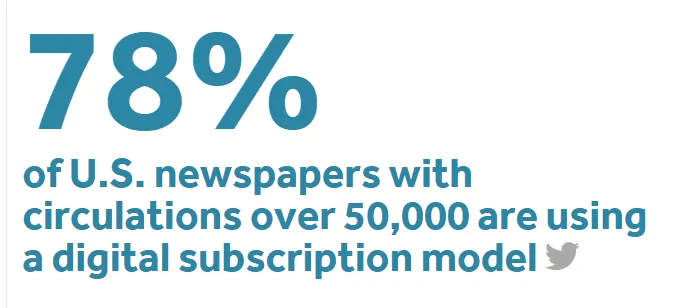
View from the executive suite: 20-somethings will turn to newspapers

10 keys to newsroom transformation
 Steve Buttry, a longtime digital pioneer, agent provocateur for newsroom change and currently the Lamar Family Visiting Scholar at Louisiana State University, has done a series of blog posts over the past week on the “Four Platform Newsroom” effort of the former Scripps newspapers.
Working with the Knight Digital Media Center at the University of Southern California at Annenberg, the “Four Platform” program set out to “transform” the newsrooms of the 13 newspapers then owned by E.W. Scripps and now known as the “Baker’s Dozen Newspapers” of the Journal Media Group.
Google most trusted source for news and information
Newspapers, and legacy media in general, have always thought that a key competitive advantage is being viewed as a “trusted source” of news and information.
Freedom of speech often takes courage
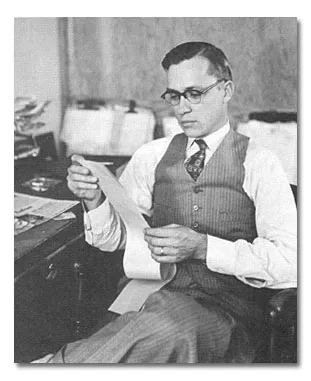 Good watch for this holiday weekend, “The Editor and the Dragon,” the story of W. Horace Carter (Jan. 20, 1921 - Sept. 16, 2009), a community newspaper editor in Tabor City, N.C., who courageously editorialized against the Carolina Ku Klux Klan in the 1950s as the organization was gaining power in the region around this town on the North and South Carolina border.
An ancient list of digital newspapers
David Carlson reminded me today of a list I created in November 1993 of all the U.S. newspapers I knew of that had electronic new services.
Good reads on the large life of John Seigenthaler
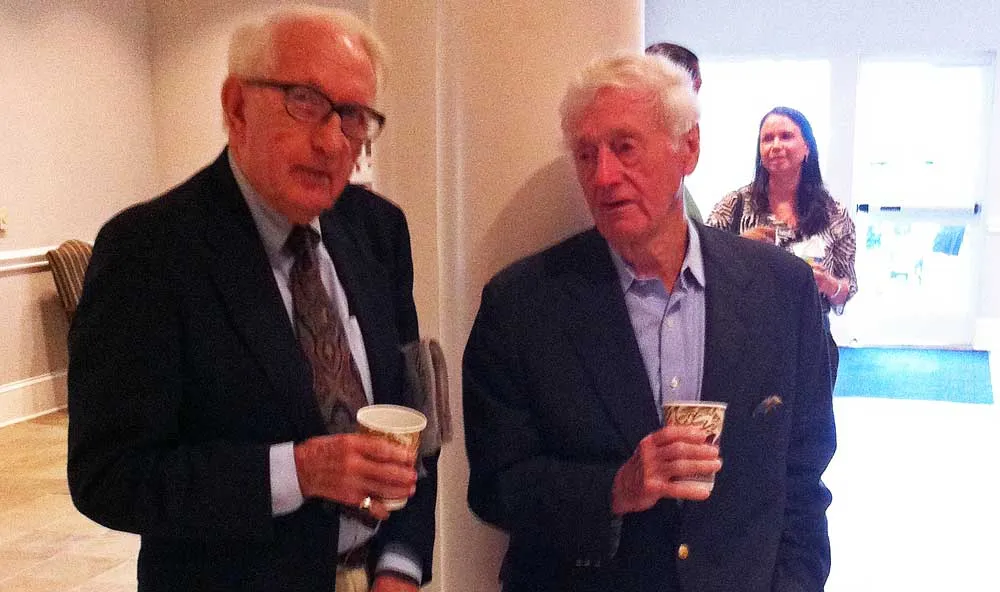
Reaction to the death of John Seigenthaler
Another year, another year older
Researcher Greg Harmon of Borrell Associates says the average age of a print newspaper reader is 57 and the average newspaper web visitor is 51. Saying the industry’s aging demographics ought to have “everyone’s hair on fire,” Harmon notes that newspaper readers have been getting a year older every year for more than a decade.
The weight of establishment and tradition
A great piece from Om Malik on media. There’s lot of food for thought in this piece.
Skillz for journalists
Good news for training in the newsroom.
Digital paywalls are the newspaper model now
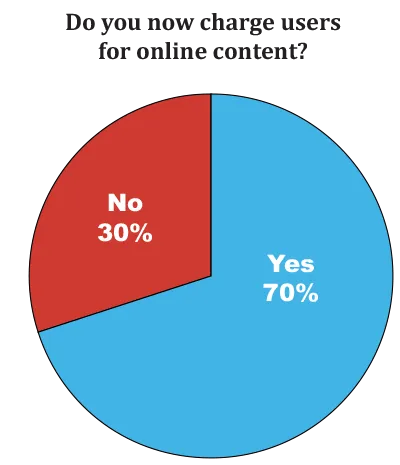 2013 was the year when paywalls became the norm for newspapers.
In search of the formula for gut instinct
Will news judgment eventually be reduced to a formula that can be charted or is it best practiced by those, like Neetzan Zimmerman, with a particularly good gut instinct for what is news, or at lesat what will grab reader’s attention?
Or, like in baseball, will there be quite a bit of space for both?
What does a graph like this mean for a newsroom?
Brian Abelson would like to come up with something more insightful than Gawker’s pageview chart and has a concept of “Pageviews Above Replacement” that might turn out to a Money Ball statistic for newsrooms.
In briefest of terms, Abelson defines Pageviews Above Replacement, or PAR, as how well an article performs in comparison to similar articles that received similar levels of promotion.
While still early in his work, he has identiifed 10 factors that seem to predict how a story will do at The New York Times:
Media groups protest lack of photo and video access to Obama
ASNE, APME and a host of other organizations protested Thursday the lack of access to photograph and video President Barack Obama performing official duties. We wrote about this issue on Oct. 30, 2013..
Q&A with BH Media Group CEO Terry Kroeger
Warren Buffett’s “newspaper guy,” BH Media Group CEO Terry Kroeger answers questions from editors at the Associated Press Media Editors national conference on Oct. 30, 2013 in Indianapolis.
White House photo access controls public image
You may have seen many photos of President Barack Obama in his office. But did you know neatly all of those have been taken by the official White House photographer and released to the media.
Pushing the reset button in the newsroom
When does a newspaper paywall work?
Phil Bronstein, former executive vice president at the San Francisco Chronicle, says paywalls alone won’t fix the broken journalism model.
(h/t Danny McCall)
The model just went away
“The disruption was fundamental. Knight Ridder saw it earliest, experimented the most, worked the hardest - and it doesn’t exist anymore. Their top budget (for innovation) was $1 million - which doesn’t amount to the sushi budget in Google’s cafeteria.”
Does the audience even need journalists … or photojournalists?
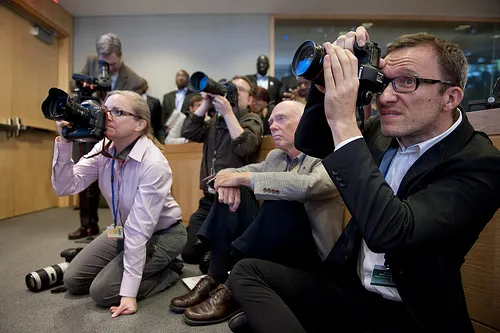
Tips on comment management
New post by @saduros: Tips on keeping comments constructive from @jacklail bit.ly/10ffDlw
— Knight Dig Media Ctr (@KDMC) March 26, 2013 *[]: 2007-12-12T15:21:48+00:00
‘Without fear or favor’ could be an exception in journalism’s history
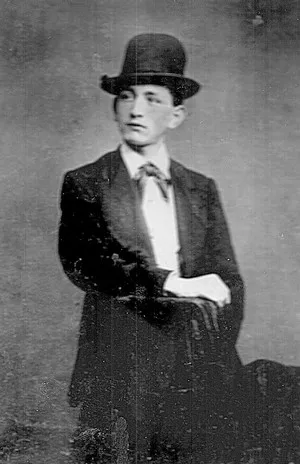 Some 117 years ago, Adolph Ochs, who began his career in Knoxville before buying a newspaper in Chattanooga, published a set of principles for his newest newspaper in which he said it would “to give the news impartially, without fear or favor, regardless of party, sect, or interests involved.”
Ochs, but 38 at the time, wrote that in The New York Times. It was a winning business model. “Without fear or favor” became a journalism credo that served journalism and the business of media well for over 100 years.
But former Newsweek editor, Pulitzer Prize winner and historian Jon Meacham said the course Ochs set may turn out to be a brief exception for journalism. The media of the 1700s and 1800s was highly partisan and the media seems to be returning to those roots today. That is where revenue is flowing, Meacham said, and you go hunting “where the ducks are.”
Frank Munger does ‘How I Got That Story’
Knoxville News Sentinel senior writer Frank Munger will be doing a “How I Got That Story” webinar on March 20.
The webinar is being held by the Scripps Howard Foundation; register here for the free one-hour session.
He’ll be using his coverage of the July 28, 2012 break-in at the Y-12 Nuclear Weapons Plant in Oak Ridge, Tenn. by three protesters to talk about:
Being a jackass is a NCAA sanctioned event
 A trio or more of media groups have been asking the NCAA to sit down and talk about changes it has ordered in the coverage of NCAA events that are detrimental to news organizations and their audiences.
So far, the NCAA just hasn’t found the time for a sitdown; no doubt, busy counting the cash from some TV contract.
A resolution for 2013: Critically rethink news beats
A good 2013 resolution for editors in newspaper newsrooms is: Critically rethink beats.
Here’s another ‘time-suck’ post
Newspaper, communications school, federal courts partnering in news coverage

News organizations are busy transforming themselves as their traditional business models change, forcing hard decisions in newsrooms, but it has also provided the impetus for thinking above new ways of covering news.
A journalist who started working as a reporter some 55 odd years ago, helped come up with an innovative idea that was announced Wednesday night at the Associated Press Media Editors Conference byofficials from Middle Tennessee State University.
Seven journalism students from MTSU’s College of Mass Communication will cover the U.S. District Court in Nashville in a partnership involving the university, federal judges and The Tennessean, which will publish the student articles. Gannett’s other Middle Tennessee newspapers will also use the stories.
John Seigenthaler, founder of the First Amendment Center in Nashville and who began working as a reporter for The Tennessean in the 1950s and went on to become its editor and publisher, approached and promoted the cooperative news gathering plan to the school, the court and the newspaper.
In recognition of his efforts, MTSU President Sidney McPhee announced that the project would be called the Seigenthaler News Service.
The students will be directed by Pulitzer prize-winning journalism professor Wendell “Sonny” Rawls Jr. and former Tennessean reporter and editor Dwight Lewis. Rawls said there are few similar efforts in the United States and none focused on covering federal courts and law enforcement. There already are discussions at MTSU about how to expand the concept to other areas of news coverage, he said.
As part of its support of the project, the federal court is providing a room for the students to work out of. In addition to the District Court, the students will cover the U.S. Attorney’s office, the FBI, DEA, ATF and other federal law enforcement and court-related agencies.
This looks to be a win-win all around. The students will get invaluable experience, course credits and clips. The newspaper will get additional content that will bolster their court coverage. Judges want the public to know about the court system’s activities.

Get a great deal on APME’s Social Media Day
As part of its national Conference, Sept. 19-21 in Nashville, the Associated Press Media Editors is offering a special one-day rate of $35 for the Social Media Day on Friday, Sept. 21.
This is a great opportunity to hear some great panels and get some takeaways you can start using immediately.
It’s open to line editors and top editors at newspapers, news directors at television stations or journalism educators. APME President Bob Heisse has the details.
You’re likely to first find out about this on Twitter or Facebook
I’m getting excited about a great panel I’m moderating at the Associated Press Media Editors Conference in Nashville on Friday, Sept. 21, 2012. You remember rock super-groups? I think I’ve got a digital super-group for the panel.
Maybe newsrooms need to kick the front page habit

 I recently did an email Q&A with Charles Duhigg, the New York Times reporter who wrote The Power of Habit: Why We Do What We Do in Life and Business
One chapter of Duhigg’s book deals with civil rights pioneer Rosa Parks’ Dec. 1, 1955 refusal to give up her seat to a white passenger on a city bus in Montgomery, Ala. and how social habits helped spark and sustain the famous Montgomery Bus Boycott and played a pivotal role in creating the Civil Rights Movement.
In addition to social movements, Duhigg explores how habits – good and bad – affect companies and how some leaders have reprogrammed habits and reshaped culture within their companies. Surely, if habits can help create and sustain social movements and affect some of the nation’s largest companies, they might have some use for transformating newspapers, who have floundered in adapting to change. So I saved for this blog one question and Duhigg’s answer from the email.
Q: As a person in an industry – Newspapers – undergoing great upheaval and transformation that is apparently lacking a Paul O’Neill or a Howard Schultz, are there lessons in what you learned about habits and successful companies that could or should be applied to newspapers?
Duhigg: Newspapers have organizational habits built around the front page - that’s how most newsrooms decide what is important, and it’s how editors transmit signals to reporters. As more and more readers go online, we need to figure out how to create habits that respond to more segmented audiences, and news cycles that have varying durations.
Top Photo: President Barack Obama sits on the famed Rosa Parks’ bus at the Henry Ford Museum following an event in Dearborn, Mich., April 18, 2012. (Official White House Photo by Pete Souza)

Let’s take a moment to bloviate on reporters

The old dog, new tricks problem
A great read for anyone worried about the newspaper business from John Paton, CEO of Digital First Media:
As career journalists we have entered a new era where what we know and what we traditionally do has finally found its value in the marketplace and that value is about zero.
Our traditional journalism models and our journalistic efforts are inefficient and up against the Crowd - armed with mobile devices and internet connections- incomplete.
Our response to date as an industry has been as equally inefficient and in many cases emotional.
“You’re gonna miss us when we’re gone” is not much of a business model.
Quick, who’s a complacent monopolist?
The Economist called Kodak a “complacent monopolist.” Does that sound like any other company you know … or maybe an industry?
Newspapers thought it would always be so
Journalism professor Jay Rosen posed this question on Sunday:
@johnrobinson Now if we could only figure out when (for the readers) “our newspaper” became “the” newspaper… When and how… Exactly how.Sun Jan 01 19:10:29 via web Jay Rosen
jayrosen_nyu
A newspaper company invented the iPad
And you thought it was Apple. Silly you.
Samsung doesn’t think so and its attorneys have set out to prove that.
Who invented the iPad? Maybe onetime newspaper goliath Knight-Ridder.
Here’s tablet, digital paper pioneer Roger Fidler talking in the 1990s about a tablet whose vision is remarkably similar to the iPad of today. Fidler’s big problem in 1994. He thought it was just a tablet newspaper. Had he thought of Angry Birds and iTunes, the history of tech and the fortunes of the newspaper chain he worked for might have turned out vastly different.

Gannett, NYT launch comment system changes
Gannett Corp. and the New York Times have rolled out changes to comments on their web sites. Gannett, which had been piloting using Facebook comments (a Facebook account is required to comment), is switching all newspaper.com sites to it. The New York Times unveiled a “trusted commenter” system.
Both moves show media companies are still trying to find the right “voice” for their web site users. The dilemma is whether “read names” will not only “clean up” hateful comments, but also turn community conversation elsewhere.
Here are the latest links I’ve tagged in my Delicious comments collection.
- Gannett Blog: GCI switching all sites to Facebook commenting
-
[The case of anonymity in social media TechRepublic](https://www.techrepublic.com/blog/tech-manager/the-case-of-anonymity-in-social-media/7025) - Obit for a Flaming Troll - Noise - Jackson Free Press: Jackson, Mississippi
- The New York Times Loves Some Readers More Than Others - Brainstorm - The Chronicle of Higher Education
- Gannett requiring Facebook for posting
-
[Comments on Your Website: The Good, the Bad, and the Ugly The City Wire](https://www.thecitywire.com/index.php?q=node/19016) -
[Asheville publisher: Bringing civility to online discourse The Asheville Citizen-Times citizen-times.com](https://www.citizen-times.com/article/20111201/COLUMNISTS30/312010037/Bringing-civility-to-online-discourse?odyssey=tab%7Cmostpopular%7Ctext%7CFRONTPAGE) - The Times to Change Policy for Comments on Web Site - NYTimes.com
- Trusted Commenters - The New York Times
-
[New York Times overhauls comment system, grants privileges to trusted readers Poynter.](https://www.poynter.org/latest-news/media-lab/social-media/154615/new-york-times-overhauls-comment-system-grants-privileges-to-trusted-readers/) -
[More media outlets ban anonymous Web comments The Tennessean tennessean.com](https://www.tennessean.com/article/20111201/NEWS01/311300144/More-media-outlets-ban-anonymous-Web-comments?odyssey=tab%7Ctopnews%7Ctext%7CFRONTPAGE) -
[Anonymous Commenters: Cowards Or Contributors? Techdirt](https://www.techdirt.com/articles/20111103/06223116619/anonymous-commenters-cowards-contributors.shtml) -
[Study: Commenters on CNN.com may call you an idiot; on msnbc.com they tell you why you’re an idiot Poynter.](https://www.poynter.org/latest-news/romenesko/146666/study-commenters-on-cnn-com-may-call-you-an-idiot-on-msnbc-com-they-tell-you-why-youre-an-idiot/) - Small-Town Gossip Moves to the Web, Anonymous and Vicious - NYTimes.com
-
[Anonymous comments end at U-T, SignOn SignOnSanDiego.com](https://www.signonsandiego.com/news/2011/sep/11/commentators-will-have-to-get-real/) - Internet anonymity suffering scrutiny courtesy of the London riots
- Google, Facebook Now Dissuade Aliases on Profiles - International Business Times
- Can gamification help solve the online anonymity problem? — Tech News and Analysis
- Naming Names on the Internet - NYTimes.com
- What’s in a Pseudo-name? Privacy, Free Expression
- What
- Google is right to demand people use real names
- On Pseudonymity, Privacy and Responsibility on Google+ - TechnoSocial
-
[danah boyd apophenia](https://www.zephoria.org/thoughts/) - Caterina.net» Blog Archive » Anonymity and Pseudonyms in Social Software
Why newsrooms suck at digital first
‘Page One: Inside The New York Times’ is a must see for news junkies
elfa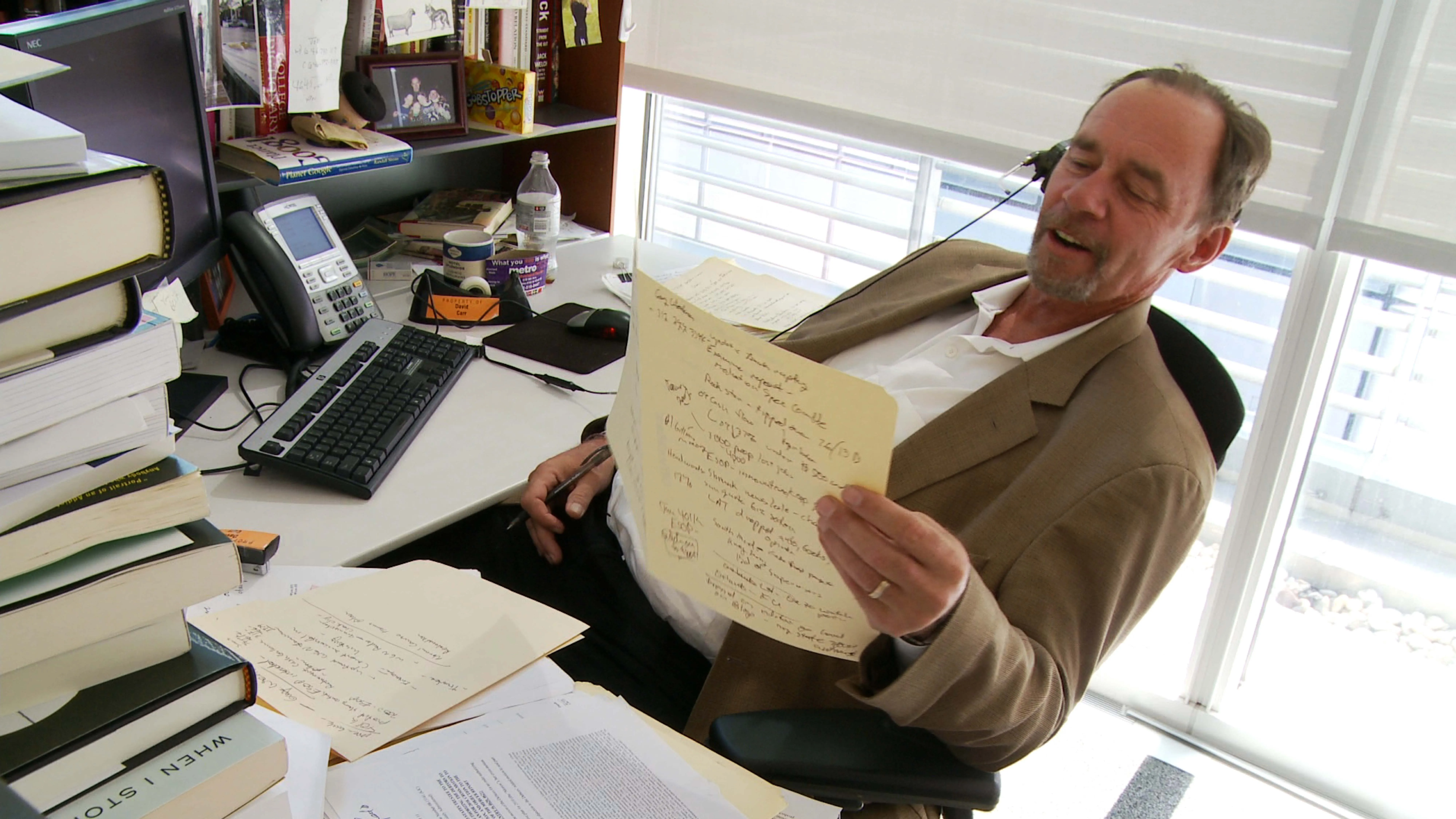
One of the personal treats of FutureMedia Fest 2011 at the Georgia Tech Conference Center on Tuesday was getting to see “Page One: Inside The New York Times.”
I’ll admit that before looking over the program for FutureMedia, I had never heard of the movie, which premiered in January at the Sundance Festival. You’ll be lucky to see it in a theater near you, I suspect, even an art house.
Judging from its Facebook page, it is being shown here and there. There was a showing at MIT in October with a panel discussion. Not many stayed on after a cocktail reception at the FutureMedia Fest (who knew there were other things to do in downtown Atlanta) to see the documentary.
But if you’re into newspapers and the changes buffeting them, it’s a must see. In late October, it was released on DVD and Blu-Ray
Jeff Jarvis and Clay Shirky are interviewed in the documentary as well as Alex Jones, who both wrote for and about The Times.
There’s former executive editor Bill Keller agonizing over layoffs (“we should be wearing bloody butcher smocks”) and holding budget meetings. There’s archive footage of Timesmen Turner Catledge and Howell Raines. There’s Gay Talesoe, who wrote one of the defining books on the paper (The Kingdom and the Power: Behind the Scenes at The New York Times: The Institution That Influences the World
It’s an inside-peek at the Gray Lady.
All good stuff if you love journalism and the New York Times.
But the star of the movie is David Carr, self-described former cocaine addict and single parent on welfare who turned his life around to marry the New York Times.
Carr, in the movie is a one of those one-of-a-kind newspaper characters, the kind journalists tell stories about over beers: irreverent, at times odd (well, maybe most times) and passionate, always passionate about his craft. His takedown of Newser’s Michael Wolff, as gifted as any with a sharp wit, but left speechless, at a panel will make you laugh.
The movie, directed by Andrew Rossi, and produced and written by Kate Novack and Ross, covers Carr’s reporting of the incredible piece on the disaster of the Sam Zell era at the Tribune Co. as well as the breakdowns involving Judith Miller’s Iraq coverage and the paper’s partnership (or was it) with Wikileaks.
There’s layoffs and iPads and pay walls and Twitter and corner newspaper hawkers. It’s the old and the new; the blemishes and the beauty; the tumultuous and the trivial.
And through all the twists and turns, the good times and the bad, there are those like David Carr who know in their hearts, it’s about fighting the good fight of journalism.
Finally watched/highly recommend: Page One: Inside the New York TImes https://t.co/2LYKrl4z Fascinating, honest, entertaining too.Sun Nov 13 15:27:18 via web Hiroko Tabuchi
HirokoTabuchi
Just another reason why local communities need local media
The Knoxville News Sentinel, my employer, has filed suit to unseal a secret file being used by defense attorneys in efforts to overturn convictions in the brutal torture and murders of a young couple in 2007. Evidence presented in the trials outaged the community.
Prosecutors and defense attorneys have a Tennessee Bureau of Investigation file that details how the judge who presided over the cases was abusing prescription painkillers during the trials (the story actually is more sordid).
The investigation eventually led to the resignation and disbarment of the judge, but the contents of the investigative file never came to light.
Now, defense attorneys are using that file to demand new trials for their clients even while it remains sealed under order from Special Judge Jon Kerry Blackwood.
“Evidence has been introduced, reliance upon it will be indicated and objections will be filed, all of which will be considered by the court and ruled upon in secret,” newspaper attorney Richard Hollow wrote. “To cloak this (information) in secrecy is an error of constitutional proportions.”
“The Christian/Newsom trials may have been the most important exercise of justice Knoxville has seen in many years,” News Sentinel Editor Jack McElroy said. “But now secret information is being used to argue that those verdicts be thrown out. The News Sentinel has a duty to challenge that secrecy and to try to bring to public light all the arguments and evidence influencing this crucial ruling.”
I won’t go as far as to say that only a newspaper could mount this war on local government secrecy; local TV stations have been willing to join in on First Amendment related issues in the past.
But I will say only local media have both the willingness, the motivation and the wherewithal to fight the issue in court.
Google and Yahoo and AOL and many others certainly have the wherewithal, but no willingness or motivation to fight a local battle. There may be individuals with the willingness or the motivation, but without the wherewithal for a protracted legal battle.
It’s a another touchstone of the importance of a vigorous and vibrant local media even in this Internet Age.
Or as McElroy said in his Sunday column:
“There are times when a newspaper has no choice but to fight to force the government to conduct its business in public.”
Tom Tomorrow on newspapers

Click on the image to see a larger version on the Credo Action Web site or see more Tom Tomorrow cartoons.
How ‘Deadline’ came to be
I shot a couple of short interviews with Curt Hahn and Hunter Atkins of the movie “Deadline,” which had its first private screening on Sept. 15, 2011 at the Associated Press Media Editors Conference in Denver. The movie is based on a true story and adapted from a novel, Grievances
It’s a cold case tale featuring investigative journalists. Some of it was filmed in the newsroom of The Tennesseean.
The real story involved a Charlotte Observer investigation of an unsolved murder in South Carolina. In the movie, the location has been moved to a Nashville newspaper and a small town in Alabama because the movie production company is based in Nashville.
Look for it in your town next year.

If managing story comments are a pain, read this
If you aren’t convinced that world peace is unachievable, read the online comment’s section of a newspaper sometime.
Newsrooms that say they are succeeding at the ‘two-way street’ are mostly lying
new post from me at GigaOM: “Memo to newspapers: The future of media is a two-way street” https://t.co/RzGJPdx tip @mediagazerWed Aug 17 22:17:07 via TweetDeck Mathew Ingram
mathewi
Redding.com tries gamification to improve comments

There’s a 100 million things you could say about this
Obviously Arianna Huffington views comments as an asset to Huffington Post. The site just passed its 100 millionth comment and averages 175,000 a day.
Quick show of hands. How many newspaper editors see comments as an asset of their websites? I thought so.
Despite whatever one thinks about Arianna Huffington as a journalist; one thing’s certain: Huffington Post has a better handle on how to manage and grow comments than nearly all newspapers in America.
Huffington Post uses a combination of humans and technology to manage the dialy deluge of 175,000 comments:
Although moderation goes a long way toward ensuring the quality of the comments, HuffPo also does an excellent job of surfacing the remarks that are most relevant to individual readers. If you connect to Huffingtonpost.com using your Facebook or Twitter login, you’ll see comments posted by people in your network above regular comments. This allows for high-frequency group debate amid the broader public conversation.
The rest of the comments are displayed not chronologically, but ordered by popularity and a user’s commenting history.
Recognition is another important factor, says Huffington. Readers can earn badges and privileges (such as the ability to author posts using rich text) for sharing and commenting on content. Soon, Huffington Post CTO Paul Berry says, users will be able to award each other badges to recognize commenters who are funny (“LOL” badge) and insightful (“pundit” badge). Leaderboards will also show commenters that are worth following.
First Amendment found damaged in storm cleanup
From the Chattanooga Times Free Press:
Last Thursday, one of our reporters, Kate Harrison, was following volunteers cleaning up debris in the heavily damaged Apison area when she was confronted by three veteran, high-ranking public officials who ordered her to stop taking photographs. The officials – Hamilton County Sheriff Jim Hammond, Chattanooga Police Chief Bobby Dodd and Hamilton County’s director of emergency services, Don Allen – clearly should have known that Harrison’s work was constitutionally protected. That they could occupy such high positions and not know, or care about, or respect the nation’s First Amendment rights boggles the mind.
John Paton’s 10 Tweets to Transform Newspapers
I bet you first saw this online
Now we know that 2010 was the year that the declining line of newspaper readership and the growing line of online news consumption crossed.
Eric Sass in MediaDailyNews:
The inevitable shift finally came in 2010, as more Americans got their daily news from online sources other than print, according to the Biannual News Consumption Survey from the Pew Research Center for the People & the Press. The findings were released this week as part of Pew’s annual overview of the news media.
Specifically, Pew found that the proportion of U.S. adults who said they got their news online the day before increased from 29% in 2008 to 34% in 2010. The proportion that cited print newspapers as the source of their recent news fell from 34% in 2008 to 31% in 2010.
Clark Gilbert and the ‘Inscrutable Dilemma’
Clark Gilbert, speaking to newspaper industry executives earlier today at the Multimedia Key Executives Conference said:
“A complete transformation is necessary to move forward and to be competitive” with new businesses entering the marketplace, adding that he believed the industry has a three-year window to make the necessary changes.
“The industry is forever broken. It will bounce again, but three years from now will be the permanent reality.”
Plan now for the next national breaking news story in your community
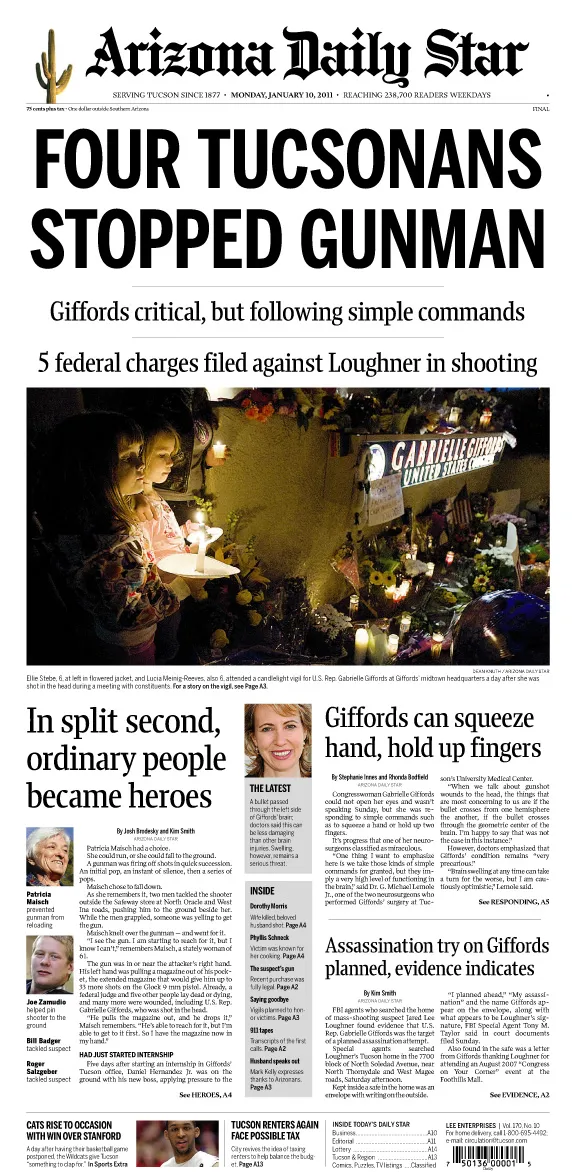 Arizona Daily Star managing editor Teri Hayt shares some lessons learned for the newspaper in the Tucson shootings.
Would you be ready?
Related articles
Top newspaper stocks in 2010
The two strongest gainers were A.H. Belo and E.W. Scripps
Article comments: The Abilene experiment
An interesting approach to managing comments by editor Barton Cromeens at the Abilene Reporter-News: Get the commenting community involved and work hard at making comments add value:
The First Amendment is under attack.
Ironically, the attacker is a free press that is frustrated with a changing media landscape and that is reacting poorly to a populace that is equally, if not more, frustrated by unmitigated, unrestrained vitriolic online commentary.
Readers and communities are fed up. Demands and threats are being made.
The most common demand - put an end to anonymous commentary. The most common threats - litigation, withdrawal of financial support, discontinuation of readership.
Fixing errors online needs some correcting at news organizations
We in the press talk a great game about correcting our errors, but in the end do a piss-poor job backing it up. (An academic study of corrections found that only two per cent of verified factual errors were corrected by newspapers. Perhaps piss-poor is too generous…)
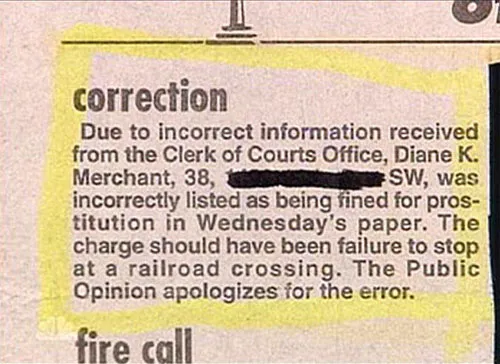
Henry King, one rare journalist
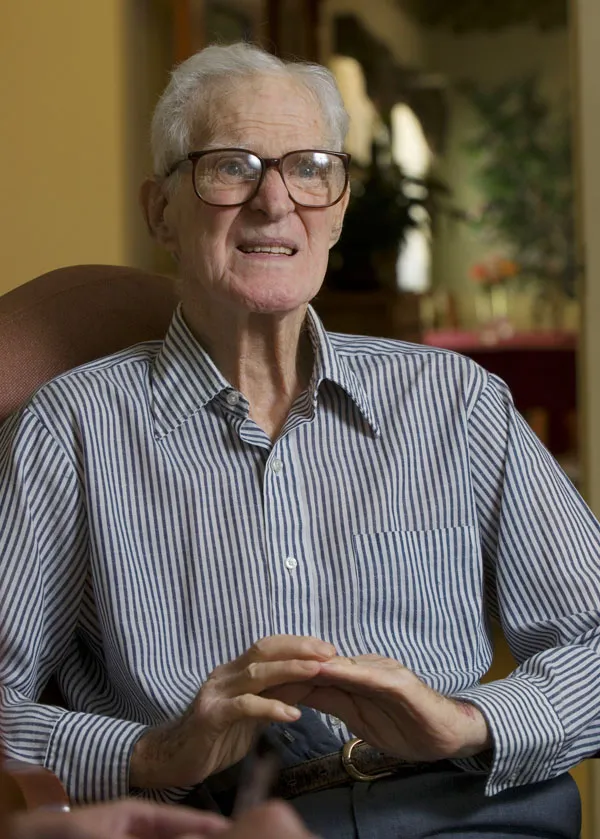 This week came news in my hometown newspaper that Henry King had died at age 91.
Copy editor massacre fears unfounded; it was just another dummy problem
LA Times’ East Zone had “dummy” headlines on entire page. Ops editor says it was glitch. 55,000 papers went out. https://lat.ms/ckOYmOFri Oct 29 04:18:43 via bitly Phil Kaplan
philkaplan
A download of great ideas for newspapers

Back in the day when type was hot
I agree with Julie Starr; these old newspaper videos from the 1950s are great. She has some others on in her blog post. Give them a look.
Somehow I don’t believe the “push this button” system we have today would make as interesting a video. Fifty years from now, however, printed newspapers themselves will seem as quaint and foreign as the production processes show here.
Do you realize, they printed pages of paper and delivered them, mind you, in the wee hours of the morning to your home. Can you imagine?
Related articles by Zemanta
Newsroom metabolism is a dichotomy problem
 Kitsap Sun Editor David Nelson has an answer for my question: Can newsroom change their “web metabolism?”
I wondered in a recent blog post whether newspaper newsrooms could change their “metabolism” to what the instant, want-it-now, always-on Internet demands while still predominately operating on what I’ll call a metabolism of setting deadlines and schedules and assignments based on printing cycles that at best are once every 24 hours and often just once a week (once a week sections, for example). Yes, within this printing press rhythm, newsrooms also are doing breaking news updates, and Twitter and Faceobook posts, live blogging, and sending text alerts, but often just a step or two late.
My post and Nelson’s are part of the conversation around the E.W. Scripps newspapers series on changes in the media landscape. Nelson notes newspaper newsrooms have the dexterously difficult task of grabbing the future and embracing the past simultaneously. He writes:
So there’s some dichotomy: The digital crowd thinks we’re stale and cannot move nimbly enough to be relevant online; the print readers are worried we’ll abandon them for the shiny new toy. That’s a timely conundrum at the Sun, where our readership is closer to being split than ever when comparing daily print subscriptions with a growing number of daily unique visitors to kitsapsun.com.
Opportunities for young journalists to get a paying internship
E.W. Scripps is recruiting journalists for internships that start as early as October chainwide.
The internships last 24 weeks and there’s even relocation money of $500.
CubReporters.org has some details. The News Sentinel, where I work, is looking for two page designers, but apply through the official site and not directly to the newspaper.
And did I say these are paid internships? They certianly are.
Related articles by Zemanta
Newspaper newsrooms need to adjust the metabolism
The Knoxville News Sentinel ran Part 2 of the Scripps Howard News Service package on the “Future of News” today. The first installment ran Sunday. (Other E.W. Scripps newspapers ran the series or parts of the series earlier. Several, like the News Sentinel, also did local pieces to go along with it.
My contributions were Q&As with Dave Morgan and Elizabeth Spiers. I mentioned the Dave Morgan piece in a Sunday blog post. Here’s one of the questions and answers from the piece with Spiers.
A: (I gave a talk about this a couple of weeks ago, so from my notes:) They don’t understand their audiences because they’re not used to using data aggressively.
They view their sites as mere brand extensions and fail to treat them as stand-alone media properties.
They don’t understand usability and make their sites pretty but impossible to navigate, and then naively think they’ll educate their users to find their content.
They don’t understand Web metabolism and produce content that’s stale.
They think Web content is inherently inferior when it’s merely different, and create inferior Web products as a result then wonder why they’re not succeeding.
They fail to monetize their products properly, then underpay talent and wonder why they can’t recruit good writers.
There’s a future in news
E.W. Scripps newspaper editors and online managers collaborated on a “Future of News” project this summer that ran in some newspapers last weekend and is on knoxnews.com today and Tuesday.
It was a challenge put forth by Chris Doyle, the company’s new vice president for content. It was part self-education and part reporting project for the group as Doyle and top managers in his division chart a course for the future. Editor Jack McElroy provides the big picture.
For part of my contributions, I decided I wanted to tap into the thoughts of a couple of smart people outside my familiar ground of newspapers. I reached out to Dave Morgan and Elizabeth Spiers. Both answered a series a questions that we are using as Q&As in the Future of News package.
The Q&A with Morgan, founder and chairman of SimulMedia, went online and in print today. The Q&A with Spiers, a media launch consultant, entrepreneur, and writer, runs Tuesday.
One the quotes I particularly liked in Morgan’s answers was his advice to journalism students:
You will have a great future if you recognize that there has never been a better time to practice great journalism; that great journalists are the eyes, ears and analysts for their audiences; that great journalists listen more than they talk and write; and that great journalists can now - more than ever before - get truly close to their audiences.
No longer is the media world one of a publishers-top editor-section editor-subeditor-journalist hierarchy. Today, audiences are in charge and they want direct access to, and interaction with, journalists.
Train, train
OK, Dolly Parton doesn’t have anything to do with this, but we should “train, train.”
Two training opportunities are coming up that might interest journalists in Tennessee (and elsewhere).
APME’s NewsTrain rolls into Nashville, Sept. 23-24.
Some heavy hitters will be on hand:
-
KEYNOTE SPEECH ON THURSDAY, SEPT. 23: TOM CURLEY, president and CEO of The Associated Press: “The Renewed Power of the Press”
-
KEYNOTE SPEECH ON FRIDAY, SEPT. 24: JOHN SEIGENTHALER, founder of the First Amendment Center: “The First Amendment, a Cornerstone of Democracy”
See the full schedule for the workshop at the John Seigenthaler Center and register.
A bargain at just $50.
Also at the John Seigenthaler Center is a Multimedia Boot Camp for Journalism Professionals and Educators Nov. 17-21, 2010.
Put on by the Freedom Forum Diversity Institute, “the multimedia training is tailored for journalists but open to anyone with an interest in multimedia storytelling, regardless of the individual’s background. For an additional charge, successful participants can earn 3 college credits. The courses are accredited by the Media Studies Department of Belmont University, which awards the credits.”
Tuition is $850. Registration is open until Oct. 31 or until the class is full..

That vexing pay wall question
A University of Kentucky gradudate student is doing an online survey on whether readers would pay to access newspaper content. Help him out by taking the survey.
Hear a distrusted media source discuss the distrusted media
I’ll be on George Korda’s “State Your Case” radio show form 1-3 (eastern) today. The show is on Newstalk 98.7 FM and is streamed on the web.
From, 1-2, I’ll be talking about near-record-low confidence in newspapers and television news. A recent Gallop organization poll found that those with “a great deal: or “quite a lot” of confidence in newspapers remains at a low level and the percentage dropped to a 20-year low for television news. Some solace, however, was that both rate higher than Congress. Maybe we need to distribute these with each copy?

From 2 to 3 p.m., I’m hanging around as friend and newspaper consultant Kevin Slimp talks about his recent customer experiences with Delta Air Lines. A frequent traveler to speaking engagements and workshops around the country, his summer of flying has been more about sitting in airports than flying. He started sharing his experiences on his Facebook page; and received support and war stories from many other weary airline passengers.
Should be fun. The show is on the same station, but it has a new home at 98.7. It’s also streamed on the Internet.
A distrusted news source
With nearly all news organizations struggling to keep up with the up-to-the-minute news cycle and to remain profitable in the process, Americans’ low trust in newspapers and television news presents a critical barrier to success. The Pew report asserts that 80% of new media links are to legacy newspapers and broadcast networks, making clear that traditional news sources remain the backbone of the media. But so long as roughly three in four Americans remain distrustful, it will be difficult to attract the large and loyal audiences necessary to boost revenues.
Not everything stays in Vegas
E.W. Scripps editors, digital managers, corporate interactive folks and corporate top exductives gathered in Las Vegas last week for two days of meetings. One of the exercises we did was to sit down for a short video on journalism and Scripps. Above is the one I did and here is where you can find the rest.
iPad apps to force website pay walls
Anonymous comments are the stuff sane people wouldn’t write
AP ripe for disruption by Web platform
Watch live streaming video from disrupt at livestream.com
Toast of the journalism trade
 In an industry hard hit by declining fortunes, layoffs, furloughs, pay cuts and dizzying org-chart reorganizations, there’s been something that has brought smiles and way-to-go comments from many a journalist.
It’s the story, as Bristol Herald Courier Editor J. Todd Foster has put it, of the “little engine that could.”
It’s the story of how a reporter, just one of seven in its newsroom at the Bristol Herald Courier, won the prestigious Pulitzer Prize for Public Service as well as awards from the Scripps Howard Foundation and other journalism contests.
It’s a story of how a newspaper took seriously its watchdog role and tackled a tough, complex story requiring hours of research, hundreds of interviews, several Freedom of Information Act requests and the analysis of thousands of financial payments.
The effort involved investigative reporting, the kind of reporting it’s exceedingly hard to do in addition to the daily routine.
And, it wasn’t even in the area where the newspaper now circulates. It is a story that others had failed to do and that even it had taken pass on at least twice.
“It’s why newspapers will continue to survive in some form,” Foster told an Associated Press reporter of Gilbert’s work. “Nobody else is going to do this sort of reporting.”
I’ve been two journalism award dinners in Tennessee in the last couple of weeks and have seen the same reaction at both.
At the Tennessee Associated Press newspaper and broadcast awards banquet on May 8 in Nashville, the reporter who won the Pulitzer, Daniel Gilbert, was the speaker and took home an armload of awards.
Last weekend in Knoxville, his editor, Foster, walked out of the East Tennessee Society of Professional Journalists awards banquet into a rainy evening with a box of 20 awards, several of which were for Gilbert’s work in exposing problems with gas royalty payments to landowners in the dirt-poor mountainous counties of Southwest Virginia.
In both cases, the Pulitzer win was recognized with hearty applause and congratulations.
Any reporter who has been at a small paper (and I have) or a mid-size paper can appreciate the gravity of the Bristol newspaper’s accomplishments.
There’s no huge staff nor army of assistants. “Daniel Gilbert is still a reporter here. I’m still the editor. And like we did eight days before the Pulitzer announcement, we will send Daniel to cover an Easter egg hunt if it’s his turn in the weekend rotation,” Foster wrote in a recent column.
When the announcement came, they toasted with $4.99 bottles of champagne that Foster bought and threw in his trunk just in case.
For journalists outside of the big metro newspapers, $4.99 champagne never tasted so good.
In the photo above, Bristol Herald Courier Publisher Carl Esposito (center) and Managing Editor J. Todd Foster (right) yesterday toasted the Pulitzer Prize for public service won by the newspaper. The eight-day series was written by Daniel Gilbert (left). David Crigger / Media General News Service
![Reblog this post [with Zemanta]](https://img.zemanta.com/reblog_c.png?x-id=f6eb7822-b730-4469-b58d-e5dbdc1ca6df)
Ruminations on news
Blogger and professor Jeff Jarvis, Steve Coll, former managing editor of the Washington Post and of the New America Foundation, and John Sturm of the Newspaper Association of America on the future of news.
(viaBuzzMachine)
Possibly related articles by Zemanta
Newspaper editors seeing more upside than broadcast counterparts
It’s tough in newspaper newsroom, but it may be tougher in broadcast newsrooms. A Pew Research Center’s Project for Excellence in Journalism survey done in association with the American Society of News Editors and the Radio Television Digital News Association finds:
Broadcast news executives are noticeably more pessimistic about journalism’s future than editors at newspaper-based operations. Broadcasters think their profession is headed in the wrong direction by a margin of nearly two-to-one (64% versus 35%). By contrast, editors working at newspapers were split (49% wrong direction versus 51% right direction). A year ago, journalists who were members of the Online News Association surveyed by PEJ fell in between these two, 54% wrong direction, 45% right.
25 ways to save newspapers
I’ve even tried No. 12, and I’ve heard some that should have made this list seriously suggested in brainstorming meetings.
Saving newspapers
(via Reportr.net)
Newspaper paywalls would be a ratings hit for local TV stations
Nice interview with E.W. Scripps CEO Richard Boehne over at TVNewsCheck, but I hate it when they call the company I work for “venerable.” Sounds so very musty.
Some selected quotes, but read the whole thing:
On online as a business:
There’s a reasonable amount of potential and it’s the same for the TV stations. TV stations have every bit the opportunity that the newspapers have and some would argue they have a better opportunity. Thus far, they have not taken advantage of that and in many markets they’re well behind the newspapers. But they’re catching up.
As strange as it sounds, we are focusing more and more on print and online as separate businesses and not the same.
Michael Wolff says: Just Do it!
For all of us in the actually Internet news business (as opposed to people in the business of putting up stuff from another news medium on the Internet), the other guys charging for content is what we’re waiting for. It’ll define the market. You can pay for that version of the news. Or take our version for free. Two models, two different forms. Let the market decide (and quite a surprising decision it will be).
Run the marathon; not the sprint
Spot on predictions so far.
Make it a talker
I want to give you more, not less. I don’t think McDonalds will assume that as long as you keep it in a yellow box, people will buy a smaller, drier Big Mac. Yet our industry seems to think people are so obligated to buy it, we can make something smaller and drier and people will still buy it. It’s crazy. You have to create something that, whatever’s in it, people in town are all going to be talking about. That’s the edge that we’ve lost.
Newspapers used to be seen as a utility. People used to ask, “Do you take the newspaper?” What we have to produce now is a product backed by marketing strategies that compels people to buy the product. It has to be of great value.
If we could only get you to screw off more at work
… and at home, too, for that matter.
However, visitors to online newspaper sites don’t spend a lot of time there. The average amount of time looking at online news is about 70 seconds a day, while the average amount of time spent reading the physical newspaper is about 25 minutes a day. Not surprisingly, advertisers are willing to pay more for their share of readers’ attention during that 25 minutes of offline reading than during the 70 seconds of online reading. So even though online advertising has grown rapidly in the last five years, it appears that somewhat less than 5% of newspapers’ ad revenue comes from their internet editions, according to the most recent Newspaper Association of America data.
There’s a reason for the relatively short time readers spend on online news: a disproportionate amount of online news reading occurs during working hours. The good news is that newspapers can now reach readers at work, which was difficult prior to the internet. The bad news is that readers don’t have a lot of time to devote to news when they are supposed to be working. Online news reading is predominately a labor time activity while offline news reading is primarily a leisure time activity. One of the big challenges facing the news industry is increasing involvement with the news during leisure hours, when readers have more time to look at both news content and ads.
What to do next
Just got a copy of Mark Briggs’ latest book Journalism Next: A Practical Guide to Digital Reporting and Publishing
Some of efforts we have been doing at the Knoxville News Sentinel are highlighted.
He visited Knoxville during his research for the book. In fact, the book has a bit of a Knoxville flavor. In addition to some people at the News Sentinel, Briggs recognizes Patrick Beeson of the Knoxville-based E.W. Scripps Interactive Newspaper Group (SING) and Jim Stovall of the University of Tennessee in the acknowledgments.
Briggs is a frequent presenter at journalism and media conferences and previously wrote “Journalism 2.0: How to Survive and Thrive.”
In this book, a cookbook of sorts of journalism and technology, Briggs tries to help readers connect the dots between technology and digital concepts and tools to the core principles of good journalism.
He does a good job. Give it a read.
Related articles by Zemanta
Burn the boats?
 Here are some excerpts from an Eric Schonfeld post on TechCrunch about an interview with Marc Andreessen.
Andreessen is the guy who co-authored the early Web browser, Mosaic, which later became the Netscape browser. He co-founded Ning.com and is investor in a slew of other Internet companies, including Digg and Twitter.
The “burn the boats” reference refers to an action Hernando Cortes ordered when he came to the New World. Andreessen’s advice to traditional media companies, ironically, comes at a time when their boats are floating higher. The stocks of several have been on the rise, a few are at 52-week highs, driven by cost-cutting and an improvement in what had been anticipated in the ad market. But the view isn’t particularly new for him; he’s said as much a year ago.
From Schonfeld:
We got to talking about how media companies are handling the digital disruption of the Internet when he brought up the Cortes analogy. In particular, he was talking about print media such as newspapers and magazines, and his longstanding recommendation that they should shut down their print editions and embrace the Web wholeheartedly. “You gotta burn the boats,” he told me, “you gotta commit.” His point is that if traditional media companies don’t burn their own boats, somebody else will.
Andreessen asked me if TechCrunch is working on an iPad app or planning on putting up a paywall. I gave him a blank stare. He laughed and noted that none of the newer Web publications (he’s an investor in the Business Insider) are either. ““All the new companies are not spending a nanosecond on the iPad or thinking of ways to charge for content. The older companies, that is all they are thinking about.”
Talking about paywalls and paid apps is like saying, “We know where the market is and we are not going to go there.” Print newspapers and magazines will never get there, he argues, until they burn the boats and shut down their print operations. Yes, there are still a lot of people and money in those boats–billions of dollars in revenue in some cases. “At risk is 80% of revenues and headcount,” Andreessen acknowledges, “but shift happens.” You’d have to be crazy to burn the boats. Crazy like Cortes.
Just another crazy reason for newspapers
How Will The End Of Print Journalism Affect Old Loons Who Hoard Newspapers?
Click on the text link if the embedded video doesn’t seem to want to play.
Newspapers will flourish while they flounder in 2010
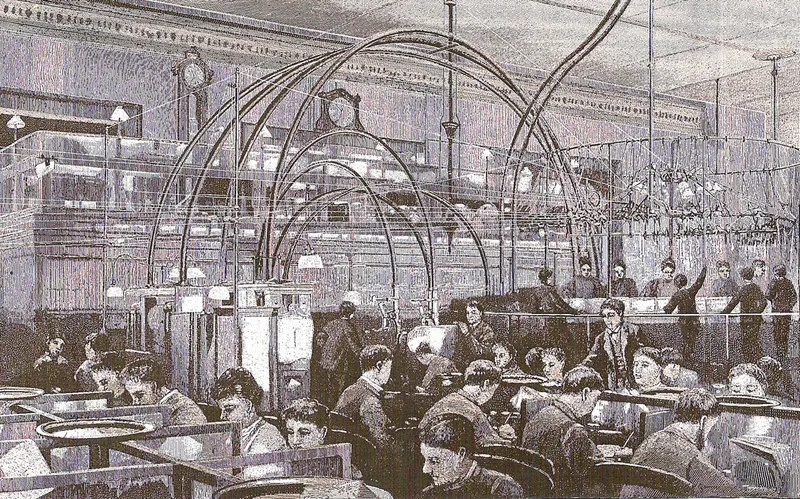 A prediction about the newspaper industry:
All those papers which serve merely as vehicles of intelligence will be destroyed
Why Examiner.com’s traffic is growing through the roof
Much to my chagrin, I’ve been noticing Examiner.com versions of stories we’re covering show up prominently in Google search results while our original journalism on knoxnews or govolsxtra is buried.
It happening a lot and not just to the sites I manage.
Examiner.com, a collection of sites that Time magazine cattily describes as “neither advancing the story nor bringing any insight,” is the fastest growing news domain with Nielsen reporting a stratospheric 228 percent increase in audience in November while the big mainstream news sites like CNN.com and MSNBC.com had double-digit declines.
A poster on the Google News forum said: “This is not a reputable form of news. Any half-brained twit can write for them (and do). It’s more like social networking as it is full of opinions and skimpy on facts”
But Google’s famously secret algorithms keep tilling fresh Examiner.com stories to the top of search results. How does that happen?
Time answers the question like this:
So why does Examiner.com’s fairly superficial posts on the big stories of the day often end up near the front of Google News’ queue? “It’s not a trick,” says (CEO Rick) Blair. “We have almost 25,000 writers posting 3,000 original articles per day.” Examiners take seminars on writing headlines, writing in the third person and making full use of social media, all of which are Google manna. But Blair thinks it’s mostly the scale of the operation that makes Examiner.com articles so attractive to search engines, from which more than half of the site’s traffic comes. That is, by stocking the lake with so many fish every day, Examiner.com increases the chances that Google trawlers will haul one of theirs up.
When everybody says sell, it’s time to buy
Newspaper companies abandoned by “savvy investors” as dinosaur stocks have been beating the Dow over the past 12 months – handily:
Those beating the Dow were: New York Times (+25%), AH Belo (+126%), Gatehouse (+350%), Lee Enterprises (+763%), McClatchy (+296%), Journal Communications (+56%), EW Scripps (+208%), Media General (+388%), Gannett (+65%) and News Corp. (+57%). Only Washington Post Co. (+6%) lagged the market.
Tennessee Newspaper Network takes another step in its growth
The four largest newspapers in Tennessee are expanding content sharing to collaborative coverage in the Tennessee gubernatorial race.
The first result of that is a piece on the finances of the GOP candidates from the Knoxville News Sentinel’s Tom Humphrey that is on the front pages of the Sunday print editions and the Web sites of all four news organizations.
Certainly, not the first newspaper content sharing agreement in the country, the group of newspapers called the Tennessee Newspaper Network is becoming more interesting with ambitious plans for cooperative coverage of who will be Tennessee’s next governor with plans for a fact check tool, issue comparison tools, jointly funded polls, the ability to hold candidates accountable if they say one thing in one end of the state and another on the other end, and possibly jointly sponsored debates.
With just a handful of written rules and simple procedures for exchanging articles and other content, the four Tennessee editors, who work for three different media companies, have built a good deal of trust among themselves in the last year that sharing content can work to benefit their readers and, by extension, their organizations. The cooperative coverage (and I think cooperative may be a better word than coordinated) is another sign that the Tennessee Newspaper Network is maturing from experiment to daily used resource.
Of course, a news cooperative that all participate in has existed for years. The Associated Press does describe itself as a “news cooperative,” but most its interactions with its “members” feel more like vendor-customer relationships rather than the collaborative approach of the newspaper editors.
Critics might argue the result will be less diversity in coverage and views. I find that doubtful, unless you think four versions of the same press conference coverage is diversity. It rarely is. Now the four editors can spread their resources to more stories. And it’s my guess that the odds are less than one in four that all four will endorse the same candidates in the primaries.
The four editors talked about the Network in their columns today:
This approach will result in more statewide watchdog journalism produced by some of the best reporters in Tennessee. At the same time, the individual newspapers will be able to devote more of their resources to important local stories without shortchanging state coverage.
The big winners will be the readers of newspapers and Web sites across the state.
Training and focusing on content quality even in tight times
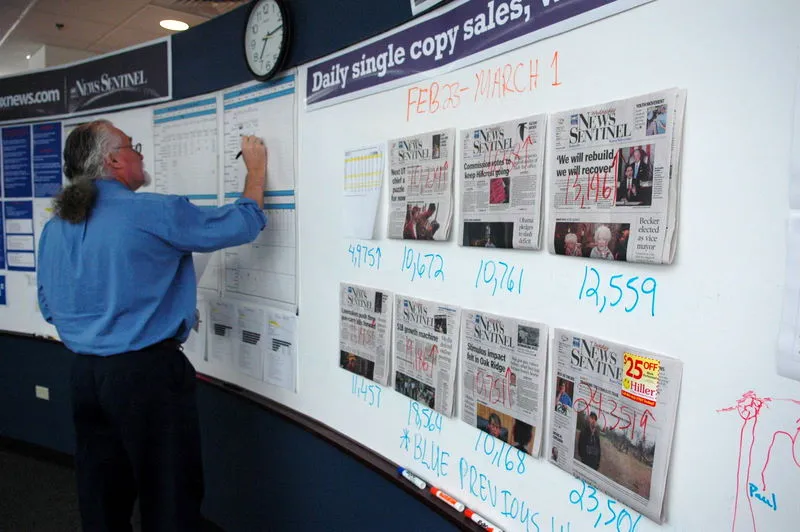 E.W. Scripps CEO Rich Boehne is getting some kudos for focusing on editorial quality and training even as the economics of the media business have forced painful cutbacks.
A large training program focused on storytelling has launched amid the media industry recession for the company’s 10 TV stations.
“It’s very deep and broad training in storytelling,” Boehne told the Cincinnati Business Journal. “It’s an out-and-out investment in the quality of the content, training hundreds of people, with no other aim than to increase quality.”
Boehne said it is part of a strategy to ensure the company continues to provide compelling value to consumers. Another aspect measures and compares the company’s newsrooms.
“We measure percent of content that’s local. We measure story count. We measure head count in newsrooms. And we spend a lot of time saying, against some research, ‘Is it any good? Is our quality increasing or decreasing?’,” Boehne said.
In addition the corporate yardsticks, the Knoxville News Sentinel has one of the most extensive metrics initiatives among Scripps newspapers. Data is posted daily on a large board in the center of the newsroom called the Visual Communication Center (yeah, a consultant came up with that gem).
Among the measures: On-time performance in getting the paper out, number of corrections, number of Web first/Web only updates, number of videos posted, number of text alerts sent and most recent single copy sales. In addition, a comprehensive training matrix tracks newsroom training.
The business journal got react from well-known newspaper industry blogger Alan Mutter:
“I agree with him that quality matters,” said Mutter, a former Chicago Sun-Times editor whose well-known blog, “Reflections of a Newsosaur,” chronicles the daily newspaper industry’s troubles.
“It’s heartening to hear that kind of commitment at a time that’s quite challenging for publishers,” Mutter said. “It’s very squishy to prove or disprove the proposition.”
Ethics in journalism’s digital age
I’m talking to a group of faculty members at Hampton University this afternoon about journalism ethics in the digital world.. As part of preparing for that talk, I rounded up some journalism ethics links that I thought others might also enjoy. (Special hat tip to Steve Buttry and Bob Steele for their help.)
_
[You reporters] should have printed what he meant, not what he said. – Earl Bush, press aide to Richard Daley (more quotes here) _
* [Ethics of social media for journalists | Save the Media](https://savethemedia.com/2009/10/19/a-journalists-guide-to-the-ethics-of-social-media/)
* [Society of Professional Journalists: Code of Ethics](https://www.spj.org/ethicscode.asp)
* [SPJ Ethic Blog: Code Words](https://blogs.spjnetwork.org/ethics/)
* [Society of Professional Journalists: Ethics](https://www.spj.org/ethics.asp)
* [NPPA Code of Ethics](https://www.nppa.org/professional_development/business_practices/ethics.html)
* [Poynter Online - Ethics ](https://www.poynter.org/subject.asp?id=32)
* [Indiana University School of Journalism � Ethics cases online](https://journalism.indiana.edu/resources/ethics/)
* [OJR: What are the ethics of online journalism?](https://www.ojr.org/ojr/wiki/ethics/)
* [Nieman Reports | Ethical Values and Quality Control in the Digital Era](https://www.nieman.harvard.edu/reportsitem.aspx?id=100699)
* [Ethics Resources (Steve Buttry's great list of links)](https://www.notrain-nogain.org/Train/Res/Ethics/ETHIC.asp)
* [Steve Buttry: Resources for journalism educators on digital ethics, new business models, journalism � Pursuing the Complete Community Connection](https://stevebuttry.wordpress.com/2009/08/29/resources-for-journalism-educators-on-digital-ethics-new-business-models-journalism/)
* [Steve Buttry: Resources for journalism ethics � Pursuing the Complete Community Connection](https://stevebuttry.wordpress.com/2009/09/18/resources-for-journalism-ethics/)
* [Poynter Online - Talk About Ethics: Ask These 10 Questions to Make Good Ethical Decisions](https://www.poynter.org/column.asp?id=36)
* [Poynter Online - Talk About Ethics: Guiding Principles for the Journalist](https://www.poynter.org/column.asp?id=36)
* [The key to social media ethics: good judgment � Pursuing the Complete Community Connection](https://stevebuttry.wordpress.com/2009/10/15/the-key-to-social-media-ethics-good-judgment/)
* [Newpaper social media policies: Out of touch | Socialmedia.biz](https://www.socialmedia.biz/2009/10/02/newpaper-social-media-policies-all-miss-mark/)
* [The Huffington Post: Citizen Journalism Publishing Standards](https://www.huffingtonpost.com/2009/04/07/citizen-journalism-publis_n_184075.html)
* [J-Source: Ethical guidelines for editing audio](https://jsource.ca/english_new/detail.php?id=1638)
* [The Daily Tar Heel's policies | dailytarheel.com](https://dailytarheel.com/about/policies)
* [Knoxville News Sentinel Code of Conduct](https://docs.google.com/fileview?id=0BwLtt9KAddttOGFiMGIyYzEtYjI0Mi00ZDc1LTkyZTgtM2NjYzA4OGRjZDJm&hl=en)
* [Kathy English's Longtail of News (when to unpublish)](/pdf/apme-longtail-report.pdf)
Hauling a tool chest of ideas back from Missouri
The speed version of the better part of last week during my stay in Saint Louis. My hotel was just across the street from the arch, but, unfortunately, I never made it to it.
Here are some resources and thought-starters from the Associated Press Managing Editors “Inspiration Starts Here” conference.
Amy Webb did a rapid fire presentation on trends to watch. Val Hoeppner leveraged off Webb’s list of trends with a blog post with a list of cool resources and tools of particular interest to journalists and another set of resources was added to the APME09 twitter stream by the Journalists Toolbox.
And then there were three great innovations.
Jill Geisler of the Poynter Institute had some advice for managing change in a presentation called You’re Not Crazy, Clueless or Cruel; You’re Managing Change. She had some links:
Newspaper becomes the story in comment case
Some of the coverage of the federal subpoena for information about a commenter on the Knoxnews.com Web site.
Jack McElroy: KNS turns commenter info over to FBI
Newsroom cuts hurt economic health of newspapers
Interesting budget season reading (emphasis added is mine) from Editor and Publisher:
This summer, Esther Thorson, dean of graduate studies and research at the University of Missouri’s School of Journalism, as well as Shrihari Sridhar and Murali Mantrala from Missouri’s Trulaske College of Business, presented research taken from the extensive confidential financial data compiled in Inland Press Association’s annual Cost and Revenue Study.
They probed the spending on newsrooms, circulation and advertising sales and developed an econometric model to see how much revenue would be affected if the mix of spending was altered.
“Could they have distributed those dollars differently to make more money with good journalism?” Thorson asks. “And the answer is virtually always yes, very consistently across hundreds of newspapers. They under-spend in newsrooms by a pretty significant amount, and they overspend in circulation – though not nearly as much as they overspend in advertising.”
Specifically, their model suggests that “under-spending” in the newsroom isn’t just missing an opportunity for greater revenue – it actually damages the business. Cutting back investment in the newsroom just 1% is three times worse than the same percentage cut in circulation or distribution, and seven times worse than making that cut in ad salespeople. The deeper the newsroom cut, the worse the damage, this research contends.
Lessons from the Rocky
History at 11
 Google has a cute logo today celebrating its turning 11 (it was founded Sept 4, 1998).
It went public in 2004 so you can’t see the complete picture of the success the company has had in its stock chart, but nonetheless, its history is a phenomenal story.
Compare Google’s story with this chart of the newspaper industry that has been making the rounds of Twitter and blogs.
Newspapers even had a head start on the Internet, but Google thrived while newspapers have seen their fortunes precipitously decline.
What will the next 11 years hold?
Webinar Series coming on “difficult online news issues”
(I am doing the first of these Webinars on Nov. 5. I hope you’ll be able to join us.)
Poynter’s NewsU and APME to Kick Off Online Credibility Webinar Series: New Approaches to Dealing With Difficult Online News Issues
_The Poynter Institute’s News University (NewsU) today announced the launch of a new series of Webinars, presented in partnership with Associated Press Managing Editors (APME) and Canadian Newspaper Association (CNA), that introduces new approaches to difficult online news credibility issues. The Online Credibility Webinar Series begins on November 5, 2009, and runs through May 2010.
_
St. Petersburg, FL (PRWEB) September 23, 2009 – The Poynter Institute’s News University (NewsU) today announced the launch of a new series of Webinars, presented in partnership with Associated Press Managing Editors (APME) and Canadian Newspaper Association (CNA), that introduces new approaches to difficult online news credibility issues. The Online Credibility Webinar Series begins on November 5, 2009, and runs through May 2010.
“One of our missions at APME is to be on the front line in helping newsrooms set ethical and journalistic standards,” said Bobbie Jo Buel, APME board president. “These Webinars will help journalists tackle the very real and very hard credibility and values issues that editors everywhere are wrestling with.”
“It’s an important discussion at an important time,” said Howard Finberg, director of interactive learning at Poynter and its e-learning project, News University. “Poynter is excited to partner with APME and CNA in this effort to strengthen the credibility and quality of online news. What will make this Webinar series special is the additional material participants will be able to access.”
The Webinars are the outcomes of projects undertaken by six newsrooms as part of APME’s Online Credibility Project and funded by grants from the Ethics and Excellence in Journalism Foundation and APME Foundation. Each newsroom explored a specific credibility issue through research of current practices and targeted interactions with the public and online users. The six issues covered by the project and to be featured in the Webinar series include:
• Taking the “mean” out of story comments - Jack Lail, director of news innovation at the Knoxville News Sentinel, discusses the role a community roundtable played in helping the newsroom implement new guidelines on story comments.
• Maintaining credibility while pursuing new revenue - Kathy Best, managing editor for digital news and innovation for seattletimes.com, talks about how the advertising and marketing departments of the Seattle Times collaborated to discover what impact contextual advertising has on news credibility - and vice versa.
• Creating the most credible user-generated and newsroom-generated content - The Victoria (Texas) Advocate conducted a market research study designed to assess the credibility of user-generated content with the help of Ken Fleming, director of the Center for Advanced Social Research at the Reynolds Journalism Institute. Editor Chris Cobler talks about how this study will influence the decisions the newsroom makes regarding this content.
• Breaking news without breaking trust - The Sioux City Journal newsroom researched how best to handle breaking news in an online environment. Editor Mitch Pugh discusses the impact this research had on issues such as naming persons of interest, correcting information in real time and when to report “what we do not yet know.” PRWeb eBooks - Another online visibility tool from PRWeb
• Building Twitter and Facebook audiences from the ground up - Salemnews.com editor David Olson talks about new standards and practices at Salem News for putting its news on Facebook and Twitter.
• Creating fairness guidelines for archived content - Public Editor Kathy English of the Toronto Star reports on how newsrooms around North America are dealing with the issue of archived content, including requests to “unpublish” it.
Each Webinar will explain what was learned through the project, detail new policies or practices adopted as a result and provide the opportunity for Q&A. The cost is $27.95 for each Webinar with discounted tuition of $9.95 available to APME and CNA members. A key feature of Poynter’s NewsU Webinars is its interactive elements, including presentation, video and audio. Participants will be able to see the presentation and ask questions of the presenter.
About Poynter and News University
The Poynter Institute is dedicated to teaching and inspiring journalists and media leaders. It promotes excellence and integrity in the practice of craft and in the practical leadership of successful businesses. It stands for a journalism that informs citizens and enlightens public discourse. It carries forward Nelson Poynter’s belief in the value of independent journalism. For more, visit www.poynter.org.
Begun in 2005 with generous support from the John S. and James L. Knight Foundation, Poynter’s News University currently has more than 120,000 registered users, including 15 percent from outside North America. It is committed to providing interactive, inexpensive courses that appeal to journalists at all levels of experience and in all types of media. For more, visit www.newsu.org.
About Associated Press Managing Editors (APME)
APME is an association of editors at newspapers in the United States and Canada. It works closely with The Associated Press to foster journalism excellence and to support a national network for the training and development of editors who will run multimedia newsrooms in the 21st Century. The association has held a multi-day conference every year since 1933 in various cities around the U.S. and Canada. Our elected officers serve as national leaders in speaking out on journalism issues. APME also provides feedback to the worldwide cooperative directly and through the Sounding Board. APME is a nonprofit, tax-exempt association under Section 501(c)(6) of the Internal Revenue Code. Any person who is the editor, executive editor or managing editor, or holds any other title that provides for senior responsibilities for the news, online or editorial staffs of a member newspaper, is eligible for membership. APME is on the front line in setting ethical and journalistic standards for newspapers and in the battle for freedom of information and the First Amendment. ###
Contact Information
Howard Finberg
The Poynter Institute
https://www.poynter.org
727-553-4371
Elaine Kramer
Associated Press Managing Editors
412-805-0812
At the fork in the road, take both
The newspaper of tomorrow is going to break down into two distinct paths and only one of them includes paper of any form. Local information is always of value and this is the form that printed versions will likely take.
The second path that newspapers will follow is that of a trusted, credible source for the news and related editorial that can be distributed through digital methods and syndicated wherever the reader might be.
Journalists running toward burning buildings as fast as they can
E.W. Scripps Vice President of Content Rusty Coats, speaking to the Knoxville Social Media Association on a humid Tuesday evening, talked about the future of journalism, social media and journalism and how Scripps is remaking itself in an reorganization announced less than a month ago.
Here how the listeners Twittered his speech outside at the Crown and Goose in Knoxville’s Old City.
The posts are not in time order, but rather are sorted alphabetically (so I could remove any duplicates I might have picked up). The “Tweet” stream (what was Tweeted and what commentary was added) is as interesting as the speech, one of his first to an external audience since the reorganization was announced.
- “If a blogger has sources, then they’re a journalist” - Rusty Coats #knoxsocialmedia – PRNicoleV (Nicole VanScoten)
- “Journalists fear we’re on the edge”-Rusty Coates #knoxsocialMedia – TexanAtHeart (Michael Torano)
- “Journos are good at capturing who is on stage but not who is in the crowd” - that’s where social media comes in! – PRNicoleV (Nicole VanScoten)
- “Mass media being replaced by media from the masses” #knoxsocialmedia – webkilledtv (Sobo)
- “Prof journalism will never go away, just some journalism companies” #knoxsocialmedia – PRNicoleV (Nicole VanScoten)
- “in 2009 you are either a multimedia editor, or you are an unemployed editor” Rusty Coates #knoxsocialMedia – TexanAtHeart (Michael Torano)
- “we must build a new model from the new core” regarding journalism -Rusty Coates #knoxsocialMedia – TexanAtHeart (Michael Torano)
- ‘bloggers are doing more verifiable journalism than ever before’ -rusty coats #knoxsocialmedia – reneegts (Renee Gates)
- https://twitpic.com/ircm0 listening to @rcoats talk at #knoxsocialmedia event – CParizman (Chad Parizman)
- @skweeds nah. i was perched on my bum drinkin a beer, listening to the great Rusty Coats #knoxsocialmedia – RandomChick (erin chapin)
- Are bloggers journalists? Coates says, “Some are…Depends on whether you picked up a phone.” #knoxsocialmedia – radioman (Michael Grider)
- Are bloggers journalists? #knoxsocialmedia. Yes, if they do their own research – DeaneneCatani (Deanene Catani)
- At #knoxsocialmedia mixer, people use tweet deck like a police scanner. To have your ear to the ground. – trekkerlc (Lynsay Caylor)
- Coats says there are 3 mobile devices for every computer o earth… That” s going to be important for traditional media #knoxsocialmedia –>radiomanmic (Michael Grider)
- Coats: Scripps centering around content on all platforms and selling the hell out of it – webkilledtv (Sobo)
- Create fundamentally good journalism. #knoxsocialmedia – jigsha (Jigsha Desai)
- Dark and quiet now at crown and goose. The back crew of @tombrasinteractive has chilled. Coats talking about comments #knoxsocialmedia – gavinbaker (Gavin Baker)
- Editors will be multimedia editors, provide actionable infor-cause journalism, sell the audience not the product #knoxsocialmedia – JessieVerino (Jessie Verino)
- Enjoying listening to Rusty Coats at #knoxsocialmedia – DebSanderfur (Deborah)
- Good content from Coats at #knoxsocialmedia and – gavinbaker (Gavin Baker)
- Great #knoxsocialmedia gathering tonight. Inspiring words on future of journalism from @rcoats.– kgranju (katie allison granju)
- Great turnout tonite @ #knoxsocialmedia Some wonderful insights from Rusty Coats, got to meet lots of folks and hear good discussion. – shanerhyne (Shane Rhyne)
- Hi-tek here at KSMA w/the speaker at the podium for Rusty Coates; now I hear him ( – TexanAtHeart (Michael Torano)
- I asked rusty why he doesn”t tweet. said he keeps social media in the family using skype and such with his kids. #knoxsocialmedia – jigsha (Jigsha Desai)
- I don’t understand the concern and focus on online comments. Are you concerned about conversations at a cocktail party? #knoxsocialmedia – Grantham (Grantham)
- I understand the need to delete potential libel and slander, but why be concerned over feelings expressed in comments? #knoxsocialmedia – Grantham (Grantham)
- Just got home from #knoxsocialmedia event. Had a blast, met lots of new people, and Rusty Coats was an exceptional speaker. – JessieVerino (Jessie Verino)
- Listening to Rusty Coates speak at KSMA; great info. Sorry you miss out! #knoxsocialmedia – lspegman (l_spegman)
- Love hearing “Fubar” in a speech abt journalism #knoxsocialmedia – surgirly (Lauren S.)
- Most tweeted comment so far RT @TexanAtHeart “you are either a multimedia editor,or you are an unemployed editor” R. Coates #knoxsocialMedia – ckrapp (CatherineMarlerRapp)
- One loud bird is competing with rusty’s speech in decibles #knoxsocialmedia – jigsha (Jigsha Desai)
- Paid content model: This has a lot to do with wishful thinking. - Rusty Coats #knoxsocialmedia – jacklail (Jack Lail)
- Professional Journalists are ppl who run TOWARDS a burning building, says Rusty Coats #knoxsocialmedia – jenmcclurg (Jen McClurg-Roth)
- Redefining who is a journalist will be central debate of immediate future says Coats @ #knoxsocialmedia – shanerhyne (Shane Rhyne)
- Reporting, data, grass roots, watchdog (iron core) plus social media are pilars to our biz (rusty costs) #knoxsocialmedia – sugirly (Lauren S.)
- Rusty Coats from Scripps on journalism online: with great freedom comes great responsibility. Nice twist on Spiderman! #knoxsocialmedia – velviscali (David Jacobs)
- Rusty Coats from Scripps on print media: we will serve our communities and not stand over own graves and weep. #knoxsocialmedia – velviscali (David Jacobs)
- Rusty Coats from Scripps: there are 3 mobile phones for every PC. #knoxsocialmedia – velviscali (David Jacobs)
- Rusty Coats, VP Content from Scripps just solved the audio issue by suggesting we remove the poster covering the speaker #knoxsocialmedia – jenmcclurg (Jen McClurg-Roth)
- Rusty Coats: Scripps editors will be multimedia editors or unemployed. #knoxsocialmedia – jacklail (Jack Lail)
- Rusty Coats: Social Media allows journalists to transcend self-selecting voices #knoxsocialmedia – KnoxSocialMedia (KSMA)
- Rusty Coats: data is king and mobile is the future in the new journalism model #knoxsocialmedia – KnoxSocialMedia (KSMA)
- Rusty Coats: if newspaper touches posted comments on any way, the newspaper open to liability #knoxsocialmedia – KnoxSocialMedia (KSMA)
- Rusty Coats: journalism is only biz specifically mentioned in U.S. Constitution #knoxsocialmedia – KnoxSocialMedia (KSMA)
- Rusty Coats: social media in teen stage, believes everyone yearning for opinion #knoxsocialmedia – KnoxSocialMedia (KSMA)
- Rusty coats at #knoxsocialmedia event “you don’t develop an audience by being shrill” – trekkerlc (Lynsay Caylor)
- Rusty talked about 21st century business model for journalism, 1st cousin to digital book publishing. Radical changes ahead #knoxsocialmedia – JessieVerino (Jessie Verino)
- Scripps products in Knoxville (KNS, MetroPulse, GoVolsExtra, etc) reaches 7 out of 9 people #knoxsocialmedia – knoxgirl75 (Carly Harrington)
- Scripps restructuring will mean putting audience interaction at core of newsroom #knoxsocialmedia – knoxgirl75 (Carly Harrington)
- Scripps was smart to give #rustrycoats authority…he can see where the media ia heaed, with insight and confidence. #knoxsocialmedia – MikeSCohen (MikeSCohen)
- Sell the crap out of great content! #Knoxsocialmedia – jigsha (Jigsha Desai)
- Social media gives journalist ‘raw reaction from their community’ #knoxsocialmedia – webkilledtv (Sobo)
- Some candid discussion about online comments @ #knoxsocialmedia – shanerhyne (Shane Rhyne)
- Terrific q and a with Rusty Coats at #knoxsocialmedia event – KnoxSocialMedia (KSMA)
- That’s how I use hootsuite! RT @gavinbaker: Coats says he uses tweetdeck like an old school police scanner. #knoxsocialmedia – ckrapp (CatherineMarlerRapp)
- There is a huge Scripps contigent at the mixer to hear Rusty Coats speak. Our publisher Hartmann is here too! #knoxsocialmedia – jigsha (Jigsha Desai)
- Watching the thumbs fly as everyone live-tweets for #knoxsocialmedia – webkilledtv (Sobo)
- We’ve turned the data collection, inside out for readers to build their own narratives – TexanAtHeart (Michael Torano)
- While newsroom struggle with web-first the world has moved to mobile #knoxsocialmedia – webkilledtv (Sobo)
- With social media, everyone writes the news - Rusty Coats #knoxsocialmedia – PRNicoleV (Nicole VanScoten)
- Wow! Coats: You’re a multimedia editor or an unemployed editor at Scripps #knoxsocialmedia – webkilledtv (Sobo)
Newspaper stocks soaring
Are the same people that drove newspapers to historic lows and into penny stock range just a couple months now doing this?
Michael Moore: Newspapers ‘Slit Their Own Throats’
“One year or two years from now,” filmmaker Michael Moore predicted, “we are not going to have daily newspapers.”
More at The Wrap.
Not just fish wrapper yet
With that in mind, it looks like E.W. Scripps (NYSE: SSP) could very possibly be the first newspaper stock to climb its way back to beat its 52 week high of $7.85. Trading of SSP was off a bit today, closing down a penny to $7.63. It’s still very close, very close.
Trend lines still perilous for newspapers
Martin Langeveld, analyzing, the latest Newspaper Association of America revenue data:
As I’ve argued previously with regard to the NAA’s views on how newspapers are doing in the online arena, where they enjoy less than 1 percent of consumer attention, this data shows the crisis relates to market share, and that newspapers are in danger of dropping to a market share level from which no bounceback is possible.
John Temple on being an organizational man
Former Rocky Mountain News Editor John Temple reflects and looks forward.
So I charted a different course, ending up inside an old and large organization where I built a life that supported my family and provided me great satisfaction. Then came last fall’s economic collapse. The Rocky Mountain News, where I had worked for 17 years, closed. My role as its editor, publisher and a vice president of news for its owner, the E.W. Scripps Co., was finished. And so, more than 30 years after my short stint at sea, I was once again without a job.
And now, breathing outside the cocoon of a large company for the first time in a generation, I realized I’d become what I once swore I never would be: an “organization man.”
And you wonder about what’s wrong with newspapers
Seth Resler found the newspaper itself a barrier to advertising. And the sad truth is, he could repeat experience in many cities. A tale of #fail.
A not-so-secret scuffle over what’s secret
The Knoxville News Sentinel finds itself in the middle of a semantic veg-a-mantic between Us. Rep. Zach Wamp, R-Tenn., and MSNBC’s news personality Rachel Maddow.
Maddow picked up on a Michael Collins piece in the News Sentinel/knoxnews on the Washington conclave known as the “C Street House,” which Wamp shares with several other members of Congress. Wamp took public umbrage with her piece.
Here’s the News Sentinel story. Here’s a Chattanooga Times Free Press follow with audio from Wamp, a Huffington Post react and a Nashville Scene take.
Here are couple YouTube videos.
One would think that Zach Wamp would just want to this go away as a distraction to his guvernatorial hopes in Tennessee. But he fanned the flame by disputing Maddow’s characterizations of the “C Street” housemates and Maddow has been happy to keep it going.
He’s ended up looking a little shifty in this one and Madodw is making some fans, one presumes, among certain Tennessee Republicans who generally abhor her..
The Internet Age that vanished
There are no yellowing, faded newspaper Web sites. Except for the WayBack machine – the best we have, but admittedly spotty – the whole dawn of Internet newspapers from the mid-1990s on could vanish, never to appear in a yard sale or a treasure proffered up on the PBS’s Antiques Roadshow.
A database crash, a decision to shut down some old servers, or even some spirited housecleaning, and, blink, days, months, years of an electronic newspaper could be gone
It’s already happening. The Wayback archive does have some early Knoxnews home pages, but many of the graphics and photos are either gone or moved to a different location and don’t work. In our early days in Vignette, we aged stories off in a couple of weeks, including online only stories for which there was no archive elsewhere. They are just gone. The organization of many static packages has been lost. Even if we still have them, we don’t know where they are. When we transferred our articles from our old Fast Forward Web publishing platform to our current Ellington/Django platform, the stories were ported, but all comments were lost.
It’s ironic that the digital forms of paper newspapers are making for a better historical record than the now often more robust online versions. For example, we have an archive solution (in fact, more than one) for the printed paper version of a dramatic jury trial in our digital archives, but the online version probably also contains important supporting documents as PDF files, such as motions and rulings, that would be of use to future researchers. The comments added to the story also provide some glimpse into the public’s view at the time of the events.
Other than posting on the Web site, there is no archiving done with future use in mind. There’s a good chance that over time the links will be broken as some new platform or technology comes along and changes everything.
Michael Miner explores this issue using the dormant RockyMountainNews.com site and how the newspaper archives that are being transferred to the Denver library system don’t include those on the Web site. It’s a good piece except for an odd aside about online comment management.
The point is that real archiving’s not a business–it’s a public service. The digital newspapers of the early 21st century will be unknown in the 22nd unless they’re aggressively safeguarded. They won’t sit around in boxes until they’re shredded or burned. Simple neglect will destroy them.
Anonymity is not a guarantee for online commenters
Federal prosecutors who had made a broad request for user information of commenters on the Las Vegas Review-Journal’s Web site backed down a bit, but an American Civil Liberties Union attorney representing four anonymous commenters on the newspaper Web site says it’s still an important, precedent-setting case.
(Maggie) McLetchie said that this case is an important one because it sets a dangerous precedent that would send a message that “if you go on the internet and you criticize the government, the government might start a criminal investigation about you, and we think that’s extremely problematic.”
Running the numbers
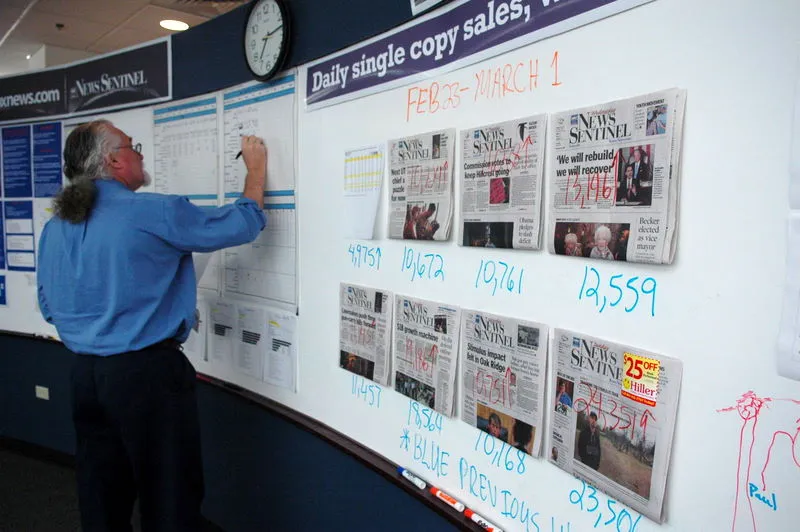 We journalist types typically eschew focus groups and market research about news coverage, saying we know what a news story is and we don’t need no stinkin’ survey to figure it out. But we are learning to measure … and are finding it useful even if we put away our pica poles long ago.
In an excerpt from his forthcoming book Journalism Next , Mark Briggs has this about the News Sentinel’s Tom Chester:
Tom Chester, news operations manager at the News-Sentinel, begins each weekday with a stand-up meeting in the newsroom. The first item on the agenda is a detailed report of content published and traffic generated the previous day. “We track updates on all platforms: web, mobile, email,” Chester said. “We started with almost nothing and now we’re up to about 500 updates per week.”
If newsroom leaders had simply announced at a staff meeting the need to learn new skills and publish more frequently to more platforms, little progress would have been made. Instead, the formerly print-centric newsroom - which has also published 3,000 videos since 2006 - has the structure in place to measure and manage the new content, the newsroom was able to show significant progress and build upon its successes.
A big newspaper bet
Nobody is investing in print newspapers, right?
Getting some notice
I like the scoop on these scores.
Why is aged news better than real news
Tosh.0| Thurs June 4th, 10pm / 9c
—|—
End Times
www.thedailyshow.com
| Daniel Tosh| Helen Keller Jokes| Single Ladies Dance Video
—|—|—
Gee, you think a network effect would work on the Internet
My reading of this is Jay Smith believes in the network effect and sees that as one of the remaining opportunities for newspapers.
Below is an excerpt from an email from retired Cox Newspapers chief executive Jay Smith to former Rocky Mountain News Editor John Temple that Temple posted with permission on his blog.
While few newspapers can gin up content on their own for which users will pay, there is content that, when properly collected and edited, does have real value. For instance, how much might, say, the soft drink industry pay for a daily report of EVERY news item of interest printed in every US newspaper? Such real-time information can be critical to anyone whose living depends on decisions made by the Coca-Colas and Pepsi-Colas of the world.
While this is but one example, you can let your imagination run wild and develop hundreds, if not thousands, of others. In effect, the AP can vacuum up and create a multitude of individual, albeit small, news and information businesses that collectively could approach something of real value for AP and its members.
Sick media just the symptom
You often hear editorial types describe the current problem of newspapers and TV as “it’s not an audience problem; it’s a revenue problem.”
Maybe, maybe not. That sort of short-circuits the question of whether news, particlarly local news, is economically viable, and if not, how to make it profitable.
It also possible the woes of traditional media are just the sympton and not the disease.
At least some think it’s advertising that’s dying not newspapers or TV or magazines. They’re just caught in the death throes of advertising. (Little solace to those in the media business, perhaps.)
A reader wrote The Atlantic’s James Fallows
The real problem is, advertising is dying. It’s just pulling down newspapers along the way. Next up: TV, radio, and Google.
Reading online comments shouldn’t be icky
There’s been a lively discussion about online comments as a result of the APME Online Credibility Roundtable on Comments we held recently in Knoxville. Our excellent Roundtable guests raised many points that others are reacting too.
The comment threads are spread across at least three different URLs. You can see the discussion on Knoxviews, on News Editor Jack McElroy’s column about the Roundtable and on knoxnews’ “This is How We Roll” blog.
We’ve posted two video pieces from the Roundtable plus the complete session as an audio file (they’re linked from the “This is How We Roll” post).
The goal is to develop strategies and solutions to curb the meanness and hate that too often deelops in comment threads. Join the conversation. We think this is a bigger problem than just one newspaper news site in Knoxville. if you blog it, let me know and I’ll add a link to our coverage links.
But it’s more than just talk. We’re developing a strategies to improve comments on the News Sentinel’s web sites on five fronts. We’re be talking about those efforts in more detail in the future.
Maybe they’ll invite Danny next time

Less bluster; more ballyhoo
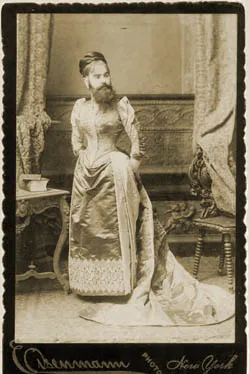 Buzzmachine Jeff Jarvis often asks “What Would Google Do?” to outline a digital strategy, but maybe the question media companies need to ask is “What would P.T. Barnum Do?”
Tom Grubisich urges newspapers to leverage their Google links to the gaudy max instead of lamenting about the search giant.
To be blunt, what newspapers have to do is emulate the marketing savvy of the carnival. When you came to the freak show, you were greeted by spectacularly clothed, fast-talking barker. Standing next to the barker was the “bearded lady” or “wild man of Borneo” or some other bizarre creature - a tantalizing sampling of what was insidethe tent. Buy a ticket for 50 cents, and you could satisfy your socially incorrect curiosity.
More editors willing to pay the price of paid content
 Despite the buzz on paid content, subscription sites and micro-payments, the idea that putting up pay walls and toll booths to save newspapers seems destined to only hasten the erosion of community relevance for newspapers.
If the newspaper industry were Twitter, going to paid content most certainly would be a “Fail Whale” moment. But unlike Twitter all would not be well in just a few minutes.
Many editors seem to be having second thoughts about the industry’s practice of giving away stories and photos on their Web sites. Twenty-eight percent of the respondents said they plan to charge for online content. About 20 percent said they will offer some coverage exclusively in their print editions to reward their paying customers.
Tennessee power trio plays Knoxville
Chattanooga Times Free Press editor Tom Griscom, former U.S. Senator Howard Baker Jr. and Freedom Forum founder and retired Gannett exeecutive John Seigenthaler at the East Tennessee History Center. Griscom and Seigenthaler had a public conversation Tuesday night on the press and journalism.
Cynthia Moxley has a report that includes this quote from Baker, whose daughter Cissy, is a news executive with the Tribune Co.:
The new journalist
An icon of Tennessee journalism, John Seigenthaler, talks about the “new journalist.”,The audio is a little rough. I just wasn’t close enough with the Nokia N96
Congratulations are in order
Congratulations to Lauren Spuhler for two first place awards and Erin Chapin for a second in the Tennessee Associated Perss Managing Editors journalism contest. Also, Knoxnews won a second and Knoxville.com a third in the best Web site category of large newspapers in Tennessee.
Praising print in video
A video is a better idea than a special section!
(via Scooping the News)
It’s not the economy, stupid!
As a medium, print is on an irreversible decline relative to digital. We are headed for an inflection point at which print newspapers as we knew them in the past will be unsustainable.
Just another victim of a shifting, churning landscape
 In honor of the hearings in the Senate on struggling newspapers, we offer up peoplereadingnewspapers.com, a thumbnail of one photo posted on the site is at right.
“As a means of conveying news in a timely way, paper and ink have become obsolete, eclipsed by the power, efficiency and technological elegance of the Internet,” Sen. John Kerry said in prepared remarks. “But just looking at the erosion of newspapers is not the full picture; it’s just one casualty of a completely shifting and churning information landscape.”
Everything is broken about newspapers
Seth Godin says his 2006 talk, “Everything is Broken,” still rings true for the most part. I think most of us would agree if business is getting smarter, they’re not sharing.
Which let me to muse about what’s still “broken” (or maybe the most critically broken things) about newspapers?
Mark Cuban says one is the way we handle our account relationships with subscribers. “You need to get reader’s credit cards on files and start being the baby Amazon of your local area.” I think his point would have fit easily into Godin’s video in 2006 or 2009 or in 1986.
(link via Daniela Barbosa)
What do you think is still broken about newspapers?
Reflecting before the next great adventure
 A Q&A with John Temple, who has started up his own blog as he moves on from the death of the Rocky.
A date with demise
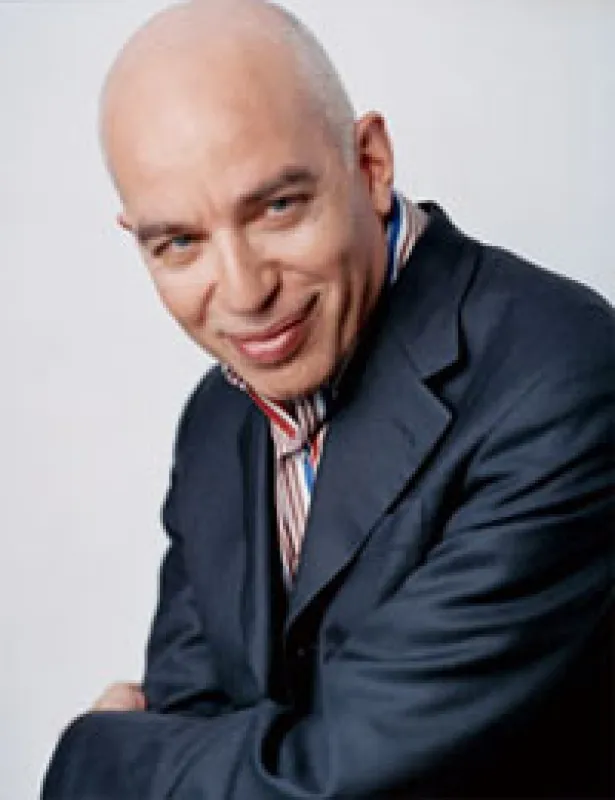 Michael Wolff, founder of Newser and author of several books
“About 18 months from now, 80 percent of newspapers will be gone. The Washington Post is supported by Kaplan’s testing business. The testing business will still be around in 18 months, and they will probably continue to support the newspaper. But that’ll be an exception.”
Hot tea and a good paper
Maybe newspapers need tea parties or pamphleteer meetups (with bloggers).
Where all politics becomes local, the need for national leaders is less important and issues of great importance do not become a personification of them.
I might add that the success of the movement in returning power to local communities and states might save more than few local newspapers.
Judge declines to restrict anonymous comments on Knoxville Web sites
This is welcome news:
A Knox County judge this afternoon issued an order refusing to require local media to shut down anonymous commentary allowed on their Web sites.
The balancing act
Quick definition: “He said, she said” journalism means…
- There’s a public dispute.
- The dispute makes news.
- No real attempt is made to assess clashing truth claims in the story, even though they are in some sense the reason for the story. (Under the “conflict makes news” test.)
- The means for assessment do exist, so it’s possible to exert a factual check on some of the claims, but for whatever reason the report declines to make use of them.
- The symmetry of two sides making opposite claims puts the reporter in the middle between polarized extremes.
Kindle to the rescue
Maybe there’s something to this Kindle thing. People willing to pay for news content who wouldn’t subscribe to a print newspaper. And geeks like it.
Remember, we’re at version two. Most technology products don’t really get prime time until version 3. Hey, I’m not into the Kool-Aid so far as to believe it’s the answer, but it could one be one of many needed answers.
Update: Katie Allison Granju doesn’t see the advantages over smartphones and free content.
Nothing will work, but everything might
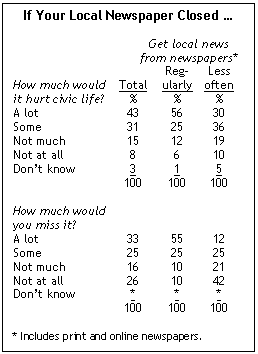 There was a good bit of discussion at an American Press Institute workshop on Friday at Middle Tennessee State University on what business models will work for newspapers even as we see newspapers that aggressively embrace the Web struggling or folding.
There weren’t cocksure responses, just pointers to hopeful experiments.
Later Friday, Clay Shirky, author of Here Comes Everybody: The Power of Organizing Without Organizations
When someone demands to know how we are going to replace newspapers, they are really demanding to be told that we are not living through a revolution. They are demanding to be told that old systems won’t break before new systems are in place. They are demanding to be told that ancient social bargains aren’t in peril, that core institutions will be spared, that new methods of spreading information will improve previous practice rather than upending it. They are demanding to be lied to.
There are fewer and fewer people who can convincingly tell such a lie.
I thought I’d share this
The informal agreement among several Tennessee newspapers to share content as well as some ideas on how to carry it beyond that is getting a good bit of attention. Editor & Publisher also is coming out with a “major feature” on content sharing this week which will be interesting to see.
Kent Flanagan, Jay Rosen and Jeff Jarvis are thinking about ways newspapers can take content sharing beyond newspapers. Interesting stuff; interesting times.
Here;s what is being said. (Know of one I missed, send me a link to jack @ jacklail.com.)
A totally intriguing “What if”
The news about a content sharing agreement between Tennessee’s four largest newspapers brought some fascinating Twitter comments from Jay Rosen, the influential New York University journalism professor, and Kent Flanagan, now at Middle Tennessee State University, but formerly the Associated Press’ bureau chief in Nashville.
Some snippets:
Rosen: What would happen if you hooked up to that content-sharing agreement in Tennessee the state’s largest J-schools?
Flanagan: I’ve already approached other j-schools about starting online news a la CUNY’s NYC’s news bureau … with fewer decent internships available, i feel students need another venue to show prospective employers what they can do. … my plan is to emphasize new media skills and encourage more than basic text from all students participating … in a democracy, we need more voices covering state capitol news, not less, and that’s what I am aiming for.
Rosen: Another piece ‘o puzzle. Take Knoxville’s good relations with the blogosphere; spread those across the system.
Newspapers sharing content in Tennessee
There hasn’t been much buzz on this, but the Memphis Flyer has a story.
This expands upon the content sharing newspapers have done through the Associated Press for years. While still very early in the arrangement, the timing … er … the economy … appears right for this Internet twist of an innovation to succeed.
The sharing is possible in large part because each paper’s Web site is publicly accessible, making sharing an efficient cut-and-paste task.
Not that many months ago, just having a meeting on an idea like this would have problematic.
The magic number is 22
Ken Doctor said earlier this week:
And the envelope, please: How many people does it take to run an online-only metro news site?
The answer appears to be 22.
Journalism is not a federal earmark
Dave Winer, a guy who loves news and, who among his many pioneering achievements, put the New York Times into RSS, says the newsroom curmudgeons who bitterly opine “those bloggers are killing journalism; who’ll do reporting then” just have it wrong.
Journalism is being killed because “the sources got blogs” …and Twitter … and, well, by journalists themselves, Winer argues in blog posted titled Death of Journalism, part 3.
Yes we will miss you when you’re gone. Now what?
No, we’re not going to ask the government to pay your salaries. I’d like the govt to pay me a salary for what I do. I don’t see you rushing to my defense. Oh please pay Dave for writing Scripting News. Everyone would like to be paid for their labor of love.
The reporters rush right by the readers in their pleas. Our only job is to miss or not miss them. This, imho, is the fatal bug in the old way of doing journalism, it’s wrong, it never was that way. We were always active participants in news, either by creating it or being effected by it. Before they rush around us to take our money from the government, how about a conversation first, ask us what we want from journalism, what we like and don’t like – and don’t assume you know the answer. (The journalists’ answer is that we want sports, movie stars, bosoms, car crashes. You know that because that’s most of what they give us. Maybe that’s why no one is rushing to their defense. Just a thought.)
What would Silence Dogood say?
Some of the react to the effort to have a judge order news media Web sites to remove comments or force commenters to use their real names. Updated: March 1, 8:33 a.m.
-
[Judge In Knoxville Case Questions Media Intent NewsTechZilla](https://www.newstechzilla.com/2009/02/judge-in-knoxville-case-questions-media-intent/) - The Krile Files: Not-So Free Speech
- lovable liberal: Defense to blogosphere: drop dead
- Hal Turner Show: Knoxville Massacre Lawyer Wants Anonymous Comments on web silenced!
-
[Case threatens anonymity for website ‘comments’ National Policy Institute](https://www.nationalpolicyinstitute.org/2009/03/01/case-threatens-anonymity-for-website-comments/) -
[Lawyers want off carjacking/murder case, cite death threats at local media websites KnoxViews](https://www.knoxviews.com/node/10513) -
[Memo to bloggers: Stop being ‘bloggers’ KnoxViews](https://www.knoxviews.com/node/10626) -
[Korda: Make your posts mean more: use your name Knoxville News Sentinel](https://www.knoxnews.com/news/2009/feb/09/korda-make-your-posts-mean-more-use-your-name/) -
[Commentary: Free speech is messy, but necessary WBIR.com](https://www.wbir.com/news/local/story.aspx?storyid=78363&catid=2) - Fatal carjacking trial focus on anonymous comments posted on news Web sites - Kingsport Times-News Online
- Defense in Christian-Newsom murder case wants comments tamed / VolunteeerTV.com
-
[Motions hearing takes aim at media WBIR.com](https://www.wbir.com/news/local/story.aspx?storyid=79381&catid=2) - Media vs. suspects’ attorneys on Christian - WATE
-
[Anonymous Commenters On Trial NewsTechZilla](https://www.newstechzilla.com/2009/02/anonymous-commenters-on-trial/) -
[In defense of the right to online anonymity Katie Allison Granju](https://blogs.knoxnews.com/knx/granju/2009/02/in-defense-of-the-right-to-onl.html) -
[I don’t think I’m a pornographer The Upfront Page](https://blogs.knoxnews.com/knx/editor/2009/02/i_dont_think_im_a_pornographer.shtml) -
[Lawyers seek to silence Web commenters knoxnews.com](https://blogs.knoxnews.com/knx/silence/archives/2009/02/lawyers_seek_to.shtml) - Judge questions media intent on Web commentary : Knoxville News Sentinel
The sales person formally known as a “print ad rep”
If every newspaper account executive that has thought of themselves as a “print ad rep” follows Terry Widnener’s example …
Terry Widener has been selling newspaper ads for 35 years. But until last fall, Ms. Widener, a 53-year-old saleswoman at The Knoxville News Sentinel in Knoxville, Tenn., had never sold an Internet ad.
Then in a two-week sales “blitz” intended to test an innovative partnership between newspapers and Yahoo, she persuaded advertisers to buy $200,000 in online ads that ran on the paper’s Web site and on Yahoo. That represented about a seventh of the amount she typically sells in an entire year.
“I’m pretty much from the old school,” Ms. Widener said. “It was such a learning experience. Hopefully I am going to sell more and more online.”
A Rocky end
Final Edition from Matthew Roberts on Vimeo.
Great vid on the end of the Rocky. Looks like one-time News Sentinel Photo Director Sonya Doctorian was involved in this project.
Forfeiting the Fourth Estate
By one estimate, a third of all US newspapers could be bankrupt by the summer. Last November, a study presented to US newspaper executives found that only one major publishing company, EW Scripps, was on a sound financial footing. And since November, the economic crisis has only deepened. But, one might ask, if a swathe of papers just vanishes - so what? After all, there’s always the internet and local television to provide the news. In the huge but fragmented media market of the US, however, it’s not so simple. Those romantic titles may be a throwback to a happier past, but their message is as relevant as it ever was.
Local newspapers are still the main source of news about the towns and cities where they are published. If anyone’s keeping them honest at City Hall or in the governor’s office, it’s the local papers, with their man covering the mayor’s office and their staffer on the police beat, doing the reporting on which everyone else feeds. Without them, entire cities might vanish off the national news radar screen.
A Darwinist Tale: The evolution of “Big Iron” to “Scrap Iron”
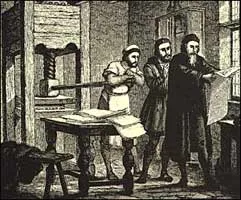 It’s nice to see Jay Small blogging more.
On Friday, he lays out some scenarios for the survival of printed news (not including the online migration of printed news). He suggests a combination of digital printing, customization and frequency changes might be the adaptations that bring new life to the ancestral line of the Gutenberg press.
Crazy talk about newspapers
TJ Sullivan proposes “It’s time for every daily newspaper in the United States, in cooperation with the Associated Press, to shut down their free Web sites for one week.”
Ah, you first TJ.
Longtime media consultant and pundit Vin Crosbie on Twitter reacts:
Now that none of these will work …
Jeff Jarvis buzzsaws through the recent spate of models of journalism that just won’t work.
Well, really business models for newspapers that he sees just won’t work. They are in order:
- Paid content
- Antitrust exemptions
- Micropayments
- Make Google pay
- Charity
- Government bailout
- Positive PR spin
A modest collection of links on Isaacson’s modest proposal

At the summit of Summitt coverage
The Knoxville News Sentinel print front page got noticed today.
From a panel session at the Tennessee Press Association
Explaining link journalism
Tammi Marcoullier, editorial director of Publish2, talks about link journalism at ONA Nashville.
ONA recap
A recap of ONA Nashville: Journalism Has a Future, “Real things real journalists can do right now to embrace it” has been posted.
Where the world gets its news
Two views of waves of the future
Newspaper consultant and NewsInc.’s David Cole from 1981. Was that Viewtron? And where DO laid-off journalists go. (Hint: they’re happier in their new jobs .. if they have them.)
Twittering our training
For the ONA workshop on Friday (last day to register is Wednesday), we’re using the hashtag of #onanash (at the suggestion of @patrickbeeson) on Twitter. Follow the action.
Newspapers: Fish wrapper or origami
Dave Morgan says he’s not going to write about newspapers anymore because he doesn’t see them as “very relevant to the future and things digital.” Morgan has a history of being prescient about the industry and so his it’s-nearly-over theme shows just how dire the situation is. In his last Online Spin column, he writes:
… the notion that the purity of newspaper journalism is the cornerstone upon which today’s great metropolitan newspapers were built is revisionist history. Most of today’s great newspapers were built through achieving dominant distribution in their markets, not through delivering better journalism. Most U.S. cities used to have two or more competitive newspapers. The eventual winner was almost always the one that won on the battle on distribution or advertising, almost never on journalism. Great journalism came later.
Finding our way in a very old saying
Glenn Reynolds of Instapundit argues in a post last night that the relationship between blogs and Mainstream Media ought to be viewed as symbiotic rather than competitive or confrontational.
He notes that bloggers who comment on or cover news seem to raise the ire of traditional journalists in a way that Craigslist doesn’t. Yet Craigslist has done far more damage to economic model that underpins their ability to do journalism than anything that ever came out of the blogosphere.
It is ludicrous to suggest – as people nonetheless have – that either Craig Newmark or Reynolds are out to destroy newspapers. Both are extremely good readers of newspapers either in print or online, and have demonstrated over years a high regard and respect for the practice of journalism wherever they find it.
Both are guilty of being adept and enterprising and lucky in utilizing a new technology in the American spirit of exploring a new frontier.
The companies that popularized digital cameras and later the companies that popularized cameras on cell phones, for example, are never made out as villainous as both Reynolds and Newmark have been despite the hallowed spot of the Brownie in camera history.
Given the choice, however, fewer people bought film cameras than digital cameras once digital models were cheaply available. Given a choice, many people have shown they will get their news from the Internet or advertise on Craigslist. Just get over it.
The challenge for traditional media, of course, is to adapt both newsgathering and economic models.
As far as bloggers and digital-only news organizations go, there can be a symbiotic relationship and a competitive relationship with traditional “Big Media.”
Politico.com may have broken more campaign scoops than any other news organization during the presidential election cycle. HuffingtonPost and Pajamas Media are building powerful media brands.
Even on my local level, there’s a bit of trash talking about who’s been more on top the latest big story, the TVA coal ash spill in Roane County. And that’s OK. Making news coverage more competitive whether it’s from the New York Times or a blogger like Randy Neal is a good thing.
Instead of viewing the blogger-MSM relationship as only symbiotic, which it certainly can be, I like to think about the media gatekeeper as having an open gate, drawing in more views and voices from both small and large, from competitor and contributor and from the uncomfortable as well as the comfortable.
Instead of heavy filtering to fit a physical newshole or time slot, mainstream media has an expanded ability to cultivate community dialogue.
Things that fit into that model would be aggregation of blogger voices, the practice of link journalism, increased transparency, user generated content and the often messy comments on stories. This is, perhaps, an expanded concept of conversation hostess or news media as deejay. I sometimes like to think of it as the “Miracle on 34th Street” theory of just being useful.
That all fits well within that very old media tradition of “Give light and the people will find their own way.”
I think there’s a future for journalists and journalism, both new and traditional, in that.
(Photo is of a Kodak Brownie from around 1910, viaSmithsonian Press).
**Update: WelcomeInstapundit readers!
**
A feeble attempt at “pundintry”
I don’t really want to wade into Paul Mulshine’s debate on whether an army of blogging “pundints”
But the letters published last night by the Wall Street Journal in response to the column show that quite a few of the people that read or used to read newspapers just don’t care about the fate of newspapers and just might be knowingly smiling at the prospect of their demise.
I do know a goodly number of people who would miss their newspaper if it failed to show up in the paper tube or driveway – or online – so it’s just not us poor ink-stained wretches who would miss them.
You can argue the problems of newspapers as content or economic ad infinitum, but, in truth, it’s a total business product issue. It won’t be pretty, but we’ll figure out how to have economically viable local news enterprises and that could very well involve more embracing of the “Army of Davids” than shunning them because they do, in fact, know how to spell pundit more times than not.
Naming rights for this blog are available*
Instead of newspapers and other media companies buying parts of sports teams and naming rights to stadiums and arenas, maybe the sports teams need to buy part of newspapers … the Dallas Mavericks Newsroom, the Tennessee Titans Press Room, the Atlanta Falcons Satellite Printing Plant?
There would be fewer headaches for team owners than Mark Cuban’s “beatwriter cooperative” idea.
Cuban said:
Buying anything more than small ads in papers to promote price promotions for the Mavs has not worked for us. I would far rather subsidize in depth coverage of the Mavs, even without any editorial control then spend more money on advertising. Im a firm believer that there is a foundation of readers who use the sports pages as their primary source of local team information. That number may not be as big as it used to be, nor will it be as big in the future. Thats ok. The numbers may not make the newspaper shareholders happy, but they are of sufficient numbers to have an impact on the local sports market.
“Willful ignorance” may win out
These two pieces on the future, or lack thereof, for newspapers are best read as a pair.
This change has been more like seeing oncoming glaciers ten miles off, and then deciding not to move.
By the turn of the century, anyone who didn’t understand that the business model for newspapers was a wasting asset was caught up in nothing other than willful ignorance, so secure in their faith in the permanence of their business that they assumed that those glaciers would politely swerve at the last minute, which minute is looking increasingly like now.
Tidings are not always glad
There’s a chorus of sorts at this holiday season bringing tidings of things to come.
The theme of these messages is that newspapers, TV stations and magazines are not doing enough to save themselves by radically rethinking their businesses.
Slate media critic Jack Shafer perhaps makes the argument most poignantly in the “The Digital Slay-Ride. What’s killing newspapers is the same thing that killed the slide rule.”
_It appears to me that most newspapers–by choice or by necessity–have made the “decision to liquidate,” to steal the phrase from Philip Meyer’s excellent 2004 book, The Vanishing Newspaper: Saving Journalism in the Information Age: They’re cutting costs, cutting staff, cutting pages, cutting features, cutting quality, and will continue cutting until the last reader and advertiser depart. (Local TV news looks to be following a similar script.)
I keep waiting for one of these distressed, failing newspapers to realize that it has nothing to lose and get a little crazy and create something brand new and brilliant for readers and advertisers. I keep being disappointed._
Improving but not reinventing
From the Bivings Group’s new look at “The User of the Internet by America’s Newspapers.”
As we look at the current state of the American newspaper industry, it appears that improving websites is a crucial component for newspapers to weather the current economic downturn and continued consumer shift towards online news and classified ads. This is particularly apparent as newspaper staffs are cut and stock prices fall. However, it is very important to note that boosting a newspaper?s web presence is not enough. Even if growth in traffic to newspaper website increase dramatically, it is not yet, and may never be, enough to make up for the hit the industry is taking from declining print advertising revenue.
Lastly, our study shows that newspapers are trying to improve their web programs and experimenting with a variety of new features. However, having actually reviewed all these newspaper websites it is hard not to be left with the impression that the sites are being improved incrementally on the margins. Newspapers are focused on improving what they already have, when reinvention may be what is necessary in order for the industry to come out of the current crisis on the other side.
Tis the season
A Christmas tale for journalists.
An unlikely savior
Illinois Gov. Rod R. Blagojevich saves newspapers?
Updated: Well, maybe not.
The public is not going look at the Blaggy scandal and slap itself on the forehead in recognition of the threat posed to democracy by shrinking newsrooms. The public is learning everything it cares to know about Blaggy from TV and blogs. Newspapers? You mean those things to which the blogs hyperlink out? Face it, we are losing a generation of readers, and if you doubt how serious that may be, ask a Gen-Xer when they last went to a horse track – now there’s a dying industry that’s now lost a couple generations.
It’s not about video, but relevance
Michael Skoler from Nieman Journalism Lab on Vimeo.
(via Journerdism)
About those paper profits
Ink-stained wretch in search of ink-stained wretch
Seattle-based journalist Sanjay Bhatt has created “The Ink-Stained Wretches Club,” a Ning group, according to the Fitz and Jen blog on the Editor & Publisher Web site.
Being an ink-stained wretch, I joined up. But that got me wondering who coined the commonly-used phrase “ink-stained wretch?” A cursory walk through Google turned up no definitive answer. But I did find where one person made a stab at it.
Any of you “ink-stained wretches” know the history of that one?
(via mcflint)
A business model built on intransigence
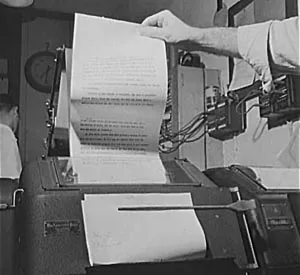 A lot is being written about CNN’s intentions on being a wire service to newspapers.
On Twitter yesterday, media strategist and all-around digital news pioneer Steve Yelvington said:
Am I supposed to take CNN seriously as a potential newswire? It keeps Lou Dobbs and Nancy Grace, fires Miles O’Brien and sci/tech team.
In these times
Crowd-sourcing layoffs at Gannett.
Odds are, they’re great at yesterday’s business
Seth Godin on the innovator’s dilemma and The New York Times.
Millennial journalists embracing social media as a news tool
Interesting stats MediaPost pulled from a study presented at the Society for New Communications Research Symposium on Nov. 14, 2008:
- 87% of 18-29 year-olds believe bloggers have become important opinion-shapers, versus 60% of 50-64 year-olds
- 87% of 18-29 year-olds confirm that new media and communications enhances the relationship with their audience, versus 42% of 50-64 year-olds
- 48% of all respondents use LinkedIn, and 45% use Facebook to assist in reporting
- 68% of all respondents use blogs to keep up on issues or topics of interest
- 86% of all respondents use company websites, 71% use Wikipedia, and 46% use blogs to research an individual organization
From glue pot to blog post
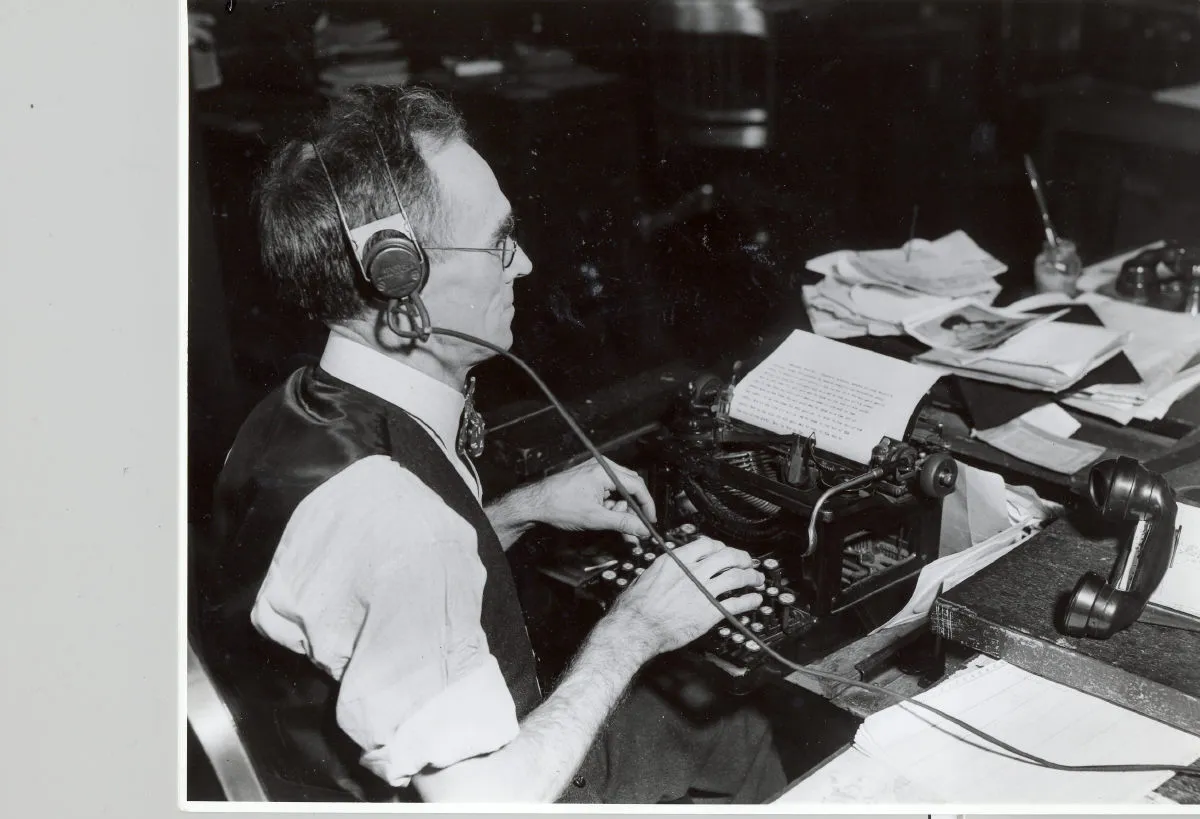 Randy Neal covers a panel discussion we were on yesterday at a journalism class at the University of Tennessee.
Newspaper execs: This is not a fire drill
Industry execs convene to discuss crisis.
Some suggestions offered to the attendees:
- Act like an entrepreneur; stop thinking first about why a new approach won’t work.
- Create a portfolio of initiatives; recognize that some will fail and kill those quickly.
- Don’t wait for every data point before taking action. “Ready, fire, aim” should be the operating principle, Shein said.
- Use downsizing as a tool when necessary to achieve a larger strategy, not simply as a cost-cutting goal.
- Figure out how to leverage core competencies into new directions and new niches.
- Be honest with employees, and get ideas from those on the front lines.
- Don’t sit and cower and weep about your problems. Inspire.
- Collaborate with outside entities that can bring expertise or resources.
- Pay attention to, and leverage, the brand.
Newspapers, whaling ships and oil drilling
The above is the short version of the Michael Rosenblum speech to the Society of Editors. The speech has deservedly created a lot of viral buzz and blogging and if you’re just stumbling upon what he said, listen to the short version at least. The long version is inpart 1 and part 2 and there’s a third link on some additional thoughts of Rosenblum from his speech.
It’s inspirational. It’s visionary. It’s cautionary.
I don’t see many signs, however, of newspapers companies wholeheartedly embracing his approach toward change even as the economic downturn accelerates and desperate measure begin to look, well, not so desperate after all.
Quickly changing is never easy for mothership-size media properties. They are attempting to manage the decline through expense control and many incremental changes, precisely the type of change Rosenblum eschews.
He says:
_In short, make your paper into the video information and public discussion node for your community.
_
No squirming on the underwear issue
Annette Moser-Wellman at Northwestern University recently did a telphone interview with me on my thoughts about a local news organization’s roles and, uh, the underwear problem. She writes:
So whether it’s news, information or someone else’s news and information, serving the needs of your audience prevails. Because when you become the trusted authority, you’ve built brand loyalty and never have to be tied up in your underwear again.
Newsrooms need crazy new job roles
Tribes
- COMMUNITY ORGANIZER. Find and connect and lead a tribe of dedicated users that contribute to and benefit from the work you do.
- STATS FIEND. Measure everything that can be measured. Do it efficiently and consistently. Find out what metrics are important and cycle until they improve.
- MANAGER OF FREELANCERS. Find and hire and manage the best outside talent in the world. If it can be defined as a project, and if great work defeats good, seriously consider having the MOF get it done.
Front pages
A PDF of the News Sentinel front page.
(via Howard Weaver)
A time capsule blog post for future generations
But will there really be newspapers when the Chicago Cubs win the World Series?
What happened with print editions yesterday (Wednesday) was unique because the circumstances were unique. If the Chicago Cubs (ever) win the World Series, you’ll likely see a similar run on the Chicago papers. It doesn’t mean they’re going to see a growth spurt in subscriptions.
The attention is apt
The Knoxville News Sentinel / knoxnews and E.W. Scripps were getting some coverage over the weekend on the rollout of the Yahoo APT ad platform and new approaches of selling online advertising in local markets..
Sleepless in the corner office
“It just seems impossible to me that you’re cutting costs dramatically without having some impact on the editorial quality of your product,” said Peter Appert, a newspaper analyst at Goldman Sachs. “I can’t prove that this is driving circulation, but it’s certainly something that if I were a newspaper publisher would keep me up at night.”
I’m wrong if middle-America goes paperless
I did make the wild-ass claim recently in an research interview that mid-market newspapers will survive – just not in their present form. Much of that revolves around their digital strategies. I think that’s a winnable bet. Cnet technology columnist Don Reisinger has a dimmer view of the future for mid-market papers. Do you think he’s right?
_
(Note to Dan: About that Sulzberger fellow. I believe his name is Arthur Ochs Sulzberger Jr. He’s the great-grandson ofArthur Ochs, who began his newspaper career in the decidedly mid-market burg of Knoxville at age 11 and bought a paper in similarly mid-market Chattannoga at age 19 before buying the New York Times. Arthur Ochs apparently knew a bit about evolving a business model.)_
(via Doug Fisher)
Visualizing newspaper endorsements
After asking knoxnews.com whether the Knoxville News Sentinel and finding finding that 75 percent said forget it, the newspaper endorsed McCain today (the editor explains). In light of that, here’s a link to a great map of newspaper of endorsements.
Philip “flip” Kromer, the creator of the map observes on the Infochimps.org blog:
* I think the amount of red in the blue states is a market effect. If you're the Boston Herald, there's no percentage in agreeing with the Boston Globe; similarly Daily News vs New York Post, SF Examiner vs SF Chronicle. That's why the Tribune endorsement, even accounting for hometown bias, is so striking. I don't mean that they're cynically pandering; rather that in a market with multiple papers readers, and journalists are efficiently sorted into two separate camps. (And the axis doesn't have to be political: though the Chronic and the Statesman are politically distinct I see their main difference being lifestyle vs. traditional news).
* The amount of blue in the red states highlights how foolishly incomplete the "[Red State](https://en.wikipedia.org/wiki/One_Fish_Two_Fish_Red_Fish_Blue_Fish "One Fish Two Fish Red Fish Blue Fish?")/[Blue State](https://en.wikipedia.org/wiki/Red_states_and_blue_states)" model is for anything but electoral college returns. The [largest part of the Red/Blue split is Rural/Urban](https://www-personal.umich.edu/%7Emejn/election/) \-- look at the electoral cartogram for the last election and almost every city is blue, even in the south and mountain; and almost all of our rural areal is red. The exceptions, chiefly Dallas, Houston and Boise, stand noticeably alone as having red unpaired with blue. (Though in this election even the Houston Chronicle is endorsing Obama.)I'm going to try to make a map colored by county, but there are no good off-the-shelf tools for doing this (that I've found).
What would Wal-Mart do?
 Some react on the Associated Press’ decision to back off its controversial pricing plans for 2009.
I suspect this will cool the defection rumblings a bit, but the plan did cause newspaper companies looking for cost-cutting everywhere to cast a keen eye on their sizable AP bills. That one’s on the evaluation table now.
- The Stress-Telegram: AP backs off rate increase
- US: AP suspends rate hike - editorsweblog
- Associated Press Makes a New Offer - NYTimes.com
- AP Backs Down On Controversial Rate Plan: Cuts Rates, Gives Members All AP Text, Halts ‘09 Increases… (PaidContent) TechNews.AM
- Common Sense Journalism: AP hoists the white flag, looks at reorganization
- Fitz & Jen: AP Execs on Decision to Alter Rates and Structure
- AP changes course on new rate plan - Lost Remote TV Blog
-
[Editors React To AP Rate Cut: ‘A Good Starting Point’ Or ‘This Changes Nothing’ paidContent.org](https://www.paidcontent.org/entry/419-editors-react-to-ap-rate-cut-a-good-starting-point-or-this-changes-noth/) - AP backflips on membership rates, but will it be enough?
The roots of MoJo
An early newspaper MoJo sighting from Julie Starr. Was live blogging once called dictation?
Feeling needed
Ethan Kaplan is at his best when he gets his rant on:
Newspapers - You’ve been given 15 years now to figure out how to change your business model around. In that time, a small San Francisco company killed your classified ad market, you guys lost the best people in your offices to startups and other journalist empires with more capital, and still surround yourself in oligarchic Taj Mahal’s with mahogany offices with the insistence that the public “needs” you. Right. The New York Times is going the right direction. The next move: get rid of the print product. Shutter the presses and move on.
The currency markets of news
In a Friday post, Dan Conover writes about “10 reasons why newspapers won’t reinvent news.” It’s an interesting list, but I found more provocative his answer in the comments to the question of what can be done: Newspaper companies should get out of the news business.
It’s a little off my topic at hand, but read that one.
One of his 10 reasons is that:
Newspapers have already lost one of their key selling points: Social currency. In 2008, all meaningful political discourse – the essential element of social currency – takes place on the Web. Print (and televised) political coverage is now but a pale shadow of the real action online.
Seismic activity and volcanic eruptions
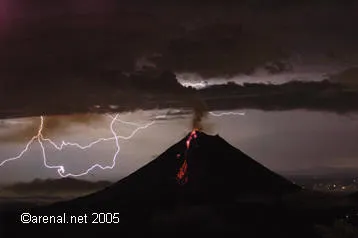 The Innovator’s Dilemma for newspapers is that while they must radically adapt to the changing media landscape and the economic realities of an economic downturn, a sizable number of loyal print readers aren’t ready to turn the page with them.
In a snarky blog post at the Tampa Tribune’s cross bay rival tampabay.com, TV/media critic Eric Deggans wrote:
It’s not exactly like the end of New Coke.
But officials at the Tampa Tribune say they are revamping the newspaper again, less than a week after combining most of the news content into one section on weekdays. Starting Monday, the weekday newspaper will offer two sections of news and a classified section, after receiving thousands of complaints from readers who once enjoyed sharing separate sections with friends and family.
The media forgets it is in the being useful business
A lot of media entities – and the journalists who work for them – think they are in the news business and all of their strategies and initiatives are wrapped around that concept.
But despite the much-burnished reputation of the Fourth Estate and the unchallengeable value of a Free Press, that’s not the business they are in – not at all. Media companies are in the business of being useful, useful with information that people consider news at precisely the moment they want to know it
This collective lapse of memory of what it is traditional media enterprises do may explain why the Drudge Report is one of the top news sites, why Google News is the bogeyman man, and why Wikipedia is the first place many people go to find the latest news on a specific topic, person or thing.
Instead of doing journalism as a means to be useful, journalism is being done because it can.
Being useful means both speed (having the information when I want it) and content (having the information I want). On the Web, having well-organized links to the information is having the information readers or users want.
As I write this, two of top three stories on the knoxnews/govoslxtra sites are simply links to external content, a roundup of blogger react to the VP debate and what ‘s being written about the Tennessee football team.
I would suggest part of the reason for the popularity of these two stories vs the thousands of others on the sites is that they are found to be useful right now.
Here’s a look from a different vantage point. The top referring domains to the sites in the last 30 days are: Google, Legacy (where our obits are posted), Yahoo, Drudge Report, and PajamasMedia (Instapundit). All five are sites that are focused on providing useful information. The two giant search engines are dependent on complex algorithmic search results. Drudge Report and Instapundit rely on the skill of humans to find the news we will find useful to know – rather quickly.
On Monday, Alan Mutter wrote:
As I scrambled from website to website this morning for the latest news while my retirement melted away, the place that consistently had the most complete, convenient and up-to-date information was the Drudge Report.
For all the millions of dollars and thousands of people employed at the mainstream newspapers, broadcast networks and cable channels, Drudge had assembled the perfect mix of salient links and real-time information …
If you’re keeping score …
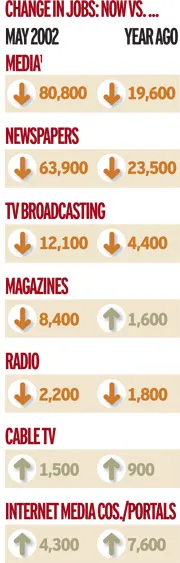 In the latest Advertising Age magazine Media 100, released on Monday, the structural changes in media become apparent.
As a media, newspapers ranked fourth, accounting for 10.4 percent of media revenue. Two decades ago, its slice of the pie was 35.9 percent.
There are winners, however, as well as losers: Digital, revenue, up 10.8 percent; cable-networks, up 10.6 percent; newspapers, down 6.8 percent. Newspaper revenue dropped $2.3 billion. Google’s gain wasn’t that far behind newspaper’s loss at $1.9 billion.
And, oh yes, the Media 100 is trailing information. It’s based on 2007 revenues. In the newspaper industry, at least, 2007 looks in hindsight to be a summer walk in the park with a rain shower compared to a brutal wintry 2008.
“Their position in a listing is the least of their problems,” said Lauren Rich Fine, a longtime newspaper analyst for Merrill Lynch, who know teaches at Kent State.
We’d get more readers if we gave them less freakin’ news to read
I missed this in August from Rich Gordon:
On the Web, though, newspapers have clearly emphasized news first. Which is a big part of the reason why so few people visit newspaper Web sites.
That desk phone is oh so quaint
I’m beginning to wonder if landline phones are needed in newsrooms?
A new Nielsen Mobile study indicates that one in five U.S. wireless households could be wireless-only by the end of 2008. Already 20 million households, or 17%, are abandoning land-line phones in favor of mobile ones. That’s up from only 8.5% in 2005.
What happens in Vegas is reported
Some coverage of the APME conference where I was earlier this week.
In a completely different time zone
I took a tour of Greenspun Interactive on Tuesday afternoon, the home of Web sites for the Las Vegas Sun and Las Vegas Weekly and discovered what might be a tell for the success (hey I’m in Vegas) of president and executive editor Rob Curley.
It’s not the refrigerator packed with Red Bull or the 12 pounds of Gummi Bears the 50-plus person staff chews its way through each week, it’s fact that Curley is just operating in a different time zone (see photo above) from the rest of the world.
There were several clocks on the wall in true world news fashion of distant cities, but these were all cities covered by the Greenspun Web crew around Las Vegas so they all had the same time except “Curley Standard Time.”
The just-completed Greenspun Interactive offices are phenomenal with a 100-inch video screen, studios rigged with enough lights and cameras for a movie premier, a “locker room” to stow gear and a “diversions” room (see photo on left).
Watch for a lot of exciting developments to come out of there – soon.
It’s all about storytelling
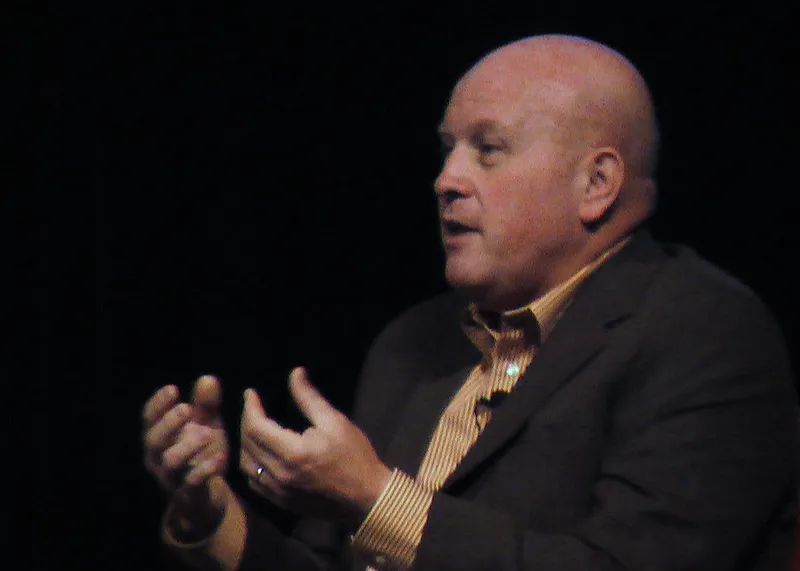
Howard Weaver, McClatchy VP for News, and Rich Boehne, CEO of E.W. Scripps, both say good storytelling is the future for newspapers. Weaver was speaking Tuesday at the APME convention in Las Vegas. Boehne spoke Saturday at the Society of Professional Journalists convention in Atlanta.
Weaver said newspapers and their editors and publishers will have to realize some things will be given up in order to excel at “mission-focused” content.
“I think doing everything incrementally worse is a death spiral,” Weaver said. Great storytelling and staying mission-focused on the communities newspapers serve will knit together a growing audience, he said.
“A lot of journalism over the past 30 years is stenography – typing sports scores and what the mayor said. There’s less of a need for that now,” Boehne said in Atlanta.
_(Another grainy photo from the APME Tuesday morning session.)
_.
Brand you
Mindy McAdams says there’s not much excuse for a journalist not having an online presence.
But more important, do you know how to put yourself out there with your blog? Do you link to and comment on other blogs? Do you use your RSS reader and Delicious links as tools to widen your personal sphere of contacts and influence? Ah. That’s what I’m talking about.
Question of the day

Your morning newspaper is a collector’s item
Media consultant Vin Crosbie has created a stir with a thought-provoking two-of-three-parts on the transformation of the newspaper industry.
The short take:
More than half of the 1,439 daily newspapers in the United States won’t exist in print, e-paper, or Web site formats by the end of next decade. They will go out of business. The few national dailies – namely USA Today, The New York Times, and The Wall Street Journal – will have diminished but continuing existences via the Web and e-paper, but not in print. The first dailies to expire will be the regional dailies, which have already begun to implode. Those plus a very many smaller dailies, most of whose circulations are steadily evaporating, will decline to levels at which they will no longer be economically viable to publish daily. Further layoffs of staffs by those newspapers’ companies cannot avoid this fate - not so long as daily circulations and readerships continually and increasingly decline. (Layoffs are becoming little more than the remedy of bleeding that was used in attempts to cure ill patients during the 18th Century and cannot restore the industry’s health.)
15,000 reporters are in Denver because …
A question from “Glenn in Knoxville” leads “Uncle Jay” to explain why so many reporters (some 15,000) are covering the Democratic National Convention.
Ah, uh, well, it might explain a few things about newspaper management.
Meanwhile, back at the entity formerly known as a print newspaper
While I was out of town yesterday, the newsroom at the Knoxville News Sentinel was doing an outstanding job of breaking news coverage of a shooting at a Knoxville high school. Complete coverage is here.
Breaking text, photos, videos, SMS alerts, email and Twittering. A photo gallery of the breaking news and two breaking news videos were among our top 10 “stories” yesterday.
It was a large scale effort to be best and first. The culture does change!
The AP isn’t your old newspaper’s wire service any more
The AP is poised to flip the age-old relationship of content provider and distributor. Inside ten years, the AP will control the distribution path to the largest possible audience, and will be offering member papers a kickback on all ads served against its articles.
Papers would be insane not to take that deal.
Quotable: Losing hold by holding on
“What’s long held back the newspaper industry and gotten it in the current mess has been holding back online innovation that might impact the legacy product (print). The kind of serious innovation that might have avoided the turmoil we’re now seeing among newspapers (especially larger metros like the Inquirer) could only take place with an attitude of “Let’s completely forget about the print edition and just try to build the best damn online service possible.”
“But the industry didn’t do that, for the most part, instead settling for incremental innovation that wouldn’t upset things too much on the legacy side. That’s exactly the thinking that’s in this Inquirer memo.”
Summing up the future of newspapers
All the arguments about the future of newspapers in one post.
It’s back
Charley Stough’s BONG Bull is back.
Times Free-Press gets shoutout
Mindy McAdams of Teaching Online Journalism becomes enamored with the Chattanooga Times Free-Press while on vacation.
Improve this post with comments
My publisher sent me several emails over the weekend about complaints about hateful, invective, acidic and just generally mean-spirited reader comments on our newspaper Web sites.
And the comments in question met all those tests - and then some. They had already been removed for the most part after being flagged by users. But one thinks publishers have better ways to spend Saturday nights? Sort of emphasizes the scope of the problem.
While the emails he received were about specific comments, questions are being raised anew about newspaper comments in general, one of the recurring (Oh, not that again) debates on journalism blogs.
Comments-as-bad has been catching fire as an issue for awhile with internal uneasiness at newspapers across the country about the often sordid area at the bottom of stories. And many readers, too timid, perhaps, to click “suggest remove” links next to offending comments, are buttonholing newspaper executives at social events.
It’s not a trivial issue. We get over 1,200 comments a day 24/7 and the number is growing. Managing unwanted comments and commenters is an increasing large time sucker. Some stats are here for knoxnews/GoVolsXtra sites.
But when the queens of rumor-mongering and snarky say they’ve seen enough, well, that’s red hot coals to cook up the debate.
On July 21, Sheila McClear of Gawker.com in the provocatively titled post laid down the argument “Why Newspapers Shouldn’t Allow Comments:”
You could argue that newspapers should rigorously vet and moderate their comments, or at least require them to use their full names. I’d argue that this is a silly misuse of their time; I’m not suggesting that newspapers should actively patrol their comments, like this and some other web sites do. (We’re a blog; comments are in our blood.) I’m suggesting they get rid of them altogether. (This doesn’t include the blog sections of various papers, which the NYT and Washington Post are stuffed full of.)
Newspapers have more important things to do than worry about comments–like, say, report the stories that blogs so desperately need in their 24-7 quest for content!
Let’s make gazillions in ad revenue with no ads
It seems if you can get the model right, there is a revenue growth opportunity in content even in these tumultuous times.
Leave it to Google (well, we did) to figure out how to make $100 million in advertising revenue from pages with no ads – or content of its own.
I still find it hard to see how an argument could be made that Google is somehow siphoning away the audience (and ad revenues) of online newspapers. For those that I am aware of, Google is the No. 1 referring domain. And Google News is a highly effective tool for users.
When the best “coverage” is a link
 The twin pieces Scott Karp and I did for the summer edition of Nieman Reports on “link journalism” and political coverage are now online. The printed mag came out a few weeks ago.
A snapshot of change in newsrooms
Amidst the doom and gloom over the newspaper industry, a refashioning is taking place in newsrooms that a majority of editors believe is improving their product even as revenues to support newsrooms, among other things, are declining.
And the audience the newsroom is reaching is at an all-time high.
Those are a couple takeaways from a just released report by journalist Tyler Marshall and the Pew Research Center’s Project for Excellence in Journalism. The study touts itself as “the most systematic effort yet to examine the changing nature of the resources in American newspaper newsrooms at a critical time. It is an attempt to document and quantify cutbacks and innovations that have generally been known only anecdotally.”
Amid these concerns–and despite the enormous cutbacks and profound worries–editors still sense that their product is improving, not worsening. Fully 56% think their news product is better than it was three years earlier.
“I believe the journalism itself is discernibly better than it was a year ago,” said the editor of a large metropolitan daily, whose paper last year lost 70 newsroom employees. “There’s an improvement in enterprise, in investigations and in the coverage of several core beats.”
Adversity is a mean teacher, but damned effective
When the media “perfect storm” passes, some will emerge stronger and thrive:
It’s inevitable that by the time the American economy improves, some of the metros will have figured out how to remake the slimmer, smaller-staffed newspaper work for both readers and advertisers. Those that are successful will provide the template. Out of that comes the reinvented metro daily.
In the Age of Editors
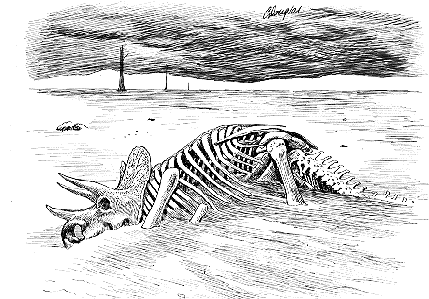 I’ve been hearing editors were dinosaurs every since, well, I became one a couple of decades ago. We haven’t gotten stuck in the tar pits yet – or have we?
Kurt Greenbaum has been listening to the drumbeats while working on an article on the future of editors. See what’s he learned so far.
And if editors are headed for extinction, just remember, my new title of news director of innovation doesn’t contain the word “editor.”
)Photo from Nature.ca)
Nip/Tuck for newsrooms
BuzzMachine Jeff Jarvis proposes how he would reallocate resources in a newsroom with a staff of a 100 with a 30 percent cut to a staff of 70. I found this more than mildly interesting since I work in a newsroom of just over 100.
I’m glad Jarvis says his chart is “utter bullshit” because I did not find my new job (news director of innovation) in his survivor column and he cuts top editors from 10 to 4. He does, however, come up with a radically smaller and locally focused staff. That’s certainly the direction that is necessary. And he has a collaborative version of his spreadsheet where you can come up with a better one that starts with 100 and ends at 70.
Take a look at his spreadsheet and see what you think.
Morris Communications’ Steve Yelvington laments the declines he see in Jarvis’ spreadsheet for copyeditors, but believes their numbers will continue to shrink outside the cells of Jarvis’ spreadsheet and in real newsrooms – and take with them reporters because of the dirty little secret of newsrooms.
Because without copy editors, the reporters who are weakest at writing, at attention to detail, at stepping out of their own heads and critically examining their work, are going to be subjected to the harshest editors of all: a readership that today is empowered to talk back.
Oh, no. You did NOT shoot that green shit at me!
They’re using our own satellites against us. And the clock is ticking.
-- David Levinson
Frightsizing potential
Rightsizing sounds better to corp execs than “panicking,” says Ken Doctor, writing about the announcement this week of deep cuts at the L.A. Times. He says a more descriptive term would be “frightsizing.” He didn’t coin the term, but he hangs it well on newspaper companies.
Doctor, however, does give my employer, E.W. Scripps, a “cut kudo” if there can be such a thing.
Certainly, the New York Times, the Washington Post, McClatchy, Scripps, Gannett and Belo come to mind as companies that are trying hard not to panic, not to frightsize. The cuts at all those companies are real, but you have the sense that there’s an appreciation of retaining key assets.
Just play like Bill Russell
I’m a believer in sticking with fundamentals and keep an eye on your goals. Flavor of the day management just leads to zigzag results with up not an option. So I was particularly pleased to read what Scott Berkun, author of The Myths of Innovation
I found some parallels between the Celtics, who had their own dark days and lean times, and the newspaper industry.
Berkun gives Boston General Manager Danny Ainge credit for risking it all and trusting his employees. Maybe one thing that’s wrong with newspapers is there are not enough Danny Ainges to go around.
While Berkun didn’t mention him, the management and work ethic espoused by his post reminded me of Celtic great Bill Russell, the center of the Boston dynasty in the glory years and a player renown for playing great defense and elevating the defensive play of his teammates rather than showboating dunks.
Berkun found five big themes in Boston’s success that can be translated elsewhere, like say newspapers in the midst of a double-team by a sick economy and industry-wide structural change.
His starting five:
- Great managers hire great talent.
- Focus on the fundamentals.
- Reward team based behavior.
- Trust your people.
- Use the past as power.
Along came AP on an otherwise slow day in June
The most ironic angle to surface so far in the AP vs Drudge Retort copyright/fair use flap is the suggestion of an ethical lapse in the New York Times’ coverage of the tempest by failing to disclose it is among the “owners” of the news service.
Which leads me to a question: Who forgot newspaper media companies were the owners of the Associated Press first? The AP or the newspapers? Oh, well, that’s a thought for another day.
The Knoxville News Sentinel’s very own Michael Silence weighs in on AP v Drudge Retort with interviewer Ed Driscollon Pajamas Media’s 6 p.m. Thursday “PMJ Political” radio show on XM Channel #130. They also archive them.
If you’re catching up:
- AP irony
- AP and the Media Bloggers Assoc.
- Comment on The NYTimes Is Conflicted And Wrong About The AP And …
- AP vs. Drudge Retort: one tough question still unanswered
- Don’t Blog with AP stories
- Randy Neal: AP, bloggers, and the fair use controversy
- AP’s Arrogance: Something The Left And The Right Can Firmly Agree On
- Should AP Set Blogging Guidelines?
- AP Biting the Hand That Feeds (Traffic To) Them
-
[PaidContent.org AP Wants Change In Blog Excerpting, Just Not Sure What](https://www.paidcontent.org/entry/419-ap-wants-change-in-blog-excerpting-just-not-sure-what/) - AP Swings the Hammer
- To Excerpt The Associated Press or Not
- Media on HuffingtonPost.com: Fortune’s Stanley Bing: 12 Bucks To Link To An AP Story?
- NewsTrust - Media - Today’s Picks: Copyright: AP gets tough and bloggers get angry
- NewsTrust - Media - Today’s Picks: AP to meet with blogging group to form guidelines
- NewsBusters.org: AP Goons Attack Drudge Retort
- Romenesko: AP plans to set guidelines for use of its articles on blogs
- Media on HuffingtonPost.com: Associated Press Plans To Crack Down On Bloggers
-
[NYT Media and Advertising: The Associated Press to Set Guidelines for Using Its Articles](https://www.nytimes.com/2008/06/16/business/media/16ap.html?partner=rssnyt) - Rexblog: Can you link to an AP story and include a brief excerpt? Yes, we can – but don’t
Reinvention takes investment
Good advice:
If your newspaper provides you with video training, realize it is just the beginning. For you to be successful, you’ll need to take ownership of your evolving career. I’m always surprised at how many journalists in newsrooms demand training, but when their newspaper fails to deliver, they refuse to invest any of their own time in reinventing themselves.
The picture’s real, but it swirls in misinformation
Gizmodo says this tornado photo from Orchard, Iowa – which made it onto a New York Times blog – is why you should carry a digital camera at all times.
But Kurt Greenbaum has the story of how newspapers and news sites handled the photo and that is nearly as fascinating as the photo is stunning.
Gizmodo’s advice is cogent. And the editors who took the time to check out and verify the photo are what I call journalists.
Lori Mehmem photo
This is how we roll
We’ve created a new blog to keep people informed about what we’re doing at knoxnews and in the online area of the newsroom. Check it out and let us know what you think.
A long tale, 140 characters at a time
On what Ron Sylvester learned from Twittering a trial.
One day, I cut and pasted all my “tweet” updates into a traditional story file. It measured 80 inches. Now, I don’t think anyone would have read an 80-inch story from the newspaper on this trial, as compelling as it was. My editors certainly wouldn’t have run a story that long. But what I found is that people will read an 80-inch story, given to them a paragraph at a time, 140 characters long. *[]: 2007-12-12T15:21:48+00:00
Elephants can’t find peanuts; may go hungry
A much needed and fascinating discussion about hyperlocal news keyed off an article in the Wall Street Journal about the Washington Post’s LoudounExtra and also of Scott Karp’s analysis of how the Washington Post covered a thunderstorm.
Something tells me the Washington Post is not ready to do local. And there is a bit of gleeful unwarranted Rob Curley bashing.
**
Updated:** Rob Curley posts about the WSJ article.
Lessons learned?
- What Newspapers Still Don’t Understand About The Web by …
- A real need for local news, “hyper” or not
- Hyperlocal hero fails, finds new job
- Now: Solve problems, fill needs, get jobs done. Later: Be cool.
- The folly of “local local”
- Washington Post’s failed hyperlocal news site was not a hyperlocal
- The Emperor Has No Clothes
- The Post’s ‘Hyperlocal Flop’
- Failing forward
- The Struggles of LoudounExtra.com
- Hyper-Local News at LoudounExtra isn’t Hyperactive
- Hyperlocal effort LoudounExtra.com ‘a flop’
- How Could Hyperlocal Fail?
- Hyperlocal News Fails Without Locals
- When Hyperlocal Isn’t
- Pegasus’ Orren: ‘Local Databases Key to HyperLocal’
- Curley on HyperLocal, The WaPo, and the Vegas Venture
- Looking for the Hyperlocal Magic Bullet
- Big Daily’s ‘Hyperlocal’ Flop
On reinventing the lowly classified ad
Simon Owens interviews Editor & Publisher columnist Steve Outing on reinventing classifieds and Scripps alum Christopher Ryan, founder of Future of News.
Outing told Simon:
“… without doing something radical sometime soon, the industry doesn’t have much hope.”
Wanted: Workable business model for newspaper classifieds; will negotiate
Bob Wyman has a thoughtful analysis of the newspaper classified business and its history, a history of missed opportunities and chances not taken. I hope his outlook for today and tomorrow, however, is a bit off.
So, where does that leave us today? Should the newspapers try at this late date to recover the online classified business? No. That would be, I am sure, a hopeless task. The opportunity is lost, the window closed. You can only fight economics temporarily and then only at specific moments in the development of an economy or market. The time for this particular battle is long over. For a newspaper to build an online classified business today would be sort of like someone building a new Internet Service Provider to compete with the phone or cable companies… It’s just not worth the bother unless the technology is distinctly and greatly different.
The Lake Wobegon audience
- Those who visit newspaper Web sites are more likely to have household incomes greater than $100,000, when compared to people who visit other sites online. Those who visit newspaper Web sites are also more likely to be in professional/managerial positions.
- Newspaper Web site visitors are significantly more likely to seek out political/campaign information online.
- Those who visit newspaper Web sites are more likely to be online shoppers, especially for travel and vehicles.
The AP, a dilemma and a bet
Steve Boriss, a blogger who writes about the future of news, analyzes the Associated Press in a piece not destined to move on the wire.
One can quibble with his facts or his interpretation of the facts, but his main points are pretty much on the mark:
1) The AP system creates umpteen copies of the same story by major news organizations, Many voices with the same story instead of many voices about the same story. You see this most pronounced in doing a Google News search of a major national issue.
2) Members have a growing uneasiness about whether the AP is looking after their interests in the Internet Age.
The concerns are not new, as he notes in quoting E.W. Scripps: “I believe the most valuable service I have rendered to my country has been that of thwarting the plans of greater, abler, and richer men than myself to establish a monopoly of news in the United States, and hence a dominating influence over all the newspapers of the country.”
I, however, don’t agree with Boriss that all news begins as a daily cabal between New York Times and the Washington Post, and filters out to every news organization from there. News has a nasty habit of happening most anywhere, even those places where those two titans of journalism don’t have reporters.
And despite AP’s homogenizing power. I would argue that citizens have access to far more voices and far more diverse voices, like Pajamas Media where his piece appears, now than in any time in our country’s history.
The ease and efficiency with which those voices can be published and read on the Internet is the true dilemma for the AP and its members. I think online most newspaper Web sites see limited traffic to AP national and international news content. It’s been commodity content for quite some time, years before the Google deal.
It’s just unclear to me whether it becomes less relevant for locally focused news organizations or more relevant in the drive to reduce costs by out-sourcing. We’re entering one of those evolutionary times for the news service and I’m betting it survives.
(via Instapundit)
EPpy winner!
 Our GoVolsXtra site won an EPpy today!
The award was presented at the Editor and Publisher Interactive Media Conference and Tradeshow in Las Vegas.
Best Sports Web Site with fewer than 1 million unique monthly visitors
arkansassports360.com
CommunitySportsDesk, kenoshanews.com
GoVolsXtra
varsity845.com, Hudson Valley Media Group
Cell phone photo from Jigsha Desai.
Boring and bland are symptoms of a disease
Roger Black on the Newspaper Disease:
What is needed is a fundamental restructuring of the newspaper business. And it has gotten too late to expect the inmates to redesign the asylum. It’s going to have to be done by the proprietors. Willful, single-minded, near-genius proprietors like the ones who built the business.
… Newspapers have about a year to get rid of all the people who can’t pull their own weight and to redeploy all the smart energetic journalists who can find the great stories and push them out to print, web and video. Some papers still have lots of talent, but they must push it to the front so readers can find it and find that they like it. Papers who continue to bury the smart people (or have already driven them away) will not make the cut. With the current recession, if newspapers don’t move quickly, the market will crush them.
Newspaper Twitter stats for April
Erica Smith has published her April newspaper Twitter stats. I love that she is doing this project!
Her stats show several newspapers had followings that grew by triple digits in the last month while @knoxnews grew by 47 percent and @Bonnaroo, which she started following mid-month, grew by about 7 percent.
Smith is tracking 141 newspaper Twitter accounts.
I’m thinking that the knoxnews growth of 47 percent shows another surge in popularity in the not-yet-mainstream service at least in the KnoxVegas area since we did no promotion of it. (The last time we mentioned it to marketing, they got the idea to change the background to coffin gray … industry symbolism?).
So if you’re on Twitter, follow:
… and even me.
The knoxnews site is not at the top of the list in number of Tweets, which is good!.
Future pix of newspapers
Does Kodak has the digital picture of the newspaper industry’s future?
Good piece in the New York Times today on the morphing of the company:
Kodak is by no means thriving. Digital products are nowhere near filling the profit vacuum left by evaporating sales of film. Its work force is about a fifth of the size it was two decades ago, and it continues to lose money. Its share price remains depressed.
But, finally, digital products are flowing from the labs. Kodak recently introduced a pocket-size television, which is selling in Japan for about $285. It has software that lets owners of multiplexes track what is showing on each screen. It has a tiny sensor small enough to fit into a cellphone, yet acute enough to capture images in low light.
The company now has digital techniques that can remove scratches and otherwise enhance old movies. It has found more efficient ways to make O.L.E.D.’s – organic light-emitting diodes – for displays in cameras, cellphones and televisions.
This month, Kodak will introduce Stream, a continuous inkjet printer that can churn out customized items like bill inserts at extremely high speeds. It is working on ways to capture and project three-dimensional movies.
And, of course, it continues to prompt consumers to take pictures with Kodak cameras, store them at Kodak sites online, display them in Kodak digital picture frames and print them on Kodak printers that use Kodak inks and papers.
Creating news that finds its audience
An insider who’s now an outsider has insider advice on outsiders for insiders running news sites.
Now I’ve got you as confused as Lou Costello in “Who’s on First”?
Well, as Bud Abbott said: “I say Who’s on first, What’s on second, I Don’t Know’s on third.”
I’m glad that’s clear; Because is in centerfield.
In a much more lucid piece, I think former newspaper New Media journalist Melissa Worden says we haven’t figured out for her that new buzz phrase:: “If the news is that important, it will find me.” (And as a phrase, It’s quite the rage.)
Or as media consultant Terry Heaton says: “You can’t ‘find’ anybody by insisting them come to you.”
It’s a concept we need to get faster than Costello learned the names of the players on his new baseball team..
Worden has some great observations on how her news habits have changed and some suggestions on how news can find her. What are some more?
And best of luck, Melissa, in your HSN gig!
The ‘Golden Age’ of Web news
(WelcomeInstapundit readers. Consider subscribing to this site.)
I think we’re in what we will be remembered as a “golden age” of Web news.
A golden age amid the rubble of declining revenues for newspapers and local TV stations? A golden age amid downsizing that is shrinking to newsrooms to the lowest levels in decades? A golden age amid the the boardroom battles in some of the largest media companies?
It certainly is and I say freakin’ bring it on.
All-media-meets on the Web has created a local news and advertising battlezone in market-after-market the likes of which I’ve never seen in a 30-plus-year career.
I’ve worked in a JOA (Joint Operating Agreement) newspaper market and the newsroom competition was fierce, but on the advertising and audience sides, it wasn’t because the business side represented both papers.
Newspapers and TV stations have long competed in news and advertising, but in different mediums. Not the same thing as playing in the same ball field.
National competitors were once, well, national, but they’ve gone local with both content and advertising.
Borrell Associates says TV stations are laggards to newspapers in online revenue, but newspaper online revenue growth is seeing a disturbing flattening as competition heats up in local markets.
And audience share is decidedly a different story. Historically, WRAL-TV in Raleigh, KUSA-TV in Denver, KXAS-TV in Dallas, and KTHV-TV in Little Rock have been pointed to as TV sites winning in their local markets. But that’s history.
It’s clear from the National Association of Broadcasters convention this month in Las Vegas that even the gray-haired men in suits have been into the Kool-Aide. And I would dare to guess that in many markets, TV Web sites are rapidly gaining on their newspapers competitors in local market share. Or have caught them. Or have passed them.
Argue specific data, but the trend is undeniable.
In my local market in Knoxville, Tenn., it’s a Web War mainly involving two big media companies, E.W. Scripps (for whom I work) and Gannett. Rocks are being thrown although the two companies remain increasingly uncomfortable partners on several fronts.
It’s a deadly serious battle for audience and ad dollars.
But it’s also fun, tremendous fun. The community will certainly win through more intense and competition-honed news coverage and some damn good local news Web sites.
Both companies are improving their already good Web presences (we launched a new Web platform a year ago and our chief TV rival, WBIR, has a slick new site in beta). Both are working to re-align their organizations for the battle. There is constant pressure for incremental improvement and innovation.
Here’s a snapshot of how it’s going from Compete. (The data from Hitwise, Scarborough, comScore, Alexa and Compete often vary widely, but this Compete tool is publicly available.)
In NASCAR, they call that door-banging racin’. And it is. See how the battle goes in your market.
If, as a journalist, being right and first, or getting a scoop doesn’t get you pumped up; or if getting beat doesn’t make you want to throw things at the wall, it’s time to head for the exits.
And that’s why it’s a golden age.
Some suggested further reading:
- Hard News, Inc.: Web 2.0 Starts to Hit Local TV
-
[Newspaper Sites Losing Market Share Promise Media](https://www.promisemedia.com/?p=102) - Video: NAB 2008: Steve Safran on the Future of Local Media on Broadcasting
- Local TV sites, competition and growth - Lost Remote TV Blog
- Study: Newspaper Web Sites Dominate Local Traditional Media, But Are Losing Share
- How ‘vs.’ thinking drags everyone down - Lost Remote TV Blog
-
[Just thinking about video in the age of disruption Howard Owens](https://www.howardowens.com/2007/just-thinking-about-video-in-the-age-of-disruption/) - TV vs. Newspaper; Local Online Video Battle � Local Media in a Web 2.0 World
- The new urgency for local TV - Lost Remote TV Blog
- Why TV sites lag newspaper sites - Lost Remote TV Blog
- MediaPost Publications - Local TV Web Sites Gaining on Newspaper Sites - 05/24/2007
- Lannie Byrd: Breaking news website: TV vs. Newspaper
- MediaPost Publications - Local Newspaper Websites Dominate Metro Markets - 04/08/2005
- New York Times agrees to sell TV stations - Lost Remote TV Blog
The trouble with print journalists
Paul Conley made me laugh. A commenter wrote: “I’m going to forward it to people who will get angry about it :)”
Conley wrote:
But the worse news for print-based journalists is that much of the Web journalism world wants nothing to do with them.
What print journalists don’t seem to understand is that:
a) A lot of Web folks are pretty tired of print folks. Nearly everyone who works in Web-only or Web-first journalism came from a print background. And for years they toiled in places where the online world was treated with disdain. Then, as Web journalism took off, the online staff found themselves in an all-new form of hell. Every day was filled with the whining, complaining and resentments of the print staff. I assure you – the Web journalists who have managed to escape that scene are not eager to start hiring the same moaning characters they left behind. The big secret of Web journalism is that it’s fun. And we don’t want anyone to spoil that.
b) A lot of Web folks think print folks are kind of lazy and stupid. Every Web journalist on earth has put in the time to learn how to be a Web journalist. No one taught it to them. They taught themselves. They put in the extra hours, took courses, read books, talked to smart people and looked for answers. And they did all that because they knew that Web journalism was important. Print journalists, on the other hand, tend to think that they themselves are important. They’re the sorts of people who, even as their publications collapse around them, think the boss should invest in training them in the new skills. Web folks don’t want to hire anyone like that. Because Web journalists know that six months from now when something new comes around the print guy is going to be demanding more training.
Newspapers have another 10 to 20, new Lail poll says
Nearly half the 75 people who took the Lail poll asking “Newspapers will print on paper for …” (years) said it is most likely newspapers will be printing on paper for another 10-to-20 years.
(Click the pie chart to get a larger version.)
The number who said newspapers would be printed for less than 10 years or for more than 20 years is pretty close, with a quarter saying less than 10 years and 27 percent going for with more than 20 years.
Who took my poll? People that responded to my “take my one question” survey, basically. I don’t pretend it’s scientific. It could include users who saw it on this blog, on Twitter.com, on Facebook or in an email I sent to a Scripps New Media list and to Knoxville News Sentinel executives.
The poll was done by using the form creation tool in Google Docs, which works very well.
I promised to compare it to a recent Pew Poll. As best as I can tell the middle range of 10-20 is about the same as what the journalists told Pew, but my poll takers see a greater possibly of newspapers ceasing publishing on paper within 10 years
Here are the comments I received in the poll. It’s great reading and I appreciate all people who took time to answer the one question:
_Not long.
The last newspaper will be printed next to the blacksmith’s shop in the colonial village attraction.
I think newspapers will be printing for as long as there is a market for the product. Printed editions will change – it won’t be the daily newspaper as we know now – to fit the content that works best for that medium.
Newspapers that allow users to define/customize the items/sections they want to read and deliver electronic and/or print versions will survive. Those who stick to the one-size-fits all, historical model will die from the waste of resources and lack of ingenuity.
It really depends on what you mean by “newspaper.” Will the daily newspaper product we see now print for this long? No. It will become more and more of a niche product over time, with lower and lower circulation to a more dedicated, discriminating clientele. Meanwhile, I think we will see and are already seeing a net increase in other niche publications, some of which are created by newspapers and many of which are not. The actual number of copies will not be as important as the number of readers/subscribers, and the number of niches served. Basically, the stratification we’ve seen in the blogosphere and with user generated content in general will move into print, mobile devices and – who knows – chips in our brains? Distribution still matters, and print is a great vehicle for it. It just needs to be more unique to the individual. - Dan Pacheco, www.futureforecast.com
It depends upon when the ink, paper and delivery cost more than it is worth. Printing and delivering to a small no. of subscribers would be a huge expense. The question becomes: When will the subscriber base shrink to that level?
But that’s not to say publishing companies won’t be printing other things. If it were my choice, I’d be researching the viability of printing slick, weekly local news magazines that people subscribe to.
I believe the newsprint, broadsheet model will go away. Sadly, that model is easier to recyle. But let’s face it. It’s dirty and awkward to handle and I think young news readers, besides relying on the Web, view newspapers as insubstantial and they’re certainly not attached to them. But that is guesswork on my part.
only for the next 50 years, most
Define “newspaper.” I give them about five more years, tops. Probably more for the BIG majors (LA, NYC, DC, etc) but for pretty much all the rest, I give ‘em about five years.
People who love print, love print. It’s still a great user interface. And there is lots of room to innovate in this medium.
are you kidding me? when i turn 58, i’ll buy a paper just to prove my point. you can’t kill tangable. even i as a geek know that.
Until the last boomer dies and affordable electronic paper is available.
There’s still a lot of hold out. I suspect plenty will go online only as newsprint becomes more expensive and online business models solidify.
But from what editors have told me lately, at least in the Bay Area, print and online audiences don’t much overlap. Ultimately, that’s a good thing, I think, because it means there’s more audience out there than we realize, but it also means we’ll continue putting out two products for the foreseeable future.
The print edition is going to become the reverse publishing piece of the web. The printed paper will be a recap of what was online the day before. HEED MY WORDS!!!! : )
Major dailies 10-20. Niche and weeklies a lot longer.
Just in a different way than now – smaller news hole, higher subscription prices, etc.
Those of us in our 40s hopefully will still be kicking and pining for the old paper.
How many high schools still have print papers? Colleges?
Foldable screens will obsolete paper
Newspapers will continue to be printed on paper for a while, simply because there is a generation of executives who simply refuse to believe that the future of journalism and newsgathering belongs on the Internet. Only when the stark reality of a business model that has not changed for the last century is finally made plain will publishers finally start to truly invest and innovate in the digital medium.
Comment from a colleague: Just change it to months (instead of years) and we’re all set.
I think we will always have some form of printed newspaper. You can’t get past the convenience of paper.
As a 40-year-old who read the newspaper almost every day as a child and teenager, I have moved to the web only. And I am not alone.
I think they’ll provide a print product for quite some time, BUT printing news on rolled up toilet paper and chucked in people’s driveways is a business model that’ll go the way of the… milkman.
Will H.
newspapers will print on less paper, but they will still print on paper for many, many years. word processing did not fully eliminate printed documents. email has not fully eliminated snail mail. books in electronic media form have not fully eliminated books. why would news online eliminate printed newspaper?
As long as there are blogs we will have customers needing informed factual reporting in print.
mb
They just won’t look like what we are used to reading today.
_
Honored to be an EPpy finalist times three
Knoxnews/GoVolsXtra today were named finalists in three categories in the 2008 EPpy™ Awards for the Best Media-Affiliated Internet Services.
The winners will be announced at the Interactive Media Conference and Trade Show on Thursday, May 15, 2008 at the Rio in Las Vegas.
The contest, now in its 13th year, is put on by Editor & Publisher and Mediaweek. It’s a big deal to win one of these. Heck, it’s a big deal to a finalist.
Here are the categories knoxnews/GoVolsXtra are finalists in:
Best Overall Design of a Web Site with fewer than 1 million unique monthly visitors
The Enquirer & Cincinnati.Com
KnoxNews.com
Las Vegas Sun
Metromix.com
Observer.com
Best Overall Newspaper-Affiliated Web Site with fewer than 1 million unique monthly visitors
APP.com, Asbury Park Press
GazetteXtra.com
Knoxnews.com
Las Vegas Sun
NWHerald.com
Best Sports Web Site with fewer than 1 million unique monthly visitors
arkansassports360.com
CommunitySportsDesk,kenoshanews.com
GoVolsXtra
varsity845.com, Hudson Valley Media Group
The credit for being named finalists goes to a very strong digital media team at the newspaper.
In the newsroom there is an awesome team of online producers led by Online Editor Jigsha Desai and composed of Lauren Spuhler, Erin Chapin, Talid Magdy and Chloe White. Deputy Managing Editor Tom Chester coordinates breaking news and other initiatives between the print and onlien groups.
On the advertising side, Ed Tisdale leads a group of designer/programmers that include Clint Barnes, Tom Wolber and Chuck Kirkpatrick.
Much of design of knoxnews is the work of E.W. Scripps’ design wizard Herb Himes. The Django/Ellington platform used for knoxnews and GoVolsXtra is supported by the corporate interactive group based in Knoxville.
Here is the complete list of finalists. Other Scripps newspapers among the finalists are naplesnews.com and commercialappeal.com.
Social idiocy, the video (I thought the text version was more inane)
OMG, somebody did a video that looks just like story comments.
Eric Berlin pointed to this video last week that I hadn’t seen. As he says: “This was produced last fall but is definitely worth a watch if you haven’t seen it. Think of it as what Slate refers to as Internet commenting as its own “special form of social idiocy” made flesh.”
Meanwhile, Kurt Greenbaum has done a number of posts on story comments in last month. They are worth the read:
Billie lives in the small town at the end of the story
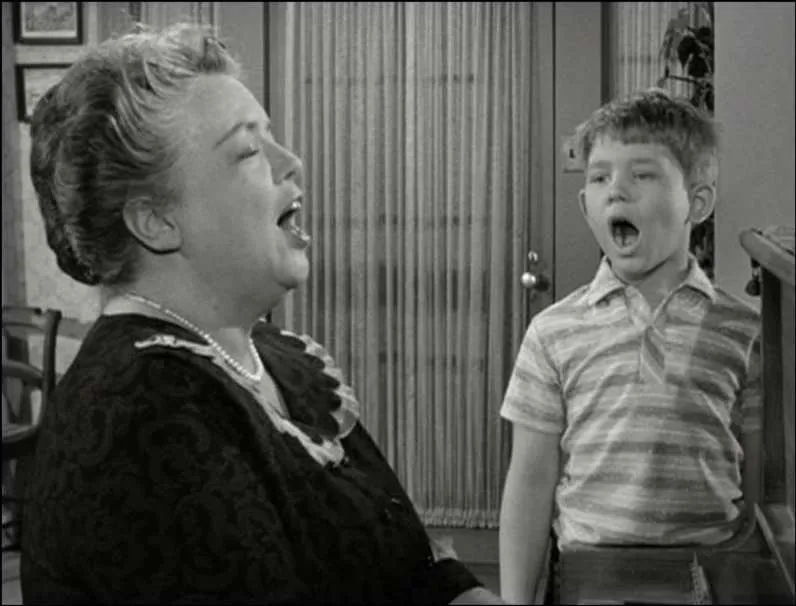 Newspapers managers do a lot of hand wringing about user comments. They are so … distasteful and base. It’s such an issue, it’s becoming a popular seminar topic.
And reader comments threads at the bottom of stories at knoxnews often aren’t for the faint of heart and can be far from uplifting. Granted my view may be a bit tainted. I can spend a good chunk of my day reviewing the ones users have found objectionable.
But then again, there is something going on in user comments that has nothing to with discussing the issue at hand or solving world problems - or even local problems. There’s an organic community evolving that operates much like a small town. It’s not a everything-always-ends-sunny Mayberry, but then again Mayberry was a mythical TV place. No, I’m talking about a “real” small town.
People “know” each other by their user names and “know of” many more. Just like a small town, it can be painfully gossipy and catty and sometimes down right mean. But the characters and voices are rich.
Beyond the end of the story may be the best reads of the day.
Here ItFrom.Us thought so on Monday, blogging:
Billie is amazing. If the KNS could find space to give Billie his/her own column, or at least a blog, I would be eternally grateful.
If you like to laugh until you cry, it’s a must read.
Poll: Newspapers will print for … years
The Pew Research Center for the People & the Press and the Project for Excellence in Journalism recently released some survey data that included a question to journalists on how long newspapers would print.
I thought it would be fun to see how my blog readers answered the question. So pleasetake my survey. It’s painless. I’ll post the results in about a week.
Some pub on iCopyright
 iCopyright has been getting some pub this week with the announcement of a deal with AP.
We’ve been using iCopyright or its technology for a several years on knoxnews and I’ve always liked how it works. When i first saw it, it was like, wow, it’s basically all self-service? And in most cases, it is.
It’s not meant as a way to keep grandma from emailing an article to Aunt Suzie, but rather a way to efficiently manage commercial reuse. And in these days of dwindling resources at newspapers, that’s more important than ever.
Here’s a some coverage from PaidContent and some from the Seattle firm’s own blog.
Best of luck to the company.
Splatter
 Is that splatter on the wall blood or art? Ideas on print media via Newscoma.
(Image from 10,000 Beasts)
WSJ gets pageviews, but misses a story
This should be a Wall Street Journal story: Why the Wall Street Journal’s pageviews up 75 percent year-over-year.
(via Martin Stabe)
My less is less than yours
I have this nightmare that media will devolve in a battle of who can do more with less. Round after round of doing MORE with less until there is no less to have less of.
Maybe, I’m not asleep. It may just be “media convergence” of my dream state with waking reality. It seems that way more so each day.
At WBIR, blogger Katie Allison Granju says having more experience already at doing more with less may actually give TV stations an advantage over newspapers.
“I’d argue that broadcast outlets have always been able to do more with less, so in some ways, they’re better able to adapt to the concept of the do-it-all multimedia journalist model.”
Repeat after me, there is no such thing as an Internet newspaper
There is no such thing as an Internet newspaper, says Nick Carr.
“The nature of a newspaper, both as a medium for information and as a business, changes when it loses its physical form and shifts to the Internet. It gets read in a different way, and it makes money in a different way.”
Twitter newspapers
Erica Smith at graphicdesignr has the most complete list of newspapers on Twitter that I’ve seen complete with metrics on “followers” and recent growth. Several newspapers have multiple Twitter accounts.
Great resource!
Rob Curley’s Neyland Stadium show
Yes, it was that big. No other venue could contain him. It had to be moved from Thompson-Boling Arena.
Good news for a good idea
Scott Karp’s Publish2 has raised $2.75 million in Series A funding from Velocity Interactive Group.
Congratulations! Read the news.
I’ve been experimenting in one area of Publish2 and Karp’s vision of the future, link journalism. I had been dabbling in extensive outside linking as “the content” rather than “supplemental content” before I ran into Karp’s ideas.
But his thinking outlined on his Publishing 2.0 blog crystallized what I could see in my the Web stats for knoxnews/govolsxtra.
The epiphany: Human aggregating is a valuable, journalistic service.
Sounds simple. Most good ideas are. What I have found is that “stories” that consist of links to relevant content are consistently high traffic drivers.
Karp’s vision goes much further than mere external linking to the power of groups, a sort of wisdom of the crowds approach. But one not subjected to gaming or social relationships that happen on sites like Digg. How to quickly develop ad hoc crowds of human aggregators on a breaking news event is one of the challenges still to unravel.
That might be enough of a goal. But his business plan goes further than creating a cool tool for journalists and it’ll be interesting to see what he outlines there. He says his ideas around a sustainable business model will be announced in the future.
This is an intriguing effort that has caught the attention smart media thinkers like Jeff Jarvis. I’m listed as an “advisor” for Publish2, but I’m more of an incurable road tester. I’ll leave the smart thinking and advising to Karp, Jarvis, Howard Weaver, Howard Owens and Beth Parke.
If you’re a journalist and you haven’t already signed up for Publish2, head over there and request an account. This is a good idea to wrap your head around.
As today’s announcement shows, guys with skin in the game think so.
That New Coke moment
 Companies often have the uncanny ability to do precisely the wrong thing at the exact right time.
Business history is a virtual junkyard of Edsels, New Cokes, Bic pantyhose.
Decisions months or years later reveal themselves as the turning point to a failed strategy or tactic.
How is it that bright, highly successful business people can do such boners?
Venture capitalist and former Apple executive Guy Kawasaki has some thoughts on that inspired by Mortimer Feinberg’s Why Smart People Do Dumb Things
Whatever the reasons for doing the wrong thing, I believe we – those of us who work for traditional media companies – are in one of those exact right places to do them.
Times are tough in media industry is an understatement of comical proportions.
We know the story.
Newspapers just ended the worst year in 50 years and prospects for 2008 seem no better. The prospects of local TV stations are none too bright either.
Structural changes in traditional audiences and advertisers; an economic downturn; and tremendous competition online for audience and advertising from digital competitors unencumbered by traditional media’s problems form a triple assault force.
The result for newsrooms and journalists? It sucks.
And, I believe, the short-term pressures to make plan, cut expenses, trim the fat in the old businesses is resulting in blind spots to opportunity for the future businesses.
The examples are not hard to find. A recent “What are They Thinking “ decision by a Nashville television station is one of the trend. I’m sure you can point to others, and please do in the comments.
This one involves Tennessee blogger A.C. Kleinheider and his VolunteersVoters blog, which became in less than two years a must read for links and quick reaction to political news in the state.
On March 14, Keinheider announced that he had written the last post for VolunteerVoters due to budget cutbacks at its owner, Nashville TV station WKRN. The station, not a broadcast ratings leader, had in recent years become one of the most innovative mainstream online presences in the state – and even in the TV business. BusinessWeek and NPR did pieces. But these are troubled times for its owner, Young Broadcasting.
React to the VoluntterVoters deicison was fast and passioned. As I type this, there are 165 responses on his final blog post.
PS-WKRN–You’re making yet another mistake is in the first comment. They don’t get more positive.
Blogger and communications director for the state Republican Party Bill Hobbs wrote:
It’s been a week, and I’ve come to a conclusion about the demise of VolunteerVoters.com. It’s not a big loss. It’s a MAMMOTHLY HUGE loss. There is a giant hole in the media fabric in Tennessee when it comes to political news. VV was the indispensable go-to source for all things political involving Tennessee, and provided depth and context that the various disparate news outlets often lack.
Additionally, while MSM outlets mention or quote from press releases and documents and such, VV often uploaded the whole thing, or gave readers a link to it - making it a far more valuable resource than any single MSM outlet for politics junkies.
It’s a damned shame that WKRN couldn’t figure out how to monetize the single most valuable political news property in the state. Here’s hoping that some other news outlet, one which understands the new media - and the new media consumer - and wants to be an information portal for its readers rather than just an information destination, decides it wants to take over VV, or at least hire Kleinheider to build a VV replacement for them.
The 50-year flood is here
2007 was the worst year for newspaper advertising in 50 years, according to industry trade group, the Newspaper Association of America.
Revenues were down industry-wide by 9.4 percent. Online ad revenues were up 18.8 percent, but make up but 7.5 percent of the pie. And worse, online ad revenue growth has significantly slowed. It grew 31.4 percent in 2006
Coverage in Editor & Publisher and PaidContent, of which the latter said:Of course, the industry is getting hit with a double whammy: secular industry shifts, and the effects of a sorry economy, which has decimated core revenue bases like housing, employment and auto ads.
2008? No sign the flood waters are abating. Where’s the higher ground? Mark Potts says we’re over the cliff. Ken Doctor has some marketing ideas (Now! More Time on Sunday to Do Other Things!) to turn the industry around.
Angry Journalist as career Yoda
 What? Angry Journalist sees future in much-maligned industry for J-School grads?
Call it optimism tempered by realism, Yoda teaches careers in journalism.
Bryan Murley pointed me to a great piece on his Innovation in College Media blog by Kiyoshi Martinez, founder of Angry Journalist.
The piece is aimed at journalists trying to enter the work force and it’s good advice, damned good advice.
As I was reading it, however, I was thinking this is fantastic advice for students contemplating journalism as a major, a sort of this is what you are getting into and can look forward if this is the path you choose my little one.
And then it occurred it me it, this is great reading for people already working in journalism, this is what you haven’t thought about recently in terms of personal marketing and how journalism is changing.
Some tidbits:
“You ought to be able to explain why you’re taking the job you’re taking, why you’re making the investment you’re making, or whatever it may be. And if it can’t stand applying pencil to paper, you’d better think it through some more. And if you can’t write an intelligent answer to those questions, don’t do it.”
You might think you know journalism. It’s writing articles for a newspaper. Or shooting photographs. Or designing pages. Or maybe even that new media stuff people keep mentioning. Wrong. Those are skills.
With Google and Wikipedia you no longer have any excuse to be stupid. Ever. Have a question or curious about something? Type it into Google.
You might think you’re too young in your career to build a brand. Wrong. You need to start developing it now. Literally, your employer is purchasing your skills over someone else.
Stop blaming others. Maybe you wanted to start blogging for your college paper, but they’re too incompetent, lazy or slow to let that happen. Same goes for video. Or soundslides. So, you’re sitting around and doing nothing now. Screw them. Do it yourself.
Get a good idea about the publication’s strategy and vision – and not the bullshit one that they’ll spin you. What have they actually done?
If all you love is newspaper journalism, then you take the risk of it not loving you back.
The curse of Barbara Bain’s dog
Jimmy Guterman, editorial director of O’Reilly’s Radar group and the editor of O’Reilly’s Release 2.0, is parting company with the printed edition of the New York Times.
What finally made me give in to the inevitable was realizing, one barely-dawn morning last week when I was reading the paper at our kitchen table, that I had already read much (most?) of it online. For all the pleasure of holding and print, the Times on paper is just too late. In 2008, today’s paper is yesterday’s news.
Humming along with Count Basie
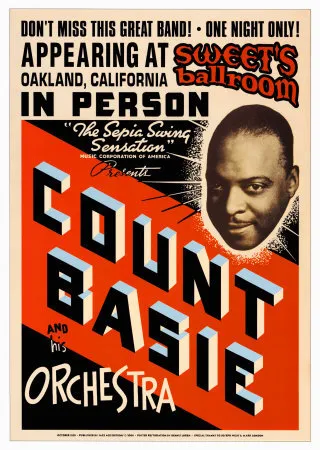 Blogger, consultant and inveterate Twitterer Stowe Boyd says hopes of a newspaper return to better, happier days are but melodic dreams of the Benny Goodman era.
He finds the pessimism in a David Carr piece on the industry in the New York Times not near pessimistic enough.
In that piece, long-time newspaper analyst John Morton says:
“Newspapers have lived through recessions before and come back strong, My worry is that when things do turn around, they will be coming back in an environment that is more competitive than ever because of the Internet, and that after all these cuts, they will have less stature, less product quality and less talent – all of the things that they need to compete.”
Behind the entries
Beth Lawton of the Newspaper Association of American highlights the knoxnews Digital Edge entry.
A media shell game
When times get tough, companies like to hunker down like a tortoise in its shell. When the rough times pass, they’ll come out of our shell again.
But in the media business today hunkering down and focusing on the core is like a tortoise withdrawing into its shell in the middle of a highway.
You have to get to the other side of the road or …
KnoxvilleTalks blogger and WBIR online producer Katie Allison Granju has some thoughts on getting to the other side in light of the well-publicized scaling back of Internet efforts at Nashville TV station WKRN, once a pioneer in how TV stations should do the Internet (and which has had more than a few ideas that newspapers could borrow).
The new State of the News Media 2008 study from the Project for Excellence in Journalism has some charts that might help to bring it into focus what is happening to news and the media.. Which of these three charts seems to be showing growth?
Daily newspaper readership by age (click image for larger version).
Average early evening news share for TV (click image for larger version).
Top online news sites and growth (click image for larger version).
Raising new and troubling questions …
 In what could only be viewed as a perverse and often baffling development, author and New Yorker magazine writer Malcolm Gladwell said last week a story he told in an early February segment of public radio’s “This American Life” is, well, a complete tall tale.
In the story, recorded at a New York club called the Moth, Gladwell recounts his early days as a cub reporter at that august bastion of journalism, Ben Bradlee’s The Washington Post.
To hear the “The American Life” segment go here and click on full episode and move the player sliderbar to about the 45:27 minute area of the audio to hear the start of the Gladwell piece.
The original piece had a disclaimer, but now, more than a month later, Gladwell has clarified the story’s veracity on his Web site:
There is a disclaimer at the end of the This American Life broadcast, to the effect that the Moth is a place where “people come to tell both true stories and occasional tall tales.” As I think should be obvious if you listen to it, my story definitely belongs to the “tall tale” category. I hope you enjoy it. But please do so with a rather large grain of salt.
The deejays of news
A trio of posts over the weekend had me musing about the new roles journalists find themselves in, roles far beyond what journalist and essayist H.L. Mencken (pictured at right) probably envisioned. Beyond reporting and writing, they are becoming community discussion leaders, the deejays of news.
Robert Niles and Howard Owens, among others, have suggested that this is a role that must be played by newspapers and other media on the Web.
Howard Owens was quoted in January as wishing: “Reporters and editors would take seriously their roles as community conversation leaders, concentrating on getting it right on the web first – Web-first publishing, blogs, video, participation – and using the print edition as a greatest hits, promote the web site vehicle. Old packaged-goods-thinking about the newsPAPER would disappear overnight.”
Robert Niles said a few months back “The core skills one needs to build an active, informative and respectful online content community are precisely the same skills reporters and editors have employed for generations to become good journalists.”
Which brings me around to this weekend’s posts.
WBIR senior online producer Katie Allison Granju says her role on KnoxvilleTalks.com is “akin to one of those salon hostesses of yore who worked to facilitate and encourage great conversation among guests.”
Trace Sharp says adds another angle. The conversation guides must have a voice themselves, much like the radio deejays when you knew the deejay’s name.
She wrote:
Blogging and the tubes are somewhat like personality-driven radio for me. I listened to DJs I liked who engaged me. That’s what I wanted to do. …
I think about blogging the same way.
And I like human aggregators. I just see blogging a bit like radio. I listen/read you because I dig what you, the person, says/writes.
Last news first
All you need to know about news judgment is last news first?
I think every newspaper on the web should at least offer the reader a choice of a reverse-chronological view of the news. I think they would find most readers would use this view, most editors would too.
I was inspired to write this today because Scott Karp at Publishing 2.0 has come to basically the same conclusion. I think we may finally be coming to the tipping point for news publishing on the web. I hope so.
Leveraging what people are already doing
There’s a point here:
There’s so much opportunity on the web – it’s just a matter of seizing it.
So how can the web make LESS work for journalists rather than more? Which weekend assignment would you have rather had?
Write human interest feature on the storm from scratch, call up people to annoy them for quotes, and then run the AP photo
OR
Read the stories and browse the compelling images already being posted across your local blogosphere, and create a quick link journalism piece to capture it
The web doesn’t have to be harder for journalism – it can be much, much easier – it’s just a matter of learning how to use the web.
Refer madness
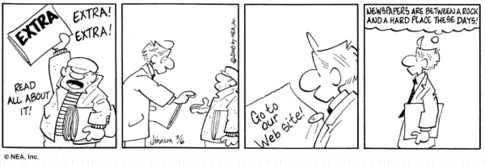 (Via Scott Karp, see full comic here)
Is your tech writer better than Arrington?
Pat Thornton says newspapers, rightly I believe, need to let some niches go.
Many newspapers have been shrinking in recent years, yet they are still trying to cover as many beats and put out similar levels of copy. Does anyone honestly believe that writers and copy editors will magically be able to turn out the same quality of work while doing much more of it each day? No one with a brain does, and this is why newspapers are constantly printing mistakes and running embarrassing corrections.
Take Steve Outing’s classified survey
Steve Outing, whose has got something going with Techgrl and who has a nice start with growingyournewswebsite.com, has yet another site in development, ReinventingClassifieds.com.
He’s looking for people in classifieds or at media companies who make strategy decisions involving classifieds and advertising to take his survey.
Consultants, academics, etc. who have expertise in the classifieds sector also are invited take the survey.
If you fit the bill, take the survey. I’m sure the learnings from his site will benefit anyone interested in this vital part of the newspaper (print and online) revenue pie.
Surely, it’s not a problem
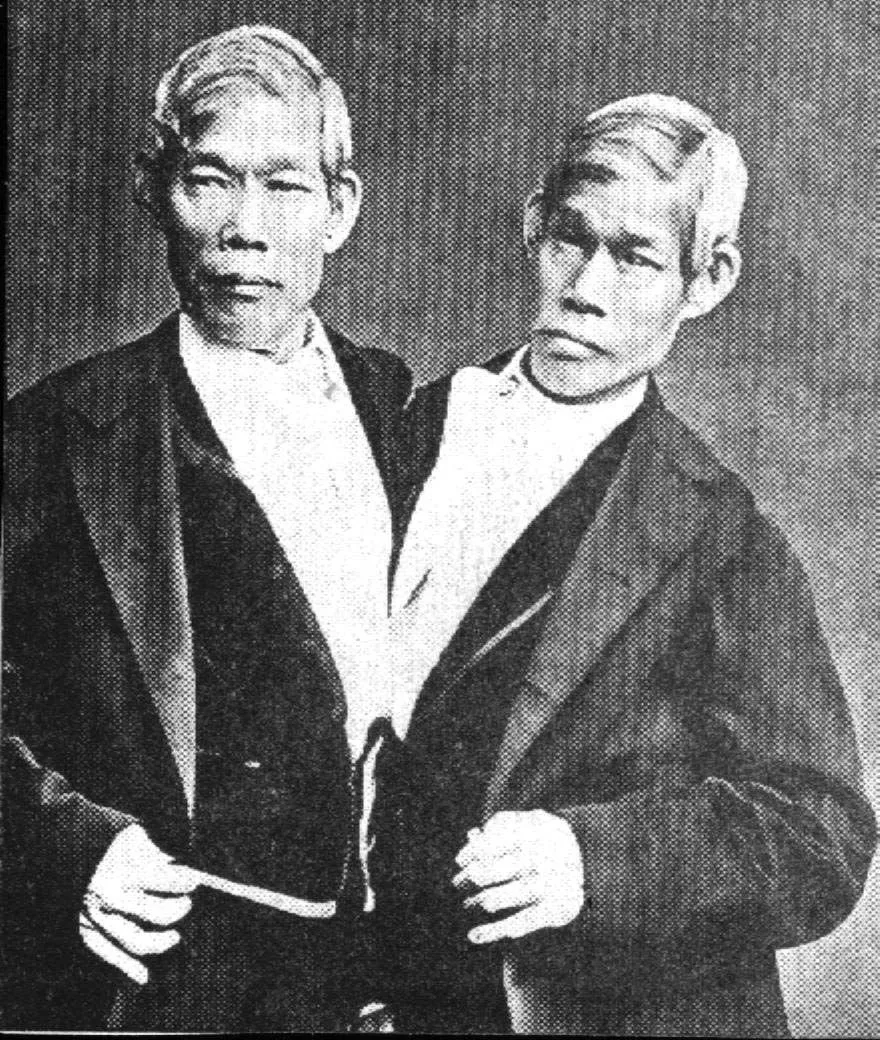 A new Zogby Interactive poll shows the shift away from traditional media - particularly newspapers - continues to move at warp speed. We’re down to only people 65 and older getting most of their news from something other than the Internet - and that’s probably TV.
When only 7 percent of the key 18-to-29 year old demographic say they use your product, it might be fair to say your long term prospects are marginal. Across all age groups, 70 percent of respondents said journalism is important to the community, but only 10 percent partake of it in a printed newspaper.
Does that indicate a problem?
Surely, not, they say round the watercoolers at traditional media companies. People will always read/watch/listen to us - and, more importantly, buy advertising.
If this poll is accurate - and Zoby says its margin of error is 2.2 percent - even many of the people subscribing to newspapers must not be reading them. My theory is the people looking for a long gradual decline in traditional media consumption (and revenue) are suffering from data smoothing delusions.
The tipping point has been breached.
It is not enough to shift your news to the growing online consumption; the underlying business structures need to quickly evolve to digital strategies with radically different cost and revenue structures. That has not begun to happen with any true urgency; in fact, online revenues for many U.S. newspapers are declining against year ago numbers or showing anemic single digit gains. (Most traditional media have their old world and new world joined like Siamese twins, where one goes, the other must follow.)
At traditional media operations, revenues, profits and readers/viewers/listeners (audience) from the traditional sources are outsized compared to digital even if stagnant or declining. Digital revenues and audience are the rocket booster on the mothership. At some point - a point that is within sight - that has to flip with traditional media the booster rocket to a digital business model. Unfortunately, that cannot be done easily or bloodlessly.
Analyzing your traditional business processes for productivity gains are unlikely to provide the systemic change necessary. Remodeling, repainting and landscaping only go so far.
From Zoby’s news release on its poll:
Nearly half of respondents (48%) said their primary source of news and information is the Internet, an increase from 40% who said the same a year ago.
Younger adults were most likely to name the Internet as their top source - 55% of those age 18 to 29 say they get most of their news and information online, compared to 35% of those age 65 and older.
These oldest adults are the only age group to favor a primary news source other than the Internet, with 38% of these seniors who said they get most of their news from television.
Overall, 29% said television is their main source of news, while fewer said they turn to radio (11%) and newspapers (10%) for most of their news and information.
Just 7% of those age 18 to 29 said they get most of their news from newspapers, while more than twice as many (17%) of those age 65 and older list newspapers as their top source of news and information.
Web sites are regarded as a more important source of news and information than traditional media outlets - 86% of Americans said Web sites were an important source of news, with more than half (56%) who view these sites as very important. Most also view television (77%), radio (74%), and newspapers (70%) as important sources of news, although fewer than say the same about blogs (38%).
Just like on ‘The Wire’
Maybe our business has changed. Pay phones?
(via the knackered hack)
‘Like meeting a rock star’
Link journalist
Scott Karp may have coined a new term in “link journalism.”
It’s a bit of jargon news editors need to unravel because it’s a powerful way to engage audiences.
It’s not a new concept. “Link journalism” has been practiced every since the Web was born and people began linking.
But Karp, founder of Publish2, argues it’s a valuable journalism function and defines it thusly.
Link journalism is linking to other reporting on the web to enhance, complement, source, or add more context to a journalist’s original reporting.
Online animals
An Edgie Trifecta
 Knoxnews won three Digital Edge Awards on Monday from the Newspaper Association of America. The Digital Edge Awards are part of the NAA’s larger Media Innovation Awards. Winning was good!
The Digital Edge Awards, or Edgies, are one of the most prestigious online newspapers awards. The Knoxville News Sentinel competes in a category with a large number of papers, those with print circulations between 75,000 and 250,000. There are many excellent newspaper Web sites in this group and lots of innovative things happening.
We won:
Best Overall News Site
Most Innovative Visitor Participation (schoolmatters.knoxnews.com)
Best Design and Site Architecture.
Here is a complete list and details.
There are a number of talented people working on knoxnews/govolsxtra at both the newspaper and the corporate level in Knoxville. A hat tip to all! But I’d especially like to thank the newsroom team of Deputy Managing Editor Tom Chester, Online Editor Jigsha Desai and online producers Lauren Spuhler, Erin Chapin and Talid Magdy.
We also have this semester two talented practicum students from the University of Tennessee: Yolanda Ortiz and Samantha Thornton.
(Katie Kolt Hall was also an online producer during the time covered by this contest. She’s, now doing wonderful things as the Web content specialist at the Knoxville Area Chamber Partnership.)
They rock the house!
Elizabeth Spiers’ secret sauce
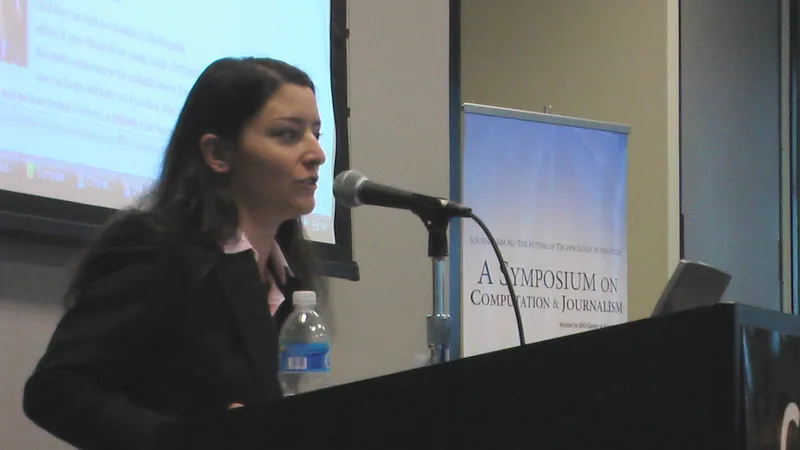 It’s one of my theories that mainstream media needs to operate a lot more like startups: nimble, flexible, quick, resourceful and hungry. We need to particularly be doing this when we create our own internal “startups.”
So it was nice to hear Elizabeth Spiers share some of the secret sauce ingredients to making a successful Indy online publication. She was speaking at “Joururnalism 3G: A Symposium on Computation & Journalism” at Georgia Tech on Saturday.
Taking advice from a gossip columnist - again? No, I was listening to the advice of a savvy media player who happened to gain a good bit of notoriety as the first editor of gossip blog Gawker. (She says it didn’t start out a celebrity gossip rag; it was focused on Manhattan. It certainly launched owner Nick Denton’s blogging empire.)
Spiers also has written for a number of magazines and newspapers. She was editor in chief ofmediabistro.com. She formed blog network Dead Horse Media (and abruptly left in April in a disagreement with her partners).
With her Gawker days behind her and a novel coming out in November, Spiers is a familiar name in New York media circles, That’s not bad for a young woman from Wetumpka, Ala. (a small town of about 5,700) with a degree from Duke who decided to make in the toughest media market in America. Like I said, I was listening closely…
“I’ve only worked in journalism about five years, which is as far as I can tell, the length of a New York Times internship,” Spiers said. Instead of learning how to run the copy machine, she learned blogging, how to start a business and how to get good writing gigs, she said. I call that pretty good cred.
For Indy online publications with limited budgets and resources, Spiers’ ingredients for a secret sauce include:
-
Keeping it tightly focused on a topic or very limited niche. You don’t have the resources to be broad or mass.
-
Post 12 to 20 new pieces of content a day. “It’s a lot more rigorous than it sounds,” she said.
-
Experienced journalists might not be the best hires. They can blog, but can quickly burn on posting 12 to 20 times a day, she said. And the heavy posting often gives experienced journalists a disincentive to do original reporting. A young person breaking into journalism may find it rewarding. They get a lot of responsibility and user feedback.
-
Ask readers to help. She said ask nicely and ask for granular info. She gave an example from earlier this year in Gawker. Nick Denton asked in blog post:
Matthew Winkler Working on a story on Bloomberg’s editor-in-chief. Is he still as much of a tyrant? Examples please! Email nick@gawker.com.
An update on the transformation of the Atlanta Journal-Constitution
 On Friday afternoon at “A Symposium on Computation & Journalism” (a sort of geeks and journos mashup at Ga. Tech), Shawn MacIntosh, director of culture and change at the Atlanta Journal-Constitution, gave an update on the upheaval at the AJC as it tries to remake itself for the digital age.
It was just a year ago that a major reorg of the AJC was announced. MacIntosh has been at the center of the whirlwind of change that re-molded the newsroom into four areas: News & Information; Enterprise, Printed Product; and Digital Department.
One of the first changes was the news meeting, which used to focus on Page One for the next day, which was “kind of crazy” for paper that already had a major Web operation, she said. The meeting was refocused on Web first and within two weeks, ajc.com was seeing Web site traffic gains.
To achieve just that obvious change required a task force and eight months of meetings, complaining and planning. That illustrates the culture change newspapers are up against, she said. “The pressmen in the halls are not used to mixing it up with the search engine optimization expert.”
MacIntosh said the biggest challenge has been serving two mediums. Some newsrooms say they are content agnostic, but not Atlanta. Print and digital are fundamentally different and newspapers that try to replicate Page One online or replicate the print “newspaper experience” online are making a mistake, she said. “The same content does not delight and thrill the same audiences,” she said. “We found honestly we couldn’t do both well.”
Roughly a third of AJC.com’s users, MacIntosh said, haven’t looked at a printed edition in some time.
Because of the differences and different audiences, the printed paper and the Digital Department are separate.
The newspaper’s reorganization strategy appears to be succeeding: print circulation has stabilized and Web traffic is rocketing.
More blogging about the symposium, which continues Saturday..
New Frontier Awards
Got some great news on Tuesday. From an Inland Press Association news release:
Winners of second newspaper Web contest chosen
The Globe Gazette, News Sentinel receive best in circulation size
The Globe Gazette, Mason City, Iowa, and the Knoxville (Tenn.) News Sentinel took first-place honors in their respective circulation divisions in the second New Frontier Awards sponsored by Inland Press Association.
The contest honors the best in newspaper online initiatives. It consists of seven categories that recognize newspapers’ achievement in producing and disseminating news content using online and new media platforms. Entries are judged on creativity and results, along with category-specific criteria. The contest is open to all Web sites run by U.S. newspapers.
The Globe Gazette (www.globegazette.com) won for papers with less than 20,000 circulation. Judges noted the ease-of-use of the Web site and its strong user engagement through multimedia. Placing second was the Rome (Ga.) News-Tribune (www.romenews-tribune.com). Taking third was the York (Neb.) News-Times (www.yorknewstimes.com).
The Knoxville (Tenn.) News Sentinel (www.knoxnews.com) won for papers over 20,000 circulation. Judges noted its well-organized Web site packs a lot on the page without sacrificing accessibility. The Rapid City (S.D.) Journal (www.rapidcityjournal.com)
earned second place. Taking third was the Frederick (Md.) News-Post (www.fredericknewspost.com).
Judges were Michele Bitoun, Medill’s senior director of undergraduate education and teaching excellence; Janice Castro, senior director of graduate education and teaching excellence, Medill School of Journalism; Rich Gordon, director of digital media in education, Medill; Jon Marshall, Medill instructor and editor and publisher of SPJ’s News Gems blog (www.spj.org/gems); Mary Nesbitt, managing director of the Readership Institute and Medill associate dean for curriculum and professional excellence; Nora Paul, director, Institute for New Media Studies, University of Minnesota; and Richard Roth, associate professor and senior associate dean, Medill.
Intrepids decloak
All the details except where the name came from. Adventures await!
Who sucks worse: Newspapers or TV Stations?
Commenting on a Broadcasting & Cable piece on the Web and TV stations, Angela Grant says:
It seems like the attitude of TV stations towards the web, according to the article, is the same type of attitude that has sunk newspapers to the level they’re at today. We’ve both got to get to the bottom of these insecurities and turn them upside down
Turn it up
Former WCPO-TV online manager Liz Foreman, a highly respected journalist who has been focused on online for years, gives a revealing glimpse of the differences between newspapers and TV stations in a Lost Remote posting yesterday.
Now, director of multimedia initiatives at the Cincinnati Enquirer, Foreman outlines for TV colleagues some of the differences she’s found between the two mainstream media operations. There are tips for newspaper newsrooms.
She finds newspapers too quiet and not urgent enough, but with lots of resources even in shrinking newsrooms.
Print newsrooms haven’t always had the ambiance of a library, but maybe that went away with the bottle in the bottom drawer. Make too much noise these days and you’ll get notes. As for urgency, she’s right, it’s in spotty supply.
I say it’s past time to turn up the volume – in noise and urgency!
Pssst , we’re being noisy over here and liking it, but the bottom drawer is still dry.
There’s more. Good read.
New for the reporter’s tool belt
Gee, where I have been, asleep or something?
A Steve Rubel twitter drove me to his Web site where he’s trying out a new Google Docs feature that allows users to create Web forms and collect the data in a Google Doc spreadsheet. Anybody can create them.
The feature apparently went live on the sixth.
I tried one and the only problem I noticed is that web-based version of Outlook (OWA) wouldn’t write the data when the form is sent in an email, but otherwise it worked great. The form can be sent in an email or just the link to the form.
This looks to be a great tool for journalists. Newsrooms that want to quickly do a survey and collect data can without programming help. No need for a Web monkey to create a form and a database. Just do it yourself. If you can fill out a form, you can create these Web forms.
You start by creating a Google Docs spreadsheet and click the “share” tab. Then under the “invite people” heading, choose “to fill out a form.”
Couldn’t be simpler. Google continues to make Docs useful. For me, it’s more than beginning to have the features that I want from MS Office and MORE without the stuff I’ve never used anyway.
Seems a crime we used to have spend all that money on MS Office licenses for what, the right to upgrade to next year’s version? Glad those days are over.
Just another sunny newspaper guy
Marc Andreessen is a really smart guy and I don’t mean to be pollyannish, but I’m not ready to do a deathwatch on The New York Times, despite its boardroom brawls with big investors, its stock price plunge over the course of 2007 and its sickly recent earnings.
Even with all the bad news, I’m just optimistic enough to think it’s a bit premature to write the prepared obit for The New York Times and the rest of the newspaper industry.
He does have a point in that media companies boardrooms are stocked with more Scotch than experts in the most important platform for their future. And you may not even be able to find the good Scotch.
Andreessen, creator of the first widely used Web browser, Mosaic, didn’t even bother to mention mobile. Maybe he thinks the deathwatch will be over before that takes over?
Funding journalism
 Last week an argument that won’t seem to go away bubbled up again - save Big J journalism and newspapers with government aid, or at the very least some form of indirect relief.
Sort of clues you in on the state of industry. Course, it wouldn’t be the first time. The industry still has a dozen or so remnants of an effort to save two newspaper towns, the Newspaper Preservation Act of 1970.
The debate started anew perhaps on Jan. 21 when Ralph Whitehead Jr., a journalism professor at the University of Massachusetts at Amherst wrote a guest column on Boston.com that outlined the economic issues facing newspaper journalism as we’ve known it, but cautioned against government intervention.
What may be emerging today, however, is a serious case of market failure that can’t be - and must not be - fixed by government intervention: the failure of the private sector to provide broadly inclusive journalism that is both comprehensive and reliable enough to meet the needs of a democracy.
Covering an election differently
We’re trying some new things on knoxnews for the Tennessee primary on Feb. 5.
You can sign up for text messages for election results or follow the results on our Twitter page (log into Twitter and click “follow” on our page). We’ll also be doing continous updates all day on election day on knoxnews.
If you’re an East Tennessee blogger who’s blogging the election or photgraphing it or something else interesting, let us know; we’ll link to it.
We’re also asking people to send us photos from a polling place with a digital camera or your cell phone. We’ll post them online. Just email your photo(s) to shareonline@knews.com.
I think this is going to be fun!
We’ll get around to it
Ethan Kaplan and Chris Brogan have done some blog posts on thoughts on newspapers and traditional media. Kaplan pulls some thoughts he had years ago and Brogan’s were cultivated from a recent panel discussion.
It is interesting Kaplan’s thoughts from seven years ago and a decade ago are similar to Brogan’s today.
Kind of tells you just how far mainstream media has moved, doesn’t it?
Going down for the wrong cause
The departure of Jim O’Shea from the L.A. Times shouldn’t be construed as fighting the gallant battle for journalism. It was the battle for status quo and business as usual.
What’s needed is creative thinking, new approaches and a reassessment of what newspapers do. O’Shea failed on all points. He needed to go.
Pulling last year’s or four year’s ago plans from the files and adjusting for inflation is not managing as an editor. Finding a way to do great journalism (big J and little J) despite the obstacles is.
Maybe one in three would miss their printed paper
From a SearchEngineLand take on the 2008 Digital Future survey from the Center For The Digital Future at Southern Cal:
Would You Miss the Print Edition of Your Newspaper? -- In a new question, respondents who read print editions of newspapers were asked if they would miss the offline edition if it was no longer available. While more than half of respondents (52 percent) expressed some level of agreement with this question, 27 percent disagreed.
Journalism experience of over 100 years is leaving the building
News Sentinel Editor Jack McElroy notes the departures late next week of three long-time newsroom folks, Gerry Segroves, Lynn Lewis and Fred Brown.
Both Fred and Lynn had worked at the Memphis Press-Scimitar before it closed in 1983.
Fred’s an example of a vet who has adapted over the years. He blogs, he’s done audio for online, he’s shot video. I’m sure he’d say it’s been an learning experience. There was a recent training session in which he said he had once shot a video with the front of the camera pointing at himself instead of the subject, but, hey, he did it. Fred is not one of those veterans that blogger and consultant Paul Conley says to forget training.
Lynn is the master of detail and organization. He has helped the online staff immensely in figuring out what was coming from the features and entertainment sections, repairing the translation errors that too often occur in throwing stories across the abyss between the print computer system and the online system, and in finding online homes for stories that just couldn’t quite be squeezed into the paper.
Gerry or the night online producer is the last person out of the newsroom in the early morning hours. I’ve turned the lights out on him more than once (he’s at the extreme other end of the newsroom). He often brought to the online producer’s attention late stories that he couldn’t get more than a couple graphs in somewhere deep in the paper that deserved better. And he let us know of fixes made that we might have missed.
Good folks all and to be missed.
Only the years have changed
The trouble with our times is that the future is not what it used to be.
- Paul Valery
And the trouble with the present is it’s so much like the past.
As we leave 2007, I decided to turn back and see what was being said about newspapers and journalism a decade ago.
Some context for 1997: There was a big newspaper company called Knight-Ridder. It was before Cragslist was feared (it started in 1995). It was the year the domain name “google.com” was registered, but before the Google, the company, was started. Flickr, Facebook, Twitter? No one would have guessed.
There was a lot of buzz about AOL’s Digital Cities, which started was started in 1995, and Microsoft Sidewalk, which started the next year. Both were local online guides that were the Googleman, I mean bogeyman, of the day for newspapers, who were deciding whether to partner up with the enemy or entrench on the front lines of local.
So what were America’s editors focusing on in 1997? At the April gathering of the American Society of Newspaper Editors, there was a fascinating panel discussion on online media, journalism and newspapering called “It’s still the content, stupid: 1997-2010.”
The 1997-2010 part of the title was meant, I suppose, to be a look to a bright future, but it actually describes a coma for journalism as practiced by newspapers. For other than pockets here and there, not much has really seemed to have changed in the past 10 years.
Who was on the panel? It was an all-star cast (names and companies at that time). Ted Leonsis of AOL, Bill Bass of Forrester Research, Diane H. McFarlin of the Sarasota (Fla.) Herald-Tribune, George Berge of the Journal and Courier in Lafayette, Ind., Ron Martin of the Atlanta Journal and Constitution, Mary Jo Meisner. between jobs, but former editor of the Milwaukee Journal Sentinel, Regina Joseph of Think New Ideas, and Farai Chideya of CNN.
What follows are some quotes from the transcript of the panel:
Ron Martin: “Part of newspapers’ challenge is to define what part of that content we do best – what’s the best for us to focus on – and leave the chat rooms, perhaps, to others.”
Mary Jo Meisner: “As newspaper people, we’ve really seen it in the context of news – covering events, reacting to them, trying to tell them passionately, but also objectively and fairly. What we’ve been perplexed by in the last couple of years as editors, is widening that definition and seeing it in new ways. We’re always talking about the local news context. Now, we’re starting to see it in terms of getting our readers to write for us, stories from the very low levels of our community where they’re providing the content for our newspapers, removing us as the filters.”
Ted Leonsis: “One of the issues the industry faces is that we think of things in discrete buckets as content: There is chat, there is advertising. I don’t think you’re going to break out of the smallness of that and think of how big a new business this really is, unless you start thinking of new brands and new businesses.”
Diane McFarin: “We’re crazy if we sit still and wait for AOL and Microsoft to come to town and set up city sites to deal with what we have the expertise in. We have the critics. We have the history and understanding of all these things. These folks don’t know anything at all about our communities.”
Ted Leoniss: “We’re more in line with some of the traditional ethos of newspapers – providing local information and context – than some of the big newspaper companies are.”
George Benge: “While I certainly appreciate all the wonderful things that the online world has brought to our business and our culture and our personal lives, … There is something about what we do as journalists that is unique, and it always will be unique. So long as we are willing and able to change tools and to discuss new idioms and new ways of presenting what we uniquely do to different and new markets, I think there will always be a wonderful future for newspapers.”
Ron Martin: “We’ve tried and need to be a mass deliverer of information in our communities. That’s a challenge for us, and one that we can’t easily give up. To say let’s just adopt an attitude – turn our baseball cap on backwards and wear baggy pants – that’s not us.”
Bill Bass: “It’s interesting you talk about newspapers presenting a complete package but, if I go through about any of your newspapers and start looking for what was created locally and how much is packaged from other people, the amount of local stuff is vanishingly small. You take out the wire stories, you take out the stock tables, you take out the classified ads, real estate and things like that, and what is left that you people in this room deliver is really a small part of the entire package.”
Ted Leonsis: “I don’t think about content. I don’t think about newspapers. I think about talent, streams of information, context. In the future, editors are going to be bartenders. That’s what I think. I know that’s a terrible thing to say, but the role of an editor will be social media: “I’m bringing you into a place … into a bar. I’m going to give you the news. I’m going to bring other people around who’ll talk to you about the news. I’ll find dissenting voices, and I’ll package that up for you.” That’s a great new position in jobs.”
Bill Bass: “Go to any newspaper and it has hundreds of years worth of papers up on the walls. Look at the ones from the 1890s and the ones from the 1990s. They look pretty much the same. Now, we have this irritant. Is it going to form a pearl? Papers haven’t had to change for a hundred years. I question whether they’ll be able to make this change – the first really fundamental change in the way they have to do business in a hundred years.”
And at least for a decade, sadly, Bass has proved right. Change a few company names, update the buzzwords and the adversaries, and this panel’s dialogue is current for today. If you’re in a newspaper, you may have heard some of this in the last week.
For the most part, the outsiders in the panel got the picture and America’s editors, publishers and their organizations have – like those on the panel – spent the ensuring decade failing to heed the admonishment to move quickly to change.
Now in 2008, the squeeze of economic forces is undeniably pressuring for change. It’s a fair question to ask if there is still time. For those who believe newspaper journalism and newspapers as institutions can continue to thrive and prosper – or at least survive – what are you doing about it?
As the saying goes: “If not you, who? If not now, when?”
(On with the Carnival of Journalism …What’s the Carnival of Journalism? Look here.)
Newspaper woes spell trouble for Bee
The newspaper industry’s troubles have even stung the National Spelling Bee, where some schools seem to be struggling to come up with the money for a $99 entrance fee needed because newspaper sponsorships are down.
Gee, without the bee, how will we find those kids that can spell s-e-r-r-e-f-i-n-e and y-o-s-e-n-a-b-e.
Voice of the customer
What newspapers can do that most bloggers can’t -- a blogger’s (and reader’s) view.
2008 trends
Eight things newspapers will do in 2008.
Contest season
Spread the word:
Since 1953 the Scripps Howard Foundation has honored the best work in journalism through its National Journalism Awards program. The awards honor excellence in 17 categories, including one that you will find of interest. The Web Reporting Award carries a cash prize of $10,000. The postmark deadline is Jan. 31; winners will be announced March 7 and honored at an awards presentation April 18 at the National Press Club in Washington, D.C. Here are details:
WEB REPORTING AWARD
Honors the news organization that demonstrates the best use of new media technologies and innovative techniques to report on a news story or news event while maintaining the highest journalistic standards.
Open to any news organization whose primary function is the gathering and disseminating of news information to the general public. The news story or event must have been originally published online in 2007. Also open to organizations that combine their traditional field with new media efforts or organizations that focus solely on online formats. No college news organization work is eligible.
Entries must provide a URL(s) for judges to view the news story or event. Entry must include a written narrative describing the organization’s efforts, a description of the news story or event and its components, original date published online, as well as justification of why the entry should be presented an award. $50 entry fee. Prize is $10,000 and a trophy. Entry form available at: https://foundation.scripps.com/foundation/programs/nja/nja.html Questions: Sue Porter at 513-977-3030.
There’s no turning back
Scott Karp on 2008 as the year of ‘change or die’.
Wave a Magic Wand
 A couple really wonderful posts about suggestions for possibly reinvigorating and reinventing print newsrooms for the Digital Age.
Editor John Robinson modifies Howard Owens’ 10 things non-wired journalists need to do contest for the “more-or-less wired journalists” in his newsroom at the Greensboro (NC) News & Record and lists 10 things the newspaper will do in 2008.
Mindy McAdams draws inspiration from Steve Outing’s column on changing newsroom culture with a great time to get crazy post. Outing blogged a follow up tying in his column and McAdams’ post
Updated with more thoughts:
Alfred Hermida adds that “It is time to stop thinking about a journalism defined by the means of distribution.”
If the biggest story of all time broke, Pat Thornton asks, would you cover it like a newspaper? He has suggestions.
“Simple put, at some newspapers, it’s time for a revolution,” writes Yoni Greenbaum, a manifesto for the old guard of editors to step aside.
Would these be the magic wands for my “reservoir of skepticism” quote in Outing’s column? If not, they’re darn good prototypes for a magic wand.
Former KNS biz writer gets promotion
Kathy Brister, a former business writer at the Knoxville News Sentinel, has a new job.
Brister, who left the News Sentinel in 2000 to become a business reporter and later editor at the Atlanta Journal-Constitution, has been named the senior editor for business and news on the “News & Information” side of the newspaper, a new position.
Congrats!
Tom Humphrey is an A-lister
 Chris Cillizza, who writes “The Fix” blog on the Washington Post Web site, asked people to send in suggestions on the best political reporters in each state and created a list in a Dec. 28 blog posting.
For Tennessee, there is Knoxville News Sentinel reporter Tom Humphrey and Tennessee Journal editor Ed Cromer.
Having worked with “Ole Tom” for years, I couldn’t agree more with his selection. Some reporters in other states were also some of the best whose work I know of.
It’s an A-list of reporters covering politics and government at the state level and a list one-time Unipresser Tom Humphey certainly deserves to be on.
(via Middle TN Pro SPJ)
Want Ad
Needed: Serious Newsroom Cultural Change
Incentivising is a very bad word, but maybe a good idea
Some more thoughts on how to compensate online content creators.
Yoni Greenbaum says extend a performance bonus plan beyond writers to online producers and editors, too! (Bring it on!)
Scott Karp says pay for performance plans might spur traffic, but they may or may not improve quality becuase the Internet “turns a blind eye to quality.” (Quality? Just kidding.)
Mathew Ingram says on balance incentivizing writers “in the long run it is likely to make them more intimately involved in their blogs, and more interested in developing a relationship with their readers, and that’s a good thing.”( Like in taking more ownership of their worK?)
Dan Blank says to find sustainable online success, we must stop calling people bloggers - and work to create more journalists… who just happen to write for blogs. (How true.)
I have some other blog postings here on the pay issue, including one that has a link to the full Nick Denton new-pay-plan memo (a must read for this subject). And there is more react at this search results link.
While people can certainly pick at Nick Denton’s plan, mainstream media hoping to make their way fully into digital need to look at whether their compensation systems reflect their old business or their new.
Readership incentives
Details have emerged on Valleywag about a new writer compensation plan for those at Nick Denton’s Gawker media empire, which includes the highly read Silicon Valley gossip blog. It’s very close to what online journalist Lucas Grindley proposed as the ideal (see an updated comment he made on his blog).
Valleywag also posted a “short version” of the new plan:
From now on, you will be paid a set monthly fee. You will be expected to contribute a set number of posts in exchange. On top of that, you will be eligible for a bonus based on the number of pageviews your posts receive each month, even if the story is months or years old. Each site will be assigned a pageview rate. At the end of the month, if the money you earn in pageviews exceeds your monthly base pay, you will be paid the extra money as a bonus.
This chart should make it clearer. If your site has a PV rate of $5:
$2,000 = 400,000 views:
$5,000 = 1m views:
$7,000 = 1.4m viewsBased on this example, if your base pay is $2,000 per month then you would need to get upwards of 400,000 pageviews to begin earning bonus. A total of 500,000 views would earn $500 bonus (or $2,500 total pay). Four sites are already using the new bonus system (Gawker, Wonkette, Gizmodo and Defamer). One guest editor on Wonkette landed a huge exclusive and walked away with an extra $3k in his paycheck.
The darlings of none
A handy newspaper stock scorecard for the year.
The last Post
Goodbye to the Cincinnati Post.
Update: Looks like the link died with the end of the JOA last night. There’s alwaysGoogle.
Bowl coverage
College bowl coverage by college journalists. Bryan Murley says the best is in Kansas.
A personal walk through 41 years of newspapering
Paul Steiger’s been in journalism a wee bit longer than I have and his reflections on how newspapers have changed in 41 years is a fascinating read. Steiger is stepping down as managing editor of the Wall Street Journal.
His history of the last four decades of the newspaper industry might be summed up by this paragraph:
Win a $100 gift certificate
A checklist and a contest for the technologically impaired journalist. No cheating with a 13-year-old.
Up for 3 Edgies!
The Newspaper Association of America announced its Digital Edge Award finalists this afternoon and knoxnews is a finalist in three categories!
Most Innovative Visitor Participation
Circ. 75,000 – 250,000
KnoxNews.com: School Matters (Knoxnews.com/Knoxville News Sentinel)
Oklahoma World War II Stories (NewsOK.com/The Oklahoman)
Polkvoice.com (The Lakeland Ledger)
Tampa Bay Area Artists’ Database (TBO.com)
Best Design and Site Architecture
Circ. 75,000 – 250,000
DaytonDailyNews.com (Dayton Daily News)
Knoxnews.com (Knoxville News Sentinel)
Quickdfw.com (The Dallas Morning News Co.)
Varsity845 (Times Herald-Record)
Best Overall News Site
Circ. 75,000 – 250,000
CommercialAppeal.com (The Commercial Appeal)
FresnoBee.com (The Fresno Bee)
KnoxNews.com (Knoxville News Sentinel)
Statesman.com (The Austin American-Statesman)
E.W. Scripps has 11 finalists in all for Edgies.
Yes, the categories are still based on print circulation.
What race cars and newspaper Web sites have in common
 The headline on Yoni Greenbaum’s post about innovation at newspaper Web sites got me thinking about NASCAR.
NASCAR and innovation at newspaper Web sites?
Bizarre, admittedly.
Well, OK, his headline is “Don’t let your website get lapped.” That happens in NASCAR on a regular basis to the also rans and sometimes to the contenders when things don’t go well.
But my NASCAR thought is on the how the cars are continually adjusted during the race to keep pace with changing track conditions and to just make the car to run better. A pound of tire pressure, a piece of rubber in the spring, a small change in something called a track bar. They can’t bring in a new car; they have to make the one they have competitive to finish high.
And for newspaper Web sites, the track conditions are constantly changing.
Greenbaum makes the argument to do the equivalent of pitstop tinkering with newspaper Web sites, Tweak it, fix it, replace it to stay in the race. There is no next year.
He has proposes you follow these rules:
If it’s broken, fix it.
If it’s missing, replace it.
And if it’s needed, add it.
Needed: A newsroom of reporters who can break news
The New Media is beginning to look a lot like the Old Media, even down to the need for ink-stained wretches.
“It’s no longer enough to take stories from The New York Times, and add a dash of snark. Gawker needs to break and develop more stories.”
Dispatches from the homefront battle
It’s hard to see this as “cyclical:”
In a historic first, online media companies collectively will sell more ads in local markets this year than such individual hometown media as newspapers, broadcasters and yellow pages, says an independent research firm.
The Techdirt on newspapers
It’s really not as simple as just “going digital.”_
_
Comment on comments
Excellent set of links about comments on news sites.
If one newsroom is a problem, get two
What’s wrong with newspapers?
Newsrooms.
How do you fix it?
You get two newsrooms.
Huh?
I guess that’s what you get when someone named “Mr. Magazine” starts deconstructing newspapers.
Who’s Mr. Magazine? That would be Samir Husni, who calls himself “Mr. Magazine” with a TM and is the Chair of the Journalism Department at the University of Mississippi: He’s one of the few people I know of that have TM in their name – what was his mother thinking.
Nonetheless, Husni has a point:
The majority of the newsrooms that I have visited are still operating in the same way they operated when I was working in a newsroom as if nothing has changed. Yes, we no longer use typewriters (we are talking 70s here) but we still have the beat system and the division of the newsroom between reporters, writers, editors and designers. The territorial divisions in the newspaper are still alive, well and kicking the newspaper to its grave. Try to tell the folks in the newsroom that the reporter from the city council beat needs to work with the reporter from the world beat and see what will happen. Try to tell the reporters to ignore yesterday’s news because their readers have already heard and seen the news and see their reaction. The newsroom has to go beyond the news and the reporters working there have to do the same.
…
I believe that we need to have two newsrooms in each paper, one to operate the on-line edition which will continue to operate like the old fashioned newsroom with beat reporters whose sole job is to chase and report the news (from their virtual office to the web directly) and a contents-room for journalists who are going to stop the news-race and rather focus on analyzing and studying the news in order to create information out of the news as the editor-in-chief of the Dutch newspaper nrc•next Hans Nijenhuis likes to say, “News is free, but information is not.”
Is convergence dead?
Convergence, as in media convergence, is one of those buzzwords that’s actually hung around longer as a working concept than many in the media industry. Remember synergy. Rarely spoken as a business buzzword these days even if it still sound good in theory..
Newsrooms are “converged” and advertising sales are “bundled.” Newsroom managers manage traditional and digital priorities. Reporters report for the Web and the traditional platform. Ad pricing is linked and account executives are expected to be product experts on a dizzying number of off-line and online products.
Does it work? Media consultant Gordon Borrell says:
**
**
Scripps watching
Just for Scripps watchers: E.W. Scripps’ turn at UBS Media Week:
PaidContent.org: E.W. Scripps; Bolt-On Acquisitions; Keeping Shopzilla. As an aside, I think writer Joe Weisenthal thought DIY’s Blog Cabin, which is being done in the Townsend area, is interesting.
Broadcasting & Cable: Political Advertising, Olympic Coverage on NBC
CNN/Money.com: UPDATE: Newspapers Update Lackluster Print Forecasts
AP: Newspaper publishers hope for online growth in 2008
Company news release: Scripps provides financial outlook at media conference in New York
Maybe they just have the model backwards
Is Citizen Journalism and U ser G enerated C ontent simply an overrated fad?
Leah McBride Mensching smugly declares:
The fad journalism model is being brought down by poorly written and poorly presented content that is greatly inferior to content produced by experts, they say. To put it bluntly, if you need information on a subject, would you rather rely on the edited and proofread opinion of an expert, or the misspelled musings from some guy sitting in his basement?
Waiting for the tide
This picture of increased time spent on the Internet and this picture of time spent on news Web sites are not what we call the picture of the rising tide lifts all.
It’s more like why is the sand castle washing away.
404 on Facebook
 Steve Outing in E-Media Tidbits
First, let me say that any journalist who’s working in the year 2007 should have a Facebook account and profile. I hope I’m not speaking to too many journalists who have not figured out yet that they need to understand the social networking phenomenon, and for that they need to spend some time in that space.
This just in
Some thoughts on breaking news.
Matt Drudge tells Britain’s Sky News the secret to a good news Website is “keep it jumping” and media writer Steve Outing says when it comes to breaking news, “holding on to it for even a short while means you’ll likely be beaten by eyewitnesses sharing what they know, and that information spreading virally.”
Outing suggests Twitter could be one platform for breaking news and got some cool pointers from the Twitter folks.
Kevin Anderson in the UK picks up on Outing’s thoughts and has some ideas of his own in “Newspapers can break news again.”
I thought how a Knoxville computer programmer and Twitter Doug McCaughan covered a high school football game Friday night was innovative:
Game over. Field stormed. Final score bearden 28. Farragut 14. Well played by both teams! 09:14 PM November 23, 2007 from txt
Bearden runs half the field for a touchdown! Bearden 28. Farragut 14. Field about to be stormed by the students. 09:08 PM November 23, 2007 from txt
Farragut punts. Bearden has possession at farragut 35 with 2:41 left in the 4th. 09:05 PM November 23, 2007 from txt
Farragut qb number 10 okay to walk off field 09:03 PM November 23, 2007 from txt
Farragut making wild passes. Farragut quarter back injured. 09:01 PM November 23, 2007 from txt
Score bearden 21. Farragut 14. 08:59 PM November 23, 2007 from txt
Bearden leads 21 to 14 08:57 PM November 23, 2007 from txt
Bearden on the 7 yard line with 4 minutes left in the 4th. Touchdown! 08:57 PM November 23, 2007 from txt
Bearden making short runs to bring the clock down. In field goal range. 08:54 PM November 23, 2007 from txt
Bearden defense giving farragut running game a hard way to go. Farragut passing game strong. Bearden now has possession at farragut 26. 08:47 PM November 23, 2007 from txt
Bearden punts to farragut 34. 1 minute left in the 3rd quarter. 08:41 PM November 23, 2007 from txt
Farragut attempts a field goal and misses 08:35 PM November 23, 2007 from txt
Farragut intercepts. Has ball on bearden 24. Its cold out here! 08:32 PM November 23, 2007 from txt
Farragut touchdown 08:26 PM November 23, 2007 from txt
Bearden leading 14 to 7 with 10 minutes left in the 3rd quarter. Another on side kick leaves farragut with possession at the bearden 43. 08:25 PM November 23, 2007 from txt
Bearden touchdown! 08:22 PM November 23, 2007 from txt
Bearden accidentally did an on side kick while kicking off in the beginning of the 3rd quarter. 08:19 PM November 23, 2007 from txt
4th and 2 field goal attempt by bearden blocked by farragut 07:51 PM November 23, 2007 from txt
Beautiful full moon. Air crisp. Very clear sky. 07:39 PM November 23, 2007 from txt
Bearden vs Farragut tie game in 2nd quarter 7 to 7 07:37 PM November 23, 2007 from txt
For high school football on the day after thanksgiving i have to park a mile from the stadium! 06:41 PM November 23, 2007 from txt
Heading to bhs to watch bearden beat farragut. And freeze. 06:29 PM November 23, 2007 from txt
The “pennies for dollars” gambit
For traditional media companies, the online strategy is “substituting pennies for dollars,” says New York Daily News publisher Mort Zuckerman.
That’s a fair assessment, although some may argue their online strategy is adding pennies to dollars. Behind that are lots of economic forces at work: disintermediation, new disruptive players, the power of the network, the loss of competitive advantages (or monopoly advantages) and on and on. Make your own list of woe.
The response of newspapers, television stations/networks and those lumped together as “traditional mainstream media” over more than a dozen years has been innovation in small steps instead of game-changing.
During the time U.S. newspaper and television chains have been trying to develop workable online business models, lots of companies have sprung up that have developed either successful business models or huge audiences or both. Others, many others, have come and gone.
Here are some convenient reference points:
- Amazon was founded in 1994.
- Yahoo was founded in 1995.
- eBay was founded in 1995.
- Craigslist was started in 1995 and incorporated in 1999.
- Google was founded in 1998.
- Flickr was founded in 2002.
- MySpace was founded in 2003.
- Facebook was founded in 2004.
- YouTube was founded in 2005.
- Twitter was founded in 2006.
This guy wants to run your newspaper
 Ethan Kaplan, 28, head of technology at Warner Bros. Records, says his secret dream is to be given a year at the helm of a newspaper to do a groundup reinvention. Now, that would be interesting. He has some ideas, including selling the presses!
Some other smart people have ideas as well on the future of newspapers.
The power of comment
Number9 says history was made this week with the first reading passage of a recall amendment by the Knox County Commission. He says:
The idea began in the comment section of the Knoxville News Sentinel. The comments section had only been in the Internet version of the News Sentinel for a few months. While not exactly a blog, people began to use it as a blog having long discussions about matters concerning local government.
Commenter Brian Paone wrote one day he would start a website for the Recall Amendment. He did, and soon an entire group of people including the founders of the Wheel Tax petition were on board.
Captured by a blob with tentacles
All these years, I’ve been working for a media blob that plans to morph into fraternal twins.
Wait, it is a big ole media octopus, now cutting off tentacles.
Whatever, Jack Shafer has a sense of humor in explaining deconsolidation::
Let’s make a deal. What would you pay for the Los Angeles Times, the Nashville Tennessean, the Des Moines Register, Newsday, the Dallas Morning News, the Knoxville News Sentinel, or any other chain-owned property? Don’t send your bids to me a slate.pressbox@gmail.com. Send them to the newspapers’ respective owners and send me the finder’s fee.
Thanksgiving tidings
In their current configurations, newspaper companies are screwed. They would begin to help themselves by acknowledging and starting to deal with this.
Envious in the newsroom
The technology Ron Sylvester utilized in covering a trial in Kansas may made the special agents of the Kansas Bureau of Investigation envious. If you work at newspaper, you should be, too.
Not because he had the fanciest and most expensive gear available (he didn’t, but it was good stuff), but because he and the Wichita Eagle were able to cobble together low-tech and high-tech in a way that allowed unique coverage.
He explains in this posting.
Do you have reporters who have never emailed in a story with their Blackberry? Do have people who say you can’t do without expensive gizmos? Are computer skills lacking?
What I found most encouraging is they just tried it.
Try it Ron’s way and see what happens.
(via Mindy McAdams)
Maybe they buried “Vinny” in Neyland Stadium
Long live the dead.
Networking the network
 The Knoxville Blog Network is getting some pub today in a nice piece by the Newspaper Association of America’s Beth Lawton.
(Photo source visualcomplexity)
Size matters
The problem with newspapers’ online business model might be size matters.
(Interesting FYI: Instapundit.com was No. 3 in knoxnews’s referring domains list for Wednesday mainly on links to a gun blog posting and secondarily on links to the above item. The only two domains that topped it were Google, of course, and Legacy.com, the obituary site.)
(Photo by David Linthicum)
Quotable Yelvington
We can’t go on running islands.

BYOMD
Bryan Murley recorded a brief audio clip of New Media journalism’s Billy Sunday at a tent revival in DC.
What? Well, it’s really the Washington Post’s Rob Curley at the CMA/ACP National College Media Convention. But there’s not a more passionate evangelist for journalists to get their careers saved by adapting and adopting. And for those that don’t listen, there’s career fire and brimstone awaiting.
Give it a listen. The advice holds as true for aspiring journalists as veterans. Better to listen to him than me. After a talk I gave to a group of journalists, one blogged that I was “such a bore.”
BYOMD = Bring Your Own Mountain Dew.
Previous Rob Curley posts on this site.
(Bryan Murley photo)
Benchmarking video efforts
Andy Dickinson has done an analysis of a video survey he did among newspapers. Among the highlights:
- The average length for video is between 2 -3 minutes
- The average production time is between 2 -4 hours
- The most common camera used in newsrooms is the Cannon XH-A1
- The most common edit software in use is Final Cut pro
- Daily papers produce around 4-8 videos a week compared to 1-4 for weeklies
- Publishers with daily and weekly papers produce 2-4 videos a week
- It takes 1 hour to produce 1 minute of video
Why does the local newspaper have to be saved
 A video clip of Jason Calacanis in Greensboro, N.C., last week talking about why it must suck to own newspapers.
Read to riches
Buried in Valleywag’s gloating over a tiny dip in print ad revenues at The Wall Street Journal was a more telling stat: The paper’s print readership went up 8 percent in the past year after its publishers cut subscription rates. Average income for the Journal’s two million-plus daily readers is around $200,000 a year, their average net worth over $2 million. Sixty percent are classified as “top management.” If the wantrepreneurs packing Web 2.0 don’t read the Journal, here’s another way to look at it: Maybe they should start.
It only took a list and a meek, mild-manner geek
Stephen Colbert thanks Craigslist founder Craig Newmark for killing the American newspaper.
Lessons from the latest wave
I, like Dan Pacheco, believe the tipping point for traditional newspapers is within three to five years. Depending on how you look at it, the tipping point has already past, but like an earthquake in the middle of the ocean, the waves haven’t hit shore (but that doesn’t mean they aren’t coming).
Ken Doctor seems to suggest that the tipping point came one evening at the Brown Palace Hotel in Denver in 1998 about the time many of us thought we were near the beginning. Maybe.
Truth be told, the history of newspapers on the Internet is littered with missed opportunities, wrong turns, and a lack of investment that all seemed smart (or at least prudent) at the time because of the industry’s strong herd instincts.
Update: The McClatchy company, which acquired the assets of Knight Ridder, is now worth less as a company ($1.5 billion) than it paid for those assets ($4.5 billion). (Knight Ridder itself was compelled to sell by a disgruntled shareholder who didn’t like the company’s valuation.) -- The Marginalization of Newspapers, Greg Sterling.
Back to AOL, which was like newspapers in its heavy dependence on subscriber revenues. Reacting a few days ago to the latest round of bloodletting at the once mighty “You’ve Got Mail,” Pacheco says:
The problem … is that sometimes changes in consumer behavior force transitions to happen too quickly for mainstream companies to react as gradually as they’re designed for. So first they panic by laying people off to trim operations, and if that doesn’t work they often end up laying off even more people just to pay the bills. And sometimes they go out of business, or are sold to the highest bidder.
The ‘Y’ in the road is here
Thoughts of a fuzzy-headed fifty-something
Meranda A. Watling, a 20-something newspaper reporter in Lafayette, Ind., reacts to Allan Mutters’ post last week on the newsroom Brain Drain with her own experiences of being the token “target audience” in a newspaper new product development committee.
If you haven’t already, read Mutter’s post and particularly the comments. And read Watling post and the comments. And read Mindy McAdams’ take, including more comments.
An organizational nerve has definitely been hit.
On the positive site, Watling is a creative young journalist with a position attitude. Just the kind of person newspapers need.
She says some good ideas fermenting in the new product development group are moving forward and some bad ideas got skimmed out.
She sees her organization as being proactive and feels good about that. But she also says in “Letting the young’ns have our say :”
That said, this isn’t a fairy tale I’m living. And for the successes I’ve watched, I’ve also seen and been disappointed. I’ve seen our own best intentions get in the way of what could be really cool.
Picture of change
 The camera wielding woman in the foreground is Knoxville News Sentinel online editor Jigsha Desai. She was getting react to the jury verdict that found the county commission had violated the state open meetings law. The lawsuit, one of the most intently followed stories of the year in the Knoxville area, had been brought by the newspaper.
And it marked an innovative experiment with bloggers. Because of the newspaper’s conflict of interest, EditorJack McElroy enlisted the help of three bloggers to help cover the trial and the newspaper’s coverage. They did many posts, one live-blogged several days in court, one did podcasts and questioned our motives, one did daily no-holds-barred critiques of the coverage. The three bloggers were David Oatney, Russ Hailey, and Russ McBee and it was good stuff. And, of course, they weren’t the only ones blogging it.
Jigsha Desai did daily video coverage of the trial as part of a package that included stories updated several times a day by reporter Jamie Satterfield and photos by several staff photographers throughout the trial.
But this front page photo says it for me in how this business I’ve been in for 30 years is changing.
(News Sentinel photo by J. Miles Cary)
It’s in the mail
This strikes me as just crazy: The nation’s daily newspapers are spending nearly $1 billion on postage for services from the U.S. Postal Service.
-- From the Newspaper Association of America.
Better by the dozen
A dozen actions journalists can take to save journalism
If we could just get the bloggers out of the newspaper?
 I was already thinking about newspaper blogs today from Edward B. Driscoll Jr.’s slap that newspaper blogs were just dull, but now along comes that fuzzy iconoclast Jeff Jarvis who says the problem with newspaper blogs is that they’re on newspapers:
So I think that if newspapers are going to blog, they should have lots of blogs at lots of addresses, lots of people creating lots of brands. And this also means that they must be written in the human voice of the person, not the cold voice of the institution. And, while we’re at it, this means that they must join in and link to other conversations; that is they only way they will spread and grow, not because they live six clicks deep into a giant newspaper site. We are seeing the links and the voice. But the architecture remains a problem.
The Parliament of Clocks can’t keep time
A piece of by Edward B. Driscoll Jr. about how bloggers expanded the news agenda is getting a good bit of attention in, well, naturally, the blogosphere.
He traces the rise corporate of mass media, pointing to the 1970s as the zenith for the Mass Media Age, a time when the three networks and a handful of newspapers controlled the national news agenda. Driscoll said that monolith first cracked during the Reagan presidency with the repeal of radio’s Fairness Doctrine and the rise of AM talk radio. It accelerated as bloggers came on the scene and had their defining moment as news sources in 9/11.
Ironically, perhaps, there were more owners of U.S. daily newspapers and radio stations in the media monolithic ’70s than today. Even as media has become more fragmented, ownership of traditional media has become more concentrated.
Basked in the sepia tone of liberal media vs. right-wing, individualistic bloggers, Driscoll succinctly de-constructs the disruption of the media industry today where:
Because Internet bandwidth is so cheap when compared with the enormous capital investments required to own a newspaper or television station, it’s possible for a blogger to experiment radically with new technologies as they come along, including burgeoning multimedia formats. It’s the advantage that the flea has over the elephant: Though the elephant may be mighty, he’s awfully slow. As Alvin Toffler once told me, “The flea is fast. The flea is fleet. . .that’s the paradox: The more power you have, the less free you are to exercise it.”
Pssst, the game has changed
Journalism icon Seymour Hersh on online journalism:
JJ: New York magazine has a profile this week of Matt Drudge of the Drudge Report, and they call him “America’s Most Influential Journalist.” What have bloggers like Drudge done to journalism, and how do you think it compares to the muckrakers that you came of age with?
SH: There is an enormous change taking place in this country in journalism. And it is online. We are eventually — and I hate to tell this to The New York Times or the Washington Post — we are going to have online newspapers, and they are going to be spectacular. And they are really going to cut into daily journalism.
I’ve been working for The New Yorker recently since ’93. In the beginning, not that long ago, when I had a big story you made a good effort to get the Associated Press and UPI and The New York Times to write little stories about what you are writing about. Couldn’t care less now. It doesn’t matter, because I’ll write a story, and The New Yorker will get hundreds of thousands, if not many more, of hits in the next day. Once it’s online, we just get flooded.
So, we have a vibrant, new way of communicating in America. We haven’t come to terms with it. I don’t think much of a lot of the stuff that is out there. But there are a lot of people doing very, very good stuff..
Could you reboot my table?
Miss, could you reboot my table?
Melissa Worden notes tabletop surfing is becoming a reality. Tully’s Coffee in San Francisco is installing tables with touch screen PCs to allow patrons free access to the hometown newspaper’s Web site, SFGate.com, as they nurse their java.
The tabletop PCs are made by TableTouch. The company calls it their “News Table.” And it has a tease on the Web site: “Please check back September, 25th after 3pm PST to see what’s in store for the future”.
Worden does note that it could put a damper on table talk if all you can get is one pre-defined Web site. And while the Tully’s pilot involves the San Francisco Chronicle, I can imagine some ingenious marketing types limiting the display to a high-flak restaurant Web site or “special” advertising site.. (sigh)
The TableTouch systems run Windows XP boxes The tables are 30 inches tall with a 30-inch round tabletop and weigh 40 pounds. The viewing area of the screen is roughly 12 x 9 inches.
Espied from the bowels of an anomaly
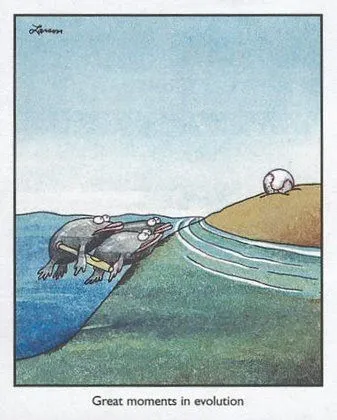 The newspaper as you know it tis but a “historical anomaly.”
Predictions from the disco era
Musings on online newspapers from 1978. Yes, 1978. Kenneth Edwards got it amazingly right. It’s held up better with time than, say, disco music.
None dead in story collision
The return of Cauthorn
Bob Cauthorn returns comes down the mountain and out of the lab and Robert Niles has the story. Good read from one of the most perceptive thinkers in online journalism. Good discussion on what’s local and community.
The model of unfinished news

Paul Bradshaw adds the “news diamond” to the inverted pyramid. Or rather, he says, the news diamond is the new inverted pyramid.
For us in the U.S. (and Japan and several Latin American countries), this has lots of baseball analogy possibilities: “That story was a walk-off grand slam.”
Attempts at humor aside, it’s a pretty good model of how online news ought to flow.
Bradshaw says:
Just as the inverted pyramid was partly a result of the increasing role of the telegraph in the news industry, and dominant cultural ideas of empiricism and science, this news diamond attempts to illustrate the change from a 19th century product (the article) to a 21st century process : the iterative journalism of new media; the story that is forever ‘unfinished’. More than anything, it’s designed to challenge the dominance of the inverted pyramid, to illustrate its origins in the industrial era, and its shortcomings.
Knoxville blog network
Noticed the Knoxville blog network we’ve launched is getting some attention.
Taking the shades off for a Sunshine suit
The News Sentinel’s decision to recruit some bloggers to help cover its Sunshine suit against the County Commissioners is drawing some react.
Editor Jack McElroy outlines the plan in his Sunday column, which was posted on his blog Friday evening. He’s trying to address the thorny issue of covering yourself in a new way, sort of crowd-sourcing a story in which the newspaper is a player. He said:
To provide independent scrutiny of our coverage, however, we also put out a request among local bloggers for volunteers to monitor our reports. Three bloggers stepped forward. Happily, they span the political spectrum.
On occasion, we may also publish excerpts from these blogs in the print edition
AP’s inline player
We’re part of a small group of online newspapers that began deploying this week an inline player on our site for the AP Online Video Network.
Covering Boomsday
Boomsday to those that don’t live here is one of the biggest events in Knoxville. People love it. It’s always Labor Day weekend. This year it was Sunday night.
Yeah, it was covered by the mainstream media, but how did people (I refuse to use the silly phrase citizen journalists) just creating and sharing their experiences cover it?
I found more than a few examples – and it’s good coverage.
Here’s a YouTube video:
;
(Posted by guitaralot920)
There are a globs of Boomsday videos on YouTube.
And they shot photos like this one on the right from bparton92. And, again, I found LOTS more Boomsday photos at flckr.
Of course, there were bloggers.
Among them were:
Eimers Family News and Photos: Boomsday in Knoxville!
The Mule: Boomsday - The Biggest Fireworks Display in the USA!
And since Google seems to index Twitter, I even found a few people that had covered it live on Twitter.com in what some call microblogging.
rlb865
Home from Boomsday. Worn out and going to bed since I have to work tomorrow. It was lots of fun though! 11:38 PM September 02, 2007 from web
Still at Boomsday. No fireworks yet…. 08:15 PM September 02, 2007 from txt
Sitting at Boomsday with Michael and his family. 06:13 PM September 02, 2007 from txt
Knoxville blog aggregator
We’re rolling out an area blog aggregator on knoxnews.com at blognetwork.knoxnews.com. Take a look and let us know what you think.
The news on AP news on Google
I’ve been updating react to Google-AP deal and now have a pretty good set of links to my original Friday night posting.
Google for news
Lots of people chiming in on Google’s use today of full-text Associated Press stories instead of linking to AP member Web sites.
Consortium desconstruction (or who bets against Google?)
A TV guy takes a long look at the newspaper-Yahoo! deal and finds no envy.
TV New Media consultant Terry Heaton says the deal (known as the Yahoo! Newspaper Consortium) poses risks to newspapers’ ability to have a return on investment and ignores the shadow across Internetland that is Google.
Course that is the damnable part of risk-taking – it involves risks, uncertainties that have to play out.
Heaton’s better option is “the creation of locals networks and a local ad network that serves both the business-to-business and business-to-consumer markets.” Huh? That is essentially what newspapers have been trying to do all along with limited success and will continue to try to do even with the Yahoo! deal. He is right that the Yahoo! framework’s scale is requiring tremendous focus, substantial resources and more bodies to execute. It’s certainly not a half-hearted bet.
An interesting outside-looking-in analysis. Give it a read.
The publication formerly known as a newspaper
Mike Cassidy on Media Post’s Video Insider blog on newspaper video:
She’s a winner
Almost 11 months ago, Cathy Clarke, a News Sentinel photographer, was seriously injured in an automobile wreck while on assignment. See earlier posts.
Some photo staff folks got together for a luncheon to present her with a Tennessee Associated Press Managing Editors’ first place award in feature photography. The winners were announced in Nashville in July.
Openings amongst the downsizing
The stock market is generally believed to be a leading indicator of future economic performance in a Wisdom of Crowds
No credit for credit
My oh my, co-worker Michael Silence has stirred up a debate about attribution in blogs with “all the news that’s fit to print.”
Commenting on Google comments
A handy reader on the weekend L.A. Times piece on Google comments:
- Tony Hung: LA Times: “… Its Bigger Than Jesus, Worse Than Bin Laden!”
- Ethan Kaplan: Newspapers are Committing Recursive Suicide
- John Battelle: Newspapers: Stages of Google Grief
- Danny Sanchez: L.A. Times editorial board decries Google News comments
- Mathew Ingram: Newspapers ignore Google at their peril
- Dave Winer: Journalism is the new Catholic Church
- Scott Karp: Journalism Is Now A Continuous Dynamic Process, Not A Static Product
- Robert Niles: The L.A. Times tells its readers: ‘Shut up’
- Jeff Jarvis: Just Kidding?
- Mike Keliher: LA Times misses the point on Google News commenting
- Brad Linder: LA Times: Google News isn’t journalism
- Donna Bogatin: Google News is a Joke: LA Times is NOT Laughing
Your job is journalism, not container cargo
Stop calling everything “content”. It’s a bullshit word that the dot-commers started using back in the ’90s as a wrapper for everything that could be digitized and put online. It’s handy, but it masks and insults the true natures* of writing, journalism, photography, and the rest of what we still, blessedly (if adjectivally) call “editorial”. Your job is journalism, not container cargo.
-- Doc Searls (on advice to newspapers)
Another Top 10
I like this Top Ten Newspapers Web site list, too. It was done by Howard Owens, director of Digital Publishing at Gatehouse Media, who took issue with some of the picks in the Bivings Group Top 10 earlier this week. Of KnoxNews, he said:
A peek out the box
Some of my younger co-workers say their perception of out-of-the-box thinking at a newspaper is of someone ever-so-slightly opening the top of the box and taking a furtive glance; maybe on a bold day, cautiously extending a moistened finger to check the direction of the wind.
Telegraph gets ‘Dear John’ letter
Note to self: This won’t work. Tags: Facebook
Top 10 Best Newspaper Websites
This was a very pleasant surprise.
A bludgeon for Blodgett
Are newspapers irreconcilably screwed as Internet economy analyst Henry Blodgett says. London-based strategic analyst Seamus McCauley says no, but he doesn’t see happy days for lots of them either. Blodgett’s argument and the argument of many others is that we’re overflowing with news and this gives news creators no pricing power. And even in the reduced costs world of producing content digitally, the costs of producing news will be higher than what newspapers can command. Thus, no business model. McCauley says, however, walk Blodgett forecast backwards and it unwinds – to a degree. If Blodgett is right, McCauley argues, then news won’t be a scare commodity because most of the players will have exited.
Zero time zone
Think just getting more organized will make you more productive; maybe not. Jimmy Guterman found the GTD regime does not work if …
Quality begats brand
“Those of us who care ought to be trying to make sure we create ways – and technologies – for ethical editors to maintain control of the content they are in charge of producing. Interactivity is a fabulous tool or it’s a catastrophic threat and a weapon of media credibility destruction. It’s our choice.”
Travel light; travel fast
| An interesting call to arms from Ryan Sholin. Tags: newspapers | Yelp! | api | Web 2.0 |
Let’s quickly get rid of gradually
I missed this Bivings Group study of America’s Top 100 newspaper Web sites when it came out last month, but the Center for Media Research pointed to me to it in an email this morning. The report says the key challenges for newspaper Web sites are:
It’s not the paper, stupid!
Another voice on the state of newspaper content
On polar bears
 Designer extraordinaire Roger Black has designed, helped design or influenced the design of many of the newspapers, magazines and Web sites we use daily. In a blog post yesterday, he has some chilling words for newspaper managers:
I’ll take a long neck
The “long neck” concept is a new one on me.
Do you see a Niche or a Demo?
| Sweet. The difference between a niche market and a demographic is in the berries. Tags: niche marketing | niche products | niche publications |
Lack of face time
| The latest lament of the death of AP’s youth experiment ASAP is Will Sullivan. For him, it was an experiment he would have liked to have seen succeed in that newspapers need to do something that will actually attract younger readers Steve Yelvington has some thoughts on why it failed and some great comments from others. We “use” it at knoxnews and Knoxville News Sentinel and probably will until it dies in October. It’s been available to our print folks, but they aren’t running much of it. They didn’t realize they had it in their wire feed for quite some time. Online the hosted version is on an inflexible platform. I never got my page view tracking code in it; never really had the ad positions we needed. AP’s Customwire is much more friendly to clients. It never really had the audience that I could tell. That may very well have been because we did little to promote it other than the promo tools provided by the service and sometimes running a piece high on the home page on weekends. The packages often were just a different spin on the traditional news topics instead of really outside the box stories. But they could be pretty good. As has been suggested, tying the product to the ‘Old Gray Lady’ probably doomed it from the start. It could not get the face time with the intended audience. Had it got their attention, I think an audience might have been possible. Maybe AP targeted it to the wrong client? It would be interesting to hear AP’s internal “lessons learned” on ASAP. Updated: Susan Mernit has this analysis: AP ending ASAP,a youth-oriented syndication package launched in 2005, in October. The cause? “A number of marketplace changes that were happening with the U.S. newspaper industry.” (Susan sez: Is that corporate speak for we’re screwed?) Tags: ASAP | Associated Press | newspapers | youth market |
Newspapers as blog networks
Scott Karp is thinking about newspapers and blogging …
When news isn’t bottled in an article
| In a review of MaineToday.com’s refreshing redesign, Howard Owens have some good observations on news site design in general, particularly link bloat and internal politics that bewilder more than bemuse. One area he didn’t delve into is one we’re struggling with a bit in our redesign (which we like overall). How do you get front-and-center attention for non-article content like blogs and videos? We have a great design if blogs and video are supplemental to text stories, but it’s a bit tougher to give them equal footing – even with links to both types of content on the front albeit below the fold. We’re still experimenting with the best solution for us and I’m sure we’ll hit upon something that works. Most content management systems I’ve seen have the article at the center of their universe and you end up working around that. Not even newspapers sites, however, need to be article-centric! How are others tweaking article-centric designs to emphasize other types of content? Tags: web design | newspapers | online media |
Chasing youth
Mark Potts is getting a lot of links today on his look back over the Backfence, but another jewel was his post last week on newspaper youth products, Dog Bites Man; Kids Don’t Care. In the not-to-do category, he says:
Stand it on its head
Newspapers everywhere are trying to “transform,” “explode,” “re-org,” “downsize,” and generally rearrange the “deck chairs” on you know what. Here’s an idea of Melissa Worden:
Shoutouts far and wide
—
A few more reacts to the relaunch of knoxnews/govolsxtra last Thursday. I noted some here last week. Bryan Murley, one of the forces behind Innovation in College Media, did a post Monday on the decision to make the formerly paid-subscription site GoVolsXtra a free site. Murley says of GVX:
We’ll be showing the redesign on the radio
 I’ll be on George Korda’s “State Your Case” radio show on Sunday (July 1) at noon, NewsTalk 100, talking about and answering questions on the redesign of knoxnews.com, a free GoVolsXtra.com and whatever else. Tune in. I’m sure I’m not exciting enough for the whole three hours (it’s on from noon to 3), but maybe we’ll have enough to talk about for the first hour. People have had things to say: Knoxviews: KNS website changes and News Sentinel website update update. Bob Stepno: New Knox Looks at Knox News Larry Jones doesn’t like your news organization: While the gnashing of teeth about the KNS and Metro Pulse continues… Southern Fried Tech: Good news for SEC football fans and proponents of keeping the Internet free� no comments Small Initiatives - Sensible Internet Design:Scripps moves Knoxnews to Ellington Michael Silence’s No Silence Here: KNS launches new KnoxNews Erin Chapin: Goodbye, Vinny Jack McElroy:Opening up KnoxNews and GoVolsXtra Stacey Campfield: At last ! Knoxnews: Knoxnews.com introduces new look today And tons of email yesterday. Tags: State Your Case I’ll be on George Korda’s “State Your Case” radio show on Sunday (July 1) at noon, NewsTalk 100, talking about and answering questions on the redesign of knoxnews.com, a free GoVolsXtra.com and whatever else. Tune in. I’m sure I’m not exciting enough for the whole three hours (it’s on from noon to 3), but maybe we’ll have enough to talk about for the first hour. People have had things to say: Knoxviews: KNS website changes and News Sentinel website update update. Bob Stepno: New Knox Looks at Knox News Larry Jones doesn’t like your news organization: While the gnashing of teeth about the KNS and Metro Pulse continues… Southern Fried Tech: Good news for SEC football fans and proponents of keeping the Internet free� no comments Small Initiatives - Sensible Internet Design:Scripps moves Knoxnews to Ellington Michael Silence’s No Silence Here: KNS launches new KnoxNews Erin Chapin: Goodbye, Vinny Jack McElroy:Opening up KnoxNews and GoVolsXtra Stacey Campfield: At last ! Knoxnews: Knoxnews.com introduces new look today And tons of email yesterday. Tags: State Your Case |
NewsTalk 100 | knoxnews |
The evolution of knoxnews
We’ve launched a new knoxnews.com today. I thought some folks might like to see the last three designs of knoxnews (sorry, not sure if I have one from further back, unfortunately). The first was used for three or four years and was “retired” in April 2005. We thought it was very tired by then. The second one is the original successor look, but I noticed in looking at the home page yesterday, we had made more “adjustmenets” by the end of its run than I had thought. The one on the right is an early morning shot of the new, current design. You can click on each image to get a larger view. Update: Jay Small explains many of thenuances.
Knoxville News Sentinel | knoxnews | newspapers
Sullivan sighting
This must rank just behind a Paris sighting among celebrity watchers. While the paparazzi didn’t get his photo, journalism professor and blogger Bryan Murley cornered Will Sullivan of exclusive Palm Beach for an online interview. Sullivan on blogging:
Sign of the times
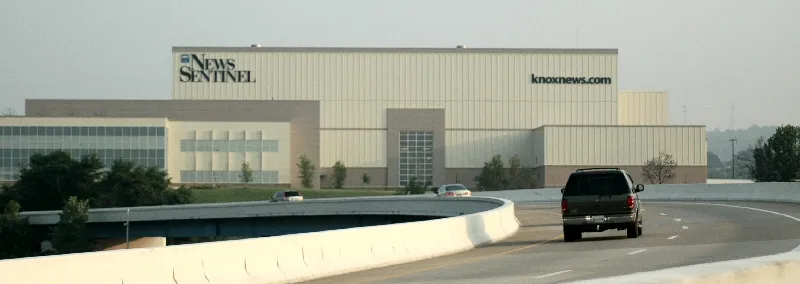
Are we measuring how many read over or rode over the newspaper?
Sometimes the react is better than the first act. Mathew Ingram and Steve Yelvington have good posts on British newspaper consultant John Duncan Webster’s Dictionary of Audience Exaggeration: How internet metrics promote the myth of the dying newspaper. Yelvington has several nuggets, but this one I can’t pass up quoting:
The news is funnier than the comedy
This is just funnier than Jon Stewart, but at least it means my kids are on top of the news. The people most knowledgeable about news events, according to a new Pew study, are:
If the founders returned …
| Missed this yesterday. It was company namesake Edward Wyllis Scripps’ birth date (June 18, 1854 – March 12, 1926). I often wonder what creativity and daring the entrepreneurial newspaper barons of the early 20th century would have brought to the industry’s current situation. Had they lived in this era, they could very well have built empires in completely different markets. But had they chose newspapers, what ideas would have have brought to bear? They were highly individualistic – more often than not eccentric – original thinkers and bare-knuckled competitors who took risks. These may be times when those very attributes are needed to remake the industry. Updated: Some info onE.W. Scripps from the James Logan Courier, which is produced by students of James Logan High School’s Journalism and News Production classes. The high school is in Union City, CA. Tags: press barons | E.W. Scripps | entrepreneurship |
NCAA to blogger: You’re outta here
The NCAA is out of its mind.
Bryan on Ryan
| Bryan Murley interviews Ryan Sholin. Tags: Ryan Sholin | Innovation in College Media |
The hidden link between Rosslyn Chapel and Innovation
Most of the ways we tend to think about innovation and innovators are just wrong, based on comic book-like fables of eureka moments and genius super heros. That’s some of what I got from Scott Berkun’s new book, The Myths of Innovation
Now count to three
Bloggers will be the salvation of newspapers – or something like that – from Dave Winer. Another post where a “tech guy” is a more optimistic about the newspaper buisness and mainstream media biz than many in it.
The view is better from here
| It’s almost funny – a lot of people outside the newspaper business are a lot of more positive on its prospects than those inside. Here on a Podtech segement posted by Tina Magnergard Bjers and called “How Will Web 2.0 Change Journalism?” Google VP Marissa Mayer says newspapers, especially, are here to stay; Web strategist Jeremiah Owyang says many of his friends consume content on paper more than digitally and ScobleShow’s Robert Scoble says if you want to be a sucessfully journalist, figure out Google, Digg and blogs. Are they just spinning us? Or maybe the audience doesn’t read the future of newspapers as anachronistically as we’ve come to see it. Granted, the structural pain is real, deep and excruciating. But if we do it right, that’s short term. Tags: newspapers | journalism | Tina Magnergard Bjers |
A letter from the newspaper while watching morning TV
| Thanks to Mark Potts for pointing to Iowahawk’s Subscribe Now!. And to NewTeeVee’s Liz Gannes for pointing to Good Morning World. Iowahawk has the history of the newspapers satirically nailed. And Andy Peppers (played by Peter Oldring) and Alasdair Coulter (played by Pat Kelly) are indeed a “bad morning show for the world.” Together, they were a great way to start the day. Check them out. Tags: newspapers | TV morning shows |
Shots were fired
And the winner is …
| Big awards weekend for the the online news staff at knoxnews. Of course, they deserved the recognition they got – and more! Jigsha, Erin, Lauren, Katie and Talid are just an absolutely awesome team. Way to go folks. Rock on. SPJ Green Eyeshade Awards (Presented in Nashville on May 5, 2007) NICHE JOURNALISM First Place: GoVolsXtra – Online and Sports Departments, Knoxville (Tenn.) News Sentinel BEST USE OF MULTIMEDIA Third Place: Sweet 15 - Jigsha Desai, Lauren Spuhler, Kevin Cowan, Joe Howell, Knoxville (Tenn.) News Sentinel Full list of finalists. East Tennessee SPJ Golden Press Awards (Presented in Knoxville on May 4, 2007) SERIES/PACKAGE/PROJECT WRITING Award of Merit: Andrew Eder, Erin Chapin,Knoxville News Sentinel WORK FOR OTHER MEDIA – VISUALS Award of Excellence: Jigsha Desai, Lauren Spuhler, Joe Howell, Knoxville News Sentinel Award of Merit: Jigsha Desai, Lauren Spuhler, Erin Chapin, Katie Kolt, The Knoxville News Sentinel (Swept category) Full list of winners. Tags: Knoxville News Sentinel | SPJ | Green Eyeshade Awards | knoxnews | Society of Professional Journalists |
Beyond the power of titans
On the changes wreaking havoc on the newspaper industry:
UMe – The University of Me
| Matt Waite has the right idea. Train yourself for the newsroom roles in demand. Could it get any easier than it is today? Call it career sweat equity. If you get training opps, make the most of them – and share. Duh! No need to wait for the reorg memo. (Thanks, Mindy) Tags: cultural change | training |
Note to self …
| Ryan Sholin has a good item for the todo list. Do you have a plan for a the biggest story that ever hit your town? Here’s what Roanoke.com did in the Virginia Tech shootings. Ditto, Ryan’s note to self. Tags: Roanoke | Virginia Tech | disaster planning |
Collegiate Times
| Wow. Great post about the Collegiate Times at the Va. Tech campus. Their coverage and response has been getting kudos all around. Tags: virginia tech | college newspapers |
Blogging media – or bloging about Media
| Newscoma got me wound up yesterday with this post. There were several good comments. Worth the read for Newscoma’s and the others. Here’s another link to it. Tags: blogs | newspapers | MSM and blogs |
Green Eyeshade finalist
| Knoxnews submitted entries are finalist in two online categories in the Society of Professional Journalists’ 57th annual Green Eyeshade Awards. The competition covers 11 southeastern states: Alabama, Arkansas, Florida, Georgia, Kentucky, Louisiana, Mississippi, North Carolina, South Carolina, Tennessee and West Virginia. The winners will be announced May 5 in Nashville. We hope we’re happy! Our entries are up against some excellent journalism: BEST USE OF MULTIMEDIA • A Killer’s Grip – Clarisa Gerlach, Tim Price, Tampa Tribune Staff, WFLA Staff, TBO.com, Tampa, Fla. • Carnival Center – Staff, The Miami Herald • Sweet 15 – Jigsha Desai, Lauren Suhles, Kevin Cowan, Joe Howell, Knoxville (Tenn.) News Sentinel NICHE JOURNALISM • Epic – Randy Johnson, Mark Caskie, Pace Communications • GoVolsXtra – Online and Sports Departments, Knoxville (Tenn.) News Sentinel • Tampa’s Local Music Scene – Ryan Bauer, Tim Price, TBO.com, Tampa, Fla. Here’s the complete list of finalists. Tags: spj | newspapers | niche journalism | multimedia |
Newspapers catching the “viral craze du jour”
The Newspaper Association of America’s girl in the know, Beth Lawton, has done a look at newspapers with a presence on Twitter. Just a handful of newspapers are using Twitter, including knoxnews.com. I have a list of the ones I know about. Lawton has a good overview of Twitter, some of the Web applications being built around Twitter, and how it’s being used. Good place to start if you’re trying to figure out this whole Twitter phenom. But don’t expect to understand it without participating in it a bit. Why are newspapers publishing anything called Tweets?
How Blacksburg got covered
Here’s a roundup of interesting coverage – and interesting trends in coverage – of the shootings on the campus of Virginia Tech:
Dispatches from digital land
Guy Berger, writing in The Mail & Guardian Online (the first internet-based news publication in Africa), has a great recap of the South by Southwest (SXSW) festival in Texas and the not-so-festive state of the traditional news business. He does a yeomen’s job of weaving all the trends in and says mainstream media still hasn’t grasped:
U.S. newspapers using Twitter
I’ve discovered five six U.S. newspapers providing headlines on Twitter. They are (with links to their Twitter pages):
Three little Easter gifts for newspapers execs
It’s almost Easter, but not many newspapers executives will think of Dave Morgan as the Easter Bunny with his latest colorful present on the Online Spin blog. But if newspapers were willing to forget who they were, they might win the future egg hunt by adopting or adapting his three suggestions. An example: Abandon print/online integration.
Not a 20-something geek
| Quirky maybe, but this guy’s not “a 20-something geek.” Yes, add me as a Twitter friend. Tags: online newspapers | journalism | online news |
Bobbling on blogging
Scripps alumnus from the pre-JOA days at the Rocky Mountain News and online pioneer Robert Niles takes on a smug assertion from Dave Zeeck. Zeeck, the immediate past president of American Society of Newspaper Editors, said that without newspapers, the lights would go out on blogging. There was something about newspapers, bloggers and fuel rods that sent Niles nuclear. Zeeck, I guess, was trying to get a bobblehead wave of acknowledgment going among the men of the gray old lady by saying:
Heard among the din
Some quotes to think about in the din on the death of newspapering:
Thanks for sharing
| CitJ guy Dan Gillmor drew my attention to this Raleigh site. Gillmor thinks it’s smart. I think it’s cool! It’s drupal based. Kudos to all involved. Tags: newspapers | online media | community journalism |
Inky-fingered and unbowed
| An inky-fingered print journalist to multimedia contender weighs in. Just discovered a new blog from Ian Reeves called Streaming Blue Murder, subtitled “Old journalism dog. New video tricks.” Looks it’s going to ba a good one! But does “streaming blue murder” mean something? if it does, it flew right over me. Tags: teleivsion | newspapers | online viedeo |
No one said culture change was uplifting
| More on newsroom transformation, this one Steve Yelvington, who asks: “When do we become the roadblock?” This one is not a high-level shifting of the trends discussion, but about the often very painful decisions that have to be made while slogging it out in the trenches. Yelvington’s call is for the online leaders to not be roadblocks as change rearranges their world, too Tags: new media | newspapers | culture change |
Are the wires dead meat?
| It wouldn’t be news to say Jeff Jarvis is one of the most interesting people talking – and writing – about media. Last week he proposed a new rule for newspapers: “Cover what you do best. Link to the rest.” it’s a great concept – disruptive as hell. Jarvis didn’t hone in on what this might do to wire services. But if I were AP, I’d be worried. If widely adopted, this makes the reason for having the Associated Press wires move from a “must have” to a “nice to have.” And we all know what happens in budgets to “nice to haves.” But the result could indeed be very good journalism. This is way beyond linking out, which Jarvis observes newspapers are becoming more comfortable with. If aggregating news from other sources was the primary means of getting news from elsewhere, reputation becomes huge. And a site’s usefulness to its users would be even more pivotal than it is today. National news might not be just what’s on the wires. Partial models are there – even with a bunch of flaws – in Digg, Netscape and Reddit, which are more mass media than niche. A story without national interest is unlikely to make the front page of these sites unless it’s been gamed there. This would allow newspapers to focus on covering their core communities like no others can. Tags: online media | jeff jarvis | bloggers | newspapers | news |
The ride really gets bumpy from here on …
| John Robinson, editor of the Greensboro News & Record, weighs in on the Atlanta Journal Constitution’s far reaching revamping and mentions the Knoxville News Sentinel – as well as his paper and some others – as among those reshaping news coverage. The News & Record is a paper I grew up reading in neighboring Randolph County – and later competing against. It’s been at the forefront of including more voices by encouraging blogging. Robinson points to several changes taking place at his newspapers and others. He also says a “different sort of paper” is coming from the News & Record. It will be interesting to see what results. News Sentinel Editor Jack McElroy also weighed in on the AJC changes. And from the comments, not everyone is happy with change. Surprise! Doug Fisher has a longer piece, including outlining a four-phase transition. Read it. And that’s just a little of the react to the changes at the AJC and elsewhere. Look here. I find it all a little like flying into a thunderstorm – blindfolded. (via Will Sullivan) Tags: journalism | newspapers | online media | culture change |
Just waiting for the wave
Starting from the premise:
Remembering Charles Scripps
| Nice piece on Charles Scripps by Dan Thomasson, former and longtime editor of Scripps Howard News Service. Tags: E.W. Scripps | Charles Scripps | newspapers |
Not drinking the Kool-Aid
Just beneath the surface of convergence and newsroom transformation, lies a darker, more cynical view of changes within newsrooms. And, unfortunately, that darkness could drag newspapers efforts to adapt into the abyss. Consider this from a recent survey of sportswriters about blogging. One longtime sportswriter said:
Quick, where do most people get their news?
Where do most people get their news? Not from newspapers it seems. Not even a second! When pollster Zogby did a survey just a couple weeks ago, people said: Where do you get most of your news and information? Internet Sites 39.9% Television 31.5% Newspapers 12.2% Radio. 12.1% Magazines .8% Blogs 1.5% When asked, “Which of the following is your most trusted source for news and information,” they said: Internet sites 33.2% Television 21.3% Newspaper 16.0% Radio 14.0% Magazine 2.0% Blogs 1.7% I think this one of the strongest showings by Internet sites vs traditional media that I’ve seen. See more poll results at JD Lasica’ Social Media site, which had an exclusive on this poll, in a PDF here. It has some fascinating data.
Woo hoo for the Randoms!
| The online producers of KnoxNews.com on Sunday night won a Digital Edge Award from the Newpaper Association of America for Best Use of Interactive Media for their weekly RandomThis videos. They are, from left in the photo above, Katie Kolt, Lauren Spuhler, Erin Chapin and Online Editor Jigsha Desai. The judges are among the smartest folks in online newspapers so it’s very nice to see this talented team get recognized for their efforts. The News Sentinel “Edgie” was one of six won by E.W. Scripps newspapers with The Naples Daily News winning four and the Evansville Courier winning one. Congratulations to all. Tags: RandomThis |
vblog | NAA | Edgie | E.W. Scripps | newspapers |
Caretakers of a vanishing world
Keith Jenkins, The Washington Post picture editor, makes a clarion call to newsrooms and their managers in “Take a Blogger to Lunch (And Other Radical Ideas for Journos Struggling to Understand the Web)” on Poytner’s site. In the process of his call for change NOW, he hammers the caretaker attitude of newsrooms, “hiding, hoping to be passed over, undiscovered, until they can make their way safely out of town.” It’s a tough mindset to change. In our newsroom, convincing managers to use IM as a communication tool has been like asking some to have a root canal without a shot. Blogging still brings on quite a bit of journalistic credibility handwringing even while we have an expanding core of writers doing it – with a few of them generating excellent traffic numbers. And our newsroom has an advantage many don’t: A new media veteran as editor. The newsroom is being challenged to change, to think differently, to try new approaches. There are successes and pockets of change There has been overall glacial movement. Yes, glacial. The money quote from Jenkins’ piece:
WSJ 3.0
| Uber-bloggers Helen and Glenn Reynolds have a podcast with Wall Street Journal publisher Gordon Crovitz about print and online and why newspaper publishers should be adapting to the new era (duh); why young people don’t read newspapers; and he offers a view of blogging as “a great journalistic art form.” Good stuff. Tags: podcast | wall street journal | newspapers | online newspapers |
Think and Leap
| If you’re preparing for a career in the shrinking world of mainstream journalism … or just trying to get a journalism job … here’s some good posts to study. It should go without say (but apparently it needs to be said): Big J jobs of the future: online skills a must. Also note: the possible careers in journalism are growing even if traditional newsrooms are contracting. Rob Curley: What sort of things should an aspiring journalist be thinking about? Mindy McAdams: Getting (and keeping) a job in journalism and with another post: It’s about stories … which stories? And why? Bob Stepno: Following up on Mindy with some of his own ideas … Glue this to a journalism school dean’s nose? Howard Owens: Don’t be thrown off by the title, it’s also about what skills to have to get a job … Additional notes on Outing’s advice for small newspapers Tags: journalism | journalism jobs | mainstream media | newspapers |
A cycle of irrational negativity …
A superb line about the newspaper environment today … The spin on newspapers is … “A cycle of irrational negativity about their prospects.” -- Steve Yelvington Tags: newspapers
The biggest sale isn’t in the newspaper; it is the newspaper
Are newspaper the new railroad stocks? Normally, with a question like that, I’d assume it’s just another newspaper industry doom and gloom story. AOL “Blogging Stocks” blog doesn’t quite draw that map. Zac Bissonnette notes that railroad stocks have performed better than other transportation stocks the S&P; 500 because their prices had been beaten down so low.
Just tell the story
Technology won’t save newspapers, but telling a good story might. Gary Goldhammer in his Below the Fold blog says newspapers have been revamped and “Tivoed” to appeal to our “cultural Attention Deficit Disorder” so that we get snippets instead of nuggets.
Registering complaints
It seems most everybody is saying newspapers should drop registration on their Web sites.
Watch the game film and learn ….
The news about newspapers is so bad that now the industry looks like the fish wrapper for what not to do. Pat Coyle, director of Database Marketing & E Commerce for the Indianapolis Colts, suggests the NFL learn from the lessons taught to newspapers rather than taking that course itself.
A broad band of change
In case you’re wondering, we are past the tipping point …
Mark Cuban says put this play in …
The never-without-an-opinion Dallas Mavs owner Mark Cuban has some insightful ideas on how newspapers could strengthen their position of “owning the sale and delivery of advertising in your market.”
Yahoo/newspaper deal
| The newspaper/Yahoo deal has been officially announced. The deal includes my employer, The Knoxville News Sentinel, a part of the E.W. Scripps group of newspapers. The announcement early Monday morning comes on the heels of a busy weekend for Yahoo news. Tags: Yahoo | newspapers | E.W. Scripps |
A Rx from Mark Potts
Longtime newspaperman-turned-online-guy Mark Potts has his version of how to save newspapers at his Recovering Journalist blog. Potts, currently a cofounder of the community news product, backfence.com, sums the current state of innovation in the business as:
Just chronicling
This is a Chronicle-themed post via Just an Online Minute and journlism.co.uk. Peter Scheer, a lawyer, journalist and executive director of the nonprofit of California First Amendment Center suggests in a Sunday column in the San Francisco Chronicle that:
Faerie Magicks
Interesting take on the Google-newspaper ad deal.
Video
Essential photo, video, productivity tools
This is a listing of programs I use regularly on my Pixelbook, a Chromebook introduced in 2017. That is to say it’s not the most powerful or fastest Chromebook and all the apps listed here work with it.
My top YouTube videos of 2021
Here are my top YouTube videos based on views in 2021. The No. 1 video had more than four times the views of the next one.
East Tennessee Tesla owners line up for photo shoot
Tesla’s Knoxville Service Center is officially opening after a few weeks of a soft opening. As part of the grand opening, East Tennessee Tesla owners gathered Friday morning for a group pix of around 40 cars coordinated by the Knoxville Electric Vehicle Association.
Sun on Big Bald Mountain
Here is a photo of Big Bald, part of the Bald Mountains as seen from the Wolf Laurel Country Club in June 2021.
The storming of the Capitol is archived
The FBI and District of Columbia police are searching for people involved in the violence at the Capitol on Wednesday – and they’re finding them and they are likely to find and arrest more.
FFmpeg tips: Quickly cut video clips or extract audio
Updated: Additional code examples, resource links, some corrections.
How to use (yt-dlp) youtube-dl to grab an online video
_Updated: Youtube-dl has not been updated in months, try using the actively maintainedyt-dlp. _
Create video slideshows with ImageMagick and FFmpeg in minutes
Updated: Sept. 21, 2022. Code examples have been updated after noticing some issues.
A flyover of Gay Street
Diversity Scholarships for APME NewsTrain at MTSU
Can’t beat this deal!
Students reinventing journalism at MTSU
I’m interested to see what the “Bragg Innovative News Network” looks like when it launches Monday. The network was announced by Middle Tennessee State University earlier this week.
Mapping hot videos
 I like this new trends map YouTube announced yesterday. It’s a great data visualization.
First rough draft of history is raw video
Maybe so obvious, is it not worth noting, but I will: The capture Col. Muammar Gaddafi was caught on video and that the video was shot with an iPhone by a participant; not a journalist.
In photos and videos of his death and body, nearly everyone seems to have a camera phone.
The first rough draft of history has become raw video shot with a cell phone capable of shooting video and with the capability of being quickly shared and posted on the Internet.
As I write this, Google Plus and Twitter and news websites are posting raw video from an earthequake in a fairly remote region of Turkey.
Related articles
Developing a news video strategy is like teaching cats to sing on YouTube

How ‘Deadline’ came to be
I shot a couple of short interviews with Curt Hahn and Hunter Atkins of the movie “Deadline,” which had its first private screening on Sept. 15, 2011 at the Associated Press Media Editors Conference in Denver. The movie is based on a true story and adapted from a novel, Grievances
It’s a cold case tale featuring investigative journalists. Some of it was filmed in the newsroom of The Tennesseean.
The real story involved a Charlotte Observer investigation of an unsolved murder in South Carolina. In the movie, the location has been moved to a Nashville newspaper and a small town in Alabama because the movie production company is based in Nashville.
Look for it in your town next year.
Important ruling in Cops vs. Cell Phone Videos
The right to film police in the performance of their public duties in a public space is a “basic, vital, and well-established liberty safeguarded by the First Amendment,” a federal appellate court held last week, marking a major victory in a time when arrests for such activities have been on the rise.
Did you notice we just passed into the ‘post-PC era’?
Bill Tallent, CEO of Mercury Intermedia, which developed the iPad app of USA Today and apps for other media companies, and Rex Hammock, founder of Hammock Inc. and author of the popular RexBlog, do some Q&A at “The Mobile Migration Workshop” in Nashville, Tenn., on April, 1, 2011.
According to IDC, several factors (Japan disaster, unrest in the Middle East, a spike in fuel prices) are causing a PC market slump in the U.S. and Western Europe, but there’s also this: “‘Good-enough computing’ has become a firm reality, exemplified first by mini notebooks and now media tablets.”
In other words, people aren’t making buying decisions based solely on specs anymore. Sure, people will still buy computers–post-PC doesn’t mean we won’t use PCs anymore–but their primacy is being diminished by devices that will do many of the basic PC tasks well: Web browsing, sending e-mail, checking Facebook, shopping online, getting directions, reading the news, etc.
“The iPad shows you don’t have to have the best hardware. It’s about marrying the software and hardware, and about what people can do with it,” said Jay Chou, senior analyst for IDC. “I think that will be key in sustaining more PC growth.”
I used to be read the Sunday paper; then I got an iPad
Bill Tallent, CEO of Mercury Intermedia, which developed the iPad app of USA Today and apps for other media companies, speaks at “The Mobile Migration Workshop” in Nashville, Tenn., on April, 1, 2011. Tallent says the iPad has the potential to replace the Sunday paper and already appears to be “the device” for news.
Great data on the smartphone, the iPad and the tablet market in his talk..
More videos of the presentations at the workshop are on YouTube.
The workshop was co-sponsored by the Online News Association and the Freedom Forum Diversity Institute.

Reuters pursues mobile strategies on multiple platforms in multiple countries
Ilicco Elia, Head of Consumer Mobile Products for Reuters, speaks at “The Mobile Migration Workshop” in Nashville, Tenn., on April, 1, 2011. He spoke via Skype from the UK.
More videos of the presentations at the workshop are on YouTube.
The workshop was co-sponsored by the Online News Association and the Freedom Forum Diversity Institute.

Responsbility in communication is vital to the future of the First Amendment
John Seigenthaler of the Freedom Forum speaking at “The Mobile Migration Workshop” on April 1, 2011 at the John Seigenthaler Center in Nashville.
Seigenthaler compared Wikileaks to the Pentagon Papers. It may be irresponsible, but irresponsible speech is protected by the First Amendment. However, he said responsibility in communication is vital in protecting First Amendment in the “general spirit of the people.”
The workshop was co-sponsored by the Online News Association and the Freedom Forum Diversity Institute.
More videos of the presentations at the workshop are on YouTube.

Upon discovering the Dallas Morning News had no viable digital business model …
Grant Moise, digital general manager of the Dallas Morning News, says the realization by his company that its digital stratgies had no vilable business model led to its current efforts with premium content, tablet apps and new digital products. Moise talked about the closed watched strategies unfolding in Dallas at “The Mobile Migration Workshop” on April 1, 2011 in Nashville.
In this video of his presentation, Moise does a deep dive to the efforts underway and planned in Dallas.
Moise is currently the Digital General Manager at The Dallas Morning News where he oversees all aspects of digital initiatives. All Editorial and Sales departments report to Moise and he is also responsible for Product Development.
Over his time leading this group, Moise has overseen the shift to a digital premium content model as well as the development of new iPhone and iPad apps which launched in the market in January of 2011. He is also currently the Publisher of Briefing which is a free print publication The Dallas Morning News launched in August of 2008 and is a 203,000 circulation newspaper in the greater Dallas area.
Prior to this role, Moise was the Vice President of Direct Channel Sales for Tribune Media Net (now known as Tribune 365). Tribune 365 is a national sales organization that represents Tribune newspapers and web sites for advertisers who advertise across multiple Tribune properties. In his role at Tribune he oversaw all advertising that came through traditional media buying channels which included direct business or advertising bought through full service advertising agencies.
Back in 2004, Moise was at The Dallas Morning News where he managed a New Business Development Team and was also a Retail and National Sales Director. Before Moise worked on the publishing side of the business, he was an Account Executive with KCNC-TV (CBS affiliate) in Denver, Colorado. He is also very active in the Advertising industry as he recently completed his term as President of the Dallas Ad League which is the 3rd largest advertising league in the country.
In addition to the time spent in the industry, Moise currently sits on the Board of Directors for the NB3 Foundation which is a foundation dedicated to improving childhood obesity for Native Americans. Moise is originally from Albuquerque, New Mexico and the Native American people have played a very significant role in his life and this foundation is a way for him to give back to this meaningful community.
Moise is a graduate of the William Allen White School of Journalism at the University of Kansas and also has an MBA from Texas Christian University.
The workshop was co-sponsored by the Online News Association and the Freedom Forum Diversity Institute.
More videos of the presentations at the workshop are on YouTube.

Fighting prejudice, hate one text at a time
Sasha Costanza-Chock, Ph.D., speaking via Skype at “The Mobile Migration Workshop” on April 1, 2011 in Nashville at the John Seigenthaler Center.
Costanza-Chock is a Postdoc at the Annenberg School for Communication & Journalism at USC and a Fellow at the Berkman Center for Internet & Society at Harvard University. He is a cofounder of VozMob.net (Mobile Voices / Voces M�viles), a community media platform for immigrant and low wage workers in Los Angeles to use mobile phones for popular communication and digital storytelling. Next year, he will be joining the faculty of MIT’s Comparative Media Studies program.
The workshop was co-sponsored by the Online News Association and the Freedom Forum Diversity Institute.
More videos of the presentations at the workshop are on YouTube.
What the iPad means for magazines
Rex Hammock of Hammock Inc., author of the popular RexBlog and just @R on Twitter, speaking at “The Mobile Migration Workshop” on April 1, 2011 in Nashville at the John Seigenthaler Center.
The workshop was co-sponsored by the Online News Association and the Freedom Forum Diversity Institute.
More videos of the presentations at the workshop are on YouTube.
Multimedia bootcamp coming up in February
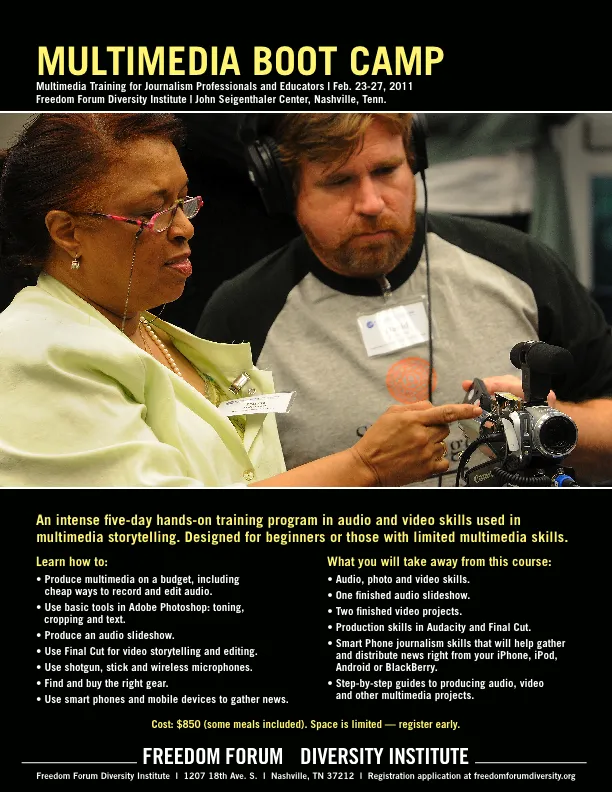 From Val Hoeppner:
Freedom Forum New Media Training at the Diversity Institute will offer a Multimedia Boot Camp for Journalism Professionals and Educators Feb. 23-27, 2011.
Registration is available immediately and on a first-come, first-served basis. Follow this link to register online: https://www.surveymonkey.com/s/REGISTER4bootcamp
The multimedia training is tailored for journalists but open to anyone with an interest in multimedia storytelling, regardless of the individual’s background.
For an additional charge, successful participants can earn 3 college credits. The courses are accredited by the Media Studies Department of Belmont University, which awards the credits.
Journalism educators, professionals, students and others can develop and hone their skills in audio, photo and video storytelling at the boot camps.
Tuition is $850, payable in advance. Registrations for the Feb. 23-27 class will be accepted until Feb. 7. Once classroom capacity is reached, registrations will be cut off.
Information about hotels near the John Seigenthaler Center can be found on our website.
Questions may be directed to lead instructor Val Hoeppner at vhoeppner@freedomforum.org or 615/426-7160.
The hands-on training is modeled after the Freedom Forum’s acclaimed multimedia curriculum and is equivalent to a 3-credit-hour college course. It is designed for those with limited or no multimedia experience. The schedule is intense.
The training will occur at the Diversity Institute’s state-of-the-art school facilities in the Freedom Forum’s John Seigenthaler Center, 1207 18th Ave. South, Nashville, Tenn. Tuition covers all supplies, use of multimedia equipment and software during training, some meals and step-by-step guides to producing audio, video and other multimedia projects.
**Participants will learn how to:
**• Produce multimedia on a budget, buy the right gear and find cheap ways to record and edit audio.
• Use basic tools in Adobe Photoshop: toning, cropping and text.
• Edit an audio story with Audacity, a multi-track editing software.
• Produce an audio slideshow in Final Cut.
• Produce two video projects, using Final Cut for storytelling and editing.
• Knowledge of smart phones and how they can be used to gather news.
**To register for boot camp:
**https://www.surveymonkey.com/s/REGISTER4bootcamp
**For more information about multimedia boot camp:
**https://freedomforumdiversity.org/workshops-and-conferences/2010/12/16/multimedia-boot-camp-i-offered-feb-23-27-2011/
The Diversity Institute was established and funded by the Freedom Forum as a school dedicated to teaching journalism skills and First Amendment values by advancing news media diversity, fairness and excellence. The Freedom Forum Diversity Institute, Inc., is a Tennessee public charity corporation with offices, staff, programs and classes at the John Seigenthaler Center in Nashville, at the Al Neuharth Media Center in Vermillion, S.D., and at the Freedom Forum headquarters and Newseum in Washington, D.C.
The tuition fee, payable at the time of registration, is non-refundable if the participant fails to show up, drops out or cancels within 30 days of the program’s start. However, if the cancellation is due to an unavoidable personal or family emergency, the tuition payment may be credited to a future class when space is available.
Text is just for context

The story of a national park in video
We’re seeing what we can do with YouTube Direct. Anybody else using it? Thoughts about it?
Here’s a little more about what we are doing in trying to gather videos of and about the Great Smoky Mountains National Park. We have some other ideas we hope to try as well.
Below is the playlist of videos created by our Smokies project.

Public TV network lowers its journalism shield
Troubling “Shield Law” incident in North Carolina as a legislative committee subpoenas raw, unaired footage from the state-funded UNC-TV public television network about a story involving the environmental record of aluminum giant Alcoa and its efforts to get re-licensed for a federal permit to run a hydro-dam on the Yakin River.
While North Carolina has a “Shield Law” that protects journalists, attorneys for UNC-TV aren’t sure it covers work that received tax funding and turned over the video to a state Senate committee.
This might be a wrinkle that hasn’t been fully considered by proponents of public funding options to support journalism. A lot of investigative journalism is being done not only by public television, but by public radio stations owned by state univeristies and funded in part by tax dollars.
Andria Krewson raises that and other questions and has a good set of links to the coverage so far.
Surprised RTNDA, SPJ and the Reporters Committee for the Freedom of the Press haven’t weighed in vocally on this one (If they have, they’re not touting it on their websites).
Tip: Great interactive map of state journalism “Shield Laws” in the United States.
Mark your calendar for multimedia boot camp
The Freedom Forum Diversity Institute will offer two Multimedia Boot Camps for Journalism Professionals and Educators in August, 2010 and one in November 2010.
**MULTIMEDIA CLASSES IN 2010:
**
• Multimedia Boot Camp: Aug. 2-6, 2010
• Multimedia Boot Camp: Aug. 11-15, 2010
• Multimedia Boot Camp: Nov. 17-21, 2010
Innovating without even knowing it
Damon Kiesow did a story today on Poynter.org with Ventura County Star Visuals Editor Ray Messe about the newspaper’s use of the iPhone to shoot video. Meese did a presentation about those efforts at the Online News Association workshop in Nashville on April 9.
It wasn’t until he spoke at an Online News Association seminar in Nashville recently that he realized the paper was breaking new ground in mobile news gathering. “Once I started talking and realized what other people were doing,” he said he discovered Ventura’s approach “was more cutting edge than I gave it credit for.”
Doing some high fives!
These two items, a plan by a Missouri Corrections Department worker to use a knoxnews video as part of a training program and the fact that the same video won the newspaper its first regional Edward R. Murrow Award from the Radio Television Digital News Association (RTDNA), have brightened the week!
The video “Death on Chipman Street’ is damn good journalism from a damn good group of online producers.
Related articles by Zemanta
While other media shrink, video grows, particularly on the small screen
Jeff Cole, director of USC’s Center for the Digital Future:
In 1975, the average American spent 16 hours a week in front of a screen. Last year, that figure hit 34 hours and should grow to 50 hours in a few years. Much of that growth will come from mobile video , as consumers watch more TV and more video on mobile screens in general.
Knoxville video has gone viral
TV reporter Gordon Boyd’s unfortunate “technical difficulties” have gone “randomly viral” on YouTube.
The big social media blog Mashable linked to it today and the YouTube video has topped 137,000 views since being posted on March 5, 2010. Here is the take of the News Sentinel’s Terry Morrow and also of Metro Pulse.
![Reblog this post [with Zemanta]](https://img.zemanta.com/reblog_c.png?x-id=40a91860-c942-4ad2-a7d0-e6a6acddfcc0)
Video training in Nashville in early January
From the Freedom Forum folks:
An Advanced Multimedia Boot Camp will be run by the Freedom Forum Diversity Institute, Jan. 6-10, 2010, at the John Seigenthaler Center in Nashville, Tenn. The course is open to any journalism educators, professionals, college students and others who know the basics and want to become more sophisticated multimedia storytellers.
Participants will create and publish a mini-documentary project using Final Cut, Google Maps, WordPress and other multimedia tools. The curriculum will cover advanced skills in audio, video storytelling, video editing, mapping and blog set-up.
To qualify for this class, registrants must have basic proficiency in multimedia storytelling through audio, still photography and video. Past participants in Freedom Forum multimedia training are strongly encouraged to sign up.
The future of journalism is in safe hands
A talented practicum student we had at the Knoxville News Sentinel during the University of Tennessee’s spring semester has created an interesting new Web site called sfevent.tv
Franck Tabouring, who came to the U.S. from Luxembourg to go to college, received a bachelor’s degree in journalism this year from the University of Tennessee and moved on to study film in San Francisco.
As a practicum student on the knoxnews.com online staff, he did a variety of maintenance tasks and site updating, but he also had time to do several videos that show his sense of humor.
Tabouring has been doing an excellent movie review blog since late 2007 called the Screening Log that has frequent posts so I found it interesting he was taking on another project while still in school.
In an email, this is what he said about sfevent.tv:
Yes, I decided to start a small cultural online video magazine that focuses on San Francisco and the Bay area. I plan on posting photos, raw footage and more detailed short documentaries about and surrounding people and all kinds of events here. I will also shoot what I call SF Spots, short clips highlighting wonderful viewpoints and other nice spots in an around the city. I will share all videos on YouTube and Vimeo, and use embedding for the site. That way, I won’t need to spend tons of money on large storage online.
I’m only starting now (and slowly) with the Pride Parade, but hopefully I will get through all my Final Cut manuals soon and get to work on bigger videos for the site.
Multimedia boot camp for journos planned in Nashville
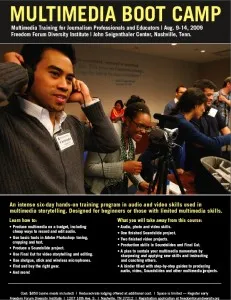 The Freedom Forum’s Diversity Institute is putting on an intensive week-long multimedia boot camp in mid-August.
The program is designed for journalism educators, students or professionals with limited multimedia skills.
Not your local TV station’s news show
 Can a newspaper do local TV? One of the most ambitious efforts yet just launched in Las Vegas with a brassy party. Hey, it’s Vegas, baby.
Greenspun Interactive is doing a half-hour show called 702.tv on Tuesdays and Thursdays in the 10:30 p.m. slot on a cable channel in Las Vegas. As planned, it will go to five days a week in the fall.
And where it’s trying to compete with other local TV news is not on front page hard news, but on the fun stuff about one of America’s glitziest cities.
It’s slick. It’s fast faced. It’s fun. There’s also a relaunched Web site, 702.tv.
“What if there were a local newscast that wasn’t about the latest accident on the 215 or the latest house fire?” Rob Curley, president and editor of Greenspun Interactive said in Las Vegas Sun article. “What if it were fun and informative? That’s 702.tv.”
“If ‘The Daily Show,’ the Travel Channel, the Food Network and E! were to try to do a daily local show in Las Vegas, this is what it might look like,” he said.
The core team of 702.tv did a groundbreaking Web/cable TV show during Curley’s stopover at the E.W. Scripps-owned Naples (Fla.) Daily News called Studio 55. But 702.tv is several iterations from Curley’s efforts in Naples. It’s more disconnected from a print product or traditional Web site than Studio 55.
Staffer Denise Spidle gives some more behind the scenes details.
This one will be fun to watch – the episodes and the project.
(One of the show’s on-air personalities, Emily Gimmel, interestingly, is also in a reality show set in Louisville, Ky., called Southern Belles: Louisville. Somebody should do a reality show about hanging with Rob Curley! … Red Bull could sponsor, or Mountain Dew.)
Local video content sharing continuing to spread
Pooling video resources among competing TV stations has come to Dallas. Barry Shlachter of the Fort Worth Star-Telegram takes a look a month into local video sharing in that market Participating are Fox’s KDFW, NBC’s KXAS and Tribune Co.’s KDAF. (KDFW and KXAS also agreed in January to share a helicopter.)
“Three or four years ago, they didn’t need to” share resources, said Phyllis Slocum, a former TV reporter who now teaches journalism at the University of North Texas in Denton.
“But the economic downturn has reduced advertising income. Remember all those new car commercials? Where are they now?”
“What’s new is that they are doing it full-time within the market,” said Harry A. Jessell, an ex-TV journalist who is editor and co-publisher of an industry Web site, tvnewsday.com. “This must run against the grain of many broadcasters, who have been fiercely competitive.
“They say this is going to free up resources for more enterprise reporting. They’ll probably just do more with fewer people. Everyone’s looking for ways to save. We had this helicopter ‘arms race’ between local stations, and now they are starting to share.”
Learning to share in the media sandbox
Content sharing among newspapers scattered across a state or large geographic area is becoming relatively common and video pooling arrangements between local TV stations in the same city are also becoming more common.
These are works in progress driven by economics, but even if the economy gives media companies a short breather, I suspect these are here to stay. The Tennessee sharing agreement between the News Sentinel, Chattanooga Times Free Press, The Tennessean, the (Murfreesboro) Daily News Journal, the (Clarksville) Leaf-Chronicle and the Commercial Appeal appears to be working well as a few rough edges get honed in the day-to-day way it works.
The forthcoming spring issue of the magazine APME News will take a deeper look at these regional arrangements between newspapers.
John Temple, the last editor of the Rocky Mountain News, says he doesn’t see why these sharing agreements couldn’t extend to TV station-newspapers sharing video:
Newspapers aren’t print products anymore. The divide between newspapers, TV stations, radio and magazines is breaking down. While this sharing is being done as an economic measure, it makes sense editorially to free up staff to focus on exclusive stories rather than having people cover the same stories at each station.
Marc Andreessen: “The game is completely over”
The whole piece on newspapers starts about 28 minutes in. (via Alfred Hermida on reportr.net)
It’s in the way that we use it
Scripps exec Jay Small on newspaper video:
Focus on video when it is the best storytelling tool for the job. For example: Raw video from a warehouse fire? Great - rough cut it and post it. Two minutes of a print reporter standing in front of a courthouse reading components of a prose story? Not so good. Trying to mimic broadcast news, with anchors, sets, graphics packages and the like, is probably a waste of effort.
Merry Christmas peeps
A knoxnews Merry Christmas.
I found it on YouTube
NAA Beth Lawton looks at YouTube and newspapers. She links to a neat Google map of newspapers with YouTube channels.
Having a presence on YouTube is a no-brainer to me, but apparently it’s controversial in spots. How many times have you heard someone say: “I found it on YouTube.” It’s a lot easier to adjust to the consumer’s behavior than to teach the consumer to adjust to your behavior.
It reminds me a bit of the debate about whether being in Google News was good for news sites.
Newspapers, whaling ships and oil drilling
The above is the short version of the Michael Rosenblum speech to the Society of Editors. The speech has deservedly created a lot of viral buzz and blogging and if you’re just stumbling upon what he said, listen to the short version at least. The long version is inpart 1 and part 2 and there’s a third link on some additional thoughts of Rosenblum from his speech.
It’s inspirational. It’s visionary. It’s cautionary.
I don’t see many signs, however, of newspapers companies wholeheartedly embracing his approach toward change even as the economic downturn accelerates and desperate measure begin to look, well, not so desperate after all.
Quickly changing is never easy for mothership-size media properties. They are attempting to manage the decline through expense control and many incremental changes, precisely the type of change Rosenblum eschews.
He says:
_In short, make your paper into the video information and public discussion node for your community.
_
Kara’s got a brand new toy
Kara Swisher at WSJ’s BoomTown has a new HD Flip video camera.
“The more Flips we have; the more fun we have.”
We just passed by another tipping point
During the first Gulf War, 24-hour cable news (specifically CNN) saw huge ratings increases and established the viability of cable news, which is now a staple of television for many Americans. Fifteen years later, we couldn’t imagine not being able to find news on television at any time of day. Might we look back at the 2008 presidential election as a catalyst for streaming video similar to what the Gulf War was for round the clock cable news? Only time will tell, but I wouldn’t bet against it.
Live from the newsroom
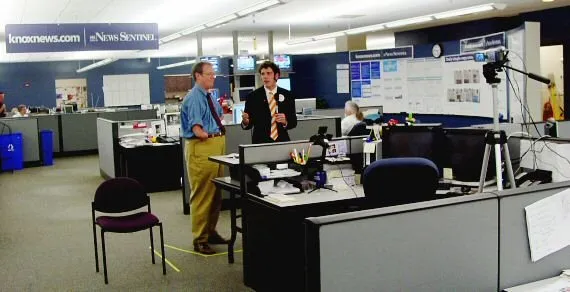 Online Editor Jigsha Desai tested, debugged and planned live streaming in the Knoxville News Sentinel newsroom Tuesday night as part of our election coverage on knoxnews.com. Not quite MSNBC or even the movie The Front Page, but reaction has been favorable. You’re likely to see us use it again. We were using Mogulus, a Web site that was also being used on election night by a number of other media companies.
We’d love to hear your feedback here.
(Jigsha Desai photo)
The basement videos

Still looking for our best shots
“I think they’re still trying to do a big mistake and that is imitate old time TV … We haven’t got to the point where we are reinventing TV and video.” – Jeff Jarvis
(via Beet.TV)
The transformation continues …
 It doesn’t take a Cray Jaguar supercomputer to figure out journalism is changing, but we used one anyway.
OK, I know I look like an idiot, but these are the things we do these days to add value to our news products.
Flip HD
Coming: An HD Flip camera by Christmas.
It’ll be interesting to see how the Flip camera folks keep their easy of use and low price point in an HD model.
Two girls and a bunch of guys
In one of the cathedrals of Southern college football, only two of the journalists “regulars” who attend press briefings are women. Hmmm… and they never noticed?
Up in TriCities
David Cate, who definitely loves music, has been doing a great job of doing video of music in the TriCities – among other things. This is a Darrell Scott video, one of my favorite songwriters, from Bristol Rhythm and Roots.
An opportunity for a different point of view
 YouTube has announced an ambitious journalism contest for “citizen journalists.” I suspect this contest will produce some powerful pieces.
In partnership with the Pulitzer Center, YouTube presents Project: Report, a journalism contest (made possible by Sony VAIO & Intel) intended for non-professional, aspiring journalists to tell stories that might not otherwise be told.
In each of the three rounds, reporters will be given an assignment to complete. Winners of each round will receive technology prizes from Sony VAIO & Intel, and the grand prize winner will be granted a $10,000 journalism fellowship with the Pulitzer Center to report on a story abroad.
Pat Boone gives a Flip interview
 Even TV networks are using the Flip camera.
From CNNPolitics.com’s “PoliticalTicker” blog is a photo of singer Pat Boone doing an interview at the RNC doing an interview with a guy with a Flip Video camera
The blog posting with photo is here. Click on the “video tab” to see the video.
The News Sentinel was an earlier adopter of these inexpensive, but very serviceable cameras.
(CNN Photo)
IM @ Knoxnews.com
When you say it, it sounds like “I’m at knoxnews.com.” And if you’re not, you should be!
No wonder she’s popular
LisaNova is pretty funny.
Obnoxious wins for now
You may not like it (and I think it reduces traffic), but expect to see more, not less, pre-roll video advertising. We need to evolve to something that works for viewers and advertisers. Being obnoxious can’t be good long term.
Joe Cocker captioned for the clear-headed
This one gets funnier each time I see it. He’s still making good music, too.
Fun at Media Day
Truly interactive media.
It’s the journalism, stupid
More from the “on being there” department. Video from inexpensive Flip video cameras rules again in Tennessee church shooting.
Newspaper video two years later
I’m glad Howard Owens is blogging again at howardowens.com
No newspaper is doing video right
Michael Rosenblum on newspapers and video:
Q: Are there any newspapers out there you think are doing this right?
A: No. None. There are some that are getting closer, but we are in uncharted waters and have a chance not only to do this right, but also to become the Gold Standard for the entire industry. That is why the stuff has to be just so excellent.
And the underwear just disappeared
Willow Nero, a summer intern for knoxnews from Ole Miss, has done her first video for us, a brief tribute to when underwear was king in Knoxville..
The mystery of “the couch” in KnoxVegas
The New York Times features a look at a weekend in Knoxville. I must hang with the wrong crowd, or at least with the people writer Allison Glock knows. I have never heard Knoxville referred to as the “the couch.”
KnoxVegas, K-Town, Knoxpatch, yes. But “the couch,” no, never.
The accompanying slide show to the article includes a WDVX Blue Plate Special show. Online Producer Talid Magdy has a weekly series of videos on those shows.
Update: KnoxvilleTalks is doing a “couch” poll. So unless you’re a couch potato, head on over there.
Never let them see you sweat
Co-worker Lauren Spuhler blogs about a small problem she had during a video shoot.
She was doing a video profile of John Grant Jr. for the monthly Songs of Appalachia video series she produces with reporter Morgan Simmons
Video that drags
Now this is really cool video. I wonder how far directly dragging video content is from general use?
This just in: The world has discovered Twitter - and it went down
The world has now discovered Twitter … so it’s ok to follow me. By the way, shortly after I watched this, Twitter went down and it’s still not operating quite correctly. Random power!
The above is also an example of the new embed code in the Scripps’ “Flaven” player (beats me). Now you can put knoxnews videos on your site like this RandomThis video. The “link” link is on the right hand side of the player.
A clear picture to the future
Here’s what we know: people are online, they watch video online, they spend money online. Therefore, video producers and advertisers are going into overdrive to figure out a model that works.
Social idiocy, the video (I thought the text version was more inane)
OMG, somebody did a video that looks just like story comments.
Eric Berlin pointed to this video last week that I hadn’t seen. As he says: “This was produced last fall but is definitely worth a watch if you haven’t seen it. Think of it as what Slate refers to as Internet commenting as its own “special form of social idiocy” made flesh.”
Meanwhile, Kurt Greenbaum has done a number of posts on story comments in last month. They are worth the read:
The Zen of Flip
Glenn Reynolds (Instapundit) points to a David Pogue piece on the New York Times Web site that says the little, unassuming Flip Camera has captured 13 percent of the camcorder market.
It’s secret: simplicity that works, or as Pogue suggests “if you’re successful at something the first time you try, you fall instantly in love with it.”
Reynolds’ post yesterday:
WOW: According to this review, the cheap and easy to use Flip Video Camera has captured an amazing 13% of the camcorder market. Why? “Having finally lived with the Flip, I finally know the answer: it’s a blast. It’s always ready, always with you, always trustworthy. Instead of crippling this ‘camcorder,’ the simplicity elevates it.” I still don’t see much advantage over video from a digital still camera, though the review says the Flip does a lot better in low light.
A follow the money story from MTV
Since I first wrote about him in December (here and here), I’ve been keeping up a bit with MTV’s Tennessee Street Teamer Dustin Ogdin, a Nashville based filmmaker.
Ogdin is part of MTV’s Choose or Lose Street Team ‘08 (chooseorlose.com).
Part 1 of a two-part report moved last week on the AP Online Video Network, which is featuring videos from the MTV effort.
Ogdin starts with the February report from the Pew Center on the States that captured attention with its “more than one of every hundred adults are behind bars” headline, but quickly transitions into tackling Nashville-based Corrections Corp of America and it’s sizable political influence in Tennessee.
Ogdin points to Sen. Lamar Alexander’s rumored pimping of the chief corporate attorney for CCA for a Middle Tennessee federal judgeship, noting that Alexander is a huge beneficiary in CCA’s political contribution largesse.
(Having judges with ties to prison operators is an amazing supply-chain innovation.)
Part 2 should be interesting.
Townsend tales
DanTraveling (Dan McCoig) has been back in East Tennessee, this time to Townsend.
Just like on ‘The Wire’
Maybe our business has changed. Pay phones?
(via the knackered hack)
TV Satellite truck in a 65-pound backpack
 The next time you see one of those big TV remote trucks with the dishes on top, think about this: CNN does much the same that the truck does with a 65-pound backpack of electronics.
That was one of the things I learned about at the “Journalism 3G: A Symposium on Computation & Journalism” conference that vividly illustrated how technology is changing newsgathering.
CNN has begun using these backpacks throughout the war-torn areas of the Middle East, in part, because they believes it better protects the people in the field (a reporter wearing a backpack is a smaller target than a reporter with a truck load of equipment). But it also allows them to leapfrog competitors in getting video of the news from nearly anywhere.
A journalist can set up and get live video on its way to CNN headquarters in less than 10 minutes, said Paul Ferguson, supervising editor, International News at CNN. Ferguson was on a Saturday morning panel on “Advances in News Gathering” at the computation+journalism symposium at Georgia Tech.
The backpack is a camera, a G4 Apple laptop and a satellite modem. Firewire the camera to the laptop, connect the laptop to the modem, fire up the software and, BAM, you’re on the “internet in the sky,” Ferguson said.
Prices for this technology vary, but Ferguson said the equipment to do broadcast quality TV costs under $20,000. That doesn’t include the satellite time usage.
CNN was honored last month with the Technology & Engineering Emmy Award for its IP-based newsgathering system. It’s groundbreaking stuff.
What Ferguson called the “Internet in the sky” is a satellite Internet system called BGAN, or Broadband Global Area Network. CNN uses the Inmarsat BGAN, but that company isn’t the only provider..
Incredible. Bill Densmore posted audio of the Advances in News Gathering session. And there’s more conference of the symposium here.
PoliceTube
More Joe Friday than Lilly Rush, upper East Tennessee police departments have gone YouTube.
The Kingsport Police Department has joined a growing number of police departments using YouTube to publicize cases. Kingsport is using YouTube in hopes of getting leads in the 1994 murder of “Miss Annie” Heath, who was 67 when she was beaten to death in her apartment.
The Johnson City Police Department is a doing a “Dirty Dozen” list of bad guys it is looking for to a soundtrack of music from TV police shows like “Law and Order.”
Not a bad idea. The videos also go on local community access cable channels.
Small camera video
Journalism pundit/pioneer/heavyweight Jeff Jarvis is having fun at the World Economic Forum in Davos, Switzerland, with Pure Digital’s FlipVideo cameras as well as a Rueters Mojo toolkit, which is centered around a Nokia N95 cell phone.
We’ve been using FlipVideo and its predecessor models (the early version from Pure Digital wasn’t called that) at the Knoxville News Sentinel since October 2006.
It’s the most disruptive tool we’ve introduced in the newsroom in years. Every reporter can potentially create video – most of our reporters have shot at least one video since October 2006; several have done many, many more.
Are they award-winning pieces? Nope. Are there times to use better equipment? Definitely.
But for spot news or the short clip, its small size, ease of use and darned good video quality make it an unassuming game changer.
(What’s the field take on using the Reuters kit, or just the N95 by itself, for news video?)
Jarvis’ idea of giving them to non-journalists to create content is also intriguing. Hand them to a high school student at a football game and say: “Be our reporter.” At just over a hundred bucks, it beats a lot of alternatives. Crazy?
Virtual candidate forums
At the blog, Knoxify, candidates are addressing the blog’s three questions for hopeful officeholders (more details). For me, the first two are but warm-ups for the real question, No. 3, What 5 things could you not live without?
Ah, we can tell when you’re faking it It’s kind of fun. Give Knoxify a visit.
At knoxnews, we’ve been rolling out our series of candidate video interviews, about two minutes or so with a candidate. News Sentinel Editor Jack McElroy explains.
A Christmas Message
 A message from the Queen (from 1957 – 50 years ago ). Royalty goes YouTube. Enjoy, Merry Christmas.
Tell it in 2 minutes
Jeremy Allaire of Brightcove, an Internet TV service, to Peter Kafka of Silicon Alley Insider on video length:
Not only are Web audiences interested almost entirely in short-form video, but they want them even shorter than they are right now.
On average, Jeremy says, Web users are selecting 4-minute videos. But they’re bailing out after streaming just two minutes.
Internet video plans for Scripps Networks
Mashable covers Scripps Networks and Maven and muses about potential.
Life at Mabry Mill
 Dan “Dan Traveling” McCoig emailed to say he has a new video up. This one is on Mabry Mill along the Blue Ridge Parkway. He’s got a good series of videos going. The video explains the origin of the saying “wait your turn.”
Twitter on TV
Twitter cameos on CBS’ CSI. Add me to your Twitter friends.
(via Lost Remote)
Editorial Comment: I’m My Wife’s Grandpa
I had to post this one cause it’s about the home state candidate and it’s just dang innovative for stodgy old opinion writers. And it’s the funniest thing I’ve seen in awhile.
The Wichita Eagle opinion staff has created a satirical video about the age and looks gap between two presidential candidates and their wives.
Damn, two Fred videos in the space of as many days.
(via Howard Weaver)
It’s OK if your video strategy is a little furry
Sorry, tis true:
The secret to a successful Internet video venture is… dogs
No magic formula, but good numbers nonetheless
Great stuff from Andy Dickinson on video workload average time. The wide range in video production times shows it’s not that easy yet to have a pat 1 minute of video equals X in work time. And the reasons he notes vary from training to type of project.
Like in the movies, good guys win in the end
An update on the Oct. 4, 2007, posting about YouTube pulling a video of knoxnews that was flagged by 20th Century Fox for copyright infringement.
The video above of the Reno 911! guys was shot by our TV critic Terry Morrow and so we filed a counter-claim with YouTube. I got an overnight email that the video has been restored.
The YouTube process is pretty streamlined, but still, we should have never gotten the copyright infringement claim in the first place.
Al Gore will change your life
 OK, so Al Gore didn’t invent the Internet (single-handily), but he did make global warming a movie and he has now re-defined TV. And TIpper cleaned up the record industry. That dynamite group gave the prize to the wrong couple; It should have been Al and Tipper, not Al and the UN.
What I like about Current, apart from the awesome design, is that they’re attempting to change the way television is consumed and created. It’s a much more interactive experience, where the audience participates and creates.
It only took a list and a meek, mild-manner geek
Stephen Colbert thanks Craigslist founder Craig Newmark for killing the American newspaper.
Seagrove videos
I found several excellent videos on some of the potters I know in Seagrove, NC. We’ve bought several (as in lots) of pieces of Terry and Anna King and their daughter, Crystal. Terry King, who I went to high school with one year, also talks a bit about my favorite Seagrove potters, Dorothy and Walter Auman, who made our wedding china. You need to go yourself!
The videos were done by Dan McCoig. He’s got lots more videos from the Southeast. I noticed several out of Great Smoky Mountains and East Tennessee.
Hey Dan, I like that Knoxville cap. I’ll send you a knoxnews.com cap if you want one!
Ain’t that ….
 Has this happened to you?
At knoxnews, we post a lot of our videos on YouTube, especially those done by our TV critic (they get a lot more traffic there than on our site).
However, we recently received this email from YouTube.
Dear Member:
This is to notify you that we have removed or disabled access to the following material as a result of a third-party notification by Twentieth Century Fox Film Corporation claiming that this material is infringing:
“Reno 911!” officers “ain’t retarded”: https://www.youtube.com/watch?v=Xl4V4lzTyI8
Picture of change
The camera wielding woman in the foreground is Knoxville News Sentinel online editor Jigsha Desai. She was getting react to the jury verdict that found the county commission had violated the state open meetings law. The lawsuit, one of the most intently followed stories of the year in the Knoxville area, had been brought by the newspaper.
And it marked an innovative experiment with bloggers. Because of the newspaper’s conflict of interest, EditorJack McElroy enlisted the help of three bloggers to help cover the trial and the newspaper’s coverage. They did many posts, one live-blogged several days in court, one did podcasts and questioned our motives, one did daily no-holds-barred critiques of the coverage. The three bloggers were David Oatney, Russ Hailey, and Russ McBee and it was good stuff. And, of course, they weren’t the only ones blogging it.
Jigsha Desai did daily video coverage of the trial as part of a package that included stories updated several times a day by reporter Jamie Satterfield and photos by several staff photographers throughout the trial.
But this front page photo says it for me in how this business I’ve been in for 30 years is changing.
(News Sentinel photo by J. Miles Cary)
On being there (Florida version)
Megan Taylor, writing on News Videographer, has an interesting covering-the-coverage piece on last week’s Andrew Meyer “Tasergate” story.
Ah, Internet-attention-span-readers, remember back to early last week before Chris Crocker’s whole Brittney thing to the University of Florida student Tasered by police during a John Kerry campaign event on campus. OK, here’s the story which is still big in Gainesville.
Anyway, I found it interesting that even with videos from two different angles, people can’t agree on the facts of the incident. Police are tracking down the people that can be identified in the videos as witnesses.
(Florida Alligator / AP photo)
Some of that Om Magic
Om Malik boils down a survey on video advertising into five takeways:
- Video-sharing sites are getting a bigger share of visits (77%) versus news sites (55%) and broadcast TV sites (49%). Lesson: Good for YouTube, not so good for old tubes.
- 43% of those polled want ads to be interactive and clickable. Lesson: Don’t put stupid TV-style commercials that are not actionable.
- Videos are for sharing. Lesson: Big media, listen to CBS Interactive’s Quincy Smith.
- 52% want ads to be relevant to them, 46% think they need to be relevant to web site’s content. Lesson: Consumer electronics ads next to people being blown up aren’t going to work. Make your ads contextual, relevant and of course tasteful.
- Make ads fun if you want attention. Consumers feel annoyed by videos ads today. Lesson: Simple enough.
Beta news
Knoxnews’s participation in the local advertising beta of the AP’s Online Video Network got a mention this morning in Microsoft’s news release touting the capability.
Dance to the news
Who says covering politics can’t be fun and refreshing?
Free sex
Now, I’ve hooked you.
The disruption of traditional media even includes porn. The commercial porn industry is being hurt by a combination of “piracy” and amateur video uploads, says George Simpson in a MediaPost column. DVD sales and rentals are down 15 to 25 percent. Sound familiar?
The industry apparently will fight back by touting quality (“We use good-quality lighting and very good sound.”)
(via Terry Heaton, who I think is right in thinking this probably has implications for mainstream video producers as well)
Instant VJ success
Angela Grant made me laugh.
Where it’s a happening
Want to know where the next new video innovators will be coming from?
AP’s inline player
We’re part of a small group of online newspapers that began deploying this week an inline player on our site for the AP Online Video Network.
I couldn’t miss it; it was on every channel
A July study of video distribution by start-up tubemogul.com highlights an interesting pattern in video viewership.
Your mother’s watching online vids
Advertiing Age has done online video study covering viewing habits this year:
During the first half of 2007:
- 62% of consumers viewed news clips
- 38% viewed movie trailers
- 36% viewed music videos (sharply down from 2006).
The publication formerly known as a newspaper
Mike Cassidy on Media Post’s Video Insider blog on newspaper video:
On cats and newsrooms
 Melissa Worden has a nice post on the Multimedia News Producers Workshop in Minneapolis.
Someone put together a funny video about newsroom training being similar to training cats to fetch. Since herding them didn’t work, maybe teaching them to fetch will? I have to agree that training about “that Internet” is a lot of like teaching cats to fetch. We had a senior editor bail out of a training session last week after five minutes. (sigh)
Worden makes the point that we have to figure out how to make training fun like Kate McGinty taking the multimedia plunge. But watch the training cats video. It’s great.
She also posted this great guide that was presented at the workshop on rating video stories and the time they can consume. I need to circulate this one around my newsroom.
One star: Raw video, recorded for no more than 45 seconds. The final product has no editing or titles. Production time: 1-2 hours, which includes shooting, ingestion, formatting and posting.
Maybe we’re missing the picture?
Even with newspaper video, the reruns can be better. Some fascinating discussion on low-end vs high-end video (does there have to be a versus?). I think this is an important discussion. Newspapers have a disruptive opportunity with video that shouldn’t be overlooked by anyone developing Internet strategies for newspapers. Should we be as passionate about producing good online video as Angela Grant and others? Sure. There’s room for both. The latest reruns on the newspaper video debate (Updated) :
Interning lunch
| Now I know. Tags: interns | Lauren Bell | Rem de Rohna |
A most useful video tool
| One-stop for video stats, facts and figures. Bookmark it; Howard’s done the work for you! Tags: video | video stats |
iPhone sex appeal overrated!
| Here’s two video views of the sex appeal (or social networking creds) of the oh-so-trendy iPhone. iPhone of the Sexes from New York video blogger Ilana Arazie and iPhone Lovin’ from the Wall Street Journal’s Andy Jordan and his new Tech Diary video blog. Gee, maybe iPhone owners will just have to use it as a phone/iPod/Internet device. Go figure. Tags: iPhone | sex appeal | social networking | adult toy |
Online Video: They saw this
Some views on the new Pew study on Video Online. On the sticky note write, “Here’s proof that there’s a Revolution happening.” -- David All
She’s on the hot list
Oh, wow, Ilana Arazie, is getting hyped on Jewlicious.com and snuck in an AP The Hot List and is doing stuff for Amaldo.com. Check out her vblog, Downtonw Diary, for her latest. The video below is a recent one on online dating that I liked.
Jack Hammer?
| Our two summer interns, R&B; (Rem de Rohan and Lauren “Bama” Bell), have done a video on life as a intern. Not to be missed. Tags: interns | newspaper video |
Fast-forwarding through the numbers
Somebody put online video on fast forward. From a new survey: Daily vidoe usage up 56 percent over last year 14 percent of American 12 to 64 watch online video daily. 80 percent of 18 to 24s watch video at least once a week.
The newscast belongs on the telly
Angela Grant has it right.
Rosslyn Chapel
| A visit to Rosslyn Chapel and the castle ruins during our vacation trip to Scotland. Tags: Scotland | Rosslyn Chapel | video |
Loch Ness
Scotland vacation cliips
Craigmillar Castle
| A video of Craigmillar Castle on the outskirts of Edinburgh in Scotland. Great castle to see. Tags: Scotland | Edinburgh | Craigmillar Castle | video |
It would have been better two years ago
| We only waited two years to see this. And Bill Shory explains why. Tags: open records | police video | in-car cameras |
On Being There
 Or “good enough” revisited. We had a video go viral this week. We had a story on Sunday about a Knoxville porn starlet who goes by the name of Barbie Cummings. She blogged that she had oral sex and had naughty photos taken during a traffic stop by a Tennessee State Trooper. (Her NSFW blog suddenly disappeared Tuesday) The Highway Patrol has suspended the trooper while it investigates. The sordid tale is here. We weren’t the first to have the story. We got scooped by a local TV station, WATE, on Friday night. But the reporter assigned to the story, Matt Lakin, got an interview with the Cummings on Saturday. He took his $99 Target camera (wait, they’re $89 now). No lights. No external mic. No tripod. usually poor audio and a challenge to hold steady. We’re not taking a fancy HD camera here, folks. It’s just sightly larger than a cigarette pack. Lakin shot the video and online producer Erin Chapin edited and posted it Saturday night. Despite the technical limitation, it proved good enough. You can see his interview: We believe he is the only reporter who has done a video interview with Cummings about her encounter with the Tennessee trooper. Traffic to the video soared on Monday, getting almost as many views during Monday as we had for all videos last week, according to stats from the Associated Press. We are one of the early sites using AP to host and play local videos. AP said the video, which was available most of Monday only from our branded version of the AP player, ranked as the third most viewed video of the day in its Online Video Network of over 1,600 affiliates. Calls came in from TV networks and Tennessee TV stations to use the video. The video was moved to the full national network and on Tuesday was listed as an “Editor’s Pick” in the national AP channel. At mid-afternoon, it was No. 1 in the AP network. Sometimes getting the story is about thinking and being there. And that’s good reporting, print or video, right? Updated: This posted was updated 2/17/2013 to fix some problem links. Instead of linking to the video, it’s embedded. Tags: Barbie Cummings Or “good enough” revisited. We had a video go viral this week. We had a story on Sunday about a Knoxville porn starlet who goes by the name of Barbie Cummings. She blogged that she had oral sex and had naughty photos taken during a traffic stop by a Tennessee State Trooper. (Her NSFW blog suddenly disappeared Tuesday) The Highway Patrol has suspended the trooper while it investigates. The sordid tale is here. We weren’t the first to have the story. We got scooped by a local TV station, WATE, on Friday night. But the reporter assigned to the story, Matt Lakin, got an interview with the Cummings on Saturday. He took his $99 Target camera (wait, they’re $89 now). No lights. No external mic. No tripod. usually poor audio and a challenge to hold steady. We’re not taking a fancy HD camera here, folks. It’s just sightly larger than a cigarette pack. Lakin shot the video and online producer Erin Chapin edited and posted it Saturday night. Despite the technical limitation, it proved good enough. You can see his interview: We believe he is the only reporter who has done a video interview with Cummings about her encounter with the Tennessee trooper. Traffic to the video soared on Monday, getting almost as many views during Monday as we had for all videos last week, according to stats from the Associated Press. We are one of the early sites using AP to host and play local videos. AP said the video, which was available most of Monday only from our branded version of the AP player, ranked as the third most viewed video of the day in its Online Video Network of over 1,600 affiliates. Calls came in from TV networks and Tennessee TV stations to use the video. The video was moved to the full national network and on Tuesday was listed as an “Editor’s Pick” in the national AP channel. At mid-afternoon, it was No. 1 in the AP network. Sometimes getting the story is about thinking and being there. And that’s good reporting, print or video, right? Updated: This posted was updated 2/17/2013 to fix some problem links. Instead of linking to the video, it’s embedded. Tags: Barbie Cummings |
porn star | Tennessee Highway Patrol | newspaper video |
Mary Farrell paints her pots
| I was testing out my video camera, a Panasonic SDR-S150, and shot this video of one of my favorite potters, Mary Farrell. She was kind enough to be my test subject. Mary and her husband, David, are marking their 30th anniversary of operating Westmoore Pottery in the Westmoore area of northern Moore County, N.C. If I haven’t bought at least one piece from them every year they’ve been open, it’d be close. I love their pottery. They make pottery in the styles of pottery made in the 17th, 18th and early 19th centuries. She said she’d had a great time helping put together an exchibit at the North Carolina Pottery Center in nearby Seagrove that features the work of Farrells, Hal and Eleanor Pugh of New Salem, NC, and historical works from North Carolina drawn from private collections here and yonder. The exhibit is called “Slipped, Dipped and Dotted: 18th-21st Century North Carolina Redwares” and runs through Aug. 25, 2007. On this Saturday afternoon, she was doing a demonstration for two children and me of how she decorates pottery. Later a photographer from the Asheoboro, NC, newspaper showed up to take some photos. If you are ever in the area, visit their shop. It’s been featured in Country Living and Home and Garden magazine. Tags: Westmoore | Seagrove Pottery | North Carolina pottery |
New video promo tool
Recent news videos
I like this new promo tool AP did for our local videos. We started using it earlier this week when something zapped the tool we were using. They’re doing something funky with the images, but otherwise I like it. Having a little search box is a great idea. Tags: ap video network | news video
JetSet Embed
A letter from the newspaper while watching morning TV
| Thanks to Mark Potts for pointing to Iowahawk’s Subscribe Now!. And to NewTeeVee’s Liz Gannes for pointing to Good Morning World. Iowahawk has the history of the newspapers satirically nailed. And Andy Peppers (played by Peter Oldring) and Alasdair Coulter (played by Pat Kelly) are indeed a “bad morning show for the world.” Together, they were a great way to start the day. Check them out. Tags: newspapers | TV morning shows |
Scrolls WERE better
| This one is bound to go viral … Medieval Tech Support. (via Tim O’Reilly) Tags: help desk | tech support |
Watching video
One of favorite blog sites, NewTeeVee, has an interesting take on online video.
Forget televised, the revolution is already on video
Not convinced news video is really big right now instead of sometime from now? If Google buying YouTube wasn’t enough to convince you the audience is there, Andy Plesser has the tipping point in some internal CNN stats:
Living on the beta edge
We launched the Associated Press beta video player yesterday on knoxnews.com that adds a “local channel” of video content. We’ve been in the AP video network for a year or more, but the ability to upload our own content into the player is new. Take a look. It’s got a pretty easy to use admin tool, delivers video in both Windows Media and Flash formats, works with at least Internet Explorer and Firefox, and the Windows and OS X operating systems. You can email links and create your own playlist. The Associated Press, working with Microsoft and some other vendors/partners, has some ambitious growth plans for the online video network. We’ll see where it goes. Tags: video | AP | Associated Press
The karmagrrrl
| Zadi Diaz has become one of my favorite vbloggers. When I was doing the viral thing, one of my co-workers said: “She’s no Ze Frank.” Ah, no, she’s not. She’s executive producer and host of JETSET and a lover of chocolate and raspberry (more bio). I don’t think I would ever mistake her for Ze Frank. Yesterday, the 50th episode of Diaz and Steve Woolf’s vblog, JETSET, was posted. JETSET, which Diaz calls a Vloggie, is described as an Internet and pop culture show for young adults (that’s not me, but I like it anyway). The first episode were online on June 1, 2006. And Zadi Diaz is on the verge of being of a big Internet video star. Maybe she already is. In the 50th episode, she gave shoutouts to a whole gang of other video bloggers (she must have just spaced The Randoms). Browse around the site and watch some other episodes. Best of luck to Diaz and Woolf in their WebbyAward nomination. Look likes a slam dunk in their category. Earlier this week, Diaz was at the Radio Television News Directors Association big confab in Vegas and talked about what she’s doing in this video clip. Here’s Lost Remote’s coverage of the same panel she was on. Beyond JETSET, Diaz has a text blog and is on Twitter. Photo on right is from her Flickr stream. And there’s Terry Heaton getting his photo taken with Diaz and Amanda Congden. How’d that happen – and in Vegas? Tags: Zadi Diaz |
vblogger | JETSET |
Primetime for video
The always interesting Mark “Blog Maverick” Cuban tells us when people watch video online (based on Comscore data):
Real tales from Ilana Arazie
 Beet.tv’s Andy Plesser has done a nice piece on Ilana Arazie, who I mentioned recently. I’m a big fan of Arazie’s “Reel City Tales” vblog. We’ve featured it a couple times on the home page and the entertainment section front of KnoxNews on the weekends and it’s gotten pretty good traffic – for a weekend. She pushing the envelope a bit for content on mainstream media sites. Check out what she has to say on this video itnerview on Beet.tv. Good interview! One wonders when she’ll leave her day gig as an AP “Product Specialist” to be a fulltime vblogger for the wire service. Tags: vblogging Beet.tv’s Andy Plesser has done a nice piece on Ilana Arazie, who I mentioned recently. I’m a big fan of Arazie’s “Reel City Tales” vblog. We’ve featured it a couple times on the home page and the entertainment section front of KnoxNews on the weekends and it’s gotten pretty good traffic – for a weekend. She pushing the envelope a bit for content on mainstream media sites. Check out what she has to say on this video itnerview on Beet.tv. Good interview! One wonders when she’ll leave her day gig as an AP “Product Specialist” to be a fulltime vblogger for the wire service. Tags: vblogging |
associated press | ilana arazie | asap |
Beet.TV on the Beta
| Really good story at Beet.TV about the AP Online Video Network beta that we’re participating in at Knoxville News Sentinel along with a number of other papers. Give the piece a read (and watch the video above). It’s the best overview of the efforts that I’ve seen. At the very least, the ability to upload local videos provides sites who are already using the AP Online Video Network a unified player for all video with ad avail spots. Whether the AP project is the answer is yet to be determined, but the news organization and its partner Microsoft have a very rich set of tools they are pushing out to their members. (Andy Plesser has a very interesting blog if you haven’t checked it out.) Tags: video | Travel | newspapers |
Inky-fingered and unbowed
| An inky-fingered print journalist to multimedia contender weighs in. Just discovered a new blog from Ian Reeves called Streaming Blue Murder, subtitled “Old journalism dog. New video tricks.” Looks it’s going to ba a good one! But does “streaming blue murder” mean something? if it does, it flew right over me. Tags: teleivsion | newspapers | online viedeo |
A crew of one
A reporter might arrive on a location to do an interview. The subject would sit there, waiting anxiously. “Can we start?” the subject says.
Where will video ads come from?
| If not from TV, yellow pages? So says that seer Greg Sterling. Tags: video | yellow pages | television | video advertising |
King of online video: Newspapers, huh?
This is disruptive as hell…
Arazie asks ‘how long should you wait?’
| Hmmm … this is not my editor’s AP. The august news wire, The Associated Press, is doing some experimenting. They’ve turned a young “product specialist” in the Online Video Network loose on the streets for eight weeks with a video camera, a Typepad account and some moxie. The results are well hidden inside ASAP, an edgier AP youth news package and Web service, but really you can just go to the vblog directly. The vblog, called Reel City Tales, is done by Ilana Arazie and her latest delves into that vexing issue of how many dates a girl should wait before having sex. She gets varied responses. I think something good could happen here while the suits aren’t watching. I hope AP lets it last longer than eight weeks. Check out her latest tale. Tags: vblog |
sex | innovation |
In the Mix atop The Hotel
| View from the Mix Lounge atop The Hotel at Mandalay Bay. Taken with a $99 Pure Digital camera. Music from Spice Music and “toxic playground remix.” Tags: the Mix | Las Vegas | Mandalay Bay | NAA |
The campaign bus rolls into YouTube
| John Edwards may not win the Democratic nomination for president in the 2008 campaign, but his use of online video is being viewed as a tipping point in defining online video as a serious medium ready to content with traditional media. Edwards pre-announced his candidacy on YouTube before the official launch. That act has almost gotten him more buzz than the actual announcement (which was expected). I think it has gotten him more blogger buzz, but that’s just a guess. The “webisode” is posted here. Al Gore invented the Internet; John Edwards invents video as a serious online medium. If Howard Dean’s was the first Internet presidential political campaign, will Edwards’ be the first to win YouTube? Tags: John Edwards | YouTube | online video | media |
Video tools collection
A collection of what appears to be handy Web-based video tools are here. What are the best tools out there? Tags: video tools
Learn by doing
Tom Abate writes about a presentation on the Ventura Counmty Star’s groundbrekaing video efforts. His takeaway on that presentation and some others at UC Berkeley’s New Media program:
A prediction for 2007
Surely one of the big developments in 2007 will be the integration of community-generated video onto established publishing platforms from CNET to the Washington Post. I bet it’s going to happen fast.
The Santa Baby Girls
| A Christmas video special from the KnoxNews producers … They’re fab! More here. Tags: RandomThis | Video | Santa Baby |
Stirring the Pot

NewTeeVee
| Om Malik’s new blog NewTeeVee will be must reading. I’ve already discovered “praying mantis girl” and Kent Nichols’ Ask a Ninja. Maybe, NewTeeVee will discover the Randoms, whose weekly video features are gems on KnoxNews.com. They rock – every week. Or maybe our use of $99 cameras from Target to do news videos like this Good luck to Om and his editorial team on the new blog. It’ll be one of my daily reads. Tags: NewTeeVee | Om Malik |
Something strange here …
| A Halloween experience at the Lail household Tags: halloween | home video |
Quotable
Post-Pandemic: Return to normal after COVID-19 pandemic unlikely
As more American get COVID-19 vaccinations, people are looking forward to a “return to normal”; visiting relatives, eating in restaurants, nightlife and concerts, and even casual shopping in a store.
Some people to follow on the ‘Future of News’
Liz Heron, who posed the question of “Who’s your favorite thinker on future-of-news issues? Why?” will be the keynote speaker Sept. 21 on what is being billed “Social Media Day” at the Associated Press Media Editors Conference in Nashville at the John Seigenthaler Center. Join us at the APME Conference Sept. 19-21!
Heron is Director of Social Media and Engagement for the Wall Street Journal.
Suggestion: Mine these recommendations for people to follow on Twitter.
[View the story “@lheron et al. on "Future-of-news thinkers"” on Storify]
Quotable: Journalism is a process, exchange, intimate
Journalism in the digital age is a process rather than a product; an exchange rather than a presentation; intimate rather than abstract.
Quotable: Prediction for newspapers
No medium has ever survived the indifference of 25 year olds.
Some quotes for the journo stocking
Two quotes worth the stocking for journalists to consider.
The most terrifying thing yet about the Internet
“Television is the first truly democratic culture - the first culture available to everybody and entirely governed by what the people want. The most terrifying thing is what people do want.”
On being good at one thing
Perfect example of how, by following one thing more closely than anyone else, you can become the go to source for news: https://t.co/8rtShM8JTue Nov 22 13:49:19 via webJay Rosen
jayrosen_nyu
Large networks of “friends” are out; intimate circles are in
Consider that according to a study conducted by GoodMobilePhones, people don’t know 20 percent of their Facebook friends. Or that USA Today recently reported that social media users are “grappling with overload.” Finally, the latest Edelman Trust Barometer, my employer’s annual tracking study, notes that experts are now far more trusted than peers and friends. This is a dramatic shift from 2006 when the opposite rang true.
Quotable: And you want to run a website
“My friends keep talking to me about how they want to start a Web site, but they need to get some backing, and I look at them and ask them what they are waiting for. All it takes is some WordPress and a lot of typing. Sure, I went broke trying to start it, it trashed my life and I work all the time, but other than that, it wasn’t that hard to figure out.”
Media is like a flu shot for democracy
I’ve stated that “trust is the new black” and that the press should be **“the immune system of democracy.”
**
Spelling Bee: Cee Pee Em
Mark Potts said it at Block by Block, but I’ve heard it before: “Small, local business owners can’t even spell ‘CPM.’”
Quotable: Treat audiences as customers would be novel
“If we don’t start treating our audiences as customers, they will stop treating us as a brand they want to consume.”
More disruptive than anything ever seen
“The internet is the most disruptive technology in history, even more than something like electricity, because it replaces scarcity with abundance, so that any business built on scarcity is completely upturned as it arrives there, You have to plan your corporate strategy around what the internet does.”
Tsk, tsk, disc, disk

A better job would be …
“We have to go from a world in which we try to do a better job of covering the same news as everyone else to a world where we’re bringing our audiences news that no one else is.”
5 questions that keep Ken Lowe up at night
1. Will media consumers pay for quality content on interactive platforms?
2. Shouldn’t we be worrying about our privacy?
3. Can we find a better way to measure audiences across platforms?
4. Why are you still watching commercials if you use your DVRs?
5. What marketing opportunities will emerge as interactive, mobile media evolves?
Good advice for innovating from another era
Take time to deliberate; but when the time for action arrives, stop thinking and go in.
News is …
News itself is becoming less of an easily digestible summary of events and more of a grotesque entertainment reality show with heavy emphasis on emotion and sensation and a swaggering comically theatrical sense of its own importance.
Disaster is spelled I-N-T-E-R-N-E-T
Lauren Rich Fine on what has happened:
“Traditional media failed to realize the competitive challenge created by the Internet as it allows all media to compete directly and without any competitive advantage,” said Lauren Rich Fine, a former media analyst at Merrill Lynch and now a Practitioner in Residence at Kent State University’s College of Communication and Information. “Now there is excess supply of both news/entertainment content and ad space, which combined with slower demand, due to the economy, is spelling disaster.”
Lean and mean, newspapers now positioned to rebuild
Recommended listening. “Fresh Air” interview with Alex S. Jones, director of the Joan Shorenstein Center on the Press, Politics and Public Policy at Harvard’s John F. Kennedy School of Government and part of a fourth generation family-owned media company based in the upper East Tennessee town of Greeneville that owns newspapers, radio stations and other media products.
Probably most newspapers in this country are making a profit now, a modest operating profit. … If the economy improves and if some resources come flowing back along with some advertising, they are going to be in a position to rebuild, rebuild both in terms of their journalistic muscle and on their digital side. And I think that is going to be essential if they are going to survive.
-- Alex S. Jones
Tell a story like it’s about your mother
“My mandate for news teams is that I want them to shoot every story like it’s about their mother, brother, sister, father, and cousin. Tell it that way. That’s the road to clarity, truth, understanding and fully becoming global.”
It’s not the economy, stupid!
As a medium, print is on an irreversible decline relative to digital. We are headed for an inflection point at which print newspapers as we knew them in the past will be unsustainable.
Quote: Butterflies
“If what you’re doing in your biz doesn’t put butterflies in your stomach sometimes, then you’re not playing BIG enough.”
-- Jennifer Haubein of Houston, Texas.
Quotable: High fidelity vs availability
High fidelity rarely wins out with consumers. It’s all about convenience, availability and ease of use.
Pilfer and prosper
Maybe the best lesson I learned during the long newspaper war in Anchorage was this: if you come across a good idea elsewhere, consider stealing it. If the good idea shows up in the competition, steal it immediately.
Quote gem
Love this quote gem from Avinash Kaushik:
Back in the 1980’s Jan Carlzon was trying to breathe new life into an ailing Scandinavian Air Services. He was famous for saying “You cannot improve one thing by 1000% but you can improve 1000 little things by 1%”.
David Bryne would miss investigative reporting by newspapers
How does a democracy work without (in-depth) news? It doesn’t. While most of the population will not care about access to high-quality news, there are always some who read to find out what’s really going on, and why. Dictatorships, totalitarian regimes and underdeveloped countries don’t have the luxury of investigative journalism, and the news-as-entertainment in highly capitalist regimes isn’t really informative either – it’s bread and circuses. An informed citizenry, said Jefferson, is necessary for a democracy to function.
Marc Andreessen: “The game is completely over”
The whole piece on newspapers starts about 28 minutes in. (via Alfred Hermida on reportr.net)
Granted, it’s journalism
My greatest fear with the challenges that newspapers face is the lack of
lengthy, rigorous investigative reporting. I doubt that the next
Woodward and Bernstein will be Twitter users: “OMG, R. Nixon’s flunkies
broke into Wtrgte Htl.” Somebody has to pay for this kind of reporting, and
if the public won’t, I hope foundations do.
New threat discovered for MSM
“Consumer behaviour is a threat to the mainstream media …”
All you really need to know about why newspapers are in trouble
Forget pay walls, micropayments, free content, secular or cyclical advertising, antiquated business models and practices, the Internet, print-centric thinking or any other of the seemingly endless list of factors adversely affecting newspapers.
You can understand the predicament of newspapers in the two short sentences below. It’s all you need to know to know why newspapers are struggling, why some of them tettering on the brink of bankruptcy, why their stock prices are depressed, why they laid-off 15,000-plus last year.
“The safer you play your plans for the future, the riskier it actually is. That’s because the world is certainly, definitely and more than possibly changing.”
The key to building a loyal audience
Dave Winer points to a 2005 blog post to remind us that a maxim of the Internet is:
Now the fundamental law of the Internet seems to be the more you send them away the more they come back. It’s why link-filled blogs do better than introverts. It may seem counter-intuitive – it’s the new intuition, the new way of thinking. The Internet kicks your ass until you get it. It’s called linking and it works.
People come back to places that send them away. Memorize that one.
Quotable: Not everything adds value
As a former editor of mine used to say, this stuff subtracts from the sum of human knowledge.
Quotable: A New Year’s resolution
“I resolve to stay relevant amid tectonic changes.”
Quotable: It won’t be benign in 2009
My hunch is that the Internet may well - and soon - bring us an utterly scary reduction of traditional content models that is somewhere in the neighborhood of 1:5, i.e. if you keep relying on the old ‘disconnected’ content revenues models you may eventually see only 1/5th of the financial returns that you had before. This could vary by industry, location and context, of course, but I would dare say that if you stick to your old models the future will be bleak, either way - and this goes for the actual creators but even much more so for the businesses that are build around them.
Quotable: Good advice
Do good to your friend to keep him,
and to your enemy to make him your friend.
- E. W. Scripps
(via Thoughts and Quotes)
And don’t forget to “friend” Random Mumblings!
Quotable: Raw and with context
… the future of media is being split into two streams: one that consists of raw news that comes like a torrent from sources such as Twitter, mobile messages and photos, the other, from old media. The eyewitness dispatches (and photos) via social media are an adjunct to the more established media – which needs to focus on providing analysis, context, and crucially, intelligence – in real time. And yet it is old media – and their next-generation counterparts, the blogs and other Internet outlets – that will have to adapt to this. Of course, the biggest adaption will need to come from the public, those of us who aren’t there ourselves.
Tennesseans quoted in Forbes’ “Thoughts”
Two Tennesseans are included in the popular quotes column “Thoughts on the Business of Life” feature in the Nov. 10, 2008, issue of Forbes magazine.
All of the quotes are about politics and the financial crisis.
Quotable: Journalism’s best days
We have the 20th century media overlaid by a rich chaos last seen in the 19th century, kicked into hyperdrive by 21st century technology.
The best of times
 The economy is tough and the news business in particular is brutal. The operative word seems to be “retrenchment” at many mainstream media companies. In this environment, PaidContent.org’s Rafat Ali says:
“This is probably the best time in history to be a journalist. I know there’s a lot of fear in the industry with all the layoffs and it’s hard to look beyond 2009, but the reality is that the craft of journalism and the need for it is the highest than any time in history…”
Quotable: At least the widows and orphans are safe … but wait
Fortunately, the Web 2.0 Bust isn’t technically a financial market bust in the way the dot.com bust was, or the way the stock market is. The 2001-02 dot.com bust was a classic market collapse in which widows and orphans lost money on a wide array of publicly traded, but vaporous, companies that had imaginary revenues, or none – nada, zilch. (Unfortunately, widows and orphans have now lost all their money in conservative, safe investments, like real estate and bank stocks.)
Snorting sawdust with the toaster on high
It’s not often I find two gems of quotes in one blog post, but I did in this one, pointed out to me by one of my Scripps peeps.
WSJ: Newspapers are suffering as advertising moves online. You are a director of Washington Post Co. Do you think newspaper companies will survive?
Mr. (Barry) Diller: If they call themselves newspaper companies they are probably going to be toast. It will depend absolutely on what the product is. We’re still at such an early period to talk about the death of journalism.
Quotable: Myths about entrepreneurs
There’s a myth that entrepreneurs have special traits that distinguish them from other people. But research shows no unique characteristics. There’s a myth that entrepreneurs are risk takers. But research has shown that they try to manage risk. They outsource it where they can. And there’s a myth that entrepreneurs have some sort of secret method that they can apply to venture after venture. But many second-time entrepreneurs fail.
We’d get more readers if we gave them less freakin’ news to read
I missed this in August from Rich Gordon:
On the Web, though, newspapers have clearly emphasized news first. Which is a big part of the reason why so few people visit newspaper Web sites.
Failure is an option
Every millionaire I’ve met has a longer list of failures than successes. If you’re always winning, then you aren’t competing against people better than you. And that means you never get better.
Mainstream media can’t call a spade a spade
Saturday’s been a good day to find great quotes. Here’s another.
“Big companies become risk-averse and are not willing to alienate power structures by calling a spade a spade, hence the lack of criticism that we saw in the run-up to the Iraq war. If that’s not the role of the fourth estate, I don’t know what is. When people write that because free classified is hurting newspapers, we are not going to have this force for democracy, well, when we really needed it, it hasn’t been there,”
Quotable: Take metrics web to print
Is it time for print to start borrowing some of the measurability
that’s common online?Why don’t more papers use 800-numbers in ads so they can track the actual phone calls their ads drive?
How about the ability to track e-mail or web responses using proxy server technology (think of something like Tiny URLs in print ads
that help the paper measure how many people are going to the
advertiser’s site based on what they saw in print)?Online products have been doing this for a long time.
-- Bob Benz on the Maroon Ventures blog *[]: 2007-12-12T15:21:48+00:00
These could be the best of times for journalists
“It’s a terrific time for journalists to take their career into their own hands. It’s always been a very passive career … you move up from market to market and you don’t have to retrain yourself. But if you take the time to retrain, if you learn the new skills – and it’s not a matter of new skills for journalism, those rules stay the same – you throw yourself to the front of the pack.”
Quotable: Godin on patience
I discovered a lucky secret the hard way about thirty years ago: you can outlast the other guys if you try. If you stick at stuff that bores them, it accrues. Drip, drip, drip you win.
It still takes ten years to become a success, web or no web. The frustrating part is that you see your tactics fail right away. The good news is that over time, you get the satisfaction of watching those tactics succeed right away.
Quotable: Losing hold by holding on
“What’s long held back the newspaper industry and gotten it in the current mess has been holding back online innovation that might impact the legacy product (print). The kind of serious innovation that might have avoided the turmoil we’re now seeing among newspapers (especially larger metros like the Inquirer) could only take place with an attitude of “Let’s completely forget about the print edition and just try to build the best damn online service possible.”
“But the industry didn’t do that, for the most part, instead settling for incremental innovation that wouldn’t upset things too much on the legacy side. That’s exactly the thinking that’s in this Inquirer memo.”
The very model of …
As newspapers try to reinvent themselves and find new models for success, here’s a thought:
Essentially, all models are wrong, but some are useful.
Quotable: On coffee …
Coffee22 situation: can’t get outta bed till I have coffee…can’t make coffee till I get outta bed.
Frightsizing potential
Rightsizing sounds better to corp execs than “panicking,” says Ken Doctor, writing about the announcement this week of deep cuts at the L.A. Times. He says a more descriptive term would be “frightsizing.” He didn’t coin the term, but he hangs it well on newspaper companies.
Doctor, however, does give my employer, E.W. Scripps, a “cut kudo” if there can be such a thing.
Certainly, the New York Times, the Washington Post, McClatchy, Scripps, Gannett and Belo come to mind as companies that are trying hard not to panic, not to frightsize. The cuts at all those companies are real, but you have the sense that there’s an appreciation of retaining key assets.
Seriously, I’m busy
“We could put out the same paper with half has many people as we have now-but they’d have to be different people.”
Original content curators
This Old House, a Time Inc. magazine, is changing the name of its June issue to “Your Old House,” because it will consist entirely of user-submitted content. Time magazine managing editor Richard Stengel says that:
the future of journalists is “to be more curators and less creators.”
He can be a bit difficult
 Meet Norman Naysayer … wait, you know each other?
The age of geek empowerment
For as it is written, the last shall be first and the geek shall inherit the earth.
-- David Brooks in The New York Times.
(via Rex Hammock)
Of voters and rabbit ears
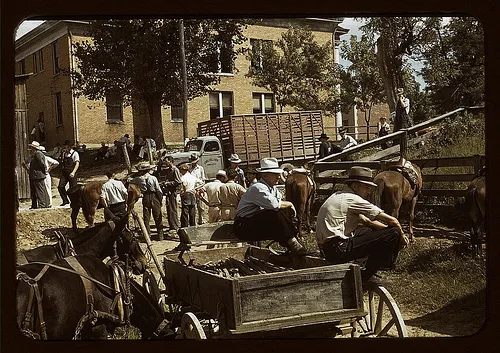 Charles Warner, who teaches at The New School in New York, and is the Goldenson Chair Emeritus at the University of Missouri School of Journalism, has an explanation at his Media Curmudgeon blog of Hillary Clinton’s wins in West Virginia and Kentucky:
I can’t imagine the folks in Appalachia grooving to iWilli’s “Yes We Can” video. They are probably watching re-runs of “I Love Lucy” on TV sets with rabbit-ear antennae and listening to “The Grand Ole Opry” on Saturday nights on WSM-AM radio - the king of Appalachia media.
And they more than likely won’t watch Obama’s inauguration speech, which is sure to be a humdinger. But I can imagine that the majority of Obama’s ardent young, post-racial, post-Appalachia supporters watching their president’s inauguration address on their computers - the media of choice of a new, young, educated generation – not the media of choice in Appalachia.
Revel in boring
 Craig Newmark is one of those people gutsy enough to “wing it” as a major college commencement speaker.
From the coverage I’ve read of his “change the world” speech to UC Berkeley graduates on Tuesday, he passed on at least one big idea, which likely will be ignored by most of the graduates, and several rules to live by that, while not novel, are worthy goals for people of any stage of life.
The big idea:
“It’s the boring stuff, the stuff we take for granted, that’s actually the important stuff.”
Another wacky idea to save journalism
Surely in an era of desperation and experimentation, the wacky idea of actually respecting your audience has to be worth a try by someone.
Many voices owned by few
Barry Diller on media consolidation:
“The conglomerates are like the Rothschilds funding both sides in the Napoleonic wars, They are on both sides of virtually every transaction.”
Fast, reliable and cheap is always in fashion
“We focus our strategies on delivering fundamental services better than anyone else. Technology changes. Competitors change. But 10 years from now, nobody’s going to say to us, We love what you do, but it’s too fast.’ Or It’s too reliable,’ or too cheap.’”
Quotable: It makes money, right?
There really is a lesson here, no matter how much journalists don’t want to hear it. A business model needs to support good journalism, but good journalism is not a business model.
Angry Journalist as career Yoda
What? Angry Journalist sees future in much-maligned industry for J-School grads?
Call it optimism tempered by realism, Yoda teaches careers in journalism.
Bryan Murley pointed me to a great piece on his Innovation in College Media blog by Kiyoshi Martinez, founder of Angry Journalist.
The piece is aimed at journalists trying to enter the work force and it’s good advice, damned good advice.
As I was reading it, however, I was thinking this is fantastic advice for students contemplating journalism as a major, a sort of this is what you are getting into and can look forward if this is the path you choose my little one.
And then it occurred it me it, this is great reading for people already working in journalism, this is what you haven’t thought about recently in terms of personal marketing and how journalism is changing.
Some tidbits:
“You ought to be able to explain why you’re taking the job you’re taking, why you’re making the investment you’re making, or whatever it may be. And if it can’t stand applying pencil to paper, you’d better think it through some more. And if you can’t write an intelligent answer to those questions, don’t do it.”
You might think you know journalism. It’s writing articles for a newspaper. Or shooting photographs. Or designing pages. Or maybe even that new media stuff people keep mentioning. Wrong. Those are skills.
With Google and Wikipedia you no longer have any excuse to be stupid. Ever. Have a question or curious about something? Type it into Google.
You might think you’re too young in your career to build a brand. Wrong. You need to start developing it now. Literally, your employer is purchasing your skills over someone else.
Stop blaming others. Maybe you wanted to start blogging for your college paper, but they’re too incompetent, lazy or slow to let that happen. Same goes for video. Or soundslides. So, you’re sitting around and doing nothing now. Screw them. Do it yourself.
Get a good idea about the publication’s strategy and vision – and not the bullshit one that they’ll spin you. What have they actually done?
If all you love is newspaper journalism, then you take the risk of it not loving you back.
The tipping point for change
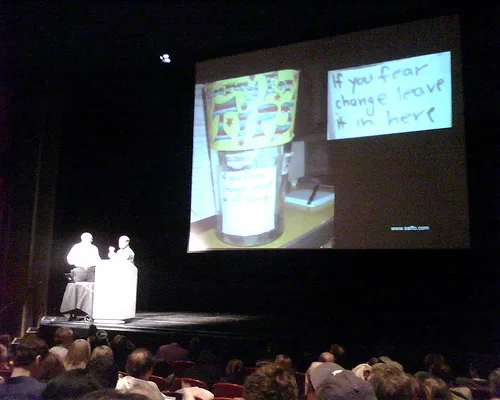 Stewart Brand recaps a talk by futurist Paul Saffo, a Stanford University professor who has spent more than 20 years looking at technological change and it practical impacts. Saffe spoke at a Jan. 11, 2008, seminar put on by The Long Now Foundation.
He outlined eight rules for forecasting the future. But what I liked was his closer. He had a photograph from a San Francisco cafe that had this tapped to a tip jar beside the cash register: “If you fear change leave it in here.”
Saffo’s eight rules of effective forecasting:
Rule: Wild cards sensitize us to surprise.
Rule: Change is never linear.
Rule: Look for indicators- things that don’t fit.
Rule: Look back twice as far.
Rule: Cherish failure. Preferably other people’s.
Rule: Be indifferent.
Rule: Assume you are wrong. And forecast often.
Rule: Embrace uncertainty.
(Steward Brand: Remember him … among his many firsts is this one I spotted in his bio and hadn’t heard before: first use of the term “personal computer” in a book, 1974. Seriously ahead of his time for decades!)
Thanksgiving tidings
Quotable: Glenn Reynolds in the act of blogging
Blackfive.net on Glenn Reynolds’ prodigious blogging in action:
… it has long been surmised that he chains law students to banks of computers like galley slaves and then blends up puppy smoothies to power his superhuman output capacity. Not true, he is actually a collection of Cray supercomputers housed in a remarkably affable and convincing human transport. Since this was the most self-referential event in history I sat next to Glenn and watched him take and upload some pics in reality and then watched them appear on my laptop at the same time, he did this while simultaneously conducting a video interview and cooking a chicken dinner.
Quotable: SacBee Editor
If you’re in a newsroom and the editor doesn’t say that change is needed, you should leave
Quotable Yelvington
Curley on institutional arrogance
Editors need to stop pining for the old world and intensify the leading to the new one,
The first thing that has to go is the attitude. Our institutional arrogance has done more to harm us than any portal.
On free, from Dilbert to Radiohead
“Free is more complicated than you’d think.”
Read to riches
Buried in Valleywag’s gloating over a tiny dip in print ad revenues at The Wall Street Journal was a more telling stat: The paper’s print readership went up 8 percent in the past year after its publishers cut subscription rates. Average income for the Journal’s two million-plus daily readers is around $200,000 a year, their average net worth over $2 million. Sixty percent are classified as “top management.” If the wantrepreneurs packing Web 2.0 don’t read the Journal, here’s another way to look at it: Maybe they should start.
And you’re getting a journalism degree?
FORBES CALLS JOURNALISTS an endangered species. It doesn’t have to be that way, though journalists seem to be doing their best to undermine their own profession.
Wondering what Jimmie Dale Gilmore is thinking
History tells us: convenience wins, hubris loses. “Who is going to want a shitty quality LP when these 78s sound so good? Who wants a hissy cassette when they have an awesome quadrophonic system? Who wants digitized music on discs now that we have Dolby on our cassettes? Who wants to listen to compressed audio on their computers?” ANSWER: EVERYONE. Convenience wins, hubris loses.
David Byrne’s crossing America
 Loved Talking Heads founder David Bryne’s descriptions of visiting Dollywood and Knoxville and heading to Memphis.
The road leading to Pigeon Forge is also the approach to Great Smokey Mountains National Park, and as there are no vendors allowed in the park, the approach roads tend to turn into a border town where all the forbidden pleasures can be indulged.
A bland infection
One reason papers are getting hammered is because they’re too bland and conservative in print. It appears that attitude has infected the part of the business in which they need to be innovating and leading. Evolve, for crying out loud–or die.
Repeat after me …
But get this straight: Just because a site has 100 million users, that doesn’t mean 100 million people see your ad. It’s not TV. Repeat: It’s not TV. The only people who will see your ad are the ones who see the page on which it appears. If you buy 10,000 impressions, aka eyeballs, you can buy them on a big site or a bunch of small sites, it doesn’t matter. Big brings no advantage other than convenience and it also brings some disadvantages like inefficiency and price. This is the essence of the change in the economic model of media. Post that on your wall and stare at it.
Your job is journalism, not container cargo
Stop calling everything “content”. It’s a bullshit word that the dot-commers started using back in the ’90s as a wrapper for everything that could be digitized and put online. It’s handy, but it masks and insults the true natures* of writing, journalism, photography, and the rest of what we still, blessedly (if adjectivally) call “editorial”. Your job is journalism, not container cargo.
-- Doc Searls (on advice to newspapers)
The Web reality
It’s like the web has now moved so close to reality now that we want reality to be more web-like.
Quality begats brand
“Those of us who care ought to be trying to make sure we create ways – and technologies – for ethical editors to maintain control of the content they are in charge of producing. Interactivity is a fabulous tool or it’s a catastrophic threat and a weapon of media credibility destruction. It’s our choice.”
It’s not the paper, stupid!
Another voice on the state of newspaper content
On polar bears
Designer extraordinaire Roger Black has designed, helped design or influenced the design of many of the newspapers, magazines and Web sites we use daily. In a blog post yesterday, he has some chilling words for newspaper managers:
Online Video: They saw this
Some views on the new Pew study on Video Online. On the sticky note write, “Here’s proof that there’s a Revolution happening.” -- David All
An elevator pitch in running shorts
| A funny Dave Morgan story. Tags: Dave Morgan | Tacoda | Real Media |
Riddle me this Batman
. . . I think news is a unique opportunity still. But what is happening is that everyone is cutting back individual news operations rather than partnering to ramp up. Consumers dont need more brands, they need more indepth reporting of more stories.
Quotable: Dead interest
… lots of folks are writing off (print) newspapers. But at this moment of their seeming weakness, relationships with them are paradoxically in very high demand among the Internet bellwethers.
Beyond the power of titans
On the changes wreaking havoc on the newspaper industry:
Complexity is maximal
America’s newspapers (like so many other institutions) are definitely in a phase transition right now – and, as physicists will tell you, this is where the really interesting stuff happens. In chaos theory, we’re on the turbulent edge, described as “a region between order and complete randomness or chaos, where the complexity is maximal.”
Some days …
From Merlin Mann on Twitter: hotdogsladies Some days I’m Dr. Frankenstein, and some days I’m The Monster, but most days I’m just a dim-witted villager with a torch and a farming tool. Tags: merlin mann
Welcome to Tennessee
| I love this one …. “Welcome to Tennessee, patron state of shootin’ stuff.” -- Bob Lee Swagger (Mark Wahlberg), in Shooter on arrival to Athens, Tenn. From this movie…. Click the play button to play (via Les Jones posted in on No Silence Here) Tags: Shooter | Mark Wahlberg | guns | Tennessee |
Dollars and sense
If Sam Zell is the future of the newspaper industry then the newspaper industry is dead–you heard it here first.
What I do
My nephew asked what I do for a living, and I told him I write e-mails.
Heard among the din
Some quotes to think about in the din on the death of newspapering:
Up and Twitting
A 23-point plan for riches
 My browsing early Monday morning stumbled upon this 23-point code of conduct that E.W. Scripps (1854-1926) wrote in an essay titled “Some Outlandish Rules for Making Money.” It holds up pretty well a century or later for thinking about innovation and entreprenuership. 1. Never spend as much money as you earn. The smaller your expenditures are in proportion to your earnings the sooner you will become rich. 2. It is more blessed to pay wages than to accept them. At least, it is more profitable. 3. Never do anything yourself that you can get someone else to do for you. The more things that someone else does for you the more time and energy you have to do those things which no one else can do for you. 4. Never do anything today that you can put off till tomorrow. There is always so much to do today that you should not waste your time and energy in doing anything today that can be put off till tomorrow. Most things that you do not have to do today are not worth doing at all. Tags: e.w. scripps My browsing early Monday morning stumbled upon this 23-point code of conduct that E.W. Scripps (1854-1926) wrote in an essay titled “Some Outlandish Rules for Making Money.” It holds up pretty well a century or later for thinking about innovation and entreprenuership. 1. Never spend as much money as you earn. The smaller your expenditures are in proportion to your earnings the sooner you will become rich. 2. It is more blessed to pay wages than to accept them. At least, it is more profitable. 3. Never do anything yourself that you can get someone else to do for you. The more things that someone else does for you the more time and energy you have to do those things which no one else can do for you. 4. Never do anything today that you can put off till tomorrow. There is always so much to do today that you should not waste your time and energy in doing anything today that can be put off till tomorrow. Most things that you do not have to do today are not worth doing at all. Tags: e.w. scripps |
business advice | entrepreneurs | entrepreneurial | innovation 5. Always buy, never sell. If you’ve got enough horse sense to become rich you know that it is better to run only one risk than two risks. You also know that just as likely as not the other fellow is smarter than you are and that whether you buy or sell, in each case you run the risk of getting the worst of the bargain. By adopting my rule you will diminish by one-half your chances of loss. 6. Never do anything, if you can help it that someone else is doing. Why compete with one person or many other persons in any occupation or line of business so long as it is possible for you to have a monopoly in some other field? 7. If circumstances compel you to pursue some occupation or to follow some line of business which is being pursued by some other person, then you do your work in some other way than that in which it is done by the other. There is always a good, better and best way. If you take the best way then the other fellow has no chance of competing with you. 8. Whatever you do once, whatever way you undertake to do a thing, don’t do the same thing again or don’t do the thing in the same way. If you know one way to do a thing you must know there is a better way to do the same thing. 9. If you’re succeeding in anything you are doing, don’t let anyone else know of your success, because if you do some other person will try to do the same thing and be your competitor. 10. When you become rich, as you will become rich if you follow my advice, don’t let anyone know it. General knowledge of your wealth will only attract the tax gatherer, and other hungry people will try to get away from you something they want and some-thing you want to keep. 11. One of the greatest assets any man can secure is a reputation for eccentricity. If you have a reputation of this kind you can do a lot of things. You can even do the things you want to do without attaching to yourself the enmity of others. Many an act which, if performed by an ordinary person, would arouse indignation, animosity and antagonism, can be per-formed by a man with a reputation for eccentricity with no other result than that of exciting mirth and perhaps pity. It is better to have the good will than the bad will, even of a dog. 12. Never hate anybody. Hatred is a useless expenditure of mental and nervous energy. Revenge costs much of energy and gains nothing. 13. When you find many people applauding you for what you do, and a few condemning, you can be certain that you are on the wrong course because you’re doing the things that fools approve of. When the crowd ridicules and scorns you, you can at least know one thing that it is at least possible that you are acting wisely. It is one of the instincts of men to covet applause. The wise man regulates his conduct rather by reason than by instinct. 14. It is far more important to learn what not to do than what to do. You can learn this invaluable lesson in two ways, the first of which and most inspired is by your own mistakes. The second is by observing the mistakes of others. Any man that learns all the things that he ought not to do cannot help doing the things he ought to do. 15. Posterity can never do anything for you. Therefore, you should invest nothing in posterity. Of course your heirs will quarrel over your estate, but that will be after you’re dead and why should you trouble your mind over things which you will never know anything about? 16. A man can do anything he wants to do in this world, at least if he wants to do it badly enough. Therefore, I say that any of you who want to become rich can become rich if you live long enough. 17. After what I have said it goes without further saying that you should save money. But no man can save himself rich. He can only make himself rich. Savings are capital. It is only by doing things that one learns how to do things. It is only the capitalist who handles capital that learns how to handle capital profitably. The more capital you have the more skillful you become as a capitalist. 18. Fools say that money makes money. I say that money does not make money. It is only men who make money. 19. There are two cardinal sins in the economic world: one is giving something for nothing, and the other is getting something for nothing. And the greater sin of these is getting something for nothing, or trying to do so. I really doubt if anyone ever does get some-thing for nothing. (Don’t marry a rich wife. Women are what they are. At best they are hard enough to get along with. They are always trying to make a man do something that he doesn’t want to do, and generally succeeding. When a woman is conscious of the fact that she has furnished all or any part of your capital, her influence over you will be so great as to be the worst handicap you can carry.) 20. If you’re a prospective heir of your father or some other relative, you should also consider that a handicap. I would advise you to refuse to be an heir. 21. Despise not the day of small things, but rather respect the small things. It is far easier to make a profit on a very small capital invested in any business than it is to make the same proportion of profit off of a large capital. It is true that after you have learned how to make a profit on a business that shows small capital, successively, as your capital grows, you learn how to handle it profitably. Then the time will come when the greater your capital becomes in this way the greater your pro-portion of profits on it should be. And, for an added reason, as your wealth and skill grow rapidly, your so-called necessary expenses grow much more slowly and in time cease to grow at all, so that beyond a certain limit all your income and added income becomes a surplus, constantly to be added to your capital. 22. It is far easier to make money than to spend it. As it becomes more and more difficult to spend money, you will spend less and less of it, and hence there will be more money to accumulate. 23. The hardest labor of all labor performed by man is that of thinking. If you have become rich, train your mind to hard thinking and hold it well in leash so that your thinking will all be with but one object in view, that of accumulating more wealth. -- from PowerHomeBiz.com and reprinted from The Book of Business Wisdom: Classic Writings by the Legends of Commerce and Industry (Book of Business Wisdom). While Wall Street finds newspaper chains today the dowdy dowagers of a vanishing day, I found it interesting (and heartening) that the Scripps essay was included in a section titled “Gunslingers and the Entrepreneurial Drive.” Sheepishly, I have to admit that in 23 years at an E.W. Scripps’ owned paper, I have never read a biographical book about the company namesake. I know a little of the lore and the legend, but I haven’t read much. Do anybody have a suggestion on a good biography? There are couple books about E.W. Scripps at Amazon. Then there is Pultizer Prize winning Vance Trimble’s The astonishing Mr. Scripps: the turbulent life of America’s penny press lord, which strangely doesn’t come up on a search for E.W. Scripps at Amazon. Or which is the best of the books E.W. Scripps wrote? Howard Weaver find good advice in Faith In My Star? Which of these are good? Are there ones I’ve just missed? |
Get in gear for the game
“But if you haven’t spent time trying to turn gears in the belly of the beast, it can be like trying to coach without ever having played the game. “
Innovation lies in yonder Mountain Dew
You might not have seen this. Bryan Murley has a new interview with online pioneer and “Hyper-Local Hero” Rob Curley. Bryan Murley is online news adviser and on the faculty of the Mass Communication Department at Emory & Henry College and is the webmaster of the Center for Innovation in College Media. Curley is Curley. As always, he’s dead-on in his thoughts. How to encourage innovation:
What readers really want to read
One of these days journalists are going to find out what people actually want to read. And that should scare the hell out of them.
A cycle of irrational negativity …
A superb line about the newspaper environment today … The spin on newspapers is … “A cycle of irrational negativity about their prospects.” -- Steve Yelvington Tags: newspapers
An expert quote
“He’s probably the leading expert in buying businesses he knows nothing about.”
The Web ad economy is ….
Web ad economy:
Lessons from a press baron of another era
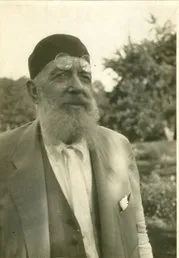 Howard Weaver, vice president for news for McClatchy, writes here he finds “continued refreshment in the words of E.W. Scripps.” Writiing in 1903, Scripps advised an editor …
It’s a human problem
Loved this quote from Dave Rand of Trend Micro in the story saying nine out of 10 emails are spam:
Hanlon’s Razor
Never attribute to malice that which can be adequately explained by stupidity.
Just do it better
I believe that in the future media companies will generate the bulk of their value from serving their ability to aggregate and serve audiences better than the competition. It doesn’t matter if the media company actually creates or even controls the content that draws them.
Here’s the Scoop …
Woody Allen is the newspaper of film directors: His audience is dying off.
Content rules
The number one thing that newspapers have is that a newspaper throws away more content in a day than Yahoo makes in a year.
It’s good to be a dumb blond
| Tags: Entrepreneurship | Brands |
Found this screensucking
| Tags: New Media | Web Usability A great line …. |
TV is becoming its own sitcom
When asked to name the top four TV networks, 4 out of every 5 people ages 16-18 could not name all four of the networks …. 1 out of every 3 people under 34 could not name ANY of these networks.
Good thought
“If you lose great people, you lose success. It’s that simple.”
If I had but one match
I liked this thought Forbes publisher Rich Karlgaard pointed out in a column last week.
P.R.: Spinning up trust
“P.R. plays much better in a world that lacks trust.”
I want to grow up to be a “Rocket Surgeon”
“It doesn’t take a rocket surgeon to know that arsenic is not good for you,” said Rep. Frank Niceley, the bill’s sponsor.
Flashing 12’s
OK, I don’t know where I’ve been, but I had never heard the above term until Wednesday when I was listening to Rob Walch’s talk on podcasting. But I love it. Walch is president of podCast411, Inc. He was speaking at the Newspaper Association of America’s CONNECTIONS Conference in Orlando. He’s written “Podcasting for Dummies.” The Urban Dictionary defines “Flashing 12’s pretty much the same way as Rob did:
More is …
 Noticed this quote in the November 2005 issue of “Fast Company.”
Nobody Does It Like Jack Lail.
So saith the The Advertising Slogan Generator. Fun! Click the link and see what slogan it can come up for your name. Saw this on Seth’s (Godin) Blog.
I’d venture to say …
“Most of them couldn’t have raised money with a gun, let alone a presentation.”
And the celebrating continues
The Lady Vols beat No. 1-ranked LSU to win their first SEC title in five years. Here’s what Coach Pat Head Summitt said:
Family
Times were harsh
My cousin, Amy Clark, won an essay writing award earlier this month for a piece based on an oral history recorded in the mid-1980s of my grandmother, Emma Stanley Edwards, and her sisters. Amy. an English professor, says the piece is part of a larger work she is tinkering with.
_… Pop pounced on her sister like a rabid cat, slicing at her back with muscled hands. Emma sprinted back to the house, screaming for her older sisters and brothers. Nancy Jane’s sons heard the commotion and saw the two women struggling up the lane. They wrangled Pop from their mother and chased her straight into thick, untamed woods, which swallowed her up.
_
What?
Cole’s pottery
 A Christmas present. a couple of pieces of pottery made at J.B. Cole Pottery. This was once the largest of the Seagrove, N.C., potteries, but has been closed for many years.
Delicious




A day golf’s Mike Strantz would have enjoyed
 I don’t play golf and I never met golf course designer Mike Strantz, but I think he would have had fun yesterday on a sunny day with a bit of crispness and trees still holding some gold fall color across the rolling landscape of Piedmont North Carolina.
The weather was splendid, the golf was good and the ribs, slow cooked for some three hours, were excellent.
The video shot nine years ago of the construction at Tot Hill Farm Golf Club shows a guy with a twinkle in his eye, a smile on his face and obviously loving what he is doing.
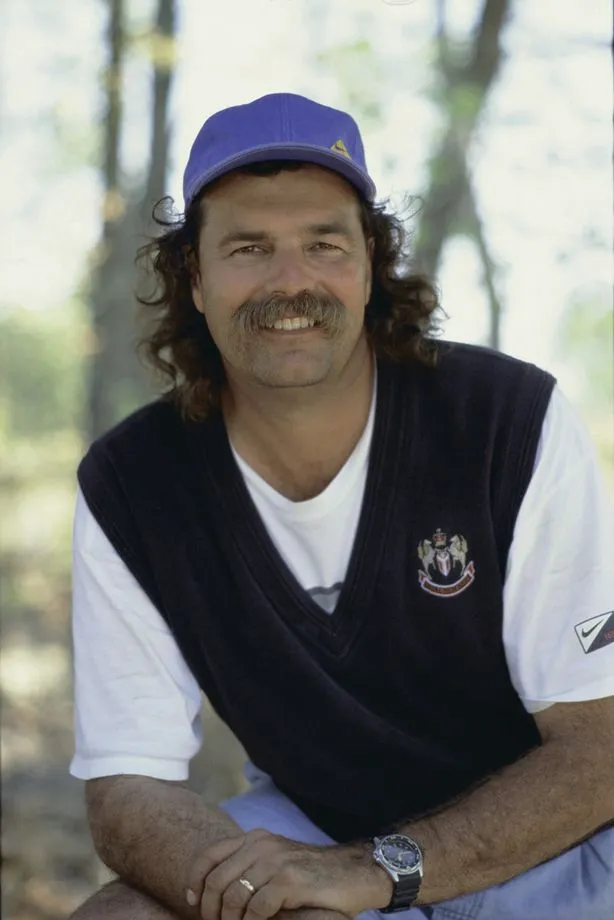 Strantz died at 50 of tongue cancer. By that time, he had become a hot talent in golf design known for challenging and controversial designs.
He began his career as a golf course designer with the famed Tom Fazio, but did a mere nine courses after going out on his own.
Two of the nine are in North Carolina, Tot Hill in Asheboro and Tobacco Road in the Sanford area. On Saturday, Tot Hill held the First Annual Mike Strantz Memorial Golf Tournament, attracting over 100 golfers.
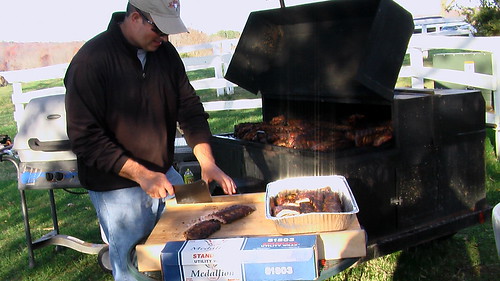 His dad was there. His two daughters were there. His wife, Heidi, spoke briefly about how the proceeds would help the Hollings Cancer Center of South Carolina, located on the campus of the Medical University of South Carolina in Charleston, S.C.
Strantz would have been proud.
(Mike Strantz photo from www.mikestrantzdesign.com. Somemore photos from Saturday.)
Jugtown vase

At the Celebration of Seagrove Potters on Friday night, I picked up this vase made by Travis Owens of Jugtown Pottery. Jugtown was recently featured on a PBS Craft in America show and Travis Owens is in that segment.
The Celebration continues through Sunday if you happen to be in Piedmont area of North Carolina. It’s in the former Luck’s Bean plant in Seagrove on N.C. 705 (also known as the NC Pottery Highway).
Halloween 2009
Halloween jack-o-lanterns this year. Hallowween decorations from earlier years.
Barn at the end of the road
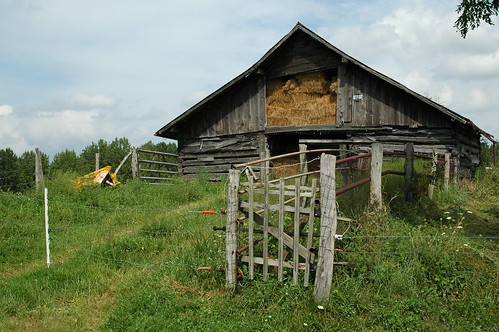
This is a barn at what was the Stanley family homeplace, where my grandmother grew up in Southwest Virginia. I took it, among others, during a Stanley Reunion this past Sunday at the Caney Fork Baptist Church. This is way back in the hills; here’s a map of the area.
Hydrangeas
I love hydrangeas and they were particularly pretty during our vacation on Chincoteague Island. Here are a few I photographed on Main Street and some info.
More beach ponies
Ponies on Assateague Island, Virginia. The annual Chincoteague Pony Swim is coming up July 29.
Patriotic … in the sense of citizen protest
 It looks very patriotic on the week of the Fourth of July, but I think it covered up a disputed sign on the side of the building of the Purple Pony.
(And because it’s the Fourth, some fireworks photos from a couple years ago.)
Assateague Island pony
 A wild pony on Assateague Island National Seashore. This foal and its mother were walking along and in the road that leads to the beach on the Virginia end of Assateague Island on Monday evening.
Here are a few more photos.
Birds at the beach


These photos were shot at dusk from the porch of the condo where we’re staying in Chincoteague Island, Va. On a nearby pier is a bar where a guy is playing guitar and singing Steve Miler’s “The Joker.”
Cause I’m a picker
I’m a grinner
I’m a lover
And I’m a sinner
I play my music in the sun.
I’m a joker
I’m a smoker
I’m a midnight toker
I get my loving on the run Wooo Woooo
Hands on Dobro
 My cousin Stanley Edwards playing the Dobro. More “hands on Dobro” photos.
Baseball season has begun

Baseball is called a sport of summer, but for high school (and college) teams, it starts in February. Bearden High School had a scrimmage Saturday with Catholic High. At least it was sunny, if a bit nippy in the wind.
**
Update:** By the time my night shift was ending, Knoxville was having a nasty mix of sleet and snow. That’s baseball season.
Cranberry crunch testing and tasting
 Early this morning I made some Cranberry Crunch to bring to the office (recipe below). I’m not sure where I got that recipe, but it meets my easy test.
I used the results to test how well the new Nokia N96
Cranberry Crunch
1 cup sugar
1 tbsp cornstarch
1/2 cup water
1 tsp vanilla
2 cups cranberries
1/2 cup raisins
1 cup oats
1 cup brown sugar
1/2 cup all purpose flour
1/3 cup butter
Combine sugar, cornstarch, water, vanilla, cranberries, and raisins. Boil over medium heat. Remove heat and simmer 5 minutes and cool
slightly.
Mix oats, brown sugar, flour and butter. Sprinkle 1/2 cup crumbs in bottom of greased 8” square pan. Spread cranberry filling. Top
with remaining crumbs. Bake at 350 F for 45 minutes.
Photo geek stuff
Camera: Nokia N96
Exposure: 0.083 sec (1302/15625)
Aperture: f/2.80078125
Focal Length: 5.2 mm
ISO Speed: 80
Flash: Flash did not fire, auto mode
X-Resolution: 300 dpi
Y-Resolution: 300 dpi
Software: Picasa 3.0
Date and Time: 2008:11:26 08:31:41
YCbCr Positioning: Centered
Date and Time (Original): 2008:11:26 08:31:41
Date and Time (Digitized): 2008:11:26 08:31:41
Shutter Speed: 35850/10000
Subject Distance: 421/1000
Metering Mode: Spot
Color Space: Uncalibrated
Exposure Index: 12/1
Custom Rendered: 1
Digital Zoom Ratio: 1/1
Contrast: Soft
Unique Image ID: 60fb6a5b2e58e62bacb9c32673829830
Compression: JPEG
By-Line (Author): Picasa 3.0
Image Width: 1936 pixels
Image Height: 1800 pixels
Happy day
Thursday was the college signing ceremony for our son, Mark, at his high school. We experimented a bit using a new Nokia N96
Stiff nerd at ballpark

Baseball Saturday night

Summer baseball
 Father’s Day was spent at the baseball field. Tennessee Copperheads won Silver Division by winning five of six games over the weekend. Mark is waiting on deck to bat. More on flickr.
The catcher
I took a lot of photos Sunday of Mark’s baseball games between the Tennessee Copperheads and the Brentwood Bulldogs. I even liked a few of them.
I’m not sure why, but the one above is one of my favorites.
A graduation message from Thomas Wolfe (and James Moeser)
 I had never heard the Thomas Wolfe quote that UNC Chancellor James Moeser used during the commencement ceremonies on Sunday and decided to email Lisa Katz, a university media contact, and the chancellor for a copy of his remarks. Both sent his remarks quickly! And many thanks.
The Yackty Yack is the UNC year book. Bonus: Slide show from The News & Observer. (Photo at right is of Thomas Wolfe and is from UNC University Libraries.)
Prepared remarks of Chancellor Moeser:
Graduates, we are coming to the end of this ceremony and we will soon go our separate ways.
I share your sense of nostalgia and your reluctance to let go of this place that we have come to love so much. I will always identify with the class of 2008, for I am graduating along with you.
Let me leave you with some words from Thomas Wolfe, class of 1920. Wolfe enjoyed enormous celebrity before his death in 1938. Two years later, his great novel appeared, bearing that memorable title: You Can’t Go Home Again.
Thomas Wolfe was right about many things, but he was wrong about that. Just before his own graduation from Carolina, Wolfe wrote the following lines for the 1920 Yackety Yack – thinking about himself and his classmates. I think he was thinking about us too.
” … But sometimes when the springtime comes,
And the sifting moonlight falls –
They’ll think again of this night here
And of these old brown walls,
Of while old well, and of old South
With bell’s deep booming tone,
They’ll think again of Chapel Hill and –
Thinking – come back home.”
Graduates, this is my charge to you (and to myself as well):
Let us heed the magic.
Take one more deep drink from the Old Well
Listen to the call.
Answer the bell.
And then, as often as we can, let us come back home again.
God bless you all, Tar Heel graduates!
Graduation day
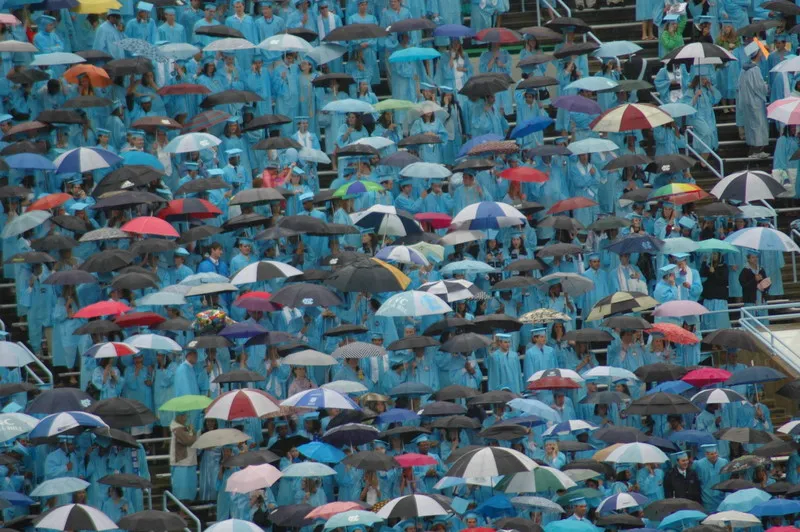
 We were in Chapel Hill over the weekend for the graduation of our son, Eric, who finished in four years and starts a new job next month in the Washington area. It was a good day for the family even if wet!
The usual two hour main commencement ceremonies at the University of North Carolina were blessedly cut short to about 20 minutes on a cool Sunday due to a steady rain in Chapel Hill.
We were in a dry spot under the upper deck on the visitor’s side of Kenan Stadium. Not all of the 15,000 there were so lucky.
Many of the students were wearing large “Eve” button on their Carolina blue gowns. The button was for Eve Carson, the 22-year-old senior class president who was found dead March 5 near the campus. She had been shot several times, including once in her right temple. Two men have been arrested in connection with her murder.
Because of the rain, UNC Chancellor James Moeser canceled most of the scheduled program including the commencement speaker (whose speech was posted online), Moeser, who received a degree himself, quoted Thomas Wolfe. Senior class president Ashley Shores did speak about Eve Carson. There were the sounds of James Taylor’s “Carolina in My Mind.”
We took photos around campus, did some shopping and had great lunch with the family of his girlfriend, Nikki Pisha, at the Carolina Brewery, where both worked. More photos.
HDR photos of Engel Stadium

Following up on my Saturday post, I took some HDR photos Sunday on Historic Engel Stadium in Chattanooga. My guess is rather than being restored, this baseball park will bulldozed at some point. The Bearden High School baseball team was playing in a tournament that was using the stadium as one of its playing sites.
This is a game photo. See the HDR photos of the stadium here. All but this one was taken before the game. A couple of them were taken from the catwalk beside the pressbox atop the stadium.
Sitting in baseball history
Made my first trip Friday to Chattanooga’s Engel Stadium, the word “historic” seems to have become part of its name although “weathered” might be more appropriate. With its unusual character and rich history, the facility deserves to be restored to its golden era glory. Hopefully, it will be before it’s lost
It’s a bit like what the new “Disneyland” major league parks aspire too in a updated, fanciful way with great sight lines and unique character. Here are some photos.
Constructed as the country was entering the Great Depression, it opened in 1930 as the home of the minor league club, the Chattanooga Lookouts, who quit playing there in 1999 for more modern digs.
Its most unusual feature as a minor league park was that it had the deepest center field in baseball history, 471 feet. Only Harmon Killebrew, it is said, hit a home run over the center marker. There’s shortening fence now.
It was an April in 1952 in Engel Stadium that blacks and whites first played in the same baseball game in Chattanooga. That game involved Jackie Robinson.
Perhaps the best known tale of the stadium is when a woman struck out both Babe Ruth and Lou Gehrig on an April day in 1931.
The woman was Virnett ‘Jackie’ Mitchell, a remarkable woman whose feat occurred when she was but 17. One newspaper speculated “maybe her curves were too much for them.” That day and Mitchell are quite a story.
Today the stadium is used for high school baseball games and I’ll be there Sunday for a less historic game.
Baseball time
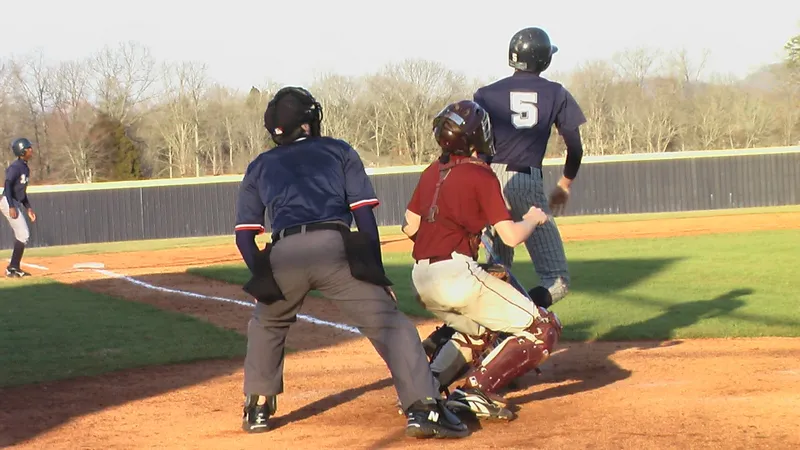
Can I go back to asleep now?
 Boots suffering through a photo while she wanted to be asleep on a Sunday afternoon. More photos here.
Sights and sounds
Quick tour of the 30th Annual Unicoi County Apple Festival in Erwin, Tennessee.
Not even few apples slows Apple Festival

Deer sighting
We saw some deer Sunday in Wolf Laurel as we were riding down to see the Buck House..
Sunrise at Wolf Laurel
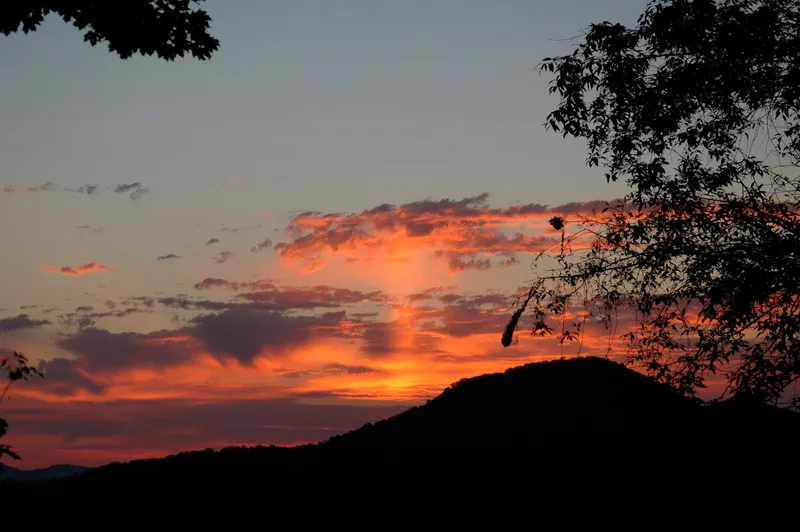
Morning in Madison County

Fireworks at the lake

HDR at Badin Lake

Ocracoke Island beaches, undoubtedly the best!
Dr. Beach says Ocracoke Island has the best beaches in the nation in his 2007 list. He’s right. It is an island of most wonderful beaches and a special place. We’ve been several times on family vacations. It was the first time a beach in Florida and Hawaii didn’t take the top spot, but Ocracoke has been in the Top Five the last two years. From an Associated Press story about Florida International University professor Stephen “Dr. Beach” Leatherman list this year::
Supersized is not better
| At the first of the week, my wife reserved a U-Haul truck to move some furniture from her sister’s house in Columbus, Ohio, to our son’s apartment in Chapel Hill, NC. She’d scheduled to pick up the U-Haul truck in Columbus. So early Saturday morning, she got a call that our U-Haul was at the Morse Road U-Haul in Columbus. When we got there, the 10-foot truck we had reserved was nowhere to be found; they had rented it to someone else despite having reserved it and despite having called about two hours earlier to say come pick it up. Instead – at the same cost – they gave us one more than double that size – 24 feet. We really didn’t have enough stuff to fill a 10-foot and now we have a 24-foot truck that is like one-eighth full. Tomororw, I’ll be driving a nearly empty big-honking U-Haul to down I-77 and I-40 to Chapel Hill. That’s quality for you: Supersized when you don’t need it. Tags: U-Haul | quality |
Rosslyn Chapel
| A visit to Rosslyn Chapel and the castle ruins during our vacation trip to Scotland. Tags: Scotland | Rosslyn Chapel | video |
Loch Ness
Scotland vacation cliips
Craigmillar Castle
| A video of Craigmillar Castle on the outskirts of Edinburgh in Scotland. Great castle to see. Tags: Scotland | Edinburgh | Craigmillar Castle | video |
Scotland vacation photos
| Vacation photos from Scotland taken by Mark Lail and Jack Lail. We were in Scotland from May 27 until June 2, 2007. Some HRD photos are here. Tags: Scotland | Loch Ness | Edinburgh | Rosslyn Chapel | Craigmillar Castle | photos |
A different look
| I tried to do some HDR photography while on vacation in Scotland last week. I’d say the results were mixed. I like the one above and there are some more here. HDR is “high dynamic range” imaging. I got interested in from looking at some stunning photos from Bob Benz, who pointed me in the right direction to learn about it and passed along a few tips. As a total neophyte, I had to learn some options on my camera I hadn’t used. I don’t have that all figured out yet. The biggest obstacle to overcome, however, was camera shake. I didn’t use a tripod with any of the ones I did. They would have worked a lot better had I had one. HDR involves taking bracketed exposures (I was trying to do three) and any movement of the camera makes the results very blurry or ghostly. In some of mine, I only used two photographs because three looked as if I had been drinking shots of Scottish whiskey between frames. I used Photmatix Pro to create the images. It’s very easy to use. Course, I’m a five-year-old flipping the switches at Mission Control. Simple! There are a number of guides and tutorials. I think I’ll try some of more. Tags: HDR |
high dynamic range photography | Scotland | Edinburgh |
Sucessful night out at the ballpark
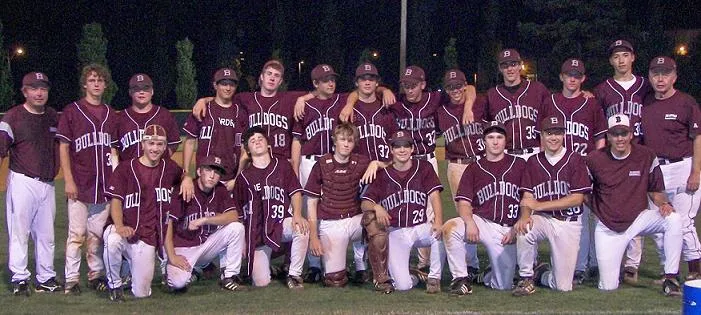 Delana Elmore photo The Bearden Junior Varsity Baseball team won the 2007 Oak Ridge Junior Varsity Tournament on Tuesday night. The Bearden team beat the Farragut Junior Varsity team 12-9 in the semifinals and beat the Farragut Freshman team 2-0 in the championship game. While the tournament involved teams from three or four counties, beating their utter arch rival Farragut in the semi-final and championship game was sweet for the players and parents (that would include me). I believe the regular season record for the team is 21-2. Earlier in the week, Knoxnews online producer did a feature on the JV and freshmen teams playing “beanbag baseball” at a senior center. See the video Tags: baseball Delana Elmore photo The Bearden Junior Varsity Baseball team won the 2007 Oak Ridge Junior Varsity Tournament on Tuesday night. The Bearden team beat the Farragut Junior Varsity team 12-9 in the semifinals and beat the Farragut Freshman team 2-0 in the championship game. While the tournament involved teams from three or four counties, beating their utter arch rival Farragut in the semi-final and championship game was sweet for the players and parents (that would include me). I believe the regular season record for the team is 21-2. Earlier in the week, Knoxnews online producer did a feature on the JV and freshmen teams playing “beanbag baseball” at a senior center. See the video Tags: baseball |
Bearden High School |
Snow flurries before baseball
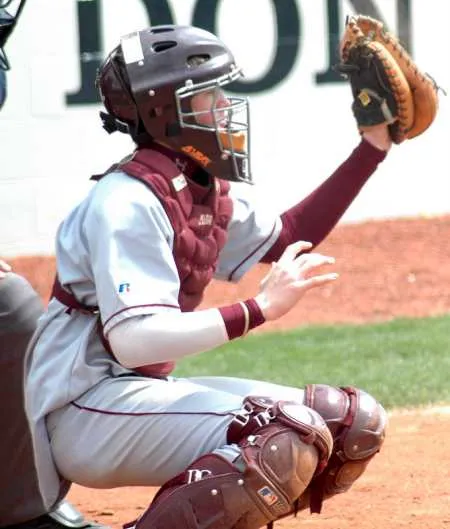

Mark catching …. and batting It was the coldest day of the season, no doubt. The Bearden JV team team Seymour 6-3. All parents survived (I think). It seemed cloudier and colder in Seymour than West Knoxville. Tags: baseball
Just got this card
 My cousin, Eddie Sudduth in North Carolina, emailed today this Christmas card of my grandparents, Hobert (1897-1973) and Emma (1903-1991) Edwards.I don’t know when this card was done, but it’s certainly more than three decades ago. Thanks for sharing!
Christmas 2006 slide show
 Decorations at the Lail household (done by Amy). See a slide show. Tags: Christmas photos
Pumpkin pie
 This looks just like Thanksgiving. My wife, Amy, made this beautiful pie. Can you smell it? More pumpkin cooking here and here Tags: pumpkin pie This looks just like Thanksgiving. My wife, Amy, made this beautiful pie. Can you smell it? More pumpkin cooking here and here Tags: pumpkin pie |
Thanksgiving |
Golf Tournament
 Golf Tournament The Bearden High School baseball team had their annual fundraising golf tournament at Dead Horse Lake on Sunday. Click on the photo to see more than 50 photos from the event. Tags: Bearden High School Golf Tournament The Bearden High School baseball team had their annual fundraising golf tournament at Dead Horse Lake on Sunday. Click on the photo to see more than 50 photos from the event. Tags: Bearden High School |
baseball | Bearden baseball team |
Apple Festival

There were tons of people in Erwin today for the Apple Festival. Lots of “country crafts” and you can basically eat your way from one end of town to the other. I recommend the fired apple pies. The festival continues on Saturday, Oct. 7. Nice fall chill in the air this morning, kind of like a chilled apple, but by mid-day, it was sunny, beautiful and mild. Suppoedly there are 300 booths (I certainly didn’t count them) and it attracts 90,000 people.
Drinking in a little family history
| I have discovered my great-grandfather was once the town policeman for Rock Creek, a tiny, incorporated town in Unicoi County, Tennessee, with an interesting, but brief history. My mother found somewhere recently a book called “Erwin, Tennessee, A Pictorial History, 1891-1929” by James A. Goforth (printed in 2004) and shared it with me. Erwin was – and remains – a small Appalachian mountain town whose fortunes were tied closely for many years with the fortunes of the railroad. One of the things Erwin is known for is the town that hung an elephant. Yes, an elephant. An elephant named “Murderous Mary” was hung in this very month (September) in 1916, but that’s another story and has nothing to do with my great-grandfather. My great-grandfather pops up in the book in a short section on the town of Rock Creek, which existed from 1898 to 1908. Its story goes like this: Tags: Tennessee |
Erwin | Unicoi | whiskey | Prohibition Rock Creek was the brainchild of William B. McNabb, an Erwin, Tennessee, area political and community leader who also happened to own a legal whiskey distillery on Rock Creek. Being an enterprising businessman, he wanted an additional outlet for his product, but saloons were only legal in municipalities. Not to worry. On May 7, 1898, the 33 residents of Rock Creek voted unanimously to incorporate the community as a town. By late November, the state had granted the charter. In due course a mayor and town board were elected, and lo and behold a license for a saloon was granted to McNabb. The saloon served as town hall and as the “Cave Bluff” post office. They had a certain decorum. Hats were removed and no drinks were served during town meetings. The town had one policeman and during seme of its history, my great-grandfather, Bill Edwards, was that policeman. Those that had a bit too much to drink at the saloon were locked up in a shack behind the saloon called the “calaboose.” It costs a $1.50 fine to get out and the fines were split between the mayor and policeman. Goforth notes that was the policeman’s only pay and the only source of income for the town. He was on a 100 percent commission plan! A photo in the book shows my great-grandfather with a bear cub on his lap sitting in a row of men, including McNabb, the town’s postmaster, a country doctor and a federal whiskey tax inspector. The bear cub was one of two McNabb (who is holding the other in a grainy photo in the book) bought off a hunter. They were a playful novelty at the saloon until they grew up to be “big, mean, aggressive bears, disrupting the community and terrorizing the inhabitants.” McNabb sold one to a man who divided it with his neighbors, leaving none for himself, and the other was sold to a Veterans Administrator Center and was a table delicacy. By Goforth’s account, the saloon was quite popular and attracted a varied clientele that included prominent area folks, but the prohibition movement brought it all to an end. Seeing the end coming, McNabb sold the saloon in 1907 to a North Carolina man and moved to Virginia. Today the saloon site at the corner of Rock Creek Road and East Erwin Road is home to a church. What happened to town of Rock Creek? It just disappeared. |
My birthday was all wet

Mark and I went rafting on the French Broad River in North Carolina for my birthday. We’re the two in the front. We went with French Broad Rafting Expeditions just outside Marshall, NC. We took an afternoon five-mile trip. It was fun. The day was beautiful. The water was cold. We didn’t fall out.
Visit to Biltmore
| We took a visit to Biltmore Estate on Sunday. Our boys had never been. Mark was the official photographer. Tags: Photos | Biltmore | Asheville |
A couple of photos from Mark
Here are a couple photos that Mark took while at his grandparents house in North Carolina. 

Photos](https://www.zoominfo.com)
Brent’s new house
 My brother Brent Lail discovers visitors have arrived at his new house in North Asheboro. (Click photo to see larger version.)
 Here Brent and his mom are hanging by his pool. He has a pool table as well. (Click photo for larger version.)
Vacation photos from Palm Beach
| Tags: Photos | Palm Beach Here’s a link to my vacation photos. |
Parasailing

Our son Eric and I went parasailing on Thursday. It was remarkably quiet up 500 feet or so and the ocean is very clear. Tags: Photo | Palm Beach | Vacation
Sunrise at Palm Beach Shores

One of a series of photos I took of sunrise on Wednesday while on vacation on Singer Island in the Palm Beach, Fl., area. Tags: Photo | Palm Beach | Vacation
Mark catches a fish
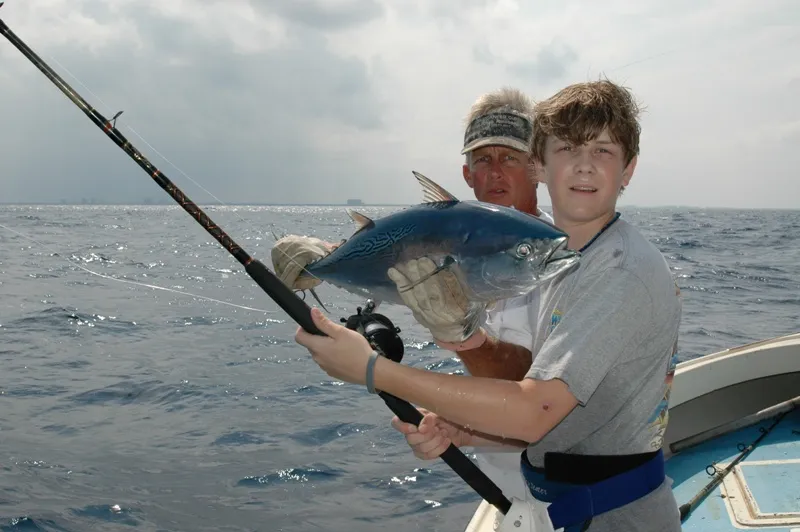 We went on a fishing charter during vacation and Mark caught a fish, a Bontiathat weighted maybe 12 pounds. I broke a reel and several got away when they went under the boat and cut the line. I did a catch a couple, but there are no photos. Only Mark has any evidence we caught anything! We released our catches. Our captain was John Peel, who was very knowledgeable and found the fish. One thing I didn’t know to ask, but would now is: How did he hook the domain name fishingpalmbeach.com? Seems like a good one.
Rainwater Ramsey Tales
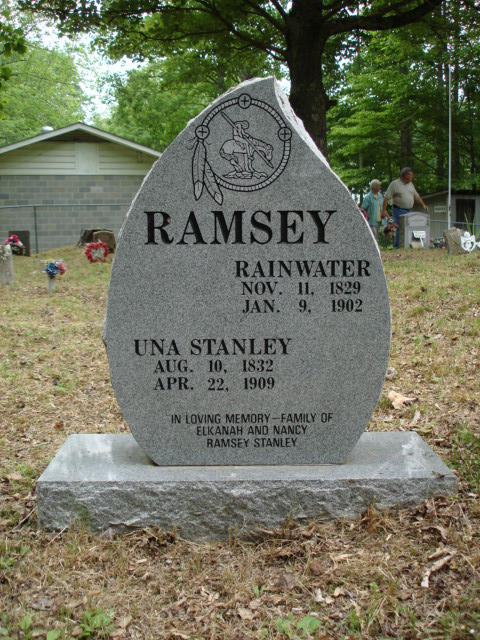 Rainwater Ramsey gravesite. Image via finadagrave.com and added by Roger Roop in 2007. Faded memories, stories that changed with the tellers . . . or just crumbled over time. I got a letter today from my mother with a clipping from a September 10, 2003, column in The Dickenson Sun/Cumberland Times. Columnist Anna Belcher was writing about my great-great-grandfather on my mother’s side the family, Rainwater Ramsey, who started his family on Ramsey Ridge in Dickenson County, Va. (The text of the article has been copied to a page on the “Find a Grave” website.) Dickenson County is a small county in mountainous country. There’s maybe 6,750 households. The three towns in the county are Clintwood, Haysi, and Clinchco. William Rainwater Ramsey was born Nov. 11, 1829 in Russell County, Virginia, and died Jan. 9, 1902 in McClure, Virginia in Dickenson County. (Russell County, one of the three counties that were carved up to create Dickenson County in 1880.) He married Universal “Una” Franklin in Clintwood, Virginia, in 1849. They had up to 17 children. They are buried at Caney Fork Church Cemetery on Ramsey’s Ridge in Dickesnon County. There seems to be records that he served as a private in the 21st Virginia Cavalry, Company E, of the Confederate Army. But he went AWOL at some point, not unusual for men from the mountains. He is said to be part Native American (Cherokee), but according to the DNA testing website 23andMe, I don’t have any Native American DNA and I know a cousin or two who have found the same. More fanciful than factual. A claim on Native American ancestry among people named Rainwater is common. Belcher said she was told he slept in a hollow log in front of the fireplace. and by another family that when he first came to the area, he lived in a hollow tree, “big enough for his horse, too!” Another account (Mrs. Olive Bentley in a history of Big Oak School in “School and Community History of Dickenson County” edited by Dennis Reedy, 1992) said Ramsey “wintered a mule and two calves in the hollow of the oak.” He built his home, the first on the ridge and the ridge was supposedly named for him. The home had four rooms, two downstairs and two upstairs. It lacks the lacks the intrigue of the The Da Vinci Code, but for far different reasons, it’s a family tale has its own share of mysteries. (The photo of the headstone was taken by Roger Roop on Oct. 2, 2005, on Ramsey Ridge, Va. An older headstone is beside it. The photo of William Rainwater Ramsey and Universal Franklin Ramsey is the most common photo of the couple on genealogy sites, but I don’t know the original source of the photo. It has been retouched to improve the quality and enlarged.) Updated on Dec. 1, 2023.
It seemed so simple
 Our 15-year-old wanted to put the PS2 on the Net and shelled out his own bucks for the $30 Internet Adapter that attaches to the Sony box. Course, then he realized that wasn’t all he needed to connect to a wireless network. He hit dad up for a “wireless gaming adapter” … the only one the sales associate at Best Buy offered up was the $100 D-Link DGL-3420. Geez, but we’ve come this far. (It would be nice if the PlayStation could use one of those USB wireless adapters, but alas.) Running the wizard and configuring the little black box with three blue lights seemed like a snap. Only problem was, my router didn’t see it unless it was directly attached to it with cable. Duh! I gave the reset button on the back (which you punch with a straightened paperclip) the 10,000-mile test drive in a single evening. After a couple hours of frustration, I bagged it for the night, grumbling. Early this morning, I gave D-Link support a call (yes, they have 24-hour live support) and got a tech who guided me through the step I missed – and wasn’t covered in the manual. …. Drum roll…. Connectivity! Some configuration and registration screens with the PlayStation and then with EA Sports and it was mission accomplished. Was it worth it dollars lighter and hours later? My son reports: “IT’S AWESOME.” A spring break diversion. Go figure. So now I have a home network connected to Comcast’s broadband service with two desktops, a laptop (two laptops when Eric is home), two Tivos, a printer, a Mirra Personal Servier (does backups) and up to two Sony PSPs.
Waxing Gibbous over Lenior City

Saturday was a great day to be outside and I took this photo while at the baseball field at Lenoir City High School (see previous blog entry). It is, I learned, the moon in the Waxing Gibbous phase (an almost full phase). The full moon is about three days away. I used the “tint effect” in Picasa2 to emphasis it a bit in a way I like. It was a nice temperature for early in March to catch a baseball game. The temperature was about 75 when I got there and cooled down to maybe 70 when I left after the second game. Course the forecast says we’re headed for rain and cold temperatures again by Tuesday.
Baseball time

It’s baseball time!. The Bearden JV squad played a tournament in Lenoir City on Friday night and Saturday evening.. Of their three games, they lost, tied and won. Mark got a double on this hti in the final game.
Christmas decorating

Reunion photos added
I have added some photos from the reunion.
Don’s birthday and Lail reunion
The Lail family had a birthday party/reunion Saturday at Mt. Bethel United Methodist Church in the Bethlehem community near Hickory, NC. It was uncle Don Lail’s birthday (11/25/1925) birthday and the whole Virginia clan (which I hadn’t seen in many, many years … most of my cousins’ children I had never met).  As is usual with these rare affairs, there was a lot of eating … and some drinking ….
And that lead to some finger pointing …. 
 And finally to things like this ….
 However, everyone went home happy with cool T-Shirts (courtesy of Donnie). … I’ll post some photos later.
Mark’s 15th birthday
 Here are some photos from Mark’s 15th birthday.
Halloween 2005

Quick trip to North Carolina
Made a quick tirp to North Carolina on Thursday My dad received theOrder of the Long Leaf Pine from the State of North Carolina at a meeting of the board of Randolph Community College. It was a great event. State lawmakers Arthur Willaims, Harold Brubaker, Arlie Culp and Jerry Tillman spoke. Kathi Keys did a nice story. The award typically honors a career of public service to the people or North Carolina and is bestowed by the governor. Other recipients include Dr. Billy Graham, Maya Angelou, Charles Kuralt and William Friday. It’s quite an honor. The proclamation from the governor says the member of the “Order of the Long Leaf Pine” may make this toast anywhere in the “free world.” _
Reunion Saturday
We had the Stanley Family Reunion on Saturday in Wolf Laurel. It was nice weather and about 40 people were there. Everybody seemed to have a good time. See some photos. And see the reunion site.
Angst at 50
I didn’t mention this here when it happened … I didn’t want to dwell on it. I turned 50 on the 16th. It sounds old; it doesn’t feel that way. Thirty was OK, 40 was OK. …. 50 … hmmm … not so OK. I’m not really buying “50 is the new 30.” jingle phrase … 60 is the new 40 and if you’re in you’re 30s, you’re in your teens! I’m not sure who first used that phrase: Let’s blame Oprah. Who knows, maybe she never said it, but Billy Bob has.
Sunset at Badin Lake
We went for a boat ride on Badin Lake on Saturday near sunset….

(click to see a larger version)
No cable, No Net, No fun
A cable repairman managed to cut off our cable service Friday afternoon while repairing a neighbor’s service. It took Comcast until Saturday evening to get another repair guy out to repair the damage of the first “repair guy.” I don’t know exactly what happened, but I now have an orange cable running around my yard now because they couldn’t find the one that was connected to my house and working fine until the first cable guy arrived. And my neighbor has a white cable running from the cable box at the corner of my yard across the street to their house. And while I’m on my mini-rant about Comcast: They need some serious work on their customer service folks. The second repair guy was a lot better for the company’s PR than any of the customer service folks we dealt with. Back at the NAA Connections Conference earlier this year in Dallas, I listened with some amusement to a session on a Yahoo experiment where people had to give up the Internet and video tape how it went. It was funny how they went from this “will be no sweat” to “just let it end” – until it briefly happened to me. It’s like when the power goes out, except you don’t need candles. Barely three channels of over-the-air TV (my wife Amy said it got so bad, she watched GOLF), no e-mail, no IM, no checking the Web, no working from home. It makes one realize how pervasive the Internet has become. Amy told our 15-year-old Mark, it was like living in the 70s. He said it was boring: Imagine life without ESPN Sportscenter and IM. Our 20-year-old said, fine, he was spending the night at a friend’s house. We survived, but just barely. Did we do any of those things we never have time for because we’re surfing, e-mailing and vegging in front of the TV. Nope.
England vacation photos
Off on vacation
We’re off to London for a week. It should be an adventure!
Stanley Family Reunion blog site
I’ve created a blog site for the Stanley Family Reunion in October. My cousin Richard has already posted a [ on the initial entry.
Baseball season is here
 The Knox Sox were in a tournament in Farragut this weekend. Friday, there were snow flurries and a cold game. Satruday was a much better day: sunny, mild and two wins. (click on the photo to see a larger version)
Will Sudduth (2/27/1925-2/23/2005)
I went to my Uncle Will’s funeral Saturday in Hickory, N.C.
(William Sudduth, 2/25/1995 - 2/23/2005, a native of Coila, Miss., who lived nearly all his adult life on Snow Creek Road in Hickory in a house I spent many hours in as a child.)
Adversity is a mean teacher
The reason why media (and news) job cuts are the lowest in years
Media and news job cuts this year are expected to hit the lowest level since at least 2008, according to data from Challenger Gray & Christmas reported by the Axios Media Trends newsletter.
Post-Pandemic: Return to normal after COVID-19 pandemic unlikely
As more American get COVID-19 vaccinations, people are looking forward to a “return to normal”; visiting relatives, eating in restaurants, nightlife and concerts, and even casual shopping in a store.
Warren Buffett on the state of newspapers
“… we haven’t been able to solve it …”
The music business is back; are there clues for news?
The music business has been growing for the last few years after going into a decline in 1999. And it doesn’t have to do with buying MP3s. The news and music industries have long been compared; they were disrupted by the Internet at about the same time and forever changed. Are there still lessons to be learned between the two industries. Would a “Spotify model” work for news? Some efforts have been tried and failed from traditional media companies, the tech powers that control the platforms and entrepreneurial startups.
Google introducing new subscription tool for publishers
Maybe Google and Facebook need publishers after all? From Bloomberg:
Newspaper paywalls by the numbers
View from the executive suite: 20-somethings will turn to newspapers
10 keys to newsroom transformation
Steve Buttry, a longtime digital pioneer, agent provocateur for newsroom change and currently the Lamar Family Visiting Scholar at Louisiana State University, has done a series of blog posts over the past week on the “Four Platform Newsroom” effort of the former Scripps newspapers.
Working with the Knight Digital Media Center at the University of Southern California at Annenberg, the “Four Platform” program set out to “transform” the newsrooms of the 13 newspapers then owned by E.W. Scripps and now known as the “Baker’s Dozen Newspapers” of the Journal Media Group.
Evolving is a painful process

The weight of establishment and tradition
A great piece from Om Malik on media. There’s lot of food for thought in this piece.
Pushing the reset button in the newsroom
The model just went away
“The disruption was fundamental. Knight Ridder saw it earliest, experimented the most, worked the hardest - and it doesn’t exist anymore. Their top budget (for innovation) was $1 million - which doesn’t amount to the sushi budget in Google’s cafeteria.”
Journalists: There’s not a less risk-taking crowd
“It’s just that journalists have to get more creative and entrepreneurial. And, I think, that’s the problem. There’s not a less risk-taking crowd than a bunch of journalists who like to tell everyone how to run their businesses,” said Kara Swisher of All Things D.
Does the audience even need journalists … or photojournalists?
Quick, who’s a complacent monopolist?
The Economist called Kodak a “complacent monopolist.” Does that sound like any other company you know … or maybe an industry?
Paid content on iPads: Mistaking a rerun for a ‘do over’

Arbiters of our future
An effort I’m involved with at E.W. Scripps to have editors and online directors redefine the company’s strategies and to hire 40 paid interns across the company to help free us a bit from the day-to-day demands so we will have the time to take a penetrating look at what the company’s newspapers need to do to grow a future, and then do it, is getting some attention, perhaps, did I detect, praise.
Ken Doctor, a news industry analyst and author of “Newsonomics: Twelve New Trends That Will Shape the News You Get
For newspaper companies, it’s time to re-start the engines. One big question is how. One somewhat new answer is coming, in differing flavors, from companies like Scripps, Journal Register and Hearst. Each is newly trying to involve its staffs in charting new directions for the news companies. … Scripps’ effort, being formally announced tomorrow, is the most ambitious in scope.
I like the energy of the Scripps effort and what appears to be happening at Journal Register. Cultural change is a prerequisite for companies truly aiming to make a transition to operations that at least think digital first.
Bringing in a raft of new talent – and hoping to keep some of it after the internships are over – is a good step, almost Patch-like, in harnessing the passion of younger journalists, unhindered by the past, and ready to grab the digital future.
Just ask: “What would Ben Franklin do?”
Journal Register declares independence from “old way of thinking about how we do business.” https://bit.ly/duu4J4Sun Jul 04 16:15:22 via TweetDeck Jim MacMillan
JimMacMillan
Ruminations on news
Blogger and professor Jeff Jarvis, Steve Coll, former managing editor of the Washington Post and of the New America Foundation, and John Sturm of the Newspaper Association of America on the future of news.
(viaBuzzMachine)
Possibly related articles by Zemanta
Where journalism gets reinvented
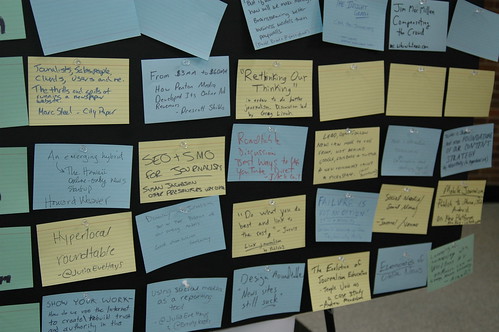
25 ways to save newspapers
I’ve even tried No. 12, and I’ve heard some that should have made this list seriously suggested in brainstorming meetings.
Make it a talker
I want to give you more, not less. I don’t think McDonalds will assume that as long as you keep it in a yellow box, people will buy a smaller, drier Big Mac. Yet our industry seems to think people are so obligated to buy it, we can make something smaller and drier and people will still buy it. It’s crazy. You have to create something that, whatever’s in it, people in town are all going to be talking about. That’s the edge that we’ve lost.
Newspapers used to be seen as a utility. People used to ask, “Do you take the newspaper?” What we have to produce now is a product backed by marketing strategies that compels people to buy the product. It has to be of great value.
Burn the boats?
Here are some excerpts from an Eric Schonfeld post on TechCrunch about an interview with Marc Andreessen.
Andreessen is the guy who co-authored the early Web browser, Mosaic, which later became the Netscape browser. He co-founded Ning.com and is investor in a slew of other Internet companies, including Digg and Twitter.
The “burn the boats” reference refers to an action Hernando Cortes ordered when he came to the New World. Andreessen’s advice to traditional media companies, ironically, comes at a time when their boats are floating higher. The stocks of several have been on the rise, a few are at 52-week highs, driven by cost-cutting and an improvement in what had been anticipated in the ad market. But the view isn’t particularly new for him; he’s said as much a year ago.
From Schonfeld:
We got to talking about how media companies are handling the digital disruption of the Internet when he brought up the Cortes analogy. In particular, he was talking about print media such as newspapers and magazines, and his longstanding recommendation that they should shut down their print editions and embrace the Web wholeheartedly. “You gotta burn the boats,” he told me, “you gotta commit.” His point is that if traditional media companies don’t burn their own boats, somebody else will.
Andreessen asked me if TechCrunch is working on an iPad app or planning on putting up a paywall. I gave him a blank stare. He laughed and noted that none of the newer Web publications (he’s an investor in the Business Insider) are either. ““All the new companies are not spending a nanosecond on the iPad or thinking of ways to charge for content. The older companies, that is all they are thinking about.”
Talking about paywalls and paid apps is like saying, “We know where the market is and we are not going to go there.” Print newspapers and magazines will never get there, he argues, until they burn the boats and shut down their print operations. Yes, there are still a lot of people and money in those boats–billions of dollars in revenue in some cases. “At risk is 80% of revenues and headcount,” Andreessen acknowledges, “but shift happens.” You’d have to be crazy to burn the boats. Crazy like Cortes.
Freeze-frame of the race for change
Here is a link to a piece I wrote for the “Convergence Newsletter” of the Newsplex at the University of South Carolina. in the issue introduction, editor Matt McColl writes:
In looking at the newsrooms of 10 or 20 years ago and those of today, the comparisons are staggering. The process of making, gathering, buying and selling the news has changed dramatically, with everything from massive layoffs to totally integrated newsrooms.
This month, Jack Lail, the Knoxville News Sentinel’s news innovation director, gives a firsthand account of his newsroom’s evolution and the mental and emotional strains that came with it. Lail also analyzes how the Sentinel’s staff has measured the effectiveness of its efforts.
All newspapers need to do is ban cell phones
Those who are particularly likely to read news in a printed version of their local paper on a typical day include: whites, those over age 50, and people who do not own cell phones
Managing change in local media
Evansville Courier-Press Editor Mizell Stewart III discusses the need to communicate change at a February Mid-America Press Institute workshop.on “Innovation: Managing Change.” There is more at mpinews.wordpress.com, including Steve Buttry on Twitter in the newsroom.
On Friday, the Talk stops
 One of the pioneering efforts in new ways to deliver news and connect with audiences in Tennessee (and the country) is “going dark”
WKRN-TV’s “Nashville is Talking” Web site, termed a “quaint reminder” of days gone by shuts down on Friday.
On the Web site WKRN general manager Gwen Kinsey writes:
NIT in its infancy introduced individual blogging to our mass media vehicle. The site generated buzz, a fair amount of regular readers and a provocative discussion about what role new media might play in the future of mainstream media. It was fun and it was messy. Our community’s level of sophistication with social media has taken off. NIT is a quaint reminder of how we all got started. Now, we find ourselves using Twitter, Facebook and live streaming to enhance our connections with our viewers in ways that blogs do less and less. It’s time to move on.
As of this Friday, NIT will go dark.
From gatekeeper to “sense-maker”
Tom Rosenstiel, director of the Pew Research Center’s Project for Excellence in Journalism, discusses the future of journalism. The gatekeeper role may be gone, but there are other roles for the Press to play, like “sense-maker.” (via Reportr.net)
And you wonder about what’s wrong with newspapers
Seth Resler found the newspaper itself a barrier to advertising. And the sad truth is, he could repeat experience in many cities. A tale of #fail.
Running the numbers
We journalist types typically eschew focus groups and market research about news coverage, saying we know what a news story is and we don’t need no stinkin’ survey to figure it out. But we are learning to measure … and are finding it useful even if we put away our pica poles long ago.
In an excerpt from his forthcoming book Journalism Next , Mark Briggs has this about the News Sentinel’s Tom Chester:
Tom Chester, news operations manager at the News-Sentinel, begins each weekday with a stand-up meeting in the newsroom. The first item on the agenda is a detailed report of content published and traffic generated the previous day. “We track updates on all platforms: web, mobile, email,” Chester said. “We started with almost nothing and now we’re up to about 500 updates per week.”
If newsroom leaders had simply announced at a staff meeting the need to learn new skills and publish more frequently to more platforms, little progress would have been made. Instead, the formerly print-centric newsroom - which has also published 3,000 videos since 2006 - has the structure in place to measure and manage the new content, the newsroom was able to show significant progress and build upon its successes.
A short movie trailer on journalism
 Mindy McAdams on how mainstream media is much like a movie theater of her youth.
It’s like the movie theater in the small town where I grew up. A small, family-owned theater, it only played second-run movies. It was open only on Friday and Saturday. There was one screen, and one new movie each week. From the time I was 9 or 10 years old, I went to that theater every week, no matter what was playing. I had very little access to movies otherwise.
Today I have Netflix, BitTorrent, and hundreds of cable TV channels.
The family closed that movie theater back in the early days of the VCR.
Local video content sharing continuing to spread
Pooling video resources among competing TV stations has come to Dallas. Barry Shlachter of the Fort Worth Star-Telegram takes a look a month into local video sharing in that market Participating are Fox’s KDFW, NBC’s KXAS and Tribune Co.’s KDAF. (KDFW and KXAS also agreed in January to share a helicopter.)
“Three or four years ago, they didn’t need to” share resources, said Phyllis Slocum, a former TV reporter who now teaches journalism at the University of North Texas in Denton.
“But the economic downturn has reduced advertising income. Remember all those new car commercials? Where are they now?”
“What’s new is that they are doing it full-time within the market,” said Harry A. Jessell, an ex-TV journalist who is editor and co-publisher of an industry Web site, tvnewsday.com. “This must run against the grain of many broadcasters, who have been fiercely competitive.
“They say this is going to free up resources for more enterprise reporting. They’ll probably just do more with fewer people. Everyone’s looking for ways to save. We had this helicopter ‘arms race’ between local stations, and now they are starting to share.”
Pooling resources
A counter-intuitive list of opportunities for newspapers
Decentralized processes are counter-intuitive. Having a single institution promise to cover “all the news that’s fit to print” seems more reliable than having a bunch of random bloggers cover the news in an uncoordinated fashion. The problem is that, in reality, newspapers are neither as comprehensive nor as reliable as they like to pretend. Just as a few dozen professionals at Britannica couldn’t produce an encyclopedia that was anywhere near as comprehensive as the amateur-driven Wikipedia, so a few thousand newspaper reporters can’t possibly to cover the news as thoroughly as millions of Internet-empowered individuals can. This isn’t to disparage the reporters and editors, who tend to be smart and dedicated. It’s just that they’re vastly outnumbered.
I thought I’d share this
The informal agreement among several Tennessee newspapers to share content as well as some ideas on how to carry it beyond that is getting a good bit of attention. Editor & Publisher also is coming out with a “major feature” on content sharing this week which will be interesting to see.
Kent Flanagan, Jay Rosen and Jeff Jarvis are thinking about ways newspapers can take content sharing beyond newspapers. Interesting stuff; interesting times.
Here;s what is being said. (Know of one I missed, send me a link to jack @ jacklail.com.)
Newspapers sharing content in Tennessee
There hasn’t been much buzz on this, but the Memphis Flyer has a story.
This expands upon the content sharing newspapers have done through the Associated Press for years. While still very early in the arrangement, the timing … er … the economy … appears right for this Internet twist of an innovation to succeed.
The sharing is possible in large part because each paper’s Web site is publicly accessible, making sharing an efficient cut-and-paste task.
Not that many months ago, just having a meeting on an idea like this would have problematic.
Forfeiting the Fourth Estate
By one estimate, a third of all US newspapers could be bankrupt by the summer. Last November, a study presented to US newspaper executives found that only one major publishing company, EW Scripps, was on a sound financial footing. And since November, the economic crisis has only deepened. But, one might ask, if a swathe of papers just vanishes - so what? After all, there’s always the internet and local television to provide the news. In the huge but fragmented media market of the US, however, it’s not so simple. Those romantic titles may be a throwback to a happier past, but their message is as relevant as it ever was.
Local newspapers are still the main source of news about the towns and cities where they are published. If anyone’s keeping them honest at City Hall or in the governor’s office, it’s the local papers, with their man covering the mayor’s office and their staffer on the police beat, doing the reporting on which everyone else feeds. Without them, entire cities might vanish off the national news radar screen.
Maybe there is something to this Internet thing after all
News Sentinel editor Jack McElroy on “Paying for newsroom with online ads.”
Veteran TV exec sees cuts in newscasts and newspaper home delivery in TN
Some predictions for 2009 from MIke Sechrist, a broadcast veteran and now entrepreneur.
I would not be surprised if the Tennessean cuts back on home delivery as a number of papers have already. I would not be surprised if one or two local TV stations cut back to one or two newscasts a day. And it would not surprise me at all if the FCC takes another look at ‘convergence’ letting one company own a newspaper and possibly multiple TV stations in one market.
I feel smarter already

(Hat tip to Paul Abraham)
The void will be filled
One could quibble with Andrew Sullivan’s facts and figures and even his prediction that newspapers will nearly vanish from your hands while you’re reading their pages, but he’s got the trend line and the economic riddle mostly right, I think:
To give my own example: I started blogging eight years ago. My once quirky blog, born in time to cover the 2000 election campaign, has steadily grown in traffic over the years, but this year, with the election campaign and a media revolution, it went into the stratosphere. In October last year my blog got 3.5m page views; in October this year it had 23m page views. The story of the campaign, in other words, did find a readership (and page views of big online papers soared as well). The growth just didn’t occur in newsprint, and the next generation of readers - those now under 30 - barely knows what a newspaper is.
Now compare my little bog’s traffic with The Baltimore Sun, a big metropolitan paper with a long history and great reputation, featured most recently in the HBO series The Wire. It had 17.5m page views in October; The Dallas Morning News got 12m; The Atlanta Journal-Constitution got 14m. The operation largely run out of my spare room reached many more online readers than some of the biggest and most loss-making papers in the country. The economics are remorseless: as news goes online, the economic model for papers cannot survive. If advertising follows page views, the game will shortly be over.
Newspaper execs: This is not a fire drill
Industry execs convene to discuss crisis.
Some suggestions offered to the attendees:
- Act like an entrepreneur; stop thinking first about why a new approach won’t work.
- Create a portfolio of initiatives; recognize that some will fail and kill those quickly.
- Don’t wait for every data point before taking action. “Ready, fire, aim” should be the operating principle, Shein said.
- Use downsizing as a tool when necessary to achieve a larger strategy, not simply as a cost-cutting goal.
- Figure out how to leverage core competencies into new directions and new niches.
- Be honest with employees, and get ideas from those on the front lines.
- Don’t sit and cower and weep about your problems. Inspire.
- Collaborate with outside entities that can bring expertise or resources.
- Pay attention to, and leverage, the brand.
Too late to get off bare-knuckle economic ride
From conglomerates to internet ventures, executives should be planning now on a decline of up to 40% in advertising spending during this cycle. Instead they’re sleepwalking into economic extinction–even those lean online ventures which were supposed to take up the mantle and preserve New York’s position as a media capital.
Designing the newsroom of the future isn’t fun
Thoughts on building a newsroom of the future from ground up. Both of these snippets are thoughts from a workshop at the New Business Models for News Summit at CUNY last month. No easy decisions … What would your plan look like?
At last week’s New Business Models for News Summit, I was in a group charged with creating a hypothetical newsroom budget with no real guidance on what it would produce. After much debate about whether this hypothetical newsroom still had to produce a newspaper or just an online news site, we decided it would be the newsroom left standing after a major metropolitan newspaper stopped publishing in print. We quickly realized that we’d need to reduce the size of the newsroom from 200 to about 35, given the revenue we could expect from this hypothetical site generating 75 million pageviews a month. A sobering thought. And none of the budget was allocated to creating a news product that might appeal to former newspaper readers. In fact, it seemed to be a given that newspaper sites spend too much time on design and should just be turning out content on basic blogging platforms.
What would Mark Andreessen do?
Marc Andreessen, founder of Netscape and now hanging out at Ning.com, in the November issue of Portfolio:
If you were running the New York Times, what would you do?
Shut off the print edition right now. You’ve got to play offense. You’ve got to do what Intel did in ‘85 when it was getting killed by the Japanese in memory chips, which was its dominant business. And it famously killed the business–shut it off and focused on its much smaller business, microprocessors, because that was going to be the market of the future. And the minute Intel got out of playing defense and into playing offense, its future was secure. The newspaper companies have to do exactly the same thing.
The financial markets have discounted forward to the terminal conclusion for newspapers, which is basically bankruptcy. So at this point, if you’re one of these major newspapers and you shut off the printing press, your stock price would probably go up, despite the fact that you would lose 90 percent of your revenue. Then you play offense. And guess what? You’re an internet company.
Sleepless in the corner office
“It just seems impossible to me that you’re cutting costs dramatically without having some impact on the editorial quality of your product,” said Peter Appert, a newspaper analyst at Goldman Sachs. “I can’t prove that this is driving circulation, but it’s certainly something that if I were a newspaper publisher would keep me up at night.”
I’m wrong if middle-America goes paperless
I did make the wild-ass claim recently in an research interview that mid-market newspapers will survive – just not in their present form. Much of that revolves around their digital strategies. I think that’s a winnable bet. Cnet technology columnist Don Reisinger has a dimmer view of the future for mid-market papers. Do you think he’s right?
_
(Note to Dan: About that Sulzberger fellow. I believe his name is Arthur Ochs Sulzberger Jr. He’s the great-grandson ofArthur Ochs, who began his newspaper career in the decidedly mid-market burg of Knoxville at age 11 and bought a paper in similarly mid-market Chattannoga at age 19 before buying the New York Times. Arthur Ochs apparently knew a bit about evolving a business model.)_
(via Doug Fisher)
The “newspaper effect” at eBay
They had a legacy business (auctions) that once made them dominant, but was now falling out of favor among consumers. Despite the obvious warning signs, executives repeatedly refused to fundamentally re-examine their core business model. They made a number of rash acquisitions that didn’t pan out. And the result is that they fell behind Amazon.com on a number of metrics.
Seismic activity and volcanic eruptions
The Innovator’s Dilemma for newspapers is that while they must radically adapt to the changing media landscape and the economic realities of an economic downturn, a sizable number of loyal print readers aren’t ready to turn the page with them.
In a snarky blog post at the Tampa Tribune’s cross bay rival tampabay.com, TV/media critic Eric Deggans wrote:
It’s not exactly like the end of New Coke.
But officials at the Tampa Tribune say they are revamping the newspaper again, less than a week after combining most of the news content into one section on weekdays. Starting Monday, the weekday newspaper will offer two sections of news and a classified section, after receiving thousands of complaints from readers who once enjoyed sharing separate sections with friends and family.
Snorting sawdust with the toaster on high
It’s not often I find two gems of quotes in one blog post, but I did in this one, pointed out to me by one of my Scripps peeps.
WSJ: Newspapers are suffering as advertising moves online. You are a director of Washington Post Co. Do you think newspaper companies will survive?
Mr. (Barry) Diller: If they call themselves newspaper companies they are probably going to be toast. It will depend absolutely on what the product is. We’re still at such an early period to talk about the death of journalism.
Always read the footnotes
Gannett Co., New York Times Co. and E.W. Scripps Co. may post steeper revenue declines than expected through 2009, with cost cuts failing to mitigate the drop, Wachovia Capital Markets analyst John Janedis said.
Newspaper industry revenue may fall 14.1% in 2008 and 9.8% in 2009, New York-based Janedis wrote in a note to clients Tuesday, compared with his previous estimates of 12.7% and 7.2%. Newspaper advertising may slide 13.5% this quarter, after an estimated 16.2% drop in the third quarter, he said.
OK, we flunked five assignments
In the Adversity is a Mean Teacher Department, ValleyWag has a typically snarky, but mostly appropriate post about five ways the newspaper botched the Web.
My CliffsNotes version:
- No porn on Viewtron. (How’d we miss that one?)
- New Century Network didn’t include enough naked dancing on stages and things. Hmm, a trend.
You can take the newspaper out of the journalist …
What do journalists after newspapers and TV. Journalism.
From starving journalist to creating must-read site
More from the “Adversity is a Mean Teacher” department. On Venture Voice Gregory Galant interviews paidContent.org’s Rafat Ali, who talks about blogging from a one-room East London apartment in the early days to the sale of the company to the Guardian for a reported $30 million earlier this month.
This is the first of Galant’s podcasts in awhile and it’s nice to hear a new one.
(Photo by Rex Hammock)
Adversity is a mean teacher, but damned effective
When the media “perfect storm” passes, some will emerge stronger and thrive:
It’s inevitable that by the time the American economy improves, some of the metros will have figured out how to remake the slimmer, smaller-staffed newspaper work for both readers and advertisers. Those that are successful will provide the template. Out of that comes the reinvented metro daily.
Fatblogging
Counting calories burned with Counting Crows
My Sunday afternoon jogging music was a good one from 2004, “Films About Ghosts (The Best Of Counting Crows).”
I notice the band is offering a free “Digital 45” on its Web site. The MP3s are time stamped Jan. 11. The two “sides” are “When I Dream of Michelanglo” and “1492.” They are from the coming March 2 release of the album “Saturday Nights & Sunday Morings.”Get ‘em.
Anyway, a track listing for “Films About Ghosts.”
- Angels Of The Silences 3:38
- Round Here 5:31
- Rain King 4:15
- A Long December 4:57
- Hanginaround 4:14
- Mrs. Potters Lullaby 7:45
- Mr. Jones 4:32
- Recovering The Satellites 5:23
- American Girls 4:33
- Big Yellow Taxi 3:45
- Omaha 3:39
- Friend Of The Devil 4:35
- Einstein On The Beach (For An Eggman) 3:52
- Anna Begins 4:31
- Holiday In Spain 3:48
- She Don’t Want Nobody Near 3:08
- Accidentally In Love
Looking back at 2007
I took an exercise holiday over the Christmas/New Year’s period (not a good idea), but I’m trying to get back in the routine. The chart below has last week’s results.
I also looked at last year and was surprised by actually how much I had accomplished considering how easily I can miss my schedule. (I track this stuff at polarpersonaltrainer.com, which is great if you have a Polar “watch.”)
So here is the picture for 2007: I logged 533.71 miles either jogging or walking (running would be euphemism) at the track or using an elliptical machine, treadmill or stationary bike. Not great, but not bad for someone as athletically disinclined as I. I averaged three exercise sessions a week and averaged 10.264 miles a week (not all the sessions are running; I loath weights, too).
Improvements
Last week was better than the week before! I’m sure I will new found incentives when this holiday season ends to get back into it with vigor. Happy Holidays!
Tis the season for no time
This holiday season busyness makes exercising hard!
Goals unmet
I almost forgot to post this one. I reached my goal in sessions last week, but not anything else
Run for your life!
This could put a damper on exercise just as the holiday gorging season beings. I’ve used lesser excuses.
Go take a step outside, see what’s shakin’ in the real world
This week my exercise music was the John Butler Trio’s Grand National, the video above is the cut “Good Excuse.” More YouTube videos of the band.
Maybe everybody knows about this group; they been releasing albums since 2001. I didn’t, but I have the “old fogey” excuse. They’re an Australian roots/jam band group. They’re big in Australia and have had hits in France and Japan. In the US, they’ve been on Leno and Letterman and toured with Dave Matthews and John Mayer. The latest release, Grand National, came out in March. More on the band and its history.
Good stuff. I would love to see them play the Tennessee Theatre.
It was a good week exercising, too.
In search of no-sweat exercise and the no-diet diet
Got back to the right number of sessions, but not enough miles or time. Some improvement, however.
Slowly getting back into the routine
Trying to get back on the routine. Week before last, I was too busy with work and last week I was just unmotivated, but I by the end of the week, I did exercise a couple times. Hoping to see some additional improvement this week.
Four in three
Crammed four sessions into three days. Ought to be doing five instead of four.
Positive graffiti
 Someone drew these chalk messages on the Lakeshore Greenway trail in Knoxville for an organized walk or fun run. I like seeing them while I’m jogging. A couple more are at flickr. It’s going to rain this week so they’ll be gone soon.
Ok, now stats for the week.
About time
Whooo, Sunday evening was the best of these sessions. It was cooler as the sun set and some old Steve Winwwood was rockin’.
Good week
Walked instead of jogging more last week than I normally do. Good week.
Spook Country jogging
Was listening to an audio version this week of William Gibson’s Spook Country
Nicer weather for jogging
The weather is getting nicer!
Just the facts
Last week:
Fat and happy in Tennessee
You may have seen this story last week; it hit the wires last Monday (Aug. 27, 2007).
Trust for America’s Health released its “F as in Fat” report on obesity rates by state and Tennessee climbed to fifth, tied with South Carolina.
In Tennessee, 27.8 percent of the population is considered to be obese.
A body mass index greater than 30 is consider obese (I’m probably on the line between overweight and obese unfortunately). Overweight is a BMI of 25 to 29.9 and normal is 18.5 to 24.9.
Here an online BMI calculator so you ca get a guess of yours.
The survey also that that 30.5 percent do not engage in any physical activity (the national average is 22 percent.).
The duh-huh fact is: A lack of exercise is a huge factor in obesity rates.
The same group has a set of stats on the health of Tennesseans.
Ok, last week …
Soul jogging
For my muggy Sunday mid-morning jog, I listened to the sweet blue-eyed soul sounds of Marc Broussard’s S.O.S.: Save Our Soul
More Marc Broussard videos on YouTube.

Running to Hot Rize
Didn’t jog as much as normal; did weights instead.
It’s hot out here
It’s rough jogging in this heat!
Sometimes, it’s good
I was still listening to Michael Franti last week, but this time “Songs From the Front Porch: An Acoustic Collection
Back in the gym
Did a couple worksouts at the gym in addition to jogging; I dislike weight training, but I need to do it. I was sore Tuesday and Wednesday. Some of my exercising tunes this week were “Say You Love Me
Jogging to Yelp
On track this week. For my Sunday jog, I listened to Gregory Galant do a 49-minute interview with Yelp co-founder and president Jeremy Stoppelman. Galant is on a binge of PayPal ex-pats, but, hey, several of them went off with their riches to start interesting new companies, like, say, Yelp. For me, jogging is a good opportunity for multitasking, whether it’s listening to music or just thinking. Stoppelman was a pretty good listen for a Sunday mid-day jog. Biggest challenge with Yelp: “Not screwing it up.” How to scale the business: “The short answer is we don’t quite know.” Refreshing frankness. If you’re into business profiles (granted that sounds geeky), Galant is a good listen, but he doesn’t post a new podcast often.
Back what?
I was more than halfway there, but well, anyway. Back boobs? Did you say “back boobs?” I don’t read diet blogs, but this quote on Susan Mernit’s blog made me look: You know you are getting fat when you discover that you have back boobs so big that they need their own bra. That’s from the blog “Back in Skinny Jeans.” Have mercy.
Good week except today
Did pretty well Wednesday, Thursday and Friday. Sunday I waited until mid-day and was hot. I walked and jogged, but because of the heat, I still averaged 145 bpm today. Anyway, ahead of schedule for the week.
Some improvement, but still sucks
Gee, I’ve sucked at this lately, but I’m trying to get back into the routine. Here’s a look at last week.
An update with short history of fatblogging
Between vacation and some work projects, I’ve slowed down, but I’m continuing. This is for last week (week ending June 10). Did some jogging on a wonderful bike trail in Westerville, Ohio. And I also noticed the L.A. Time history of fatblogging.
Not so good
Ran out of time this week. On vacation next week. Maybe a rough stretch? SessionsCalories burned Time exercising Miles jogged
** Actual** 3 1874 2:13 11.25 Target 4 2000 3:15 No advice The month-to-date miles is 52.09. Tags: jogging | fatbloggers | jason calacanis
Three of four
A little late with the data, but here it is. SessionsCalories burned Time exercising Miles jogged/walked
** Actual** 3 2159 2:51 14.25 Target 4 2000 3:15 No advice The month-to-date miles is 41.65. Tags: jogging | fatbloggers | jason calacanis
Another week
Wow, what a nice weekend from Saturday afteroon through Sunday. Here’s what last week looked like: SessionsCalories burned Time exercising Miles jogged/Eliptical
** Actual** 4 2409 3:20 14.06 Target 4 2000 3:15 No advice The month-to-date miles is 26.59. Tags: jogging | fatbloggers | jason calacanis
Varied routine
Varied the routine a little this week. Instead of one short, two medium and one long session, I did two short, and three medium sessions. Looks like I lost 1.5 pounds last week. Here’s what this week looked like: SessionsCalories burned Time exercising Miles jogged/Eliptical
** Actual** 5 2532 3:37 12.53 Target 4 2000 3:15 No advice The month-to-date miles is 12.53. Tags: jogging | fatbloggers | jason calacanis
Junked out
I think I junked out too much last week and I ended up gaining a half pound instead of losing any. Boo! Also exercised one day less than the plan. The hard part is doing it when you’re tired or you just don’t feel like it or you just don’t seem to have the time. I did change it up a bit by doing one session on a recumbent bike. Here’s what this week looked like: SessionsCalories burned Time exercising Miles jogged/stationary
bike Actual 3 2264 2:57 16.35 Target 4 2000 3:15 No advice The month-to-date miles is 52.96. Tags: jogging | fatbloggers | jason calacanis
Ah, spring
| Nice weather for outdoor jogging (I hate cold). Spring is back! Dropped another pound. Appreciate the comments of support. Recording the results certainly helps me stick with it. Here’s what last week looked like: SessionsCalories burned Time exercising Miles jogged/eliptical Actual 5 2989 3:41 15.75 Target 4 2000 3:15 No advice The month-to-date miles is 36.61 Tags: jogging | fatbloggers | jason calacanis |
A better week
| Back on track! SessionsCalories burned Time exercising Miles jogged/eliptical Actual 4 2605 3:44 13.72 Target 4 2000 3:15 No advice The month-to-date miles is 20.086 Tags: jogging | fatbloggers | jason calacanis |
Thinking of another weighty subject
| This is last week’s update. I’ve done better this week. However, I did find this interesting. Since my shocking New Year’s weigh-in (ah, the Christmas season does leave its little presents), I’ve lost 14.5 pounds. But from around this time a year ago, I’m down a mere 1.5 pounds. Does that mean the exercising is working or I just seasonally eat less? I probably did go on exercise jag last year, too. Who knows, off to the gym. SessionsCalories burned Time exercising Miles jogged/eliptical Actual 2 1265 1:32 7.14 Target 4 2000 3:15 No advice The month-to-date miles is 15.83 Tags: jogging | fatbloggers | jason calacanis |
Bad week, good month
| Too busy last week! Will be the same story for this week, I fear. But the month of March looks pretty good. SessionsCalories burned Time exercising Miles jogged/eliptical Actual 2 926 1:20 5.83 Target 4 2000 3:15 No advice March TotalsSessionsCalories burned Time exercising Miles jogged/eliptical Actual 16 10,450 13:43 55.36 Target 19 9,400 15:05 No advice Tags: jogging | fatbloggers | jason calacanis |
Great weekend
| Beautiful weekend. In 80s both days SessionsCalories burned Time exercising Miles jogged/eliptical Actual 4 2405 3:34 12.44 Target 4 2000 3:15 No advice The month-to-date miles is 49.53 Tags: jogging | fatbloggers | jason calacanis |
It’s not a race, it’s a lifestyle
| Jason Calacanis explains the fatblogging philosophy. Tags: fatblogging | Jason Calacanis |
Did OK this week
| Ended up walking more than running today, but otherwise OK. SessionsCalories burned Time exercising Miles jogged/eliptical Actual 4 2450 3:26 13.19 Target 4 2000 3:15 No advice The month-to-date miles is 37.09 Tags: jogging | fatbloggers | jason calacanis |
Met my goal this week!
I did better exercising this week than last week. A coworker ragged me a bit about not putting last week’s in a table. So this week I didn’t use a table either, but I did use CSS. I’ve created a new category to track this: fatblogging. Sessions
Calories burned
Time exercising
Miles jogged/eliptical
Actual
4
3019
3:35
14.9
Target
4
2000 3:15
No advice The month-to-date miles is 23.9 Tags: jogging | fatbloggers | jason calacanis
Missed my goal
Fatbloging update. Yeah, I sucked. For the week stats:
Actual   Target
Sessions:            2         4
Calories burned:    1,640    2,000
Time exercising:    1:48     3:15
Miles jogged:        9       No advice
| I did better last week. Tags: jogging | fatbloggers | jason calacanis |
Wonderful Sunday for a jog
 Great day in Knoxville Sunday. Sunny, windy and warm (in the mid-60s). Went jogging at my favorite greenway and did 7.75 miles in 1:20:48 (156 average heart rate bpm). Yep, that’s Slowsky; I usually don’t jog/walk that long – or far. It was good. Lots of folks and dogs out. Only two problems: it was phewy on the sewer plant side cause of the rain, I guess, and the strong wind broke a big limb that hit me in the shoulder while was I was on the river side of the course (sort of surprised me). For the week, I’ve gone 15.75 miles jogging or on the elliptical. Including non-cardio, I exercised 3:04 hours and burned 2670 calories. At my pace, maybe I ought to sign up with Jason Calacanis’ highly public Fatblogging campaign. He’s got a domain name, fatblogging.com, mapped to his blog, where he’s been spending a good bit of time tracking his exercise and diet regimes, and trading tips on programs, diets and equipment. I was listening to some good stuff to keep me moving: Michael Power’s Prodigal Son. Fav track: Lay Down the Hooch (sample clip). Tags: jogging Great day in Knoxville Sunday. Sunny, windy and warm (in the mid-60s). Went jogging at my favorite greenway and did 7.75 miles in 1:20:48 (156 average heart rate bpm). Yep, that’s Slowsky; I usually don’t jog/walk that long – or far. It was good. Lots of folks and dogs out. Only two problems: it was phewy on the sewer plant side cause of the rain, I guess, and the strong wind broke a big limb that hit me in the shoulder while was I was on the river side of the course (sort of surprised me). For the week, I’ve gone 15.75 miles jogging or on the elliptical. Including non-cardio, I exercised 3:04 hours and burned 2670 calories. At my pace, maybe I ought to sign up with Jason Calacanis’ highly public Fatblogging campaign. He’s got a domain name, fatblogging.com, mapped to his blog, where he’s been spending a good bit of time tracking his exercise and diet regimes, and trading tips on programs, diets and equipment. I was listening to some good stuff to keep me moving: Michael Power’s Prodigal Son. Fav track: Lay Down the Hooch (sample clip). Tags: jogging |
fatbloggers | michael powers | jason calacanis | knoxville | lakeshore greenway |
Music
Indigestion at Little Caesars Arena
Kid Rock has some growing up to do if he plans to be a politician.
Chet Flippo, October 21, 1943 - June 19, 2013
While Tim O’Brien was in Knoxville
Knoxnews’ Talid Magdy recorded one of my favorite musicians, Tim O’ Brien, at a recent WDVX Blue Plate show. O’Brien has a new CD out, Chicken and Egg. This video is of him doing “Suzanna,” which is on the CD.
O’Brien, who first came to my attention as a member of the Colorado-based band Hot Rize has long been one of my favs – and for good reason!
Magdy posted a couple of other videos of O’Brien as well:
Related articles by Zemanta
Good listen for October
I’m liking this title cut and other tunes from the new I And Love And You
Murder In The City
A little Avett Brothers as a shoutout to Pirate fans as they get ready for Saturday’s football game in Chapel Hill. Scott Avett went to East Carolina. I think this version of Glory Days is pretty cool. As you can see from their YouTube channel, a new box set release is coming Sept. 29.
Still on keeping on
Remembering Jerry Garcia.
Punk cabaret
You have watch to the end to learn the amazing story of this video or you can just read TechDirt’s post.
Bluegrass stars on the plane
 Being a bluegrass fan, it dawned on me that the guy sitting behind me on a flight Monday from New York to Nashville was bluegrass star Dan Tyminski. Never heard of him? He’s been a member of Alison Krauss and Union Station since 1994 and the winner of 10 Grammy awards. See more on his Web site.
Turns out he was returning from a couple of shows in Scotland and was excited about heading to L.A. in the next few days for the Grammys and some golf.
He’s up for a Grammy for his Wheels
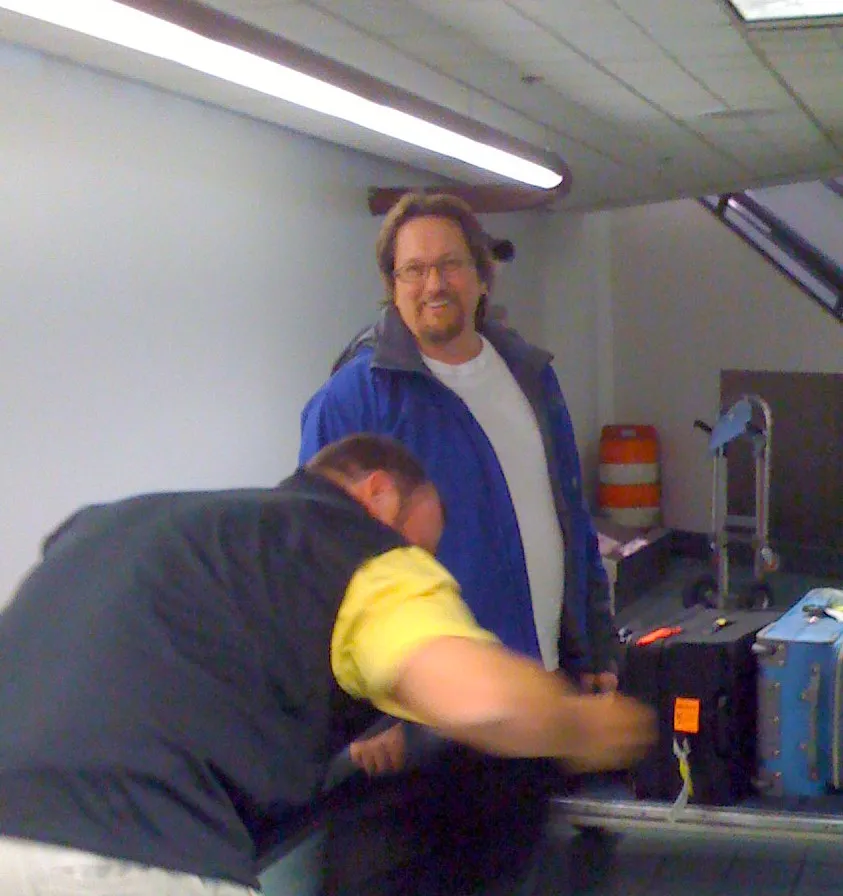 Once I got off the plane, I realized that Dobro player extraordinaire Jerry Douglas was also on board. Douglas has played on more than 1,600 albums. I have no idea how he’s done that. See his Web site.
Now that’s flying.
A Little Bit Of Riddim
I’m a fan of Michael Franti & Spearhead’s and I’ve been enjoying All Rebel Rockers
That’s why we have elections
A post election message from 1988 and Patti Smith: “People have the Power.”
(via Ethan Kaplan)
Up in TriCities
David Cate, who definitely loves music, has been doing a great job of doing video of music in the TriCities – among other things. This is a Darrell Scott video, one of my favorite songwriters, from Bristol Rhythm and Roots.
A local connection to a viral infection by Weezer
Weezer - Pork And Beans
Uploaded byWeezer
Daughter of a conjugal visit
This song “Conjugal Visit” is on the Wayback’s new “Loaded
Amazon’s MP3 download service rocks.
Join this Facebook group
I wonder if my headline is direct enough?
If you have a minute, join the new Facebook group that co-worker Lauren Spuhler created called “Songs of Appalachia.”
She describes it:
“Songs of Appalachia” is a monthly video series featuring musicians from East Tennessee who help define the music of this region. It is published on knoxnews.com and is more than just country music.
The music may be classified as “home-grown” or “old-timey” and has deep roots to Africa, Scotland, Ireland and England. It is a mixture of fiddle, banjo, mandolin and guitar, incorporating jigs, reels, polkas, country and bluegrass.
Join online producer/videographer Lauren Spuhler and News Sentinel staff writer Morgan Simmons as they explore the musical roots of our region.
Counting calories burned with Counting Crows
My Sunday afternoon jogging music was a good one from 2004, “Films About Ghosts (The Best Of Counting Crows).”
I notice the band is offering a free “Digital 45” on its Web site. The MP3s are time stamped Jan. 11. The two “sides” are “When I Dream of Michelanglo” and “1492.” They are from the coming March 2 release of the album “Saturday Nights & Sunday Morings.”Get ‘em.
Anyway, a track listing for “Films About Ghosts.”
- Angels Of The Silences 3:38
- Round Here 5:31
- Rain King 4:15
- A Long December 4:57
- Hanginaround 4:14
- Mrs. Potters Lullaby 7:45
- Mr. Jones 4:32
- Recovering The Satellites 5:23
- American Girls 4:33
- Big Yellow Taxi 3:45
- Omaha 3:39
- Friend Of The Devil 4:35
- Einstein On The Beach (For An Eggman) 3:52
- Anna Begins 4:31
- Holiday In Spain 3:48
- She Don’t Want Nobody Near 3:08
- Accidentally In Love
Eyes on the prize
If you need a sound track for Martin Luther King Jr. Day, try Mavis Staples’ “We’ll Never Turn Back
A rumor that keeps floating
 The rumor about Led Zeppelin headlining at Bonnaroo just won’t go away. Maybe that means there’s some truth to it or maybe it means the Internet is nothing but an echo chamber.
My suspicion is that AC Entertainment’s Ashley Capps is loving keeping us guessing about whether the band will be in Manchester.
We’re all crooks and cheats
A couple of quotes from a Washington Post story:
The [recording] industry maintains that it is illegal for someone who has legally purchased a CD to transfer that music into his computer.
Copying a song you bought is “a nice way of saying ‘steals just one copy,’”
A Robert Earl Keen kind of Christmas
One of my Christmas music favs from Robert Earl Keen, who has described it as the Rocky Horror Picture Show of Christmas songs.
Stairway to Manchester
Twitter news tip
Did AC Entertainment break some news yesterday on Twitter?
The price is right

Soul jogging
For my muggy Sunday mid-morning jog, I listened to the sweet blue-eyed soul sounds of Marc Broussard’s S.O.S.: Save Our Soul
More Marc Broussard videos on YouTube.
Hit the pause button for a second
In this break in the action, I’d like to ask: Other than greed, what is up with the proposed Net Radio copyright fees, which some say will drive radio off the Internet? Mashable says there has been a slight reprieve from the Monday (July 15) fee increase that would force a lot of radio stations off the Net under their present business models.
UFO Alert
| UFO Sighting in Tennessee by 80,000! Possible Abductions … With Photo! Not as out there as recent reality. Tags: Bonnaroo | Flaming Lips | UFO |
From jambalaya to icicles in my meatloaf
Karen Knotts, one of the Book Bandits, has posted a Chicken & Sausage Jambalaya recipe that sounds right tasty. She says it came from a “gazillion-year-old Southern Living magazine” and doesn’t have anything to do with books at all, except:
Music from the 865
 Wayne Bledsoe, co-worker and News Sentinel music writer, has been spearheading an effort to do a CD of Knoxville music sponsored by the paper. He’s hassled through record companies, production details and a cover art battle to get what is hoped to be a annual series of local music CDs. The CD, called “Preview presents: Greetings from Knoxville - Songs by local musicians,” is coming out now. Luckily, the CD is longer than the title – much longer. Sez Wayne:
Just for “A Little Good News”
| After a week of tragedy at Virginia Tech, it would be nice to have a world like the lyrics of the country song, “A Little Good News:” There’s a local paper rolled up in a rubber band One more sad story’s one more than I can stand Just once how I’d like to see the headline say “Not much to print today, can’t find nothin’ bad to say”, … Written by Charles Black, Rory Bourke, and Thomas Rocco The BR549 version, not Anne Murray’s! Tags: Virginia Tech | newspapers |
I’ve got the Willies with this storm
| The powerful nor’easter covering the Northeast is also affecting East Tennessee. We’ve had 1.65 inches of rain in the last 24 hours at the airport and haven’t seen any sign of the sun during the weekend. Meanwhile, nationwide the storm was grounding airlines and created the worst coastal flooding in 14 years, according to AP reports. The gray day seemed like good weather to llisten to The Little Willies while I was exercising. The album is a collection of classic country tunes, including, “Lou Reed.” And we don’t mean to sound like we’re trippin But we swear to God We saw Lou Reed cow tippin Cow tippin The Little Willies are Noah Jones, (piano) Alexander (bass), Jim Campilongo (electric guitar), Richard Julian (guitar, vocals), and Dan Rieser (drums). Check it out. Tags: weather |
The Little Willies | nor’easter |
Pop’s Kulture
 Various 20-something-to-30-something Random Girls have told me my knowledge of pop culture lacks a certain, hmmmm, immediacy (and that is a kind term, rest assured). But pop culture and its fads cycle around. So maybe I’m not hopeless. Don’t laugh. One of those cycles caught me in the last month. Several times while I was riding around listening to the University of Tennessee student radio station, 90.3 “the Rock,” the station would play this just dynamite version of Chest Fever done by Widespread Panic. I first looked on iTunes for all of Widespread Panic’s albums and didn’t see Chest Fever anywhere. Long story short, it took me awhile to realize that on Jan. 30, 2007, one of those various artist tribute albums came out. This one was the first taking the measure of The Band. It’s called Endless Highway – The Music of the Band. Various 20-something-to-30-something Random Girls have told me my knowledge of pop culture lacks a certain, hmmmm, immediacy (and that is a kind term, rest assured). But pop culture and its fads cycle around. So maybe I’m not hopeless. Don’t laugh. One of those cycles caught me in the last month. Several times while I was riding around listening to the University of Tennessee student radio station, 90.3 “the Rock,” the station would play this just dynamite version of Chest Fever done by Widespread Panic. I first looked on iTunes for all of Widespread Panic’s albums and didn’t see Chest Fever anywhere. Long story short, it took me awhile to realize that on Jan. 30, 2007, one of those various artist tribute albums came out. This one was the first taking the measure of The Band. It’s called Endless Highway – The Music of the Band.  Chest Fever was originally on “Music from the Big Pink,” a 1968 vinyl album. Several more on the Endless Highway disc are from “The Band” (the brown album), my favorite and which was released in 1969, when I was still in junior high school. The Band was a done deal by 1978. It’s nice hearing the likes of Widespread Panic, Guster, Bruce Hornsby, the Allman Brothers Band, Jack Johnson, Lee Ann Womack and Rosanne Cash doing Band classics. Here’s the track list of the regular version. 1. I Shall Be Released – Jack Johnson 2. The Weight – Lee Ann Womack 3. Makes No Difference – My Morning Jacket 4. When I Paint My Masterpiece – Josh Turner 5. Unfaithful Servant – Roseanne Cash 6. Rockin’ Chair – Death Cab for Cutie 7. King Harvest – Bruce Hornsby and the Noisemakers 8. Whispering Pines – Jakob Dylan w/ Lizz Wright 9. Chest Fever – Widespread Panic 10. Lookout Cleveland – Jackie Greene 11. Wheel’s on Fire – Guster 12. Up on Cripple Creek – Gomez 13. Stage Fright – Steve Reynolds 14. Night They Drove Old Dixie Down – Allman Bros. Band 15. Rag Mama Rag – Blues Traveler 16. Life Is A Carnival – Trevor Hall 17. Acadian Driftwood – The Roches The Best buy version has four extra tracks including one from Gov’t Mule. The Fye (not around here) version has Steve Forbert doing a cut and the Borders version has John Hiatt and the North Mississippi Allstars. 429 Records has done a really nice site for the album here, but if you want to know about the Band, go here (it’s got everything). So my pop culture includes Rick Danko, Garth Hudson, Richard Manual, Robbie Robertson and Levon Helm as well as Blues Traveler, Gomez, Roseanne Cash, Bruce Hornsby, Jack Johnson and Widespread Panic. I found one of the videos from 429’s site on YouTube. It’s of Guster doing kind of a “Last Waltz” thing. It’s good – and funny. Watch it. Who spent $4,000 having a curry delivered from Britian to New York? Oh, well. Tags: the band Chest Fever was originally on “Music from the Big Pink,” a 1968 vinyl album. Several more on the Endless Highway disc are from “The Band” (the brown album), my favorite and which was released in 1969, when I was still in junior high school. The Band was a done deal by 1978. It’s nice hearing the likes of Widespread Panic, Guster, Bruce Hornsby, the Allman Brothers Band, Jack Johnson, Lee Ann Womack and Rosanne Cash doing Band classics. Here’s the track list of the regular version. 1. I Shall Be Released – Jack Johnson 2. The Weight – Lee Ann Womack 3. Makes No Difference – My Morning Jacket 4. When I Paint My Masterpiece – Josh Turner 5. Unfaithful Servant – Roseanne Cash 6. Rockin’ Chair – Death Cab for Cutie 7. King Harvest – Bruce Hornsby and the Noisemakers 8. Whispering Pines – Jakob Dylan w/ Lizz Wright 9. Chest Fever – Widespread Panic 10. Lookout Cleveland – Jackie Greene 11. Wheel’s on Fire – Guster 12. Up on Cripple Creek – Gomez 13. Stage Fright – Steve Reynolds 14. Night They Drove Old Dixie Down – Allman Bros. Band 15. Rag Mama Rag – Blues Traveler 16. Life Is A Carnival – Trevor Hall 17. Acadian Driftwood – The Roches The Best buy version has four extra tracks including one from Gov’t Mule. The Fye (not around here) version has Steve Forbert doing a cut and the Borders version has John Hiatt and the North Mississippi Allstars. 429 Records has done a really nice site for the album here, but if you want to know about the Band, go here (it’s got everything). So my pop culture includes Rick Danko, Garth Hudson, Richard Manual, Robbie Robertson and Levon Helm as well as Blues Traveler, Gomez, Roseanne Cash, Bruce Hornsby, Jack Johnson and Widespread Panic. I found one of the videos from 429’s site on YouTube. It’s of Guster doing kind of a “Last Waltz” thing. It’s good – and funny. Watch it. Who spent $4,000 having a curry delivered from Britian to New York? Oh, well. Tags: the band |
widespread panic | guster |
Get some Mississippi Soul
 Have you heard of this guy. Slick Ballinger? Whoa. The 21-year-old Raleigh, N.C., native turned Mississippi bluesman has a debut album called “Mississippi Soul” on Oh Boy records. By the time he was 18, Slick (real name is Daniel and he’s an Eagle Scout) was already hanging out on stage with B.B. King and Pinetop Perkins. His decision to become a bluesman sprang from seeing the 1986 movie Crossroads. Ballinger spent the summer of 2002 as a teen living with a 94-year-old bluesman in Mississippi in a house with no running water or electricity. He musta learned something. There are some mp3 and video clips on anolder site and a lot of links to articles. Interesting to see (and hear) before they sharpened his image for the new album. In 2004 he was named “most promising guitarist” in the International Blues Challenge. If you like Mississippi blues, this is a must have. My fav cuts (so far) are the title cut “Mississippi Soul” and the bonus gospel blues song “Talkin’ ‘Bout Jesus.’” Blues in all its rawness. Best played loud. One old lady was crawling on her belly And some young girl was shaking like jelly. -- “Let’s get down” Tags: Skip Ballinger Have you heard of this guy. Slick Ballinger? Whoa. The 21-year-old Raleigh, N.C., native turned Mississippi bluesman has a debut album called “Mississippi Soul” on Oh Boy records. By the time he was 18, Slick (real name is Daniel and he’s an Eagle Scout) was already hanging out on stage with B.B. King and Pinetop Perkins. His decision to become a bluesman sprang from seeing the 1986 movie Crossroads. Ballinger spent the summer of 2002 as a teen living with a 94-year-old bluesman in Mississippi in a house with no running water or electricity. He musta learned something. There are some mp3 and video clips on anolder site and a lot of links to articles. Interesting to see (and hear) before they sharpened his image for the new album. In 2004 he was named “most promising guitarist” in the International Blues Challenge. If you like Mississippi blues, this is a must have. My fav cuts (so far) are the title cut “Mississippi Soul” and the bonus gospel blues song “Talkin’ ‘Bout Jesus.’” Blues in all its rawness. Best played loud. One old lady was crawling on her belly And some young girl was shaking like jelly. -- “Let’s get down” Tags: Skip Ballinger |
blues | Mississippi Soul |
The Duhks
 I guess I’m a latecomer to the Duhks. I bought the band’s latest album Migrations” over the weekend and am enjoying it. Best of luck in your Grammy nomination for “Best Country Performance By A Duo Or Group With Vocal” for “Heaven’s My Hom,” which is on the Migrations release. Produced by Tom O’Brien. Can’t go wrong there. Nice tunes! And … WNCW has posted their listeners Top 100. Also includes top regional, top blues, top reggae, top bluegrass and top celtic. Great list to scan for new tunes. Tags: duhks I guess I’m a latecomer to the Duhks. I bought the band’s latest album Migrations” over the weekend and am enjoying it. Best of luck in your Grammy nomination for “Best Country Performance By A Duo Or Group With Vocal” for “Heaven’s My Hom,” which is on the Migrations release. Produced by Tom O’Brien. Can’t go wrong there. Nice tunes! And … WNCW has posted their listeners Top 100. Also includes top regional, top blues, top reggae, top bluegrass and top celtic. Great list to scan for new tunes. Tags: duhks |
folk | Grammy Awards |
The Song in My Head Today
| Old Crow Medicine Show’s Wagon Wheel keeps playing in my head today. It’s addictive and a great video, too! (You may have to click the start button twice to play.) See albums. Tags: O.C.M.S. |
Wagon Wheel | Old Crow Medicine Show |
Well-deserved accolades for Tim O’Brien
| Congrats to Tim O’Brien for winning to the Male Vocalist of the Year” and “Song of the Year” from the International Bluegrass Music Association on Thursday. O’Brien won “Song of the Year” for “Look Down That Lonesome Road” from Fiddler’s Green. Visit his Web site. He’s got a body of work that’s been consistently good since his Hot Rize days in the late ’70s and early ’80s at least. Looks like he’ll be playing a few reunion Hot Rizeshows next week in Nashville, Cincinnati, and Boulder. Now that’d be good. Np KnoxVegas stops on the horizon. If you’ve never heard him, here’s a link to an mp3 from his Web site, “You Are My Flower” recorded May 19, 2005 at the Belcourt Theatre in Nashville. Tags: IBMA |
bluegrass |
Lemonade, please
One of the best CDs I brought recently is G. Love’s “Lemonade.” Released Aug. 1, 2006, it’s a collection of really nice tunes with a host of guest musicians including Ben Harper, Marc Broussard, Jack Johnson (the CD is on Johnson’s Brushfire Records), Tristan Prettyman, Blackalicious. Philly-based hip/hop bluesman Garrett “G. Love” Dutton (who one reviewer calls “one of the premier purveyors of a funky fusion of sparkling acoustic pop, white-boy rap, and ragged blues” .. whew, whatever) has one nice CD. I’ll think I’ll be listening to it for quite awhile. Here’s the track list: 1. Ride 2. Ain’t That Right 3. Hot Cookin’ 4. Can’t Go Back to Jersey 5. Missing My Baby 6. Holla! 7. Banger - Blackalicious, G. Love, Lateef the Truth Speaker 8. Thanks and Praise - G. Love, 9. Let the Music Play - Marc Broussard, G. Love, 10. Free 11. Beautiful - G. Love, Tristan Prettyman 12. Rainbow - G. Love, Jack Johnson 13. Breakin’ Up 14. Still Hanging’ Around/Sneakster 15. Love
Motivational Music
 Heard an Alvin Youngblood Hart track the other night and decided to buy the CD, a 2005 release called “Motivational Speaker.” Recorded in Memphis, it is da Blues. Here’s a little snippet from the CD’s first track “Big Mama’s Door (Might Return).” Tags: AYH Heard an Alvin Youngblood Hart track the other night and decided to buy the CD, a 2005 release called “Motivational Speaker.” Recorded in Memphis, it is da Blues. Here’s a little snippet from the CD’s first track “Big Mama’s Door (Might Return).” Tags: AYH |
Alvin Youngblood Hart | Blues It’s got that raw edged Mississippi hill country sound. Course, Luther Dickenson of the North Mississippi All-stars and Dickenson’s dad, Jim Dickenson, guest on the album. Also features Audley Freed of the Black Crowes among others. It’s more than a straight up blues affair. He covers Led Zeppelin, Otis Redding and Johnny Paycheck – if you can imagine. Turn it up loud; you’ll like it. Maybe, it’s just “southern rootsy charm.” Hart’s kind of a eclectic guy. He says he went to three high schools in three time zones and learned electronic well enough in the Coast Guard to fix amps in the wife’s shop in Memphis. He’s one of those artists whose next album won’t be like the last, but “Motivational Speaker” is a mighty fine place to start listening to him. |
Cottars update
I wrote about the Cottars in February and I got an email today that says they are breaking up in November. Dang! Thanks to David Ogilvie for the heads up.
In the CD player this morning
 There are some albums that just sound like summer. You can just feel the sunny hot summer afternoons or warm summer nights hanging outside with lightin’ bugs and crickets. The January 2006 release of the Subdudes’ “Behind the Leeve” is just one of thsoe really nice summer sounding albums. There are some albums that just sound like summer. You can just feel the hot summer afternoons and warm summer nights outside with lightin’ bugs and cricket sounds. The January 2006 release of the Subdudes’ “Behind the Leeve” is just one of thsoe really nice summer sounding albums. Give a listen to the first track: “Dukie & The Mud People.” Now crank it up and try to keep from moving. There’s a whole story to that song. It’s Keb’ Mo’s first producing effort and I’m a Keb’ Mo’ fan, too. It’s got a Keb feel to it without his vocal sound. The Subdues call their music “New Orleans-flavored Americana.” It’s a little R&B;, a little country-folk, some Little Feat, melodious accordian, laced in jazz and nice harmonies, I guess New Orleans-flavored Americana gets it. The album was recorded at the Dockside Studios near Lafayette, La. The band members have been playing together on and off since 1987, but they parted ways in 1997 only to reform in 2003. Good idea! I’d love to see them live. They’re not booked into Knoxville anytime soon, but do play Kingsport (Twilight Alive) and Asheville (Downtown after Five) in mid-June.
The Cottars
 Wow, what an impressive sounding album from a pair of sisters and brothers from Cape Breton Island in Nova Scotia. I got their new album, Forerunner , a few days ago and it’s really nice. And it’s the band’s third. The first came out in 2002 and they seem to have been together since 2000. Forerunner is their U.S. debut album. The Cottars are four teens: two girls 16 and two guys 18. Ciar�n and Fiona MacGillivray are the children of Canadian author/composer, Allister MacGillivray. The other half of the group is Roseanne and Jimmy MacKenzie. Find out more about them on their Web site. You can also hear a few songs from the new CD on their MySpace site (I wonder why they didn’t post those on their Web site). If you like a Celtic-influenced sound, you’ll enjoy this group. I hope they come to the Tennessee Theater sometime. I particularly liked their versions of “Send Me a River” and “Hold On.” Have you heard these four?
Lately, I’ve been listening too …
 I recently bought a couple R.L. Burnside CDs: “Burnside on Burnside” and “Wish I was in Heaven Sitting Down.” Of the two, I like “Burnside on Burnside” the best. It’s a live concert recorded in January 2001 in San Francisco and Portland, Ore. It’s got that raw North Mississippi hill country blues style with “adopted” son Kenny Brown on guitar and Burnside’s grandson Cedric on drums, That disc was made when he was already in his 70s. Listening to that CD, one can only imagine what Burnside was like in his prime on a Saturday night in a juke joint like friend Junior Kimbrough’s in Holly Springs, Miss. Cranked up on shine, he musta had the whole place electrified. Who the heck was R.L. Burnside? Well, for one, he’s dead. He died this past Sept. 1 in Memphis at age 78. A sharecropper in rural Mississippi, Burnside started playing the blues in 1948, but was “discovered” in the early 1990s. . It’s said he murdered a man, perhaps by shooting him in the back of the head over a $400 gambling debt. It’s said he only served six months because the farm he worked on needed him.
Uncategorized
Poynter’s Al Tompkins coming to Knoxville
If you’re a journalist in East Tennessee, this is a “can’t miss” event, a chance to attend a workshop led by Al Tompkins for free! (Make sure to RSVP.)
Sugar Daddy Google
Google is funding news projects with up to$300,000 per grant.
What issues are important to Tennessee voters
This is an interactive chart that will update. Click on a county to get county level trends. (Sorry, this embed doesn’t seem to work anymore because it’s not AMP compliant. I’ve substituted a static image.)
Google Tools training for journalists coming to Knoxville
[caption id=”attachment_2088” align=”alignnone” width=”525”] SPJ Training Program in association with Google News Initiative[/caption] Don’t miss an upcoming free training opportunity in Knoxville for journalists. The East Tennessee chapter of the Society of Professional Journalists is bringing SPJ’s Google Tools training to town on Saturday, June 2. The four-hour session begins at 10 a.m. at the Scripps Lab, 1345 Circle Park Drive, on the University of Tennessee campus. While free, registration is required. Sign up here: https://bit.ly/2IJ1cCR Participants need to bring a laptop and phone to the session. [caption id=”attachment_2087” align=”alignnone” width=”510”] SPJ Trainer Mike Reilley, founder of SPJ’s Journalists Toolbox.[/caption] The instructor will be Mike Reilley, founder of SPJ’s Journalists Toolbox, a treasure-trove of journalism resources. Reilley (@journtoolbox) is a visiting professor in data journalism and digital journalism at the University of Illinois-Chicago and is a consultant to national media organizations on digital innovation. This innovative training is made possible by the Google News Initiative and the Society of Professional Journalists. The Google News Initiative partnered with SPJ in 2015 to teach Google digital tools for news and storytelling at conferences, workshops and newsrooms across the country. Google and SPJ are committed to training as many journalists as possible. This intensive course will help make you be a better digital journalist, teaching you how to take advantage of Internet sources for researching court cases, public data and news archives, among other sources. It is designed to improve the efficiency and efficacy of your in-depth research. Here is an outline for the course.
Everything you need to know about Tennessee open records

Sign up for the Murfreesboro NewsTrain before prices go up
‘I live in a game perserve of corruption’
“Black & White and Dead All Over” sounds like an interesting documentary, if a bit mysterious at this point. Here’s the trailer.
Doing better storytelling with opinion polling
One of the more intriguing demos I saw at Georgia Tech’s People and Technology Forum 2012 a week ago is one with the seemingly obtuse name of “Tangible Anchoring.”
If you’re after culture change, it helps to be an emotional psycho
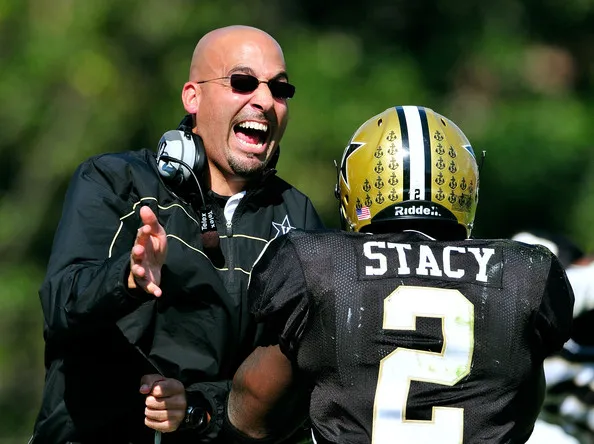 Anybody that has ever been involved in a culture change or newsroom transformation effort has got to appreciate what Vanderbilt University football coach James Franklin has accomplished.
Are you ready for your cell phone to explode?
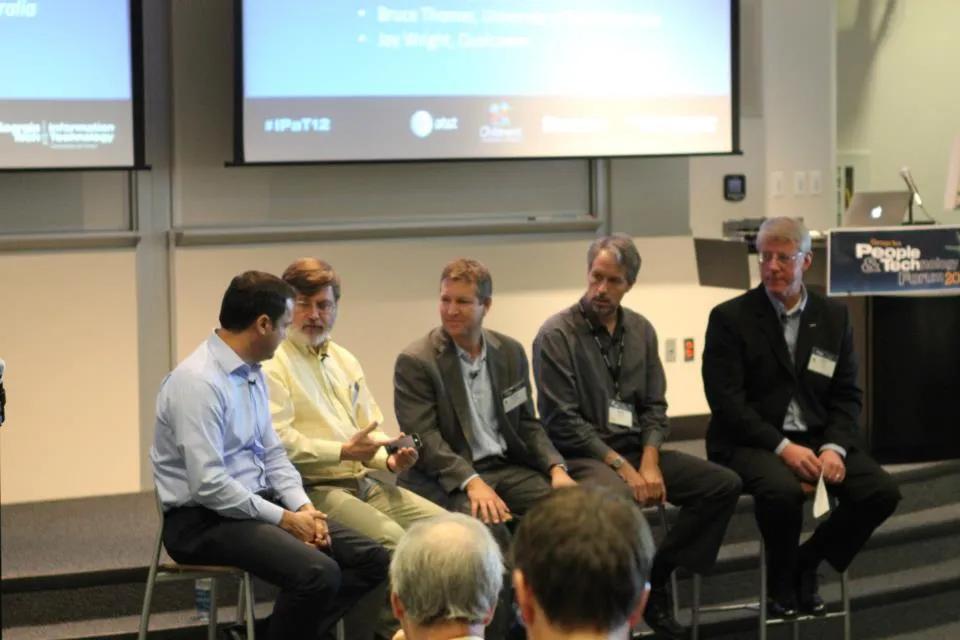
The Magic Window
It’s fascinating how a low-cost, but powerful technology like Microsoft’s Kinect, a motion sensing device primarily marketed as an addon for the video gamer’s Xbox 360 but also available for Windows computers, is being used in creative ways. Here’s one I noticed at the Georgia Tech People and Technology Forum 2012 on Tuesday called “The Magic Window.”
It’s both simple in purpose and powerful in potential. Tie a Kinect unit to a fisheye video camera with a web app to allow people look into a “magic window” for a remote tour controlled by gestures like looking the left and right. Other types of content can be embedded in the presentation to add additionl depth.
Watch Brian Davidson, Operations Manager and Principal Software Developer with the Georgia Tech Research Computer Operations Network, show how it works. (Sorry about the shifting contrast in the video; I was trying to pull out some of the detail on the monitor.)
Students and faculty demonstrated many of the projects they are working on Tuesday afternoon, which I’ve found to be the most fun part of the event. Most of the projects are far from polished and some are at a very early stage of development, but the ideas are truly amazingly creative. I expect to see many of these to find their way into real world applications in the not too distant future.
New Journalism Fellowship on the Economics of Aging and Work
Fellowship Opp:
The geography of Knoxville cell phone calls

Comment bouncers: No admittance without a Facebook ID
 The introduction of the new Facebook comment plugin and the legal efforts to force the Indianapolis Star to disclose information it may have on anonymous commenters makes it a salient time to post an updated list of comments links.
These are part of a collection of links on delicious about comments on websites, particularly news websites. I hope you find them helpful. There are also some previous posts on comments..
- The Real “Authenticity Killer” (and an aside about how bad the Yahoo brand has gotten) — Scobleizer
-
[Anonymous comments: Adding to debate or facilitating hate? American Observer](https://inews6.americanobserver.net/articles/anonymous-comments-adding-debate-or-facilitating-hate) - Reflections of a Newsosaur: Facebook comments: Friend or foe for pubs?
- On the Media: Your words, your real name - Los Angeles Times
-
[Singel-Minded: Facebook Comments Are Another ‘Good News, Bad News’ Proposition Epicenter Wired.com](https://www.wired.com/epicenter/2011/03/singel-facebook-empire/) - Zenroll ☯ Tech In Asia
-
[Website posters’ anonymity is being put to the test The Indianapolis Star indystar.com](https://www.indystar.com/article/20110306/LOCAL/103060372/Website-posters-anonymity-is-being-put-to-the-test?odyssey=tab%7Cmostpopular%7Ctext%7CFRONTPAGE) - Judge: Media must reveal IDs of online posters - chicagotribune.com
-
[A 5-minute framework for fostering better conversations in comments sections Poynter.](https://www.poynter.org/how-tos/digital-strategies/121664/a-5-minute-framework-for-fostering-better-conversations-in-comments-sections/) - The Pros And Cons Of Facebook Comments
- Facebook Comments Have Silenced The Trolls — But Is It Too Quiet?
- A close look at troll comments versus real ones
- Changes to commenting system roll out across 100 GateHouse sites - - GHS Newsroom
- Keeping Up With the Commentariat - NYTimes.com
- 3+ Ideas on Being/Stopping a Comment Troll - Todd Lyden
- Cromeens: A Reporter-News plan for improving online conversation » Abilene Reporter-News
-
[Are fewer comments the cost of online civility? Poynter.](https://www.poynter.org/latest-news/media-lab/social-media/109506/are-fewer-comments-the-cost-of-online-civility/) -
[Also We Don’t Wash Corrente](https://www.correntewire.com/also_we_dont_wash) - Simple Justice: Online Accountability Picks Up Steam
-
[Trolling, toxic talk and the challenges of transparency Crisisblogger](https://ww2.crisisblogger.com/?p=1295) - I hope to one day live in a world without trolls — Tech for the Rest of Us — Orlando Sentinel
- Someone On The Internet Was Mean To Me - TalkLeft: The Politics Of Crime
- Balloon Juice » Blog Archive » Getting Anonymity Wrong, As Usual
-
[Under the Bridge: The Side Benefits of Troll Culture The Awl](https://www.theawl.com/2010/11/under-the-bridge-the-side-benefits-of-troll-culture) -
[Don’t Feed the Trolls. No, Wait! Feed the Trolls. The Atlantic Wire](https://www.theatlanticwire.com/features/view/feature/Dont-Feed-the-Trolls-No-Wait-Feed-the-Trolls-2656)
There is life after a newspaper’s death; sometimes a better one
John Temple, last editor of the Rocky Mountain News takes a look in a piece in Atlantic magazine at what has happened to his former staff two years after the closing of the newspaper. Temple wrote:
A survey I just conducted of the 194 members of the paper’s editorial staff on its last day found that the blow of losing a job doesn’t mean life is going to be worse down the road. My survey wasn’t scientific. It’s possible that those who didn’t respond are struggling personally or financially more than those who did. But the 146, or 75 percent, who did respond have lessons for journalists and others who fear the instability of their jobs or who may have suffered a similar fate.
Top blog posts in 2010
Here are the top blog posts here during 2010 based on page views. Thanks for reading!
Two were written in 2007, one in 2008 and the rest in 2010.
- Hey, Michael Moore, I’m calling you out
- Letter from the epicenter
- Free enterprise just hasn’t been good for journalism
- In the ring: Dolly vs Google
- The iPad as “transformative device”
- Knoxville.com does Bonnaroo like no one else
- Fireworks at the lake
- On Being There
- This story intentionally left blank
- On Friday, the Talk stops
1 for All
.. c
From the “1 for All Campaign.”
That sustainability question
It is not about just refashioning journalism, it’s about reinventing the business proposition for news. Janet Coats of the Patterson Foundation wrote yesterday:
Instead of looking to the past, to the old buckets for ad revenue, we’d better focus on those three themes – mobility, Internet dominance in all content areas and improving user experience – as places where we might get ahead of the money.
…
For journalism to work, it has to prove its value to the community it serves, and proving that value means attracting business revenue - whether through advertising, subscription, or underwriting by an audience committed to the coverage your provide. Likely, it will be a combination of all those things, and more.
A Social Media innovation worth Google Buzz
 The Net buzz is about Google Buzz, which launched this week. It’s an important product, another turning point in the development of Social Media, no doubt. But it’s a week in which we were also reminded that game-changing ideas aren’t the sole province of big companies with legions of brillantly smart people.
The New York Times discovered that Chatroulette, a site that connects you randomly to a Webcam user and has rapidly grown in popularity worldwide (often hosting 20,000 users at time at night) was developed by a 17-year-old … in Moscow.
Surprised?
_
_
Kiffin clash
A video of the negotiations between the Knoxville media and Bud Ford, the University of Tennessee’s Associate Athletics Director - Media Relations (Men) - Football, before the press conference where head football coach Lane Kiffin announced he was leaving Tennessee for the head coaching job at the University of Southern California.
Kiffin wanted to do two press conferences, one without cameras and one with. No questions apparently were going to be allowed at either. He also did not want any live feeds either video or audio.
Update: Jack McElroy and Katie Granju blogging the same thing.
Asbestos jammies
Sometimes you have to wade into your inbox wearing asbestos jammies.
A plea from newsrooms
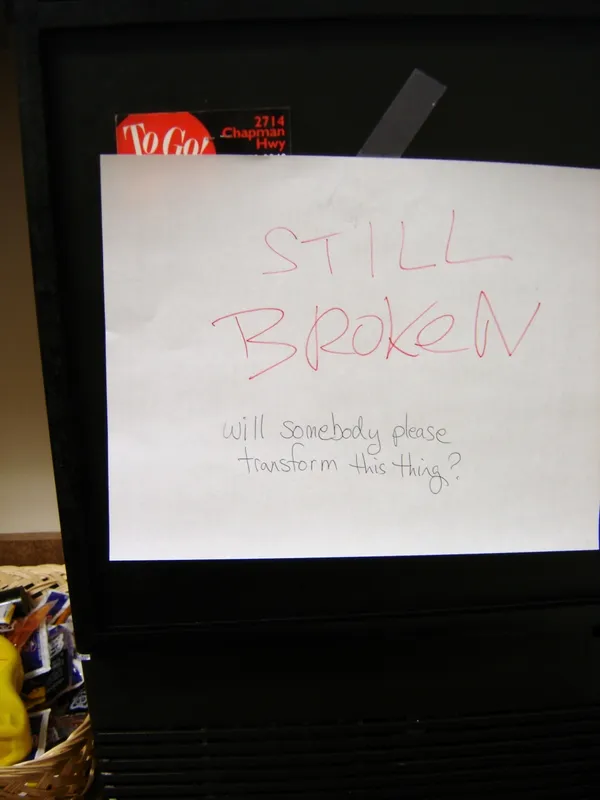
A slave to email
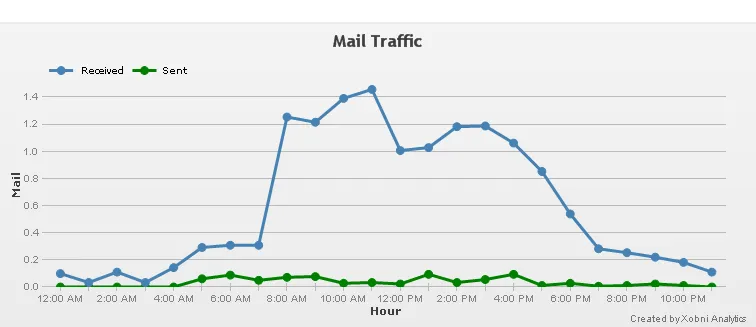 Coming back from a short vacation and not checking company email for four days, brought with it an inbox with over 675 new messages.
Now, many of them were “status” messages; new video available from AP, someone flagged a comment on knoxnews, please post a story. Easily deleted and no reply necessary, but still there were over 675 in just four days and two of those were light volume weekend days.
Luis Suarez of IBM says he cut his email load “by 80 percent in a single week” by various tactics from not sending emails to using other technologies like blogs and wikis.
Suarez, social computing evangelist at the computer giant, says “E-mail can become extinct, if not repurposed altogether, even at big companies.”
That wouldn’t work for me in my current email-focused corporate culture. We struggle to get people to use Outlook’s calendar and getting people on IM was met with unrepentant obstinance. I and my online team, however, use IM, Twitter, SMS, Facebook, blogs, and Google groups much as IBM’s Suarez does. They improve communication greatly within and without work. But, alas, they haven’t perceptibly cut email volume.
I’m more like Daniela Barbosa, business development manager at Synaptica, who hasn’t quite found any suitable replacement and remains “your e-mail slave.”
The chart above (click on it to get a larger version) shows part of the picture, or problem. It’s a graph showing average email by hour to my desktop Outlook program. Problem is I also read, reply and delete a lot of mail in the Web-based version of Outlook. And then there’s Gmail (a couple accounts), Yahoo email, and, oh yes, Hotmail.
The chart was generated by the analytics in the Xobni Outlook add-in that has great email search and does these spiffy charts.
I may be hopelessly hooked without an email “patch,” but could you delete the email habit? And how would you do it?
Santa cat

Peas from the heart
 Several of the Tennessee Twitterers I follow, djuggler, rexhammock and newscoma among them, are participating in the frozen peas awareness and fundraising effort.
Frozen peas endangered or in need of aid? Hardly.
It’s an effort inspired by Twitterer Susan Reynolds, who has been blogging about her breast cancer at Boobs on Ice. She explains the peas in this post.
Duncan Riley at TechCrunch notes the social significance of the outpouring of support.
There’s a Frozen Pea Friday flickr group with 280 members (at this writing).. There is a frozen pea fund that has raised at least $3,500 in the wrapup report on Frozen Pea Friday.
An interesting use and heartwarming use of Twitter. My best wishes to Susan Reynolds.
If you don’t already, follow me on Twitter.
Are you serious?
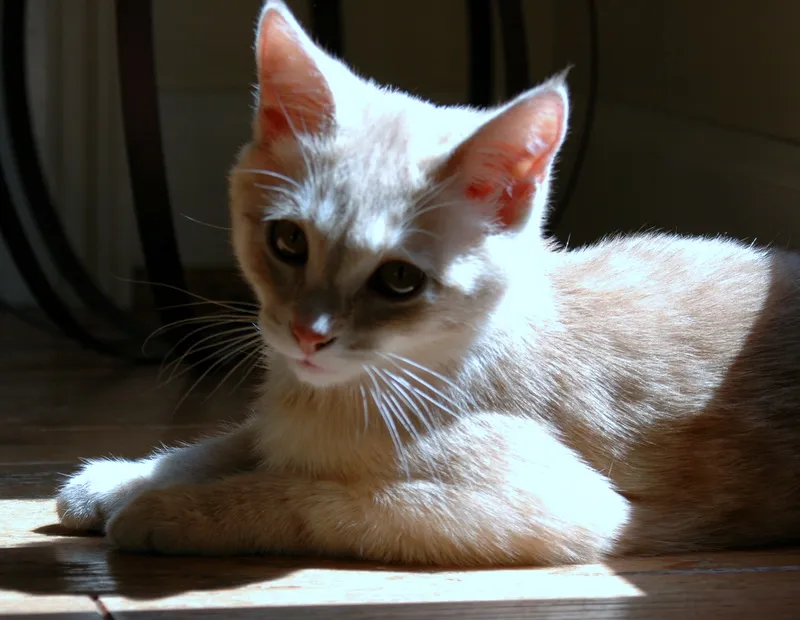
Duh, a thinking blog?
 Whoa, been tagged by none other than Randy Neal in the Thinking Blogger Awards. My mamma would be proud. Here’s five. 1) Mathew Ingram, technology writer for the Toronto Globe and Mail. He’s always interesting, such as with this one on Robert Scoble and Chris Pirillo experimenting with Ustream and Twiter. 2) Bob Sutton’s Work Matters. Hey, a college professor should make you think, right? He’s got a lot of good advice and interesting research and ask him a question and more likely than not, he’ll answer it. In this one, he points to an online article he recently wrote. 3) Ex-Scrippser and now a Gatehouse Guy, Howard Owens is a prolific blogger who’s not wishy-washy when it comes to opinions. 4) He’s been parrying or partying with Yahoo too much lately to be blogging, methinks, but my sole homie pick is Jay Small’s Small Initiatives. I liked this recent post. (That’s not say there’s not a lot of thought-provoking homies hereabouts; there are.) 5) I find Eric Berlin always a good read. Saturday’s post was on blog strategy. So there, five tagged. They’ve probably been tagged earlier, but anyway Sunday morning fun. It’s definitely random because almost every blog I read on a regular basis makes me think – or tells me something I didn’t know. Da rules (as I understand them) for the Thinking Blog Award:
Do Ya Think I’m Sexy
Stephen Bagg at Compete says:
The Nashville Nobody Knows
I found “the nashville nobody knows” searching through the podcasts on iTunes. Looks like a nice podcast program. Anybody who interviews Sam Bush, Tim O’Brien and Darrell Scott has Producer Candace Corrigan, a singer/songwriter herself, at least has good taste in picking show subjects. Sounds interesting.
Abandoning the News
There seem to a spate of articles about the future of news and newspaper – most of them filled with dire predictions. One of the most thought-provoking I’ve seen appeared this week: Merrill Brown’s “Abandoning the News” report for the Carnegie Corp.
Paper Profits
Ole Venob had a call from someone who said a copy of the News Sentinel Pat Summitt edition was selling for 41 bucks. Yep, sure thing. Here’s the link. Another seller has same paper up to $15.
Send a plate flying
Fixed some brain errors that hosed the Post Card program that sends “plate cards.” Send a photo of one of these beautiful Westmoore Pottery plates to someone! Send one now.
Beautiful Saturday
A very beautiful March Saturday in Knoxville. Sunny, 60 or so breezy. Jogging (I call it jogging … a fast walker could pass me, no doubt) at Lakeshore, I could hear: The yells from the soccer fields. The ping of aluminum bats at the batting cage. * Walkers on their cell phones. A wonderful hint of spring in early March. The forecast looks equally splendid.
Newsroom managers

This photo of newsroom managers was taken by photographer Saul Young for associate editor Georgiana Vines, who retired last week. George came to the News Sentinel in 1968 and only left for a couple of years to edit the Scripps paper in El Paso. I’m sure she’ll be as busy as ever.
Stopping the Presses
The Internet has changed the economics of the publishing industry in a way commercial television never did. The price of news and information has irrevocably been pushed way down the supply/demand curve. The Web has also destroyed the functional monopoly of the local daily newspaper with the very high barriers to technical entry. Anyone can be a publisher, and, it seems, these days, most anyone is.
More on newspapers buying Web companies
More on the ABout.com and MarketWatch buys:
Bubble II bubbles
WSJ buying MarketWatch, NYT buying About.com. the Washington Post Co. buying Slate. and a virtual horse race of big Internet players buying up startups with promising technologies all point to the telltale signs of Internet Bubble II. These may all be good deals, but expect to see a lot of money burned on mergers and acquisitions that would never work and business plans straight from the Meth Lab. The driver is the growing penetration of “always on” ubiquitous Internet access from broadband in the home, WiFi networks and cell phones. And newspaper companies are scrambling to redouble their efforts to be part of the next “New, New Thing “ (to steal the title of Michael Lewis’ 2000 book). Frank Arhens’ Feb. 20, piece in the Washington Post “Hard News, Daily Papers Face Unprecedented Competition . . ..”nails the issues for newspapers.
The first mumble
OK, I mumble. But I think what I’m saying is clear. So follow these random mumbles to see where they lead.
Carnival
Dangerous ideas for pushing the boundaries of journalism
Lots of video responses have been posted to April’s “Carnival of Journalism” of question: “What is your most dangerous idea for pushing the boundaries of journalism?”
You see them on the right in the recent posts list on this site for University of Southern California’s J556 class taught by Andrew Lih. Give them a look; they are generally around 1:40.
Here’s Paul Bradshow of the Online Journalism Blog to get you started:

Training as a dangerous idea for journalism
My April Carnival of Journalism entry offers up training as my most dangerous idea for pushing the boundaries of journalism.
A roundup of all the responses to “What is your most dangerous idea for pushing the boundaries of journalism” will be posted sometime afer April 30.
Do you find training as an odd choice?
I have an augmented reality view of the next big thing in journalism
It’s been a bit of a buzz for some time now, years even, but one of the technologies approaching wide-scale use that is likely to upend current journalism in augmented reality.
A carnival of wish lists

Just surprise me

This month’s Carnival of Journalism is themed for the holiday season.
THE TOPIC
With it being December, we thought we would adopt a Christmas theme for this month’s topic - and pick something, in keeping with being hosted by a Developer blog, that we could ask of both technologists and journalists.
If you are a journalist, what would be the best present from programmers and developers that Santa Claus could leave under your Christmas tree?
And, correspondingly, if you are a programmer or developer, what would be the best present from journalism that Father Christmas could deliver down your chimney?
Beta burnout
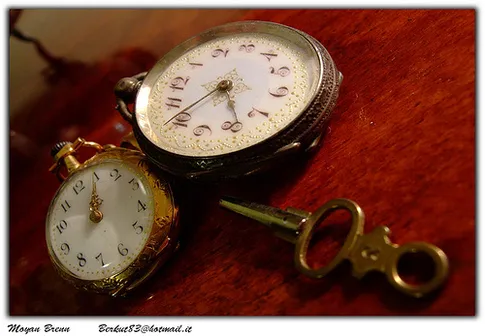
Another blogging platform; another next Twitter or Facebook or YouTube; another must-have smart phone app; another groundbreaking piece of hardware that will revolutionize … After awhile, it’s just so much beta burnout.
If you are trying to lead the way to whatever is next for journalism (which I suspect is true of many of the readers of the Carnival of Journalism), then you have been there and done that.
It’s the kind of thing we bitch about over beers, but our Carnival host this month, Bryan Murley, has made a call to pull back the tent flaps and see the clowns without makeup:
How do you decide to dedicate time to a new tool/platform/gadget? What is the process you go through mentally? And then later - how do you convince others to go through that process? And, last: How do you ensure that the tools you do adopt are used once the “newness” factor fades?
Video has to be in the DNA of newspaper newsrooms
There is compelling evidence that newspapers have a great opportunity in video. If you’re a newspaper a newsroom header, don’t let shrinking newsrooms, the demands of multiple platforms, anemic advertising, or training or workflow issues deter you.
Those are the challenges, not the indicators of whether it’s working.
This piece is part of the September Carnival of Journalism, or JCARN as it’s become known, on online video.
I believe the opportunity for newspapers and video is greater than that of local television and video. For TV stations, video is repurposed broadcast content; newspapers are doing original web video news without the traditions and legacy issues of television.
A Link News study of 16 to 25 year olds found 69 percent consumed news almost every day, 29 percent several times during a day.
They’re an always on, “continuous partial attention,” generation, snatching news like snacks between classes or activities.
Their top news sources: Video websites like YouTube (85 percent) followed by the website of a national or local newspaper (77 percent).
I smell opportunity. Yes, the Link News study could be skewed toward young news junkies, but still, these are heartening signs.
Least popular news sources were blog sites and individual journalists (ouch!).
What information sources do they trust? National newspapers like the New York Times (60 percent); newspaper websites (local or national) 59 percent; and international brands like the BBC, 56 percent.
Again, a heartening confluence of trends.
Video was used by 90 percent of the respondents in the survey.
From the Link News white paper:
“Focus group discussions revealed that video was considered an important feature when it wasn’t overly produced and contained rough or unpolished footage. ‘Seeing for yourself’ through amateur video or roughly produced footage without voiceover allows the natural context to emerge and is perceived as an important direct lens on news for youth.”
A Google+ discussion about news comments
Google+ will undoubtedly have many impacts on the journalism uses of Social Media. I’m looking forward to reading what the other contributors to the August edition of the Carnival of Journalism muse about.
One of the more interesting issues that has been rekindled is over the use of real names vs “handles” or users names or pseudonyms.
Google’s rigid requirement of real names … it really doesn’t have a “user name” … and the fact that whatever account name is used is the one used for all other Google products has sparked a tremendous amount of debate.
While a social media communities and article comment areas are not exactly the same thing, I think there are threads and implications in this debate for news organizations, their web sites and their commenters.
Prior to Google+’s launch, there had been a growing chorus against anonymity for comments on news sites. Long-time blogger and Internet figure Anil Dash may have come up with the best headline: IF YOUR WEBSITE’S FULL OF ASSHOLES, IT’S YOUR FAULT.
In an excellent follow up post, he said:
“This isn’t about agreeing or disagreeing – many great sites can, and do, allow vigorously dissenting or unpopular views, from anonymous or pseudonymous commenters, without degenerating into cesspools of unkindness. But if a site allows racist or sexist or hateful comments to persist in its conversations, … then they’re not merely giving a home to an awful conversation. Instead, that site owner is signifying to members of the groups being attacked that they would rather profit from the page views of the people leaving those comments than make a welcoming, inclusive space for the people being attacked.
I Walk Like An Egyptian
The Carnival of Journalism (#Jcarn) this month takes on the Big F, Failure.
There were rules about what you could write about and while not a rule abider at all times, the ones laid out by David Cohn seemed reasonable enough.
What is failure?
It is a mistake? It is a failure if you make a mistake, recognize it, take a step back and learn from it before moving on? I have had a gracious amount of material to work with there, but I don’t think those are abject and utter failures.
George Bernard Shaw: “A life spent making mistakes is not only more honorable but more useful than a life spent in doing nothing.”
It is the learning along the way that matters. Plan and strive for success, but welcome mistakes as the most helpful teachers you will ever know.
Is failure something that didn’t work? Inventor Thomas Edison said no and was far smarter than I. His famous quote goes: “I have not failed. I’ve just found 10,000 ways that won’t work”
I don’t think I’ve hit 10,000 yet, but, Tom, I’m working on it.
If you try an idea and it flops and you recognize it, so what? Learn from that experience and try something else.
So if neither mistakes or flops are the Big F, what could possibly be failure?
I think true failure is the inability to recognize or escape from a mistake and thus keep repeating it again and again and wondering why it doesn’t work. Failure is never changing.
My failure, one I have yet to fully escape, is the tendency to “Walk Like An Egyptian” (hey, the title of a hit song in 1986 fits this post).
Who are the Egyptians? I don’t mean those throngs in the streets of Cairo chanting and shooting YouTube videos. I mean newspapers and, by extension, “newspaper people.” That would be me.
Their approach to digital from as early as the mid-1990s onward has been like, well, newspapers.
But digital environments haven’t proven to be much like the monopoly, geographically focused markets newspapers had been so successful in. Far from it.
At almost every step along the way, newspapers and their leaders, including me, made missteps based on our framework of reality as newspapers and newspaper people..
Newspapers and newspaper companies tend to watch and borrow from each other in a near-closed society.
And note I say newspaper companies, not media companies or digital information providers or some other buzzworthy phrase for those who print newspapers.. The DNA of these companies is newspapers. They really haven’t evolved very far despite the extensive and expensive plastic surgery.
Again, I count myself among those who have difficulty breaking the tendency of thinking from a vantage point that might not even be that relevant..
There are, however, some things I and you can do to not get sucked into always walking like an Egyptian.
-
Borrow ideas and watch for trends outside the newspaper industry.
-
Deliberately go to conferences and trade shows about topics you’re interested in that are under-represented by traditional newspaper media companies. If you’re the only person there from a newspaper company; most likely you’ll find some new ideas.
-
Talk to startups and entrepreneurs; they aren’t constrained by your industry framework.
-
Challenge assumptions. Easier said than done, but critically think thorough them to see if they really make sense.
-
Seek inspiration in unusual places.
-
Don’t accept “we’ve always done this way’ as an acceptable answer.
How am I doing? It’s a work in progress. I hope to call this a failure I’ve overcome one day.
I’m looking forward to reading the other “Fail” pieces this month.

Revamping the ‘take a chance, win a prize approach’ to funding journalism innovation

I was too occupied to contribute to the Carnival of Journalism’s latest edition, but it’s not surprising Carnival came up with a great set of pieces anyway.
Here is David Cohn’s rundown on the various #jcarn posts, who writes:
Yet another fantastic #jcarn. With every one of these, we find new participants, and others become hardened veterans. Once again, we’ve made the Harvard Nieman Lab’s “This Week In Review” (pretty f’n badass), but we will do our own wrap-up below.
Explore increasing news sources #JCarn
I participated in the February Carnival of Journalism. Lots of good ideas/observations in these posts. David Cohn, who organized the Carnival writes:
We have almost 40+ responses to the broad question: “What can I do to increase the number of news sources?” Many of your sentiments overlapped, but each person brought a unique perspective to the mix. Several agreed that increasing news sources is a bad idea, and others championed it. That’s what this carnival is for – to dialogue and engage one another and the community at large.
Why I’m curating news and why you should too
David Cohn, our host for the 2011 Renewal Tour of the Carnival of Journalism asks this month:
Considering your unique circumstances what steps can be taken to increase the number of news sources?
This wording is not chosen lightly. The question is how to increase the sources of news. This does not necessarily mean how do we increase the number of news organizations, although that can be an answer. Being a source of news and being a news organization are distinct. An individual posting a twitpic of a car crash with the hashtag #yourcity is a source of news even though he/she is not a news organization.
We need universities smart enough to fix the potholes
First, thanks to Dave Cohn for reviving the Carnival of Journalism. We haven’t put up the big tent in a long while.
For this carnival, a number of journalism bloggers have been asked by Cohn to write about one topic: The changing role of Universities for the information needs of a community: One of the Knight Commission’s recommendations is to “Increase the role of higher education … as hubs of journalistic activity.”
 You can find links to all of the pieces here in a couple days.
This is one of those topics where I can smugly tell others how they ought to do it. I’ve always found it is easier to figure out what others should do than what I should do myself.
With that caveat, I do believe there is a lot in this idea for educational institutions and I’m not talking about just journalism or communications schools/departments.
I think institutions of higher learning, particularly those that are publicly owned, should be doing a lot more to leverage their skills and expertise and computer infrastructure to create tools and data repositories that allow citizens to be more informed or mine data.
Let’s take something simple: Street problems.
Tech experts, for example, could create a tool to visually show potholes, maybe using an application like the Ushahidi Platform
Journalism departments could use their students armed with cell phones to crowd source street problems, prming an effort that encouraged others to participate.
The tool could be hosted on the school computer network. Most of which have very robust networks.
This is but a simple example. I’m sure if you thought about it for a bit, you could think of something even more useful or with more impact.
In fact, I invite you riff off this idea with our own ideas in the comments.
It would not be a new thing for universities to do; they just aren’t doing it consistently enough.
Here’s a real world example:
Early in the days of the public Internet, a group at the University of Tennessee led by Greg Cole created the idea of a freenet-type or community portal service for the Knoxville, Tennessee, region. In large part due to Cole’s infectious enthusiasm for the project, KORRnet, short for Knoxville-Oak Ridge Regional Network, launched in March 1994. It’s called DiscoverET.org today.
It allowed groups to create their own Internet presence from a central hub. It was groundbreaking, forward thinking in 1994.
Without the efforts by this University of Tennessee employee and his team, it wouldn’t have happened.
(KORRnet certainly isn’t the only innovative project Cole has been a leader of.)
I think the spirit of the Knight Commission recommendation is for there to be many stories like Greg Cole and his crazy idea for a community directory open to every group.
It’s a challenge colleges and universities should be taking on regularly to enrich their communities.

Looking for rules to go with our thumbs
This month’s Carnival of Journalism is about the theme of “How to support journalism online financially.”
There are examples of successful journalism online: Rafat Ali’s PaidContent, Nick Denton’s Gawker Media, Pete Cashmore’s Mashable, AOL’s blogs and others. I’d even include Wikipedia and Mahalo as doing journalism. Wikipedia is a non-profit and a Web “encyclopedia,” but nonetheless “covers” breaking news very well.
(Side note: Nick Denton’s dire predictions for the 2009 advertising environment are looking more on target than those who poo-poohed them as “there goes Nick again.”)
I think, however, what Carnival host Paul Bradshaw was getting at with his question was how would journalism as practiced by newspapers and broadcast outlets be funded online. And that’s a much tougher proposition.
Some argue the geographic territory covered by most regional newspapers and TV stations is too small to develop the audience size necessary while others argue that newspapers are uniquely positioned to have the feet-on-the-street forces necessary to get local advertising. Both of those could be true, which makes the Yahoo Consortium’s effort so incredibly important to its members, the feet on the street will sell both their sites and Yahoo’s geographic audience for their market.
But as we are developing these new media forces, what will be new rules of thumb for online journalism?
In talking to a colleague yesterday, my off-the-cuff guess at how many people could be supported by an online-only version of the Rocky Mountain News is five journalists. Nearly 250 could lose their jobs if the newspaper closes. An announcement about its fate could come as early as today.
Where did I come up with five? I just made it up, of course. It could be 10, 15, or more, but definitely not 250. For newspapers, we have a good basis of knowledge about expenses, costs, and staffing levels over time from the annual Inland Press Association studies. These are the rules of thumb for running a newspaper, at least in the United States.
A post on Thursday on Inland’s site provides an overview of how the stats changed in 2008 and more info on the report is here.
The post notes that while newsroom job cuts have been much publicized, staffing levels, according to the most recent study, are higher than the traditional “rule of thumb” based on print circulation.
Though the prevailing opinion is that newsroom staffing has declined, study results indicate staffing is increasing when measured using the perceptive “per 1,000 circulation paid,” coming in at about 1.5 persons per thousand against a rule of thumb of about 1.2 news staffers per thousand. This may mean that newsroom reductions have not kept pace with circulation declines.
Pragmatically positive predictions for 2009
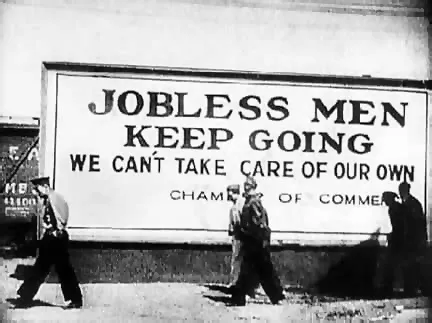 This month’s Carnival of Journalism assignment is tough.
Dave “Digidave” Cohn of Spot.Us suggested we make “New Media Predictions for 2009” and that we might be even so bold as to try to make positive New Media predictions.
Now that’s an assignment in the face of what is shaping up to be the worst year in the history of U.S. media. The headline a week or so ago on a Gawker post “Newspapers Heading Straight Into Toilet In ‘09, Says Everyone” sneakily captures the prevailing sentiment.
I’m pragmatic, not a curmudgeon. My co-workers don’t have a hard time getting an “oh me” out of me; I’m not one to see happy days on every sunrise.
As I began to write this a few days ago, I noticed a Twitter message from a talented intern from this past summer at the Knoxville News Sentinel.
This whole auto industry sinking, layoff frenzied, economy drop still feels so surreal. Am I going to have to get a job in fast food?
Five Ws from the Barack Obama campaign
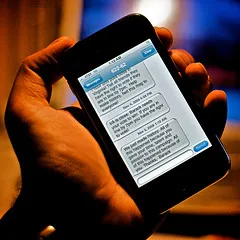 There’s been a lot written about the lessons of President-elect Barack Obama’s “Triple O” Internet campaign for marketers, but little on lessons for media and journalists.
But that’s about to change because the Carnival of Journalism is rolling into November with that topic in its big tent. All of this month’s carnival posts are linked from sideshow barker Adam Timworth’s blog.
Did Obama win because he had an iPhone app as the Geek Cowboy facetiously asked? No, but the combination of strategies used by his Internet team, dubbed “Triple O,” is as likely to change national politics as fireside chats during World War II and television debates in the 1960s, some say.
I noticed five Web 2.0 strategies (we can still use that term, right) that the campaign of Obama executed or exploited better than most news media do – and none of are new discoveries from the wilds of the Web. “They’ve taken all our stupid ideas and made them smart,” Zephyr Teachout, who ran Howard Dean’s online organizing in 2004, told Salon.
Here’s my five Ws for Web 2.0 or social media journalism from the Obama campaign:
1) Mobile text and email strategy: The campaign built a formible opt-in SMS text database (its size seems to be a closely guarded secret) and had a sophisticated email marketing strategy around 10 million e-mail addresses that adjusted the times emails were sent to times the recipients typically opened emails. It had a mobile site and a free iPhone app. It’s text messages, geocoed to area code, often included the viral suggestion of “please fwd this message.” You may remember that he announced his VP choice of Joe Biden by SMS about 3 million phone numbers, but what worked was thousnda of register to vote and get out the vote texts. Are you aggresively growing your SMS and email databases?
2) YouTube and video: The Obama campaign poured more resources video than any presidential campaign. He will become the first president to put his Saturday addresses on YouTube. They were still doing radio addressess only in 2008? Remember, YouTube did not exist in 2004. By 2008, Musician will.i.am’s independent video in support of Obama “Yes We Can” has been seen more than 15 million times. Nearly 2,000 videos have been uploaded by the campaign to YouTube. Are you saying “Yes We Can” to YouTube as a video platform?
3) Effectively using customer databases: If you work for a U.S. media company, Barack Obama’s campaign database wizards likely know more about your readers or viewers than the editor or the news director. They’re likely to know if someone in your market is a reader or viewer. They know where many vote, what their phone number is, how they are likely to vote and how often they’ve accessed the campaign’s social networking site, if ever, My.BarackObama.com. They know how many children there are in the family and what magazines and catalogs you get or cable news shows you watch. Despite heaps of data and study after study, is your news organization effectively using any demographic data to better serve and to tap new readers or viewers? Be honest!
4) Be where the users are: The Obama campaign were following about 130,000 people on Twitter and had nearly that many following its Tweets. The campaign has profiles Facebook, MySpace, flickr and as many as 16 sites. How many social networks is your news oragnizaiton on and has it done anything with them since signing up?
5) Enable the community. The Obama online campaign was focused at using online tools to get offline results, get people to volunteer to man a phone bank or go door-to-door or show up at an event. Are you using online media to mobilize your content consumers in either online or offline ways?
Some links that I found interesting while researching this post:
- blackrimglasses - What the Obama campaign could teach the record business
- Text-Friendly Hopefuls Vie For Hearts And Thumbs - washingtonpost.com
-
[Barack Obama Vs. John McCain Social Media and Search Engine Scorecard Adult ADD Strengths](https://adultaddstrengths.com/2008/11/05/obama-vs-mccain-social-media/) -
[MoJo DoJo Obama campaign’s text/mobile effort: A model for newsrooms?](https://blogs.courierpostonline.com/mojodojo/2008/11/03/obama-campaigns-textmobile-effort-a-model-for-newsrooms/) - Technology Review: How Obama Really Did It
-
[Heather McRobie: Barack Obama’s win was due, in large part, to the youth vote. Maybe now people will stop accusing us of apathy Comment is free guardian.co.uk](https://www.guardian.co.uk/commentisfree/cifamerica/2008/nov/11/voterapathy-youngpeople) - Lessons in SMS marketing from the Obama campaign :: BtoB Magazine
- Obama to post weekly address on YouTube : Gina Hughes : Yahoo! Tech
-
[Huffington Post Jonathan Spalter: Obama’s Mobile Moment](https://www.huffingtonpost.com/jonathan-spalter/obamas-mobile-moment_b_120819.html) -
[Washington Post Obama’s Wide Web](https://www.washingtonpost.com/wp-dyn/content/article/2008/08/19/AR2008081903186_pf.html/) -
[What Next for Obama’s Text-Messaging Database? The Trail washingtonpost.com](https://voices.washingtonpost.com/the-trail/2008/11/02/what_next_for_obamas_text-mess.html) -
[Obama’s use of technology didn’t end with vote National Chron.com - Houston Chronicle](https://www.chron.com/disp/story.mpl/nation/6102843.html) - The Medium - Clicking and Choosing - The Election According to YouTube - NYTimes.com
-
[TechCrunch Is Obama Ready To Be A Two-Way President?](https://www.techcrunch.com/2008/11/15/is-obama-ready-to-be-a-two-way-president/) - geek cowboy: Obama Won Because He Had An iPhone App
-
[Will Social Media Replace TV, Radio & Newspapers? Ari Herzog, AriWriter](https://www.ariwriter.com/2008/11/will-social-media-replace-tv-radio-newspapers/) -
[Barack Obama’s super marketing machine Salon News](https://www.salon.com/news/feature/2008/07/16/obama_data/) - Obama’s Social Media Advantage, Act II - ReadWriteWeb
- Obama’s Social Media Advantage - ReadWriteWeb
-
[Marketing lessons from Barack Obama The Responsible Marketing Blog](https://responsiblemarketing.com/blog/?p=679) - Ruminating Shit: 10 lessons for marketers from Barack Obama
-
[6 B2B Marketing Tips Courtesy of McCain & Obama B2B B2G MarCom Minute Blog](https://www.marcomink.com/blog/2008/11/04/6-b2b-marketing-tips-courtesy-of-mccain-obama/)
Seven ways to get lucky with innovation
This month’s host to the vagabond Carnival of Journalism, Will Sullivan, posed a theme for our musings:
What are small, incremental steps one can make to fuel change in their media organization? (Yes, we’d all like to swing in our newsroom, lay some boot heels on chests, hoist the black flag and change everything by the end of business on Monday – but the reality is, that ain’t happening unless you have a couple buckets of cash to buy a paper of your choice and a rusty sabre.) So what are some realistic, real-world examples of free (or cheap) ways you can help fuel change at your newsroom.
Done in by reform
Doug Fisher proposed another attempt for the vagabonds bloggers in the Carnival of Journalism to tackle a single issue for the July stop in our Carnival.
He asked if we might write upon this theme:
What changes will need to be made in national and international legal systems to help the digital age, and especially journalism in the digital age, flourish?
Tag a site hyperlocal and it’s doomed
The problem with creating a hyperlocal site is once you call it that, it’s doomed. Doomed to be irrelevant. Doomed to be ignored? Doomed to be abhorred by advertisers.
That’s my spin on a topic posed by Andy Dickinson in this month’s Carnival of Journalism.
His question for all the carnival writers was roughly around whether we would have accept the fact that local journalism doesn’t pay. I decided to address ideas on how to make hyperlocal or community journalism viable.
The history of hyperlocal site has many well-traveled journeys that came up short and many others that were lost before ever receiving hype. It doesn’t take a lot of searching to find these listless ghost ships in the night.
They, in a word, weren’t LOVED.
If I had the formula for winning with hyperlocal content, or the equally dreadful phrase “community news” sites, I doubt I’d be writing this. I’d be too busy selling it. Every local publisher wants it and global players like Google and Yahoo want to conquer local as the last frontier.
Everybody wants a great site that dives deep, deep into local, but nobody is getting “9’s” when the judges hold up the scorecards As a niche, is there something peculiarly wrong with local?
Nothing more than it being hard to do well, really hard. Magic sites of user generated content (build them and they will come) turned out to be another in a long line of perpetual motion proposals. Oh, but the drawings (business plans) did look wonderful
But while the well-funded efforts have mostly been failures, or more charitably, lack-luster performers, you can find in nearly every community, someone, who, without the benefit of capital budgets, marketing staffs and stock-option plans, has created a site that people recommend to others or that generates backyard buzz.
Let’s leave the magic behind and look at what good old-fashioned long hours, hard work and sharp pencils have to offer. In addition to individuals who have created wonderful local online presences, there are numerous shoppers, weeklies, and small dailies that are darned successful in print. Well-read, attracting advertisers and profitable. There is quality evidence that there is both audience and advertisers for local news and infrormation.
Short of answers, I do have suggestions on what is needed to create a site focused on the small geographical areas known as local communities.
- Find someone passionate about covering a community to lead it. Knowing and being engaged in a community is key. If the readers know more about the community than the writers, what is the value? Remember, Craig Newmark still handles customer service issues daily on craigslist. That’s passion for the product and the users.
- Build standalone sites instead of a portal or umbrella site. A portal almost guarantees the site, and those who run it, aren’t focused. You can develop strategies to sell advertising across a group and maybe group them, but first convince me you’re an expert and definitive source for my area. Gawker Media, with its stable of content niche sites, might be a model of how to develop a stable of geographically focused sites.
- Keep expenses low. Standard blog software might be all the CMS you need. TMZ.com, in a sense, covers a “community.”
- It takes professionals. It has to be someone’s job to make a great site. Have a voice. Have a point of view. Bring knowledge of the community to provide perspective and insight.
- It’s a news site, not a community album. If there’s news in your niche, no one else should have it first.
- Use user generated content to supplement and enrich, but don’t build the whole strategy on it. Be generous in linking out to the content of others.
- Market it. This will mean speaking at clubs, posting fliers, waving the flag at community events. It’s not a TV campaign, you’re serving a small niche. This is ground level, door-to-door winning customers.
- Set goals, assess brutally; refine incessantly. Develop measures to find out what’s being read and if it’s effective for advertisers. If it clearly is not working, shut it down and try another area with your learnings.
- Consider thinking beyond geographic communities. Place may not be as compelling a magnet as Interests. Sites could be developed around youth baseball or soccer, local genealogy or for local history buffs.
The Parris Island days for newsrooms
Ryan Sholin, our host for this month’s Carnival of Journalism, asked an intriguing question on Friday: “What should news organizations stop doing, today, immediately, to make more time for innovation?”
Newsrooms intrinsically abhor dropping things partly because of the “one reader rule.” The one reader rule states that if you take even the smallest thing away, at least one reader will call to complain about the loss of their “favorite thing about the newspaper.” And it’s added back. It’s developed into a don’t take anything away mindset.
Some people call that customer service or even “reader focused.” Sometimes it is; often it’s not.
 The current audience and economic pressures on newsrooms are finally forcing changes in behavior, an economic and business culture version of the drill sergeant and the raw recruit at Marine Boot Camp on Parris Island, S.C. The recruit thought he was in shape; he finds otherwise.
Life is going to be different - If we live through the transition. It’s tough and bloody, and not all of us will make it. But we are relearning. Newsrooms will no doubt be trimmer, stronger and more nimble in the future.
And while these painful economic changes take place, journalists must innovate, adapt, refine, and experiment.
And fast. Daunting, but doable. We are responding to the economic drill sergeant’s challenges to remake ourselves and our newsrooms.
In an attempt to answer Sholin’s question, I decided to ask people within my newsroom and within my parent company, E.W. Scripps … I considered that an innovative way of meeting my assignment deadline. I got a some fantastic answers even on a Friday afternoon before a long holiday weekend.
Update (an addition):Silas Lyons, Editor and VP for New Media Content, Redding Record Searchlight:
We need to immediately stop working five days a week, at least on the core paper and Web site. We also need to stop coming in to the office on that fifth day. It’s amazing what a small team can do when they work somewhere else (in our case, it’s an off-site warehouse) for one day out of the week. Just making that simple commitment forces decisions about what not to do, or what to postpone – and I think those are different answers for every department, at every newspaper.
Hope that helps. I realize it will elicit the obvious sarcastic answer – you usually only work five days a week? – but you get my point.
The ‘Golden Age’ of Web news
(WelcomeInstapundit readers. Consider subscribing to this site.)
I think we’re in what we will be remembered as a “golden age” of Web news.
A golden age amid the rubble of declining revenues for newspapers and local TV stations? A golden age amid downsizing that is shrinking to newsrooms to the lowest levels in decades? A golden age amid the the boardroom battles in some of the largest media companies?
It certainly is and I say freakin’ bring it on.
All-media-meets on the Web has created a local news and advertising battlezone in market-after-market the likes of which I’ve never seen in a 30-plus-year career.
I’ve worked in a JOA (Joint Operating Agreement) newspaper market and the newsroom competition was fierce, but on the advertising and audience sides, it wasn’t because the business side represented both papers.
Newspapers and TV stations have long competed in news and advertising, but in different mediums. Not the same thing as playing in the same ball field.
National competitors were once, well, national, but they’ve gone local with both content and advertising.
Borrell Associates says TV stations are laggards to newspapers in online revenue, but newspaper online revenue growth is seeing a disturbing flattening as competition heats up in local markets.
And audience share is decidedly a different story. Historically, WRAL-TV in Raleigh, KUSA-TV in Denver, KXAS-TV in Dallas, and KTHV-TV in Little Rock have been pointed to as TV sites winning in their local markets. But that’s history.
It’s clear from the National Association of Broadcasters convention this month in Las Vegas that even the gray-haired men in suits have been into the Kool-Aide. And I would dare to guess that in many markets, TV Web sites are rapidly gaining on their newspapers competitors in local market share. Or have caught them. Or have passed them.
Argue specific data, but the trend is undeniable.
In my local market in Knoxville, Tenn., it’s a Web War mainly involving two big media companies, E.W. Scripps (for whom I work) and Gannett. Rocks are being thrown although the two companies remain increasingly uncomfortable partners on several fronts.
It’s a deadly serious battle for audience and ad dollars.
But it’s also fun, tremendous fun. The community will certainly win through more intense and competition-honed news coverage and some damn good local news Web sites.
Both companies are improving their already good Web presences (we launched a new Web platform a year ago and our chief TV rival, WBIR, has a slick new site in beta). Both are working to re-align their organizations for the battle. There is constant pressure for incremental improvement and innovation.
Here’s a snapshot of how it’s going from Compete. (The data from Hitwise, Scarborough, comScore, Alexa and Compete often vary widely, but this Compete tool is publicly available.)
In NASCAR, they call that door-banging racin’. And it is. See how the battle goes in your market.
If, as a journalist, being right and first, or getting a scoop doesn’t get you pumped up; or if getting beat doesn’t make you want to throw things at the wall, it’s time to head for the exits.
And that’s why it’s a golden age.
Some suggested further reading:
- Hard News, Inc.: Web 2.0 Starts to Hit Local TV
-
[Newspaper Sites Losing Market Share Promise Media](https://www.promisemedia.com/?p=102) - Video: NAB 2008: Steve Safran on the Future of Local Media on Broadcasting
- Local TV sites, competition and growth - Lost Remote TV Blog
- Study: Newspaper Web Sites Dominate Local Traditional Media, But Are Losing Share
- How ‘vs.’ thinking drags everyone down - Lost Remote TV Blog
-
[Just thinking about video in the age of disruption Howard Owens](https://www.howardowens.com/2007/just-thinking-about-video-in-the-age-of-disruption/) - TV vs. Newspaper; Local Online Video Battle � Local Media in a Web 2.0 World
- The new urgency for local TV - Lost Remote TV Blog
- Why TV sites lag newspaper sites - Lost Remote TV Blog
- MediaPost Publications - Local TV Web Sites Gaining on Newspaper Sites - 05/24/2007
- Lannie Byrd: Breaking news website: TV vs. Newspaper
- MediaPost Publications - Local Newspaper Websites Dominate Metro Markets - 04/08/2005
- New York Times agrees to sell TV stations - Lost Remote TV Blog
That New Coke moment
Companies often have the uncanny ability to do precisely the wrong thing at the exact right time.
Business history is a virtual junkyard of Edsels, New Cokes, Bic pantyhose.
Decisions months or years later reveal themselves as the turning point to a failed strategy or tactic.
How is it that bright, highly successful business people can do such boners?
Venture capitalist and former Apple executive Guy Kawasaki has some thoughts on that inspired by Mortimer Feinberg’s Why Smart People Do Dumb Things
Whatever the reasons for doing the wrong thing, I believe we – those of us who work for traditional media companies – are in one of those exact right places to do them.
Times are tough in media industry is an understatement of comical proportions.
We know the story.
Newspapers just ended the worst year in 50 years and prospects for 2008 seem no better. The prospects of local TV stations are none too bright either.
Structural changes in traditional audiences and advertisers; an economic downturn; and tremendous competition online for audience and advertising from digital competitors unencumbered by traditional media’s problems form a triple assault force.
The result for newsrooms and journalists? It sucks.
And, I believe, the short-term pressures to make plan, cut expenses, trim the fat in the old businesses is resulting in blind spots to opportunity for the future businesses.
The examples are not hard to find. A recent “What are They Thinking “ decision by a Nashville television station is one of the trend. I’m sure you can point to others, and please do in the comments.
This one involves Tennessee blogger A.C. Kleinheider and his VolunteersVoters blog, which became in less than two years a must read for links and quick reaction to political news in the state.
On March 14, Keinheider announced that he had written the last post for VolunteerVoters due to budget cutbacks at its owner, Nashville TV station WKRN. The station, not a broadcast ratings leader, had in recent years become one of the most innovative mainstream online presences in the state – and even in the TV business. BusinessWeek and NPR did pieces. But these are troubled times for its owner, Young Broadcasting.
React to the VoluntterVoters deicison was fast and passioned. As I type this, there are 165 responses on his final blog post.
PS-WKRN–You’re making yet another mistake is in the first comment. They don’t get more positive.
Blogger and communications director for the state Republican Party Bill Hobbs wrote:
It’s been a week, and I’ve come to a conclusion about the demise of VolunteerVoters.com. It’s not a big loss. It’s a MAMMOTHLY HUGE loss. There is a giant hole in the media fabric in Tennessee when it comes to political news. VV was the indispensable go-to source for all things political involving Tennessee, and provided depth and context that the various disparate news outlets often lack.
Additionally, while MSM outlets mention or quote from press releases and documents and such, VV often uploaded the whole thing, or gave readers a link to it - making it a far more valuable resource than any single MSM outlet for politics junkies.
It’s a damned shame that WKRN couldn’t figure out how to monetize the single most valuable political news property in the state. Here’s hoping that some other news outlet, one which understands the new media - and the new media consumer - and wants to be an information portal for its readers rather than just an information destination, decides it wants to take over VV, or at least hire Kleinheider to build a VV replacement for them.
Boss Hogg couldn’t survive bloggers buzz
 On dark days I feel like starting a Keith Olbermann countdown to the demise of newspapers and journalism as we know it - or knew it.
Perhaps the end of journalism as I knew it when I got into this business 30-odd years ago has already passed and I missed the story?
Interrupting my bouts of grizzly cynicism, however, are events such as the Feb. 5 primaries in this valley of the American Heartland far from the high tech coastal social network meccas. Journalism appears alive and thriving if not always in the hands of those that call themselves journalists by trade and if not always in the traditional modern forms of print, television and radio.
A bit of background and I’ll be brief. In Knoxville, Tenn., politics is played the Good Ole’ Boy way. Think Boss Hogg from TV’s The Dukes of Hazzard and its fictional Hazzard County, Georgia.
County organization charts read like family trees. Paid county employees hold county elected offices. Meetings are mere formalities for decisions made in used car lots.
Controversies break out among fighting factions aligned with politicos who control dollars and patronage, but rarely ripple out as interests to the average citizen.
And the voters? Don’t raise taxes and keep the schools open and most couldn’t tell you who represents them and couldn’t care less.
The cynical have smugly believed the cozy system couldn’t be breached. But it was and my theory is happened because the Good Ole’ Boys (and sometimes Gals) failed to grasp that the Internet provided a transparency like X-ray vision into their hallway deals. And when the public saw, they gasped.
The most entertaining thumbnail view of the Knox County controversy is a New York Times piece published the day before Super Tuesday. The saga, which is destined to continue for months, started on Jan. 31, 2007 on a day known as “Black Wednesday.”
Term-limited by a court decision, the commissioners had to replace 12 officeholders, including eight commissioners, with appointees. Before it was over there were handshake deals, double-crosses, and fights. Cronies, a spouse and a son were appointed. People, for once, were outraged.
The editor of the newspaper I work for and a group of citizens filed a state open meetings suit that ended in defeat for the Good Ole’ Boys in October.
And Black Wednesday was the match that ignited a reform fire that ousted incumbents en masse on Feb. 5 and is still burning.
News Media covered the year-long “county chaos” story with text, video, photos and by posting documents online. Stories were heavily commented upon online and in the pre-election run up, a common comment was a just a list of the incumbents on the ballot with the exhortation to vote against these. Bloggers fanned the fire and new sites sprang up.
Since The Knoxville News Sentinel was a party in the open meetings, or Sunshine, lawsuit it was covering, Editor Jack McElroy asked a group of bloggers to cover its coverage and the newspaper highlighted their sometimes unflattering critiques.
Looking back at the year, McElroy said:
The online media played a significant role in the county commission story. Within a few days of the “Black Wednesday” meeting, the online dialog was so great on Knoxnews.com, that – at the suggestion of online readers – we extracted two days worth of comments and ran them in the print edition.
They filled a full broadsheet page at eight-point type and vividly showed the community the depth of the reaction. When the trial began, volunteer bloggers covered the newspaper’s coverage of its own court case, helping mitigate an unavoidable conflict of interest As the scandal continued, bloggers played a significant role.
One orchestrated an online campaign that resulted in a recall provision being placed on the general election ballot. During the election, bloggers helped profile the candidates and, in one case, presented the most comprehensive look at campaign contributions.
Only the years have changed
The trouble with our times is that the future is not what it used to be.
- Paul Valery
And the trouble with the present is it’s so much like the past.
As we leave 2007, I decided to turn back and see what was being said about newspapers and journalism a decade ago.
Some context for 1997: There was a big newspaper company called Knight-Ridder. It was before Cragslist was feared (it started in 1995). It was the year the domain name “google.com” was registered, but before the Google, the company, was started. Flickr, Facebook, Twitter? No one would have guessed.
There was a lot of buzz about AOL’s Digital Cities, which started was started in 1995, and Microsoft Sidewalk, which started the next year. Both were local online guides that were the Googleman, I mean bogeyman, of the day for newspapers, who were deciding whether to partner up with the enemy or entrench on the front lines of local.
So what were America’s editors focusing on in 1997? At the April gathering of the American Society of Newspaper Editors, there was a fascinating panel discussion on online media, journalism and newspapering called “It’s still the content, stupid: 1997-2010.”
The 1997-2010 part of the title was meant, I suppose, to be a look to a bright future, but it actually describes a coma for journalism as practiced by newspapers. For other than pockets here and there, not much has really seemed to have changed in the past 10 years.
Who was on the panel? It was an all-star cast (names and companies at that time). Ted Leonsis of AOL, Bill Bass of Forrester Research, Diane H. McFarlin of the Sarasota (Fla.) Herald-Tribune, George Berge of the Journal and Courier in Lafayette, Ind., Ron Martin of the Atlanta Journal and Constitution, Mary Jo Meisner. between jobs, but former editor of the Milwaukee Journal Sentinel, Regina Joseph of Think New Ideas, and Farai Chideya of CNN.
What follows are some quotes from the transcript of the panel:
Ron Martin: “Part of newspapers’ challenge is to define what part of that content we do best – what’s the best for us to focus on – and leave the chat rooms, perhaps, to others.”
Mary Jo Meisner: “As newspaper people, we’ve really seen it in the context of news – covering events, reacting to them, trying to tell them passionately, but also objectively and fairly. What we’ve been perplexed by in the last couple of years as editors, is widening that definition and seeing it in new ways. We’re always talking about the local news context. Now, we’re starting to see it in terms of getting our readers to write for us, stories from the very low levels of our community where they’re providing the content for our newspapers, removing us as the filters.”
Ted Leonsis: “One of the issues the industry faces is that we think of things in discrete buckets as content: There is chat, there is advertising. I don’t think you’re going to break out of the smallness of that and think of how big a new business this really is, unless you start thinking of new brands and new businesses.”
Diane McFarin: “We’re crazy if we sit still and wait for AOL and Microsoft to come to town and set up city sites to deal with what we have the expertise in. We have the critics. We have the history and understanding of all these things. These folks don’t know anything at all about our communities.”
Ted Leoniss: “We’re more in line with some of the traditional ethos of newspapers – providing local information and context – than some of the big newspaper companies are.”
George Benge: “While I certainly appreciate all the wonderful things that the online world has brought to our business and our culture and our personal lives, … There is something about what we do as journalists that is unique, and it always will be unique. So long as we are willing and able to change tools and to discuss new idioms and new ways of presenting what we uniquely do to different and new markets, I think there will always be a wonderful future for newspapers.”
Ron Martin: “We’ve tried and need to be a mass deliverer of information in our communities. That’s a challenge for us, and one that we can’t easily give up. To say let’s just adopt an attitude – turn our baseball cap on backwards and wear baggy pants – that’s not us.”
Bill Bass: “It’s interesting you talk about newspapers presenting a complete package but, if I go through about any of your newspapers and start looking for what was created locally and how much is packaged from other people, the amount of local stuff is vanishingly small. You take out the wire stories, you take out the stock tables, you take out the classified ads, real estate and things like that, and what is left that you people in this room deliver is really a small part of the entire package.”
Ted Leonsis: “I don’t think about content. I don’t think about newspapers. I think about talent, streams of information, context. In the future, editors are going to be bartenders. That’s what I think. I know that’s a terrible thing to say, but the role of an editor will be social media: “I’m bringing you into a place … into a bar. I’m going to give you the news. I’m going to bring other people around who’ll talk to you about the news. I’ll find dissenting voices, and I’ll package that up for you.” That’s a great new position in jobs.”
Bill Bass: “Go to any newspaper and it has hundreds of years worth of papers up on the walls. Look at the ones from the 1890s and the ones from the 1990s. They look pretty much the same. Now, we have this irritant. Is it going to form a pearl? Papers haven’t had to change for a hundred years. I question whether they’ll be able to make this change – the first really fundamental change in the way they have to do business in a hundred years.”
And at least for a decade, sadly, Bass has proved right. Change a few company names, update the buzzwords and the adversaries, and this panel’s dialogue is current for today. If you’re in a newspaper, you may have heard some of this in the last week.
For the most part, the outsiders in the panel got the picture and America’s editors, publishers and their organizations have – like those on the panel – spent the ensuring decade failing to heed the admonishment to move quickly to change.
Now in 2008, the squeeze of economic forces is undeniably pressuring for change. It’s a fair question to ask if there is still time. For those who believe newspaper journalism and newspapers as institutions can continue to thrive and prosper – or at least survive – what are you doing about it?
As the saying goes: “If not you, who? If not now, when?”
(On with the Carnival of Journalism …What’s the Carnival of Journalism? Look here.)
Tesla
What I’ve seen in five years of owning a Tesla Model Y
I’ve just hit five years owning a Tesla Model Y Long Range, one of the earliest owners to hit that mark with a Y because the first ones were only delivered in mid-March 2020, just as COVID was beginning to shut down much of the economy.
Fast Charge TN Network plugs in slowly
Tennessee and TVA’s plan to fund a network of electric vehicle fast charging stations along every 50 miles of the state’s interstates and major highways is moving at a trickle charge pace.
Tesla Model Y: What I learned in three years of ownership
I bought a Tesla Model Y Long Range, my first electric car, in the midst of the Pandemic sight-unseen. No test drive. No look at a friend’s car. Never sat in a Tesla or electric car of any kind.
Tennessee governor wants highest electric vehicle registration fee in nation
If Tennessee Gov. Bill Lee gets his way – and the Republican governor probably will with a General Assembly that has a compliant Republican super-majority – Tennessee will triple its electric vehicle registration fee in 2023 to the highest in the land.
A short list of features a Tesla does not need
Tesla has decided to drop the mobile charger as part of the standard accesssories with its all-electric cars.
Hope you are in a Tesla if you get stuck in a traffic standstill for hours
A winter storm this weekend is stretching from Arkansas through Tennessee into the Carolinas and moving in Virginia.
Second Knoxville Tesla Supercharger under construction
UPDATE: This 250 kW supercharger recently became operational and should make supercharging in Knoxville a bit easier. The 150 kW supercharger in Turkey Creek was often full and with a line on weekends.
East Tennessee Tesla owners line up for photo shoot
Tesla’s Knoxville Service Center is officially opening after a few weeks of a soft opening. As part of the grand opening, East Tennessee Tesla owners gathered Friday morning for a group pix of around 40 cars coordinated by the Knoxville Electric Vehicle Association.
What’s it like to own a Tesla Model Y for a year
If you are thinking about buying a Tesla – and perhaps any electric vehicle – here are some random observations after one year of ownership.
Tesla: How a MY does on a 1,635 mile road trip
One of the biggest worries electric vehicles is how practical is it to take an electric car on a long road trip.
Tesla Supercharger opens in Pigeon Forge
UPDATE: The Pigeon Forge Supercharger is up and running. It’s at a shopping center on Teaster Lane near Wears Valley Road. It has 12 stalls (up to 250 kW).
Tesla service center coming to Knoxville
With a Tesla Service Center rumored to be opening in April in the former Sears Automotive building at West town Mall (after being touted as “as opening next year” in by Tesla CEO Elon Musk in 2018), East Tennessee interest in the car company’s models should increase.
ETSPJ
Golden Press Card Awards open for entries
Get you best work of 2020 recognized by entering the East Tennessee Society of Professional Journalists Golden Press Card Awards.
An insider-turned-critic’s view of health insurance, COVID-19, and the fate of the Affordable Care Act
A don’t miss event is coming up on Thursday evening from the East Tennessee Society of Professional Journalists and you can join us via this Zoom link.
TCOG Director leads session on access in a pandemic
 Deborah Fisher, executive director of the Tennessee Coalition for Open Government
Poynter’s Al Tompkins coming to Knoxville
If you’re a journalist in East Tennessee, this is a “can’t miss” event, a chance to attend a workshop led by Al Tompkins for free! (Make sure to RSVP.)
Mobile
Here’s the SLAM ToolKit for journalists
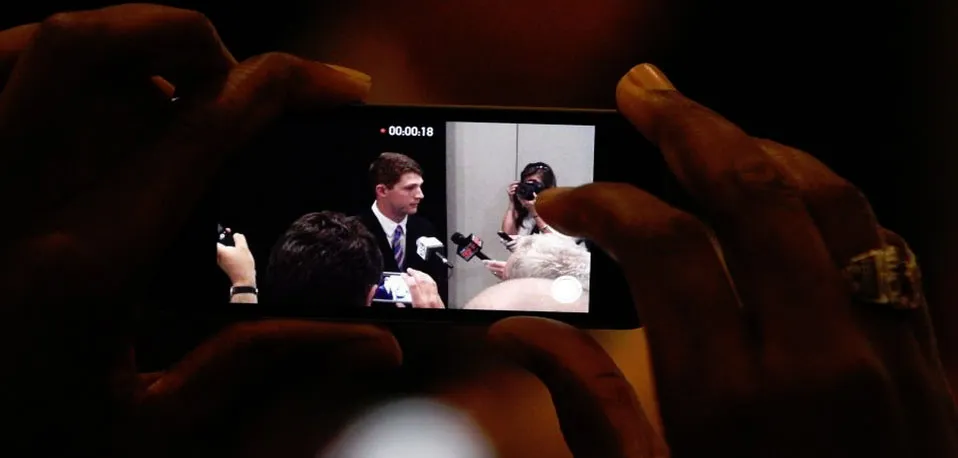
Does journalism even need articles?
The hiring of Anthony De Rosa from Reuters as editor-in-chief has given fresh buzz to Circa, which does “atomized” content, adding nuggets of info to continuing stories. I’ve been using the app for awhile and, while I like it, it’s not yet got for me a compelling daily must-read. But the Circa team is onto something, something journalists should be paying attention too.
More mobile friendly design
I’ve switched this website to a more mobile friendly design. It’s the new “Rainier” template that ships with Movable Type 5.2.2.
Mary Meeker: Mobile to pass PCs as way to get on Internet before you think
Open Meetings/Open Records
Sunshine Week approaches
Sunshine Week is March 14-20 which highlights and celebrates access to public information and open government.
TCOG Director leads session on access in a pandemic
Deborah Fisher, executive director of the Tennessee Coalition for Open Government
website
New year, new CMS
After years of hosting my own site on Wordpress I have moved it to Jekyll.
Social
Facebook, meet Friendster
OK, not exactly, but daily time spent on Facebook declined by 3 minutes by U.S. users in 2018 and usage is forecast to be flat to down to the horizon.